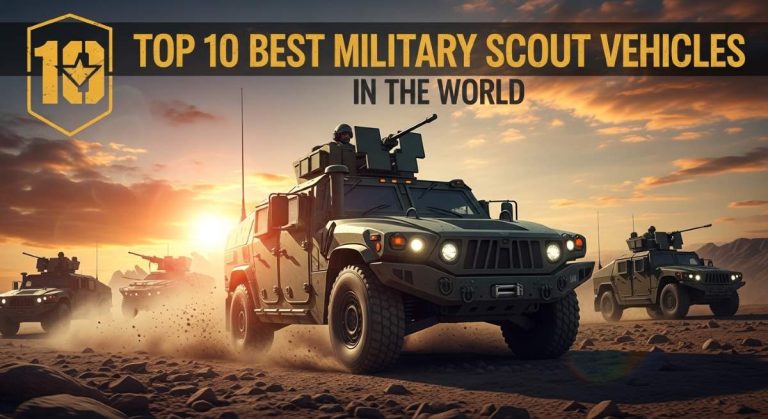
Today in this article we will discuss about the Top 10 Best Military Scout Vehicles in the world (.pptx) and The 10 Best Military Scout Vehicles known as Reconnaissance vehicle in the World: Complete Specifications Guide Where Speed, Stealth, and Sensors Rule the Battlefield so, In the fog of war, knowledge is power, and scout vehicles or Reconnaissance vehicle are the eyes of the battlefield. These specialized machines sneak into hostile territory, scan enemy positions, and survive in places no main battle tank would dare to tread. From lightning-fast reconnaissance to high-tech stealth sensors, these are the top 10 best military scout vehicles in the world today.
Table of Contents
Military scout vehicles represent a unique category of armored fighting vehicles optimized for reconnaissance missions rather than direct combat. They combine mobility, survivability, and advanced sensor technology to perform one of warfare’s most dangerous missions-getting close enough to observe the enemy without being detected or destroyed. Speed, stealth, and smart sensors rule this game.
This comprehensive ranking examines the ten best military scout vehicles currently in service worldwide, from Cold War legends that refuse to retire to cutting-edge reconnaissance platforms incorporating artificial intelligence and drone connectivity. Each vehicle is presented with complete technical specifications including origin, introduction date, engine specifications, top speed, amphibious capability, configuration, armament, dimensions, weight, crew, and estimated cost.
Note: Specifications reflect publicly available military data and manufacturer information. Costs represent estimated unit prices and may vary based on configuration, production quantities, and contracts. Performance characteristics are for standard configurations unless otherwise noted.
Understanding Scout Vehicle Design Philosophy
Scout vehicles prioritize mobility and sensors over armor and firepower. Their mission is observing and reporting, not engaging in sustained combat. Success means gathering critical intelligence and returning safely, which drives design choices emphasizing speed, stealth, advanced optics, and communication systems over heavy protection and large-caliber weapons. Let’s roll into the shadows of modern warfare and examine these reconnaissance machines in detail.
Top 10 Best Military Scout Vehicles in the world (.pptx)
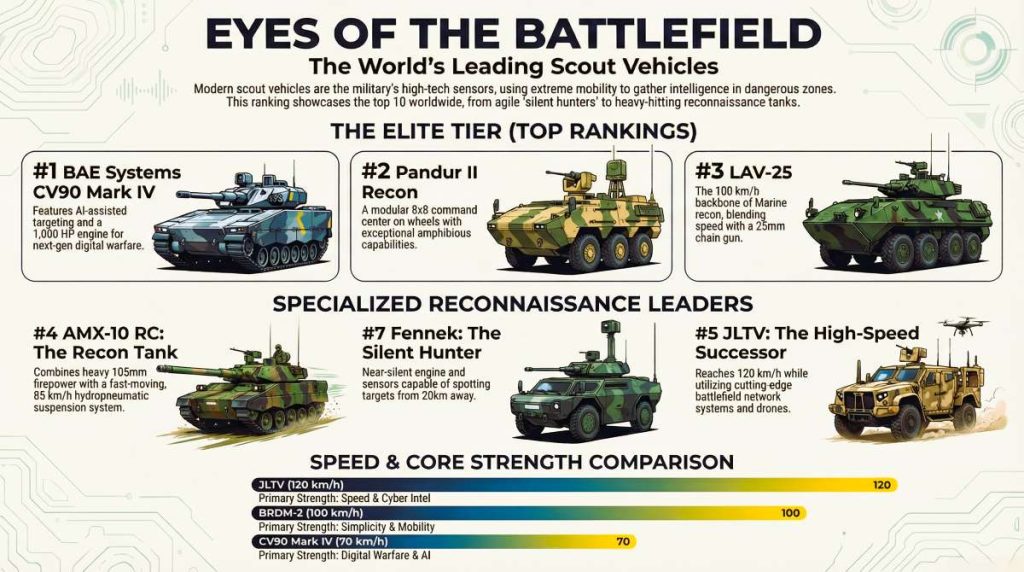
The Top 10 Best Military Scout Vehicles: Complete Rankings (MSVs)
#10. BRDM-2: The Durable Workhorse That Refuses to Retire
The Russian amphibious BRDM-2 may be old school, but it’s still a legend in battlefield scouting. Introduced in the 1960s, this armored scout car continues to serve in dozens of armies worldwide. While technology has advanced dramatically, the BRDM-2’s rugged simplicity and mobility keep it operationally relevant.
Complete Technical Specifications:
- Origin: Soviet Union/Russia
- Manufacturer: GAZ (Gorkovsky Avtomobilny Zavod)
- Introduced: 1962
- Engine: GAZ-41 V8 gasoline, 140 horsepower
- Top speed: 100 km/h (62 mph) on roads, 10 km/h in water
- Configuration: 4×4 with two additional belly wheels
- Amphibious: Yes, twin water jets
- Length: 5.75 meters
- Width: 2.35 meters
- Height: 2.31 meters
- Weight: 7 tonnes (combat loaded)
- Crew: 4 (commander, driver, two scouts)
- Armament: 14.5mm KPVT heavy machine gun, 7.62mm PKT coaxial machine gun
- Armor: 10mm maximum (light protection)
- Range: 750 kilometers on roads
- Estimated cost: $50,000-$100,000 (surplus/modernized)
Operational Legacy: With a 140 horsepower engine and four-wheel drive, it can travel at 100 km per hour on roads and swim across rivers using twin water jets. Its light armor offers basic protection against small arms, but its true power lies in mobility and simplicity. Modernized versions come with thermal imagers and upgraded radios, keeping it relevant in modern combat. The BRDM-2 is the durable workhorse that refuses to retire from reconnaissance duty, serving in over 50 countries worldwide.
#9. Ferret Scout Car: British Cold War Icon
The British Ferret might look small, but it’s been a battlefield scout icon since the Cold War. Designed for speed and stealth, this tiny armored car proved that sometimes less is more in reconnaissance operations.
Complete Technical Specifications:
- Origin: United Kingdom
- Manufacturer: Daimler Company
- Introduced: 1952
- Engine: Rolls-Royce B60 Mk 6A inline-6 petrol, 129 horsepower
- Top speed: 93 km/h (58 mph)
- Configuration: 4×4
- Amphibious: No
- Length: 3.84 meters
- Width: 1.91 meters
- Height: 1.88 meters (hull)
- Weight: 4.4 tonnes (Mk 2/3)
- Crew: 2-3 (driver, commander, optional gunner)
- Armament: Various (7.62mm machine gun or .30 cal Browning depending on variant)
- Armor: 8-16mm
- Range: 300 kilometers
- Estimated cost: $30,000-$60,000 (surplus)
Compact Excellence: This tiny armored car could zip around at 93 km/h with minimal noise, making it perfect for reconnaissance missions. Its small frame allowed it to navigate tight terrains while its armor offered protection against small arms fire. Used by over 30 nations, it proved that sometimes less is more. Many Ferrets are still operational today, fitted with modern sensors and weapons-a living relic of British engineering and battlefield efficiency.
#8. Type 87 Reconnaissance Vehicle: Japan’s High-Tech Observer
The Japanese Type 87 is a sleek six-wheeled scout built for high-tech observation. Equipped with thermal imagers, laser rangefinders, and night vision, it’s perfect for Japan’s varied terrain from mountains to coastal regions.
Complete Technical Specifications:
- Origin: Japan
- Manufacturer: Komatsu Ltd.
- Introduced: 1987
- Engine: Isuzu 10PC1 V10 air-cooled diesel, 305 horsepower
- Top speed: 100 km/h (62 mph)
- Configuration: 6×6
- Amphibious: No
- Length: 5.99 meters
- Width: 2.48 meters
- Height: 2.80 meters
- Weight: 15 tonnes
- Crew: 5 (commander, driver, gunner, 2 observers)
- Armament: 25mm Oerlikon KBA autocannon, 7.62mm Type 74 coaxial machine gun
- Sensors: Thermal imager, laser rangefinder, night vision
- Armor: Classified (light armor against small arms)
- Range: 500 kilometers
- Estimated cost: $1.5-2 million
Advanced Sensors: Powered by a 305 horsepower diesel engine, it races up to 100 km per hour while maintaining a low radar profile. Though lightly armored with a 25mm autocannon and 7.62mm machine gun, its true weapon is its advanced surveillance suite. Deployed since the late 1980s, it remains one of Asia’s most sophisticated reconnaissance vehicles, prioritizing intelligence gathering over brute force.
#7. Fennek LGS: The Silent Desert Fox
The Fennek-meaning ‘desert fox’-lives up to its name. This German-Dutch marvel blends stealth, agility, and advanced optics into one silent hunter.
Complete Technical Specifications:
- Origin: Germany/Netherlands
- Manufacturer: ARTEC (joint Krauss-Maffei Wegmann/Rheinmetall)
- Introduced: 2003
- Engine: Deutz BF6L714 diesel, 240 horsepower
- Top speed: 115 km/h (71 mph)
- Configuration: 4×4
- Amphibious: No (can ford 1.5 meters)
- Length: 5.71 meters
- Width: 2.49 meters
- Height: 1.82-2.03 meters (adjustable suspension)
- Weight: 8.5-10.5 tonnes (depending on armor)
- Crew: 3 (commander, driver, observer)
- Armament: 12.7mm machine gun or 40mm automatic grenade launcher
- Sensors: Thermal imaging, laser rangefinder, infrared surveillance, detection range 20+ km
- Armor: Modular (STANAG Level 2-4)
- Range: 1,000 kilometers
- Estimated cost: $1.5-2 million
Stealth Master: Its height-adjustable suspension and near-silent diesel engine make it almost ghostlike on the battlefield. The Fennek’s sensors can spot targets up to 20 kilometers away, and its 12.7mm machine gun provides self-defense. Its infrared and laser surveillance systems feed real-time data back to command units. Whether in deserts or forests, the Fennek is the ultimate silent scout, proving that information superiority wins wars.
#6. Armored Multi-Purpose Vehicle (AMPV) Recon: Future of US Scouting
The American AMPV reconnaissance variant is the future of U.S. battlefield scouting. Built on the proven Bradley platform, it offers robust protection and state-of-the-art battlefield awareness.
Complete Technical Specifications:
- Origin: United States
- Manufacturer: BAE Systems
- Introduced: 2020 (deliveries began)
- Engine: Cummins VTA-903T diesel, 600 horsepower
- Top speed: 66 km/h (41 mph)
- Configuration: Tracked (based on Bradley chassis)
- Amphibious: Limited (can swim with preparation)
- Length: 6.55 meters
- Width: 3.6 meters
- Height: 2.57 meters
- Weight: 27-29 tonnes (depending on variant)
- Crew: 2-6 (depending on mission configuration)
- Armament: Remote weapon station (typically .50 cal or 7.62mm)
- Sensors: Advanced battlefield awareness systems, drone integration
- Armor: Modular, mine-resistant
- Range: 300+ kilometers
- Estimated cost: $1.8-2.5 million per unit
Network Warfare: Its advanced sensors, communication gear, and drones extend its eyes far beyond the horizon. With modular armor, mine resistance, and a 600 horsepower engine, it can handle the most dangerous zones while keeping its crew safe. Designed for seamless integration with networked command systems, the AMPV ensures the U.S. Army never loses sight of its enemies or allies.
#5. Joint Light Tactical Vehicle (JLTV): Humvee’s High-Tech Successor
Meet the Humvee’s high-tech successor-the JLTV. Designed to dominate modern reconnaissance and light combat roles, it’s fast, tough, and packed with digital sensors.
Complete Technical Specifications:
- Origin: United States
- Manufacturer: Oshkosh Defense
- Introduced: 2015 (entered service 2016)
- Engine: Gale Banks 866T diesel V8, 370 horsepower
- Top speed: 120 km/h (75 mph)
- Configuration: 4×4
- Amphibious: No (can ford 1.5 meters)
- Length: 6.02 meters
- Width: 2.13 meters
- Height: 1.88-2.06 meters (depending on variant)
- Weight: 6.4 tonnes (empty), 10.9 tonnes (max)
- Crew: 4 (plus mission equipment)
- Armament: Various remote weapon stations (.50 cal, 40mm grenade launcher, etc.)
- Special features: TAK-4i independent suspension, modular armor, drone capability
- Armor: MRAP-level (modular)
- Range: 480 kilometers
- Estimated cost: $400,000-$500,000 per unit
Cyber-Age Platform: Built by Oshkosh Defense, the JLTV features adaptive suspension, modular armor, and cutting-edge battlefield network systems. It can carry remote weapon stations, drones, and advanced surveillance gear, all while cruising at 120 km per hour. The JLTV combines off-road muscle with cyber-age intelligence, making it one of the most versatile scout vehicles on the planet.
#4. AMX-10 RC: Reconnaissance Tank with Attitude
The French AMX-10 RC is more than a scout-it’s a reconnaissance tank with attitude. Armed with a 105mm gun, it can gather intel and fight its way out of trouble.
Complete Technical Specifications:
- Origin: France
- Manufacturer: Renault Trucks Defense (now Nexter/KNDS)
- Introduced: 1981
- Engine: Baudouin 6F 11 SRY diesel, 280 horsepower
- Top speed: 85 km/h (53 mph)
- Configuration: 6×6
- Amphibious: Yes (with preparation)
- Length: 6.15 meters (hull), 9.15 meters (with gun)
- Width: 2.95 meters
- Height: 2.68 meters
- Weight: 17 tonnes (combat loaded)
- Crew: 4 (commander, driver, gunner, loader)
- Main armament: 105mm F2 BK-MECA rifled gun
- Secondary: 7.62mm coaxial machine gun
- Suspension: Hydropneumatic
- Sensors: Thermal sights, laser rangefinder
- Armor: Aluminum alloy (protects against 23mm)
- Range: 800 kilometers
- Estimated cost: $2-3 million
Armed Reconnaissance: Its hydropneumatic suspension allows for smooth travel across rough terrain, and its top speed of 85 km per hour makes it a fast mover. With thermal sights and battlefield sensors, French and Ukrainian crews use it to observe and strike with precision. It’s the perfect blend of reconnaissance and firepower-a heavyweight among light scouts.
#3. LAV-25: Backbone of Marine Reconnaissance
The LAV-25 is the backbone of U.S. Marine reconnaissance. This eight-wheeled amphibious scout vehicle combines speed, firepower, and adaptability in one proven platform.
Complete Technical Specifications:
- Origin: United States/Canada (based on Swiss MOWAG Piranha)
- Manufacturer: General Dynamics Land Systems
- Introduced: 1983
- Engine: Detroit Diesel 6V53T diesel, 275 horsepower
- Top speed: 100 km/h (62 mph) on land, 10 km/h in water
- Configuration: 8×8
- Amphibious: Yes
- Length: 6.39 meters
- Width: 2.50 meters
- Height: 2.69 meters
- Weight: 12.8 tonnes (combat loaded)
- Crew: 3 + 6 scouts (commander, driver, gunner plus passengers)
- Main armament: M242 25mm Bushmaster chain gun
- Secondary: 7.62mm M240 coaxial machine gun
- Ammunition: 210 rounds 25mm, 420 rounds 7.62mm
- Armor: Aluminum alloy (STANAG Level 3)
- Range: 660 kilometers
- Estimated cost: $1.5-2 million
Marine Corps Standard: The LAV-25 can reach 100 km/h on land and glide across water with ease. Armed with a 25mm chain gun and advanced optics, it’s capable of fighting and fleeing in equal measure. Its modular armor, low profile, and digital communication systems make it a favorite for intelligence and patrol operations. Used by U.S. Marines and allies for decades, the LAV-25’s mix of speed, firepower, and adaptability keeps it among the world’s best.
#2. Pandur 2 Recon: Modern Marvel of Modular Design
The Pandur 2 reconnaissance variant is a modern marvel of modular design. This eight-wheeled armored scout vehicle offers exceptional mobility and advanced battlefield sensors.
Complete Technical Specifications:
- Origin: Austria
- Manufacturer: Steyr-Daimler-Puch (now General Dynamics European Land Systems)
- Introduced: 2001
- Engine: Cummins ISLe 350 diesel, 350 horsepower
- Top speed: 105 km/h (65 mph)
- Configuration: 8×8
- Amphibious: Yes (with preparation, water jets optional)
- Length: 7.02 meters
- Width: 2.99 meters
- Height: 1.82-2.90 meters (depending on variant)
- Weight: 13-22 tonnes (depending on armor configuration)
- Crew: 3-9 (depending on mission variant)
- Armament: Various (remote weapon stations, 12.7mm to 30mm)
- Sensors: Long-range optics, radar, thermal imaging, data-sharing systems
- Armor: Modular (STANAG Level 4)
- Range: 700 kilometers
- Estimated cost: $2.5-3.5 million
Command Center on Wheels: Equipped with long-range optics, radar, and data-sharing systems, it serves as a command center on wheels. High ground clearance and amphibious capability make it perfect for both urban and rugged terrains. The vehicle’s adaptability allows it to perform reconnaissance, command, and escort missions seamlessly. Used by nations like Portugal and the Czech Republic, the Pandur 2 is a modern battlefield sentinel-fast, smart, and hard to spot.
#1. BAE Systems CV90 Mark IV Recon: The Future of Reconnaissance Warfare
Topping our list is the CV90 Mark IV reconnaissance variant-the ultimate blend of armor, speed, and digital warfare. Built for next-generation battlefield awareness, this Swedish-designed platform represents the cutting edge.
Complete Technical Specifications:
- Origin: Sweden
- Manufacturer: BAE Systems Hägglunds
- Introduced: 2018 (Mark IV)
- Engine: Scania DSI14 diesel, 1,000 horsepower (745 kW)
- Top speed: 70 km/h (43 mph)
- Configuration: Tracked infantry fighting vehicle chassis
- Amphibious: Optional (with preparation kit)
- Length: 6.47 meters (hull), varies with armament
- Width: 3.19 meters
- Height: 2.50 meters
- Weight: 35 tonnes (combat loaded, depending on armor)
- Crew: 3 (commander, driver, gunner/observer)
- Armament: Remote weapon station (various calibers) or 30-40mm autocannon depending on variant
- Sensors: 360° surveillance cameras, thermal imaging, radar, AI-assisted targeting
- Special features: Drone connectivity, integrated sensor suite, active protection system
- Armor: Adaptive modular armor (protects against mines, RPGs, 30mm rounds)
- Range: 300 kilometers
- Estimated cost: $5-7 million per unit
Next-Generation Dominance: The CV90 Mark IV features a fully integrated sensor suite, AI-assisted targeting, and drone connectivity. Its 1,000 horsepower Scania engine lets it sprint across terrain at 70 km per hour, while its adaptive armor protects against everything from mines to RPGs. With 360° surveillance cameras, radar, and thermal imaging, it delivers real-time intelligence straight to command. The CV90 isn’t just a scout-it’s the future of reconnaissance warfare.
The Digital Ghost: When War Machines Become Too Smart for Their Crews
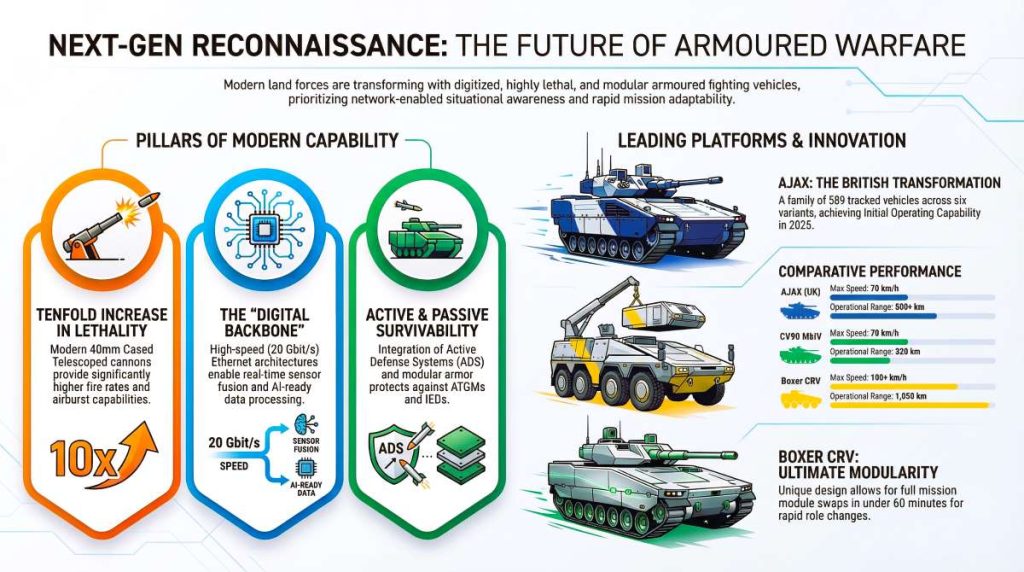
The smoke-belching tank relying on thick steel and a commander’s binoculars is dead. Today’s armored vehicles are “data centers on tracks”-processing 20 gigabits per second, storing six terabytes of sensor data, and utilizing AI-enabled targeting that can hear a gunshot and automatically return fire.
But here’s the shocking paradox: we’ve built machines so sophisticated that humans can’t survive inside them.
The UK’s AJAX reconnaissance vehicle-the “eyes and ears” of a digitized British Army-achieved its technological goals brilliantly. It processes battlefield data at unprecedented speeds and fires innovative cased telescoped ammunition. But excessive vibration and noise caused severe nausea, tinnitus, and joint swelling in crews. After 42,000 km of testing, Initial Operating Capability was officially withdrawn in January 2026 after 30 more soldiers fell ill.
From France’s “Scorpion” modernization to Germany’s modular Boxer, the modern battlefield is being rewritten by software updates, 60-minute mission transformations, and vehicles that can “hear” enemy gunfire and shoot back automatically. But as engineering sophistication outstrips human resilience, one question haunts the future of armored warfare: Have we created a digital ghost that’s too advanced for the humans meant to lead it into battle?
The 5 Realities Rewriting Armored Warfare
1. The 20 Gbit/s Tragedy: Britain’s AJAX Disaster
The AJAX was supposed to be revolutionary-the first new British armored vehicle in three decades, built around intelligent open architecture processing 20 Gbit/s via Ethernet and storing six terabytes of sensor data. It successfully integrated the innovative CT40 cannon with cased telescoped ammunition (warhead seated inside propellant casing to save space).
The technology worked. The humans didn’t.
Despite 42,000 km of testing, the chassis proved hostile to occupants. Excessive vibration and noise caused:
- Severe nausea
- Tinnitus (ringing in ears)
- Joint swelling and pain
Timeline of failure:
- Initial Operating Capability (IOC) tentatively declared: November 2025
- IOC status officially withdrawn: January 2026 after secondary halt left 30 soldiers ill
It’s the ultimate irony: a digital masterpiece designed for NATO’s future that the human body literally cannot survive.
2. The “Smartphone-ification” of Combat Vehicles
Military hardware is no longer delivered as a “finished” product. Following consumer electronics, vehicles now receive iterative “standards”-essentially hardware and software patches over a multi-year lifecycle.
France’s EBRC Jaguar (replacing the aging AMX-10 RC) demonstrates this evolution:
- Standard R1: Initial qualification and deployment
- Standard R2 (mid-2024): Enabled engaging moving targets with primary and secondary weapons while on the move
- Standard R3 (2025): Integrates Akeron MP anti-tank missile system with reprogrammable flight trajectories
In this new era, a vehicle is a living platform-never “finished,” only “updated” to remain relevant against evolving threats.
3. LEGO-Style Modularity: The 60-Minute Metamorphosis
Armies can no longer afford massive single-purpose vehicle fleets. The solution: modular chassis that transform mission profiles in under 60 minutes.
The Boxer CRV exemplifies “swap-and-go” mission modules-one chassis supporting variants like:
- Ares: Armored Personnel Carrier
- Athena: Command & Control
- Apollo: Repair vehicle
- Atlas: Recovery vehicle
The Jackal 3 takes a different approach: conversion from 4×4 to 6×6 via suspension transformation, doubling load capacity for logistics and deep patrol.
4. From “Dumb Metal” to Digital Senses
The “hunter-killer” era (commander finds target, hands off to gunner) is dead. Welcome to “killer-killer”-both commander and gunner equipped with independent, stabilized digital sights (like SEOSS), engaging targets independently and simultaneously.
CV90 MkIV’s “iFighting” concept:
- Fourth-generation NGVA Standard Electronic Architecture
- AI-enabled machine learning and sensor data fusion
- Real-time parallel data processing
Boxer CRV’s Acoustic Shooter Localisation System (ASLS):
- Digital “ears” hear enemy gunshots
- Triangulate shooter position automatically
- Auto-slew weapons toward threat-no human spotting required
5. Stealth Isn’t Just for Jets Anymore
Signature reduction-managing radar, acoustic, and infrared profiles-is now survival-critical for 35-ton ground vehicles.
CV90 MkIV’s ADAPTIV technology: Makes the vehicle undetectable to enemy electronic surveillance
Active Defence Systems (ADS) replace thick armor:
- LEDS-150: Intercepts incoming RPGs and guided missiles before impact
- ROSY (Rapid Obscurant System): Identifies and defeats threats pre-impact
Modern philosophy: “Not being seen” and “shooting the bullet with a bullet” beat surviving direct hits with “dumb” armor.
Modern Armored Vehicle Comparison
| Platform | Country | Key Innovation | Data Processing | Primary Weakness |
|---|---|---|---|---|
| AJAX | UK | 20 Gbit/s battlefield digitization; 6TB sensor storage | 20 Gbit/s Ethernet | Excessive vibration/noise incapacitates crews |
| EBRC Jaguar | France | Iterative “standards” like smartphones; Akeron MP integration | Real-time sensor fusion | Dependency on software update cycles |
| Boxer CRV | Germany | 60-min mission module swaps; ASLS acoustic targeting | Digital multi-sensor architecture | Module logistics complexity |
| CV90 MkIV | Sweden | “iFighting” AI-enabled targeting; ADAPTIV stealth | 4th-gen NGVA parallel processing | High unit cost |
| Jackal 3 | UK | 4×4 to 6×6 suspension transformation | Standard tactical systems | Lower protection than heavy platforms |
The AJAX Crisis Timeline
| Date | Event | Status | Impact |
|---|---|---|---|
| Pre-2025 | 42,000 km testing completed | Development phase | CT40 cannon integration successful |
| November 2025 | Initial Operating Capability (IOC) tentatively declared | Provisional approval | Cautious optimism despite crew health issues |
| January 2026 | IOC status officially withdrawn | PROGRAM HALT | 30+ soldiers ill from vibration/noise |
| Current | Engineering reviews underway | Suspended deployment | £5.5 billion program in crisis |
Technology Evolution: From Hunter-Killer to Killer-Killer
| Era | Capability | Crew Division | Technology | Limitation |
|---|---|---|---|---|
| Legacy (Pre-2010) | Hunter-Killer | Commander finds, gunner shoots | Analog optics, manual targeting | Sequential engagement only |
| Digital Transition (2010-2020) | Enhanced Hunter-Killer | Improved handoff speed | Digital sights, basic automation | Still dependent on commander |
| Current (2020+) | Killer-Killer | Both independently engage | SEOSS stabilized sights, AI targeting, sensor fusion | Requires extensive crew training |
| Near Future (2025+) | Autonomous Swarm Coordination | Minimal human oversight | Full AI decision-making, 20 Gbit/s networking | Human biology can’t keep up |
Modularity Philosophy Comparison
| System | Platform | Transformation Time | Variants Supported | Philosophy |
|---|---|---|---|---|
| Mission Modules | Boxer CRV | <60 minutes | Ares (APC), Athena (C2), Apollo (Repair), Atlas (Recovery) | “Swap-and-go” LEGO-style reconfiguration |
| Suspension Conversion | Jackal 3 | Variable | 4×4 patrol ↔ 6×6 logistics | Built-in transformation capability |
| Software Standards | EBRC Jaguar | Software update cycle | R1 (basic) → R2 (moving targets) → R3 (anti-tank missiles) | “Smartphone-ification” approach |
Active Defense vs. Passive Armor
| Defense Type | Technology Examples | Mechanism | Effectiveness | Cost |
|---|---|---|---|---|
| Passive Armor | Steel plates, composite armor | Absorb kinetic/blast energy | Declining vs. modern ATGMs | Weight/mobility penalty |
| Active Defense (Hard-kill) | LEDS-150 | Intercept projectile pre-impact | High vs. RPGs/missiles | Expensive; limited shots |
| Active Defense (Soft-kill) | ROSY obscurant system | Defeat guidance systems | Medium vs. guided weapons | Requires rapid deployment |
| Signature Reduction | ADAPTIV stealth (CV90) | Avoid detection entirely | Best-can’t hit what you can’t see | Requires constant power |
| Acoustic Detection | ASLS (Boxer) | Auto-target shooters | High vs. ambushes | Software-dependent |
Digital Sensor & Targeting Systems
| System | Platform | Capability | Processing Architecture | Advantage |
|---|---|---|---|---|
| SEOSS (Stabilized Sights) | Multiple | Independent commander/gunner targeting | Digital multi-spectral | Simultaneous engagement |
| iFighting | CV90 MkIV | AI-enabled machine learning targeting | 4th-gen NGVA Standard Electronic Architecture | Real-time threat prioritization |
| ASLS | Boxer CRV | Acoustic shooter localization | Triangulation + auto-slew | Immediate counter-fire |
| CT40 Cannon Data | AJAX | Integrated ballistics computer | 20 Gbit/s Ethernet backbone | Cased telescoped ammunition optimization |
| Sensor Fusion | EBRC Jaguar | Multi-source data integration | Iterative standards (R1→R2→R3) | Evolving threat adaptation |
The Iterative Standards Model: Jaguar Evolution
| Standard | Deployment | Key Capability Added | Mission Impact |
|---|---|---|---|
| R1 | Initial | Basic qualification and deployment | Foundation platform |
| R2 | Mid-2024 | Engage moving targets with primary/secondary weapons while moving | Dynamic combat effectiveness |
| R3 | 2025 | Akeron MP anti-tank missile integration; reprogrammable flight trajectories | Precision anti-armor capability |
| Future Standards | 2026+ | AI decision support, swarm coordination, counter-UAS | Continuous evolution vs. obsolescence |
Signature Reduction Technologies
| Technology | Platform | Reduction Target | Mechanism | Operational Benefit |
|---|---|---|---|---|
| ADAPTIV | CV90 MkIV | Infrared signature | Thermal camouflage tiles | Undetectable to thermal imaging |
| Low-noise engines | Multiple | Acoustic signature | Engine/transmission optimization | Reduced detection range |
| Angled armor | Modern designs | Radar cross-section | Geometry optimization | Lower radar visibility |
| Composite materials | Multiple | Overall signature | Non-metallic construction | Multi-spectrum reduction |
| Active cooling | High-end platforms | Heat signature | Directed thermal exhaust | Defeats infrared missiles |
The Human Factor Crisis
| Issue | AJAX Example | Industry-Wide Challenge | Potential Solution |
|---|---|---|---|
| Vibration | Severe nausea, joint swelling | Crew endurance limits | Active suspension, isolation mounts |
| Noise | Tinnitus in crews | Hearing damage, communication failure | Better acoustic insulation, active cancellation |
| Cognitive Load | 20 Gbit/s data overwhelming | Information overload | AI filtering, priority alerts only |
| Training Time | Complex multi-systems | Months to proficiency | Simplified interfaces, automation |
| Physical Space | Cramped for equipment | Crew comfort vs. protection trade-off | Unmanned variants |
The Bottom Line: Too Smart for Their Crews?
The paradox of modern armored warfare is stark: we’re succeeding at building the technology but failing at integrating the human.
Key takeaways:
- The AJAX disaster proves limits exist – 20 Gbit/s data processing is worthless if crews can’t operate the vehicle without falling ill
- “Smartphone-ification” is the new normal – Vehicles are never “finished,” only updated through iterative standards
- Modularity is survival – 60-minute mission module swaps replace maintaining separate vehicle fleets
- Digital senses exceed human capability – Vehicles can “hear” gunshots, auto-target threats, and engage simultaneously with multiple weapons
- Stealth and active defense beat thick armor – Not being seen or shooting bullets with bullets is more effective than surviving direct hits
The AJAX withdrawal serves as a haunting reminder: we can build machines that process six terabytes of data while firing cased telescoped rounds on the move, but we’re struggling to build a chassis that doesn’t incapacitate the human sitting inside it.
As we look toward autonomous-ready systems and AI-enabled brigades, the most pressing question isn’t how much data a vehicle can process-it’s whether the “digital ghost” we’ve created has finally made these machines too sophisticated for the humans meant to lead them into battle.
The future may not be “data centers on tracks” with human crews-it may be data centers on tracks with no humans at all. The technology is ready. The question is whether we are.
Also read: Top 10 Most Expensive Military Drones in the World (.PPTX)
Conclusion: The Evolution of Battlefield Eyes
These ten scout vehicles demonstrate the evolution of battlefield reconnaissance from Cold War simplicity to network-centric warfare. From the BRDM-2’s rugged reliability to the CV90 Mark IV’s AI-assisted targeting and drone connectivity, each platform represents different approaches to the fundamental challenge of gathering intelligence while surviving in hostile environments.
Key insights:
- Longevity Through Modernization: The BRDM-2 (1962) and Ferret (1952) prove good designs remain viable through upgrades
- Stealth vs. Protection: Fennek and Type 87 emphasize sensors and stealth; CV90 and AMPV emphasize survivability
- Amphibious Capability: BRDM-2, LAV-25, AMX-10 RC, and Pandur 2 can cross water obstacles independently
- Network Integration: Modern platforms like JLTV, AMPV, Pandur 2, and CV90 prioritize data sharing
Which scout vehicle would you trust to lead your reconnaissance mission? The silent Fennek operating ghostlike in enemy territory? The combat-capable AMX-10 RC ready to fight? The amphibious LAV-25 supporting Marine operations? Or the futuristic CV90 Mark IV with AI and drone connectivity? Each represents a valid approach based on specific operational requirements.
In modern warfare, knowledge is power. Scout vehicles provide that knowledge, operating in the shadows where speed, stealth, and sensors determine survival. From proven platforms serving over 60 years to cutting-edge machines incorporating artificial intelligence, these vehicles ensure commanders can see the battlefield clearly-and the side that sees first often wins.
About This Analysis
This analysis compiles technical specifications from manufacturer data, military procurement documents, defense publications including Jane’s Armoured Fighting Vehicles, and operational assessments. Costs represent estimated unit prices based on publicly available procurement data and may vary significantly based on configuration, production quantities, and specific contracts. Performance characteristics reflect standard configurations.