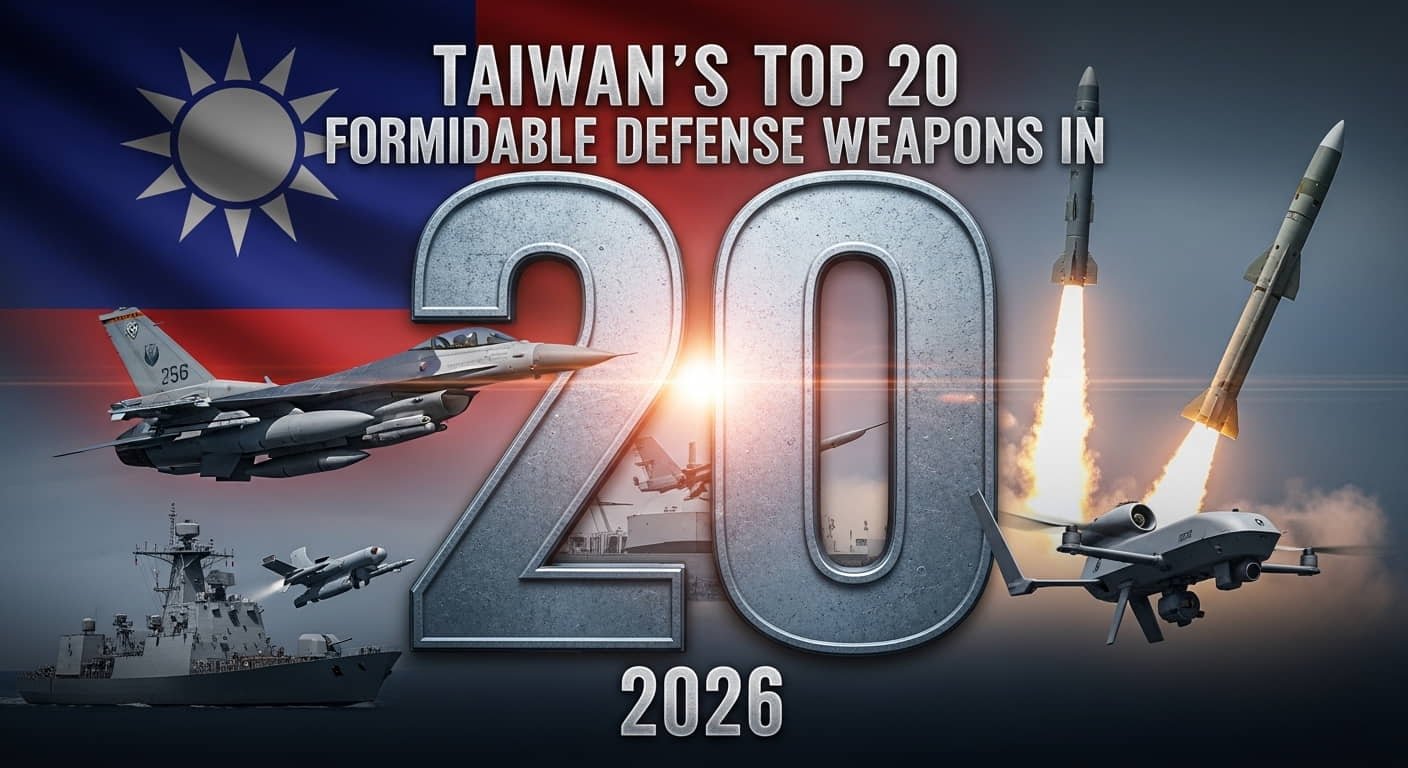
Today in this article we will discuss about the Taiwan’s Top 20 Formidable Defense Weapons in 2026 or Taiwan‘s 20 Most Formidable Defense Weapons in 2026: A Comprehensive Analysis so as we all know that geopolitical tensions continue to escalate in the Indo-Pacific region, Taiwan has transformed itself into what defense analysts call a ‘high-tech porcupine’-a small but exceptionally well-armed territory that would present extraordinary challenges to any potential aggressor. The Taiwan Strait has been identified as one of the most strategically sensitive waterways globally, and Taiwan’s response has been to develop and deploy a sophisticated multi-layered defense system.
Table of Contents
This comprehensive analysis examines the 20 weapons systems that form the backbone of Taiwan’s asymmetric defense strategy, ranging from individual infantry weapons to advanced submarine technology. Understanding these capabilities is crucial for anyone following Indo-Pacific security dynamics, defense policy, or military technology developments.
Note: This article synthesizes publicly available information from defense publications, government sources, and military analysis reports current as of early 2026. All weapon specifications and deployment details are based on open-source intelligence and official announcements.
Taiwan’s Top 20 Formidable Defense Weapons – PPT SLIDES (43) | .PPTX
Infantry and Man-Portable Systems
1. T91 Assault Rifle: Taiwan’s Frontline Infantry Weapon
The T91 represents Taiwan’s commitment to indigenous defense production. This standard-issue rifle combines design elements from both the M16 and AR-18 platforms, specifically engineered for Taiwan’s challenging environmental conditions.
Key Features:
- Over 100,000 units deployed across Taiwan’s armed forces
- Optimized for high humidity and salt-air environments typical of island warfare
- Modular design allowing customization for different combat roles
- Proven reliability in beach defense drills under adverse conditions
The T91’s significance extends beyond its technical specifications. As a domestically produced weapon, it represents Taiwan’s industrial capacity and reduces dependence on foreign arms suppliers, a critical consideration given the island’s unique diplomatic situation.
2. FIM-92 Stinger: Portable Air Defense
The Stinger missile system exemplifies asymmetric warfare principles-enabling individual soldiers to threaten multi-million dollar aircraft. Taiwan’s extensive Stinger inventory creates a distributed air defense network that would be extraordinarily difficult for any adversary to neutralize.
Tactical Advantages:
- Thousands of units strategically positioned in mountain tunnels and urban locations
- Infrared heat-seeking technology effective against helicopters and low-flying aircraft
- Man-portable design enables rapid repositioning and concealment
- Creates a lethal environment for close air support and transport operations
Defense analysts emphasize that the Stinger’s true power lies not in individual units but in the aggregate deterrent effect of thousands of missiles positioned across the island, making low-altitude air operations extremely hazardous.
3. Javelin Anti-Tank Missile: The ‘Top Attack King’
The Javelin represents one of the most sophisticated anti-armor weapons available. Its ‘fire-and-forget’ capability and top-attack profile make it particularly effective in the beach defense scenarios Taiwan would face.
Operational Capabilities:
- Attacks armored vehicles from above, where armor protection is thinnest
- Autonomous guidance allows operators to take cover immediately after firing
- Effective range of approximately 2.5 kilometers
- Particularly effective against vehicles emerging from landing craft-a critical beach defense scenario
The Javelin’s effectiveness was dramatically demonstrated in Ukraine, where similar weapons systems proved decisive against armored formations. Taiwan has studied these lessons extensively in developing its own anti-armor tactics.
Unmanned Systems and Drone Technology
4. LTS-600M Loitering Munition: Precision Suicide Drone
Loitering munitions represent a revolutionary development in modern warfare, combining the surveillance capabilities of drones with the precision strike capability of guided missiles. Taiwan’s LTS-600M exemplifies this technology.
System Characteristics:
- Extended loitering time enables persistent surveillance
- Real-time video transmission to operators at safe distances
- Precision strike capability against high-value targets like command vehicles and radar systems
- Small radar signature makes detection and interception difficult
- Cost-effective compared to traditional munitions
The proliferation of loitering munitions fundamentally changes battlefield dynamics by enabling small units to threaten enemy assets previously vulnerable only to artillery or air strikes. This technology is particularly valuable for a defensive force operating on known terrain.
5. Chien Hsiang Drone: Electronic Warfare Specialist
The Chien Hsiang (translated as ‘Sword Incense’ or ‘Sharp Aroma’) represents Taiwan’s domestic answer to the critical problem of enemy air defense systems. This kamikaze drone is specifically designed for Suppression of Enemy Air Defenses (SEAD) missions.
Mission Profile:
- Homes in on radar emissions from enemy air defense systems
- Destroys or damages radar installations, creating gaps in enemy air defense coverage
- Enables follow-on strikes by manned aircraft and other weapons systems
- Forces enemy to choose between operating radars (making them targets) or turning them off (losing air defense capability)
The strategic value of anti-radiation drones extends beyond their direct impact. By forcing adversaries into a dilemma between detection and survival, these systems create operational windows for other offensive capabilities.
6. MQ-9B Guardian: Advanced Surveillance Platform
The MQ-9B Guardian represents the cutting edge of maritime surveillance technology. This advanced drone platform provides Taiwan with unprecedented persistent monitoring capabilities over the Taiwan Strait.
Surveillance Capabilities:
- Flight endurance exceeding 30 hours enables continuous coverage
- Advanced thermal and radar sensors effective in all weather conditions
- Real-time data link to ground-based missile batteries and command centers
- Maritime search radar capable of detecting surface vessels at extended ranges
The Guardian’s integration into Taiwan’s broader defense network exemplifies modern network-centric warfare concepts. By serving as a ‘sensor’ feeding data to ‘shooter’ platforms, it multiplies the effectiveness of the entire defense system.
Anti-Ship Missiles and Naval Deterrence
7. Hsiung Feng III: Supersonic Ship Killer
The Hsiung Feng III (translated as ‘Brave Wind III’) represents the crown jewel of Taiwan’s anti-ship arsenal. This domestically developed supersonic cruise missile poses one of the most significant threats to any naval force attempting to operate in the Taiwan Strait.
Technical Specifications:
- Cruising speed of Mach 3 (approximately 3,700 km/h)
- Sea-skimming flight profile maintains altitude just meters above waves
- Kinetic energy of impact sufficient to cause catastrophic damage even without warhead detonation
- Extremely limited reaction time for enemy defenses (seconds from detection to impact)
- Range estimated at 300-400 kilometers
Defense analysts consider the Hsiung Feng III one of the world’s most capable anti-ship missiles. Its combination of speed, sea-skimming capability, and range create engagement scenarios where even modern air defense systems struggle to respond effectively.
8. Harpoon Coastal Defense System: Mobile Anti-Ship Platform
The Harpoon missile is one of the most widely deployed anti-ship weapons globally, with proven combat effectiveness. Taiwan’s ground-based version mounted on mobile platforms adds a critical dimension to coastal defense.
Operational Concept:
- Truck-mounted launchers provide strategic mobility
- Missiles stored in hardened mountain shelters when not deployed
- Rapid deployment to firing positions along coastline
- Engagement range of approximately 120 kilometers
- Return to concealment before enemy counter-battery fire
The mobility of Taiwan’s Harpoon systems makes them extraordinarily difficult to neutralize preemptively. The combination of hardened storage, rapid deployment, and immediate withdrawal creates a ‘shoot and scoot’ capability that significantly complicates enemy targeting.
Air and Missile Defense Systems
9. Sky Bow III: Advanced Missile Defense
The Sky Bow III (Tien Kung III in Chinese) represents Taiwan’s domestic solution to the ballistic and cruise missile threat. This sophisticated surface-to-air system forms the upper tier of Taiwan’s layered air defense network.
Defense Capabilities:
- Intercepts ballistic missiles, cruise missiles, and aircraft
- Engagement velocity exceeding Mach 7
- Integrated into Taiwan’s ‘T-Dome’ defense network linking multiple sensor systems
- Active radar homing for terminal phase interception
- Protects critical infrastructure including government facilities, power plants, and communication nodes
The Sky Bow III’s integration into a networked defense system represents a force multiplier. By sharing sensor data across multiple platforms, the system can engage threats more efficiently than standalone air defense units.
Artillery and Rocket Systems
10. M142 HIMARS: Precision Strike Platform
The High Mobility Artillery Rocket System (HIMARS) gained international attention for its effectiveness in Ukraine. Taiwan’s acquisition of these systems provides a critical long-range precision strike capability.
Strike Capabilities:
- Range extending to 300 kilometers with ATACMS missiles
- GPS-guided munitions provide accuracy within meters
- Can engage ports, staging areas, and logistics hubs on mainland
- Rapid displacement capability complicates counter-battery operations
- Modular launch system accommodates different munition types
The strategic significance of HIMARS extends beyond its technical capabilities. By providing Taiwan with the ability to strike targets on the mainland, these systems create a deterrent effect and complicate enemy operational planning.
11. M109A6 Paladin: Self-Propelled Artillery
The M109A6 Paladin represents the modernized version of one of the world’s most widely used self-propelled howitzers. Taiwan’s Paladins provide mobile, responsive artillery support for coastal defense operations.
Artillery Features:
- 155mm gun capable of firing multiple round types
- Shoot-and-scoot capability minimizes exposure to counter-battery fire
- Automatic fire control system enables rapid engagement
- Range extending beyond 30 kilometers with rocket-assisted projectiles
- Armored protection for crew survivability
In beach defense scenarios, the Paladin’s combination of firepower and mobility proves particularly valuable. The system can deliver sustained fire support while continuously repositioning to avoid enemy targeting.
Armored Fighting Vehicles
12. CM-34 Clouded Leopard: Indigenous Infantry Fighting Vehicle
The CM-34 Clouded Leopard represents Taiwan’s domestic armored vehicle program. This 8×8 wheeled vehicle provides protected mobility and fire support optimized for Taiwan’s terrain.
Vehicle Characteristics:
- Armed with 30mm Bushmaster chain gun (same weapon used on Apache helicopters)
- Eight-wheel drive provides excellent mobility on varied terrain
- Top speed exceeding 100 km/h enables rapid response
- Specifically designed for Taiwan’s narrow, winding roads
- Modular design supports multiple mission configurations
The Clouded Leopard’s domestic production provides Taiwan with industrial base experience and reduces dependence on foreign suppliers. Its design reflects lessons learned from studying modern conflicts and Taiwan’s specific operational requirements.
13. M1A2T Abrams: Main Battle Tank
The M1A2T represents a customized version of the US Army’s premier main battle tank, specifically configured for Taiwan’s requirements. These vehicles provide the ultimate counter to any armored threat.
Combat Capabilities:
- 120mm smoothbore gun with advanced ammunition types
- Composite armor protection against kinetic and chemical threats
- Advanced fire control system with hunter-killer capability
- Thermal imaging and night vision systems
- Turbine engine providing excellent power-to-weight ratio
Beyond their direct combat value, the Abrams tanks serve a critical deterrent function. Their presence forces potential adversaries to plan for engaging one of the world’s most capable tank platforms, significantly complicating invasion planning.
Fighter Aircraft and Air Superiority
14. Mirage 2000-5: High-Altitude Interceptor
The French-designed Mirage 2000-5 provides Taiwan with specialized high-altitude interception capability. While the F-16 handles multi-role missions, the Mirage excels in specific combat scenarios.
Performance Characteristics:
- Exceptional climb rate for rapid intercept missions
- Optimized for high-altitude combat operations
- Advanced radar and beyond-visual-range missile capability
- Part of Taiwan’s Quick Reaction Alert (QRA) force
- Delta wing design provides excellent high-altitude performance
Despite being an older design, the Mirage 2000-5’s specialized capabilities remain relevant in 2026. Its role in Taiwan’s air defense strategy emphasizes the importance of having aircraft optimized for specific mission profiles rather than relying solely on multi-role platforms.
15. F-CK-1 Ching-kuo: Indigenous Defense Fighter
The F-CK-1 Ching-kuo Indigenous Defense Fighter (IDF) was born from necessity when the United States initially refused to sell advanced fighters to Taiwan. It has since evolved into a capable modern combat aircraft.
Operational Capabilities:
- Primary carrier for Wan Chien cruise missiles
- Can strike enemy airfields and staging areas from hundreds of kilometers away
- Ongoing upgrades maintain combat relevance
- Demonstrates Taiwan’s aerospace engineering capabilities
- Equipped with domestically produced avionics and weapons systems
The IDF program’s significance extends well beyond the aircraft itself. The industrial base and technical expertise developed through this program provides Taiwan with capabilities that transcend any single weapons platform.
16. F-16V Block 70 Viper: Advanced Multi-Role Fighter
The F-16V represents the most advanced iteration of the world’s most numerous modern fighter aircraft. Taiwan’s F-16V fleet forms the backbone of its air combat capability.
Advanced Features:
- Active Electronically Scanned Array (AESA) radar provides superior detection and tracking
- Can simultaneously track dozens of targets beyond range of older radars
- Compatible with full spectrum of US precision-guided munitions
- Capable of air-to-air, air-to-ground, and anti-ship missions
- Advanced electronic warfare and countermeasure systems
The F-16V’s versatility makes it the workhorse of Taiwan’s Air Force. Its ability to execute diverse mission types with a single airframe provides operational flexibility critical in the resource-constrained environment of island defense.
Naval Combat Systems
17. Automated Mine Layer Ships: Sea Denial Platform
Taiwan’s automated mine layer vessels represent a critical component of the ‘porcupine strategy.’ These specialized ships can rapidly create extensive minefields that fundamentally alter the naval operating environment.
Strategic Capabilities:
- Rapid deployment of extensive mine barriers
- Modern ‘smart’ mines with sophisticated targeting and safety features
- Can create channelized approach routes forcing enemy into kill zones
- Automation reduces crew requirements and exposure to danger
- Particularly effective in Taiwan Strait’s shallow waters
Naval mines remain among the most cost-effective weapons in modern naval warfare. The threat of mines forces adversaries to dedicate substantial resources to mine countermeasures, slowing operations and creating predictable approach routes vulnerable to other weapons systems.
18. Tuo Chiang-Class Corvette: The ‘Carrier Killer’
The Tuo Chiang-class corvette exemplifies asymmetric naval warfare concepts. Despite its small size, this stealthy catamaran packs extraordinary firepower designed for hit-and-run tactics.
Combat Systems:
- Carries 16 anti-ship missiles despite compact hull
- Catamaran hull design provides exceptional speed and sea-keeping
- Reduced radar cross-section complicates enemy detection and targeting
- Can sortie from small ports and fishing harbors
- Tactical concept emphasizes launching missiles and withdrawing before counter-attack
The Tuo Chiang class demonstrates how modern technology enables small platforms to threaten much larger adversaries. By concentrating firepower in a stealthy, fast platform, Taiwan created a naval asset that punches well above its weight class.
19. Hai Kun-Class Submarine: Indigenous Undersea Warfare
The Hai Kun-class represents a watershed moment in Taiwan’s defense capabilities-the island’s first domestically built submarine. Completed in early 2026, this achievement demonstrates significant industrial and technological advancement.
Submarine Capabilities:
- Diesel-electric propulsion provides exceptional quiet operation on battery power
- Designed to operate in deep water trenches off Taiwan’s east coast
- Can maintain station silently for extended periods
- Creates area denial zone complicating enemy naval operations
- Provides secure second-strike capability
The strategic value of submarines extends beyond their direct combat capability. The mere presence of submarines in an operating area forces adversaries to devote substantial resources to anti-submarine warfare, complicating operational planning and slowing tempo.
20. Kee Lung-Class Destroyer: Fleet Air Defense
The Kee Lung-class destroyers, while featuring older hull designs, have been comprehensively modernized with 2026-era sensors and weapons systems. These ships provide the air defense umbrella necessary to protect Taiwan’s naval forces.
Defense Systems:
- Advanced phased array radar systems
- Extensive vertical launch system (VLS) for surface-to-air missiles
- Serves as command and control node for dispersed naval forces
- Provides wide-area air defense for smaller vessels
- Anti-submarine warfare capabilities
The Kee Lung class demonstrates how judicious modernization can extend the service life and relevance of existing platforms. By integrating modern sensors and weapons with proven hulls, Taiwan achieved capability improvement at lower cost than new construction.
Also read: Top 10 Highest Paid Pilots In The World
Strategic Analysis: The Porcupine Strategy in Practice
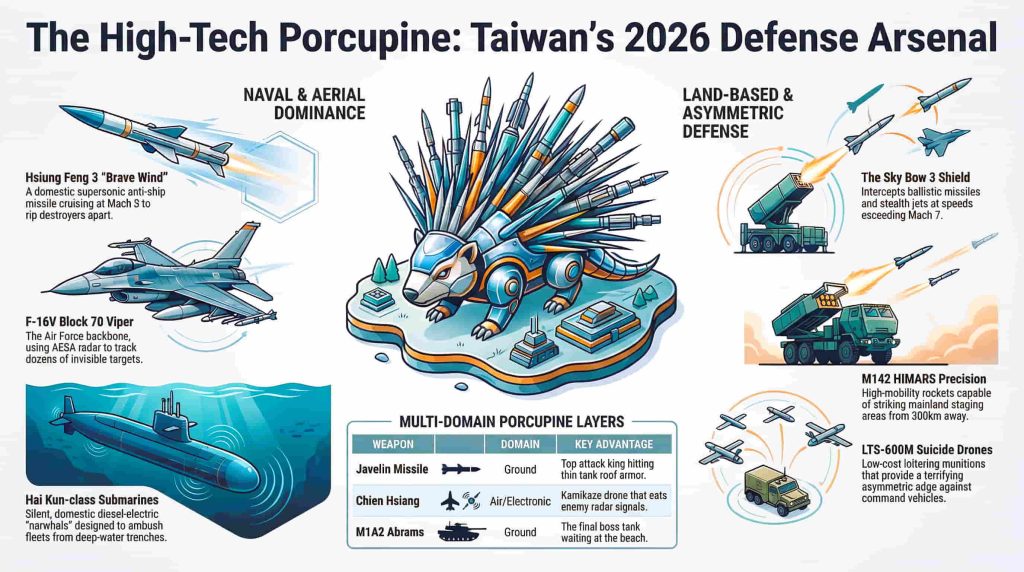
Taiwan’s comprehensive defense modernization reflects a sophisticated understanding of asymmetric warfare principles. Rather than attempting to match a larger adversary system-for-system, Taiwan has developed a layered defense designed to make any invasion attempt prohibitively costly.
Key Strategic Principles
- Asymmetric Advantage: Many of Taiwan’s weapons systems embody cost-imposition strategies. Relatively inexpensive systems like Stinger missiles or loitering munitions can threaten adversary platforms costing orders of magnitude more. This cost asymmetry creates favorable exchange ratios for the defender.
- Survivability Through Mobility and Concealment: From truck-mounted Harpoon missiles to Tuo Chiang corvettes operating from small harbors, Taiwan’s systems emphasize the ability to strike and withdraw. This shoot-and-scoot capability significantly complicates enemy targeting and force planning.
- Network-Centric Integration: Modern warfare increasingly relies on information networks linking sensors and shooters. Taiwan’s investments in systems like the MQ-9B Guardian and the T-Dome air defense network reflect understanding that individual platforms gain effectiveness through integration into broader systems.
- Indigenous Production: Developing domestic capabilities in areas like submarines, fighters, and missiles provides strategic benefits beyond the weapons themselves. Indigenous production creates industrial base resilience and reduces vulnerability to external supply disruption.
Operational Challenges
While Taiwan’s defense modernization is impressive, significant challenges remain:
- Manpower constraints: Taiwan faces demographic challenges in maintaining force levels
- Reserve force readiness: Converting Taiwan’s theoretical reserve strength into effective combat power requires sustained investment in training and equipment
- Sustainability: Many advanced systems require sophisticated maintenance and supply chains that could be disrupted during conflict
- Operational integration: Converting individual capabilities into cohesive defensive operations requires extensive training and realistic exercises
The High-Tech Porcupine: 5 Ways Taiwan is Rewriting the Rules of Modern Defense
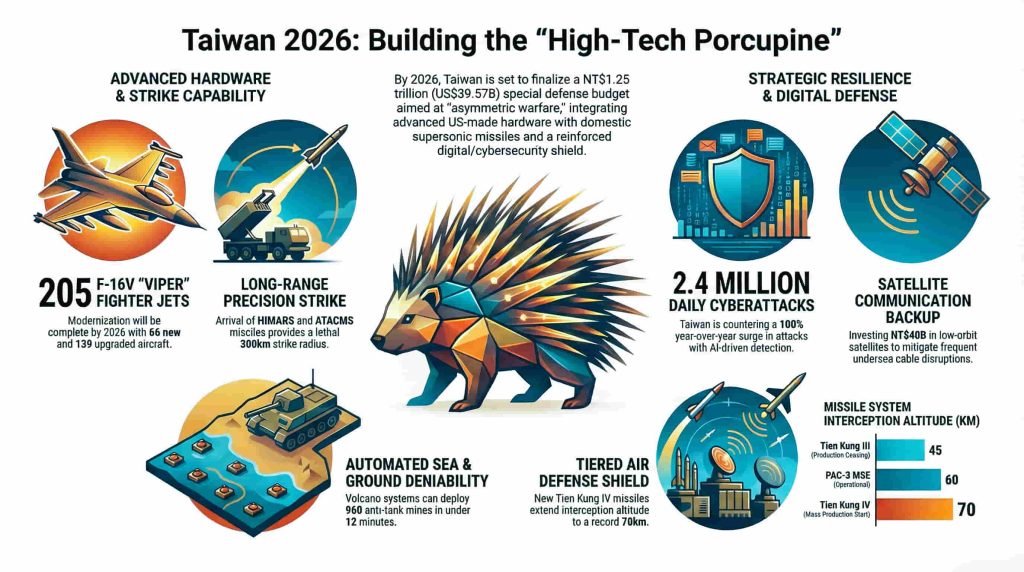
As of early 2026, Taiwan has fundamentally transformed its defense posture from conventional military preparedness into a sophisticated, multi-layered ecosystem that integrates cutting-edge technology across physical, digital, and cognitive domains. With a historic NT$1.25 trillion (US$39.57 billion) special defense budget, the island nation has evolved its theoretical ‘porcupine strategy’-designed to make invasion prohibitively costly-into a high-tech reality. This transformation encompasses five critical dimensions: air-launched supersonic missile capabilities that turn fighter jets into maritime executioners, an AI-driven cyber defense infrastructure facing up to 40 million attacks monthly, subsea cable protection systems backed by satellite redundancy and unmanned submarines, an integrated T-Dome network featuring 70-kilometer altitude interception capabilities, and a uniquely Taiwanese innovation-a ‘human firewall’ of digitally-literate citizens trained to counter cognitive warfare and disinformation campaigns. This comprehensive approach represents a paradigm shift in modern defense strategy, where semiconductor technology, democratic resilience, and supersonic deterrence converge to create a defense model unlike any other in the world.
The following table provides a detailed breakdown of Taiwan’s five-pillar defense transformation in 2026 and Beyond Traditional Military Hardware: The Evolution of Taiwan’s Multi-Domain Defense:
| Defense Pillar | Key Capabilities & Strategic Impact |
| 1. Air-Launched ‘Brave Wind’ Supersonic Missiles | 1. Breakthrough Achievement: On December 18, 2025, Taiwan successfully test-fired an air-launched version of the Hsiung Feng III (HF-3) anti-ship missile from an F-CK-1C (IDF) fighter jet (tail number 1490) under the ‘Xiong-Zhi Project.’ 2. Technical Specifications: Weight reduced from 1,100kg to 900kg by removing ship-launch boostersCruising speed: Mach 3 (approximately 3,700 km/h)Range: Exceeding 150 kilometersFlight profile: Free-fall, ballistic glide, ramjet ignition, sea-skimmingSensor integration: Paired with AESA radar-equipped IDF fighters 3. Strategic Impact: Transforms every IDF fighter into a ‘high-speed maritime executioner’ capable of engaging enemy vessels from stand-off distances. The kinetic energy alone at Mach 3 can potentially ‘rip a destroyer in half’ even without warhead detonation. |
| 2. AI-Driven Cyber Defense Infrastructure | 1. Threat Landscape: Taiwan faces 2.4 million daily cyberattacks on government networks (doubled from 2023), with 20-40 million attacks monthly across the broader national ecosystem, making it the world’s most active cyber warfare laboratory. 2. Defense Architecture: Ministry of Digital Affairs (MODA) operates as a digital command centerAI-driven threat detection systems protect critical infrastructurePriority protection: Port networks, highways, and semiconductor facilitiesDefense against: State-sponsored brute-force attacks, ransomware, IP theft 3. Strategic Significance: Protects trade secrets of an industry producing 92% of the world’s advanced logic chips. The operational mandate ‘Cybersecurity is national security’ reflects the existential nature of digital defense. |
| 3. Subsea Infrastructure Defense & Satellite Redundancy | 1. Critical Vulnerability: Taiwan’s digital connectivity depends on 14 international submarine cables. Following 12 cable cuts at Matsu Island in 2023 and 2025 sabotage incidents involving Chinese-controlled vessels (e.g., Xing Shun 39), Taiwan developed multi-layered redundancy. 2. Defense Systems: Satellite Shield: NT$40 billion investment in low-orbit communication satellites (partnering with SES and Eutelsat)Huilong-Class UUV: 100-foot-long, 100-tonne unmanned submarine with rare torpedo tubesDual purpose: Testbed for Haikun-class submarine components and potential mine-laying assetSubmarine Cable Automatic Warning System: Real-time alerts for suspicious vessel approach 3. Strategic Objective: Ensure data sovereignty and communication continuity during crisis scenarios. The UUV provides both defensive intelligence and potential offensive mine-laying capabilities in Taiwan Strait deep trenches. |
| 4. T-Dome Integrated Defense & Mobile Strike Systems | 1. High-Altitude Defense: The Tien Kung IV (Sky Bow IV) ‘Strong Bow’ program achieved 70-kilometer maximum interception altitude, surpassing PAC-3 (60km) for enhanced ballistic and cruise missile defense. 2. Integrated Kill Chain Components: MQ-9B Guardian Drones: 30+ hour endurance providing real-time targeting data to mobile batteries82 HIMARS Launchers: Equipped with 20 ATACMS missiles (300km range) targeting mainland staging areas60 M109A7 Paladin Howitzers: Self-propelled ‘shoot and scoot’ artillery capabilityM136 Volcano System: Deploys 960 anti-tank mines in under 12 minutes66 F-16 Block 70 Vipers: Fleet completion by end of 2026 (first 10 units arriving late 2025) 3. Tactical Advantage: Network-centric integration creates an accelerated kill chain where sensors (drones) directly feed shooters (HIMARS, artillery), transforming the entire Taiwan Strait into a ‘shooting gallery’ with minimal response time. |
| 5. ‘Human Firewall’: Cognitive Defense & Democratic Resilience | 1. Cognitive Warfare Threat: Taiwan faces relentless disinformation campaigns designed to erode democratic trust. The ‘Typhoon Jebi’ incident-where false evacuation reports led to a senior diplomat’s suicide-demonstrated the lethal potential of information warfare. 2. Participatory Defense Systems: Civic Tech Infrastructure: g0v and Taiwan FactCheck Center empower citizen verificationCoFacts System: Processed over 87,000 false reports using crowdsourced verification on Line appMedia Literacy Education: Ministry of Education white paper integrates deepfake detection and critical thinking into national curriculumCivilian Cyber Guard Reserve Corps: Tech-savvy population trained to maintain decentralized networks during blockade 3. Unique Strategic Advantage: Taiwan pioneers the concept that a transparent digital democracy, armed with media literacy and civic participation, can serve as an effective deterrent alongside kinetic weapons-treating information resilience as a core national security capability. |
Strategic Synthesis: The 2026 Defense Paradigm
Taiwan’s 2026 defense posture represents a fundamental reimagining of modern deterrence. The integration of Mach 3 air-launched missiles with AI-driven cyber defenses, subsea infrastructure protection through unmanned submarines and satellite networks, accelerated kill chains via the T-Dome system, and a uniquely democratic ‘human firewall’ creates a multi-domain defense ecosystem without parallel. Where Haikun-class submarines wait in silent deep-water trenches and supersonic missiles guard the skies, Taiwan demonstrates that 21st-century deterrence requires not just advanced hardware, but the synthesis of technology, democratic transparency, and citizen resilience. The question for the Indo-Pacific region is no longer whether conventional military strength alone can ensure security, but whether the integration of kinetic and cognitive defense-hardware and human capital-represents the future of democratic deterrence in an age of hybrid warfare.
Conclusion
Taiwan’s 20 key weapons systems represent a comprehensive approach to deterrence through defensive capability. From individual infantry weapons to sophisticated naval platforms, each system contributes to an integrated defense posture designed to make military aggression against Taiwan an extraordinarily risky proposition.
The effectiveness of these systems cannot be evaluated in isolation. Rather, their cumulative effect-combined with Taiwan’s advantageous geography, motivated population, and potential international support-creates a defensive equation far more complex than simple platform-versus-platform comparisons might suggest.
As the strategic environment in the Indo-Pacific continues to evolve, Taiwan’s defense investments will remain a critical factor in regional stability. Understanding these capabilities provides essential context for analyzing one of the world’s most significant security situations.
Important:
- Another important addition often overlooked is one of the most significant emerging weapon systems within Taiwan’s porcupine defense strategy – the newly contracted Barracuda-M series cruise missiles, with reported ranges of approximately 100, 250, and 500 miles (or nautical miles). These systems have moved into mass-production planning within Taiwan, highlighting a growing focus on domestic defense manufacturing. Alongside this, the Altius-600M loitering munition program has also received in-country production contracts, strengthening stand-off strike capabilities. The ability to domestically produce, sustain, and stockpile stand-off munitions during periods of conflict is increasingly viewed by analysts as a decisive factor in maintaining long-term defensive resilience.
- Recent reports highlight expanding defense and technology cooperation between Taiwan and U.S. companies, particularly in the development of low-cost precision loitering munitions. These systems are described as having long-range strike capability — potentially up to around 1,000 kilometers – along with resistance to electronic warfare and electromagnetic interference. The munitions are said to incorporate Taiwan-developed integrated SoC technology featuring AI-assisted image recognition, target data integration, and inertial navigation correction. Prototype testing has reportedly been conducted in the United States, with future plans focusing on mass production, operational deployment, and possible export cooperation with U.S. allies. Analysts note that such stand-off systems are designed to target strategic infrastructure such as airfields, ports, missile launch sites, troop concentrations, and command centers during high-intensity conflict scenarios.
In parallel, legislative developments in the United States have proposed expanding civil space and aerospace collaboration with Taiwan, including potential joint work on sounding rockets, low-orbit transport platforms, and the concept of shared launch infrastructure. Some proposals envision rapid long-distance aerospace logistics connecting U.S. and Taiwanese technology hubs to accelerate the movement of high-tech components and sensitive equipment, although many of these initiatives remain at the planning or policy stage.
More broadly, Taiwan’s industrial and technological base has advanced significantly over recent decades. While its domestic defense manufacturing was historically limited in scope, growing regional security concerns and deeper international partnerships have accelerated investment in indigenous research, production capacity, and high-technology sectors. Observers increasingly view Taiwan as an advanced manufacturing hub with expanding capabilities across both civilian and defense industries.
About This Article:
This analysis is based on publicly available information from defense publications, WIKIPEDIA, NOTEBOOKLM, CHATGPT, GOOGLE and official government sources, and reputable military analysis organizations. Weapon specifications and capabilities are drawn from open-source intelligence and may not reflect classified performance parameters. The strategic assessments presented represent informed analysis based on available information and should not be considered official policy positions.
Readers seeking additional information should consult primary sources including Taiwan’s Ministry of National Defense publications, defense industry reports, and peer-reviewed military journals. This article is intended for educational and informational purposes only.