

Today in this article we will discuss about the Top 10 Maneuverable Re-entry Vehicles in the World (2026) (MaRVs) with PPT, PDF and Infographic so, From Russia’s Mach 27 Avangard to Pakistan’s Shaheen-III – The Most Advanced Hypersonic and Maneuverable Warheads, Maneuverable Re-entry Vehicles (MaRVs) and Hypersonic Glide Vehicles (HGVs) represent the cutting edge of missile technology-designed to perform evasive maneuvers during atmospheric re-entry to bypass missile defense systems. Unlike standard ballistic trajectories where warheads follow predictable parabolic paths, these advanced systems can shift their flight path, making them significantly harder to intercept. This technological revolution is fundamentally reshaping strategic deterrence, missile defense architectures, and the global balance of military power.
Table of Contents
This comprehensive guide examines the ten most advanced maneuverable re-entry systems currently operational or in development as of early 2026. From Russia’s revolutionary Avangard hypersonic glider achieving Mach 27 to China’s DF-17 with its DF-ZF glide vehicle, from America’s Dark Eagle Long-Range Hypersonic Weapon to India’s Agni-P precision strike system, these weapons showcase the extraordinary technological sophistication achieved by major military powers in their pursuit of unstoppable delivery systems.
Each system profiled includes complete technical specifications, development history, strategic capabilities, and analysis of what makes it among the world’s most formidable maneuverable re-entry vehicles. Whether you’re a defense analyst, military technology enthusiast, or international relations student, this guide provides the most detailed examination available of maneuverable warhead technology in 2026.
Understanding Maneuverable Re-entry Vehicles: Revolutionary Technology
Before examining specific systems, understanding what defines maneuverable re-entry vehicles and why they represent such a significant technological leap provides essential context.
What Are MaRVs and HGVs?
Traditional ballistic missile warheads follow fixed trajectories determined at launch-they ascend on rocket power, coast through space in a predictable arc, and plunge toward targets following the laws of physics. This predictability enables missile defenses to calculate intercept points and position interceptors accordingly. Maneuverable Re-entry Vehicles (MaRVs) and Hypersonic Glide Vehicles (HGVs) shatter this paradigm.
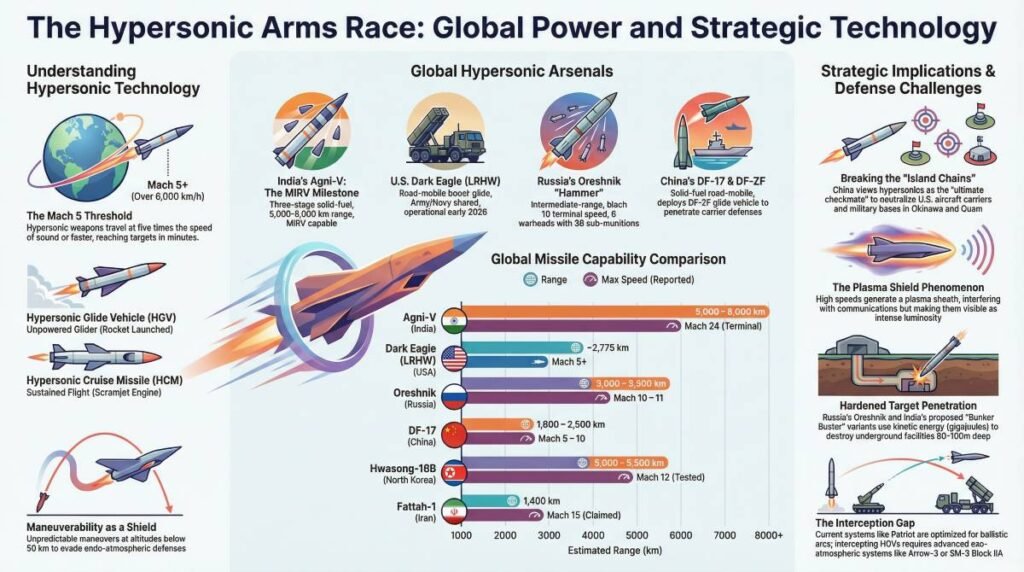
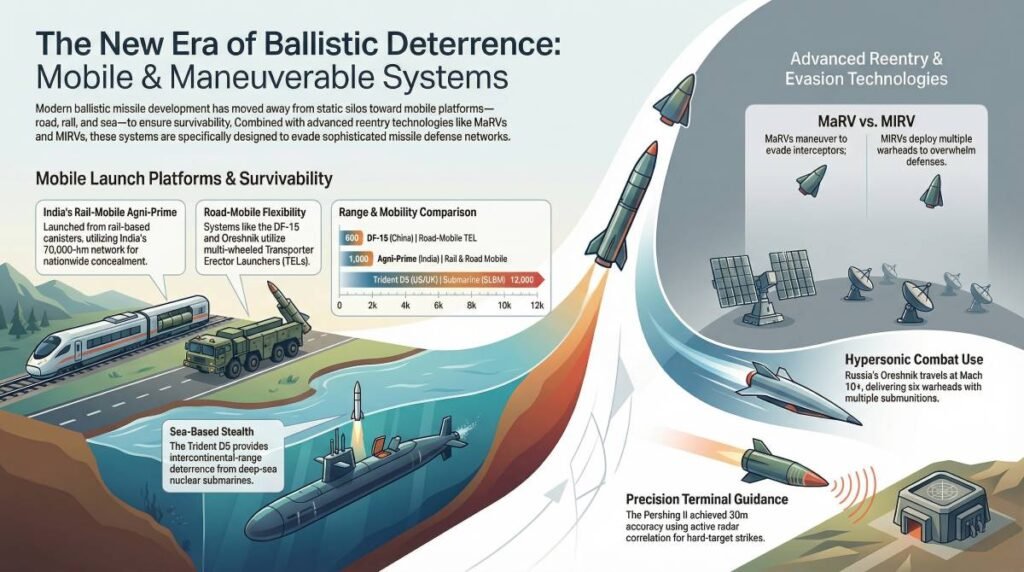
Maneuverable Re-entry Vehicles (MaRVs): These systems incorporate small thrusters, control surfaces, or movable fins enabling trajectory adjustments during re-entry. They can dodge left or right, accelerate or decelerate, and adjust their descent angle-creating unpredictability that defeats defensive targeting solutions. Examples include China’s DF-21D carrier-killer, India’s Agni-P, and Iran’s Emad missile.
Hypersonic Glide Vehicles (HGVs): These represent even more sophisticated technology. Instead of re-entering ballistically, HGVs separate from their boost rockets at high altitude and glide through the atmosphere at hypersonic speeds (Mach 5+), often for hundreds or thousands of kilometers. During this glide, they can maneuver continuously, change altitude, and follow unpredictable flight paths. Examples include Russia’s Avangard, China’s DF-ZF (launched by DF-17), and America’s C-HGB/Dark Eagle systems.
- MARV full form: MARV stands for Maneuverable Re-entry Vehicle.
- HGV full form: HGV stands for Hypersonic Glide Vehicle.
Also read: Top 10 Medium Range Ballistic Missile in the World (MRBM)
Why They Matter: Strategic Revolution
- Defense Penetration: Current missile defense systems struggle enormously with maneuvering targets. Systems like THAAD, Patriot PAC-3, and Aegis rely on calculating where a warhead will be based on its ballistic trajectory. When the warhead can change course unpredictably, these calculations become useless. Success rates that might reach 60-80% against ballistic warheads drop dramatically-possibly to 10-30% or lower-against maneuvering threats.
- Compressed Response Time: Hypersonic glide vehicles traveling at Mach 5-27 compress decision-making windows to minutes or even seconds. Traditional ballistic missiles provide 15-30 minutes of warning for intercontinental strikes. HGVs can reduce this to under 10 minutes, eliminating time for deliberation or escalation control. This compression creates ‘use it or lose it’ pressures on nuclear command authorities-dramatically destabilizing crisis scenarios.
- Unpredictable Targeting: Traditional ballistic missiles reveal their targets early in flight based on trajectory. Maneuverable vehicles can change targets mid-flight, keeping adversaries guessing about intended strikes until moments before impact. This complicates defensive prioritization-defenders cannot know which assets to protect most urgently.
- Conventional Precision: MaRVs and HGVs enable precision conventional strikes with accuracy measured in meters rather than kilometers. This precision transforms missiles from city-destroying strategic weapons into tactical tools capable of destroying specific buildings, bridges, or command centers without nuclear warheads. The strategic implications are profound-nations can now conduct devastating attacks without crossing the nuclear threshold.
Top 10 Maneuverable Re-entry Vehicles in the World (MaRVs) | PPT SLIDES
SPECIFICATIONS: Top 10 Maneuverable Re-entry Vehicles in the World (MaRVs) Systems
Table 1: Technical Specifications and Status (2026)
This comprehensive table presents all ten maneuverable re-entry systems ranked by strategic impact, speed, and technological sophistication based on the latest available data as of 2026.
| Rank | System Name | Country | Type | Max Speed | Est. Range | Status (2026) |
| 1 | Avangard | Russia | HGV | Mach 27 | 6,000+ km | Operational (2019) |
| 2 | DF-17 / DF-ZF | China | HGV | Mach 5-10 | 1,800-3,500 km | Operational (2019) |
| 3 | Dark Eagle (LRHW) | USA | HGV | Mach 5+ | 2,775+ km | Fielded / Late Testing |
| 4 | DF-21 | China | HGV | Mach 8-10 | 6,000-8,000 km | Limited Deployment |
| 5 | DF-21D | China | MaRV | Mach 10+ | 1,500+ km | Operational (ASBM) |
| 6 | Agni-P (Prime) | India | MaRV | Mach 5-10 | 1,000-2,000 km | Induction Phase |
| 7 | Hwasong-16B | North Korea | HGV | Mach 10+ | 1,500+ km | Tested / Operational |
| 8 | Emad | Iran | MaRV | Mach 5+ | 1,700 km | Operational |
| 9 | Hyunmoo-2C | S. Korea | MaRV | Mach 5+ | 800 km | Operational |
| 10 | Shaheen-III | Pakistan | MaRV | Mach 5+ | 2,750 km | Operational |

DETAILED ANALYSIS: Top 10 Maneuverable Re-entry Vehicles in the World (MaRVs)
#1. Avangard (Russia) – The Mach 27 Strategic Game-Changer
Russia’s Avangard hypersonic glide vehicle represents perhaps the most revolutionary weapons system developed since the intercontinental ballistic missile itself. Achieving speeds up to Mach 27 (approximately 33,000 km/h or 20,500 mph) and capable of maneuvering throughout its flight, Avangard renders current missile defense systems effectively obsolete and provides Russia with an assured second-strike capability that cannot be countered with existing technology.
- How Avangard Works: Unlike traditional ICBMs where warheads separate and fall ballistically, Avangard rides atop a modified SS-19 Stiletto or RS-28 Sarmat ICBM to the edge of space. Upon reaching altitude, the Avangard glider separates and begins its hypersonic glide through the atmosphere. During this phase-which can last thousands of kilometers-the vehicle maneuvers continuously, potentially changing targets multiple times. The combination of extreme speed (Mach 27 during portions of flight) and continuous maneuverability creates an essentially unstoppable weapon.
- Technical Sophistication: Achieving Mach 27 generates surface temperatures exceeding 2,000°C-hot enough to melt most materials. Avangard reportedly uses advanced heat-resistant materials and active cooling systems to survive these extreme conditions. The guidance system must function perfectly despite temperatures, vibrations, and G-forces that would destroy conventional electronics. That Russia successfully developed and deployed this technology demonstrates extraordinary engineering achievement.
- Strategic Impact: Avangard fundamentally alters the strategic balance between Russia and the United States. American missile defenses-designed to intercept ballistic warheads following predictable trajectories-cannot effectively engage maneuvering hypersonic targets. Even if U.S. systems detect Avangard launches, tracking systems lose lock as the vehicle maneuvers, and interceptors lack the speed or maneuverability to catch a Mach 27 target changing course. This gives Russia confidence its nuclear deterrent can penetrate any defense, ensuring mutually assured destruction remains intact.
- Operational Deployment: Russia declared Avangard operational in December 2019, making it the world’s first deployed strategic hypersonic weapon. The system reportedly equips at least one missile regiment with several more planned. Russian President Vladimir Putin has publicly highlighted Avangard as proof of Russia’s ability to overcome U.S. missile defenses and maintain strategic parity despite larger American defense budgets.
- Specifications: Type: Hypersonic Glide Vehicle | Maximum Speed: Mach 27 (33,000 km/h) | Range: 6,000+ km from release point | Launch Platform: SS-19 Stiletto / RS-28 Sarmat ICBM | Warhead: Nuclear (exact yield classified) | Guidance: Maneuverable throughout flight | First Deployment: December 2019 | Status: Fully operational
#2. DF-17 / DF-ZF (China) – Regional Precision Hypersonic Strike
China’s DF-17 missile system, carrying the DF-ZF hypersonic glide vehicle, represents the world’s first operational medium-range hypersonic weapon and has fundamentally altered strategic calculations in the Indo-Pacific. Deployed in 2019, the DF-17 provides China with the capability to strike U.S. bases in Japan, South Korea, and Guam with near-certainty of penetrating defenses-a game-changing capability that undermines American regional military posture.
- DF-ZF Glide Vehicle Technology: The DF-ZF hypersonic glider (previously designated WU-14 during testing) separates from the DF-17 booster rocket at high altitude and glides through the atmosphere at speeds between Mach 5 and Mach 10. Unlike traditional warheads that re-enter steeply, the DF-ZF maintains aerodynamic lift while maneuvering laterally, changing altitude, and adjusting its flight path continuously. This unpredictable flight profile makes tracking and interception extraordinarily difficult.
- Extensive Testing Program: China conducted at least nine known DF-ZF tests between 2014-2018 before declaring the system operational. These tests demonstrated progressively longer ranges, higher speeds, and more complex maneuvering. The testing program’s thoroughness-far exceeding what many nations conduct before deployment-suggests Chinese confidence in the system’s reliability and performance.
- Strategic Applications: The DF-17’s 1,800-2,500 km range places critical U.S. military installations at risk: Kadena Air Base in Okinawa, Marine Corps bases in Japan, Osan and Kunsan Air Bases in South Korea, and potentially Guam (though Guam is near maximum range). In a Taiwan contingency, DF-17s could strike these bases with precision conventional warheads, destroying runways, fuel facilities, and aircraft on the ground before U.S. forces could respond. This ‘first-strike’ capability dramatically raises the stakes for U.S. intervention in regional conflicts.
- Mobile Deployment: The DF-17 launches from road-mobile transporter-erector-launchers (TELs), providing survivability through mobility. Chinese forces can disperse missiles across the country, relocate unpredictably, and launch from concealed positions. This mobility ensures at least some DF-17s survive any preemptive strike, maintaining credible deterrence and coercive power.
- Specifications: System: DF-17 (missile) + DF-ZF (glide vehicle) | Type: Hypersonic Glide Vehicle | Speed: Mach 5-10 during glide | Range: 1,800-3,500 km | Warhead: Conventional (nuclear capability possible) | Launch Platform: Road-mobile TEL | First Deployment: 2019 | Status: Operational with PLA Rocket Force
#3. Dark Eagle / LRHW (USA) – America’s Hypersonic Equalizer
The U.S. Army’s Long-Range Hypersonic Weapon (LRHW), officially designated Dark Eagle, represents America’s response to Russian and Chinese hypersonic developments. After decades where the United States led in precision strike technology, Russian and Chinese hypersonic deployments created a capability gap the Pentagon scrambled to close. Dark Eagle, using the Common Hypersonic Glide Body (C-HGB) developed jointly by Army and Navy, aims to provide U.S. forces with similar penetrating strike capability.
- Common Hypersonic Glide Body (C-HGB): Rather than developing separate hypersonic systems for each service, the Pentagon mandated a ‘common glide body’ approach. The C-HGB serves as the payload for Army’s ground-launched LRHW, Navy’s sea-launched Conventional Prompt Strike (CPS) system, and potentially future Air Force weapons. This commonality reduces costs, speeds development, and simplifies logistics. The C-HGB reportedly achieves speeds exceeding Mach 5 and can maneuver throughout flight to evade defenses.
- Accelerated Development: The LRHW program has experienced compressed timelines driven by urgency to counter peer competitors. Initial design work began around 2015, with successful flight tests occurring in 2020 and 2022. The Army fielded initial batteries to the 1st Multi-Domain Task Force in 2023-2024, with full operational capability expected in 2025-2026. This represents remarkably fast development compared to traditional weapons programs that often take 15-20 years from concept to deployment.
- Strategic Role: Dark Eagle provides U.S. ground forces with long-range precision strike capability against high-value targets including enemy command centers, missile launchers, radar sites, and naval vessels. With ranges exceeding 2,775 km (1,725 miles), LRHW can strike from rear areas into enemy territory without requiring air superiority or exposing aircraft to air defenses. In Pacific scenarios, Dark Eagle batteries positioned in Japan or Guam could hold Chinese targets at risk, complicating Chinese war planning.
- Current Status: As of early 2026, Dark Eagle is in late-stage testing and initial fielding. The first battery was delivered to operational units in 2023-2024, with soldiers beginning training on the system. Additional successful tests in 2024-2025 validated performance, and the Army expects full operational capability soon. Unlike some developmental systems, Dark Eagle appears on track for successful deployment.
- Specifications: Official Name: Long-Range Hypersonic Weapon (LRHW), Dark Eagle | Type: Hypersonic Glide Vehicle (C-HGB) | Speed: Mach 5+ (exact speed classified) | Range: 2,775+ km (1,725+ miles) | Warhead: Conventional | Launch Platform: Ground-mobile battery | Status: Fielded / Late-stage testing | Expected FOC: 2025-2026
#4. DF-21 (China) – Long-Range Strategic Strike
China’s DF-21 represents one of the most versatile and widely deployed ballistic missile families in the world. While best known for the DF-21D anti-ship variant (discussed separately), the baseline DF-21 and its DF-21A/C variants serve as medium-range strike missiles capable of delivering nuclear or conventional warheads against strategic targets. Recent variants incorporate maneuverable warhead technology, creating weapons that combine long range with defense-penetration capability.
- Development History: The DF-21 program dates to the 1980s, evolving from China’s first submarine-launched ballistic missile (JL-1) adapted for ground launch. The original DF-21 used liquid fuel, but later variants adopted solid propellant-dramatically improving responsiveness and survivability. Over four decades, the DF-21 family has grown to include multiple variants optimized for different missions: strategic nuclear strikes, conventional precision attacks, and anti-ship operations.
- Extended Range Variants: While early DF-21 variants had ranges around 1,800-2,000 km, recent developments extended range significantly. Intelligence assessments suggest newer DF-21 variants may achieve 6,000-8,000 km range depending on payload weight-effectively blurring the line between medium-range and intermediate-range ballistic missiles. This extended range places targets throughout Asia, the Middle East, and potentially European Russia within striking distance.
- Maneuverable Warhead Integration: Recent DF-21 variants reportedly incorporate maneuverable reentry vehicles or potentially hypersonic glide vehicles similar to the DF-ZF. These advanced warheads enable terminal maneuvers to evade missile defenses while maintaining accuracy. The integration demonstrates China’s systematic approach to upgrading existing missile families with cutting-edge technology rather than developing entirely new systems.
- Strategic Implications: The DF-21’s combination of long range, solid fuel (enabling rapid launch), mobile deployment, and advanced warheads makes it a cornerstone of Chinese strategic deterrence. With hundreds of missiles deployed across multiple variants, the DF-21 family provides mass and diversity that complicate enemy targeting. Even if adversaries destroy some launchers preemptively, surviving DF-21s ensure devastating retaliation capability.
- Specifications: Designation: DF-21 (various variants) | Type: Medium-to-Intermediate Range Ballistic Missile with HGV capability | Speed: Mach 8-10 | Range: 6,000-8,000 km (extended variants) | Warhead: Nuclear or conventional | Launch Platform: Road-mobile TEL | Status: Limited deployment of advanced variants | Operational: PLA Rocket Force
#5. DF-21D (China) – The ‘Carrier Killer’ Anti-Ship Weapon
The DF-21D represents one of the most strategically significant weapons developments of the 21st century-the world’s first operational anti-ship ballistic missile (ASBM). Designed specifically to target and destroy U.S. aircraft carriers, the DF-21D provides China with capability to hold at risk the U.S. Navy’s primary power projection tool, fundamentally challenging American ability to operate freely in the Western Pacific.
- Revolutionary Concept: Traditional ballistic missiles target fixed locations with known coordinates. Hitting a moving ship-traveling at 30+ knots and maneuvering-requires revolutionary technology: space-based reconnaissance satellites to detect carrier groups, over-the-horizon radar to track movements, real-time data links transmitting targeting updates to missiles in flight, and maneuverable reentry vehicles capable of adjusting course to intercept moving targets. The DF-21D integrates all these elements.
- Maneuverable Reentry Vehicle (MaRV): The DF-21D’s warhead incorporates a sophisticated MaRV with active radar seeker, control surfaces or thrusters, and onboard processing enabling autonomous target engagement. During terminal approach, the MaRV receives mid-course guidance updates narrowing the target’s location. As it descends through the atmosphere at Mach 10+, the active radar activates, acquires the carrier among surrounding ships, and guides the warhead to impact. This combination of speed and terminal guidance makes interception extraordinarily difficult.
- Kill Chain Requirements: The DF-21D’s effectiveness depends on a complex ‘kill chain’ functioning flawlessly: satellites must detect carrier groups amid vast ocean expanses; radar systems must track movements continuously; command centers must process data and calculate firing solutions; missiles must launch with accurate targeting information; mid-course updates must reach missiles despite electronic warfare; and terminal seekers must acquire targets despite defensive countermeasures. Any break in this chain prevents successful engagement. U.S. strategy focuses on breaking the kill chain through satellite jamming, radar destruction, cyber attacks, and electronic warfare.
- Strategic Impact: The DF-21D forces U.S. carriers to operate 1,500-2,000+ kilometers from Chinese shores-far enough that carrier aircraft cannot effectively conduct missions without extensive aerial refueling. This dramatically reduces carrier effectiveness and calls into question U.S. ability to defend Taiwan or project power near China. Even if DF-21D has never been tested against an actual carrier (such tests are impossible without war), its theoretical capability forces defensive planning around the threat.
- Specifications: Designation: DF-21D | Type: Anti-Ship Ballistic Missile with MaRV | Speed: Mach 10+ terminal velocity | Range: 1,500+ km | Warhead: Conventional, estimated 300-500 kg | Guidance: Mid-course updates + terminal active radar | Launch Platform: Road-mobile TEL | First Deployment: ~2010 | Status: Operational
#6. Agni-P (Prime) – India’s Next-Generation Precision Strike
India’s Agni-P (‘Prime’) represents the next generation of Indian ballistic missile technology-combining the range of older Agni-II with advanced features including canisterized cold launch, solid propellant, and maneuverable reentry vehicle. Designed as a precision strike weapon for India’s two-front challenge (Pakistan and China), Agni-P provides capabilities matching or exceeding those of many peer competitors while maintaining India’s strategic doctrine of credible minimum deterrence.
- Canisterized Launch System: Unlike older Agni missiles requiring road-mobile erector-launchers, Agni-P uses canisterized cold launch-where compressed gas ejects the missile from its storage canister before the rocket motor ignites. This technology (borrowed from submarine-launched missiles) provides several advantages: faster launch times, better protection from weather and surveillance, longer storage periods without maintenance, and reduced thermal signature making detection harder. Only the most advanced missile powers master canisterization.
- Maneuverable Reentry Vehicle: The Agni-P incorporates a maneuverable reentry vehicle capable of performing evasive maneuvers during terminal phase. Small thrusters or control surfaces enable course corrections improving accuracy while complicating interception. Indian defense officials claim accuracy improvements over previous Agni variants, with circular error probable (CEP) possibly under 20 meters-precision sufficient for striking specific buildings or bunkers rather than just cities.
- Strategic Flexibility: With range estimates between 1,000-2,000 km (some sources suggest 2,500+ km with reduced payload), Agni-P can strike throughout Pakistan and reach strategic locations in western China. This range covers Pakistan’s capital Islamabad, China’s military installations in occupied Tibet, and critical infrastructure in western Chinese provinces. The missile’s solid fuel enables rapid launch during crises, providing responsive strike capability.
- Testing and Induction: Agni-P has undergone multiple successful tests since first launching in 2021, demonstrating reliability and performance. Indian authorities announced the missile entering ‘induction phase’ in 2024-2025, meaning initial deployment to operational units. Full operational capability is expected by 2026-2027. The relatively quick development (compared to earlier Agni variants that took decades) demonstrates India’s maturing missile industrial base.
- Specifications: Designation: Agni-P (Prime) | Type: Canisterized ballistic missile with MaRV | Speed: Mach 5-10 (estimated) | Range: 1,000-2,000 km (potentially 2,500 km) | Warhead: Nuclear or conventional | Launch Platform: Canisterized road-mobile | Status: Induction phase (2025-2026) | Developer: DRDO, India
#7. Hwasong-16B (North Korea) – DPRK’s Hypersonic Breakthrough
North Korea’s Hwasong-16B represents the DPRK’s entry into operational hypersonic weapons-a stunning achievement for a nation operating under severe sanctions and resource constraints. First tested in 2021-2022 and reportedly operational by 2024-2025, the Hwasong-16B demonstrates North Korean determination to develop advanced weapons matching those of major powers, ensuring regime survival through credible nuclear deterrence that cannot be negated by missile defenses.
- Hypersonic Glide Vehicle Development: North Korea claims the Hwasong-16B carries a hypersonic glide vehicle capable of maneuvering during flight at speeds exceeding Mach 10. While Western analysts initially dismissed these claims as propaganda, successful tests in 2021-2022 demonstrated maneuvering capability and high terminal velocities consistent with HGV technology. Whether North Korea developed this technology independently or received foreign assistance remains debated, but the capability appears genuine.
- Testing Program: Known tests occurred in September 2021 (first claimed hypersonic test), January 2022 (demonstrating lateral maneuvering), and additional tests in 2023-2024. Videos released by North Korean media showed missiles maneuvering mid-flight and achieving very high speeds. South Korean and U.S. intelligence confirmed these tests demonstrated advanced capabilities, though exact performance specifications remain uncertain.
- Strategic Implications: If operational as North Korea claims, Hwasong-16B provides Pyongyang with capability to strike targets in South Korea and Japan with reduced warning time and higher probability of penetrating defenses. For South Korea in particular-where major cities lie within 100-200 km of the border-even short-range hypersonic weapons create devastating threat. The missiles’ speed compresses decision-making to minutes, potentially preventing South Korean or U.S. authorities from ordering evacuations or mobilizing defenses.
- Technology Questions: Significant uncertainty surrounds Hwasong-16B’s actual capabilities. North Korea’s claims must be viewed skeptically given the regime’s propaganda purposes. However, dismissing the system entirely risks underestimating North Korean capabilities-a mistake that could prove catastrophic. Most analysts adopt a cautious middle position: the system probably works but may not achieve all claimed performance specifications.
- Specifications: Designation: Hwasong-16B | Type: Hypersonic Glide Vehicle (claimed) | Speed: Mach 10+ (North Korean claims) | Range: 1,500+ km (estimated) | Warhead: Conventional or nuclear | Launch Platform: Road-mobile TEL | Status: Tested / Reportedly operational | Developer: North Korea
#8. Emad (Iran) – Precision-Guided Deterrent
Iran’s Emad missile represents a significant technological achievement-Iran’s first indigenous precision-guided ballistic missile with maneuverable reentry vehicle. While Iran has developed numerous ballistic missiles based on foreign designs (particularly North Korean Scud and Nodong technology), Emad demonstrates increasingly sophisticated domestic capabilities. The missile’s combination of reasonable range (1,700 km), terminal maneuverability, and improved accuracy makes it a credible threat to regional adversaries particularly Israel and U.S. bases throughout the Middle East.
- Maneuverable Reentry Vehicle: The Emad’s maneuverable warhead can make in-flight corrections during terminal approach, improving accuracy and complicating interception. Iranian sources claim CEP (circular error probable) of 50-500 meters-a dramatic improvement over earlier Iranian missiles with accuracy measured in kilometers. While these claims cannot be independently verified, observed test performances suggest genuine accuracy improvements. The maneuvering capability specifically targets defeating Israeli Arrow missile defenses and U.S. Patriot/THAAD systems deployed regionally.
- Strategic Message: Iran’s development and testing of Emad carries political and strategic messaging beyond pure military capability. Each test-conducted openly and publicized by Iranian media-demonstrates Iranian resolve to develop deterrent capabilities despite international pressure and sanctions. The tests signal to Israel, Saudi Arabia, and the United States that Iran possesses weapons that can strike their territories and installations with increasing accuracy. This deterrent posture aims to prevent military action against Iranian nuclear facilities or strategic infrastructure.
- Liquid Fuel Limitations: Emad uses liquid propellant-a significant limitation compared to solid-fueled systems. Liquid missiles require hours of fueling before launch, creating vulnerable periods where missiles sit exposed on launch sites. This makes preemptive strikes more feasible-adversaries detecting fueling activity could launch attacks destroying missiles before they fire. Iran’s subsequent development of solid-fueled missiles like Sejil addresses this vulnerability, but Emad remains primarily liquid-fueled.
- Regional Range: The 1,700 km range places all of Israel (1,000-1,500 km away), U.S. bases in Kuwait, Qatar, UAE, and Bahrain, Saudi Arabian oil facilities and cities, and Turkish military installations within striking distance. This coverage makes Emad a credible regional deterrent-Iran can threaten retaliation against any nation launching attacks on Iranian territory.
- Specifications: Designation: Emad | Type: Liquid-fueled ballistic missile with MaRV | Speed: Mach 5+ during reentry | Range: 1,700 km | Warhead: 750 kg conventional or nuclear (Iran denies nuclear program) | Accuracy: 50-500 meters claimed CEP | Launch Platform: Road-mobile TEL | Status: Operational | First Test: 2015
#9. Hyunmoo-2C (South Korea) – Precision Counter-Force Weapon
South Korea’s Hyunmoo-2C represents Seoul’s contribution to the growing club of nations fielding maneuverable ballistic missiles. Designed primarily for precision strikes against North Korean leadership targets, command bunkers, and WMD facilities, the Hyunmoo-2C provides South Korea with capability to hold at risk high-value targets that might otherwise require nuclear weapons to destroy. The missile’s accuracy, maneuverability, and operational deployment make it a critical component of South Korean deterrence and warfighting strategy.
- Precision Strike Mission: The Hyunmoo-2C is optimized for precision conventional strikes rather than mass destruction. With reported accuracy of 20-50 meters CEP, the missile can strike specific buildings within North Korean leadership compounds, destroy specific bunker entrances, or hit mobile missile launchers. This precision enables ‘decapitation’ strategies targeting North Korean leadership and command-and-control, potentially disrupting DPRK war-making capability before nuclear weapons are employed.
- Maneuverable Reentry: The Hyunmoo-2C incorporates terminal maneuvering capability enabling course corrections during final approach. This maneuverability serves dual purposes: improving accuracy by correcting for atmospheric disturbances and GPS errors, and complicating North Korean defensive efforts. North Korea’s limited missile defense capabilities struggle against even non-maneuvering ballistic missiles; adding maneuverability virtually ensures penetration.
- Rapid Response Capability: As a solid-fueled missile, Hyunmoo-2C can launch within minutes of receiving orders. This responsiveness is critical in Korean Peninsula scenarios where North Korean targets-particularly mobile missile launchers-might move or hide rapidly. The ability to strike quickly upon detecting targets maximizes chances of destroying them before they relocate or launch their own weapons.
- Part of Layered Arsenal: Hyunmoo-2C is one element of South Korea’s ‘Kill Chain’ strategy-a comprehensive approach to preemptively destroying North Korean nuclear and missile capabilities before they can be employed. The strategy combines intelligence gathering, rapid decision-making, precision strike weapons (including Hyunmoo-2C), and missile defenses. While controversial and operationally challenging, the strategy reflects South Korean determination to survive and prevail in Korean Peninsula conflicts.
- Specifications: Designation: Hyunmoo-2C | Type: Solid-fueled ballistic missile with MaRV | Speed: Mach 5+ terminal velocity | Range: 800 km | Warhead: 500 kg conventional penetrator | Accuracy: 20-50 meters CEP | Launch Platform: Road-mobile TEL | Status: Operational | Developer: Agency for Defense Development, South Korea
#10. Shaheen-III (Pakistan) – Extended-Range Strategic Deterrent
Pakistan’s Shaheen-III represents the longest-range missile in Pakistan’s arsenal and incorporates advanced features including maneuverable reentry vehicle technology. With estimated range of 2,750 km, Shaheen-III extends Pakistani strike capability beyond previous systems, covering all of India including the Andaman and Nicobar Islands in the Bay of Bengal. The missile’s development demonstrates Pakistan’s determination to maintain credible nuclear deterrence against India despite resource constraints and technological challenges.
- Extended Range Significance: The 2,750 km range places all of India within striking distance-addressing Pakistani concerns that India might relocate strategic assets to southern India beyond the range of shorter Pakistani missiles. The Andaman and Nicobar Islands host Indian military facilities including potential future nuclear-armed submarine bases. Shaheen-III’s ability to threaten these islands denies India any sanctuary and ensures Pakistani deterrent credibility regardless of Indian strategic dispositions.
- Maneuverable Reentry Vehicle: Later Shaheen-III variants reportedly incorporate maneuverable reentry vehicles enabling terminal course corrections. This capability addresses potential Indian missile defense deployments. India operates Russian S-400 systems, indigenous AAD/PDV interceptors, and pursues additional defensive capabilities. By incorporating maneuverability, Pakistan ensures Shaheen-III can penetrate current and future Indian defenses, maintaining deterrent credibility.
- Solid-Fuel Advantage: Shaheen-III’s solid propellant enables rapid launch with minimal preparation-a critical advantage for survivability. Pakistani strategy assumes that in crisis or conflict, India might attempt preemptive strikes against Pakistani nuclear forces. Solid-fueled missiles that can launch quickly from mobile platforms dramatically complicate Indian targeting, ensuring some Pakistani weapons survive for retaliation. This survivability stabilizes deterrence by guaranteeing mutual destruction regardless of who strikes first.
- Strategic Stability Debate: Shaheen-III’s development has sparked debate about strategic stability on the subcontinent. Some analysts argue extended-range capabilities reduce miscalculation risks by ensuring comprehensive mutual vulnerability-neither side can protect assets by moving them beyond enemy range. Others worry that new capabilities might encourage aggressive postures or arms racing. The truth likely combines both effects: strategic stability is maintained through mutual vulnerability, but the path to that stability involves periodic tensions as each side develops new capabilities.
- Specifications: Designation: Shaheen-III | Type: Solid-fueled ballistic missile with MaRV capability | Speed: Mach 5+ during reentry | Range: 2,750 km | Warhead: Nuclear (estimated 1,000 kg payload) | Launch Platform: Road-mobile TEL | Status: Operational | First Test: 2015 | Developer: National Development Complex, Pakistan
STRATEGIC COMPARISON TABLE
Table 2: Key Features and Defensive Challenges
| System | Primary Innovation | Defense Penetration | Strategic Role | Guidance |
| Avangard | Mach 27 hypersonic speed | Extremely High | Strategic nuclear deterrent | Continuous maneuvering |
| DF-17/DF-ZF | Medium-range HGV | Very High | Regional precision strike | Glide + maneuver |
| Dark Eagle | Common glide body | Very High | Long-range conventional strike | C-HGB maneuverable |
| DF-21 | Extended range HGV | High | Strategic strikes | Advanced terminal |
| DF-21D | Anti-ship targeting | Very High | Carrier killer | Active radar seeker |
| Agni-P | Canisterized launch | High | Two-front deterrence | MaRV precision |
| Hwasong-16B | DPRK hypersonic | High (claimed) | Regional deterrent | HGV (reported) |
| Emad | Iranian precision | Moderate-High | Regional deterrence | Terminal maneuvering |
| Hyunmoo-2C | Precision counter-force | Moderate | NK leadership targeting | MaRV accuracy |
| Shaheen-III | Extended Pakistan range | Moderate-High | India full-coverage | MaRV penetration |
REGIONAL STRATEGIC IMPLICATIONS
U.S.-Russia-China Strategic Triangle
The deployment of Avangard, DF-17, and Dark Eagle has fundamentally altered great power strategic competition. Russia’s Mach 27 Avangard and China’s operational DF-17 demonstrated that both peer competitors possess hypersonic weapons the United States cannot reliably intercept. This capability gap created urgency driving accelerated American hypersonic programs including Dark Eagle. The competition creates risks: compressed warning times, reduced crisis stability, and potential for accidental escalation as decision-makers face ‘use it or lose it’ pressures.
Indo-Pacific Regional Balance
China’s deployment of DF-17 and DF-21D has shifted the regional balance in the Western Pacific. U.S. carrier strike groups can no longer assume ability to operate freely near Chinese shores. Japan and South Korea host U.S. bases that face precision hypersonic strike threats. This forces American military planners to adopt distributed postures, spreading forces across more locations to complicate Chinese targeting. However, distribution comes with costs: reduced combat power concentration and increased logistical challenges.
South Asian Nuclear Balance
India’s Agni-P and Pakistan’s Shaheen-III represent continuing efforts to maintain stable deterrence through assured mutual vulnerability. Both nations pursue capabilities ensuring neither can launch successful preemptive strikes-guaranteeing devastating retaliation regardless of who strikes first. This stability through mutual destruction has so far prevented nuclear war despite ongoing tensions over Kashmir. However, technological advances create risks: either side perceiving advantage might miscalculate, and conventional conflicts could escalate uncontrollably as both sides approach nuclear thresholds.
MISSILE DEFENSE CHALLENGES
The systems profiled in this guide create extraordinary challenges for missile defense. Current defensive systems including U.S. THAAD, Patriot PAC-3, Aegis, Russian S-400/S-500, and Israeli Arrow face common problems:
- Hypersonic Speed: Targets moving at Mach 5-27 compress engagement windows to seconds. Defensive radars struggle to maintain tracking locks at such speeds, and kinetic interceptors must achieve nearly impossible precision to score hits.
- Continuous Maneuverability: Systems like Avangard and DF-ZF maneuver throughout flight, defeating trajectory prediction algorithms defensive systems rely on. Even if radars track the target initially, maneuvers break tracking locks.
- Low Observable Characteristics: Many advanced warheads incorporate stealth features reducing radar cross-sections. Smaller signatures mean later detection, compressing reaction times further.
- Saturation and Decoys: Nations deploying MaRVs and HGVs typically possess numerous missiles enabling coordinated salvos that overwhelm defensive magazine capacity. Decoys and countermeasures complicate target discrimination-defenders struggle distinguishing actual warheads from sophisticated inflatable decoys or chaff clouds.
- Cost Exchange Ratio: Advanced maneuverable warheads are expensive, but defensive interceptors cost more-sometimes 2-3x per shot. Attackers can afford to launch multiple missiles for each defended target, while defenders exhaust expensive interceptor inventories quickly.
These challenges explain continued offensive investment despite extensive defensive deployments. The offense-defense balance currently favors offense-particularly with hypersonic and maneuverable systems. Until revolutionary defensive technologies emerge (directed energy weapons, AI-enabled tracking, or fundamentally new intercept concepts), maneuverable warheads will remain essentially unstoppable.
FAQ:
Q1: What’s the difference between MaRVs and HGVs?
Maneuverable Re-entry Vehicles (MaRVs) and Hypersonic Glide Vehicles (HGVs) both involve maneuvering warheads, but differ significantly in flight profiles. MaRVs follow generally ballistic trajectories but incorporate small thrusters or control surfaces enabling limited course corrections during terminal phase-typically the final 30-60 seconds before impact. Examples include DF-21D, Agni-P, Emad, and Shaheen-III. HGVs represent more sophisticated technology: they separate from boost rockets at high altitude and glide through the atmosphere for extended periods (potentially hundreds or thousands of kilometers), maneuvering continuously throughout this glide phase. HGVs maintain aerodynamic lift like aircraft while traveling at hypersonic speeds. Examples include Avangard, DF-ZF, and C-HGB. The key distinction: MaRVs maneuver briefly during reentry; HGVs maneuver continuously throughout extended glide phases.
Q2: Can current missile defenses intercept these systems?
Current missile defenses struggle significantly with advanced maneuverable systems. Against traditional ballistic warheads following predictable trajectories, systems like THAAD, Patriot PAC-3, and Aegis achieve success rates possibly ranging from 50-85% under optimal conditions (exact rates remain classified and debated). Against MaRVs that maneuver during terminal phase, success rates likely drop to 20-50% or lower depending on the sophistication of maneuvering. Against HGVs like Avangard or DF-ZF, current defenses are essentially ineffective-these systems can maneuver throughout flight at speeds exceeding Mach 5-27, defeating trajectory prediction and outmaneuvering interceptors. Until revolutionary defensive technologies emerge, advanced hypersonic systems appear largely unstoppable. This is precisely why nations invest heavily in developing them-they provide assured penetration of any current defensive architecture.
Q3: Why are these weapons so expensive and difficult to develop?
Developing maneuverable reentry vehicles and hypersonic glide vehicles requires overcoming extraordinary technical challenges. Materials must withstand temperatures exceeding 2,000°C during hypersonic flight without melting or degrading. Guidance systems must function perfectly despite extreme heat, vibration, and G-forces that destroy conventional electronics. Aerodynamic designs must maintain control at hypersonic speeds where conventional aircraft control surfaces don’t work. Communication systems must transmit targeting data through ionized plasma sheaths surrounding hypersonic vehicles-a phenomenon that typically blocks radio signals. Testing requires expensive facilities including hypersonic wind tunnels and specialized instrumentation. Flight tests cost tens of millions of dollars each, and numerous tests are required to validate performance. The combination of exotic materials, advanced guidance, precision manufacturing, and extensive testing creates development costs in billions of dollars and timelines measured in decades for most programs.
Q4: Which country has the most advanced technology?
Based on currently deployed systems, Russia possesses the most advanced operational technology with Avangard-the only system operational achieving Mach 27 and demonstrating continuous maneuvering over intercontinental distances. However, this lead is narrow and potentially temporary. China demonstrated early operational deployment with DF-17 in 2019 and operates the world’s only anti-ship ballistic missile (DF-21D), suggesting very sophisticated capabilities. The United States, while behind in operational deployment, possesses tremendous research and development capacity that could enable rapid advancement once programs like Dark Eagle mature. India, North Korea, Iran, Pakistan, and South Korea all demonstrate varying levels of capability, with India’s technology base arguably most advanced among this second tier. The competitive landscape is dynamic-technological advantages are temporary as nations learn from each other and indigenous programs mature.
Q5: Are these weapons nuclear or conventional?
Most systems profiled are dual-capable-designed to carry either nuclear or conventional warheads. Avangard, DF-21 (baseline), Agni-P, and Shaheen-III are primarily nuclear deterrent systems but could theoretically carry conventional payloads. The DF-17 and Dark Eagle are optimized for conventional precision strikes but could be nuclear-armed. DF-21D is primarily conventional (designed for anti-ship missions) though nuclear variants likely exist. North Korea’s Hwasong-16B, Iran’s Emad, and South Korea’s Hyunmoo-2C are primarily conventional systems in their current configurations. The dual-capable nature creates strategic ambiguity: adversaries cannot determine whether an incoming missile carries nuclear or conventional warheads until impact, potentially prompting nuclear retaliation against conventional strikes-a dangerous escalation dynamic.
Q6: How do these systems navigate and target?
Advanced maneuverable systems use layered guidance combining multiple technologies. During boost phase, inertial navigation systems (gyroscopes and accelerometers) track the missile’s position and velocity. For ballistic phases, pre-programmed flight paths guide the weapon toward target areas. Mid-course guidance often incorporates satellite navigation (GPS, GLONASS, Beidou) providing position updates and enabling trajectory corrections. Some systems receive targeting updates via data links-particularly anti-ship missiles like DF-21D that must track moving targets. During terminal phase, various guidance modes activate: active radar seekers scan for targets and guide weapons to impact (DF-21D); infrared seekers detect heat signatures; terrain-matching systems compare actual terrain to digital maps; and maneuvering thrusters or control surfaces execute course corrections. The most sophisticated systems fuse data from multiple sensors, using onboard computers to autonomously select targets and optimize attack profiles.
Q7: What is ‘strategic stability’ and how do these weapons affect it?
Strategic stability refers to conditions where neither side in a nuclear relationship has incentives to launch preemptive strikes or faces ‘use it or lose it’ pressures during crises. Stable deterrence exists when both sides possess secure second-strike capabilities-assured ability to retaliate devastatingly even after absorbing an enemy first strike. MaRVs and HGVs affect stability in complex ways. On one hand, their ability to penetrate defenses ensures second-strike capability remains credible-stabilizing deterrence by guaranteeing mutual destruction. However, their speed compresses decision timelines, potentially forcing leaders to decide within minutes whether to retaliate, reducing opportunities for communication and de-escalation. Their precision enables counterforce strikes against enemy nuclear weapons, potentially creating first-strike advantages if one side believes it can destroy enough enemy weapons to limit retaliation. Overall, maneuverable systems probably increase crisis instability while maintaining long-term deterrent stability through assured penetration capability.
Q8: Are there international treaties limiting these weapons?
Currently, no international treaties specifically prohibit maneuverable reentry vehicles or hypersonic glide vehicles. The 1972 Anti-Ballistic Missile (ABM) Treaty limited defenses but didn’t restrict offensive weapons; the U.S. withdrew from ABM in 2002. The 2010 New START Treaty between U.S. and Russia limits deployed strategic nuclear warheads and delivery vehicles but doesn’t prohibit specific technologies like HGVs-Avangard’s deployment is consistent with New START limits. The 1987 Intermediate-Range Nuclear Forces (INF) Treaty prohibited certain ground-launched missiles but applied only to U.S. and Russia, and collapsed in 2019. No treaty addresses hypersonic weapons specifically. Arms control advocates argue new frameworks are needed addressing destabilizing technologies, but great power competition and mutual distrust make negotiations difficult. The absence of treaties means nations pursue maneuverable systems unconstrained by international law-limited only by technical capabilities and resources.
Q9: How much do these systems cost?
Exact costs remain classified, but estimates provide rough guidance. Development programs typically cost billions: the U.S. Dark Eagle program reportedly costs $3-4 billion through initial deployment; Russia’s Avangard development likely cost $5-10 billion; China’s HGV programs probably total billions as well. Per-unit costs for the missiles themselves vary dramatically: simpler MaRVs like Hyunmoo-2C might cost $2-5 million per unit; more sophisticated systems like Agni-P possibly $10-20 million; advanced HGVs like Dark Eagle potentially $20-40 million per missile. For comparison, ICBMs cost $50-100+ million each. Beyond acquisition, operational costs include storage, maintenance, training, and infrastructure. Nations weigh these costs against strategic value: even expensive maneuverable systems cost far less than the military capabilities or territories they protect, making them rational investments for deterrence.
Q10: What’s next in maneuverable warhead technology?
Future developments will likely emphasize:
- (1) Increased speed-pushing beyond current Mach 27 maximum toward even higher velocities further compressing defensive reaction times;
- (2) Artificial intelligence-autonomous target recognition, adaptive countermeasures, and multi-missile coordination enabling swarm attacks;
- (3) Longer glide ranges-extending HGV glide distances from current hundreds/thousands of kilometers to potentially global reach;
- (4) Improved precision-accuracies potentially reaching single-digit meters enabling surgical strikes against individual vehicles or persons;
- (5) Enhanced stealth-reduced radar and infrared signatures making detection even more difficult;
- (6) Multi-payload buses-single missiles carrying multiple independently-maneuverable warheads, each capable of striking different targets;
- (7) Integration with other domains-coordination with cyber attacks, electronic warfare, and space-based systems creating multi-domain operations. These advances will further favor offense over defense, potentially necessitating revolutionary defensive technologies like directed-energy weapons or AI-driven point defenses to restore balance.
CONCLUSION: The Maneuverable Warhead Revolution
Maneuverable Re-entry Vehicles and Hypersonic Glide Vehicles represent one of the most significant military technological revolutions since the development of nuclear weapons and intercontinental ballistic missiles themselves. The ten systems profiled in this comprehensive guide-from Russia’s stratospheric Mach 27 Avangard to Pakistan’s extended-range Shaheen-III-collectively demonstrate that the era of predictable ballistic trajectories has ended. Modern strategic weapons now maneuver continuously, achieve hypersonic velocities, and penetrate defenses with near-certainty, fundamentally reshaping deterrence, military planning, and international security.
The strategic implications extend far beyond military technology. These weapons compress decision timelines to minutes or seconds, potentially eliminating opportunities for crisis communication, deliberation, or de-escalation. They render multi-billion-dollar missile defense investments partially or wholly ineffective, forcing defensive strategies toward proliferation, dispersal, and hardening rather than active interception. They enable precision conventional strikes with effects previously requiring nuclear weapons, blurring the firebreak between conventional and nuclear warfare. They create asymmetric advantages for nations achieving technological breakthroughs-advantages that may persist for years until adversaries develop countermeasures or equivalent capabilities.
Looking forward, the maneuverable warhead revolution appears likely to accelerate rather than plateau. More nations will develop these capabilities as technology matures and proliferates. Existing systems will be upgraded with faster speeds, longer ranges, improved stealth, and artificial intelligence. Competition will drive innovation as nations seek advantages over peer competitors. Defensive technologies may eventually catch up-directed energy weapons, AI-enabled tracking, or fundamentally new intercept concepts could restore offense-defense balance-but such breakthroughs remain years or decades away.
The maneuverable warheads examined in this guide represent more than military hardware. They embody national ambitions, reflect strategic calculations, and shape the security architectures of regions from Eastern Europe to East Asia to South Asia. Understanding these weapons-their capabilities, limitations, and strategic implications-is essential for anyone seeking to comprehend modern warfare, nuclear deterrence, and international security in an era where speed, maneuverability, and precision define strategic advantage. As we progress through 2026 and beyond, these systems will remain central to how nations project power, deter adversaries, and pursue security in an increasingly competitive and dangerous world.
About This Article
This comprehensive analysis of maneuverable re-entry vehicles and hypersonic glide vehicles is compiled from authoritative defense and aerospace sources including Jane’s Strategic Weapon Systems, IHS Jane’s Defence Weekly, Aviation Week & Space Technology, The International Institute for Strategic Studies (IISS) Military Balance 2026, U.S. Department of Defense reports and Congressional testimony, Russian Ministry of Defense statements, Chinese military publications and assessments from RAND Corporation, Carnegie Endowment for International Peace, Federation of American Scientists (FAS), Center for Strategic and International Studies (CSIS), Middlebury Institute of International Studies at Monterey, verified intelligence reporting, and academic research from leading defense studies programs. Many specifications remain classified; data represents best available open-source assessments as of early 2026. Testing data, deployment timelines, and capability claims-particularly from Russia, China, North Korea, and Iran-cannot always be independently verified and should be considered carefully. This analysis emphasizes strategic assessment and capability analysis rather than promoting any nation’s military developments.