Today in this we will discuss about the Top 10 Anti-Ship Missiles in the World 2026 with PDF, PPT, Table and Infographic and A Complete Guide to the Largest, Fastest, and Most Advanced Anti-Ship Missiles, Anti-Ship Missile Speed, Range, and Capabilities Explained so, In an era of rapidly evolving naval warfare, the anti-ship missile has become one of the most decisive weapons on the modern battlefield. Whether launched from a fighter jet as an air launched anti-ship missile, fired from a surface vessel, or deployed from a submarine, these weapons have fundamentally changed how navies operate and defend themselves at sea.
Table of Contents
Modern naval warfare is defined by one question: can you strike the enemy fleet before it strikes yours? The anti-ship missile has been the definitive answer to that question for more than five decades. From the first use of the Soviet P-15 Termit in 1967 to the Exocet’s devastating performance in the 1982 Falklands War, and now to the era of hypersonic sea-skimmers traveling at Mach 8, anti-ship missiles have continuously reset the limits of naval power.
Today, every major navy in the world deploys anti-ship missiles as its primary long-range strike weapon against surface ships. The technology has evolved into multiple distinct categories: supersonic missiles like the BrahMos anti-ship missile from India, stealthy air-launched systems like the American LRASM, hypersonic weapons like Russia’s Zircon, and combat-proven workhorses like the French Exocet and American Harpoon.
This article ranks and profiles the Top 10 Anti-Ship Missiles in the World, covering every dimension that matters: speed (in Mach numbers), range (in kilometers), warhead weight and type, launch platforms including the critical air-launched anti-ship missile category, country of origin, and an honest assessment of each weapon’s strengths and real-world effectiveness. All 10 missiles are covered in full detail with dedicated headings.
What Is an Anti-Ship Missile?
An anti-ship missile (AShM) is a precision-guided missile specifically engineered to locate, track, and destroy naval vessels at sea. It differs from a standard cruise missile in one critical way: an anti-ship missile uses an active seeker – typically an active radar homing head, an imaging infrared sensor, or a combination of both – to autonomously hunt and strike a moving ship. A cruise missile, by contrast, is primarily guided to a fixed GPS coordinate on land.
The defining characteristics of a true anti-ship missile are: an active terminal guidance seeker capable of tracking a moving target; a sea-skimming terminal flight profile (typically 2–10 meters above the water surface to defeat ship radar); a warhead optimized for ship penetration and internal detonation; and electronic counter-countermeasures (ECCM) to defeat jamming.
Anti-ship missiles are also classified by their launch platform – air-launched anti-ship missiles (dropped from aircraft), surface-launched (fired from warships or coastal batteries), and submarine-launched (fired from underwater). Many modern missiles like the BrahMos can be launched from all three domains, giving them exceptional operational flexibility.
Quick Overview: Top 10 Anti-Ship Missiles in the World at a Glance
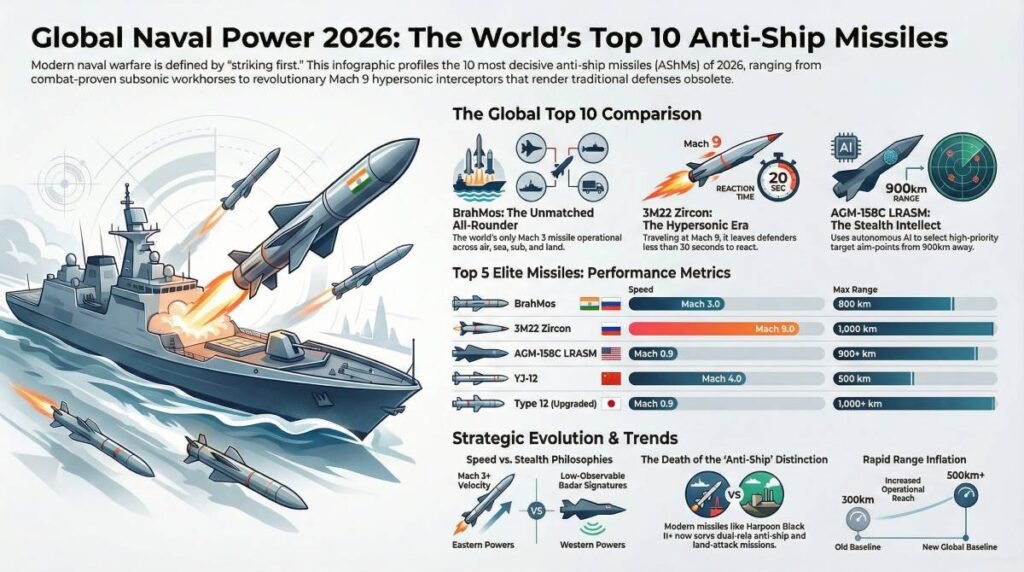
The following table summarizes all 10 missiles before we go into full detail on each one:
| # | Missile | Country | Speed | Range | Warhead | Type | Launch Platform |
| 1 | BrahMos | India / Russia | Mach 3 | 800 km | 300 kg | Supersonic | Air / Sea / Sub / Land |
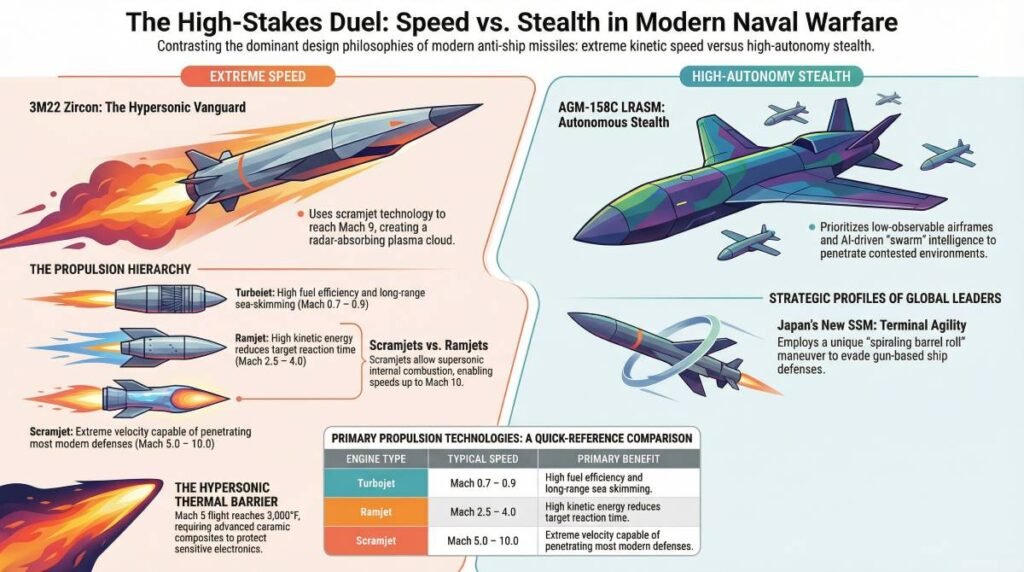
| 2 | 3M22 Zircon | Russia | Mach 8–9 | 1,000 km | ~400 kg | Hypersonic | Surface / Sub |
| 3 | AGM-158C LRASM | USA | Mach 0.9 | 900+ km | 450 kg | Subsonic Stealth | Air (B-1B, F/A-18, F-35) |
| 4 | YJ-12 | China | Mach 3–4 | 400–500 km | 205–500 kg | Supersonic | Air (H-6K bomber) |
| 5 | Harpoon Block II+ | USA | Mach 0.85 | 315 km | 221 kg | Subsonic | Air / Sea / Sub / Land |
| 6 | NSM / JSM | Norway | Mach 0.95 | 250/550 km | 120 kg | Subsonic Stealth | Air (F-35) / Sea |
| 7 | Exocet MM40 Block 3 | France | Mach 0.93 | 180+ km | 165 kg | Subsonic | Air / Sea / Sub / Land |
| 8 | P-800 Oniks / Yakhont | Russia | Mach 2.5 | 800 km | 250 kg | Supersonic | Air / Sea / Sub |
| 9 | P-270 Moskit (Sunburn) | Russia | Mach 3+ | 250 km | 300 kg | Supersonic | Surface |
| 10 | Type 12 Upgraded | Japan | Mach 0.9 | 1,000+ km | ~200 kg | Subsonic | Land / Air / Sea |
Top 10 Anti-Ship Missiles in the World (2026) (LRAShM) (PPT SLIDES)
#1. BrahMos – India’s World-Class Supersonic Anti-Ship Missile
- Country of Origin: India and Russia (BrahMos Aerospace, joint venture)
- Anti-Ship Missile Speed: Mach 2.8 to Mach 3.0 (approximately 3,450 km/h)
- Anti-Ship Missile Range: 290 km (original) / 500 km / 800 km (extended range variant)
- Warhead: 300 kg semi-armor-piercing high explosive
- Length: 8.4 meters (ship-launched) / 6.1 meters (air-launched variant)
- Weight: Approximately 3,000 kg
- Guidance System: Active radar homing + INS + GPS mid-course
- Launch Platforms: Su-30MKI (air-launched), destroyers, frigates, submarines, land-based mobile launchers
- Status: Fully operational; exported to Philippines, Vietnam (in negotiation)
Overview
The BrahMos anti-ship missile is the most celebrated and most capable supersonic anti-ship missile in the world today. Developed jointly by India’s Defence Research and Development Organisation (DRDO) and Russia’s NPO Mashinostroyenia, BrahMos takes its name from two rivers – India’s Brahmaputra and Russia’s Moskva – symbolizing the partnership behind the weapon. Since its first test in 2001, BrahMos has evolved into the flagship of anti-ship missile India capability and one of the most feared naval strike weapons on earth.
Speed and Lethality
What makes BrahMos exceptional is speed. At Mach 3, it is three times the speed of sound – meaning a target 500 km away is struck in under 6 minutes. More importantly, at that velocity, the missile carries enormous kinetic energy: even if the warhead fails to detonate, the sheer impact force can crack a warship’s hull and disable it completely. BrahMos uses a two-stage propulsion system: a solid-fuel rocket booster to supersonic speed, followed by a ramjet sustainer that maintains Mach 3 all the way to impact.
Multi-Platform Versatility
BrahMos is unique in being fully operational across all four launch domains. The Indian Navy fires it from Kolkata-class destroyers and Shivalik-class frigates as a ship-launched weapon. The Indian Air Force deploys it as an air-launched anti-ship missile on the Sukhoi Su-30MKI – the only fighter in the world carrying a Mach 3 anti-ship missile. The Indian Army maintains shore-based BrahMos batteries. Submarine-launched variants are under development for the Arihant-class submarines. This four-domain capability is matched by only a handful of nations.
BrahMos as an Anti-Ship Missile India Export Success
India’s 2022 sale of BrahMos to the Philippines marked India’s entry as a serious defense exporter. The deal – worth approximately $375 million for a coastal defense regiment – was the largest Indian arms export in history at the time. Vietnam, Indonesia, and Saudi Arabia are reportedly in advanced negotiations. BrahMos-NG (Next Generation), a lighter and smaller variant for carriage on lighter aircraft and smaller warships, is in development. BrahMos II, a joint India-Russia hypersonic missile program targeting Mach 7+, is the long-term successor.
Why BrahMos Ranks #1
No other anti-ship missile in the world combines Mach 3 speed, 800 km range, 300 kg warhead, and four-domain launch capability in one fully operational package. The BrahMos anti-ship missile is simultaneously the fastest operational cruise-type anti-ship missile, one of the longest-range non-hypersonic anti-ship missiles, and the most versatile multi-platform weapon in its class. That combination earns it the top spot.
#2. 3M22 Zircon / Tsirkon – Russia’s Anti-Ship Hypersonic Missile
- Country of Origin: Russia (NPO Mashinostroyenia)
- Anti-Ship Missile Speed: Mach 8 to Mach 9 (approximately 9,800 km/h)
- Anti-Ship Missile Range: 500–1,000 km (classified, estimated from open sources)
- Warhead: ~300–400 kg (estimated)
- Propulsion: Scramjet (supersonic combustion ramjet)
- Guidance System: INS + active radar (terminal phase)
- Launch Platforms: Admiral Gorshkov-class frigates, Yasen-class submarines (future)
- Status: Operational – inducted January 2023, frigate Admiral Gorshkov
Overview
The 3M22 Zircon is the world’s first confirmed operational anti-ship hypersonic missile and the most terrifying naval weapon in service today. Inducted into the Russian Navy in January 2023 aboard the frigate Admiral Gorshkov, the Zircon represents a generational leap beyond everything else on this list. It does not simply outpace existing defenses – it renders them conceptually obsolete.
Why Hypersonic Speed Changes Everything
At Mach 8, the Zircon covers 2,720 meters every second. A target 500 km away is struck in approximately 3 minutes and 4 seconds. A ship’s radar might detect the incoming missile at a range of 30–50 km, leaving roughly 11–18 seconds for any defensive response. No currently deployed naval interceptor – not the Standard Missile-6, not the ESSM, not the CAMM – is designed to reliably engage a hypersonic sea-skimmer in that window. The Zircon’s plasma sheath at hypersonic speeds also partially blinds radar tracking, adding another layer of difficulty for defenders.
Strategic Impact
The Zircon’s emergence has directly accelerated US investment in directed energy weapons (lasers), next-generation naval interceptors, and hypersonic defense programs. It is the primary threat driving the US Navy’s Conventional Prompt Strike program and expanded Aegis upgrades. Russia’s deployment of the Zircon on frigates – relatively small warships – means the threat is not confined to capital ships but spreads across the entire fleet. The Zircon ranks #2 only because its limited current deployment (single frigate class) and classified performance parameters make full assessment difficult. In raw lethality, it may already be the world’s most dangerous anti-ship weapon.
#3. AGM-158C LRASM – America’s Intelligent Air-Launched Anti-Ship Missile
- Country of Origin: United States (Lockheed Martin / DARPA)
- Anti-Ship Missile Speed: High subsonic, approximately Mach 0.9
- Anti-Ship Missile Range: 900+ km (exact figure classified; estimated 920–1,000 km)
- Warhead: 450 kg penetrating blast fragmentation – largest warhead on this list
- Weight: ~1,100 kg
- Guidance System: Imaging infrared seeker + passive RF sensor + GPS/INS + autonomous AI targeting
- Launch Platforms: B-1B Lancer (internal bay), F/A-18E/F Super Hornet, F-35 (integration planned)
- Status: Operational – B-1B declared 2018, F/A-18 declared 2019
Overview
The Long Range Anti-Ship Missile (LRASM) is America’s most advanced anti-ship weapon and the world’s most capable autonomous air-launched anti-ship missile. Where Russia and China pursue speed to defeat defenses, the United States chose a different path with the LRASM: defeat defenses through stealth, artificial intelligence, and precision – and hit the target so accurately that even a relatively smaller warhead causes catastrophic damage.
Autonomous Intelligence
The LRASM’s most revolutionary feature is its onboard intelligence. After launch, the missile autonomously navigates around known threat areas using pre-loaded electronic order of battle data. It classifies multiple ships in a group and selects the highest-priority target. It then identifies the optimal aim point on that specific vessel – bridge, engine room, ammunition magazine – and flies directly to it. No other production anti-ship missile can do this without human guidance in the terminal phase. This level of autonomy makes the LRASM genuinely unlike any previous weapon in the category.
Stealth and Range
The LRASM’s low-observable design – composite body, carefully shaped surfaces – gives it a radar cross-section comparable to a large bird. Combined with its 900+ km range, this means the launching aircraft never needs to approach the target’s defense perimeter. A B-1B bomber can carry 24 LRASMs internally, launch from outside the enemy’s air defense umbrella, and overwhelm any single ship’s defensive magazine capacity many times over. This combination of stealth and quantity is the LRASM’s unique advantage.
#4. YJ-12 Eagle Strike – China’s Fastest Air-Launched Anti-Ship Missile
- Country of Origin: China (CASC – China Aerospace Science and Technology Corporation)
- Anti-Ship Missile Speed: Mach 3 to Mach 4 (terminal phase)
- Anti-Ship Missile Range: 400–500 km
- Warhead: 205–500 kg depending on variant
- Guidance System: Active radar homing + INS
- Launch Platforms: H-6K strategic bomber (primary air-launched anti-ship missile platform), H-6J
- Status: Operational with PLAAF; deployed in Western Pacific
Overview
The YJ-12 Eagle Strike is China’s most dangerous air-launched anti-ship missile and one of the primary threats to US Navy carrier strike groups operating in the Western Pacific. At Mach 3 to Mach 4, it is the fastest air-launched anti-ship missile in operational service anywhere in the world – faster even than the BrahMos in its air-launched form. When combined with the H-6K strategic bomber’s range, the YJ-12 creates a threat envelope that forces US carriers to operate further from Chinese shores than at any point in the past 70 years.
The Carrier-Killer Threat
Defense analysts at the RAND Corporation and US Naval War College have identified the YJ-12 as one of the top two threats to US carrier operations in the Pacific (alongside the DF-21D ballistic missile). Its combination of speed, range, and terminal maneuverability – it executes violent evasive maneuvers in the final approach phase – makes it extremely challenging for Aegis combat systems to reliably intercept. A single H-6K regiment can carry enough YJ-12 missiles to overwhelm any single carrier group’s defensive magazines. China operates multiple H-6K regiments.
Terminal Maneuverability
Unlike BrahMos, which flies a relatively predictable terminal trajectory, the YJ-12 is reported to execute high-G evasive maneuvers in its terminal phase that defeat the firing solutions of ship-based interceptors. At Mach 3–4 while also maneuvering, the missile presents an engagement challenge for which no current naval defense system has a reliable answer at scale.
#5. AGM/RGM/UGM-84 Harpoon – The World’s Most Widely Deployed Anti-Ship Missile
- Country of Origin: United States (Boeing Defense & Space)
- Anti-Ship Missile Speed: Mach 0.85 (subsonic)
- Anti-Ship Missile Range: 124 km (Block 1C) / 240 km (Block II) / 315 km (Block II+)
- Warhead: 221 kg penetrating blast fragmentation
- Weight: 691 kg
- Guidance System: Active radar homing + GPS/INS (Block II+)
- Launch Platforms: Air-launched (AGM-84): P-3 Orion, P-8 Poseidon, F/A-18; Surface (RGM-84): warships; Submarine (UGM-84); Land-based
- Operators: 30+ nations worldwide – most widely deployed anti-ship missile in history
- Status: Continuously updated; Block II+ in production; combat-proven
Overview
The Boeing Harpoon is the anti-ship missile against which all others are measured. In continuous production since 1977 and operated by over 30 nations, it is the most widely deployed anti-ship missile in the history of naval warfare. Its four designation variants – AGM-84 (air-launched), RGM-84 (surface ship), UGM-84 (submarine), and a ground-launched coastal defense version – cover every possible deployment scenario. No other anti-ship missile offers this breadth of operational flexibility combined with proven combat performance.
Combat Record
The Harpoon’s combat history is unmatched. US Navy aircraft used it in the 1986 Gulf of Sidra operations against Libyan patrol boats. The USS Constellation used it during Operation Praying Mantis in 1988 against Iranian warships. Most recently, Ukraine deployed shore-launched Harpoons against Russian naval vessels in the Black Sea in 2022, including reportedly against ships supporting the siege of Snake Island. Each engagement confirmed its reliability and effectiveness against real targets with real countermeasures.
Block II+ Upgrades
The latest Harpoon Block II+ adds GPS/INS navigation for land-attack missions, a new digital autopilot for improved sea-skimming at very low altitude, a datalink for in-flight retargeting, and improved terminal maneuvers. These upgrades blur the traditional anti-ship missile vs cruise missile distinction: the Block II+ is effectively a dual-role weapon. At 315 km range, it also addresses the most common criticism of older Harpoon variants. While it cannot compete with the BrahMos in speed or the LRASM in range, the Harpoon’s affordability, availability, and global support network ensure it will remain relevant well into the 2030s.
#6. Naval Strike Missile (NSM) / Joint Strike Missile (JSM) – The Stealthiest Anti-Ship Missile in NATO
- Country of Origin: Norway (Kongsberg Defence and Aerospace)
- Anti-Ship Missile Speed: High subsonic, approximately Mach 0.95
- Anti-Ship Missile Range (NSM): 185–250 km
- Anti-Ship Missile Range (JSM): 550+ km
- Warhead: 120 kg blast-fragmentation with penetrator
- Weight: 400 kg (NSM) / 416 kg (JSM)
- Guidance System: Imaging infrared seeker + GPS/INS + terrain reference navigation
- Special Capability: Only anti-ship missile designed to fit inside F-35’s internal weapons bay
- Launch Platforms: NSM: surface warships, shore batteries; JSM: F-35A/C (internal carriage)
- Operators: Norway, USA (Littoral Combat Ships, new frigates), Poland, Germany, Australia, others
Overview
Norway’s Naval Strike Missile and its air-launched derivative, the Joint Strike Missile, represent the most sophisticated application of stealth technology in the anti-ship missile category. While the NSM cannot match the BrahMos in speed or the LRASM in range, it outperforms every other weapon in this list on one critical metric: survivability against modern ship-based radar. Its composite body and carefully optimized shaping give it a radar cross-section so small that it routinely evades detection until it is within close-in weapons system range – often too late for effective engagement.
The JSM and the F-35 Combination
The JSM holds a distinction that no other anti-ship missile in the world can claim: it is the only anti-ship missile engineered from the outset to fit inside the F-35 Lightning II’s internal weapons bay. All other anti-ship missiles require external carriage on the F-35, immediately breaking its stealth signature by making it visible to radar. The JSM/F-35 combination allows a pilot to penetrate heavily defended airspace, release the missile while remaining completely invisible to enemy radar, and return to base before the target even knows it was under attack. This makes the JSM/F-35 the most covert anti-ship missile delivery system in operational service.
Autonomous Target Selection
Like the LRASM, the NSM and JSM feature an imaging infrared seeker that allows autonomous aim point selection. The missile identifies the ship type, selects the most vulnerable section of the hull, and steers directly to it without further human input. This level of terminal intelligence, combined with its radar-evading stealth, makes the NSM/JSM combination the Western world’s most sophisticated anti-ship missile for contested environments where speed alone cannot guarantee penetration.
#7. Exocet AM39 / MM40 Block 3 – The World’s Most Combat-Proven Anti-Ship Missile
- Country of Origin: France (MBDA)
- Anti-Ship Missile Speed: Mach 0.93
- Anti-Ship Missile Range (Block 3): 180–200 km
- Warhead: 165 kg semi-armor-piercing high explosive
- Weight: 670 kg (MM40 Block 3)
- Propulsion: Turbofan engine (Block 3) – extends range over earlier turbojet variants
- Guidance System: Active radar homing + GPS/INS mid-course
- Launch Platforms: AM39: air-launched (Dassault Rafale, Super Etendard, Atlantique); MM40: surface ships; SM39: submarine-launched
- Operators: 40+ navies worldwide – one of the most widely deployed anti-ship missiles
- Combat History: Falklands War 1982, Iran-Iraq War, Gulf War, Yemen conflict
Overview
No anti-ship missile in history carries more weight – both literally and historically – than the Exocet. Made by MBDA of France, the Exocet is the weapon that permanently changed how the world thinks about naval vulnerability. Before 1982, major Western navies were dismissive of the anti-ship missile threat to their modern warships. The Falklands War changed that forever.
The Falklands War: When the World Learned to Fear Anti-Ship Missiles
On May 4, 1982, an Argentine Air Force Super Etendard aircraft – flying at wave-top height to avoid British radar – fired a single AM39 Exocet air-launched anti-ship missile at HMS Sheffield, a Royal Navy Type 42 destroyer. The missile struck amidships and started a fire that the crew could not control. Sheffield was abandoned and later sank. It was the first time a Western warship had been destroyed by a missile in combat, and it sent shockwaves through every navy in the world. The message was unmistakable: modern warships were not invulnerable, and even a single anti-ship missile could sink a major surface combatant.
The Exocet went on to sink the container ship Atlantic Conveyor, damage HMS Glamorgan, and sink multiple vessels in the Iran-Iraq War. Its combat record is unmatched by any other anti-ship missile on this list – or arguably in history.
MM40 Block 3: A Fully Modernized Weapon
The MM40 Block 3 Exocet is a comprehensively modernized weapon with turbofan propulsion for extended range, GPS/INS mid-course navigation, and an upgraded active radar seeker. Its anti-ship missile range has been pushed to over 180 km – significantly greater than original variants. It remains the backbone of many allied navies and a weapon that any serious opponent must plan to counter. Operated by over 40 nations, it is one of the most widely deployed anti-ship missiles in the world, trailing only the Harpoon.
#8. P-800 Oniks / Yakhont – Russia’s Versatile Supersonic Hunter
- Country of Origin: Russia (NPO Mashinostroyenia)
- Anti-Ship Missile Speed: Mach 2.5
- Anti-Ship Missile Range: 300 km (low altitude sea-skimming) / 800 km (high altitude cruise)
- Warhead: 250 kg semi-armor-piercing
- Weight: 3,000 kg
- Propulsion: Solid-fuel rocket booster + ramjet sustainer
- Guidance System: Active radar homing (autonomous target selection capability)
- Launch Platforms: Surface warships, Bastion coastal defense system (land-based), submarines, Su-27/30 (air-launched variant tested)
- Export Variant: Yakhont – sold to Syria, Vietnam, Indonesia, India (BrahMos derivative)
- Status: Operational in Russian Navy and multiple export nations; used in combat in Syria
Overview
The P-800 Oniks holds a special place in the history of the anti-ship missile: it is the direct progenitor of the BrahMos. When India and Russia formed BrahMos Aerospace in 1998, the Oniks design was the starting point, and Indian engineering elevated it to Mach 3. The Oniks itself, while slightly slower than BrahMos at Mach 2.5, is nonetheless a formidable supersonic anti-ship missile in its own right and serves as the foundation of Russia’s current-generation surface ship anti-ship capability.
Salvo Intelligence
One of the Oniks’s most significant – and often overlooked – capabilities is its salvo intelligence. When multiple Oniks missiles are fired simultaneously at a group of ships, they communicate with each other via data link to coordinate target assignment. Each missile independently selects a different ship in the group, preventing the waste of multiple missiles hitting the same target while others escape. One missile in the salvo assumes a ‘command’ role, flying a higher trajectory to gather targeting data before diving toward its assigned ship. This autonomous tactical coordination was a groundbreaking capability when it was first developed and remains relevant today.
Combat Deployment – Syria
Syria’s Russian-supplied Yakhont coastal defense batteries have been used operationally during the Syrian civil war, though primarily in land-attack roles against shore targets rather than naval targets. The Bastion-P coastal defense system, which fires the Oniks/Yakhont, has also been demonstrated by Russia in exercises in the Caspian and Baltic Seas, confirming its anti-ship mission readiness.
#9. P-270 Moskit / SS-N-22 Sunburn – One of the Largest Anti-Ship Missiles Ever Built
- Country of Origin: Russia (Raduga Design Bureau)
- Anti-Ship Missile Speed: Mach 2.2 (high altitude) / Mach 3+ (sea-skimming terminal phase)
- Anti-Ship Missile Range: 120 km (low altitude) / 250 km (high altitude)
- Warhead: 300 kg conventional OR 120 kiloton nuclear option
- Weight: 4,500 kg – one of the heaviest anti-ship missiles in service
- Length: 9.745 meters
- Guidance System: Active radar homing
- Launch Platforms: Sovremenny-class destroyers (primary), Tarantul-class missile boats
- Operators: Russia, China (acquired Sovremenny destroyers with Moskit in 1990s–2000s)
- Status: Aging but operational; Chinese acquisition accelerated domestic supersonic missile development
Overview
The P-270 Moskit (NATO codename SS-N-22 Sunburn) is one of the most imposing weapons in the history of the anti-ship missile category. Developed during the Cold War with the explicit mission of sinking US aircraft carriers, the Moskit embodies the Soviet philosophy of using overwhelming force – massive size, enormous warhead, and high speed – to defeat layered defenses through sheer destructive power. At 4,500 kg and nearly 10 meters in length, it is among the largest anti-ship missiles ever put into operational service.
Designed to Kill Aircraft Carriers
The Moskit’s design philosophy is pure Cold War: if a 300 kg conventional warhead doesn’t guarantee carrier destruction, a 120 kiloton nuclear warhead certainly will. The nuclear option was standard Soviet doctrine for anti-ship missiles of this era – they were not designed merely to damage enemy ships but to guarantee their annihilation regardless of defensive measures. At Mach 3 in its final sea-skimming approach, the Moskit gives a ship’s Phalanx CIWS approximately 2–3 seconds of engagement time – barely enough to fire a burst, let alone guarantee a kill.
China’s Acquisition and Its Impact
China’s purchase of four Sovremenny-class destroyers from Russia in the 1990s and early 2000s – each armed with eight Moskit missiles – was a landmark event in Pacific naval competition. Chinese engineers studied the Moskit intensively, and the lessons directly influenced subsequent Chinese supersonic anti-ship missile development including the YJ-12. In this way, the Moskit’s legacy extends far beyond its own operational service life, having shaped the most dangerous Chinese naval weapons of the current era.
#10. Type 12 (Upgraded) – Japan’s Long-Range Anti-Ship Missile
- Country of Origin: Japan (Mitsubishi Heavy Industries)
- Anti-Ship Missile Speed: Approximately Mach 0.9 (subsonic)
- Anti-Ship Missile Range: 200 km (current Type 12) / 1,000+ km (upgraded variant, delivery from 2026)
- Warhead: ~200 kg (estimated)
- Guidance System: Active radar homing + GPS/INS + terrain reference navigation
- Launch Platforms: Land-based truck launchers (current); air-launched (F-15J, F-35A) and ship-launched variants under development
- Status: Current Type 12 operational; upgraded 1,000 km variant approved, entering service from 2026
Overview
Japan’s Type 12 anti-ship missile program represents one of the most significant strategic shifts in Japanese defense policy since the end of World War II. The current Type 12 is a capable but regionally limited subsonic anti-ship missile. The upgraded variant approved under Japan’s landmark December 2022 National Security Strategy – the first major Japanese rearmament plan in modern history – will push its anti-ship missile range from 200 km to over 1,000 km, placing it among the longest-range non-hypersonic anti-ship missiles in the world.
Japan’s Strategic Revolution
For a nation that has maintained an exclusively defensive military posture since 1945, the decision to develop 1,000 km range anti-ship missiles is genuinely revolutionary. The upgraded Type 12 gives Japan the ability to strike naval forces – and potentially land targets – throughout the East China Sea, Yellow Sea, and beyond, without deploying its own ships to forward positions. This dramatically enhances Japan’s sea-denial capability and significantly complicates Chinese naval planning in the Western Pacific.
Multi-Domain Expansion
Japan is developing air-launched variants of the upgraded Type 12 for its F-15J and F-35A fleets, sea-launched variants for Japan Maritime Self-Defense Force destroyers, and retaining the land-based truck-launched coastal defense version. This mirrors India’s BrahMos multi-domain strategy. When fully deployed, the upgraded Type 12 will give Japan a comprehensive sea-denial capability across all launch domains and a 1,000 km threat radius – making it one of the most strategically significant new anti-ship missile programs in the world today.
Honorable Mentions: Anti-Ship Missiles Just Outside the Top 10
Several additional anti-ship missiles deserve recognition and could enter the top 10 as they mature or as geopolitical conditions change:
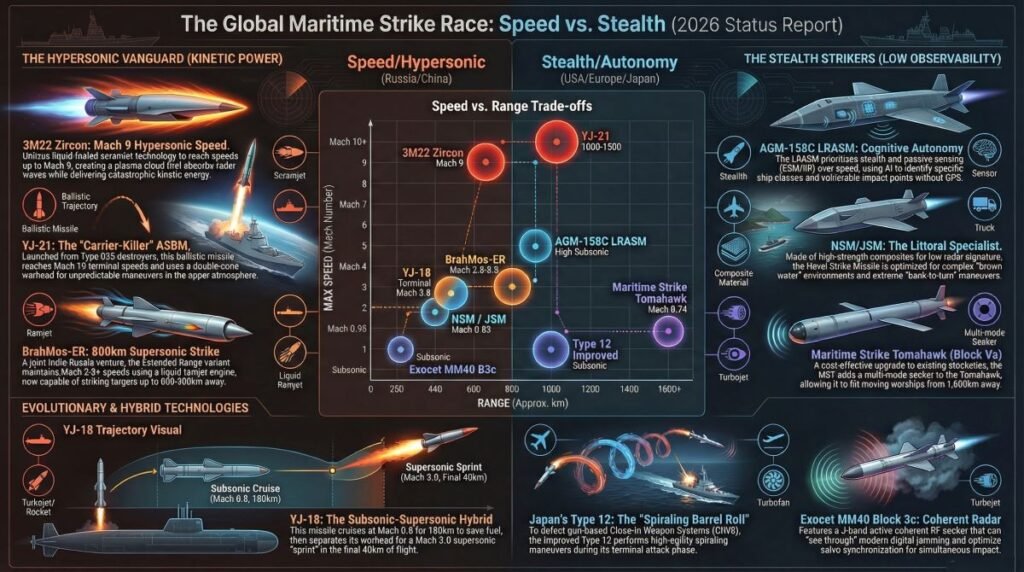
- YJ-21 (China) – Ballistic-trajectory anti-ship hypersonic missile, Mach 6+, operational on Type 055 cruisers. Excluded from main list because its ballistic trajectory (rather than sustained hypersonic cruise) makes its classification as an anti-ship missile vs ballistic anti-ship weapon somewhat ambiguous.
- Naval Strike Weapon / NSM Mk II (Norway/USA) – Next-generation NSM under development for the 2030s with enhanced range and capability.
- BrahMos II (India/Russia) – The anti-ship hypersonic missile successor to BrahMos. Targets Mach 7+ and 600 km range. Expected trials in late 2020s.
- Maritime Strike Tomahawk (USA) – Block V Tomahawk upgraded with an anti-ship radar seeker. Blurs the anti-ship missile vs cruise missile line completely.
- Kalibr 3M54 (Russia) – The naval variant with a supersonic terminal stage. Used extensively in Ukraine primarily in land-attack role but has anti-ship primary mission.
Also read: Top 10 5th Generation Fighter Jets in the World 2026 (.PPTX)
Key Trends Shaping Anti-Ship Missiles in 2026
- Hypersonic proliferation: Russia’s Zircon is operational. China’s YJ-21 is operational. India’s BrahMos II and the US HALO/OASuW are in development. By 2030, every major naval power will field an anti-ship hypersonic missile.
- Range inflation: 300 km was tier-one in 2010. By 2026, the baseline for serious powers exceeds 500 km. The upgraded Type 12 and the LRASM push toward 1,000 km as the new standard.
- AI autonomy: The LRASM demonstrated that missiles can autonomously navigate, classify targets, and choose aim points. This capability is being incorporated into next-generation programs across all major powers.
- Convergence of anti-ship missile vs cruise missile: The distinction is dissolving. Modern weapons like BrahMos, LRASM, and Block II+ Harpoon perform both missions.
- Swarm tactics over largest anti-ship missile mass: Cold War doctrine favored the largest anti-ship missile possible. Modern doctrine increasingly favors coordinated salvos of smaller, smarter missiles to saturate layered defenses.
Conclusion
The top 10 anti-ship missiles in the world represent a rich and diverse picture of naval warfare technology in 2025–2026. Three design philosophies dominate: Russia and China racing toward extreme anti-ship missile speed and anti-ship hypersonic missile dominance; the United States and Norway perfecting stealth, autonomy, and precision; and India leveraging (Long Range – Anti Ship Missile (India)) (LRAShM) the BrahMos partnership to field the world’s finest all-round supersonic capability.
Each missile on this list earned its place for a specific reason: BrahMos for its unmatched combination of Mach 3 speed, 800 km range, and multi-domain versatility; the Zircon for the revolutionary threat of operational hypersonic flight; the LRASM for its AI-powered autonomy and precision; the YJ-12 for its terrifying speed as an air-launched anti-ship missile; the Harpoon for its unmatched combat record and global deployment; the NSM/JSM for its stealth and its unique F-35 internal bay capability; the Exocet for its irreplaceable combat history; the Oniks for its salvo intelligence and role as BrahMos’s predecessor; the Moskit for being one of the largest anti-ship missiles ever built and its role in shaping Chinese missile development; and the upgraded Type 12 for representing Japan’s strategic transformation.
From the largest anti-ship missiles of the Cold War to the autonomous stealthy weapons of today and the hypersonic weapons of tomorrow, the anti-ship missile continues to be the decisive instrument of naval power. Understanding these ten weapons is understanding the future of warfare at sea.