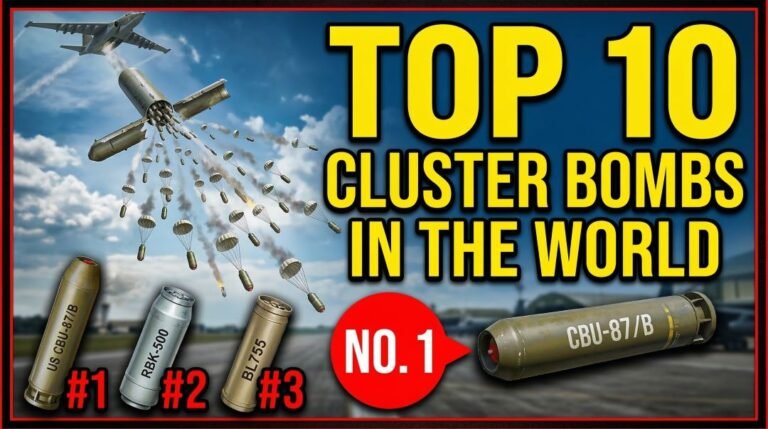
Top 10 Cluster Bombs in the World: An in-depth, fully updated guide to the top 10 cluster bombs in the world as of 2026. Covers types, effects, failure rates, prices, manufacturers, legal status, PDF, PPT, TABLE and country-by-country data on cluster munitions.
Table of Contents
Cluster bombs – also called cluster munitions – are among the most debated, studied, and controversial weapons in modern military history. From newspaper headlines about their use in Ukraine and the Middle East to research papers examining their humanitarian impact in Laos and Vietnam, cluster munitions occupy a unique and deeply contested space in global security.
This fully updated 2026 guide gives you everything you need: the top 10 cluster bombs in the world ranked by technical capability and historical impact, detailed comparison tables, price and manufacturer data, failure rates, legal status, and regional breakdowns. All data has been cross-referenced with the latest information available as of March 2026, including Google AI’s analysis of notable cluster munition systems.
Note: This article is written exclusively for educational, research, journalistic, and humanitarian awareness purposes.
What Are Cluster Bombs? (Meaning and Definition)
A cluster bomb, or cluster munition, is an explosive weapon that opens in the air and releases dozens to hundreds of smaller submunitions – commonly called bomblets – over a wide area simultaneously. Unlike a conventional bomb, which creates a single large explosion at one point, a cluster bomb saturates a broad geographic zone with multiple smaller detonations.
This area-coverage capability is what makes cluster bombs both militarily attractive and deeply controversial from a humanitarian standpoint. The same wide coverage that allows a military to engage dispersed targets also means that civilian areas, farms, and infrastructure can be affected – and that many submunitions fail to detonate, leaving dangerous unexploded ordnance (UXO) on the ground for decades.
Key characteristics of cluster munitions:
- Delivered by aircraft, artillery, rockets, or ballistic missiles
- Release multiple submunitions (bomblets) during flight or upon container opening
- Designed for area saturation rather than precision strikes
- Many submunitions fail to detonate on impact, creating long-term UXO hazards
When Were Cluster Bombs Invented?
Cluster bombs were invented during World War II in the early 1940s. Germany’s SD-2 ‘Butterfly Bomb’ was one of the first operational cluster-type weapons, deployed against Allied forces across Europe. The United States simultaneously developed its own CBU (Cluster Bomb Unit) series. After WW2, cluster bomb technology advanced rapidly during the Cold War, and the U.S. made massive use of them in the Vietnam War and in Laos – dropping an estimated 270 million submunitions over Southeast Asia.
Historical timeline:
- 1940s (WW2): Germany’s SD-2 Butterfly Bomb and early U.S. CBU series developed
- 1964-1973: Massive U.S. cluster bomb use in Vietnam and Laos
- 1991: Extensive use in the Gulf War
- 1999: NATO use in Kosovo
- 2006: Israel uses cluster bombs extensively in Lebanon
- 2008: Convention on Cluster Munitions (CCM) signed in Oslo
- 2022-2024: Documented use in Russia-Ukraine conflict and Middle East
- 2026: Lithuania withdraws from CCM; at least 17 countries still produce or reserve cluster bombs
Top 10 Cluster Bombs in the World (PPT SLIDES)
Types of Cluster Bombs (The 5 Main Categories)
Cluster munitions are categorized by their delivery system and intended effect. Here are the five primary types:
1. Air-Delivered Cluster Bombs
Dropped from aircraft, these bombs open in mid-air and scatter submunitions over a large area. The U.S. CBU series (CBU-87, CBU-97, CBU-100) is the most well-known example. Many modern variants include wind-corrected or sensor-guided tail kits for improved accuracy.
2. Artillery-Delivered Cluster Munitions
Fired from artillery guns, these rounds burst open in flight scattering dual-purpose submunitions. The DPICM M864 shell is the NATO standard example and has been central to the Ukraine conflict. The German SMArT 155 is a premium precision variant.
3. Rocket-Delivered Cluster Munitions
Launched from MLRS systems (BM-21 Grad, BM-30 Smerch, M270 MLRS), these deliver cluster payloads over distances from 20 to 90+ km. Some ATACMS variants can carry cluster submunitions over 165 km.
4. Ballistic Missile Cluster Warheads
Ballistic missiles like Russia’s Iskander-M and Iran’s Khorramshahr-4 can be fitted with cluster warheads containing dozens of submunitions. These represent the longest-range cluster delivery systems, with ranges of 500 km to 2,000 km.
5. Mortar-Delivered Cluster Munitions
A less common variant used for shorter-range area engagement by infantry units. They carry fewer submunitions and require lighter equipment.
Top 10 Cluster Bombs in the World (2026)
The following list covers the most historically significant, technically advanced, and widely deployed cluster munition systems globally. Rankings reflect a combination of technical sophistication, historical impact, scale of deployment, and current relevance as of 2026.
#1. CBU-105 / CBU-97 Sensor-Fuzed Weapon (United States)
The CBU-97 and its updated variant the CBU-105 SFW (Sensor-Fuzed Weapon) are widely regarded as the most technologically advanced cluster bombs ever fielded. Each bomb carries 10 BLU-108 submunitions; each BLU-108 releases 4 infrared-guided ‘Skeet’ warheads, totaling 40 self-guided explosives per bomb. The Skeet warheads parachute down, scan for armored vehicles using IR sensors, then fire explosively formed penetrators (EFPs) downward through the thinnest part of tank armor.
The CBU-105 is often seen as an ‘ethical’ choice by U.S. and allied forces because its self-guided warheads are specifically designed to engage individual vehicles rather than blindly saturating an area. Modern versions have a self-destruct mechanism to reduce dud rates below 1%.
- Country of origin: USA | Manufacturer: Textron Systems
- Submunitions: 40 self-guided Skeet warheads (10 BLU-108s x 4 Skeets)
- Max range: ~24 km (15 miles) when air-delivered
- Unit cost (estimated): USD 700,000 to 800,000
- Technology level: Ultra-High (IR sensors, EFP warheads)
- Primary target: Armored vehicles and battle tanks
#2. SMArT 155 (Germany – Rheinmetall/Diehl)
The SMArT 155 (Suchzunder Munition fur die Artillerie) is Germany’s premium precision cluster munition. It is a 155mm artillery shell that contains only 2 autonomous submunitions, each of which uses a millimeter-wave radar and infrared sensor to precisely detect and engage individual tanks from above – striking their thin top armor with an explosively formed penetrant.
The SMArT 155 is considered the most discriminating cluster munition available: it targets individual vehicles rather than saturating areas, which is why Germany and several other countries argue it sits in a different legal category from traditional cluster bombs. It is exported to Australia, Greece, Switzerland, and Ukraine.
- Country of origin: Germany | Manufacturer: Rheinmetall/Diehl (GIWS)
- Submunitions: 2 autonomous IR/radar-guided warheads per shell
- Max range: ~28 km (17 miles)
- Unit cost (estimated): USD 150,000 to 250,000 per shell
- Technology level: Ultra-High (radar + IR dual sensor)
#3. DPICM M864 Artillery Shell (United States / NATO)
The DPICM (Dual-Purpose Improved Conventional Munition) M864 is a 155mm artillery shell containing 72 submunitions effective against both light armor and personnel. It is the workhorse cluster munition of NATO armies and has been in service for decades. DPICM rounds became the center of global debate in 2023 when the United States controversially supplied them to Ukraine, where they have been used extensively in high-intensity combat.
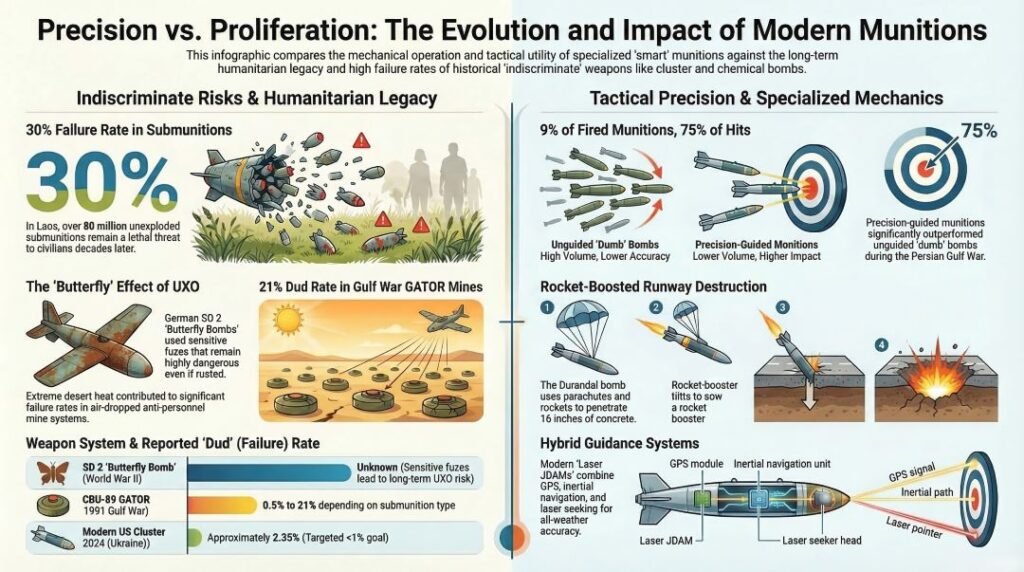
DPICM shells are the most cost-effective cluster munitions in widespread use today, but their moderate dud rate (3-15%) remains a significant humanitarian concern.
- Country of origin: USA | Manufacturer: General Dynamics / Army Labs
- Submunitions: 72 dual-purpose bomblets (M77/M42)
- Max range: ~29 km via 155mm artillery
- Unit cost (estimated): USD 3,000 to 5,000 per shell
- Production status: Stockpile/active – rapidly replenished for Ukraine
- Notable use: Gulf War, Kosovo, Iraq, Ukraine (2023-2026)
#4. RBK-500 Cluster Bomb (Russia – Bazalt)
The RBK-500 is Russia’s primary air-delivered cluster bomb, capable of carrying a wide variety of submunition types – including PTAB anti-tank submunitions, AO-2.5 fragmentation bomblets, ShOAB-0.5 area-denial spheres, and SHOAB incendiary variants. Its flexibility makes it one of the most versatile cluster weapons in the world.
The RBK-500 has been extensively used in Syria and Ukraine. A key development since 2024 is Russia’s integration of UMPK glide-kit guidance systems on the RBK-500, significantly extending its effective range to approximately 60 km and making it far harder for air defenses to intercept the delivery aircraft.
- Country of origin: Russia | Manufacturer: Bazalt State Research
- Submunitions: Variable (15-500 depending on type)
- Max range: ~60 km (37 miles) with UMPK glide kit
- Unit cost (estimated): USD 15,000 to 25,000
- Production status: Active (Russia operating 24/7 production cycle)
- Notable use: Syria, Ukraine
#5. Iskander-M Cluster Variant (Russia – KBM)
The Iskander-M (NATO designation SS-26 Stone) is a road-mobile ballistic missile system with a range of approximately 500 km. When fitted with a cluster warhead containing around 50 submunitions, it becomes one of the most lethal area-denial weapons in any arsenal. The Iskander-M can be delivered with high accuracy at high speed, making it very difficult to intercept. It has been used extensively in the Ukraine conflict for strikes on high-value military and infrastructure targets.
- Country of origin: Russia | Manufacturer: KBM
- Submunitions (cluster variant): ~50
- Max range: ~500 km (310 miles)
- Unit cost (estimated): USD 3 million to 5 million per missile
- Technology level: High (ballistic, GPS-guided)
#6. ATACMS M39 (United States – Lockheed Martin)
The Army Tactical Missile System (ATACMS) M39 is a ground-launched ballistic missile carrying 950 M74 anti-personnel/materiel submunitions in its warhead. Launched from the M270 MLRS or HIMARS platforms, it can strike targets up to 165 km away. The M39 variant with the cluster warhead was widely used in the Gulf War, and ATACMS missiles (including conventional variants) have been supplied to Ukraine since 2024.
- Country of origin: USA | Manufacturer: Lockheed Martin
- Submunitions: 950 M74 anti-personnel grenades
- Max range: ~165 km (100 miles)
- Unit cost (estimated): USD 1.3 million to 1.7 million
- Technology level: High (GPS-guided ballistic missile)
#7. BM-30 Smerch (Russia – Splav State Research)
The BM-30 Smerch is a heavy multiple-launch rocket system (MLRS) that fires 300mm rockets, each containing up to 72 submunitions. A single Smerch battery (12 launchers) can deliver 864 rockets in a single salvo – blanketing an enormous area. The Smerch has a maximum range of approximately 90 km and has been used in multiple conflicts including Chechnya, Syria, and Ukraine. Its sheer area-saturation capability makes it one of the most feared rocket artillery systems in existence.
- Country of origin: Russia | Manufacturer: Splav State Research
- Submunitions per rocket: 72
- Max range: ~90 km (56 miles)
- Unit cost (estimated): USD 100,000+ per rocket
- Production status: Active
#8. CBU-87 Combined Effects Munition (United States)
The CBU-87 CEM (Combined Effects Munition) is one of the most widely deployed U.S. air-delivered cluster bombs, carrying 202 BLU-97/B submunitions. Each BLU-97 bomblet combines three effects: a shaped charge for armor penetration, a fragmentation sleeve for anti-personnel effect, and an incendiary zirconium ring for fire-starting. This triple-effect design made the CBU-87 highly effective – and highly controversial due to its high dud rate and civilian impact.
The CBU-87 was a cornerstone weapon in Operation Desert Storm and NATO operations over Kosovo. It is known for high failure rates (up to 20% or more), which left significant UXO contamination in Kosovo and Iraq.
- Country of origin: USA
- Submunitions: 202 BLU-97/B combined effects bomblets
- Effects: Anti-armor + anti-personnel + incendiary
- Production status: Legacy (stockpile, being replaced by guided variants)
#9. MK 20 Rockeye II (United States – Honeywell)
The MK 20 Rockeye II is a classic anti-armor cluster bomb carrying 247 MK-118 HEAT (High Explosive Anti-Tank) bomblets. It has been a staple of U.S. Navy and Air Force arsenals since the Vietnam War era and was widely exported to over 30 countries during the Cold War. Most export versions are now being stockpile-only or decommissioned by CCM signatory nations. The Rockeye is considered a legacy system with a low unit cost but a relatively high dud rate.
- Country of origin: USA | Manufacturer: Honeywell (historical)
- Submunitions: 247 MK-118 HEAT bomblets
- Max range: ~10 km (6 miles)
- Unit cost (estimated): USD 10,000 to 15,000
- Production status: Stockpile only (no active production)
#10. BL755 (United Kingdom) and M-85 Submunition (Israel)
The BL755 is a British air-delivered cluster bomb historically used by the RAF. It contains 147 anti-armor submunitions and was used in the Gulf War and the Falklands conflict. The UK has since destroyed all its BL755 stockpiles after becoming a State Party to the CCM in 2010. However, significant quantities were exported to Germany, India, Iran, and Saudi Arabia, where stocks may still exist. The unit cost is estimated at under USD 10,000 historically.
The M-85 is an Israeli artillery-delivered submunition that was designed with a self-destruct mechanism intended to reduce dud rates. However, post-conflict investigations after the 2006 Lebanon War found the self-destruct mechanism failed far more often than claimed, leaving widespread UXO contamination across southern Lebanon.
- BL755 – Origin: UK | Submunitions: 147 anti-armor | Status: Destroyed (UK stockpile)
- M-85 – Origin: Israel | Type: Self-destruct artillery submunition | Controversy: Self-destruct failure in Lebanon 2006
Complete Data Table: Comparison of Major Cluster Munition Systems (2026)
The following table provides a comprehensive overview of the most prominent cluster munition systems globally, based on their delivery method, payload capacity, and operational characteristics as of early 2026.
| Munition System | Origin | Delivery Method | Submunition Count | Primary Target | Unit Cost (Est.) | Key Feature |
| CBU-105 SFW | USA | Air-Dropped Bomb | 40 (Skeet) | Armor/Tanks | $700k–$800k | Sensor-fused, self-destruct <1% dud |
| SMArT 155 | Germany | 155mm Artillery | 2 | Tanks/Vehicles | $150k–$250k | High-precision; IR + radar sensors |
| M864 DPICM | USA | 155mm Artillery | 72 | Dual (Pers/Armor) | $3k–$5k | Base-bleed; widely used in Ukraine |
| RBK-500 | Russia | Air-Dropped Bomb | Variable (15–500) | Personnel/Armor | $15k–$25k | Versatile; UMPK glide-kit upgrade |
| Iskander-M (9M723K1) | Russia | Ballistic Missile | ~50 | High-value area | $3M–$5M | Tactical missile; high-speed penetration |
| BM-30 Smerch | Russia | 300mm Rocket | 72 | Large Area | $100k+ | Multi-launch rocket system (MLRS) |
| CBU-87 CEM | USA | Air-Dropped Bomb | 202 | Combined Effects | ~$15k–$20k | High volume; known for high dud rates |
| ATACMS (M39) | USA | Ground Missile | 950 (M74) | Soft/Area Targets | $1.3M–$1.7M | Long-range (165km+) tactical missile |
| MK 20 Rockeye II | USA | Air-Dropped Bomb | 247 | Tanks/Armor | $10k–$15k | Legacy anti-tank; used in Gulf/Vietnam |
| Khorramshahr-4 | Iran | Ballistic Missile | ~20–24 | Strategic Targets | $1M–$2M | Recent combat use reported (2026) |
| BL755 | UK | Air-Dropped Bomb | 147 | Anti-Armor | ~$10k (historical) | Retired by UK; stocks in other nations |
Economic and Operational Data: Price, Production, Export, and Maintenance
Because many of these systems are sensitive military assets, precise maintenance costs are often classified. The following table provides estimated economic and operational data based on open-source defense research and reports current as of early 2026.
| Munition System | Unit Cost (Est.) | Production Status | Export / Import History | Maintenance Note |
| CBU-105 SFW | $700k–$800k | Active / Limited | Exported to: Saudi Arabia, India, South Korea, UAE | Requires specialized storage and electronic testing for IR sensors |
| M864 DPICM | $3k–$5k | Stockpile / Rapidly replenished | Exported to: Ukraine (via US aid), Turkey, various NATO | Simple long-term storage; periodic fuze inspections required |
| SMArT 155 | $150k–$250k | Active | Exported to: Australia, Greece, Switzerland, Ukraine | High-tech sensors require climate-controlled storage |
| RBK-500 | $15k–$25k* | Active (Russia) | Exported to: Syria, Belarus, various former Soviet states | Low maintenance; recently upgraded with UMPK glide kits for standoff use |
| Iskander-M (9M723) | ~$3M–$5M | Active (Russia) | Exported to: Belarus, Armenia | Extremely high maintenance; requires dedicated mobile transporter-loader vehicles |
| BM-30 Smerch | $100k+ (per rocket) | Active | Exported to: Algeria, India, Kuwait, Vietnam | Rocket motors have fixed shelf lives; propellant monitoring required |
| ATACMS (M39) | $1.3M–$1.7M | Legacy / Upgraded | Exported to: Ukraine, Taiwan, Poland, UAE | Maintenance involves ‘recapping’ old motors and electronics |
| MK 20 Rockeye II | $10k–$15k | Stockpile only | Exported to: Over 30 countries in 70s-90s | Legacy system; mostly decommissioned by CCM signatories |
| Khorramshahr-4 | ~$1M–$2M | Active (Iran) | Imported by proxy groups; potentially Russia | Requires specialized liquid fuel handling (missile carrier) |
| BL755 | ~$10k (historical) | Ceased | Exported to: Germany, India, Iran, Saudi Arabia | High disposal costs for CCM signatory nations |
*Russian prices are estimated based on local production costs and current exchange rates.
Range and Manufacturers: The Smart vs. Dumb Divide
One of the most important distinctions in understanding cluster munitions today is the technological divide between ‘smart’ sensor-fused weapons and ‘dumb’ legacy bombs. This table summarizes the key systems by range and manufacturer as of 2026.
| Munition System | Max Range (Approx.) | Primary Manufacturer | Country of Manufacture | Technology Level |
| CBU-105 SFW | ~24 km (15 miles) | Textron Systems | USA | Ultra-High (IR Sensors) |
| SMArT 155 | ~28 km (17 miles) | GIWS (Rheinmetall/Diehl) | Germany | Ultra-High (Radar+IR) |
| Iskander-M | ~500 km (310 miles) | KBM | Russia | High (Ballistic Missile) |
| ATACMS (M39) | ~165 km (100 miles) | Lockheed Martin | USA | High (GPS-Guided) |
| M864 DPICM | ~29 km (18 miles) | General Dynamics / Army Labs | USA | Medium (Base-Bleed) |
| BM-30 Smerch | ~90 km (56 miles) | Splav State Research | Russia | Medium (Rocket MLRS) |
| RBK-500 (UMPK) | ~60 km (37 miles)* | Bazalt | Russia | Low/Med (Glide Kit) |
| MK 20 Rockeye II | ~10 km (6 miles) | Honeywell (historical) | USA | Low (Gravity Bomb) |
| Khorramshahr-4 | ~2,000 km (1,242 miles) | AIO | Iran | High (Strategic Carrier) |
*Range significantly increased in 2024-2025 due to the addition of UMPK guidance/wing kits.
Global Comparison: Smart vs. Standard vs. Legacy Cluster Munitions
To give a clear big-picture view, this table compares the three main categories of cluster munitions: Smart/Sensor-Fuzed, Standard Artillery (DPICM), and Legacy Air-Dropped bombs.
| Feature | Smart/Sensor-Fuzed | Standard Artillery (DPICM) | Legacy Air-Dropped |
| Top Examples | CBU-105 (USA), SMArT 155 (GER) | M864 (USA), 3BK20 (RUS) | RBK-500 (RUS), MK 20 (USA) |
| Typical Cost | High ($150k–$800k per unit) | Low ($3k–$5k per shell) | Medium ($10k–$25k per bomb) |
| Precision | Very High (targets individual vehicles) | Low (saturates a large field) | Low (wide area coverage) |
| Reliability (Dud Rate) | Very Low (<1%) | Moderate/High (3%–15%) | High (up to 20% or more) |
| Primary Goal | Destroying armored columns | Suppressing infantry & light armor | Mass destruction of area targets |
| Current User Trend | Increasing (seen as ‘ethical’ choice) | Peak usage (high demand in Ukraine) | Decreasing (replaced by glide bombs) |
| Legal Status | Often exempt from certain bans | Strictly banned by CCM signatories | Strictly banned by CCM signatories |
Submunition Types and Their Effects (2026)
To understand cluster munitions fully, you need to understand the submunitions – the smaller bomblets packed inside the main shell. These vary from simple grenades to high-tech ‘skeets’ that hunt for heat signatures.
| Submunition Name | Parent System | Mechanism | Primary Effect | Lethality Note |
| BLU-108 ‘Skeet’ | CBU-105 SFW | Sensor-Fused | Armor Piercing | Uses an explosive penetrator (EFP) to punch through top tank armor |
| BLU-97/B | CBU-87 CEM | Combined Effects | Triple Threat | Fragmentation (personnel) + Shaped Charge (armor) + Zirconium (incendiary) |
| M77 / M42 | DPICM (M864) | Dual-Purpose | High Explosive | Designed to hit both infantry and light vehicles; high ‘dud’ risk in soft soil |
| PTAB-1M | RBK-500 | Anti-Tank | Point Charge | Specifically designed to burn through heavy tank hulls from above |
| AO-2.5RT | RBK-500 | Fragmentation | Anti-Personnel | Explodes on impact, scattering thousands of steel shards over a 30m radius |
| M39 (APAM) | ATACMS (M39) | Anti-Personnel/Materiel | Mass Saturation | 950 ‘M74’ grenades inside; covers an area the size of 4 football fields |
| DM 1490 | SMArT 155 | EFP (Smart) | Precision Kill | Parachutes down, scans with radar/IR, and fires a slug at the target |
| ShOAB-0.5 | RBK-500 | Ball fragmentation | Area Denial | Small spherical bomblets; very difficult to detect once settled on ground |
Cluster Bomb Effect: Immediate and Long-Term Humanitarian Impact
Immediate Effects
- Wide-area destruction of vehicles, personnel, and infrastructure
- Simultaneous detonation of dozens to hundreds of submunitions across a large zone
- Fragmentation, blast, and incendiary effects depending on submunition type
- Psychological impact: cluster munitions make entire regions too dangerous to enter, stopping civilian movement and economic activity
Long-Term Effects – UXO Contamination
The most serious long-term consequence is unexploded ordnance (UXO). Submunitions that fail to detonate on impact lie dormant in soil, vegetation, and buildings for decades – killing and injuring civilians, particularly children, long after conflicts end.
- Laos: ~30% of the country remains contaminated from 1960s-70s U.S. bombing – the most heavily bombed nation per capita in history
- Vietnam: Millions of unexploded bomblets remain in rural areas; ongoing clearance programs
- Ukraine: Significant new UXO contamination from 2022-2026 conflict
- Lebanon: Clearance ongoing after 2006 war; M-85 self-destruct failures created widespread hazards
What Is the Failure Rate of Cluster Munitions?
According to the ICRC and the Cluster Munition Coalition, dud rates for cluster munitions vary significantly by type and conditions:
- Smart/Sensor-Fuzed (CBU-105, SMArT 155): Less than 1% dud rate – modern self-destruct mechanisms
- Standard DPICM artillery shells: 3% to 15% dud rate depending on terrain and conditions
- Legacy air-dropped bombs (CBU-87, BL755): Up to 20% or more dud rate
- Older M77 submunitions (M26 rocket): Estimated 5% to 23% dud rate in real combat conditions
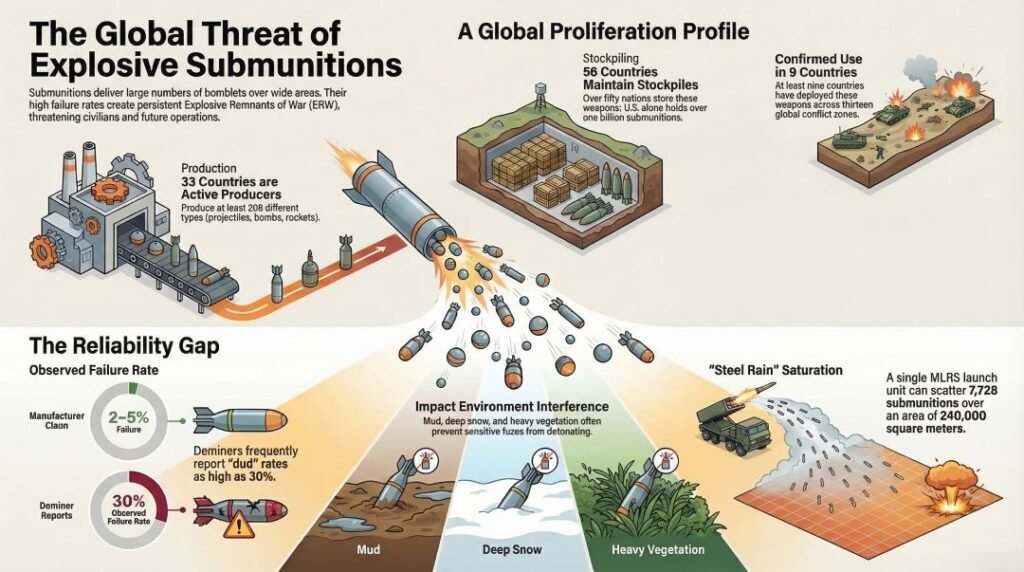
Factors that increase dud rates include soft or wet ground, vegetation, cold weather, and age of munitions. Even a 5% dud rate, when millions of submunitions are dropped, means hundreds of thousands of unexploded bomblets left on the ground indefinitely.
Are Cluster Bombs Legal? Geneva Convention and the CCM Ban
The Convention on Cluster Munitions (CCM), adopted in May 2008 and entered into force in August 2010, prohibits the use, production, stockpiling, and transfer of cluster munitions for all signatory nations. As of early 2026, over 110 nations have formally become States Parties to the CCM.
However, at least 17 countries continue to produce or reserve cluster bombs – including major military powers who have not joined the treaty:
- Major non-signatory producers (2026): USA, Russia, China, India, Iran, Israel, and Brazil
- Recent conflicts with documented use (March 2026): Ukraine, Lebanon, and Israel
Historic 2026 Development: Lithuania Withdraws from CCM
In a historic first, Lithuania formally withdrew from the Convention on Cluster Munitions on March 6, 2026, citing the need for ‘defensive tools’ due to regional security threats from Russia. This is the first time any nation has withdrawn from the treaty and represents a significant shift in the global consensus against cluster munitions.
What the Geneva Convention Says
The Geneva Convention itself does not explicitly ban cluster bombs. However, their use in civilian-populated areas may violate the principles of distinction (between combatants and civilians) and proportionality under international humanitarian law – regardless of whether a country has signed the CCM.
Countries That Have Committed to Non-Use (CCM States Parties)
As of early 2026, over 110 nations have formally stopped using cluster munitions by becoming States Parties to the CCM. The following table highlights key countries that have ceased use and production, including those that completed stockpile destruction:
| Country | Status | Action Taken | Historical Note |
| United Kingdom | State Party | Destroyed all stocks (finished 2013) | Former major user in Iraq and the Falklands |
| France | State Party | Destroyed all stocks (finished 2016) | Former producer and user in Chad and Kuwait |
| Germany | State Party | Completed stockpile destruction (finished 2015) | Maintains a small amount for training purposes only |
| South Africa | State Party | Completed stockpile destruction (Sept 2023) | Only country in Africa known to have produced them |
| Peru | State Party | Completed stockpile destruction | Last State Party to finish destroying its stocks |
| Bosnia & Herzegovina | State Party | Completed clearance of all contaminated land (2023) | Heavily affected by remnants from past conflicts |
| Bulgaria | State Party | Completed stockpile destruction (Sept 2023) | Former producer that fulfilled treaty obligations |
| Nigeria | State Party | Ratified convention (Feb 2023) | One of the most recent major African nations to join |
| Lithuania | WITHDREW | Formally withdrew from CCM (March 6, 2026) | First nation ever to withdraw; cited Russian security threat |
Cluster Bombs in Key Regions
Cluster Bombs in Laos
Laos is the most heavily bombed country per capita in history. Between 1964 and 1973, the United States dropped over 2 million tons of ordnance on Laos, including an estimated 270 million cluster submunitions – approximately 80 million of which failed to detonate. Decades later, UXO contamination continues to kill and injure Laotian civilians, particularly children and rural farmers. International UXO clearance programs continue to operate across the country.
Cluster Bombs in Vietnam
Vietnam was one of the primary targets of U.S. cluster bomb use during the Vietnam War. Vast rural areas remain contaminated with unexploded bomblets. Vietnam continues to dedicate national resources to UXO clearance and has received international aid for this purpose. The long-term cluster bomb effects in Vietnam are among the most cited arguments for a complete global ban.
Cluster Bombs in Israel
Israel’s use of cluster bombs during the 2006 Lebanon War drew intense international criticism. Israel reportedly dropped up to 4 million submunitions in the final days of the conflict, many landing in civilian areas of southern Lebanon. Post-conflict investigations found the M85 submunition’s self-destruct mechanism failed far more often than its marketed 1% dud rate. As of 2026, Israel remains a non-signatory to the CCM, and cluster munition use has been documented in recent Middle East conflicts.
Cluster Bombs in Ukraine
Ukraine surpassed Syria in 2022 to become the most heavily cluster-bombed country in recent years according to international watchdog organizations. Both Russian forces and Ukrainian forces (using U.S.-supplied DPICM following the controversial 2023 transfer decision) have used cluster munitions extensively. As of March 2026, intensive use of both legacy and advanced cluster systems has been documented, with significant civilian casualty risks from older munitions’ high failure rates.
Cluster Bombs in India
India is not a signatory to the Convention on Cluster Munitions and maintains cluster munition stockpiles. India continues to be one of the primary importers of ‘smart’ cluster systems, according to 2026 trend data. Both neighboring Pakistan and China also retain cluster munition capabilities, creating a complex regional dynamic in South Asia where cluster bomb risks remain significant.
Key Trends in 2026
- Production Shifts: The U.S. and Russia have significantly increased production of 155mm and 152mm shells to meet high demand in current high-intensity conflicts.
- Glide Bomb Conversion: Russia’s integration of UMPK glide-kit guidance systems on the RBK-500 has converted older ‘dumb’ cluster bombs into longer-range precision weapons.
- Maintenance vs. Replacement: Many nations are choosing to ‘recap’ (refurbish) old cluster stockpiles – like ATACMS or DPICM shells – rather than building new ones.
- India and Saudi Arabia remain primary importers of advanced ‘smart’ cluster systems as they are not signatories to the ban treaty.
- Syria Decline: Following the collapse of the Assad government in December 2024, reporting as of late 2025 suggests a significant drop in new cluster bomb use in Syrian territory.
Which Bomb Is Most Powerful in the World?
While cluster bombs cover wide areas, they are not the most powerful in terms of raw explosive yield. The most powerful bombs in the world are:
- GBU-43/B MOAB (USA): The most powerful non-nuclear bomb ever used in combat. Carries 11 tons of explosives with a blast radius of approximately 300 meters. Deployed in Afghanistan in 2017.
- FOAB – Father of All Bombs (Russia): A thermobaric bomb claimed to be four times more destructive in radius than the MOAB.
- Nuclear warheads: By far the most powerful explosive devices in existence, with yields measured in kilotons to megatons of TNT equivalent.
In terms of geographic area coverage (without nuclear weapons), large-scale rocket artillery cluster systems like the BM-30 Smerch firing multiple salvos can affect the largest land areas per mission. A single Smerch battery can cover approximately 4 square kilometres in one engagement.
Conclusion
Cluster bombs represent one of the most complex intersections of military technology and humanitarian concern in the modern world. From Germany’s SD-2 Butterfly Bomb in WW2 to today’s sensor-guided CBU-105 and SMArT 155, cluster munitions have evolved from indiscriminate area-saturation weapons into, in some cases, precision systems targeting individual vehicles.
Yet the fundamental challenge persists: legacy systems with high dud rates continue to contaminate Laos, Vietnam, Lebanon, and now Ukraine with unexploded bomblets that kill civilians for decades after conflicts end. The 2026 withdrawal of Lithuania from the CCM is a stark reminder that geopolitical pressures can reverse even the most firmly established humanitarian norms.
Understanding the history, types, technical data, effects, and legal status of cluster bombs is not just an academic exercise – it is essential context for anyone following modern conflict, international humanitarian law, or global security policy.
Disclaimer: This article is written exclusively for educational, research, journalistic, and humanitarian awareness purposes. All information is drawn from publicly available historical records, international organization reports (ICRC, UN, Cluster Munition Monitor, Human Rights Watch), open-source defense research, and Google AI, PREVIOUS KNOWLEDGE analysis of current data as of 2026. The author and publisher do not endorse or promote the use, production, or proliferation of cluster munitions or any weapons systems.
Also read: Top 10 Longest Range Missiles in India 2026 (.PPTX)
FAQ:
Q: What is the meaning of cluster bombs?
A: A cluster bomb is an explosive weapon that opens in mid-air and releases multiple smaller submunitions (bomblets) over a wide area, covering far more ground than a single conventional bomb.
Q: When were cluster bombs invented?
A: Cluster bombs were invented during World War II in the early 1940s. Germany’s SD-2 Butterfly Bomb and the U.S. CBU series were among the earliest deployed examples.
Q: Are cluster bombs legal or banned?
A: Cluster bombs are banned under the Convention on Cluster Munitions (CCM) for 110+ signatory nations. However, major powers including the U.S., Russia, China, Israel, India, and Iran have not signed the CCM and may legally produce and use them. Lithuania withdrew from the CCM in March 2026 – the first nation ever to do so.
Q: What is the failure rate of cluster munitions?
A: Failure rates range from less than 1% for modern sensor-fuzed weapons to over 20% for legacy air-dropped bombs. Even moderate dud rates result in millions of unexploded bomblets when large-scale deployments occur.
Q: Which bomb is most powerful in the world?
A: The most powerful conventional bomb is the GBU-43/B MOAB (USA). Nuclear warheads are the most powerful weapons overall. In terms of geographic area affected, large-scale cluster MLRS systems like the BM-30 Smerch cover the widest zones per engagement.
Q: What are the types of cluster bombs?
A: The main types are: (1) Air-delivered cluster bombs, (2) Artillery-delivered cluster munitions, (3) Rocket-delivered cluster munitions, (4) Ballistic missile cluster warheads, and (5) Mortar-delivered cluster munitions.