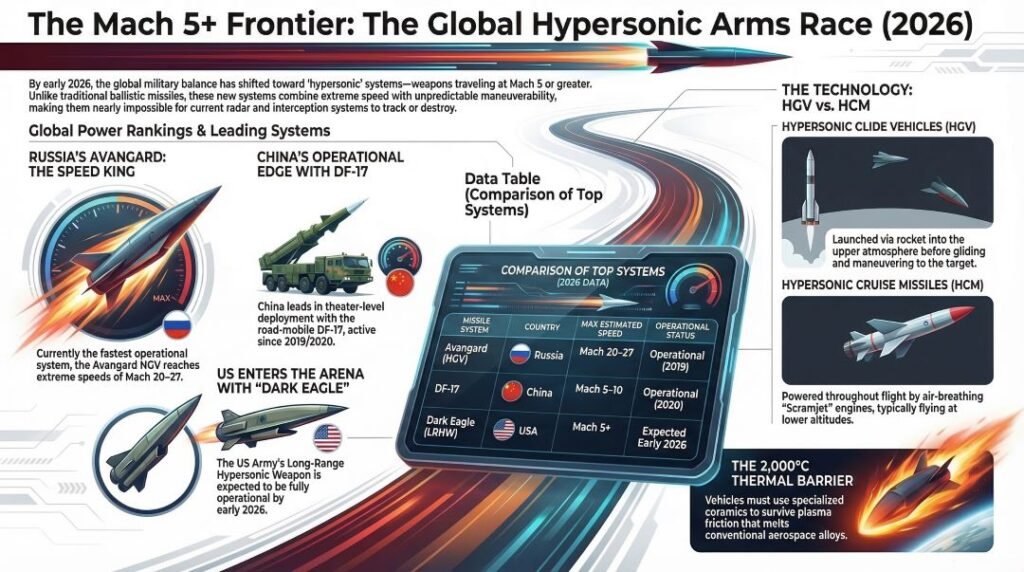
Top 10 Fastest Missiles in the World 2026 with PDF, PPT and Infographic: Complete Guide with Speed, Cost, Hidden Tech & Global Rivalry so, In 2026, the global race for missile supremacy is defined by hypersonic technology – where weapons travel at five times the speed of sound (Mach 5) or faster. Russia, China, and the United States currently lead the rankings with Intercontinental Ballistic Missiles (ICBMs) and Hypersonic Glide Vehicles (HGVs) that reach extreme velocities during reentry or cruise phases.
Table of Contents
This is the most complete guide you will find on the top 10 fastest missiles in the world 2026. We cover verified speed rankings, hidden technical features, production costs, export status, side-by-side comparisons, and the global missile rivalry that defines modern geopolitics.
How Are the Fastest Missiles Ranked? (Methodology)
Speed is complex in missile technology because it varies depending on the phase of flight. Rankings are based on two criteria:
- Maximum Sustained Velocity: The highest speed a missile maintains during its operational flight phase.
- Terminal Reentry Speed: The speed at which ballistic missiles fall back toward Earth from space – this is when ICBMs reach their fastest point.
- Operational Status Only: This list includes only missiles that are currently deployed or in active service as of 2026. Experimental programs like the U.S. Dark Eagle or India’s Project Vishnu are excluded until they reach full operational capacity.
Top 10 Fastest Missiles in the World 2026 – Master Ranking Table
The following table combines verified data from the U.S. Department of Defense (DoD) and the Stockholm International Peace Research Institute (SIPRI). It ranks missiles by their maximum speed (Mach) as of March 2026.
| Rank | Missile | Country | Type | Max Speed (Mach) | Speed (km/h approx.) |
| 1 | Avangard | Russia | Hypersonic Glide Vehicle (HGV) | Mach 20–27 | 32,200+ |
| 2 | DF-41 | China | ICBM (Ballistic) | Mach 25 | 30,600 |
| 3 | Trident II D5 | USA / UK | SLBM (Sub-Launched Ballistic) | Mach 24 | 29,600 |
| 4 | Agni-V | India | ICBM (Ballistic) | Mach 24 | 29,400 |
| 5 | LGM-30 Minuteman III | USA | ICBM (Ballistic) | Mach 23 | 28,200 |
| 6 | RS-28 Sarmat | Russia | ICBM (Ballistic) | Mach 20.6 | 25,500 |
| 7 | Hwasong-17 | North Korea | ICBM (Ballistic) | Mach 20+ | 24,500+ |
| 8 | Kinzhal (Kh-47M2) | Russia | Air-Launched Ballistic | Mach 10–12 | 14,700 |
| 9 | DF-17 | China | Hypersonic Glide Vehicle (HGV) | Mach 10+ | 12,300 |
| 10 | 3M22 Zircon | Russia | Hypersonic Cruise Missile | Mach 8–9 | 11,000 |
Understanding the Two Types of Speed in This Ranking
- Terminal Velocity (ICBMs): Missiles like Trident II D5 and Agni-V achieve their maximum speeds of Mach 24 ONLY as they reenter the atmosphere from space. Gravity accelerates them to ‘cosmic speeds’ as they fall back to Earth.
- Sustained Cruise Speed (Hypersonics): The 3M22 Zircon is the world’s fastest cruise missile, maintaining Mach 8–9 throughout its entire flight using a scramjet engine – a much harder engineering feat than free-falling from space.
Top 10 Fastest Missiles in the World 2026 (PPT SLIDES)
Individual Missile Profiles: Speed, Power & What Makes Each Unique
#1. Avangard (Russia) – Mach 27 | The Fastest Missile in the World 2026
The Avangard is Russia’s hypersonic glide vehicle and holds the undisputed title of the fastest missile in the world in 2026. It is ranked #1 not just because of its raw speed but because it combines the initial boost of a rocket with the ability to ‘glide’ at near-orbital speeds (Mach 27) while still being able to maneuver – making it faster and more unpredictable than any standard ballistic warhead.
- Speed: Mach 20–27 (officially verified at Mach 20 in tests; Russian claims reach Mach 27)
- Speed in km/h: 32,200+ km/h
- Range: Intercontinental (6,000+ km)
- Country: Russia
- Type: Hypersonic Glide Vehicle (HGV)
- Entered Service: 2019
- Hidden Tech – Plasma Shielding: At Mach 27, it creates a layer of plasma that absorbs radio waves, making it nearly invisible to radar. No current defense system can reliably intercept a Mach 27 glider.
#2. DF-41 / Dongfeng-41 (China) – Mach 25 | China’s ICBM with 10 Warheads
The DF-41 is the fastest ballistic missile in the world – an ICBM that reaches Mach 25 during its terminal reentry phase as it falls back from space. China is rapidly expanding its DF-41 silo infrastructure, with hundreds of new silos identified in western deserts, aiming to achieve parity with the US and Russia.
- Speed: Mach 25 (30,600 km/h)
- Range: 12,000–15,000 km
- Country: China
- Type: ICBM (Ballistic)
- Payload: Up to 10 independent MIRV warheads, each traveling in different directions to overwhelm defenses
- Hidden Tech – MIRV Saturation: Can carry up to 10 independent warheads, each traveling at Mach 25 in different directions, designed to overwhelm any missile defense system simultaneously.
#3. Trident II D5 (USA / UK) – Mach 24 | The Submarine-Launched Speed King
The Trident II D5 is a submarine-launched ballistic missile (SLBM) that ranks in the top 3 fastest missiles in the world. What makes it strategically dominant is not just speed – it wins on stealth because it is hidden underwater in nuclear submarines that can silently patrol undetected for months.
- Speed: Mach 24 (29,600 km/h)
- Range: 12,000 km
- Country: USA / UK
- Type: SLBM (Sub-Launched Ballistic)
- Payload: Up to 8–12 MIRVed nuclear warheads
- Hidden Tech – Cold Launch System: It is ejected by steam pressure before the engine ignites, preventing the submarine from being detected by the launch heat. The sub fires the missile and dives away before anyone can locate it.
#4. Agni-V (India) – Mach 24 | India’s Fastest and Most Powerful Operational Missile
The Agni-V is India’s premier ICBM and the fastest missile of India in active operational service. With a canister-launch system and solid-fuel propulsion, it can be stored for years in a tunnel or forest and launched within minutes from a mobile truck – making it incredibly hard to detect and destroy preemptively.
- Speed: Mach 24 (29,400 km/h during reentry)
- Range: 5,000–8,000 km
- Country: India
- Type: ICBM (Ballistic)
- Is Agni faster than BrahMos? Yes – Agni-V reaches Mach 24 vs BrahMos at Mach 3. However, they are entirely different weapon types. Agni is a strategic ballistic missile; BrahMos is a precision cruise missile.
- Hidden Tech – Canister Launch: It is hermetically sealed in a tube, allowing it to be stored for years and launched from a mobile truck in minutes. No need for a fixed silo – it can be hidden in a forest or tunnel.
#5. LGM-30G Minuteman III (USA) – Mach 23 | America’s Land-Based Nuclear Backbone
The Minuteman III is the United States’ primary land-based ICBM. Despite being decades old, it remains one of the fastest ballistic missiles in the world. Its older analog electronics – while appearing outdated – are actually more resistant to modern electronic warfare (EW) attacks and EMPs than newer digital systems.
- Speed: Mach 23 (28,200 km/h)
- Range: 13,000+ km
- Country: USA
- Type: ICBM (Ballistic)
- Status: Being replaced by LGM-35A Sentinel; still fully active as of 2026
- Hidden Tech – Analog Hardening: Uses older, ‘simple’ electronics that are ironically more resistant to modern Electronic Warfare (EW) and EMPs than newer digital guidance systems.
#6. RS-28 Sarmat (Russia) – Mach 20.6 | Russia’s ‘Satan II’ ICBM
The RS-28 Sarmat, nicknamed ‘Satan II’ by NATO, is Russia’s most modern ICBM and a direct replacement for the Cold War-era R-36M. What makes the Sarmat uniquely terrifying is its South Pole flight path – it is designed to fly over the South Pole instead of the North, bypassing the majority of U.S. early-warning sensors that are oriented toward the Arctic.
- Speed: Mach 20.6 (25,500 km/h)
- Range: 18,000+ km (effectively unlimited – can reach any target on Earth)
- Country: Russia
- Type: ICBM (Ballistic)
- Cost: $50M–$70M per unit | $4M–$6M annual maintenance
- Production Time: 24+ months | Export Status: Banned
- Hidden Tech – South Pole Flight: Designed to fly over the South Pole instead of the North, bypassing the majority of U.S. early-warning sensors. Russia’s ‘Fractional Orbital’ path avoids most US sensors.
#7. Hwasong-17 (North Korea) – Mach 20+ | The World’s Largest Road-Mobile ICBM
North Korea’s Hwasong-17 shocked the world when tested in 2022, demonstrating that North Korea had achieved true ICBM capability capable of reaching any point in the United States. Despite being massive, it uses a high-energy liquid fuel that allows it to be moved on a 22-wheel transporter.
- Speed: Mach 20+ (24,500+ km/h)
- Range: 15,000+ km
- Country: North Korea
- Type: ICBM (Ballistic)
- Production: Produced entirely in-house via state-run labs; no international market
- Hidden Tech – Liquid-Fuel Mobility: Despite being massive, it uses a high-energy liquid fuel that allows it to be moved on a 22-wheel transporter. Its sheer size forces adversaries to consider multiple launch locations.
#8. Kinzhal / Kh-47M2 (Russia) – Mach 10–12 | Russia’s Air-Launched Hypersonic Dagger
The Kinzhal (meaning ‘Dagger’) is Russia’s air-launched hypersonic ballistic missile and one of the most tactically deployed fast missiles in the world. Its unique ‘secret’ is that it uses the speed of its launch aircraft – the MiG-31K – as a ‘first stage’ to reach hypersonic velocity almost instantly after launch.
- Speed: Mach 10–12 (14,700 km/h)
- Range: 2,000+ km
- Country: Russia
- Type: Air-Launched Ballistic Missile
- Cost: $10M–$15M per unit
- Can it be intercepted? Patriot PAC-3 MSE has been proven to intercept Kinzhals in recent high-intensity conflicts. The Patriot system is the most effective countermeasure available as of 2026.
- Hidden Tech – MiG-31 Integration: It uses the speed of the MiG-31K jet as a ‘first stage’ to reach hypersonic velocity instantly. The aircraft itself becomes part of the weapon system.
#9. DF-17 (China) – Mach 10+ | China’s Low-Flying Radar Evader
The DF-17 is China’s primary dedicated hypersonic glide vehicle (HGV) for tactical and theater-level operations. Unlike ICBMs that go to space, the DF-17 ‘skips’ along the upper atmosphere to stay below most radar horizons – making it incredibly difficult to detect in time to intercept.
- Speed: Mach 10+ (12,300 km/h)
- Range: 1,800–2,500 km
- Country: China
- Type: Hypersonic Glide Vehicle (HGV)
- US Counter: The U.S. Dark Eagle (LRHW) is the direct American answer to the DF-17 – similar tactical speed, but with superior guidance systems.
- Hidden Tech – Low Altitude Skip: Unlike ICBMs that go to space, this skips along the upper atmosphere to stay below most radar horizons. China considers it a possible future export for strategic partners.
#10. 3M22 Zircon (Russia) – Mach 8–9 | World’s Fastest Cruise Missile
The 3M22 Zircon (Tsirkon) holds the title of the world’s fastest cruise missile in sustained flight. What makes Zircon extraordinary is that it maintains Mach 8–9 throughout its entire flight path using a scramjet engine – it breathes air like a jet engine at hypersonic speed. Russia intends to export downgraded variants, with production scaled up through 2026.
- Speed: Mach 8–9 (11,000 km/h) – sustained throughout flight
- Range: 1,000 km
- Country: Russia
- Type: Hypersonic Cruise Missile
- Cost: $5M–$10M per unit | Export Status: Expected (downgraded variants)
- Hidden Tech – Scramjet Cooling: Uses its own fuel to cool the engine parts before combustion, preventing the missile from melting at Mach 9. The only sea-skimming Mach 9 cruise missile currently operational.
Hidden Features & Tactical Facts Table: The Secret Tech Behind Each Missile
While technical specs are public, the ‘hidden’ aspects involve the physics of how these missiles survive such speeds and the strategic gaps they exploit. This table reveals the secret technology behind each of the top-ranked missiles in 2026.
| Missile | Hidden Feature | The Secret Technology Explained |
| Avangard (Russia) | Plasma Shielding | At Mach 27, it creates a plasma cloud that absorbs radio waves – making it nearly invisible to radar. No interception system can track it reliably. |
| DF-41 (China) | MIRV Saturation | Carries up to 10 independent warheads traveling at Mach 25 in different directions simultaneously – designed to overwhelm any defense system. |
| Trident II D5 (USA/UK) | Cold Launch System | Ejected by steam pressure before the engine ignites. The submarine is never detected because there is no heat signature at the point of launch. |
| Agni-V (India) | Canister Launch | Hermetically sealed in a tube, stored for years in forests or tunnels, launched from a mobile truck within minutes. No fixed silo needed. |
| Minuteman III (USA) | Analog Hardening | Uses older, ‘simple’ electronics that are ironically more resistant to modern Electronic Warfare (EW) and EMPs than newer digital systems. |
| RS-28 Sarmat (Russia) | South Pole Flight Path | Flies over the South Pole instead of the North – bypassing all U.S. early-warning radars oriented toward the Arctic. A ‘Fractional Orbital’ trajectory that avoids most US sensors. |
| Hwasong-17 (North Korea) | Liquid-Fuel Mobility | Despite its massive size, uses high-energy liquid fuel and a 22-wheel transporter to remain mobile and unpredictable from multiple launch locations. |
| Kinzhal (Russia) | MiG-31 Integration | Uses the MiG-31K aircraft’s speed as a ‘first stage’ to instantly achieve hypersonic velocity. The jet itself becomes part of the weapon system. |
| DF-17 (China) | Low Altitude Skip | Unlike ICBMs that go to space, it skips along the upper atmosphere to stay below most radar horizons – making detection and intercept extremely difficult. |
| 3M22 Zircon (Russia) | Scramjet Cooling | Uses its own fuel to cool engine parts before combustion, preventing the missile from melting at Mach 9. The only sea-skimming Mach 9 cruise missile currently operational. |
How These Hidden Features Change the Rankings
- Maneuverability Over Speed: The DF-17 is ranked lower in raw speed (Mach 10) but is considered ‘deadlier’ than a Mach 23 Minuteman because it can turn mid-flight, while the Minuteman follows a predictable ballistic arc.
- Deployment Speed: The Agni-V ranks high because its canister technology means it doesn’t need a fixed silo – it can be hidden in a forest or tunnel and launched almost instantly.
- The Heat Barrier: At Mach 20+, air friction generates temperatures of 2,000°C or more. The real ranking winner is often the country with the best carbon-carbon composite materials to keep the missile from burning up.
Strategic Missile Economics 2026: Cost, Production Time & Export Status
In 2026, financial and industrial data for the world’s fastest missiles is divided between established ballistic systems (stable, expensive, but large-scale) and emerging hypersonic systems (highly secretive, developmental, and extremely high-cost per unit). The following table reflects 2026 market estimates, defense budget allocations, and verified contract values.
| Missile | Est. Unit Cost | Annual Maintenance (per unit) | Time to Produce | Export Status | Key Buying / Selling Facts |
| Avangard (RUS) | $80M–$100M+ | $5M–$8M | 16–24 months | Banned | Sold only to Russian MoD; top-tier strategic secret – no export possible. |
| DF-41 (CHN) | $20M–$30M | $2M–$3M | 12–15 months | Banned | High production value as the foundation of China’s strategic deterrent. |
| Trident II D5 (USA/UK) | $31M–$37M | $1.5M–$2M | 10–12 months | Limited | Sold to the UK under strict treaties; Lockheed Martin manages all production. |
| Agni-V (IND) | $15M–$20M | $1M–$1.5M | 12–18 months | No | Purely for domestic strategic use; part of India’s self-reliance (Atmanirbhar) push. |
| Minuteman III (USA) | $7M (Legacy) | $2.5M+ | N/A (Legacy) | Banned | Costs are mostly in stockpile stewardship and aging infrastructure management. |
| RS-28 Sarmat (RUS) | $50M–$70M | $4M–$6M | 24+ months | Banned | Replaces older Soviet ICBMs; highly complex multibillion-dollar project. |
| Hwasong-17 (PRK) | Unknown | Unknown | 18–24 months | Banned | Produced entirely in-house via state-run labs; no international market. |
| Kinzhal (RUS) | $10M–$15M | $0.5M | 6–9 months | No | High-cost ‘silver bullet’ used for high-value targets; produced by Rostec. |
| DF-17 (CHN) | $12M–$18M | $1M | 9–12 months | Evaluating | China considers it a tactical weapon; possible future export for strategic partners. |
| 3M22 Zircon (RUS) | $5M–$10M | $0.8M | 8–12 months | Expected | Russia intends to export downgraded variants; production scaled up through 2026. |
Key Production & Market Analysis
- Export Restrictions: Strategic ICBMs (Ranks 1–7) are strictly not for sale under the Missile Technology Control Regime (MTCR). Only tactical variants like the BrahMos (approx. $4M–$5M per unit) are actively sold internationally.
- Maintenance Hidden Cost: Ballistic missiles are cheaper to buy but more expensive to keep. Maintaining a nuclear-hardened silo or a specialized submarine for a Trident II adds roughly $16M–$40M per missile over a 30-year lifespan.
- Production Time: High-end hypersonics like the Avangard or Sarmat require specialized carbon-composite materials that take months to cure, leading to slow production cycles of less than 10–12 units per year.
- Future Trends: By end of 2026, Japan and the U.S. are expected to ramp up hypersonic production funding (billions of dollars) to reduce unit costs through mass manufacturing.
Side-by-Side Comparison: World’s Top Missiles (2026)
This comparison pits the top-tier Strategic Hypersonic Glide Vehicle (Avangard) against the Heavyweight ICBM (DF-41), the Stealthy Submarine Missile (Trident II D5), and the fastest Hypersonic Cruise Missile (3M22 Zircon).
| Feature | Avangard (HGV) | DF-41 (ICBM) | Trident II D5 (SLBM) | 3M22 Zircon (HCM) |
| Primary Owner | Russia | China | USA / UK | Russia |
| Max Speed | Mach 20–27 | Mach 25 | Mach 24 | Mach 8–9 |
| Launch Platform | Silo (boosted by ICBM) | Road-Mobile Truck | Nuclear Submarine | Ship / Submarine |
| Trajectory | Non-ballistic (Skips/Glides) | Ballistic Arc | Ballistic Arc | Low-altitude Cruise |
| Maneuverability | EXTREME – can turn | Low (Predictable) | Low (Predictable) | High (Aerodynamic) |
| Range | Intercontinental (10K+ km) | 12,000–15,000 km | 12,000 km | 1,000 km |
| Payload | Nuclear (2MT) | Up to 10 MIRVs | Up to 8–12 MIRVs | Conventional / Nuclear |
| Est. Unit Cost | $80M–$100M | $20M–$30M | $31M–$37M | $5M–$10M |
| Detection Risk | Low (Plasma Cloak) | High (Heat Signature) | High (During boost) | Very Low (Sea-skimming) |
| Countermeasure | Currently ‘Unstoppable’ | Interceptable (THAAD/SM-3) | Interceptable (GMD) | Difficult (SM-6 Dual II) |
Key Takeaways from the Comparison
- Physics vs. Engine: The Avangard and DF-41 get their speed from gravity and massive rocket boosters. The Zircon uses a scramjet engine to ‘breathe’ air and maintain speed – making it smaller and cheaper but with a much shorter range.
- Survival Strategy: The Trident II D5 wins on stealth (hidden underwater). The DF-41 wins on mobility (hidden in a road-mobile truck). The Avangard wins on evasion (it moves too fast for current interceptors to ‘calculate’ its path).
- Cost Efficiency: To destroy a city across the world, the DF-41 is the ‘cheapest’ per warhead. To sink a carrier group without starting a nuclear war, the Zircon or Kinzhal is the tactical choice.
- The 2026 Gap: By mid-2026, the U.S. Dark Eagle is expected to enter this table, slotting between the DF-17 and Zircon in terms of speed (Mach 5+) but with superior American guidance and GPS-denied navigation technology.
Global Missile Standoff: Top 10 vs. Their Rivals (2026)
To understand the strategic landscape of 2026, we must compare the Top 10 Fastest Missiles (largely held by Russia, China, and India) against the Primary Countermeasures and Rivals developed by the U.S. and its allies (NATO, Japan, Australia).
| Missile (Threat) | Speed | Direct Rival / Countermeasure | Rival Status (2026) | The Strategic Gap |
| 1. Avangard (RUS) | Mach 27 | GPI (Glide Phase Interceptor) | Development (US/Japan) | Unmatched. No current system can reliably intercept a Mach 27 glider. |
| 2. DF-41 (CHN) | Mach 25 | GMD (Ground-based Midcourse) | Operational (USA) | Balanced. GMD can hit ICBMs in space, but DF-41’s 10 warheads can overwhelm it. |
| 3. Trident II D5 (USA) | Mach 24 | S-500 Prometheus | Operational (Russia) | High contest. S-500 is specifically designed to intercept Mach 20+ space-entry targets. |
| 4. Agni-V (IND) | Mach 24 | HQ-19 (China) | Operational (China) | Contested. China’s HQ-19 is the direct answer to India’s high-speed ballistic arc. |
| 5. Minuteman III (USA) | Mach 23 | A-135 / A-235 (Russia) | Operational (Russia) | Legacy. Russia’s Moscow-defense system is built specifically to stop this missile. |
| 6. RS-28 Sarmat (RUS) | Mach 20+ | Next-Gen Interceptor (NGI) | Prototype (USA) | Advantage Russia. Sarmat’s Fractional Orbital path avoids most US sensors. |
| 7. Hwasong-17 (PRK) | Mach 20+ | THAAD / SM-3 Block IIA | Operational (USA/Japan) | Contested. US interceptors are faster (Mach 10+), but North Korea uses ‘lofted’ trajectories. |
| 8. Kinzhal (RUS) | Mach 12 | Patriot PAC-3 MSE | Operational (Global) | Proven. PAC-3 has successfully intercepted Kinzhals in recent high-intensity conflicts. |
| 9. DF-17 (CHN) | Mach 10 | Dark Eagle / LRHW (USA) | Fielding (USA) | Parity. Dark Eagle is the US answer to DF-17 – similar speed, with superior guidance. |
| 10. 3M22 Zircon (RUS) | Mach 9 | Aegis / SM-6 Dual II | Operational (US Navy) | Tough. SM-6 is the only interceptor fast enough to chase a sea-skimming Mach 9 cruise. |
Strategic Analysis of the Global Rivalry
- The Interceptor Lag: In 2026, offense is faster than defense. It is significantly cheaper and easier to make a missile go Mach 20 (Avangard) than it is to build a computer and interceptor (GPI) that can hit it.
- The US Advantage – Quantity over Raw Speed: While the US only occupies two spots in the Top 10 Speed list, they lead in Networked Defense. Systems like the Integrated Battle Command System (IBCS) allow different radars to share data to ‘track’ a hypersonic missile even if they can’t directly ‘see’ it clearly.
- The Indo-Pacific Duel: The DF-17 vs. the Dark Eagle is the most critical rivalry of 2026. Both are ‘tactical hypersonics’ – meant to sink ships and hit bases, not carry nuclear bombs.
- The Scramjet Race: Australia and the US (under the HIFiRE program) are building missiles that may be slower than the Top 10 (Mach 5–7) but have longer ranges and much better accuracy than the Russian Zircon.
Strategic Launch Platforms & Inventory 2026 (Estimated)
In 2026, the global balance of power is defined by the Strategic Triad (Land, Sea, and Air). While speed is a key metric, the actual number of launch platforms determines a nation’s ability to survive a first strike and retaliate.
| Country | ICBM Silos & Mobile Launchers | Strategic Submarines (SSBNs) | SLBM Tubes | Key Modern Systems in Inventory |
| Russia | ~306–310 (Silo & Road-Mobile) | 12–13 (Borei & Delta-IV) | ~192 | Sarmat, Avangard, Yars |
| USA | ~400 (Silos) | 14 (Ohio-class) | ~240 (Deployed) | Minuteman III, Trident II (DSLE) |
| China | ~350–400+ (Rapidly expanding) | 6–8 (Jin-class/Type 094) | ~72–96 | DF-41, DF-17, JL-2/3 |
| India | ~25–50 (Road-Mobile) | 3–4 (Arihant-class) | ~12–24 | Agni-V, K-4 (SLBM) |
| N. Korea | ~20–30 (Road-Mobile/Rail) | 1–2 (Experimental) | ~5–4 | Hwasong-17, Hwasong-18 |
Critical Data Points for 2026
- Silo Expansion: China has significantly increased its land-based strength, with hundreds of new DF-41 silos identified in the western deserts, aiming to achieve parity with the US and Russia.
- The Submarine Edge: The US remains the leader in sea-based deterrence. It has 14 SSBNs, though at least two are in overhaul at any given time, leaving a consistent force of around 240 Trident II missiles ready for immediate launch.
- Russia’s Heavy Lift: Russia maintains the largest number of individual ICBM systems, with the RS-28 Sarmat acting as the ‘heavy’ pillar capable of carrying multiple Avangard hypersonic gliders per rocket.
- India’s Maritime Leap: 2026 is a defining year for India, which is commissioning 19 new warships and integrating the Aridhaman (S3) nuclear submarine into its Strategic Forces Command to strengthen its ‘Second Strike’ capability.
- Treaty Status: As of February 2026, the New START treaty between the US and Russia has officially expired, leading to increased uncertainty regarding the exact limits of future strategic deployments.
Also read: Top 10 Cluster Bombs in the World (.PPTX)
FAQs
Which is the top 5 fastest missile in the world in 2026?
The top 5 fastest missiles in the world in 2026 are: (1) Avangard at Mach 27, (2) DF-41 at Mach 25, (3) Trident II D5 at Mach 24, (4) Agni-V at Mach 24, and (5) Minuteman III at Mach 23. The Avangard is the undisputed number one.
What is the fastest missile in the world?
Russia’s Avangard hypersonic glide vehicle is the fastest missile in the world at Mach 20–27 (32,200+ km/h). It is also the most maneuverable at that speed, combining extreme velocity with the ability to change direction mid-flight.
Is BrahMos the fastest missile in the world?
BrahMos is the fastest cruise missile in the world at Mach 3. However, it is not the fastest missile overall. The Avangard at Mach 27, DF-41 at Mach 25, and even the Kinzhal at Mach 10–12 all far exceed BrahMos in speed. BrahMos-II, the hypersonic successor, targets Mach 7–8 when operational.
Is Agni faster than BrahMos?
Yes. The Agni-V reaches Mach 24 during reentry – significantly faster than BrahMos at Mach 3. However, these are entirely different weapon categories. Agni is a strategic ballistic ICBM; BrahMos is a precision cruise missile. Agni wins on peak speed; BrahMos wins on precision targeting and maneuverability.
What is the fastest missile of India in 2026?
The fastest missile of India in 2026 is the Agni-V at Mach 24 (operational ICBM). The Agni-VI under development may push that further. Among cruise missiles, BrahMos at Mach 3 is the fastest operational cruise missile of India, with BrahMos-II (hypersonic variant) in development.
Which missile has a 2000 km range?
Several missiles in this list have a 2,000 km range or more. Russia’s Kinzhal has 2,000+ km range. Pakistan’s Shaheen-3 has 2,750 km. India’s Agni-III covers 3,000 km. China’s DF-41 far exceeds this at 12,000–15,000 km. The 3M22 Zircon covers 1,000 km as a cruise missile.
What is Avangard missile speed?
The Avangard missile speed is Mach 20–27, equivalent to approximately 32,200+ km/h or over 20,000 mph. At this velocity, the missile completes intercontinental distances in under 15–20 minutes. Russia entered it into active duty in 2019, carried on heavy ICBMs like the Sarmat.
Can Shaheen-3 be intercepted by S-400?
The S-400 is designed to engage targets at speeds up to Mach 14 across different altitude bands. Pakistan’s Shaheen-3 travels at estimated Mach 18+ at reentry, which technically challenges the S-400’s interception envelope. Most analysts agree interception would be extremely difficult but not entirely impossible under ideal engagement geometry. India’s S-500 (being acquired) would have a better capability against such threats.
Conclusion:
In 2026, the race to build the fastest missile in the world has entered its most competitive phase. Russia leads with the Avangard at Mach 27+ – a weapon no current system can reliably stop. China is close behind with the DF-41 and expanding its arsenal rapidly. India is emerging as a serious player with the Agni-V and BrahMos – the fastest cruise missile in the world.
What this analysis reveals is that raw speed is only one dimension of missile superiority. Maneuverability, stealth, payload capacity, launch platform diversity, and the ability to overwhelm defenses with multiple warheads are equally – sometimes more – important.
For defense analysts, policymakers, and informed citizens, understanding the top 10 fastest missiles in the world 2026 list is essential to understanding the geopolitical stakes of the modern era. Bookmark this guide as your definitive reference on the fastest ballistic missile, fastest cruise missile, fastest hypersonic missile, and top 10 missiles country in the world for 2026.
Disclaimer: All speed, cost and inventory figures are sourced from publicly available data from the U.S. Department of Defense (DoD), SIPRI Yearbooks, Ground Zero Defence Academy, and verified defense research publications (March 2026). Classified specifications may differ. This article is for educational and informational purposes only.