
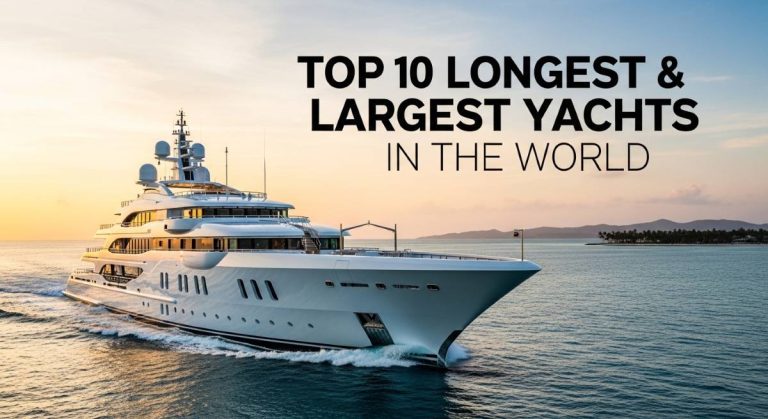
In this article we will discuss about the Top 10 Longest and Largest Yachts in the World 2026 with PPT, PDF and infographics for better understanding the Ranking so, From Floating Palaces to Research Vessels – The Most Magnificent Mega Yachts Ever Built, The world’s largest yachts represent the absolute pinnacle of naval engineering, luxury craftsmanship, and unlimited wealth. These floating palaces-some stretching longer than 2 football fields placed end-to-end-blur the boundary between private yacht and cruise liner, incorporating amenities that range from submarine docking bays and helipads to concert halls, research laboratories, and even missile defense systems. Built by the world’s most prestigious shipyards in Germany, Italy, Norway, and Denmark, these mega yachts or Superyachts cost hundreds of millions-and in some cases, close to a billion dollars-to construct.
Table of Contents
This comprehensive guide examines the ten longest and largest yachts ever built, ranked by length. For each vessel, we provide complete technical specifications, construction details, ownership history, estimated costs, unique features, and the story behind why each yacht earned its place in maritime history. From traditional royal yachts serving Middle Eastern monarchies to cutting-edge research vessels dedicated to ocean conservation, these ships showcase the extraordinary diversity of purpose, design, and ambition in the modern superyacht industry.
Whether you’re a yacht enthusiast, maritime history buff, or simply fascinated by extreme luxury and engineering achievement, this guide provides the most detailed analysis available of the world’s most spectacular mega yachts.
Note: Yacht specifications are compiled from superyacht industry publications including SuperYacht Times, Boat International, BOAT Pro, yacht builder official specifications, and maritime registry data. Ownership details reflect publicly available information; many yacht owners value privacy and ownership is often held through corporate entities. Construction costs are estimates based on industry sources and may not reflect final actual expenditure. Lengths are measured LOA (Length Overall). Gross Tonnage (GT) is a measure of internal volume, not weight.
Understanding Megayacht, Superyacht Scale: What Makes a Yacht ‘Large’?
Before examining the specific vessels, understanding the metrics and context of superyacht scale provides essential perspective.
Length Overall (LOA):
The primary measurement used to rank yachts is Length Overall-the maximum length of the hull measured from the forward-most point to the aft-most point, including any fixed extensions. In the superyacht industry, vessels over 24 metres (80 feet) are typically classified as superyachts. Mega yachts are those exceeding 60 metres (200 feet). The yachts on this list range from 147 metres to 222 metres-placing them in an ultra-exclusive category where only a few dozen vessels worldwide exist.
Gross Tonnage (GT):
Gross Tonnage measures the internal volume of a vessel-not its weight despite the name. It is calculated based on the total enclosed space within the hull and superstructure. A higher GT indicates more interior volume for cabins, lounges, machinery spaces, and amenities. The yachts on this list range from approximately 13,000 GT to an extraordinary 33,500 GT. For comparison, many small cruise ships have GT ratings between 20,000-40,000 GT.
Construction Complexity:
Building a yacht over 150 metres requires years of engineering, thousands of skilled workers, and collaboration between the owner’s representatives, naval architects, exterior designers, interior designers, and the shipyard. Steel or aluminium hulls must be fabricated to tolerances measured in millimeters. Advanced stabilisation systems, propulsion configurations, wastewater treatment, and satellite communications all require integration. The construction timeline for yachts on this list ranged from three to six years in most cases.
Operating Costs:
While construction costs for these yachts range from $350 million to over $700 million, annual operating costs are equally staggering. Industry estimates suggest annual running costs approximate 10% of the yacht’s value. This includes crew salaries (mega yachts employ 50-100+ crew members), fuel (thousands of litres per day at sea), maintenance, insurance, docking fees at exclusive marinas, and refit costs. For a $600 million yacht, annual operating expenses can exceed $60 million.
With that context established, let us examine each of the ten longest yachts ever constructed.
Top 10 Longest and largest Yachts in the world 2026 (.PPTX) | PPT SLIDES
#10. Prince Abdulaziz – Saudi Arabia’s Legendary Royal Yacht (147 Metres)
The Prince Abdulaziz holds special significance as one of the pioneering mega yachts that defined what was possible in private yacht construction. For over two decades after her launch, she ranked among the largest yachts in the world, serving as the flagship for the Saudi royal family and hosting countless state functions, diplomatic meetings, and royal gatherings.
Complete Specifications:
- Length Overall (LOA): 147 metres (482 feet)
- Builder: Helsingør Værft A/S, Helsingør, Denmark
- Year launched: 1984
- Original name: Prince Abdulaziz (unchanged since delivery)
- Owner: Saudi Royal Family
- Gross Tonnage: Approximately 5,360 GT (estimates vary due to age of vessel)
- Top speed: 22 knots
- Cruising speed: 18 knots
- Propulsion: Twin diesel engines
- Construction cost: $180 million (1984) – equivalent to approximately $520 million in 2024 values
- Exterior designer: Maierform Design
- Interior designer: David Hicks (late British interior designer)
- Guest capacity: 64 guests in 38 cabins
- Crew: 65 crew members
- Hull material: Steel
- Year of construction: 1981–1984 (3 years)
Interior Design and Features:
The late David Hicks-one of Britain’s most celebrated interior designers-created an interior that masterfully blended palatial Arabic styling with Western luxury aesthetics. The yacht features multiple grand salons with soaring ceilings, intricate Islamic geometric patterns in marble floors and wall panels, crystal chandeliers, and furniture combining European craftsmanship with Middle Eastern design sensibilities.
The vessel includes a fully equipped cinema with theatre-style seating, multiple formal and informal dining areas capable of hosting large state dinners, private royal apartments with separate sleeping quarters and offices, and extensive deck spaces designed for outdoor entertaining in the warm climates where the yacht typically operates-the Red Sea, Mediterranean, and occasionally the Atlantic.
Security and Military Features:
Given her royal ownership and the security concerns inherent in state vessels, the Prince Abdulaziz reportedly incorporates advanced security features unusual for civilian yachts. Reports have suggested the inclusion of an underwater missile defense system-detection equipment capable of identifying approaching threats such as torpedoes or underwater vehicles. While these systems have never been officially confirmed, multiple industry sources have referenced their existence over the decades.
Historical Significance:
When launched in 1984, the Prince Abdulaziz was the largest private yacht in the world, holding that title until the arrival of larger vessels in the 1990s and 2000s. Her construction by a Danish yard-rather than the German or Italian yards that would come to dominate the mega yacht market-reflects the different industry landscape of the early 1980s when such enormous private vessels were exceptionally rare.
The yacht has hosted numerous historically significant meetings and gatherings over her four decades of service. She represents a transitional vessel between the traditional royal yachts of European monarchies (which were often retired by the 1980s due to cost) and the modern era of privately owned mega yachts built for Middle Eastern royal families and billionaires.
Why She Makes the List: At 147 metres, Prince Abdulaziz established the template for royal mega yachts and served as the largest private yacht in the world for years. Her longevity-still in service after 40 years-demonstrates exceptional build quality and maintenance.
#9. Al Said – Oman’s Royal Flagship (155 Metres)
The Al Said represents the Sultanate of Oman’s prestige on the high seas. Commissioned by the late Sultan Qaboos bin Said al Said, who ruled Oman from 1970 until his death in 2020, this magnificent vessel served as both a working royal yacht for state functions and a symbol of Oman’s emergence as a stable, prosperous nation under his modernizing leadership.
Complete Specifications:
- Length Overall (LOA): 155 metres (508.5 feet)
- Builder: Lürssen Yachts, Bremen, Germany
- Year delivered: 2008 (launched 2007)
- Owner: Sultanate of Oman (royal fleet)
- Gross Tonnage: 15,850 GT – among the most voluminous private yachts ever built
- Top speed: 25 knots – exceptional for a vessel of this size
- Cruising speed: 21 knots
- Range: Approximately 7,500 nautical miles at cruising speed
- Propulsion: Twin MTU diesel engines
- Exterior designer: Espen Øino Naval Architects
- Interior designer: Redman Whiteley Dixon Design
- Guest capacity: Up to 70 guests
- Crew: 154 crew members – one of the largest crew complements on any private yacht
- Construction cost: Estimated $600 million
- Hull material: Steel hull with aluminium superstructure
- Notable feature: Concert hall capable of accommodating a 50-piece orchestra
Design Philosophy – Understated Elegance:
Unlike some mega yachts that make bold visual statements through aggressive styling or dramatic architectural elements, Al Said pursues understated elegance. Her exterior profile is classic and refined-a white hull with graceful lines and proportions that prioritise timelessness over trendiness. This design approach reflects Omani cultural values that favour sophistication and discretion over overt displays.
The yacht’s substantial beam (width) of 24 metres creates enormous interior volume, allowing for exceptionally spacious public areas and guest accommodations. The interior design by Redman Whiteley Dixon incorporates both Western luxury materials-Italian marble, rare woods, precious metals-and design elements reflecting Omani heritage and Islamic artistic traditions.
The Concert Hall:
Al Said’s most distinctive feature is her concert hall, designed to accommodate a full 50-piece orchestra. Sultan Qaboos was a passionate patron of classical music and commissioned this space specifically to host musical performances at sea. The hall features professional-grade acoustics, tiered seating for audience members, and stage facilities comparable to land-based concert venues. This amenity is essentially unique among private yachts-while some yachts have screening rooms or small performance spaces, a full orchestral concert hall is unparalleled.
Operational History:
The Al Said has maintained a relatively low profile throughout her operational life, consistent with the Omani royal family’s preference for privacy. She is typically stationed in Muscat, Oman, and undertakes cruises in the Arabian Gulf, Indian Ocean, and Mediterranean. The yacht has hosted numerous state visits and diplomatic meetings, serving as a venue where Sultan Qaboos met with foreign leaders in an environment blending formality with hospitality.
Following Sultan Qaboos’s death in 2020, the yacht transitioned to the new Sultan, Haitham bin Tarik al Said, and continues to serve as Oman’s primary royal yacht.
Why She Makes the List: At 155 metres and over 15,850 GT, Al Said ranks among the most voluminous yachts ever built. Her unique concert hall, extraordinary crew complement, and 25-knot top speed make her one of the most capable royal yachts afloat.
#8. Dilbar – Record-Setting Internal Volume (156 Metres)
The Dilbar holds a remarkable distinction: while she is the eighth-longest yacht in the world at 156 metres, she holds the record for the largest yacht in the world by gross tonnage at 15,917 GT. This means Dilbar has more internal volume than any other private yacht-including vessels that are longer. Her extraordinary beam (width) of 23.5 metres creates unprecedented space for amenities and accommodations.
Complete Specifications:
- Length Overall (LOA): 156 metres (511.8 feet)
- Beam (width): 23.5 metres (77.1 feet) – among the widest yachts afloat
- Gross Tonnage: 15,917 GT – largest in the world by internal volume
- Builder: Lürssen Yachts, Bremen, Germany
- Year delivered: 2016 (launched 2015)
- Owner: Alisher Usmanov (Uzbek-Russian billionaire)
- Construction cost: Estimated $600-800 million – one of the most expensive private yachts ever built
- Top speed: 22.5 knots
- Cruising speed: 18 knots
- Range: 6,000 nautical miles at cruising speed
- Propulsion: Diesel-electric hybrid system – two diesel generators plus electric motors
- Exterior designer: Espen Øino International
- Interior designer: Winch Design, London
- Guest capacity: 24 guests in 12 cabins
- Crew: 80+ crew members
- Hull material: Steel hull, aluminium superstructure
- Notable features: 25-metre swimming pool (largest ever installed on a yacht), two helipads, submarine
The Record-Breaking Swimming Pool:
Dilbar’s most famous feature is her 25-metre swimming pool-the largest ever installed on a private yacht. For context, Olympic swimming pools are 50 metres long; Dilbar’s pool is half that length but still requires an enormous deck space and structural engineering to support the weight of hundreds of tons of water plus the pool structure itself. The pool reportedly features a current generation system allowing swimmers to swim against resistance, effectively creating an endless swimming experience.
The pool’s location on an upper aft deck provides panoramic views while swimming, and the surrounding deck space includes lounging areas, bars, and sun beds creating a resort-style pool club atmosphere.
Diesel-Electric Propulsion:
Dilbar uses a diesel-electric propulsion system rather than traditional diesel engines directly driving propellers. In this configuration, diesel generators produce electricity, which then powers electric motors that turn the propellers. This arrangement provides several advantages: quieter operation (the generators can be located away from guest areas and mounted on vibration-dampening systems), more efficient power management (generators operate at optimal RPM regardless of ship speed), and the ability to easily integrate additional power sources in the future if desired.
Interior Design by Winch Design:
Winch Design of London-one of the superyacht industry’s most prestigious design houses-created Dilbar’s interior. The design philosophy emphasises luxurious but restrained elegance rather than ostentatious excess. Natural materials including rare woods, stone, and fine fabrics create warm, inviting spaces. The yacht’s exceptional beam width allowed Winch to design unusually spacious cabins and social areas with proportions more commonly found in hotels than yachts.
Operational Profile:
Dilbar is frequently spotted cruising the Mediterranean, particularly in popular superyacht destinations including Monaco during the Monaco Grand Prix and Yacht Show, the Spanish Balearic Islands, and the French Riviera. Her size limits which ports she can enter-only the largest marinas and commercial harbors can accommodate her draft and length-but this also enhances her exclusivity.
Why She Makes the List: Dilbar’s 15,917 GT makes her the largest yacht in the world by volume despite being eighth in length. Her record-setting 25-metre pool and diesel-electric propulsion showcase advanced engineering applied to extreme luxury.
#7. Blue – Eco-Conscious Luxury at (160 Metres)
The Blue represents the next generation of superyacht design where environmental sustainability and operational efficiency are treated as design priorities equal to luxury and performance. Delivered in 2022, Blue incorporates hybrid propulsion technology and dual-fuel capability that significantly reduce emissions compared to traditional diesel-only mega yachts.
Complete Specifications:
- Length Overall (LOA): 160 metres (524.9 feet)
- Gross Tonnage: 14,785 GT
- Builder: Lürssen Yachts, Bremen, Germany
- Year delivered: 2022
- Owner: Believed to be Sheikh Mansour bin Zayed Al Nahyan, Deputy Prime Minister of UAE
- Construction cost: Estimated $600 million
- Top speed: 20 knots
- Cruising speed: 15 knots (optimised for efficiency)
- Range: 8,500 nautical miles – exceptional endurance for global cruising
- Propulsion: Hybrid diesel-electric with dual-fuel capability (diesel/LNG)
- Exterior designer: Espen Øino International
- Interior designer: Terence Disdale Design
- Guest capacity: Up to 24 guests
- Crew: Approximately 70 crew
- Hull material: Steel
- Environmental features: LNG fuel capability, advanced wastewater treatment, selective catalytic reduction (SCR) exhaust cleaning
Hybrid and Dual-Fuel Propulsion:
Blue’s propulsion system represents one of the most advanced installations on any private yacht. The dual-fuel capability allows the yacht to operate on either conventional marine diesel or liquefied natural gas (LNG). LNG combustion produces approximately 20-25% less CO2 than diesel, eliminates sulfur oxide (SOx) emissions almost entirely, and dramatically reduces nitrogen oxide (NOx) and particulate matter.
The hybrid configuration includes battery banks that can power the yacht for short periods without running generators, enabling silent operation while at anchor and reducing fuel consumption during low-speed manoeuvring in harbors. The system also captures waste heat from generators to improve overall energy efficiency.
Regulatory Compliance and Future-Proofing:
Increasingly stringent environmental regulations are being applied to superyacht operations, particularly in environmentally sensitive areas like the Mediterranean and Northern Europe. Blue’s design anticipates these regulations, ensuring the yacht can operate worldwide without restrictions. The selective catalytic reduction (SCR) system treats exhaust gases to reduce NOx emissions to levels meeting the most stringent current and anticipated future standards.
Terence Disdale Interior Design:
The late Terence Disdale-one of the superyacht industry’s most respected interior designers who passed away in 2023-designed Blue’s interior. Disdale’s approach emphasised timeless elegance, exceptional craftsmanship, and the creation of spaces that feel warm and inviting rather than cold and formal. His portfolio included many of the world’s most significant yachts, and Blue represents one of his final projects.
Why Eco-Conscious Yachts Matter:
The superyacht industry has faced increasing scrutiny regarding the environmental impact of operating vessels that consume thousands of litres of fuel per day. Yachts like Blue demonstrate that it is technically feasible to dramatically reduce emissions through hybrid-electric propulsion, alternative fuels, and efficiency optimization. While a 160-metre yacht will never be environmentally neutral, reducing emissions by 30-40% through better technology represents meaningful progress.
Why She Makes the List: At 160 metres, Blue showcases that environmental sustainability and luxury need not conflict. Her hybrid propulsion and dual-fuel capability make her one of the most technologically advanced and eco-conscious mega yachts ever built.
#6. Dubai – The Ruler’s Jewel (162 Metres)
The Dubai yacht holds special significance as a vessel completed in the United Arab Emirates rather than at a European shipyard. Originally begun by Blohm+Voss in Germany, the project was completed by Platinum Yachts in Dubai-making her a symbol of the UAE’s growing capabilities in advanced maritime engineering and luxury yacht construction.
Complete Specifications:
- Length Overall (LOA): 162 metres (531.5 feet)
- Gross Tonnage: 13,470 GT
- Original builder: Blohm+Voss, Hamburg, Germany (hull construction)
- Completion: Platinum Yachts, Dubai, UAE (outfitting and completion)
- Year delivered: 2006
- Owner: Sheikh Mohammed bin Rashid Al Maktoum, Prime Minister of UAE and Ruler of Dubai
- Construction cost: Estimated $400 million
- Top speed: 26 knots – exceptionally fast for her size
- Cruising speed: 21 knots
- Range: 8,500 nautical miles
- Propulsion: Four MTU diesel engines (total 21,000+ horsepower)
- Exterior designer: Platinum Yachts with Andrew Winch Designs
- Interior designer: Platinum Yachts design team
- Guest capacity: Up to 115 guests
- Crew: 88 crew members
- Hull material: Steel hull, aluminium superstructure
- Notable features: Mosaic swimming pool, cascading waterfall, multiple entertainment decks
Construction History – From Germany to Dubai:
The yacht that became Dubai was originally ordered by Prince Jefri Bolkiah of Brunei from Blohm+Voss in the 1990s under the project name Platinum. Financial difficulties related to the 1997 Asian financial crisis led to the project being suspended with the hull partially complete. Sheikh Mohammed bin Rashid Al Maktoum acquired the unfinished vessel and relocated it to Dubai, where Platinum Yachts-a yard established specifically for this project-completed the build between 2001 and 2006.
The decision to complete the yacht in the UAE was both practical and symbolic. Practically, it allowed the owner’s representatives direct oversight and the ability to make continuous design modifications. Symbolically, it demonstrated the UAE’s capability to complete a project of this complexity-building confidence in the country’s emerging maritime industry.
The Mosaic Swimming Pool and Cascading Waterfall:
Dubai’s pool features intricate mosaic tilework incorporating traditional Islamic geometric patterns in blues, golds, and earth tones. The artistry required to create these mosaics on the curved surfaces of a yacht pool represents exceptional craftsmanship. A cascading waterfall flows into the pool, creating both visual drama and a soothing audio backdrop-an unusual feature requiring careful engineering to manage water circulation and filtration.
Performance and Power:
Dubai’s four MTU diesel engines produce a combined output exceeding 21,000 horsepower-among the highest total power installations on any private yacht. This immense power enables her exceptional 26-knot top speed despite her substantial size. For comparison, most yachts over 150 metres struggle to exceed 20 knots due to the hull resistance increasing dramatically with length. Dubai’s power-to-displacement ratio and hull form design optimise high-speed performance.
Operational Profile:
Dubai serves as both a private yacht for Sheikh Mohammed’s personal use and as a venue for official state functions, business meetings, and hosting foreign dignitaries. She typically operates in the Arabian Gulf but also undertakes Mediterranean cruises during summer months. Her size and draft require deepwater ports-she cannot enter most marinas and instead anchors offshore, using her extensive tender fleet to transport guests to land.
Why She Makes the List: At 162 metres and with the rare distinction of UAE completion, Dubai showcases exceptional performance (26 knots top speed) and represents the expansion of luxury yacht construction beyond traditional European shipbuilding centers.
#5. M/Y Eclipse – The Billionaire’s Fortress at Sea (162.5 Metres)
The Eclipse dominated headlines when delivered in 2010 as the world’s longest and most expensive private yacht. Commissioned by Russian billionaire Roman Abramovich-owner of Chelsea Football Club, major shareholder in Russian steel and mining companies, and one of the world’s wealthiest individuals-Eclipse pushes the boundaries of both luxury and security features.
Complete Specifications:
- Length Overall (LOA): 162.5 metres (533.1 feet)
- Gross Tonnage: 13,564 GT
- Builder: Blohm+Voss, Hamburg, Germany
- Year delivered: 2010 (launched 2009)
- Owner: Roman Abramovich (Russian billionaire)
- Construction cost: Estimated $700 million – believed to be the most expensive private yacht ever built at time of delivery
- Top speed: 22 knots
- Cruising speed: 18 knots
- Range: 6,000 nautical miles
- Propulsion: Diesel-electric: four diesel generators powering electric motors
- Exterior designer: Terence Disdale Design
- Interior designer: Terence Disdale Design
- Guest capacity: 36 guests in 24 cabins
- Crew: 70+ crew members
- Hull material: Steel
- Notable features: Two helipads, mini-submarine, missile detection system, armour plating, anti-paparazzi laser shield
Security Features – A Fortress at Sea:
Eclipse incorporates security features unprecedented on a civilian yacht, reflecting both her owner’s wealth and security concerns. The most publicised system is the missile detection system-equipment that can identify incoming missiles or rockets and provide early warning. While specific technical details remain confidential, such systems typically use radar and infrared sensors to detect approaching threats.
Armour plating is reported to protect the owner’s master suite and other critical areas. Bulletproof windows in key locations provide additional protection. The yacht’s bridge and critical systems are hardened against potential attack scenarios.
Perhaps most unusual is the anti-paparazzi laser system. When the yacht’s crew detects cameras pointed at the vessel, the system can direct focused laser beams toward the camera, overwhelming the sensor and preventing clear photographs without causing permanent damage to equipment or injury to photographers. This system gained significant media attention and represents a unique application of technology to privacy protection.
The Mini-Submarine:
Eclipse carries a mini-submarine capable of descending to significant depth with a small crew. While recreational submarines on yachts are not unique to Eclipse, hers is reported to be particularly capable, potentially including pressure hulls rated for deep ocean diving. The submarine serves multiple purposes: recreational diving to explore underwater environments, potential emergency escape capability, and hull inspection.
Two Helipads – Unprecedented on a Private Yacht:
Most large yachts have a single helipad, typically located at the stern (rear). Eclipse features two helipads-one forward and one aft-allowing simultaneous helicopter operations. This capability provides logistical flexibility: one helicopter can be used for guest transport while another is available for crew, supplies, or emergency medical evacuation. The forward helipad’s location is unusual and required sophisticated structural engineering to manage the stresses imposed by helicopter landings on the yacht’s forward structure.
Interior Design – Disdale’s Vision of Understated Luxury:
Terence Disdale designed Eclipse’s exterior and interior with a philosophy of elegance through restraint. Rather than ostentatious gold leaf and crystal chandeliers, the interior emphasises fine materials used with subtlety: rare woods with exceptional grain patterns, Italian marble in neutral tones, leather seating in muted colors. The result is spaces that feel sophisticated and timeless rather than showy. The 24 guest cabins each feature ensuite marble bathrooms and customised storage.
Operational History:
Eclipse held the title of world’s longest yacht from 2010 until 2013 when Azzam surpassed her. She remains one of the most recognisable mega yachts due to her security features and high-profile owner. The yacht typically cruises the Mediterranean during summer-frequently seen in French and Italian ports-and Caribbean during winter. Her substantial draft and length limit port access, but her tender fleet (multiple high-speed boats carried onboard) facilitates shore access.
Why She Makes the List: Eclipse’s $700 million cost, unprecedented security systems (missile detection, armour plating, anti-paparazzi lasers), two helipads, and mini-submarine make her one of the most extraordinary private yachts ever built.
#4. Fulk Al Salamah – Oman’s Royal Support Vessel (164 Metres)
The Fulk Al Salamah represents a unique category in the superyacht world: a vessel built primarily as a support and transport ship for the Omani royal family rather than for private leisure cruising. Despite her functional military-adjacent role, she embodies elegance and capability, serving as both a working vessel and a symbol of Omani national prestige.
Complete Specifications:
- Length Overall (LOA): 164 metres (538.1 feet)
- Gross Tonnage: 20,361 GT – among the highest GT ratings of any private/royal vessel
- Builder: Fincantieri (Mariotti Yachts division), Genoa, Italy
- Year delivered: 2016
- Owner: Sultanate of Oman (royal fleet support vessel)
- Construction cost: Estimated $600 million
- Top speed: Approximately 19 knots
- Cruising speed: 15 knots
- Range: 10,000+ nautical miles – designed for extended deployment
- Propulsion: Twin diesel engines
- Primary role: Royal fleet support, state transport, disaster relief capability
- Guest capacity: Approximately 60-80 guests (estimates vary)
- Crew: 100+ crew and support staff
- Hull material: Steel
- Notable features: Multiple helicopter landing areas, extensive cargo capability, medical facilities
Design Purpose – Function and Formality:
Unlike the leisure-focused mega yachts that dominate this list, Fulk Al Salamah was designed as a support vessel for the larger Al Said royal yacht and the Omani royal fleet. Her role encompasses several functions: transporting supplies, equipment, and additional staff to support Al Said during extended cruises; providing accommodation for security personnel, diplomatic delegations, and support staff during state functions; offering helicopter support with multiple landing areas; and serving as a disaster relief platform with medical facilities and cargo capacity.
Despite her functional role, Fulk Al Salamah is far from utilitarian. Her exterior styling maintains elegance and presence befitting a royal vessel. Interior spaces include formal reception areas for diplomatic functions, comfortable guest accommodations, and extensive crew facilities. The design balances capability with the dignity expected of a vessel representing a sovereign nation.
Construction in Italy – Fincantieri’s Expertise:
Fincantieri is one of the world’s largest shipbuilding groups, constructing everything from naval warships and cruise ships to private yachts. The Mariotti Yachts division specialises in large superyachts and handled Fulk Al Salamah’s construction at the Genoa facility. Building a 164-metre vessel with both luxury accommodations and cargo capability required expertise in multiple vessel types-combining cruise ship construction techniques with yacht-level finishing quality.
The project reportedly took approximately five years from contract signing to delivery, reflecting the complexity of integrating diverse systems: luxury HVAC for guest areas, industrial refrigeration for extended food storage, advanced communications for coordinating with other fleet vessels, and helicopter operations infrastructure including fuel storage and maintenance facilities.
Operational Doctrine:
Fulk Al Salamah operates as part of a fleet rather than as an independent yacht. During royal cruises, she accompanies Al Said, providing logistical support that extends the larger yacht’s operational capability. During state visits, she can accommodate additional guests, security personnel, and staff when Al Said’s capacity is exceeded. Her medical facilities enable her to provide humanitarian assistance during natural disasters in the Indian Ocean region-a capability that enhances Oman’s soft power and disaster response capacity.
Why She Makes the List: At 164 metres and over 20,361 GT, Fulk Al Salamah is one of the largest and most capable royal support vessels ever built. Her dual role as luxury transport and functional support ship showcases unique engineering challenges.
#3. Azzam – The Speed Record Holder (180 Metres)
The Azzam represents one of the most remarkable engineering achievements in the history of yacht construction. At 180 metres, she held the title of world’s longest private yacht from 2013 until 2024. More impressively, she achieves a top speed of over 30 knots-an extraordinary performance for a vessel of her size that challenges conventional assumptions about hull speed limitations.
Complete Specifications:
- Length Overall (LOA): 180 metres (590.6 feet)
- Gross Tonnage: 13,136 GT
- Builder: Lürssen Yachts, Bremen, Germany
- Year delivered: 2013 (launched 2013)
- Owner: Sheikh Khalifa bin Zayed Al Nahyan (late President of UAE; died 2022)
- Construction cost: Estimated $600-650 million
- Top speed: Over 32 knots – fastest yacht of her size, possibly fastest yacht over 100m ever built
- Cruising speed: 26 knots
- Range: Estimated 6,500 nautical miles at cruising speed
- Propulsion: Combined gas turbines and diesel engines (CODAG) – two gas turbines for high speed, two diesel engines for cruising
- Total power: Approximately 94,000 horsepower – extraordinary for a civilian yacht
- Exterior designer: Nauta Design, Italy
- Interior designer: Christophe Leoni, France
- Guest capacity: 36 guests
- Crew: 80+ crew members
- Hull material: Steel with lightweight superstructure
- Construction workforce: Over 4,000 workers contributed to construction at peak periods
The Engineering Marvel – Combined Gas and Diesel Propulsion:
Azzam’s most extraordinary characteristic is her propulsion system. To achieve 30+ knot top speed in a 180-metre yacht required revolutionary engineering. Lürssen employed a Combined Diesel And Gas (CODAG) propulsion configuration borrowed from naval warship design. Two powerful gas turbines-the same type used in naval frigates-provide high-speed propulsion. These turbines produce approximately 70,000 hp between them but are fuel-inefficient at low speeds. Two conventional diesel engines provide economical cruising power at moderate speeds.
The system’s sophistication lies in its integration. Computer-controlled gearboxes can engage turbines for maximum acceleration, diesels for efficient cruising, or both simultaneously for maximum power. The turbines can bring Azzam from 0 to 30+ knots in surprisingly short distances-performance typically associated with vessels one-third her size.
Hull Design – Optimised for Speed:
Achieving 30+ knots in a 180-metre hull required extraordinary hydrodynamic optimization. Lürssen collaborated with naval architects Mubarak Saad al Ahbabi and Nauta Design to create a hull form with extremely fine entry lines (sharp bow), minimal wetted surface area (reducing friction), and carefully optimised stern geometry to manage wake and reduce resistance.
The yacht’s relatively low gross tonnage (13,136 GT) for her length indicates a focus on speed over maximum interior volume. A beamier (wider) hull would provide more internal space but create higher resistance. Azzam’s hull form prioritises hydrodynamic efficiency, accepting somewhat less volume than a slower yacht of equal length might achieve.
Interior Design – French Elegance by Christophe Leoni:
French designer Christophe Leoni created Azzam’s interior with a brief to reflect both European luxury traditions and elements resonating with the UAE’s heritage. The design incorporates refined French classical aesthetics-subtle colors, fine proportions, exceptional materials-while integrating architectural elements and decorative motifs reflecting Islamic artistic traditions. The result avoids direct cultural pastiche while creating spaces that feel both cosmopolitan and personally meaningful to the owner.
Construction Timeline and Workforce:
Azzam’s construction took approximately three years from keel laying to delivery-an extraordinarily compressed timeline for a yacht of this complexity. At peak construction periods, over 4,000 workers were employed across Lürssen’s facilities and supplier workshops. The hull was fabricated in sections, assembled, launched for outfitting, and underwent extensive sea trials to validate the propulsion system’s performance before delivery.
National Symbol:
Azzam served as more than a private yacht for Sheikh Khalifa. She represented UAE national pride-a vessel embodying Emirati wealth, taste, and ambition. Her delivery in 2013 coincided with a period of UAE investment in cultural institutions, infrastructure, and global positioning as a centre of luxury, innovation, and stability in the region.
Following Sheikh Khalifa’s death in 2022, ownership reportedly transferred within the Al Nahyan family, continuing her role as a symbol of UAE prestige.
Why She Ranks #3: Azzam’s 180-metre length made her the world’s longest yacht for a decade. Her 32+ knot top speed remains unmatched by any yacht remotely near her size-a testament to engineering innovation combining gas turbine naval technology with civilian luxury yacht construction.
#2. REV Ocean – Science and Conservation at (195 Metres)
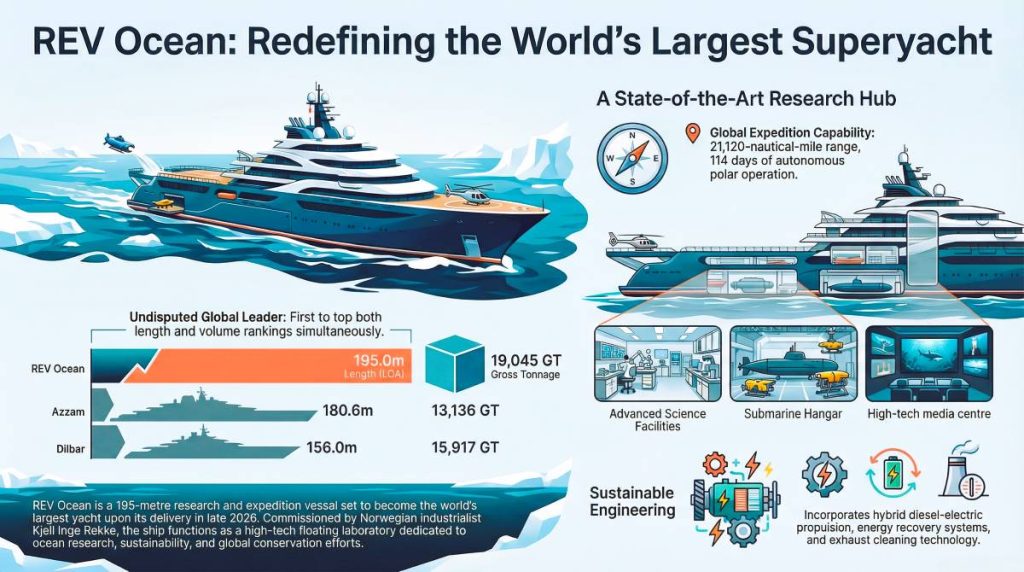
The REV Ocean stands apart from every other yacht on this list. She is not a pleasure yacht or royal vessel but a purpose-built research and expedition ship dedicated to ocean conservation, scientific research, and environmental education. Funded by Norwegian billionaire Kjell Inge Røkke, REV Ocean represents a commitment to using private wealth for public benefit and environmental stewardship.
Complete Specifications:
- Length Overall (LOA): 195 metres (639.8 feet)
- Gross Tonnage: 19,235 GT
- Builder: Vard Holdings (Fincantieri Group), Norway
- Year launched: 2019
- Expected completion: 2026 (delayed from original 2024 timeline)
- Owner/Founder: Kjell Inge Røkke (Norwegian billionaire, fishing and shipping magnate)
- Construction cost: Estimated $350 million – modest relative to comparable-length luxury yachts
- Top speed: 17 knots
- Cruising speed: 14 knots (optimised for efficiency and minimising disturbance to marine life)
- Range: 18,000+ nautical miles – designed for trans-oceanic research expeditions
- Propulsion: Diesel-electric hybrid with advanced environmental systems
- Ice class: Polar Code Category C – capable of operating in light ice conditions
- Exterior designer: Espen Øino International
- Interior spaces: Research laboratories, scientific equipment bays, conference facilities, guest accommodations for scientists and VIPs
- Research capacity: Up to 60 scientists and researchers plus 30 crew
- Notable features: Advanced sonar and mapping systems, submersible deployment capability, oceanographic sampling equipment, environmental DNA analysis lab, extensive data processing facilities
Mission and Purpose – Conservation Through Research:
Kjell Inge Røkke made his fortune in fishing and shipping-industries that interact directly with marine ecosystems. In 2017, he announced the REV Ocean project with a stated mission to use the vessel as a platform for ocean research, conservation advocacy, and environmental education. The yacht is operated by the REV Ocean foundation, a non-profit organisation conducting and facilitating marine research in partnership with leading scientific institutions worldwide.
REV Ocean’s purpose encompasses multiple objectives: conducting original scientific research on ocean health, pollution, and marine biology; providing a platform for scientists from various institutions to collaborate on research expeditions; hosting educational experiences for students, journalists, and policymakers to increase ocean conservation awareness; and demonstrating that large vessels can be operated with minimised environmental footprint through advanced technology.
Research Capabilities – A Floating Laboratory:
REV Ocean incorporates research facilities comparable to dedicated scientific research vessels. Multiple laboratories equipped for marine biology, chemistry, and oceanography enable onboard analysis of samples collected during expeditions. Advanced sonar systems including multibeam echosounders create high-resolution maps of seafloor topography and can detect marine life distributions.
The vessel carries remotely operated vehicles (ROVs) and autonomous underwater vehicles (AUVs)-robotic submarines that can dive to significant depths to observe, film, and collect samples from deep ocean environments. A moon pool (an opening in the hull allowing deployment of equipment while sheltered from waves) facilitates launching and recovering research equipment in moderate sea conditions.
An environmental DNA (eDNA) analysis laboratory allows scientists to analyse water samples for genetic material shed by marine organisms, enabling detection of species presence without direct observation-a revolutionary technique in marine biology.
Environmental Technology:
REV Ocean practices the environmental responsibility she advocates. The diesel-electric hybrid propulsion system allows variable engine operation optimised for efficiency. Advanced exhaust treatment systems reduce emissions. The vessel is designed to minimise underwater noise pollution that disturbs marine mammals-propeller design, hull shape, and machinery mounting all contribute to quiet operation.
Waste management systems treat wastewater to high standards before discharge. Refrigeration and HVAC systems use environmentally friendlier refrigerants. The galley prioritises sustainable food sourcing, and single-use plastics are banned onboard.
Delayed Completion:
REV Ocean’s construction faced delays related to technical complexity, the COVID-19 pandemic’s impact on shipbuilding schedules, and evolving mission requirements. Originally expected to complete outfitting by 2024, the vessel is now anticipated to enter service in 2026. This extended timeline reflects the challenges of creating a vessel that must satisfy both luxury yacht standards for VIP guests and scientific research vessel requirements for equipment and operating procedures.
Hybrid Model – Science and VIP Hospitality:
REV Ocean’s operational model is unique. While scientific research missions constitute her primary purpose, she also accommodates private guests in luxury accommodations. This hybrid approach generates revenue supporting research operations while exposing influential individuals to ocean conservation issues firsthand. VIP guests experience life aboard a research vessel, participate in scientific activities, and learn from embarked researchers-potentially becoming conservation advocates in their own spheres of influence.
Why She Ranks #2: At 195 metres, REV Ocean is the second-longest yacht in the world. Her unique mission dedicated to ocean research and conservation, extraordinary range (18,000 nm), and advanced scientific capabilities make her arguably the most purposeful large vessel on this list.
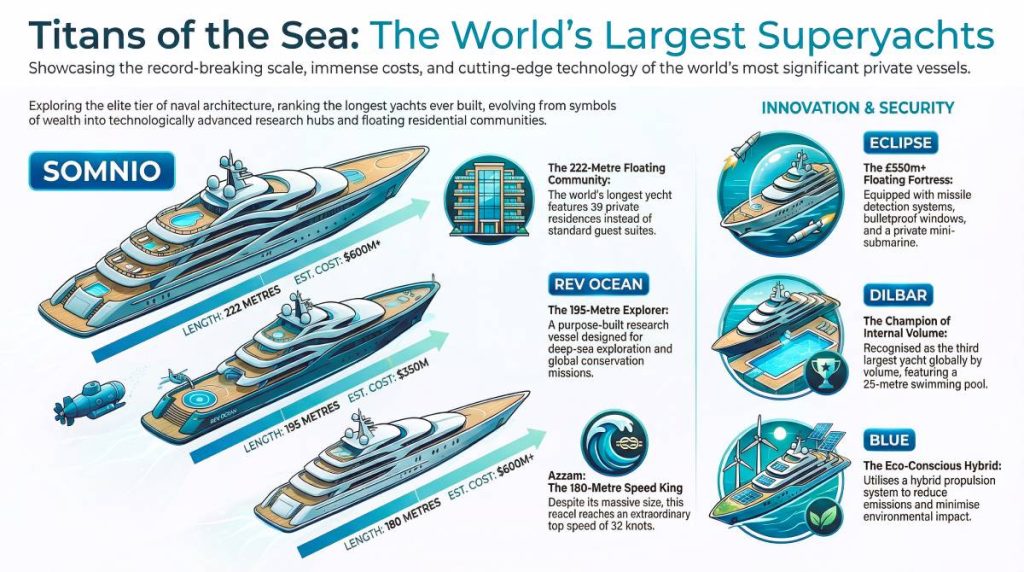
#1. Somnio – The Floating Residence at (222 Metres) – World’s Longest Yacht
The Somnio represents the ultimate evolution of the mega yacht concept: a vessel so large that she functions not as a yacht in the traditional sense but as a floating luxury residential community. At 222 metres, Somnio is the longest yacht in the world by a substantial margin-27 metres longer than REV Ocean, the previous record holder. But her true distinction lies in her revolutionary concept: 39 privately owned luxury apartments rather than guest suites.
Complete Specifications:
- Length Overall (LOA): 222 metres (728.3 feet) – world’s longest yacht
- Gross Tonnage: 33,500 GT – by far the largest GT of any private vessel
- Builder: Vard Holdings (Fincantieri Group), Norway
- Year launched: 2024
- Expected delivery: 2025-2026 (completion ongoing)
- Ownership model: 39 privately owned residential apartments (not traditional charter or single owner)
- Project cost: Exceeds $600 million (estimate; exact costs not publicly disclosed)
- Top speed: 18.5 knots (34.262 km\h)
- Cruising speed: 15 knots
- Range: Global cruising capability with extended endurance
- Propulsion: Diesel-electric with hybrid capability and advanced emissions control
- Exterior design: Tillberg Design of Sweden
- Interior design: Winch Design, London, working with Tillberg Design
- Residents: Up to 200 residents plus guests
- Crew: Approximately 150+ crew and staff
- Hull material: Steel hull, advanced superstructure
- Environmental features: Advanced wastewater treatment, selective catalytic reduction, battery augmentation for hotel load
The Residential Yacht Concept – A New Category:
Somnio reimagines the superyacht entirely. Rather than a single owner or charter guests, she is divided into 39 privately owned apartments ranging from approximately 300 to over 1,000 square metres in size. Owners purchase these apartments outright-reported pricing ranges from $10 million to over $50 million per unit depending on size, location, and customisation. Owners pay annual operating fees covering crew salaries, fuel, maintenance, port fees, and communal operations.
This model borrows from luxury residential cruise ships like The World (a smaller residential cruise ship operating since 2002) but applies it at an unprecedented scale of luxury and customisation. Each apartment can be fully customised by its owner-choosing layouts, materials, furniture, technology systems, and amenities. Some owners have reportedly installed personal gyms, home cinemas, libraries, and even interior swimming pools within their private residences.
Facilities and Amenities – A Floating Luxury Resort:
Beyond the private residences, Somnio includes extensive communal facilities: multiple fine dining restaurants featuring cuisine from various global culinary traditions; casual dining venues and cafés; a medical centre staffed by doctors and equipped for minor surgical procedures and extended care; fitness centres and spas offering comprehensive wellness programs; a beach club at the stern with direct water access via a lowering platform; swimming pools; extensive deck spaces for lounging and socialising; a cinema/theatre for entertainment; and business centres and conference facilities.
The vessel also incorporates research facilities-ocean observation equipment and space for embarking marine scientists for specific research programmes. This reflects a commitment to responsible ocean stewardship and provides residents with opportunities to contribute to marine science.
Global Itinerary – Perpetual Cruising:
Somnio’s operating model involves continuous global cruising. She follows a carefully planned itinerary visiting the world’s most desirable destinations while avoiding tourist high seasons and focusing on authentic cultural experiences. The vessel can anchor off exclusive private islands, access remote wilderness locations, and dock at prestigious yachting destinations worldwide.
The itinerary is shaped partially by resident input-owners vote on destinations and influence routing decisions through a residents’ committee. This democratic element differentiates Somnio from traditional yachts where an owner dictates all operational decisions.
Environmental Responsibility:
Despite her immense size, Somnio incorporates environmental features reflecting contemporary expectations for sustainability: advanced diesel-electric propulsion optimised for fuel efficiency; selective catalytic reduction and other exhaust treatment systems minimising air pollution; comprehensive wastewater treatment exceeding regulatory requirements; battery storage enabling silent, emission-free operation at anchor; shore power connectivity allowing the vessel to shut down generators entirely when docked at equipped ports; and extensive recycling and waste management programs.
The project markets itself to environmentally conscious ultra-high-net-worth individuals, recognising that even wealthy buyers increasingly expect environmental responsibility.
Construction and Technical Challenges:
Building a 222-metre, 33,500 GT vessel that must satisfy both luxury yacht standards and residential building codes presented extraordinary challenges. Fire safety systems, life safety equipment, structural engineering for apartment layouts, HVAC systems managing 39 independent zones, and plumbing/electrical infrastructure supporting customised apartments all required innovative engineering.
Vard Holdings-part of the Fincantieri group with extensive experience in complex vessel construction-built the hull and basic structure in Norway. Outfitting is being completed in partnership with specialist contractors, with the project employing thousands of workers across multiple facilities.
The Target Market – A New Class of Luxury:
Somnio targets ultra-high-net-worth individuals who want permanent luxury residences but reject the geographic permanence of traditional real estate. Owners can live aboard continuously, treating Somnio as their primary residence while the vessel brings them to new destinations. Alternatively, owners can treat their apartment as a vacation property, visiting periodically while the vessel continues cruising.
The project anticipates attracting retired executives, multigenerational families establishing floating family estates, and younger wealthy individuals embracing location-independent lifestyles. With prices reaching over $50 million for the largest apartments plus annual fees potentially exceeding $1 million, this remains one of the most exclusive residential opportunities in the world.
Why She Ranks #1: At 222 metres and 33,500 GT, Somnio is the longest and largest yacht in the world by substantial margins. Her revolutionary residential ownership model, 39 privately owned apartments, and vision of a floating luxury community redefine what a superyacht can be. She is not merely the longest yacht-she is an entirely new category of vessel.
Also read: Top 10 Fastest Electric Car in the World 2026 (.PPTX)
Summary Rankings and Comparisons
Complete Rankings by Length:
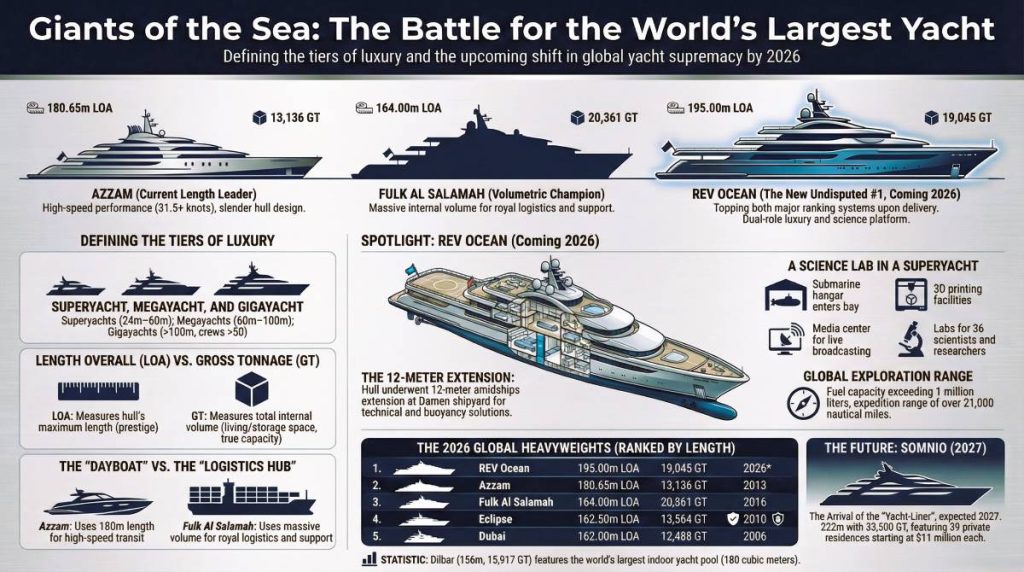
- 1st: Somnio – 222 metres (728.3 ft) – Residential yacht, 39 apartments
- 2nd: REV Ocean – 195 metres (639.8 ft) – Research vessel for ocean conservation
- 3rd: Azzam – 180 metres (590.6 ft) – 32+ knot top speed record holder
- 4th: Fulk Al Salamah – 164 metres (538.1 ft) – Omani royal support vessel
- 5th: M/Y Eclipse – 162.5 metres (533.1 ft) – Advanced security systems, $700M
- 6th: Dubai – 162 metres (531.5 ft) – Completed in UAE, 26 knots
- 7th: Blue – 160 metres (524.9 ft) – Hybrid propulsion, eco-conscious
- 8th: Dilbar – 156 metres (511.8 ft) – Largest by volume (15,917 GT), 25m pool
- 9th: Al Said – 155 metres (508.5 ft) – Concert hall for 50-piece orchestra
- 10th: Prince Abdulaziz – 147 metres (482 ft) – Pioneering mega yacht, 1984
By Gross Tonnage (Internal Volume):
- 1st: Somnio – 33,500 GT
- 2nd: Fulk Al Salamah – 20,361 GT
- 3rd: REV Ocean – 19,235 GT
- 4th: Dilbar – 15,917 GT (largest traditional yacht by volume)
- 5th: Al Said – 15,850 GT
By Top Speed:
- 1st: Azzam – 32+ knots (extraordinary for size)
- 2nd: Dubai – 26 knots
- 3rd: Al Said – 25 knots
- 4th: Dilbar – 22.5 knots
By Estimated Cost:
- 1st: M/Y Eclipse – $700 million
- 2nd: Somnio – $600+ million (project cost)
- 3rd (tie): Multiple yachts – approximately $600 million (Azzam, Dilbar, Al Said, Blue, Fulk Al Salamah)
Conclusion: The Evolution of the Mega Yacht
The ten yachts examined in this guide span four decades of superyacht evolution-from the pioneering Prince Abdulaziz of 1984 to the revolutionary Somnio expected to complete in 2025. Across these decades, several trends emerge that define the trajectory of the world’s largest yachts.
Scale has increased dramatically. In 1984, the 147-metre Prince Abdulaziz was considered almost inconceivably large. Today, she would rank only 10th on this list, surpassed by yachts up to 222 metres. Gross tonnage has increased even more dramatically-from approximately 5,000 GT for Prince Abdulaziz to 33,500 GT for Somnio, reflecting ever-more-spacious interiors and extensive amenity programs.
Ownership models are diversifying. Most mega yachts remain single-owner vessels serving royal families or individual billionaires. But REV Ocean demonstrates the philanthropic research vessel model, while Somnio pioneers the floating residential community concept. These alternative ownership structures suggest the future of mega yachts may be more varied than the traditional billionaire’s pleasure craft.
Environmental consciousness is emerging. The newest vessels-Blue with her hybrid propulsion and dual-fuel capability, Somnio with her battery augmentation and advanced emissions systems, and REV Ocean’s entire conservation-focused mission-reflect growing expectations that even ultra-luxury vessels demonstrate environmental responsibility. Whether driven by regulation, marketing, or genuine commitment, sustainability features are becoming standard on new mega yacht projects.
Technology integration defines modern yachts. Advanced propulsion systems combining diesel engines and gas turbines (Azzam), diesel-electric configurations (Eclipse, Dilbar, Blue), and hybrid battery storage (Blue, Somnio) reflect sophisticated engineering borrowed from commercial shipping and naval vessels. Communication systems, stabilisation technology, dynamic positioning, and entertainment systems all represent state-of-the-art implementations.
Security features have proliferated. Eclipse’s missile detection systems, armour plating, and anti-paparazzi lasers represent the extreme end, but most modern mega yachts incorporate heightened security including surveillance systems, secure communications, and hardened critical spaces. This reflects both increased global security threats and the ultra-high-net-worth owners’ concerns.
Geographic diversity in construction is emerging. While German yards (Lürssen, Blohm+Voss) and Italian builders (Fincantieri/Mariotti) still dominate, Norwegian yards (Vard) are increasingly prominent, and the Dubai’s completion in the UAE demonstrates capabilities expanding beyond traditional centers. This geographic diversification brings fresh approaches and competitive pressure that benefits buyers.
The line between yacht and other vessel types is blurring. REV Ocean functions more as a research ship than a yacht. Fulk Al Salamah is essentially a naval auxiliary vessel. Somnio is a residential cruise ship. Only traditional definitions of ‘yacht’ based on private ownership and leisure purpose include these vessels-their scale and capabilities align them with commercial ships.
Looking forward, several factors will shape the next generation of mega yachts. Regulatory pressure for emissions reductions will drive further adoption of hybrid-electric propulsion, alternative fuels, and efficiency optimization. The ultra-wealthy demographic is aging-successors to today’s mega yacht owners may have different values prioritising sustainability and purpose over pure luxury. Economic pressures may make alternative ownership models like Somnio’s residential approach or shared fractional ownership more attractive. And geopolitical tensions may influence where yachts are built, registered, and operated.
What remains constant is the human desire to create monuments to achievement, wealth, and ambition. The mega yachts on this list represent the extreme edge of what is technically possible and economically feasible in private vessel construction. They push shipbuilding technology, showcase exceptional craftsmanship, and create experiences impossible on land. Whether viewed as magnificent achievements of engineering and art or as symbols of inequality and excess, they indisputably represent the ultimate expression of luxury on the world’s oceans.
About This Article
All yacht specifications are compiled from authoritative superyacht industry publications including SuperYacht Times, Boat International, BOAT Pro, and yacht builder official sources. Length measurements are LOA (Length Overall). Gross Tonnage figures are drawn from official maritime registries where available; some figures are estimates from industry sources. Ownership information reflects publicly available data; many yachts are owned through corporate entities for privacy. Construction costs are industry estimates and may not reflect actual final expenditure. Top speed figures are manufacturer stated or independently verified where noted (2026-2027).