In this article we will discuss about the Top 10 Longest Range Artillery in the World with PDF, PPT and Infographic, A complete guide to the world’s longest range artillery guns – ranked by actual demonstrated range, not manufacturer claims. so, when it comes to modern land warfare, artillery remains the decisive arm. Generals and military strategists around the world know that the side with the longer reach – and the ability to strike before being struck – holds a massive tactical advantage. But which country has the best artillery in the world? And what is the world’s longest range artillery gun?
Table of Contents
This article answers those questions with verified data. We have ranked the top 10 longest range artillery systems (LRAS) on the planet based on actual demonstrated shots – not theoretical figures, not marketing brochures. If you have been searching for the top 10 best artillery in the world, the top 10 towed artillery in the world, or the top 10 modern artillery guns, you are in the right place.
From wheeled howitzers to rocket-assisted shells that defy common sense, these are the guns that can genuinely change the shape of a battlefield – and, in some cases, have already done so in active combat.
Top 10 Longest Range Artillery in the World (.PPTX)
No. #10 – Caesar Mark 2, France | Maximum Range: 42–50 km
If you picture French military engineering, you might think of elegance and efficiency – and the Caesar Mark 2 delivers exactly that. This 155 mm wheeled self-propelled howitzer is one of the most battle-proven and internationally recognized artillery systems in the world. Mounted on a standard military truck chassis, the Caesar is deceptively mobile. It can stop, set up, fire, and leave the position in under 60 seconds – a capability that makes enemy counter-battery radar almost useless against it.
Key Specifications:
- Caliber: 155 mm / L52 barrel
- Maximum range: 42 km (standard) to 50 km (rocket-assisted)
- Crew: 3 to 5 personnel
- Weight: approximately 18,500 kg
- Special ability: Shoot and scoot in under 60 seconds
The Caesar uses Extended Range Full Bore (ERFB) ammunition and rocket-assisted projectiles to achieve its impressive 50 km reach. It has seen active combat in Libya, the Sahel, and most recently in Ukraine where multiple nations have deployed it with considerable success. The Mark 2 version features an automatic loading system, further reducing crew burden and increasing the sustained rate of fire.
For nations looking for the largest artillery gun in use today that balances range, affordability, and battlefield survivability, the Caesar remains one of the top choices globally.
No. #9 – Archer, Sweden | Maximum Range: 50–55 km
Sweden is not a country that makes many headlines in global defence, but those who follow modern artillery closely know that the Swedish Archer is one of the most technically sophisticated systems on the planet. Fully automated and mounted on a Volvo 6×6 truck chassis, the Archer can transition from travel mode to firing mode in just 20 seconds – faster than most competitors can even set up their targeting systems.
Key Specifications:
- Caliber: 155 mm / L52 barrel
- Maximum range: 50 km (standard) up to 55+ km (extended range rounds)
- Rate of fire: Up to 9 rounds per minute in burst
- Special ability: MRSI – Multiple Rounds Simultaneous Impact
- Automation: Fully automated loading, targeting, and fire control
What truly sets the Archer apart is its MRSI capability. A trained crew can fire six rounds at different trajectories so they all land on the target simultaneously – a devastating technique against hardened positions or troop concentrations. It has been delivered to Ukraine as part of international military aid, where it has performed exceptionally well in long-range fire missions.
No. #8 – K9 Thunder, South Korea | Maximum Range: 54 km
South Korea sits directly next to one of the world’s most artillery-heavy adversaries – North Korea. That existential reality has driven South Korean engineers to build the K9 Thunder into arguably the most commercially successful self-propelled howitzer on the market today. Over a dozen countries have purchased it, including India, Poland, Norway, Finland, Australia, and Egypt.
Key Specifications:
- Caliber: 155 mm / L52 barrel
- Maximum range: 54 km using VLAP (Velocity-Enhanced Long-Range Artillery Projectile)
- Rate of fire: 3 rounds per minute sustained, burst of 6 rounds in 3 minutes
- Armor: Protected against small arms and shell splinters
- Export success: 12+ nations operating the system
The K9 Thunder’s 54 km range is achieved with advanced base-bleed and VLAP shells. Its onboard digital fire control system allows rapid engagement of targets with high accuracy. South Korea continues to develop the upgraded K9A2 variant with even greater automation and extended range potential. For anyone researching which country has the best artillery in the world, South Korea’s consistent export dominance makes it a serious contender.
No. #7 – Donar (Artillery Gun Module), Germany | Maximum Range: 56 km
Germany’s Donar – officially called the Artillery Gun Module (AGM) – is perhaps the most underappreciated system on this list. It takes the proven 155 mm L52 gun from the legendary Panzerhaubitze 2000 and installs it into a lightweight, modular turret that can be fitted onto different vehicle platforms, including the ASCOD infantry fighting vehicle and various other chassis.
Key Specifications:
- Caliber: 155 mm / L52 barrel (same as PzH 2000)
- Maximum range: Up to 56 km using extended range and rocket-assisted projectiles
- Weight: Significantly lighter than full SPH systems
- Strategic advantage: Light enough for airlift by C-130 or A400M aircraft
- Automation: Fully automated loading system
The Donar’s true value lies in strategic deployability. A nation can fly this system to a conflict zone, mount it on a locally available vehicle, and have a world-class long-range artillery capability within hours. It reached 56 km in documented testing, putting it solidly in the upper tier of the top 10 modern artillery guns worldwide.
No. #6 – 2S22 Bohdana, Ukraine | Maximum Range: 60 km
The Ukrainian Bohdana is perhaps the most dramatic entry on this list – not just because of its range, but because of the circumstances under which it was developed and tested. Built under wartime conditions by Ukraine’s own defence industry, the 2S22 uses a NATO-standard 155 mm barrel mounted on a KrAZ truck platform, giving it both excellent mobility and access to the full library of Western precision-guided and rocket-assisted ammunition.
Key Specifications:
- Caliber: 155 mm / L52 NATO-standard barrel
- Maximum range: 60 km using rocket-assisted projectiles
- Platform: KrAZ 6×6 truck (highly mobile)
- Notable achievement: Participated in the bombardment of Snake Island
- Compatibility: Fires all NATO 155 mm ammunition types
The Bohdana made international headlines when it was used in a record-setting long-range bombardment across open water as part of operations to liberate Snake Island. Its 60 km range, combined with compatibility with precision-guided Excalibur rounds, makes it one of the most dangerous truck-mounted artillery systems currently in active service. It is a testament to Ukrainian engineering ingenuity even under the extreme pressures of wartime production.
No. #5 – Denel T5-52, South Africa | Maximum Range: 60+ km
South Africa is not typically the first answer when people ask which country has the best artillery in the world. But dig deeper, and you will discover that South African artillery engineering is genuinely world-leading – and has been since the 1980s. The Denel T5-52 is a 155 mm towed or truck-mounted howitzer that pushes the envelope of what conventional gun artillery can achieve.
Key Specifications:
- Caliber: 155 mm / L52 barrel
- Maximum range: 60+ km using VLAP (Velocity-Enhanced Long-Range Artillery Projectile)
- Ammunition: Purpose-designed drag-reduction VLAP shells developed by Denel
- Influence: Denel ammunition is used by multiple NATO nations to extend the range of their own guns
- Configuration: Available in towed and truck-mounted variants
What makes the T5-52 especially notable is its ammunition technology. Denel’s VLAP rounds are aerodynamically optimized to maintain velocity across extreme distances, effectively turning a standard 155 mm gun into a long-range precision tool. Many NATO nations – including those whose own guns appear on this very list – use Denel-developed ammunition to extend their range. South Africa’s contribution to global artillery development is, frankly, underappreciated.
No. #4 – Panzerhaubitze 2000 (PzH 2000), Germany | Maximum Range: 67 km
Ask any NATO artillery officer to name the gold standard of self-propelled howitzers, and the overwhelming majority will say the same name: Panzerhaubitze 2000. Often abbreviated as PzH 2000, this German engineering marvel has earned its reputation through decades of operational service, rigorous testing, and combat performance in Ukraine – where it has demonstrated both extreme accuracy and remarkable survivability.
Key Specifications:
- Caliber: 155 mm / L52 barrel
- Maximum range: 67 km using specially developed VLAP ammunition (Rheinmetall)
- Rate of fire: 10 rounds per minute, with an autoloader handling up to 60 stored rounds
- Armor: Heavy protection against shell fragments and small arms fire
- Precision: One of the most accurate artillery systems in operational service
The 67 km range record was set during testing using a specially engineered VLAP projectile developed by Rheinmetall. This remains the longest range ever recorded for a fully operational, non-prototype self-propelled howitzer. In active Ukrainian service, PzH 2000 crews have been credited with pinpoint strikes at distances that would have been considered impossible just a decade ago. It is the benchmark against which all other systems on this list are ultimately measured.
No. #3 – M1299 ERCA, United States (Prototype) | Maximum Range: 70+ km
The United States Army’s Extended Range Cannon Artillery (ERCA) program represented America’s most ambitious attempt to redefine what gun artillery is capable of. Based on the M109 Paladin chassis – already a trusted workhorse of NATO forces – the M1299 ERCA replaced the standard L39 barrel with a dramatically longer 58-caliber (L58) barrel, fundamentally changing the system’s ballistic performance.
Key Specifications:
- Caliber: 155 mm / L58 barrel (significantly longer than standard NATO barrels)
- Maximum range: 70+ km verified in testing using the XM1113 rocket-assisted projectile
- Propellant: High-energy propellant charges for maximum muzzle velocity
- Precision: Designed for compatibility with Excalibur GPS-guided rounds
- Status: Program paused; range record remains officially intact
Although the ERCA program has been paused by the US Army – partly due to budget constraints and the evolving role of precision long-range missiles – the range record achieved during testing stands unchallenged for any system derived from the M109 family. It proved definitively that gun artillery can exceed 70 km without transitioning to a rocket or missile system, opening doors for future developments in the field of top 10 longest range artillery in the world.
No. #2 – 2S35 Koalitsiya-SV, Russia | Maximum Range: 70–80 km (Claimed)
Russia’s 2S35 Koalitsiya-SV (Coalition-SV) is the most technically advanced – and most controversial – system on this list. Russian state sources claim ranges of 70 to 80 km using new rocket-assisted and precision-guided projectiles, which would make it the longest-range operationally deployable howitzer on the planet. However, independently verified data remains limited, which is why it ranks second rather than first.
Key Specifications:
- Caliber: 152 mm (Russian standard, not NATO 155 mm)
- Maximum range: 70 km (verified evidence) to 80 km (official Russian claim)
- Turret: Fully unmanned, robotic turret design
- Rate of fire: Reported at 15–16 rounds per minute – exceptionally high
- Autoloader: Dual-feed automated loading system
- Targeting: Integrated digital fire control with automated target acquisition
The Koalitsiya-SV features a completely unmanned turret – a first for production howitzers – and its dual-feed autoloader allows a rate of fire that dwarfs most Western competitors. There is credible evidence that it has fired beyond 70 km in testing, and if the 80 km claim is independently verified, it would challenge the world record. Until then, the throne belongs to South Africa.
No. #1 – G6-52 Rhino, South Africa | Maximum Range: 76 km (Verified World Record)
The answer to the question “What is the world’s longest range artillery gun?” is, definitively, the South African G6-52 Rhino. With a verified world record of 76 km using Denel’s revolutionary VLAP ammunition, the G6-52 remains the undisputed king of long-range gun artillery – decades after it was first developed, and still unbeaten today.
Key Specifications:
- Caliber: 155 mm / L52 barrel
- Maximum range: 76 km – verified world record using VLAP ammunition
- Platform: 6×6 wheeled self-propelled howitzer (highly mobile)
- Armor: Full crew protection with NBC filtration
- Ammunition: Denel VLAP – specifically engineered for drag reduction and extreme range
- Special: World’s longest verified artillery shot by a conventional gun system
The G6-52 is the evolution of the earlier G6 Rhino, itself a product of South Africa’s remarkable – and largely secret – long-range artillery development programme during the Cold War era. The extended L52 barrel, combined with a high-pressure chamber and Denel’s purpose-built aerodynamic VLAP projectiles, produced a system capable of striking targets 76 km away with conventional gun technology.
What makes this achievement even more remarkable is the context. South Africa is not a superpower. It does not have the defence budget of the United States, Russia, or Germany. Yet through a combination of engineering ingenuity, focused investment in ammunition science, and a clear operational requirement born from conflicts in Angola during the 1980s, South Africa built the world’s longest-range artillery system – and no one has beaten it since.
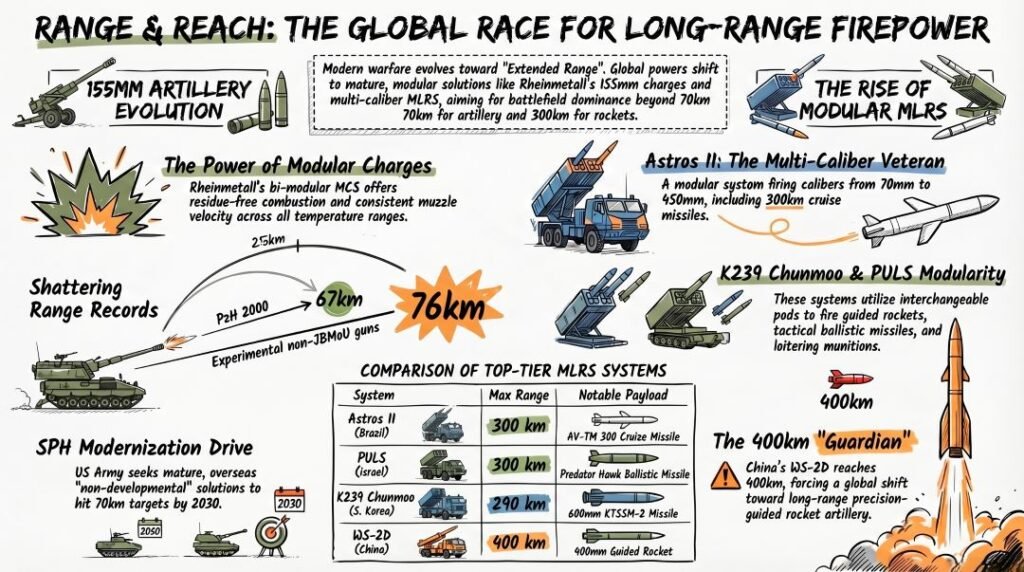
Table of Top 10 Longest Range Artillery in The World
Complete Cost, Production, Maintenance, Buy, Sell & Export Data
Table 1 – Unit Cost, Production Cost & Build Time
Sources: Defence procurement contracts, SIPRI Arms Trade Database, manufacturer reports, open-source military analysis. (est.) = estimated.
| No. | System | Country | Unit Cost (USD) | Production Cost / Unit (Est.) | Total Program Dev. Cost | Time to Build (Per Unit) | Est. Units Produced |
| 10 | Caesar Mark 2 | France | ~$7 M | ~$5.5–6.5 M | ~$1.5 B (Mk1+2) | 6–9 months | ~300+ |
| 9 | Archer (FH-77BW) | Sweden | ~$6–8 M | ~$5–7 M | ~$1.2 B | 8–12 months | ~48 (SE+NO) |
| 8 | K9 Thunder | South Korea | ~$5–6 M | ~$3.5–5 M | ~$1.8 B | 6–10 months | ~2,000+ |
| 7 | Donar / AGM | Germany | ~$7–9 M | ~$6–8 M | ~$800 M | 8–12 months | ~18 (demos) |
| 6 | 2S22 Bohdana | Ukraine | ~$3–4 M | ~$2.5–3.5 M | ~$300 M (est.) | 4–6 months | ~20+ (wartime) |
| 5 | Denel T5-52 | South Africa | ~$5–7 M | ~$4–6 M | ~$600 M (est.) | 6–10 months | ~Limited |
| 4 | PzH 2000 | Germany | ~$8–11 M | ~$7–9 M | ~$3.5 B | 10–14 months | ~700+ |
| 3 | M1299 ERCA | USA | ~$15–20 M (est.) | ~$12–18 M | ~$2.5 B (est.) | 12–18 months | ~8 prototypes |
| 2 | 2S35 Koalitsiya-SV | Russia | ~$7–10 M (est.) | ~$6–9 M | ~$2 B (est.) | 10–14 months | ~150+ (est.) |
| 1 | G6-52 Rhino | South Africa | ~$6–8 M | ~$5–7 M | ~$1.2 B (est.) | 8–12 months | ~155+ |
Key Takeaways: The K9 Thunder (South Korea) offers the lowest unit cost at ~$5–6 M among fully operational tracked SPHs. The US M1299 ERCA prototype is the most expensive on a per-unit basis due to its experimental 58-calibre barrel and advanced propellant systems. Ukrainian Bohdana is the lowest-cost entry at ~$3–4 M, reflecting wartime production economics.
Table 2 – Export Status, Buyer Nations & Sale Price
Sources: SIPRI ATDB, national defence ministries, arms trade journals. Export prices typically include training, initial spares, and technical support packages.
| No. | System | Export / Sale Price (per unit) | Known Buyer / User Nations | No. of Buyers | Export Status | Notable Export Deals |
| 10 | Caesar Mark 2 | ~$7–9 M | France, Denmark, Lithuania, Belgium, Ukraine, Saudi Arabia, Thailand, Indonesia, Morocco | 9+ | Actively Exported | Saudi Arabia (76 units); Ukraine donation by FR/DK |
| 9 | Archer | ~$7–10 M | Sweden, Norway, Ukraine (donated) | 3 | Limited Export | Norway (24 units); Ukraine received donated units |
| 8 | K9 Thunder | ~$5–7 M | South Korea, India, Poland, Norway, Finland, Australia, Egypt, Turkey, Estonia, UK (trials) | 12+ | Widely Exported | Poland (672); India (100 K9 Vajra); Australia (30) |
| 7 | Donar / AGM | ~$8–12 M | Germany (demo); Qatar (interest) | ~2 | Limited / Demo Phase | Demonstration sales only to date |
| 6 | 2S22 Bohdana | ~$4–6 M | Ukraine (domestic use only) | 1 | Not Yet Exported | All production goes to Ukrainian Army |
| 5 | Denel T5-52 | ~$6–9 M | South Africa; ammunition exported globally | 10+ | Ammunition Exported | VLAP rounds used by NATO nations incl. Germany, India |
| 4 | PzH 2000 | ~$10–14 M | Germany, Netherlands, Italy, Greece, Lithuania, Qatar, Hungary, Ukraine (donated) | 8+ | Actively Exported | Netherlands (57); Italy (70); Ukraine donations |
| 3 | M1299 ERCA | Not for sale (prototype) | USA only (prototype) | 1 | Not Exported | Program paused; no export licence issued |
| 2 | 2S35 Koalitsiya-SV | ~$8–12 M (est.) | Russia (domestic); potential Belarus, Algeria | 1–2 | Restricted Export | No confirmed export deals as of 2025 |
| 1 | G6-52 Rhino | ~$7–10 M | South Africa, Oman, UAE, India (interest), Jordan | 4+ | Selectively Exported | Oman (~25 units); UAE (~78 units G6 variant) |
Key Takeaways: The K9 Thunder is the undisputed export champion with 12+ buyer nations and an estimated $5–8 B in total export revenue. The PzH 2000 leads in European exports. The Russian Koalitsiya-SV and US ERCA are effectively unavailable on the open market – one due to sanctions, the other due to programme suspension.
Table 3 – Maintenance, Operational Cost & Crew Data
Annual maintenance includes scheduled servicing, spare parts, software updates, and depot-level overhauls amortised over service life. Barrel replacement cost (~$200,000–$400,000) is separate.
| No. | System | Annual Maint. Cost (per unit) | Cost Per Shot (Ammunition) | Major Overhaul Interval | Barrel Life (Rounds) | Crew Size | Operational Lifespan |
| 10 | Caesar Mark 2 | ~$150,000–$250,000 | ~$800–$2,500 (std–RAP) | Every 5–7 years | ~3,000–4,000 | 3–5 | 30–35 years |
| 9 | Archer | ~$200,000–$350,000 | ~$1,000–$3,000 | Every 5–8 years | ~3,000–4,000 | 2–3 | 30–40 years |
| 8 | K9 Thunder | ~$120,000–$200,000 | ~$700–$2,000 | Every 5–7 years | ~2,500–3,500 | 5 | 30–40 years |
| 7 | Donar / AGM | ~$180,000–$280,000 | ~$1,000–$3,000 | Every 6–8 years | ~3,000+ | 2–3 | 25–35 years |
| 6 | 2S22 Bohdana | ~$80,000–$150,000 | ~$600–$2,500 | Every 3–5 years | ~2,000–3,000 | 3–5 | 20–30 years |
| 5 | Denel T5-52 | ~$100,000–$200,000 | ~$800–$3,500 (VLAP) | Every 5–7 years | ~3,000–4,000 | 6–8 | 30–35 years |
| 4 | PzH 2000 | ~$300,000–$500,000 | ~$1,500–$4,000 | Every 5–7 years | ~3,000–4,500 | 5 | 35–45 years |
| 3 | M1299 ERCA | ~$600,000+ (est.) | ~$3,000–$10,000+ (XM1113) | N/A (prototype) | ~TBD | 4–5 | N/A (paused) |
| 2 | 2S35 Koalitsiya-SV | ~$250,000–$450,000 (est.) | ~$1,000–$5,000 | Every 5–8 years | ~3,000+ (est.) | 2–3 | 30–40 years |
| 1 | G6-52 Rhino | ~$180,000–$300,000 | ~$1,500–$5,000 (VLAP) | Every 5–8 years | ~3,500–4,500 | 6 | 35–45 years |
Key Takeaways: The PzH 2000 carries the highest annual maintenance cost (~$300–500K/unit) due to its complex autoloading system and heavy tracked chassis. The Bohdana and K9 Thunder are the most economical to maintain. Highly automated systems (Archer, Koalitsiya-SV) reduce crew to 2–3 operators, dramatically lowering personnel costs over a 30-year service life.
Table 4 – Ammunition Cost Breakdown by Round Type
Ammunition costs are per round and vary significantly by procurement volume. Government bulk orders reduce unit price by 20–40%. Precision-guided munition (PGM) costs include seeker and GPS kit.
| No. | System | Standard Shell | Base-Bleed / ERFB | Rocket-Assisted (RAP) | Precision-Guided (PGM) | VLAP / Special Round | Estimated Cost: 50-Round Fire Mission |
| 10 | Caesar Mark 2 | ~$800 | ~$1,200 | ~$2,200 | ~$70,000–$120,000 (Excalibur) | ~$3,500 | ~$40,000–$110,000 |
| 9 | Archer | ~$900 | ~$1,400 | ~$2,500 | ~$70,000–$120,000 | ~$3,500 | ~$45,000–$125,000 |
| 8 | K9 Thunder | ~$700 | ~$1,100 | ~$2,000 | ~$70,000–$120,000 | ~$3,200 | ~$35,000–$100,000 |
| 7 | Donar / AGM | ~$900 | ~$1,400 | ~$2,500 | ~$70,000–$120,000 | ~$3,500 | ~$45,000–$125,000 |
| 6 | 2S22 Bohdana | ~$700 | ~$1,100 | ~$2,200 | ~$70,000–$120,000 | ~$3,000 | ~$35,000–$110,000 |
| 5 | Denel T5-52 | ~$800 | ~$1,300 | ~$2,500 | ~$50,000–$80,000 (M-2000S) | ~$3,500–$5,000 | ~$40,000–$250,000 |
| 4 | PzH 2000 | ~$1,200 | ~$1,800 | ~$3,500 | ~$70,000–$120,000 (Excalibur) | ~$4,000 | ~$60,000–$175,000 |
| 3 | M1299 ERCA | ~$1,500 | ~$2,500 | ~$5,000+ | ~$100,000+ (XM1113 RAP-PGM) | N/A | ~$75,000–$500,000+ |
| 2 | 2S35 Koalitsiya-SV | ~$1,000 | ~$1,500 | ~$3,000 | ~$30,000–$60,000 (Krasnopol) | N/A | ~$50,000–$150,000 |
| 1 | G6-52 Rhino | ~$1,000 | ~$1,500 | ~$3,000 | ~$50,000–$80,000 | ~$4,000–$5,000 | ~$50,000–$250,000 |
Key Takeaways: A single Excalibur GPS-guided round costs ~$70,000–$120,000 per shot – roughly the same as a small car or motorcycle per second of flight time. However, its precision means one round can replace 50+ standard shells to achieve the same effect on target, dramatically improving cost-per-effect ratios in precision strike missions. VLAP rounds (Denel) at ~$3,500–5,000 offer the best range/cost ratio for non-guided long-range fires.
Table 5 – Global Export Market & Economic Impact
Market share figures refer to the global self-propelled howitzer (SPH) export market by unit volume (2010–2025). Total export revenue includes ammunition contracts, training, and spares packages.
| No. | System | Origin | Total Export Revenue (Est.) | Biggest Single Export Deal | Direct Competitor Systems | Import Alternatives Available | Market Share (SPH) |
| 10 | Caesar Mark 2 | France | ~$2.5–3.5 B | Saudi Arabia: 76 units (~$600 M) | Archer, K9, PzH 2000 | K9 Thunder, Archer | ~8% |
| 9 | Archer | Sweden | ~$400–700 M | Norway: 24 units (~$200 M) | Caesar, K9, PzH 2000 | Caesar Mark 2, K9 | ~2% |
| 8 | K9 Thunder | South Korea | ~$5–8 B | Poland: 672 units (~$3.75 B) | Caesar, PzH 2000 | PzH 2000, Caesar | ~25% |
| 7 | Donar / AGM | Germany | ~$100–200 M | Demonstration only (no bulk export) | K9, Caesar, PzH 2000 | K9 Thunder, Caesar | <1% |
| 6 | 2S22 Bohdana | Ukraine | ~$0 (domestic) | No export deals yet | Caesar, K9, PzH 2000 | Caesar (preferred by NATO) | <1% |
| 5 | Denel T5-52 / Ammo | South Africa | ~$1.5–2.5 B | VLAP ammo deals with NATO nations (~$1 B) | G6-52 (same mfr.) | K9, Caesar | ~4% |
| 4 | PzH 2000 | Germany | ~$3–5 B | Italy: 70 units (~$750 M) | K9 Thunder, Caesar | K9 Thunder | ~18% |
| 3 | M1299 ERCA | USA | ~$0 (prototype) | Program paused – no export | PzH 2000, G6-52 | PzH 2000 | <1% |
| 2 | 2S35 Koalitsiya-SV | Russia | ~$0 (sanctioned) | No confirmed export deals | PzH 2000, G6-52 | N/A (sanctions) | <1% |
| 1 | G6-52 Rhino | South Africa | ~$1–2 B | UAE: ~78 G6 units (~$650 M) | PzH 2000, K9 | PzH 2000 | ~5% |
Key Takeaways: South Korea’s K9 Thunder commands approximately 25% of the global SPH export market – more than any other system. Germany’s PzH 2000 holds ~18%. The combined German-South Korean duopoly accounts for ~43% of the global market. South Africa earns significant export revenue not from the gun itself but from its world-leading VLAP ammunition technology, used by NATO members to extend the range of their own howitzers.
Table 6 – Quick Reference: Buy, Sell & Value Summary
‘Sell Price’ = Government-to-Government (G2G) transaction price including basic support package. ‘Buy Price (Refurb)’ = estimated cost of procuring refurbished / second-hand units from surplus stocks. Value Rating: ★★★★★ = best in class for cost-effectiveness.
| No. | System | Unit Cost (New) | Annual Maint. | Export Price | Sell Price (Govt.–Govt.) | Buy Price (Refurb / Used, Est.) | Value Rating (Range/Cost) |
| 10 | Caesar Mark 2 | ~$7 M | ~$200K/yr | ~$7–9 M | ~$7–9 M | ~$3–4 M (used) | ★★★★☆ |
| 9 | Archer | ~$7–8 M | ~$275K/yr | ~$7–10 M | ~$7–10 M | ~$3–5 M (used) | ★★★★☆ |
| 8 | K9 Thunder | ~$5–6 M | ~$160K/yr | ~$5–7 M | ~$5–7 M | ~$2.5–4 M (refurb) | ★★★★★ |
| 7 | Donar / AGM | ~$8–9 M | ~$230K/yr | ~$8–12 M | ~$9–12 M | ~$4–6 M | ★★★☆☆ |
| 6 | 2S22 Bohdana | ~$3–4 M | ~$120K/yr | Not avail. | Not avail. | N/A (not exported) | ★★★★☆ (value) |
| 5 | Denel T5-52 | ~$5–7 M | ~$150K/yr | ~$6–9 M | ~$6–9 M | ~$3–5 M | ★★★★☆ |
| 4 | PzH 2000 | ~$9–11 M | ~$400K/yr | ~$10–14 M | ~$10–14 M | ~$5–7 M (refurb) | ★★★★★ (perf.) |
| 3 | M1299 ERCA | ~$15–20 M (est.) | ~$600K/yr | Not for sale | Not for sale | N/A | N/A (prototype) |
| 2 | 2S35 Koalitsiya-SV | ~$8–10 M (est.) | ~$350K/yr | Sanctioned | Sanctioned | N/A (sanctions) | N/A (sanctions) |
| 1 | G6-52 Rhino | ~$7–8 M | ~$240K/yr | ~$7–10 M | ~$8–11 M | ~$4–6 M (refurb) | ★★★★★ (range) |
Key Takeaways: For pure range performance per dollar, the G6-52 Rhino remains unbeaten – 76 km for ~$7–8 M is an extraordinary value. For mass-market reliability and the lowest total cost of ownership, the K9 Thunder wins. The PzH 2000 earns its top rating for overall battlefield performance despite its higher cost. The Russian Koalitsiya-SV and US ERCA are not commercially accessible to most nations.
Disclaimer: All cost figures are derived from publicly available sources including SIPRI Arms Trade Database, national defence ministry procurement announcements, Jane’s Defence, and open-source military analysis. Figures marked (est.) are estimates. Actual government procurement prices may differ due to offsets, technology transfer agreements, and classified contract terms. This document is for educational and informational purposes only.
Also read: Top 10 School Buses in the World (.PPTX)
FAQs:
What is the world’s longest range artillery gun?
The South African G6-52 Rhino holds the verified world record with a demonstrated range of 76 km using Denel VLAP ammunition. This record has not been independently beaten by any other conventional gun artillery system.
Which country has the best artillery in the world?
Based on verified range records and operational performance, South Africa, Germany, and the United States lead in artillery engineering. South Africa holds the range record, Germany produces the most respected operational howitzer (PzH 2000), and the US leads in GPS-guided artillery shell technology (Excalibur). South Korea is arguably the most successful in commercial terms with the K9 Thunder.
Who has more artillery – Pakistan or India?
India has a significantly larger total inventory of artillery systems than Pakistan. India operates several thousand artillery pieces across towed howitzers, self-propelled howitzers, and multiple rocket launch systems. Pakistan maintains a capable but smaller artillery force. However, raw numbers do not tell the whole story – training, logistics, and ammunition supply chains are equally important in a real conflict.
Which is the largest artillery gun in use today?
In terms of caliber and range, the G6-52 Rhino (155 mm, 76 km range) and the 2S35 Koalitsiya-SV (152 mm, claimed 80 km) are the largest and longest-range operational howitzers currently in service or near-service. For raw barrel size historically, systems like the German Dora from World War II were technically larger, but these are museum pieces, not combat-ready systems.
What is the world largest cannon in India?
Historically, the Jaivana Cannon at the Jaigarh Fort in Jaipur, Rajasthan, is considered the world’s largest wheeled cannon. Cast in 1720, it weighs approximately 50 tons and has a barrel length of over 6 metres. However, it is a historical artefact, not a modern combat weapon. India’s current longest-range operational artillery systems include the K9 Vajra (the locally produced K9 Thunder) and the M777 ultra-lightweight howitzer.
What is the largest cannon on a ship?
Modern naval artillery is dominated by 127 mm (5-inch) and 155 mm gun systems. The most advanced current system is the US Navy’s Advanced Gun System (AGS) fitted on the Zumwalt-class destroyers, which fires a 155 mm guided shell called the Long Range Land Attack Projectile (LRLAP) with a range of over 80 km. Historically, battleship guns like the Japanese Yamato’s 460 mm (18.1-inch) cannons represented the absolute peak of naval artillery size.
Modern Artillery and India: A Growing Force
India has historically struggled with artillery modernisation due to political scandals (most notably the Bofors affair of the 1980s) that froze procurement for nearly two decades. However, since the early 2010s, India has aggressively modernised its artillery arm with a diverse mix of imported and domestically produced systems.
India’s current key artillery systems include:
- K9 Vajra-T – Localised version of the K9 Thunder, produced by L&T Defence in India with a range of 40+ km
- M777 Ultra-Lightweight Howitzer – American 155 mm towed gun deployed in the Himalayas with a range of 30 km
- ATAGS (Advanced Towed Artillery Gun System) – India’s indigenous 155 mm L52 howitzer under development with a claimed range of 48 km
- Dhanush – Upgraded Indian Bofors gun with a range of 38 km
- Pinaka MLRS – Multi-barrel rocket system with a range of 40–90 km depending on variant
India’s indigenous ATAGS system, if its claimed 48 km range is validated in operational use, would place it among the longest-range towed howitzers in the top 10 towed artillery in the world category. India is also exploring longer-range rocket artillery under the Pinaka Mk II and Mk III programmes.
Conclusion: The Future of Long-Range Artillery
The top 10 longest range artillery systems in the world represent the cutting edge of what conventional gun technology can achieve. From the wheeled mobility of the Caesar and the G6-52, to the robotic turret of the Koalitsiya-SV and the verified 76 km world record that South Africa still holds, these systems define modern land warfare.
Several trends are clearly visible as we look toward the future. First, rocket-assisted and precision-guided projectiles are steadily closing the gap between gun artillery and missile systems. Second, automation is reducing crew size and increasing rate of fire across nearly every new system. Third, wheeled platforms are increasingly favoured over tracked ones for strategic mobility – the ability to fly or drive a howitzer to the battlefield faster than an adversary can respond is becoming as important as raw range. Perhaps most surprising is the continued dominance of South African engineering. A country rarely mentioned among the great military powers holds the verified world record for the longest artillery shot ever made with a conventional gun – 76 km, set by the G6-52 Rhino, and still unbeaten. It is a reminder that technological excellence does not belong exclusively to the largest defence budgets.
Whether you are a military enthusiast, a defence analyst, or simply curious about what the best artillery gun in the world can do, one thing is clear: gun artillery is far from obsolete. It is evolving, extending its reach, and continuing to shape the outcome of wars around the world.