In this article we will discuss about the Top 10 Longest Range Missiles in India 2026 with PPT, PDF, Infographic and Complete List, Types, Range & Ranking so, India possesses one of the most sophisticated missile arsenals in the world, primarily developed by the Defence Research and Development Organisation (DRDO). Whether you have been searching for the top 10 longest range missiles in India, the Indian missile list with range, or want to know which Indian missile has the longest range – this is the most comprehensive and up-to-date guide for 2026.
Table of Contents
This article covers the complete list, types, ranges, hidden features, production costs, and a global rivals comparison – everything you need to understand where India stands in missile technology ranking today.
Which Is the Longest Range Missile in India?
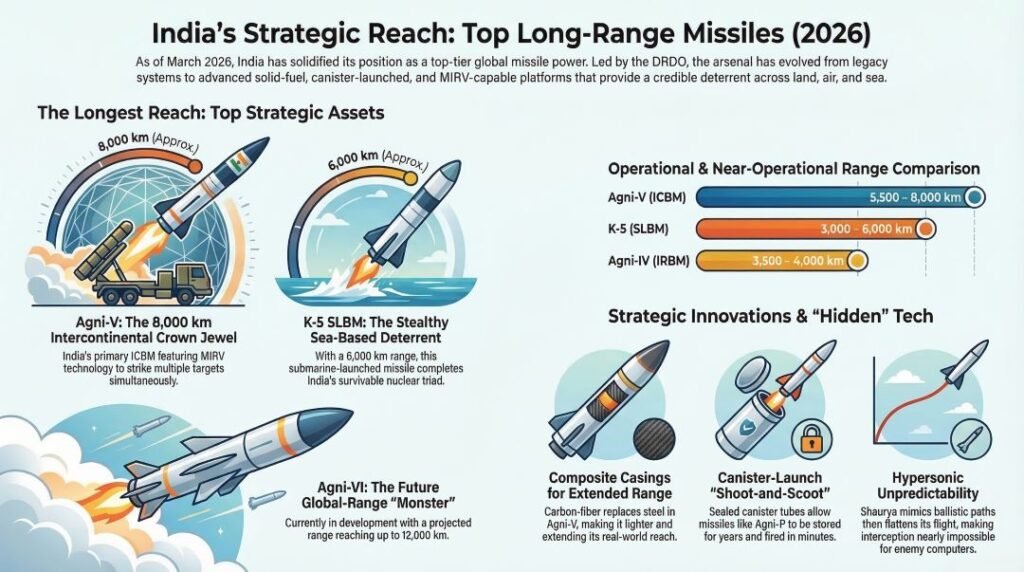
As of March 2026, the Agni-V is India’s longest range operational missile with a confirmed range of 5,500–8,000 km. However, the newly completed K-5 SLBM (Submarine-Launched Ballistic Missile), whose development was officially completed in mid-2025, now ranks close behind with a range of 5,000–6,000 km. India’s longest range nuclear missile in the pipeline – the Agni-VI – is expected to reach 8,000–12,000 km once inducted.
Top 10 Longest Range Missiles in India 2026 (.PPTX)
Table of Top 10 Longest Range Missiles in India 2026
The following list ranks India’s top 10 longest range missiles by their maximum operational range, with strategic survivability and payload capacity as secondary tie-breakers.
| Rank | Missile Name | Type | Range (Approx.) | Platform | Status |
| 1 | Agni-V | ICBM | 5,500 – 8,000 km | Road-Mobile | In Service |
| 2 | K-5 (SLBM) | Submarine-Launched Ballistic Missile | 5,000 – 6,000 km | Nuclear Submarine | Dev. Completed (Jul 2025) |
| 3 | Agni-IV | Intermediate-Range Ballistic Missile | 3,500 – 4,000 km | Road-Mobile | In Service |
| 4 | Agni-III | Intermediate-Range Ballistic Missile | 3,000 – 5,000 km | Rail/Road-Mobile | In Service |
| 5 | K-4 (SLBM) | Submarine-Launched Ballistic Missile | 3,500 km | Nuclear Submarine (Arihant-class) | In Service |
| 6 | Agni-II | Medium-Range Ballistic Missile | 2,000 – 3,000 km | Road-Mobile | In Service |
| 7 | Agni Prime (Agni-P) | Medium-Range Ballistic Missile | 1,000 – 2,000 km | Canisterized Mobile | In Service / Final Trials |
| 8 | Shaurya / K-15 | Hypersonic / SLBM | 700 – 1,900 km | Ground / Submarine | In Service |
| 9 | Nirbhay / LRLACMf | Subsonic Cruise Missile | 1,000 – 1,500 km | Multi-Platform | In Service (Inducted 2025-26) |
| 10 | Agni-I | Medium-Range Ballistic Missile | 700 – 1,200 km | Road-Mobile | In Service |
Detailed Missile Profiles – Top 10 Longest Range Missiles in India 2026
#1. Agni-V – India’s Crown Jewel ICBM
- Type: Intercontinental Ballistic Missile (ICBM)
- Range: 5,500 – 8,000 km (defence analysts suggest the upgraded Mk-II variant could exceed 7,000–8,000 km due to composite materials)
- Developer: DRDO | Status: In Service
- Warhead: Nuclear-capable with MIRV technology (Mission Divyastra – successfully validated in 2024 and 2025)
- Hidden Feature: Uses carbon-fibre composite casing instead of steel, making it significantly lighter and extending its real range well beyond the diplomatically stated 5,000 km
Agni-V is India’s most advanced long-range missile and the only true ICBM in its operational arsenal. With Mission Divyastra, India officially validated its ability to deploy Multiple Independently Targetable Re-entry Vehicles (MIRVs) – meaning a single Agni-V can strike multiple cities simultaneously with separate nuclear warheads. It uses a three-stage solid-fuel engine, is road-mobile, and can be launched in minutes from any location.
#2. K-5 (SLBM) – The Ghost Submarine Missile
- Type: Submarine-Launched Ballistic Missile (SLBM)
- Range: 5,000 – 6,000 km
- Developer: DRDO | Status: Development Completed July 2025
- Platform: Integration with future S4/S5 nuclear submarines underway
- Warhead: Nuclear-capable, 2 tons (with MIRV capability)
- Hidden Feature: Uses water-tight gas ejection to pop out of the submarine before ignition – this prevents the sub’s location from being revealed by a large underwater bubble
The K-5 is named in honour of former President Dr. A.P.J. Abdul Kalam, who is considered the father of India’s missile programme. It is the successor to the K-4 and dramatically extends the underwater nuclear reach of India’s Arihant-class and future S4/S5 nuclear submarines. With its development completed in mid-2025, it now represents one of the top 3 longest range missiles in India and forms the sea leg of India’s nuclear triad alongside Agni-V.
#3. Agni-IV – Precise Long-Arm Deterrent
- Type: Intermediate Range Ballistic Missile (IRBM)
- Range: 3,500 – 4,000 km
- Developer: DRDO | Status: In Service – core intermediate-range deterrent
- Warhead: Nuclear-capable
- Hidden Feature: Heat shielding on the re-entry tip withstands temperatures of 3,000°C – a composite shield keeps the inside at a cool 50°C
Agni-IV is fully operational and remains India’s primary intermediate-range deterrent. It features advanced composite materials in its two stages, making it lighter and faster than Agni-III. It provides coverage of all strategic targets across China and the broader Asian theatre.
#4. Agni-III – High-Payload Heavy Lifter
- Type: Intermediate Range Ballistic Missile (IRBM)
- Range: 3,000 – 5,000 km
- Developer: DRDO | Status: In Service – known for high accuracy in the intermediate range
- Warhead: Nuclear-capable, up to 2 tons payload
Agni-III is a two-stage solid propellant missile renowned for carrying the heaviest warhead payload of any Agni variant. With a circular error probable (CEP) well under 40 metres, it delivers exceptional accuracy at intermediate ranges. It can carry large thermonuclear warheads and provides India with a guaranteed second-strike capability.
#5. K-4 (SLBM) – Active Sea-Based Deterrent
- Type: Submarine-Launched Ballistic Missile (SLBM)
- Range: 3,500 km
- Developer: DRDO | Status: In Service on INS Arihant and INS Arighat
- Warhead: Nuclear-capable
The K-4 is actively deployed on Arihant-class submarines like INS Arihant and INS Arighat. It provides India’s credible minimum nuclear deterrence from beneath the ocean. The K-series sits at the bottom of the sea for months – making it practically impossible for an adversary to wipe out India’s sea-based nuclear capability in a pre-emptive strike.
#6. Agni-II – Proven Medium Range Workhorse
- Type: Medium Range Ballistic Missile (MRBM)
- Range: 2,000 – 3,000 km
- Developer: DRDO | Status: In Service with the Strategic Forces Command
- Warhead: Nuclear or conventional
Agni-II has been a backbone of India’s strategic forces for over two decades. It is a rail and road-mobile missile designed specifically to hold targets in Pakistan’s Andaman & Nicobar region and throughout China’s interior. Its proven reliability and quick deployment from mobile launchers make it one of the most battle-ready missiles in India’s arsenal.
#7. Agni Prime (Agni-P) – Next-Generation Canister Missile
- Type: Medium Range Ballistic Missile (MRBM) – Next-Generation
- Range: 1,000 – 2,000 km
- Developer: DRDO | Status: In Service / Final Operational Trials completed late 2025
- Warhead: Nuclear-capable with MIRV payload potential
- Hidden Feature: Cold-launched from a sealed canister tube – can be stored for years without maintenance and launched in minutes from any hidden roadside
Agni Prime completed its final operational configuration trials in late 2025, making it the newest addition to India’s active ballistic missile fleet. It uses canister-launch technology similar to the US Minuteman III and Russia’s Topol-M, dramatically reducing preparation time. It is intended to replace both Agni-I and Agni-II in India’s strategic arsenal, delivering better accuracy with a lighter frame.
#8. Shaurya / K-15 – Hypersonic Glide Surprise
- Type: Hypersonic / SLBM Hybrid
- Range: 700 – 1,900 km
- Developer: DRDO | Status: In Service
- Platform: Ground-Mobile and Submarine-launched
- Hidden Feature: Acts like a ballistic missile initially but flattens out its flight path in the upper atmosphere – making its final destination impossible to predict for enemy computers
Shaurya is one of India’s most underappreciated strategic assets. While classified as a hypersonic glide vehicle, it uses two separate fuel chambers to reignite its engine at different stages – giving it a ‘second wind’ and unexpected additional range or speed. It provides rapid-response strike capability and is nearly impossible to intercept due to its unpredictable trajectory. It is effectively the land-based version of the K-15 SLBM.
#9. Nirbhay / LRLACM – India’s Tomahawk
- Type: Subsonic Long-Range Cruise Missile
- Range: 1,000 – 1,500 km
- Developer: DRDO (ADE) | Status: In Service (inducted 2025-26)
- Platform: Land, Sea, and Air (multi-platform)
- Hidden Feature: Flies just 50 metres above the ground – weaving through valleys to stay completely below enemy radar coverage
Nirbhay is often called India’s equivalent of the American Tomahawk cruise missile. Inducted into service in 2025-26, it uses terrain-hugging flight paths at extremely low altitudes, making it practically invisible to conventional radar systems. It is powered by a turbofan engine for sustained cruise and can engage high-value targets deep inside enemy territory with great precision.
#10. Agni-I – The Reliable Veteran
- Type: Short-to-Medium Range Ballistic Missile (SRBM/MRBM)
- Range: 700 – 1,200 km
- Developer: DRDO | Status: In Service – regularly test-fired by Strategic Forces to maintain combat readiness
- Warhead: Nuclear or conventional, up to 1,000 kg
Agni-I was India’s first truly indigenous nuclear-capable ballistic missile and the foundation on which the entire Agni family was built. Although it is the shortest-ranged missile on this list, it remains operationally relevant for border-conflict deterrence against Pakistan. It is steadily being replaced by the newer Pralay quasi-ballistic missile and Agni Prime for tactical missions.
Future Developments – What Comes Next in India’s Missile Programme?
- Agni-VI: Currently under development with a projected range of 8,000–12,000 km, designed to carry multiple warheads. Once inducted, it will become India’s first true global-range ICBM and rival Russia’s RS-28 Sarmat.
- BrahMos-II: A hypersonic variant of BrahMos with a planned range of 1,500 km and speeds up to Mach 8, using scramjet technology. It will rank among the fastest anti-ship missiles on Earth.
- LR-AShM (Long Range Anti-Ship Missile): Showcased in January 2026 – a Hypersonic Glide Missile with a range of over 1,500 km that reached Mach 10 in recent tests, signalling India’s entry into operational hypersonic anti-ship strike capability.
Hidden Features and Strategic Secrets of India’s Missiles
Beyond range and speed, India’s missile programme contains several design choices and strategic features that rarely make headlines. Here is what makes each missile special under the surface.
| Missile | Hidden Feature | Why It Matters |
| Agni-V | Composite Casing | Carbon-fibre instead of steel makes it ~2,000 km lighter than its official 5,000 km range suggests |
| Agni Prime | Canister Launch | Cold-launched from a sealed tube – can be stored for years and fired in minutes from a hidden roadside |
| K-Series (K-4/K-5) | Water-Tight Gas Ejection | A gas generator pops the missile out before engine ignition – the sub’s location is never revealed by a bubble |
| Nirbhay | Terrain Hugging | Flies just 50 metres above ground, weaving through valleys to stay below enemy radar |
| Shaurya | Hybrid Flight | Mimics a ballistic missile then flattens out – final destination is impossible to predict |
| Agni-V (MIRV) | Decoy Deployment | Mission Divyastra revealed it carries dummy warheads to trick interceptors while real nukes hit the target |
| BrahMos | S-Manoeuvre | In its final seconds, it performs a high-G S-turn at Mach 3 – no ship defence system can track a target moving that fast in a zig-zag |
| Agni-IV | Heat Shielding | Re-entry tip withstands 3,000°C – composite shield keeps interior at just 50°C |
| Pralay | Quasi-Ballistic | Can change flight path mid-air – if intercepted, it shifts trajectory while still at supersonic speed |
| K-15 (Sagarika) | Double Pulse | Two separate fuel chambers reignite at different stages – gives it a second wind of range or speed |
How and Why These Missiles Are Ranked This Way?
The ranking is based on maximum strike distance as the primary metric. In cases where ranges overlap, the more advanced or higher-payload system is ranked higher. Here is the methodology:
- Maximum Strike Distance: The Agni-V holds the top spot as India’s only true ICBM, capable of reaching targets across entire continents.
- Confirmed Development vs. Speculation: The K-5’s development was officially completed in mid-2025, earning it the #2 rank. Agni-VI remains in the hardware realization phase and has not undergone full flight testing as of early 2026 – so it is excluded from the operational top 10.
- Strategic Platform Priority: Sea-based systems like K-4 and K-5 are ranked higher than land-based systems of similar range because they provide a survivable second-strike capability – the cornerstone of India’s No First Use nuclear doctrine.
- Technology Multipliers: Systems with MIRV capability like Agni-V are prioritized because of their ability to hit multiple targets simultaneously with a single launch.
- Speed vs. Range: Missiles like Shaurya and BrahMos are ranked lower on this list not because they are less capable – but because they prioritize speed and survivability over maximum distance.
Missile Economics – Production Cost, Maintenance and Export Status
India’s missile costs are among the lowest globally due to high indigenisation and efficient R&D by DRDO. Strategic ballistic missiles are built for internal deterrence. Cruise missiles like BrahMos have become major export earners.
| Missile | Unit Production Cost (Est.) | Annual Maintenance | Export Status | Major Buyers / Notes |
| Agni-V | Rs. 50–100 Crore | Moderate | Prohibited | Strategic internal deterrent only |
| K-4 / K-5 | Rs. 90–130 Crore (Est.) | High (sub-saltwater) | Prohibited | Classified – exclusive to Indian Navy |
| BrahMos (Std) | Rs. 25–28 Crore (~$3M) | Low to Moderate | Active Export | Philippines ($375M deal) |
| BrahMos (ER) | Rs. 34 Crore (~$4M) | Low to Moderate | Active Export | Indonesia ($300–450M deal) |
| Nirbhay | Rs. 10–15 Crore (Est.) | Low | Internal Use | Potential future export to friendly nations |
| Agni-P | Rs. 25–40 Crore (Est.) | Very Low (Canister) | Internal Use | Next-gen replacement for Agni-I and II |
| Pinaka (Rocket) | Rs. 2.3 Crore (~$279K) | Very Low | High Demand | France and Armenia (reports of keen interest) |
Key financial facts about India’s missile programme:
- Export Policy: India strictly regulates exports via the SCOMET list to prevent proliferation to hostile actors.
- MTCR Impact: As an MTCR member, India can export missiles with ranges under 300 km and payloads under 500 kg with fewer restrictions – like the standard BrahMos.
- Production Hubs: Bharat Dynamics Limited (BDL) is the main manufacturer for the Agni and Akash series. The new Lucknow BrahMos Facility – a Rs. 300 crore plant – produces 80–100 BrahMos missiles annually.
- Cost Advantage: Indian systems like the Pinaka cost roughly 1/10th of comparable Western systems.
- R&D Investment: The total value of DRDO-developed systems inducted into India’s armed forces is estimated at over Rs. 5 Lakh Crore.
India vs. The World – Global Rivals Comparison Table
To understand where India stands globally, here is how its top 10 missiles compare against their closest foreign equivalents from China (primary strategic rival), Pakistan (regional rival), and the USA/Russia (global gold standards).
| Rank | Indian Missile | Global Rival | Country | Rival’s Range | The Verdict |
| 1 | Agni-V (ICBM) | DF-41 | China | 12,000–15,000 km | The Gap: DF-41 has nearly double the range. However, Agni-V covers all relevant targets in Asia/Europe – making extra range unnecessary for India’s doctrine |
| 2 | K-5 (SLBM) | JL-3 | China | 10,000+ km | Tech Catch-up: China’s JL-3 allows subs to strike the US from protected waters. India’s K-5 is a massive leap forward |
| 3 | Agni-IV (IRBM) | DF-26 | China | 4,000–5,000 km | Guam Killer vs. Deterrence: The DF-26 targets aircraft carriers. Agni-IV is purely a strategic deterrent for cities |
| 4 | Agni-III (IRBM) | Jericho III | Israel | 4,800–6,500 km | Payload Power: Both are heavy lifters. Agni-III matches Jericho III in throw weight, allowing for large fusion weapons |
| 5 | K-4 (SLBM) | M51 (France) | France | 8,000–10,000 km | Range Disadvantage: The French M51 is a true intercontinental SLBM. K-4 is designed for regional second strikes rather than global reach |
| 6 | Agni-II (MRBM) | Shaheen-III | Pakistan | 2,750 km | Direct Counter: Shaheen-III was built specifically to reach India’s Andaman & Nicobar Islands. Agni-II is the proven counter-force |
| 7 | Agni Prime (MRBM) | DF-21D | China | 1,500–1,700 km | Accuracy Evolution: Agni-P uses canister-launch tech similar to the DF-21D but focuses on shoot-and-scoot survival rather than anti-ship |
| 8 | Shaurya (Hypersonic) | DF-17 | China | 1,800–2,500 km | Speed Match: Both are hypersonic gliders designed to defeat missile defence like THAAD and S-400. DF-17 is seen as slightly more mature in deployment |
| 9 | Nirbhay (Cruise) | Tomahawk | USA | 1,600–2,500 km | The Inspiration: Nirbhay is often called India’s Tomahawk. While the US version is far more battle-hardened, Nirbhay offers similar terrain-hugging stealth at a fraction of the cost |
| 10 | Agni-I (MRBM) | Shaheen-I | Pakistan | 750–900 km | The Old Guard: Both are short-range nuclear-capable missiles meant for border conflicts. Agni-I is reliable but slowly being replaced by Pralay and Agni Prime |
Strategic Analysis – Where India Stands in 2026
- The Range Gap Reality: Indian missiles generally have shorter ranges than Chinese or American equivalents. This is intentional. India’s security doctrine is Threat Specific – it only builds missiles with enough range to cover China and Pakistan. It has no strategic need to target North America or South America.
- The Platform Shift: India has successfully moved from liquid-fuelled, open-launch systems like the older Prithvi to solid-fuelled, canister-launch platforms like Agni-P and Agni-V. This matches the global gold standard set by the US Minuteman III and Russia’s Topol-M – missiles can now be launched in minutes rather than hours.
- Hypersonic Club: With Shaurya and the HSTDV (Hypersonic Tech Demonstrator), India is one of only four nations alongside Russia, China, and the USA with active hypersonic glide vehicle technology – placing it ahead of all European powers in this niche.
- Upcoming Match-ups: If India builds the Agni-VI at 12,000 km, it will finally enter the Monster Class of ICBMs alongside Russia’s RS-28 Sarmat (Satan II). BrahMos-II vs. Russia’s Zircon: These will likely be the two dominant hypersonic cruise missiles of the late 2020s.
Also read: Top 10 Weapons of Iran 2026 (.PPTX)
(FAQs)
Q1. Which is the longest range missile in India?
Agni-V is India’s longest range operational missile at 5,500–8,000 km. The Agni-VI under development will push this to 8,000–12,000 km when inducted.
Q2. What is the maximum range of Indian missiles?
As of March 2026, the maximum confirmed operational range is 8,000 km (Agni-V). With Agni-VI in development, this will increase to approximately 12,000 km.
Q3. How many Agni-5 missiles does India have?
The exact number is classified by the Indian government and Strategic Forces Command. Open-source defence analysts suggest India has a meaningful operational stockpile sufficient for credible minimum nuclear deterrence across multiple launch platforms.
Q4. How many Agni-6 missiles does India have?
As of early 2026, Agni-VI has zero operational missiles. It remains in the hardware realization phase and has not yet undergone full flight testing. Once inducted, it will become the flagship of India’s strategic arsenal.
Q5. Is Agni faster than BrahMos?
It depends on the phase of flight. BrahMos cruises at Mach 2.8–3.0, making it the fastest active cruise missile in the world. Agni missiles during re-entry can reach Mach 20+ – far faster than BrahMos. However, BrahMos is harder to intercept during its active phase due to its low altitude and high-G manoeuvring capability.
Q6. How many S-400 missile systems does India have?
India has procured five S-400 Triumf air defence missile systems from Russia. These systems can track and neutralise aircraft, cruise missiles, drones, and certain ballistic missiles at ranges of up to 400 km, providing India with a powerful layered missile defence shield.
Q7. What are the top 5 missiles of India?
- Agni-V – ICBM, 5,500–8,000 km, nuclear-capable with MIRV
- K-5 (SLBM) – 5,000–6,000 km, submarine-launched nuclear deterrent
- Agni-IV – IRBM, 4,000 km, precision nuclear deterrent
- K-4 (SLBM) – 3,500 km, sea-based nuclear triad asset
- BrahMos – Mach 3 supersonic cruise missile, world’s fastest operational cruise missile
Q8. What is India’s total ballistic missile count?
India operates multiple types of ballistic missiles including the Agni series (I through VI), K-series submarine-launched missiles, Prithvi, Pralay, and Shaurya. The total operational ballistic missile stockpile is classified, but India is estimated to maintain between 160–200 nuclear warheads with multiple delivery systems according to open-source research.
Conclusion
India’s missile programme in 2026 is a story of extraordinary self-reliance, strategic vision, and scientific achievement. From the Agni-V ICBM capable of reaching Europe to the newly completed K-5 SLBM prowling the ocean depths, India has built a comprehensive nuclear triad that covers the full spectrum of modern deterrence.
The top 10 longest range missiles in India include intercontinental ballistic missiles, submarine-launched deterrents, hypersonic gliders, and precision cruise missiles – each built at a fraction of the cost of Western equivalents. India’s India missile technology ranking consistently places it among the top 5–6 missile powers globally, alongside the US, Russia, China, France, and Israel.
Whether you were looking for the Indian missile list with range, Agni-6 missile range, how many Agni-5 missiles India has, India missile range map coverage, or a complete comparison against global rivals – this guide has covered every dimension of India’s remarkable missile arsenal.