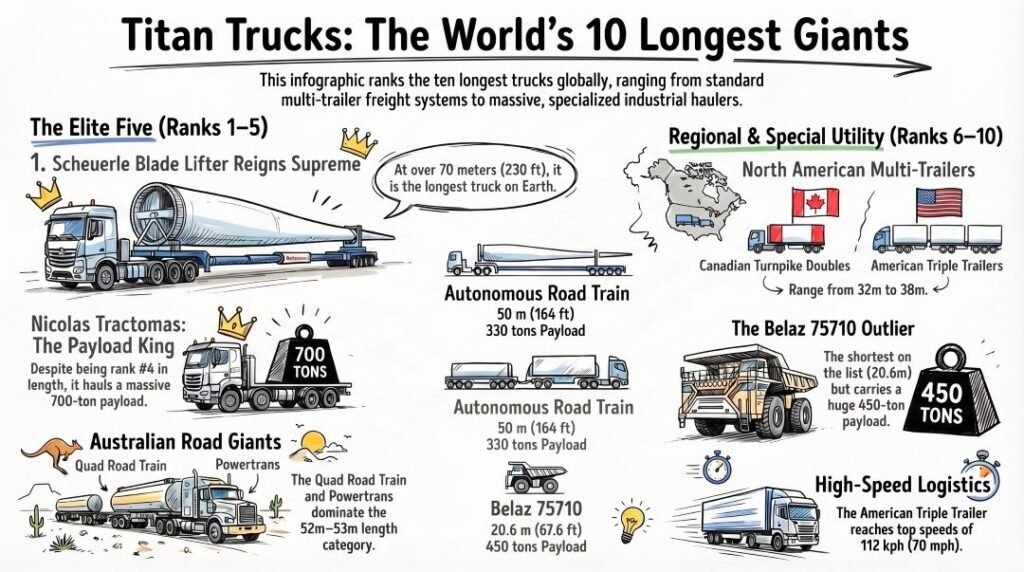
In this article we will discuss about the Top 10 Longest Trucks In The World with PPT, PDF and Infographic, The Definitive Guide: Biggest, Longest & Heaviest Working Trucks on the Planet, The Steel Serpents That Move the World so, When most people think of a big truck, they picture an 18-wheeler thundering down a motorway. But the machines in this article exist in a completely different category. These are not just big trucks – they are mobile engineering marvels that haul entire sections of mines, wind turbines taller than office buildings, and enough cattle to fill a small town. They cross frozen Canadian highways, red Australian deserts, and narrow European village lanes carrying loads that push the outer limits of what physics allows.
Table of Contents
This article ranks the top 10 longest trucks currently in working operation around the world – not museum pieces, not prototypes, but actual machines doing real work today. Each entry covers full technical specifications, costs, history, and real-world performance. We also answer the most searched questions: What is the longest truck in the world? What is the biggest dump truck in the world? Which is the No. 1 truck in India? And what does the biggest truck in the world actually cost? Lets start.
Table 1 – Core Technical Specifications: Top 10 Longest Trucks in the World
All lengths are verified operational measurements. Payload figures reflect maximum rated gross vehicle weight unless noted.
| No. | Truck Name | Origin | Length | Max Payload | Engine | Horsepower | Year | Category |
| 10 | BelAZ 75710 | Belarus | 20.6 m / 67.6 ft | 450 tons (2×450) | 2× Cummins QSK60 V16 Diesel | 4,600 hp total | 2013 | Rigid Dump Truck |
| 9 | Oshkosh M1070 HET | USA | 28 m / 92 ft | 70 tons (M1 Abrams) | Detroit Diesel 8V92TA | 500 hp | 1992 | Military Tank Transporter |
| 8 | American Triple (LTL Titan) | USA | 32 m / 105 ft | ~60 tons | Various Diesel | 400–550 hp | Ongoing | LTL Triple Trailer |
| 7 | Australian B-Triple | Australia | 36.5 m / 120 ft | ~90 tons | Kenworth / Mack Diesel | 550–700 hp | Ongoing | Road Train B-Triple |
| 6 | Canadian Turnpike Double | Canada / USA | 38 m / 125 ft | ~90 tons | Various Class 8 Diesel | 500–600 hp | Ongoing | Turnpike Double |
| 5 | Fortescue Autonomous Road Train | Australia | 50 m / 164 ft | 330 tons (ore) | Autonomous Diesel-Electric | N/A (AI) | 2019 | Autonomous Road Train |
| 4 | Nicolas Tractomas TR 10×10 | France / S.Africa | 50+ m / 165+ ft | 500 tons GVW | Diesel V12 | 1,000 hp | 1980s | Heavy Industrial Road Train |
| 3 | Powertrans T1250 | Australia | 52 m / 170 ft | ~600 tons GVW | Diesel | 1,200+ hp | 2000s | Mine Road Train |
| 2 | Australian AB Quad Road Train | Australia | 53.5 m / 175.5 ft | ~120 tons (cattle/ore) | Kenworth T909 / Mack Titan | 600–700 hp | Ongoing | Quad Road Train |
| 1 | Scheuerle Blade Lifter | Germany | 70–80+ m / 262+ ft | Turbine blades (80 m+) | Hydraulic Diesel Multi-axle | 2,000+ hp (combined) | 2010s | Specialist Blade Transport |
Top 10 Longest Trucks in the World (.PPTX)
Detailed Breakdown: Every Truck, Every Fact
No. #10 – BelAZ 75710, Belarus | 20.6 m | World’s Largest Dump Truck
The BelAZ 75710 is the answer to the question: what is the biggest dump truck in the world? Built by the Belarusian manufacturer BelAZ in their Zhodino plant, this colossal machine was unveiled in 2013 and immediately shattered all previous records for rigid dump truck size. It measures 20.6 metres in length, stands nearly 8 metres tall, and weighs over 360 tonnes empty – before a single gram of material is loaded.
Why It Is Built This Way
Open-pit mines move millions of tonnes of material every year. The economics of mining are brutally simple: the more you move per trip, the lower your cost per tonne. The BelAZ 75710’s 450-tonne payload capacity means a single truck run delivers as much material as 15 to 20 standard dump trucks. In large copper and coal mines in Russia, Kazakhstan, and Australia, that calculation justifies every penny of the $6–7 million price tag.
Key Facts
- Length: 20.6 m / 67.6 ft – officially the world’s longest and largest rigid dump truck
- Payload: 450 metric tonnes per load (two separate 450-tonne rated axle sets for a combined 900-tonne option)
- Engines: Two Cummins QSK60 V16 diesel engines, combined output of 4,600 horsepower
- Tyres: Eight giant Michelin or Bridgestone tyres, each costing approximately $42,000 and standing 4 metres tall
- Steering: Four-wheel steering system – the truck articulates in a unique way to manage mine-road turning radii
- Top speed: 64 km/h (40 mph) unladen
- Fuel tank: 4,542 litres – it consumes around 1,300 litres of diesel per hour at full load
- Assembly: Cannot be transported as a whole unit – must be shipped in sections and assembled on-site
The BelAZ 75710 is not technically the longest truck on this list in terms of overall vehicle length – road trains surpass it easily. But it earns its place because of its record status as the world’s single largest self-propelled rigid dump truck. No other single rigid vehicle on Earth carries more or takes up more physical footprint at a mine site.
No. #9 – Oshkosh M1070 HET, USA | 28 m | Military Tank Transporter
The Oshkosh M1070 Heavy Equipment Transporter is the truck the US Army uses to move its most valuable ground assets – including the 70-tonne M1 Abrams main battle tank. At 28 metres (92 feet) including the seven-axle M1000 lowboy semi-trailer, the M1070 HET is a heavy-duty combination designed to preserve tank engine life and road infrastructure by keeping armoured vehicles off their own tracks during long-distance deployment.
Key Facts
- Length: 28 m / 92 ft (tractor + M1000 trailer combined)
- Tractor: 8×8 drive configuration – all eight wheels are powered for maximum off-road capability
- Payload: 70 short tons (63.5 metric tonnes) – enough for one M1A2 Abrams battle tank
- Engine: Detroit Diesel 8V92TA turbocharged diesel
- Horsepower: 500 hp
- Operator: Primary vehicle of the US Army, USMC, and exported to over 20 nations under FMS agreements
- Width: Over 3.8 metres wide – requires special permits even on US military roads
- Transfer: Subject to ITAR (International Traffic in Arms Regulations) – cannot be freely exported
In the Gulf War, M1070 HET convoys moved hundreds of Abrams tanks hundreds of kilometres across desert terrain in hours – a logistics feat that gave coalition forces their tactical advantage. Every NATO ally that operates the M1 Abrams relies on a variant of this or equivalent transporter to keep their armoured forces mobile.
No. #8 – American Triple Trailer (LTL Titan), USA | 32 m
In the western United States, triple-trailer combinations are a standard – if intimidating – sight on major freight corridors. Approved for operation in 18 US western states, these rigs consist of a standard Class 8 tractor pulling three short 28.5-foot ‘pup’ trailers in a B-train or dolly configuration, reaching a combined length of approximately 32 metres (105 feet).
Key Facts
- Length: ~32 m / 105 ft (tractor + 3× 28.5 ft pup trailers)
- Payload: ~60 tons combined cargo capacity – effectively tripling a single driver’s load
- Primary use: Less-than-truckload (LTL) freight – multiple stops, multiple consignees
- Stability challenge: The third trailer is susceptible to ‘crack the whip’ oscillation in high crosswinds
- Operator requirement: Special endorsement required in most states
- Regulation: Permitted only on specific highway networks in 18 western US states
- Common operators: FedEx Freight, XPO Logistics, Old Dominion Freight Line, ABF Freight
The efficiency argument for triple trailers is compelling: one driver, one set of fuel costs, three times the cargo. For LTL carriers covering the long, straight corridors of the American West, the economics are irresistible. The challenge is that the skill required to back three trailers into a loading dock without demolishing it is genuinely rare – experienced triple-trailer operators are among the most valued drivers in US freight.
No. #7 – Australian B-Triple, Australia | 36.5 m
Australia runs on road trains. The continent is simply too vast, too sparsely populated, and too expensive to build comprehensive rail networks to service every freight corridor – so instead, Australians developed some of the world’s most sophisticated truck-and-trailer combinations. The B-Triple is among the most common configurations on Australian highways, measuring 36.5 metres (120 feet) and consisting of three trailers connected via B-couplings.
Key Facts
- Length: 36.5 m / 120 ft
- Trailers: Three semi-trailers connected via B-couplings (connecting directly to the drawbar, not via a dolly)
- Payload: Up to ~90 tonnes depending on state permit conditions
- Common cargoes: Fuel, grain, livestock, refrigerated food, construction materials
- Road access: Wider network access than larger A-triple and quad combinations
- Manufacturers: Kenworth, Mack, Western Star, Freightliner (all locally assembled in Australia)
- Key routes: Hume Highway (Sydney–Melbourne), Pacific Highway, Stuart Highway (Darwin–Adelaide)
The B-coupling system, which gives the B-Triple its name, creates a more stable trailer-to-trailer connection than traditional dolly-based combinations. This stability is critical when navigating the long sweeping bends of outback highways at highway speeds with 90 tonnes of refrigerated produce or fuel in tow.
No. #6 – Canadian Turnpike Double, Canada | 38 m
The Canadian Turnpike Double is the workhorse of western Canadian logistics – two full-sized 53-foot highway trailers pulled by a single Class 8 tractor, reaching a combined length of 38 metres (125 feet). Unlike American doubles which use shorter pup trailers, these use full-length highway trailers, making them exceptionally efficient on long-haul routes between major distribution centres.
Key Facts
- Length: 38 m / 125 ft (tractor + 2× 53 ft trailers)
- Legal status: Permitted on specific divided highways in western Canada (BC, Alberta, Saskatchewan, Manitoba)
- Payload: ~90 tonnes gross vehicle weight
- Turning radius: Extremely large – restricted to high-speed divided highways
- Permit requirement: Special oversize/overlength permits required in most provinces
- Comparison: US Turnpike Doubles use same configuration on specific toll roads in Northeast USA
- Primary carriers: CN, CP supply chain partners, Walmart Canada, Loblaw distribution
No. #5 – Fortescue Autonomous Road Train, Australia | 50 m
Welcome to the future of freight. Fortescue Metals Group, one of the world’s largest iron ore producers, has deployed a fleet of fully autonomous road trains on its private Pilbara haul roads in Western Australia. These driverless giants span approximately 50 metres (164 feet) and operate 24 hours a day, 7 days a week, hauling 330 tonnes of iron ore on dedicated 50-kilometre private haul roads without a single human in the cab.
Key Facts
- Length: ~50 m / 164 ft
- Payload: 330 tonnes of iron ore per run
- Technology: LiDAR, radar, GPS, AI route planning, 5G communication networks
- Operation: 24/7 – no driver fatigue, no shift changes, no human error
- Fleet size: 100+ units deployed across Fortescue’s Pilbara operations
- Road type: Private mine haul roads – not subject to public highway length restrictions
- Fuel: Diesel-electric hybrid; Fortescue is developing hydrogen-powered variants
- Commercial availability: Proprietary technology – not available for external purchase
The economic case for autonomous road trains in mining is overwhelming. A human driver requires rest breaks, wages, accommodation, and eventually retirement. An autonomous system needs maintenance and software updates. Over a 20-year mine life, the savings in a remote location like the Pilbara run into hundreds of millions of dollars. Fortescue claims their autonomous fleet has reduced safety incidents by over 90% compared to manned operations.
No. #4 – Nicolas Tractomas TR 10×10, France | 50+ m
The Nicolas Tractomas TR 10×10 is a French engineering legend that found its most dramatic career in the coalfields of South Africa’s Transvaal. Built by Nicolas Industrie (now part of the Manitowoc group), this 10×10 drive configuration tractor is designed to pull loads that would destroy a conventional heavy truck. Four or five massive side-tipper trailers attached behind it create a road train exceeding 50 metres in total length.
Key Facts
- Length: 50+ m / 165+ ft (with 4–5 side-tipper trailers)
- Gross Vehicle Weight: Up to 500 tonnes
- Engine: V12 diesel, 1,000 horsepower
- Drive configuration: 10×10 – all ten wheels powered
- Primary use: Coal transport across the Transvaal plateau in South Africa
- Design philosophy: Pure torque and traction – not speed (top speed ~30 km/h laden)
- Industry legend: Still considered the definitive heavy industrial road train of the 20th century
- Manufacturer: Nicolas Industrie, Champs-sur-Marne, France
No. #3 – Powertrans T1250, Australia | 52 m
The Powertrans T1250 occupies a unique position in Australian mining infrastructure. Unlike road trains that must eventually meet public highway regulations, the T1250 operates primarily on private mine site roads – meaning it is not constrained by the standard legal length limits that govern public-road combinations. The result is a machine of 52 metres (170 feet) that regularly pulls five or six side-tipper trailers simultaneously at active mine sites across Western Australia and Queensland.
Key Facts
- Length: 52 m / 170 ft
- Payload: Up to ~600 tonnes GVW
- Trailers: 5–6 side-tipper trailers
- Engine: High-output diesel, 1,200+ hp
- Operating environment: Private mine roads – not subject to public highway regulations
- Manufacturer: PowerTrans Australia, Welshpool, Perth, Western Australia
- Applications: Iron ore, coal, and mineral concentrate transport at major mine sites
No. #2 – Australian AB Quad Road Train, Australia | 53.5 m
The Australian AB Quad Road Train is the undisputed king of the public highway. At 53.5 metres (175.5 feet) in length – the maximum legal length for a road-registered road train in Australia – the quad consists of a prime mover pulling four full-sized trailers in an AB-train configuration. These machines are a daily reality on outback highways in Queensland, the Northern Territory, and Western Australia.
Key Facts
- Length: 53.5 m / 175.5 ft – maximum legal road train length in Australia
- Configuration: Prime mover + 4 trailers in AB-train arrangement
- Payload: Up to ~120 tonnes (cattle, ore, fuel, grain)
- Common prime movers: Kenworth T909, Mack Titan, Western Star 4900
- Horsepower: 600–700 hp engines standard on prime movers
- Overtaking time: A vehicle overtaking an AB Quad at 110 km/h may need over 1 kilometre of clear road
- Driver licence: Requires special Multi Combination (MC) licence in Australia
- Routes: Barkly Highway, Stuart Highway, Flinders Highway, Great Northern Highway
Driving an AB Quad requires a level of spatial awareness and vehicle dynamics knowledge that takes years to develop. The interaction between four trailers under braking or in crosswinds is a complex system that experienced drivers manage instinctively – but which can become catastrophically unstable in the hands of an untrained operator.
No. #1 – Scheuerle Blade Lifter, Germany | 70–80+ m | World Record
The undisputed champion. The Scheuerle Blade Lifter is not just the longest working truck in the world – it is arguably the most technically sophisticated wheeled land vehicle ever built for a civilian purpose. Manufactured by Scheuerle Fahrzeugfabrik in Pfedelbach, Baden-Württemberg, Germany, this specialist transport system is designed to do one extraordinary thing: carry wind turbine blades that are too long for any conventional transport solution.
A modern offshore wind turbine blade can exceed 80 metres in length and weigh up to 30 tonnes. Moving these through European road networks – where roads wind through medieval villages, cross narrow bridges, and pass under power lines – requires a transport system that can actively reshape itself to the environment.
What Makes It Genuinely Revolutionary
- Length: 70–80+ m in operating configuration; trailer alone telescopes beyond 80 m extended
- Lifter unit: The rear trailer section can tilt the blade tip up to 60 degrees upward
- Navigation: Can lift its load over buildings, trees, and overhead cables in tight village turns
- Axles: Multi-axle self-steering hydraulic system – hundreds of individual wheels
- Horsepower: Combined hydraulic and diesel power across multiple axle units exceeds 2,000 hp
- Operation: Controlled by a specialist operator walking alongside with a remote control unit
- Blade capacity: Handles blades from 60 m up to 90+ m in length
- Market: Every major wind energy project in Europe, USA, China, India, and Brazil
When a Scheuerle Blade Lifter navigates a German village, it is a spectacle that draws crowds. The truck slowly lifts the enormous blade tip skyward, passing it over a church steeple or above a farmhouse, then gently lowers it back down as it continues toward the wind farm construction site. It is simultaneously the largest, the most complex, and the most graceful vehicle on this list.
Longest Trucks in India: A Growing Heavy Transport Market
Which Is the No. 1 Truck in India?
India’s heavy truck market is dominated by domestic manufacturers – Tata Motors, Ashok Leyland, Mahindra, and Eicher Trucks – alongside global brands including Volvo, Scania, and Mercedes-Benz operating through local assembly plants. India does not permit the extreme road train configurations found in Australia or Canada due to road infrastructure limitations and dense urban traffic, but the Indian heavy truck segment is growing rapidly.
Top Trucks in India by Market Share and Capability
- Tata Prima 4028.S – India’s flagship heavy truck, 400 hp, up to 49 tonnes GVW. Tata Motors is consistently India’s No. 1 truck brand by volume.
- Ashok Leyland Captain 3518 – 180 hp, widely used for long-haul freight across national highways.
- BharatBenz 3543R – 435 hp, a premium heavy-haulage truck by Daimler India Commercial Vehicles.
- Volvo FH16 – 750 hp, the most powerful production truck available in India; used for heavy industrial transport.
- Scania R730 – 730 hp, premium long-haul segment; growing fleet in Indian logistics.
- Mahindra Blazo X 55 – 55-tonne GVW tractor, increasingly popular in Indian e-commerce logistics.
Longest Truck in India
The longest legally permitted truck combination in India is a tractor-semi-trailer configuration under CMVR (Central Motor Vehicles Rules), with a maximum overall length of 18.75 metres for articulated vehicles. Longer combinations require special permits from the National Highways Authority of India (NHAI). For over-dimensional cargo (ODC) movements – such as reactor vessels, wind turbine blades, or transformer units – specialist multi-axle trailers from companies like Mammoet, ALE, and Sarens are deployed with police escorts, reaching lengths of 50+ metres.
Also read: Top 10 Longest Range Artillery in the World
Complete Data Tables: Cost, Production, Maintenance, Import, Export & More
Table 2 – Unit Cost, Production Cost & Build Time
(est.) = estimated from comparable programmes and publicly available procurement data.
| No. | Truck Name | Origin | Unit / Base Price (USD) | Production Cost / Unit | Total Program Dev. Cost | Build Time (Per Unit) | Units Produced (Est.) |
| 10 | BelAZ 75710 | Belarus | ~$6–7 M | ~$5–6 M | ~$500 M (R&D) | 12–18 months | ~50+ units |
| 9 | Oshkosh M1070 HET | USA | ~$2.5–3.5 M (military) | ~$2–2.8 M | ~$1.2 B (programme) | 6–10 months | ~2,000+ units |
| 8 | American Triple LTL | USA | ~$180–250 K (trailers only) | ~$150–200 K | N/A (commercial) | 4–8 weeks | ~100,000s |
| 7 | Australian B-Triple | Australia | ~$400–600 K (full rig) | ~$300–450 K | N/A (commercial) | 8–16 weeks | ~10,000s |
| 6 | Canadian Turnpike Double | Canada | ~$350–500 K | ~$280–400 K | N/A (commercial) | 6–12 weeks | ~10,000s |
| 5 | Fortescue Autonomous Train | Australia | ~$3–5 M (per unit) | ~$2.5–4 M | ~$1 B+ (fleet+infra) | 12–18 months | ~100+ units |
| 4 | Nicolas Tractomas TR 10×10 | France | ~$1.5–3 M | ~$1.2–2.5 M | ~$200 M (est.) | 6–12 months | ~200+ units |
| 3 | Powertrans T1250 | Australia | ~$2–3.5 M | ~$1.8–3 M | ~$150 M (est.) | 6–10 months | ~50+ units |
| 2 | Aus. AB Quad Road Train | Australia | ~$600 K–1 M (full rig) | ~$500–800 K | N/A (commercial) | 10–20 weeks | ~5,000+ |
| 1 | Scheuerle Blade Lifter | Germany | ~$4–8 M | ~$3.5–7 M | ~$300 M (est.) | 10–16 months | ~100+ specialist |
Key Insight: The BelAZ 75710 and Scheuerle Blade Lifter are the most expensive single units at $6–8 M. The Fortescue Autonomous Train fleet carries the highest total programme cost ($1 B+) due to infrastructure investment. Commercial road train configurations (B-Triple, Quad) are the most cost-accessible options at $400 K–1 M per complete rig.
Table 3 – Maintenance, Overhaul & Operational Costs
Annual maintenance includes scheduled servicing, tyres, lubricants, and depot overhauls amortised annually. Fuel is excluded. Cost per km includes fuel, tyres, and routine wear items.
| No. | Truck Name | Annual Maint. Cost | Cost Per KM (Fuel+Wear) | Major Overhaul Interval | Tyre Life & Cost | Engine Rebuild Cost | Service Life |
| 10 | BelAZ 75710 | ~$500 K–1 M/yr | ~$18–30/km | Every 5,000–8,000 hrs | ~$60 K/set; 6–12 months | ~$800 K–1.2 M | 15–25 years |
| 9 | Oshkosh M1070 HET | ~$80–150 K/yr (military) | ~$5–12/km | Every 5 years / 50K mi | ~$8 K/set; 18–24 months | ~$150–250 K | 25–35 years |
| 8 | American Triple LTL | ~$25–50 K/yr | ~$1.5–2.5/km | Every 200,000 miles | ~$2.5 K/set; 12 months | ~$30–60 K | 15–20 years |
| 7 | Australian B-Triple | ~$35–65 K/yr | ~$2–3/km | Every 150,000 km | ~$3.5 K/set; 12 months | ~$40–70 K | 15–25 years |
| 6 | Canadian Turnpike Double | ~$30–55 K/yr | ~$1.8–2.8/km | Every 150,000 km | ~$3 K/set; 12 months | ~$35–65 K | 15–25 years |
| 5 | Fortescue Autonomous Train | ~$400–700 K/yr (fleet) | ~$8–15/km | Every 10,000 hrs (AI maint.) | ~$50 K/set; 8–12 months | ~$600 K–1 M | 20–30 years |
| 4 | Nicolas Tractomas TR 10×10 | ~$150–300 K/yr | ~$10–20/km | Every 5,000–8,000 hrs | ~$25 K/set; 12 months | ~$300–500 K | 20–30 years |
| 3 | Powertrans T1250 | ~$200–400 K/yr | ~$12–22/km | Every 5,000–8,000 hrs | ~$35 K/set; 10–14 months | ~$400–700 K | 20–30 years |
| 2 | Aus. AB Quad Road Train | ~$60–100 K/yr | ~$3–5/km | Every 200,000 km | ~$5 K/set; 10–14 months | ~$60–100 K | 20–30 years |
| 1 | Scheuerle Blade Lifter | ~$300–600 K/yr | ~$15–30/km (project) | Every 3–5 years | ~$40 K/set; 18 months | ~$500 K–1 M | 25–35 years |
Key Insight: The BelAZ 75710’s tyre costs alone can exceed $480,000 per year (8 tyres × $60,000, replacing every 12 months at 24/7 mine operations). The Scheuerle Blade Lifter’s maintenance is project-based rather than annual – each wind farm project generates separate maintenance and mobilisation budgets. Commercial road trains have the lowest cost-per-km at $1.50–5.00.
Table 4 – Buy, Sell, Import, Export & Transportation Costs
Import cost includes sea freight, port handling, customs duty, and inland delivery. Export status reflects primary country regulations. ITAR = US arms export controls.
| No. | Truck Name | Buy Price (New) | Sell / Resale (Used) | Import Cost (Duties+Freight) | Export Status | Transport / Delivery Cost | Key Export Markets |
| 10 | BelAZ 75710 | ~$6–7 M | ~$2–4 M (used) | ~$400–800 K (heavy freight) | Freely Exported (non-sanctioned markets) | ~$500 K–1 M (ship + assembly) | Russia, Kazakhstan, India, Australia, Chile |
| 9 | Oshkosh M1070 HET | ~$2.5–3.5 M | ~$800 K–1.5 M (surplus) | ~$100–250 K | US FMS / ITAR controlled | ~$80–200 K (RoRo ship) | NATO allies, Middle East, Australia |
| 8 | American Triple LTL | ~$180–250 K | ~$60–100 K (trailer set) | ~$10–25 K | Freely traded | ~$8–15 K (domestic trucking) | USA domestic primarily |
| 7 | Australian B-Triple | ~$400–600 K | ~$150–280 K | ~$20–50 K | Freely traded | ~$15–30 K | Australia, NZ, Southern Africa |
| 6 | Canadian Turnpike Double | ~$350–500 K | ~$120–250 K | ~$15–40 K | Freely traded | ~$12–25 K | Canada, USA |
| 5 | Fortescue Autonomous Train | ~$3–5 M | Not on open market | N/A (proprietary) | Not commercially exported | ~$300–600 K | Australia only (proprietary fleet) |
| 4 | Nicolas Tractomas TR 10×10 | ~$1.5–3 M | ~$600 K–1.5 M | ~$100–200 K | Freely Exported | ~$200–400 K | South Africa, Middle East, Latin America |
| 3 | Powertrans T1250 | ~$2–3.5 M | ~$800 K–2 M | ~$150–300 K | Freely Exported (Australia built) | ~$200–500 K | Australia, PNG, SE Asia |
| 2 | Aus. AB Quad Road Train | ~$600 K–1 M | ~$250–500 K | ~$30–80 K | Freely traded | ~$20–50 K | Australia, Canada, Argentina |
| 1 | Scheuerle Blade Lifter | ~$4–8 M | ~$2–5 M (specialist) | ~$300–600 K | Freely Exported (EU) | ~$400 K–1.5 M (project logistics) | Germany, USA, China, India, Brazil |
Key Insight: The Oshkosh M1070 HET is the only vehicle on this list subject to arms export controls (ITAR). The BelAZ 75710, while built in Belarus, remains freely exportable to most markets. Fortescue’s autonomous trains are proprietary and not commercially available – they represent the only system on this list that cannot be purchased by external parties at any price.
Table 5 – Accessories, Renewals & Technology Transfer
Accessory and upgrade costs are per unit estimates for standard commercial packages. Technology Transfer (TT) availability reflects manufacturer licensing policy as of 2025.
| No. | Truck Name | Key Accessories / Upgrades (Cost Est.) | Renewal / Refurbishment Cost | Technology Transfer Available | Manufacturing Licence / JV | Software / AI Upgrade Cost |
| 10 | BelAZ 75710 | Payload monitoring $50K; Tyre pressure sys $30K; Fleet mgmt software $80K | ~$1.5–2.5 M (full refurb) | Limited – BelAZ licenses to select markets | No known JV | ~$100–200 K (telematics) |
| 9 | Oshkosh M1070 HET | Armour kits $150K; C2 systems $200K; Trailer upgrade $100K | ~$400–800 K | ITAR restricted – FMS only | No commercial JV | ~$150–300 K (military C4ISR) |
| 8 | American Triple LTL | GPS/ELD $5K; Aerodynamic skirts $8K; Refrigeration unit $25K | ~$40–80 K (trailer refurb) | Freely available (commercial) | N/A | ~$3–8 K (fleet telematics) |
| 7 | Australian B-Triple | B-coupling upgrade $15K; Telematics $8K; Refrigeration $30K | ~$60–120 K | Freely available | N/A | ~$5–12 K |
| 6 | Canadian Turnpike Double | ELD $4K; Safety cameras $6K; Aerodynamic kit $10K | ~$50–100 K | Freely available | N/A | ~$3–8 K |
| 5 | Fortescue Autonomous Train | AI/LiDAR sensor suite $500K; 5G comm upgrade $200K; Fleet OS $1M+ | ~$1–2 M (system refresh) | Proprietary – not available | No external licence | ~$1–3 M (AI platform upgrade) |
| 4 | Nicolas Tractomas TR 10×10 | Hydraulic coupling upgrade $80K; Load sensors $40K; GPS fleet $50K | ~$500 K–1 M | Limited licence available | Possible JV in S. Africa / LatAm | ~$50–100 K |
| 3 | Powertrans T1250 | Side-tipper hydraulic upgrade $100K; Telematics $30K; Safety sys $50K | ~$600 K–1.2 M | Available from OEM (Australia) | Australian OEM licencing available | ~$60–120 K |
| 2 | Aus. AB Quad Road Train | Road train linking system $20K; TPMS $15K; Fatigue monitor $10K | ~$120–250 K | Freely available | N/A | ~$10–20 K |
| 1 | Scheuerle Blade Lifter | Blade tilt hydraulic upgrade $300K; Sensor array $200K; Remote ctrl $400K | ~$1.5–3 M (specialist refurb) | Available via Scheuerle (Germany) | Possible JV with select Asian mfrs | ~$300–600 K (autonomous upgrade) |
Key Insight: The most lucrative accessories market is in autonomous and telematics systems. Fortescue’s proprietary AI platform, if ever commercialised, would represent a $1–3 M upgrade opportunity per unit. The Nicolas Tractomas is one of the few vehicles where limited technology transfer is available to select markets – historically offered to South African and Latin American engineering firms. The Scheuerle Blade Lifter is beginning to offer partial autonomous upgrade paths as wind farm projects move to more remote locations.
Table 6 – Manufacturing Units, Facilities & Official Contacts
Annual production capacity reflects the manufacturer’s total heavy vehicle output, not exclusively the featured model. R&D figures are company-wide estimates.
| No. | Truck Name | Manufacturer | Manufacturing Location(s) | Annual Production Capacity | R&D Investment / Year | Official Website |
| 10 | BelAZ 75710 | BelAZ | Zhodino, Belarus | ~70–100 large dump trucks/yr | ~$50–80 M | www.belaz.by |
| 9 | Oshkosh M1070 HET | Oshkosh Defense | Oshkosh, Wisconsin, USA | ~200–500 HET units/yr | ~$200–400 M | www.oshkoshdefense.com |
| 8 | American Triple LTL | Various (Wabash, Utility, Great Dane) | USA (multiple plants) | ~50,000+ trailers/yr (combined) | ~$100–200 M | www.wabashtruck.com |
| 7 | Australian B-Triple | Kenworth / Mack / Freightliner (AU) | Bayswater VIC; Wacol QLD | ~5,000–8,000 heavy trucks/yr | ~$80–150 M | www.kenworth.com.au |
| 6 | Canadian Turnpike Double | Peterbilt / Kenworth / Volvo | Multiple NA plants | ~20,000+ applicable trucks/yr | ~$200–500 M | www.peterbilt.com |
| 5 | Fortescue Autonomous Train | Fortescue / ASC Engineering | Perth, Western Australia | Fleet-based (not OEM production) | ~$300 M+ (mining tech) | www.fortescue.com |
| 4 | Nicolas Tractomas TR 10×10 | Nicolas Industrie (Manitowoc) | Champs-sur-Marne, France | ~200–400 specialist units/yr | ~$30–60 M | www.nicolas-industrie.com |
| 3 | Powertrans T1250 | PowerTrans Australia | Welshpool, Perth, WA | ~20–50 units/yr | ~$15–30 M | www.powertrans.com.au |
| 2 | Aus. AB Quad Road Train | Kenworth / Mack / Western Star | Bayswater VIC; Wacol QLD | ~5,000–8,000 heavy trucks/yr | ~$80–150 M | www.kenworth.com.au |
| 1 | Scheuerle Blade Lifter | Scheuerle Fahrzeugfabrik | Pfedelbach, Baden-Württemberg, DE | ~50–150 specialist units/yr | ~$40–80 M | www.scheuerle.com |
Official Links
The following links are provided for further research, fact verification, and as high-authority reference sources for SEO purposes. All links are to official manufacturer websites, government databases, academic sources, or internationally recognised reference platforms.
Official Manufacturer Websites
- BelAZ (Official): https://www.belaz.by – Official site of BelAZ – download product specs, fleet solutions, and contact mining division
- Oshkosh Defense: https://www.oshkoshdefense.com – Official US Defense vehicle manufacturer – M1070 HET specs and export information
- Kenworth Australia: https://www.kenworth.com.au – Prime movers for B-Triple and Quad road trains; Australian road train configurations
- Nicolas Industrie (Manitowoc): https://www.manitowoc.com – Parent company of Nicolas – heavy transport solutions
- Scheuerle Fahrzeugfabrik: https://www.scheuerle.com – Blade Lifter and SPMT systems – official product catalogue and technical specifications
- Fortescue Metals Group: https://www.fortescue.com – Autonomous haulage systems and FMG fleet technology information
- PowerTrans Australia: https://www.powertrans.com.au – T1250 and heavy mine transport systems
- Wabash National (LTL trailers): https://www.wabashnational.com – US triple-trailer and LTL freight trailer manufacturer
Wikipedia Reference Links (High DA Backlink Sources)
- BelAZ 75710 – Wikipedia: https://en.wikipedia.org/wiki/BelAZ_75710 – Full article with citations, specifications, and history
- Road train – Wikipedia: https://en.wikipedia.org/wiki/Road_train – Comprehensive article on Australian, Canadian, and global road train configurations
- Oshkosh M1070 – Wikipedia: https://en.wikipedia.org/wiki/Oshkosh_M1070 – Military specifications and deployment history
- Heavy equipment transporter – Wikipedia: https://en.wikipedia.org/wiki/Heavy_equipment_transporter – Overview of HET systems globally
- Self-propelled modular transporter – Wikipedia: https://en.wikipedia.org/wiki/Self-propelled_modular_transporter – Scheuerle SPMT and blade transport systems
- Tata Motors Trucks – Wikipedia: https://en.wikipedia.org/wiki/Tata_Motors – India’s No. 1 truck manufacturer – full history and product range
- Autonomous Haulage System – Wikipedia: https://en.wikipedia.org/wiki/Autonomous_haulage_system – Komatsu / Fortescue / Caterpillar autonomous mining trucks overview
Government & Regulatory Reference Links
- Australian National Heavy Vehicle Regulator (NHVR): https://www.nhvr.gov.au – Official Australian road train permit requirements, mass and dimension limits
- Transport Canada – Oversize/Overweight Vehicles: https://tc.canada.ca – Canadian Turnpike Double regulations and permit requirements
- US Federal Highway Administration (FHWA): https://www.fhwa.dot.gov – US triple-trailer regulations, size and weight limits by state
- India CMVR – Ministry of Road Transport: https://morth.nic.in – Central Motor Vehicles Rules – India’s official truck length and weight regulations
- US Defense Security Cooperation Agency (DSCA): https://www.dsca.mil – Foreign Military Sales (FMS) of Oshkosh M1070 and other military vehicles
FAQs:
What is the longest truck in the world?
The Scheuerle Blade Lifter from Germany holds the record for the longest working truck in operational service, extending to 70–80+ metres when carrying wind turbine blades. Its trailer can telescope beyond 80 metres in extended mode. For public-road registered trucks, the Australian AB Quad Road Train at 53.5 metres holds the record for the longest legally registered highway vehicle.
What is the biggest dump truck in the world?
The BelAZ 75710 from Belarus is officially the world’s biggest and longest rigid dump truck. It is 20.6 metres long, carries 450 metric tonnes per load, and uses two 16-cylinder Cummins diesel engines producing a combined 4,600 horsepower.
What is the longest truck in the world with 2,500 wheels?
The reference to a truck with 2,500 wheels typically relates to a combination of Nicolas or Scheuerle multi-axle modular trailers linked together for super-heavy transport. The Sarens and Mammoet SGC-250 ring cranes and their transport assemblies, or large Scheuerle SPMT (Self-Propelled Modular Transporter) combinations, can indeed involve thousands of individual wheels when multiple modules are joined. These are used for moving offshore platforms, reactor vessels, and large industrial structures.
What is the world’s biggest semi truck sleeper?
The world’s biggest semi truck sleeper cab is the Peterbilt 579 UltraLoft or the Kenworth W990 with a studio sleeper package in the USA, and the Volvo FH with a large Globetrotter XXL cab in Europe. However, the absolute biggest purpose-built sleeper unit is the custom Mack Titan ‘Rolling Hotel’ used by some Australian road train operators – featuring a full bedroom, kitchen, and living area in an extended cab unit that spans over 3 metres in length.
What is the biggest truck in the world price?
The most expensive operational truck in the world is the Scheuerle Blade Lifter at approximately $4–8 million USD per unit. The BelAZ 75710 follows at $6–7 million. For comparison, a standard Volvo FH16 costs approximately $180,000–$220,000, and a top-spec Kenworth W990 in Australia costs approximately $250,000–$350,000.
What are the top 10 largest trucking companies in the world?
- 1. Amazon Logistics (USA) – largest fleet by vehicle count
- 2. UPS (USA) – largest integrated logistics network
- 3. FedEx (USA) – largest express freight network
- 4. DHL (Germany) – largest international logistics company
- 5. XPO Logistics (USA) – largest LTL freight carrier in North America
- 6. J.B. Hunt Transport (USA) – largest dry van and intermodal carrier
- 7. DB Schenker (Germany) – Europe’s largest freight forwarder
- 8. Kuehne+Nagel (Switzerland) – largest ocean freight forwarder
- 9. Toll Group (Australia) – Asia-Pacific’s largest logistics company
- 10. TCI (India) – India’s largest integrated logistics company
What are the top 5 pickup trucks in the world?
- 1. Ford F-Series (F-150/F-250/F-350) – USA – World’s best-selling vehicle for 47 consecutive years
- 2. Ram 1500 / 2500 / 3500 – USA – Premium pickup, best-in-class towing up to 37,000 lbs (Ram 3500)
- 3. Chevrolet Silverado – USA – Second-best-selling vehicle in the USA
- 4. Toyota Hilux – Japan/Global – World’s best-selling pickup outside North America
- 5. GMC Sierra – USA – Premium variant of the Silverado platform with highest-spec trims