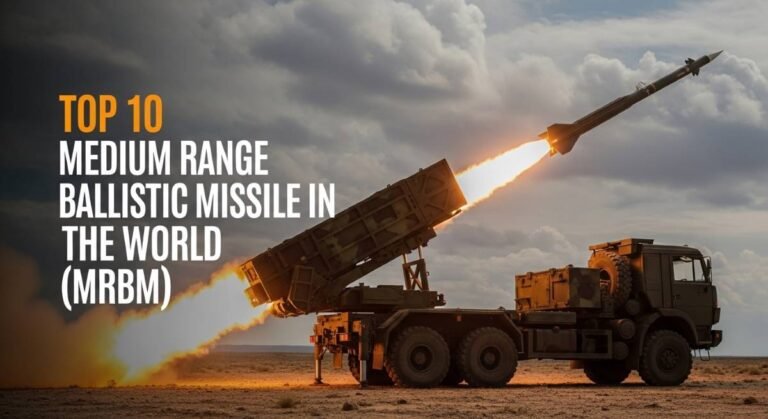
Today in this article we will discuss about the Top 10 Medium Range Ballistic Missile in the World (MRBM) with PDF, PPT and Infographic and we will Discover the top 10 most powerful medium-range ballistic missiles in the world with a complete expert guide covering range, speed, technology, and strategic importance from China’s hypersonic DF-17 to North Korea’s Pukguksong-2.
Table of Contents
Why Medium-Range Ballistic Missiles Matter More Than Ever?
In the complex and often volatile landscape of modern military strategy, few weapons systems carry as much geopolitical weight as the medium-range ballistic missile. They are not the largest missiles in any country’s arsenal – that distinction belongs to intercontinental ballistic missiles capable of crossing oceans and targeting cities on the other side of the planet. Nor are they the smallest – short-range tactical missiles serve different battlefield roles altogether. But medium-range ballistic missiles, commonly known as MRBMs, occupy a uniquely consequential middle ground that makes them central to the strategic calculations of nearly every major military power on Earth.
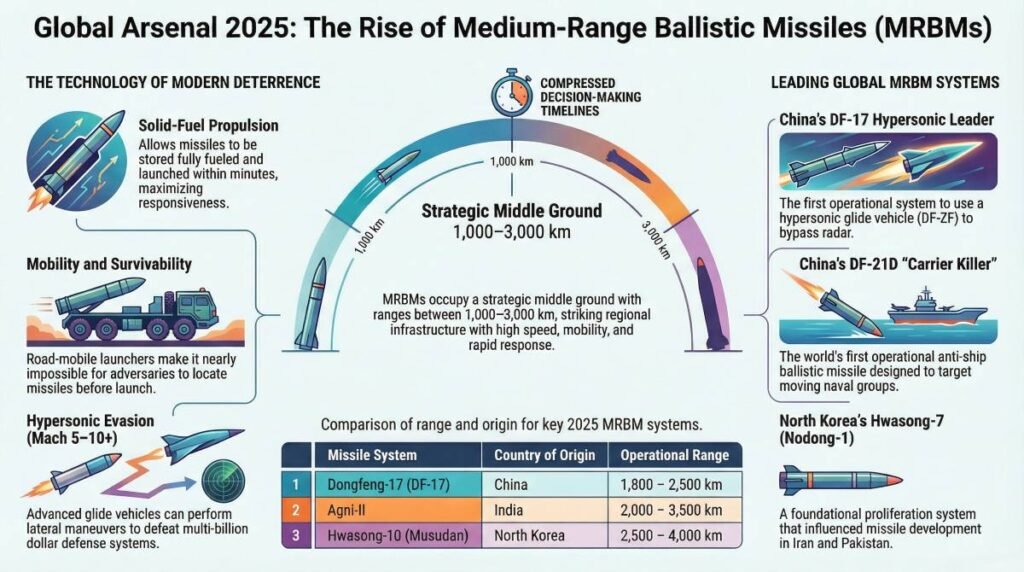
Defined by a range of approximately 1,000 to 3,000 kilometres, MRBMs can strike key regional targets – military bases, naval ports, air defence networks, command-and-control infrastructure, and major population centres – without requiring the enormous engineering complexity of an intercontinental system. In many ways, that is precisely what makes them so strategically significant. They are powerful enough to hold entire regions at risk, fast enough to compress decision-making timelines to minutes, and often mobile enough to be nearly impossible to find and destroy before launch.
The geopolitical consequences of MRBM development and deployment have been felt throughout history. The Cuban Missile Crisis of 1962 – the closest the world has come to nuclear war – was triggered in significant part by the deployment of Soviet medium-range ballistic missiles in Cuba, just 90 miles from the United States coast. The 1987 Intermediate-Range Nuclear Forces (INF) Treaty between the United States and Soviet Union was specifically designed to eliminate an entire category of ground-launched ballistic and cruise missiles with ranges between 500 and 5,500 kilometres – a testament to how destabilising these systems were considered. The US withdrawal from the INF Treaty in 2019 has since reopened the door to MRBM development among major powers, further raising the stakes.
Today, MRBMs are more sophisticated, more accurate, and more survivable than at any previous point in history. Solid-fuel propulsion systems allow missiles to be stored fully fuelled for years and launched within minutes. Mobile launchers mounted on road vehicles or rail cars make it extraordinarily difficult for adversaries to locate and destroy missiles before they fire. Advanced manoeuvrable re-entry vehicles and, in some cases, hypersonic glide vehicles can defeat modern missile defence systems that cost billions of dollars to deploy and operate. And multiple nations – China, India, Iran, Israel, North Korea, and Pakistan – have invested heavily in these systems, reshaping regional balances of power across Asia and the Middle East.
Because much of the technical data surrounding these weapons systems is classified, creating a definitive ranked comparison is genuinely challenging. What follows is a carefully researched, expert-informed overview of the ten most strategically significant medium-range ballistic missiles currently in service or operational deployment around the world, drawing on publicly available intelligence assessments, declassified military analyses, and credible open-source research.
What Exactly Is a Medium-Range Ballistic Missile?
Before examining specific systems, it is worth establishing a clear technical foundation. A ballistic missile is a weapon that follows a ballistic trajectory – meaning it is powered during an initial boost phase and then follows an unpowered, free-falling arc through space toward its target. Unlike cruise missiles, which fly through the atmosphere like an aircraft under continuous power, a ballistic missile’s warhead spends most of its flight in the upper atmosphere or even briefly in space before re-entering the atmosphere and descending toward the target at hypersonic speeds.
The classification of ballistic missiles by range is defined as follows by most defence authorities. Short-range ballistic missiles have a range of under 1,000 kilometres. Medium-range ballistic missiles operate between 1,000 and 3,000 kilometres. Intermediate-range ballistic missiles, sometimes called theatre ballistic missiles, cover 3,000 to 5,500 kilometres. Intercontinental ballistic missiles exceed 5,500 kilometres and can strike targets anywhere on Earth.
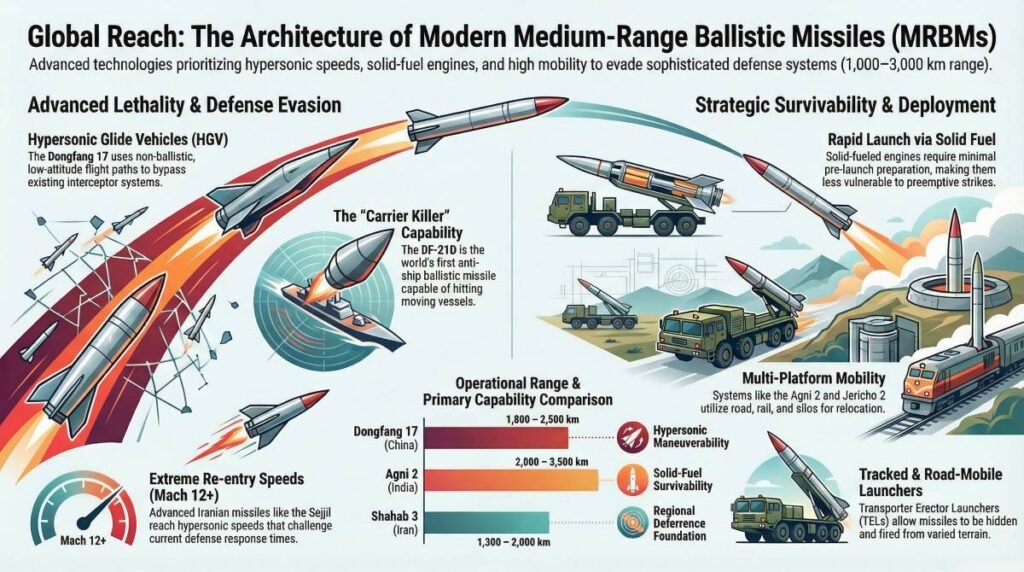
Modern MRBMs are characterised by several key technological features. Solid-fuel propulsion is preferred over liquid fuel because it dramatically reduces launch preparation time – from hours to minutes – and eliminates the need for hazardous fuelling procedures that can betray a missile’s location to surveillance satellites. Mobile launch platforms, including wheeled transporter-erector-launchers (TELs) and rail-mounted systems, allow missiles to be repositioned constantly, denying adversaries a fixed target. Manoeuvrable re-entry vehicles (MaRVs) and, in the most advanced cases, hypersonic glide vehicles allow the warhead to perform evasive manoeuvres at extreme speeds, defeating even the most sophisticated missile defence systems currently deployed. With that context established, here are the ten most significant medium-range ballistic missiles in the world today.
Top 10 Medium Range Ballistic Missile in the World (MRBM) | PPT SLIDES
#1. Dongfeng-17 (DF-17) – China
The Dongfeng-17 is almost certainly the most technically advanced medium-range ballistic missile currently in operational service anywhere in the world. Developed by China and first publicly displayed at the National Day parade in Beijing in October 2019, the DF-17 has a reported range of approximately 1,800 to 2,500 kilometres. However, to focus on range alone is to fundamentally misunderstand what makes this system so remarkable and so alarming to Western military planners.
The DF-17’s defining feature is not the missile body itself but its payload: a hypersonic glide vehicle known as the DF-ZF. In a conventional ballistic missile, the warhead follows a predictable, high-arching parabolic trajectory through space before re-entering the atmosphere in a steep, fast descent. This trajectory, while fast, is mathematically predictable – which is exactly why modern missile defence systems like the US Terminal High Altitude Area Defense (THAAD) and the Aegis Ballistic Missile Defense system are designed to intercept warheads during this re-entry phase. They know where the warhead is going to be and can position an interceptor to destroy it.
The DF-ZF hypersonic glide vehicle defeats this logic entirely. After separating from the missile’s boost stage in the upper atmosphere, the glide vehicle does not continue on a predictable ballistic arc. Instead, it pulls out of its descent and glides at extremely low altitudes – well below the engagement envelope of most missile defence radars – at speeds of Mach 5 to Mach 10. Throughout this glide phase, it can perform lateral manoeuvres of hundreds of kilometres, making its final target uncertain until the very last seconds of flight. By the time a missile defence system detects it and attempts to calculate an intercept solution, there is simply not enough time to respond.
The DF-17 entered operational service with the People’s Liberation Army Rocket Force in 2019, making China the first nation in the world to field a hypersonic glide vehicle on an operational ballistic missile. It represents a genuine paradigm shift in missile technology – not just an incremental improvement but a fundamental change in the nature of the threat. Military analysts in the United States, Japan, and India have described the DF-17 as a system for which no effective defence currently exists, and its development has significantly accelerated hypersonic weapons research programmes in multiple countries.
#2. Agni-II – India
India’s Agni-II is a testament to what a determined national space and defence research programme can achieve over decades of sustained investment. Developed by India’s Defence Research and Development Organisation (DRDO) and first tested in 1999, the Agni-II is a two-stage, solid-fuel ballistic missile with a reported range of approximately 2,000 to 3,500 kilometres – enough to cover virtually the entire Pakistani landmass and significant portions of China, both of India’s primary strategic concerns.
The Agni-II is a key component of India’s nuclear deterrent posture, which is based on a declared policy of No First Use – meaning India commits to using nuclear weapons only in retaliation for a nuclear attack against it, but guarantees a massive second strike in response. For that posture to be credible, India’s nuclear delivery systems must be able to survive an adversary’s first strike and still retaliate effectively. The Agni-II addresses this requirement through road and rail mobility. Missiles can be transported on mobile launchers and repositioned continuously, making it extremely difficult for an adversary to locate and destroy them before they can be launched.
The missile’s guidance system combines an inertial navigation system with terminal guidance, giving it a circular error probable – the radius within which 50 percent of warheads will land – that has been reported at under 40 metres in some test configurations. Its re-entry vehicle is designed to withstand the intense heat of high-speed atmospheric re-entry, and its manoeuvrable characteristics make it significantly harder for missile defence systems to intercept in the terminal phase. The Agni-II has undergone numerous test flights and is considered a mature, reliable system that forms the backbone of India’s medium-range nuclear deterrence.
#3. Dongfeng-21D (DF-21D) – China
The Dongfeng-21 family of missiles has been in service with the Chinese military since the early 1990s, with early variants designed as dual-capable systems able to carry either nuclear or conventional warheads. But it is a specific variant of this missile – the DF-21D – that has genuinely changed the calculus of naval power in the Pacific and attracted intense scrutiny from defence analysts around the world. The DF-21D holds the distinction of being the world’s first operational anti-ship ballistic missile.
For most of the post-Cold War era, the aircraft carrier was the ultimate symbol of unchallenged US military dominance. A carrier strike group – centred on a nuclear-powered aircraft carrier and surrounded by cruisers, destroyers, attack submarines, and carrier-based aircraft – could project overwhelming air power anywhere in the world’s oceans with near-impunity. The development of effective defences against aircraft and cruise missiles made these groups extremely survivable, and no adversary had a meaningful way to threaten them from long range.
The DF-21D was designed specifically to change this. It is equipped with a manoeuvrable re-entry vehicle that, unlike a standard ballistic warhead, can perform in-flight corrections during the terminal phase of its trajectory. Using targeting data provided by over-the-horizon radars, satellites, reconnaissance aircraft, and potentially underwater sensor networks, the DF-21D’s re-entry vehicle can adjust its course to intercept a moving ship. The missile has a reported range of up to 1,500 kilometres, placing US carrier strike groups operating in the Western Pacific well within its engagement envelope – and forcing significant changes in US naval operational planning in the region.
The DF-21D is a cornerstone of China’s Anti-Access/Area Denial strategy, designed to prevent adversary naval forces from operating freely in the South China Sea, the Taiwan Strait, and surrounding waters during any potential conflict. Whether it can reliably hit a manoeuvring aircraft carrier in a real combat environment remains a subject of considerable debate among military analysts – the targeting chain is complex and potentially vulnerable to electronic warfare – but the strategic impact of even the theoretical possibility has been profound.
#4. Shahab-3 – Iran
The Shahab-3 is Iran’s foundational medium-range ballistic missile and the system around which the Islamic Republic built its initial strategic deterrent capability. First tested in 1998 and entering operational service in 2003, the Shahab-3 has a reported range of approximately 1,300 to 2,000 kilometres depending on the variant and payload configuration – sufficient to reach Israel, US military bases across the Middle East, and virtually any target in the Gulf region.
The Shahab-3 is derived from North Korea’s Nodong-1 missile, itself an evolution of the Soviet Scud series, and the technology transfer between Pyongyang and Tehran that made its development possible has been a persistent concern of Western intelligence agencies for decades. In its original form, the Shahab-3 was a liquid-fuelled single-stage missile with a relatively simple guidance system and a conventional conical warhead – capable, but not particularly sophisticated by modern standards.
Later variants, particularly the Ghadr-1, represented a significant evolution. The most distinctive change was the adoption of a so-called baby-bottle shaped warhead – a triconic re-entry vehicle design that separates from the missile body during descent and can increase terminal velocity. This design change serves two strategic purposes: it increases the speed at which the warhead impacts the target, and it presents a different radar cross-section to missile defence interceptors, making it harder to track and engage. The Shahab-3’s maximum speed has been reported at approximately Mach 7 during re-entry, and it carries both conventional and – according to Western intelligence assessments – potentially nuclear-capable warhead designs.
The Shahab-3 remains operationally significant not only for its direct capabilities but because it has proliferated widely. Its technology formed the basis for North Korea’s Nodong missile programme, which in turn influenced Pakistani missile development, creating a complex web of ballistic missile proliferation that continues to concern non-proliferation experts worldwide.
#5. Sejjil – Iran
If the Shahab-3 represents Iran’s entry into the medium-range ballistic missile club, the Sejjil represents Iran’s graduation to a qualitatively more sophisticated level of strategic capability. The Sejjil is a two-stage, solid-fuelled ballistic missile and its significance lies precisely in that distinction – the shift from liquid to solid propellant that sets it apart from virtually every earlier Iranian missile system.
Liquid-fuelled missiles like the Shahab-3 must be fuelled immediately before launch, a process that takes hours, requires specialised ground support equipment, and – critically – can be detected by adversary reconnaissance satellites watching for the infrared signatures of fuelling operations. This vulnerability provides a window for pre-emptive strikes. Solid-fuelled missiles, by contrast, are stored fully fuelled and ready to fire. They can be launched within minutes of a launch order, eliminating the detection window and dramatically reducing vulnerability to pre-emptive attack.
The Sejjil has an estimated range of 2,000 to 2,500 kilometres, covering the same regional target set as the Shahab-3 but with significantly greater responsiveness and survivability. Its speed upon re-entry has been estimated by some analysts at Mach 12 to Mach 14 – if accurate, this would make it one of the fastest medium-range ballistic missiles in the world and an extraordinarily challenging target for current missile defence systems. The Sejjil was first tested in 2008 and has undergone multiple subsequent test flights. It represents Iran’s most capable domestically developed ballistic missile system and a clear signal of the Islamic Republic’s long-term strategic ambitions.
#6. Jericho II – Israel
Israel’s Jericho II occupies a unique place in the global MRBM landscape – operating within the strategic doctrine of a country that has officially neither confirmed nor denied possessing nuclear weapons, a policy known as deliberate nuclear ambiguity. Despite this official silence, the Jericho II is widely assessed by Western intelligence agencies, academic institutions, and arms control organisations as a nuclear-capable delivery system that is operational and maintained at a high state of readiness.
The Jericho II is a two-stage solid-fuelled ballistic missile with a reported range of approximately 1,500 to 3,500 kilometres, placing virtually the entire Middle East, parts of Central Asia, and southeastern Europe within its reach. Its most significant strategic feature is platform diversity – the ability to be launched from a variety of configurations including road-mobile launchers, hardened underground silos, and reportedly even rail-mounted systems. This diversity of basing options makes it extremely difficult for adversaries to plan a comprehensive pre-emptive strike, since destroying every possible launch location simultaneously is effectively impossible.
A particularly noteworthy aspect of the Jericho programme is its relationship with Israel’s civil space programme. The Shavit satellite launch vehicle, which has placed multiple Israeli intelligence satellites into orbit since 1988, is directly derived from Jericho missile technology. This dual-use capability – the same engineering that puts satellites in orbit can deliver warheads to strategic targets – is a feature shared by several other nations and reflects the inherently dual-use nature of advanced ballistic missile technology. The Jericho III, an extended-range variant with intercontinental-class range, is believed to have entered service in recent years, further extending Israel’s strategic reach.
#7. Hwasong-10 (Musudan) – North Korea
The Hwasong-10, known in Western intelligence and policy circles by its NATO reporting name Musudan, is one of the most intriguing and in many ways puzzling ballistic missiles in North Korea’s inventory. Its origins lie not in North Korean domestic engineering – at least not initially – but in the acquisition and adaptation of Soviet-era technology. The Hwasong-10 is believed to be derived from the R-27 Zyb, a submarine-launched ballistic missile developed by the Soviet Union in the 1960s and 1970s for deployment on ballistic missile submarines.
The acquisition of this technology – whether through direct transfer from Russia in the immediate post-Soviet period, through the black market, or through the recruitment of former Soviet missile engineers – gave North Korea access to considerably more advanced propulsion technology than it had previously possessed. The R-27 used liquid hypergolic propellants – chemicals that ignite spontaneously on contact with each other, eliminating the need for an ignition system – which provided superior performance to the older Scud-derived fuels used in North Korea’s earlier missiles.
The Hwasong-10 has a reported range of 2,500 to 4,000 kilometres, theoretically placing US military bases in Guam within its potential reach – a strategically significant threshold. However, its testing record has been remarkably poor. Of eight test launches conducted in 2016, only one was considered fully successful. The missile demonstrated persistent reliability problems that called into question its operational viability. Nevertheless, North Korea continued to develop the programme, and the engineering lessons learned from it – including propulsion system advances – contributed to subsequent, more capable systems. At maximum re-entry speed, analysis suggests the Hwasong-10 can achieve velocities that would challenge current missile defence interceptors.
#8. Shaheen-II – Pakistan
Pakistan’s Shaheen-II, also known as the Hatf-VI, is a two-stage solid-fuelled medium-range ballistic missile that forms a central pillar of Islamabad’s nuclear deterrent. Developed by the National Development Complex under the oversight of Pakistan’s Strategic Plans Division, the Shaheen-II was first tested in 2004 and has undergone multiple subsequent tests to validate its performance and reliability. Its reported range of approximately 1,500 to 2,000 kilometres gives Pakistan the ability to strike targets throughout India, including major cities, military installations, and naval bases on both the western and eastern coasts of the Indian subcontinent.
The Shaheen-II’s most operationally significant attribute is its mobility. The missile is launched from a wheeled road-mobile transporter-erector-launcher – a large vehicle that can transport the missile in its canister, raise it to a vertical launch position, and fire it within a relatively short preparation window. This mobility means the missile has no fixed address that an adversary’s strike planners can target in advance. It can be dispersed across the country, hidden in tunnels or under camouflage, and only revealed at the moment of launch – by which point it is typically too late for an adversary to mount an effective pre-emptive strike.
The Shaheen-II is equipped with a manoeuvrable re-entry vehicle capable of performing evasive lateral manoeuvres during the terminal phase of flight. This capability is specifically designed to defeat missile defence interception attempts, particularly given India’s ongoing development and acquisition of ballistic missile defence systems including the Russian S-400 and domestically developed Prithvi Air Defence systems. The Shaheen-II represents Pakistan’s hedge against India’s growing air defence capabilities and is considered a fully operational and reliable system by Pakistani defence officials.
#9. Hwasong-7 (Nodong-1) – North Korea
The Hwasong-7, more widely known by its Western designation Nodong-1, holds a place of profound historical and strategic significance that extends far beyond North Korea itself. It was North Korea’s first ballistic missile with sufficient range to strike Japan – specifically the western portions of the Japanese main islands – from launch sites on North Korean territory. This capability represented a fundamental shift in the geopolitical landscape of Northeast Asia when the Nodong was first tested in 1993.
Japan hosts approximately 54,000 US military personnel across dozens of installations, including the critical Yokosuka naval base – home port of the US Seventh Fleet – and Kadena Air Base in Okinawa, one of the most important US Air Force installations in the Pacific. The ability to hold these facilities at risk with ballistic missiles gave North Korea a meaningful strategic lever it had not previously possessed, and forced both Japan and the United States to significantly accelerate investment in missile defence systems, including the deployment of Patriot PAC-3 batteries across Japan and the acquisition of Aegis destroyers equipped with SM-3 interceptor missiles.
Perhaps the Nodong’s most significant legacy, however, is its role in global missile proliferation. North Korea transferred Nodong missile technology to Iran, where it formed the basis of the Shahab-3 programme. Iran in turn shared elements of this technology with other actors in the Middle East. Pakistani missile programmes also drew on technology with common lineage. The Nodong thus sits at the centre of a global proliferation network that has distributed ballistic missile capability to multiple nations outside the original nuclear powers – one of the most consequential technology transfers in modern military history. The missile’s maximum speed of approximately Mach 7 during high-angle trajectory tests creates genuine challenges for regional missile defence systems.
#10. Pukguksong-2 (KN-15) – North Korea
The Pukguksong-2, designated KN-15 in Western intelligence nomenclature, represents one of the most significant milestones in North Korea’s missile development programme – not because of its range or warhead capacity, but because of what it reveals about North Korea’s technological trajectory and strategic thinking. The Pukguksong-2 is a land-based derivative of the Pukguksong-1, which was itself a submarine-launched ballistic missile that North Korea successfully tested from a submarine in 2016. Adapting submarine-launch technology for ground-mobile deployment is a complex engineering challenge, and the successful development of the Pukguksong-2 demonstrated that North Korea’s missile engineers had mastered it.
The Pukguksong-2’s most operationally important feature is its solid-fuel propulsion system – the first solid-fuelled medium-range ballistic missile to enter operational service in North Korea’s arsenal. As discussed with the Iranian Sejjil, the shift from liquid to solid propellant is strategically transformative. It eliminates the need for fuelling operations that can be detected by surveillance satellites, reduces launch preparation time from hours to minutes, and dramatically increases the missile’s survivability against pre-emptive strikes. Combined with its launch platform – a tracked, armoured transporter-erector-launcher that can move across virtually any terrain, not just paved roads – the Pukguksong-2 is extraordinarily difficult to locate and destroy before launch.
The missile has an estimated operational range of 1,200 to 3,000 kilometres, placing much of Japan, South Korea, and significant portions of the Western Pacific within its engagement envelope. It is assessed to be nuclear-capable. Kim Jong-un declared the Pukguksong-2 operational in May 2017 following a successful test, making it one of the fastest systems to move from development to operational deployment in North Korea’s history. Its success has directly influenced North Korea’s subsequent development of the Pukguksong-3 submarine-launched variant and has pushed North Korean solid-fuel missile technology to a new level of sophistication.
COMPLETE SPECIFICATIONS TABLE: Top 10 MRBMs
| Rank | Missile | Country | Range (km) | Max Speed | Fuel Type | Mobility |
| 1 | DF-17 | China | 1,800-2,500 | Mach 5-10 (HGV) | Solid | Road-mobile TEL |
| 2 | Agni-II | India | 2,000-3,500 | Mach 12+ reentry | Solid (2-stage) | Road/rail mobile |
| 3 | DF-21D | China | 1,500-2,150 | Mach 10 terminal | Solid (2-stage) | Road-mobile TEL |
| 4 | Shahab-3 | Iran | 1,300-2,000 | Mach 7 reentry | Liquid (single-stage) | Road-mobile TEL |
| 5 | Sejil | Iran | 2,000-2,500 | Mach 12-14 reentry | Solid (2-stage) | Road-mobile TEL |
| 6 | Jericho 2/3 | Israel | 1,500-6,500 | Hypersonic reentry | Solid (2-stage) | Mobile/silo/rail |
| 7 | Hwasong-10 | North Korea | 3,000-4,000 | High hypersonic | Liquid hypergolic | Road-mobile TEL |
| 8 | Shaheen-2 | Pakistan | 1,500-2,000 | Mach 8+ reentry | Solid (2-stage) | Road-mobile TEL |
| 9 | Hwasong-7 | North Korea | 1,300-1,500 | Mach 7 reentry | Liquid (single-stage) | Road-mobile TEL |
| 10 | Pukguksong-2 | North Korea | 1,200-3,000 | Mach 6+ reentry | Solid (2-stage) | Tracked TEL |
Table of Key Features and Strategic Roles
| Missile | Primary Role | Key Innovation | Defense Penetration | Nuclear Capable |
| DF-17 | Regional precision strike | Hypersonic glide vehicle | Extremely High | Yes (likely) |
| Agni-II | Strategic nuclear deterrent | Road/rail dual mobility | High (MaRV) | Yes |
| DF-21D | Anti-ship / carrier killer | Moving target engagement | Very High | Yes |
| Shahab-3 | Regional deterrence | Extended reach (Iran) | Moderate | Yes (claimed) |
| Sejil | Rapid-response deterrent | Solid fuel (Iran) | High (speed) | Yes (likely) |
| Jericho 2/3 | Second-strike assurance | Multi-platform launch | Very High | Yes (undeclared) |
| Hwasong-10 | Extended regional reach | Hypergolic propellants | High (speed) | Yes |
| Shaheen-2 | India deterrence | MaRV technology | High | Yes |
| Hwasong-7 | Japan deterrence | Range extension (DPRK) | Moderate | Yes |
| Pukguksong-2 | Survivable deterrent | Solid fuel + tracked TEL | High | Yes |
The Technology Behind Modern MRBMs: What Makes Them So Dangerous
Solid Fuel vs. Liquid Fuel Propulsion
One of the most consequential technological choices in ballistic missile design is the type of propellant used. Early ballistic missiles – including the Soviet Scuds that proliferated widely through the Cold War – used liquid propellants that had to be loaded into the missile immediately before launch. This process was time-consuming, required significant ground support equipment, and created observable signatures that could be detected by intelligence-gathering satellites, providing adversaries with warning time.
Modern MRBMs increasingly use solid-fuel propulsion, where the propellant is pre-loaded into the missile during manufacture and remains there indefinitely. Solid-fuelled missiles can be stored for years in ready-to-fire condition and launched within minutes of a launch order. This dramatically reduces the window during which pre-emptive action can prevent a launch, fundamentally changing the strategic calculus for any adversary considering a first strike.
Manoeuvrable Re-Entry Vehicles and Hypersonic Glide Vehicles
A conventional ballistic missile warhead follows a predictable trajectory – powered during boost phase, unpowered during the midcourse phase in space, and then descending steeply during terminal re-entry. The predictability of this trajectory is both a vulnerability and a strength: it allows for simple guidance systems, but also allows adversaries to compute intercept solutions for missile defence.
Manoeuvrable re-entry vehicles address this vulnerability by giving the warhead the ability to perform lateral manoeuvres during the terminal phase. By changing direction unpredictably as it descends, a MaRV forces missile defence interceptors to compute a constantly moving target – dramatically reducing the probability of a successful intercept. Hypersonic glide vehicles go further still, pulling out of the ballistic descent entirely and gliding through the upper atmosphere at hypersonic speeds along an unpredictable path, as seen in China’s DF-17.
Mobile Launch Platforms
Fixed launch sites – missile silos or dedicated launch pads – are visible to reconnaissance satellites and represent known, targetable locations that adversary strike planners can include in pre-emptive attack scenarios. Mobile launch platforms completely upend this logic. A missile carried on a road-mobile transporter-erector-launcher can be parked in a forest, driven through a tunnel, or dispersed across a continent-sized country. Without knowing where the missile is at the moment of launch decision, pre-emptive destruction becomes effectively impossible.
This is why virtually every modern MRBM development programme – from India’s Agni-II to Pakistan’s Shaheen-II to North Korea’s Pukguksong-2 – has prioritised mobility as a core requirement. The survivability of the second-strike capability that underpins nuclear deterrence depends entirely on the adversary’s inability to destroy all launch vehicles in a pre-emptive first strike.
The Geopolitical Impact of MRBM Proliferation
Asia: The World’s Most Contested MRBM Theatre
The Asia-Pacific region has become the world’s most active arena for medium-range ballistic missile development and deployment. China’s DF-17, DF-21D, and a range of other MRBM systems are reshaping the security environment of the Western Pacific, challenging decades of US military dominance in the region. India and Pakistan are locked in a continuous action-reaction cycle of missile development, with each advance by one side prompting a counter-investment by the other. North Korea’s expanding MRBM arsenal holds Japan and South Korea at perpetual risk and has forced significant changes in US alliance commitments and force posture across the region.
The sheer density of MRBM deployments in Asia – combined with ongoing territorial disputes, historical grievances, and multiple nuclear-armed states operating in close proximity – makes the region uniquely sensitive to miscalculation. The compressed timelines of MRBM attacks mean that decision-makers would have minutes, not hours, to assess incoming threats and decide on a response. In a crisis scenario, this dramatically raises the risk of catastrophic escalation driven by misperception rather than deliberate choice.
The Middle East: Iran’s Strategic Deterrent
In the Middle East, Iran’s development of the Shahab-3 and Sejjil has fundamentally altered the regional strategic balance. By developing missiles capable of striking Israel, US military bases across the Gulf, and targets across the wider Middle East, Iran has created a strategic deterrent that it calculates reduces the likelihood of military action against it. This calculation is explicitly understood by all regional actors, and Iran’s missile programme has been a persistent source of tension in US-Iran relations, European negotiations over Iran’s nuclear programme, and Israeli security planning.
The proliferation of Iranian missile technology – to Hezbollah in Lebanon, to Houthi forces in Yemen, and to other non-state actors across the region – has created a distributed missile threat environment that presents entirely new challenges for regional missile defence and crisis management. Missiles that began as state-level strategic deterrents have, through transfer and adaptation, become tools of sub-state conflict in ways their original designers may not have anticipated.
The Collapse of Arms Control and Its Consequences
The 1987 INF Treaty between the United States and Soviet Union, which eliminated an entire class of ground-launched ballistic and cruise missiles with ranges between 500 and 5,500 kilometres, was for decades a cornerstone of European and global strategic stability. The US withdrawal from the treaty in August 2019 – citing persistent Russian violations – effectively removed the last major arms control framework specifically targeting medium-range missiles. The strategic consequences of that withdrawal are still unfolding.
With the INF Treaty gone, the United States is actively developing new medium-range ground-launched missile systems for potential deployment in the Pacific, while China – which was never a party to the treaty – continues to expand its already substantial MRBM forces. Russia has likewise accelerated development of systems that would have been treaty-prohibited. The result is a world in which medium-range missile arsenals are growing across multiple major powers simultaneously, with no arms control framework to manage or limit that growth.
Missile Defence: Can MRBMs Be Stopped?
The development of effective defences against medium-range ballistic missiles has been one of the most expensive and technically challenging endeavours in modern military history. The fundamental physics of the problem are daunting: an MRBM warhead re-entering the atmosphere at speeds of Mach 7 to Mach 14 is covering several kilometres per second. A missile defence interceptor must not only reach the right place in space at the right time but must do so with sufficient accuracy to physically destroy or disable a warhead travelling at these speeds.
Current missile defence systems provide meaningful – if imperfect – protection against unsophisticated ballistic missile threats. The US Terminal High Altitude Area Defense system (THAAD) is designed to intercept medium to intermediate range ballistic missiles in their terminal phase and has demonstrated effectiveness in controlled test conditions. The Aegis Ballistic Missile Defense system, deployed on US Navy destroyers and cruisers as well as on shore-based Aegis Ashore installations in Romania and Poland, provides both midcourse and terminal phase interception capability against ballistic missiles.
However, advanced countermeasures – particularly manoeuvrable re-entry vehicles and hypersonic glide vehicles – pose challenges that current missile defence systems were not designed to address. The DF-17’s hypersonic glide vehicle, for example, flies below the engagement altitude of THAAD and at speeds and trajectories that challenge the Aegis system’s engagement geometry. This technological competition between offensive missiles and defensive systems continues to evolve, with enormous resources being invested on both sides of the equation.
Beyond the Hype: 5 Impactful Takeaways from the New Age of Missile Proliferation
The silos of the Cold War are giving way to a crowded, chaotic marketplace of high-speed delivery systems. While the world’s attention is often captured by the theater of “Stealth” and “Hypersonics,” a more fundamental shift is occurring beneath the surface. According to the 2025 in-depth report by the Ballistic Missile Non-Proliferation Youth Group, the global security landscape is being radically reshaped by a “vertical and horizontal spread” of missile technology. We are currently navigating a dangerous vacuum left by the erosion of traditional arms control treaties, and the clock is ticking: the potential October 18, 2025, “snapback” of UN sanctions on Iran looms as a pivot point that could collapse the remaining architecture of regional stability.
1. The “Hypersonic” Branding War: Prestige vs. Physics
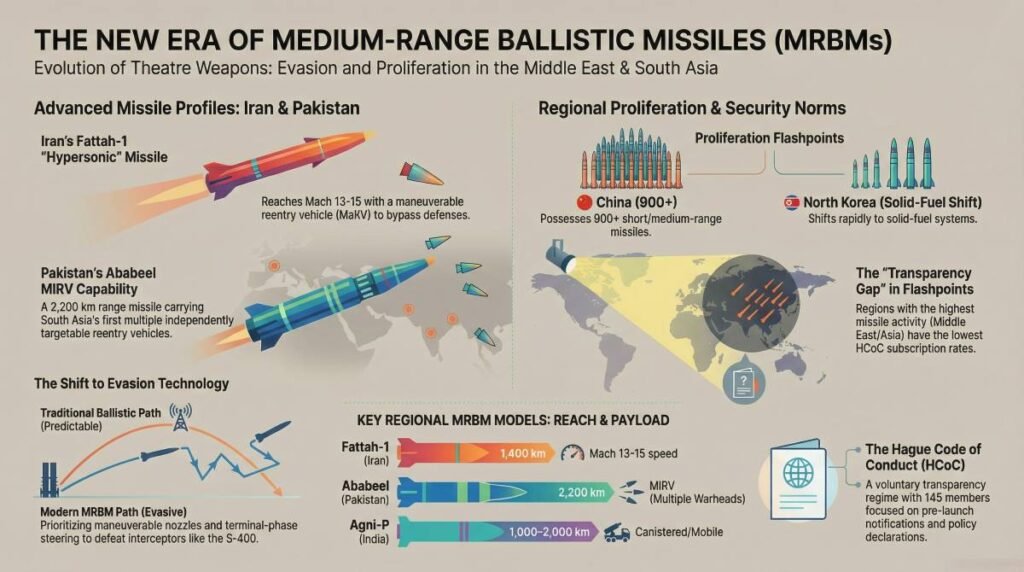
In June 2023, Brigadier General Amir Ali Hajizadeh, the commander of the IRGC Aerospace Force, stood before the Fattah-1 and claimed Iran had achieved a “major generational leap.” Touting speeds of Mach 13–15 and the ability to breach all existing defenses, Tehran leaned heavily into the “hypersonic” label. However, the technical reality is far more nuanced-and the prestige branding may be more about geopolitical signaling than actual physics.International analysts remain skeptical. Fabian Hinz, a research fellow at the International Institute for Strategic Studies, argues that the “hypersonic” description “obscures more than it illuminates.” Technically, the Fattah-1 is a medium-range ballistic missile (MRBM) equipped with a maneuverable reentry vehicle (MaRV). While a true Hypersonic Glide Vehicle (HGV) surfs the atmosphere with sustained, fluid maneuverability, a MaRV essentially “wiggles” during its final descent to adjust its point of impact.The Fattah-1 achieves this terminal-phase maneuvering through a small solid-propellant motor and a moveable nozzle for thrust vector control (TVC). This hardware allows for exo-atmospheric maneuvering, but it falls short of the sustained atmospheric flight that defines modern hypersonic weaponry. For Tehran, the label is a strategic asset, designed to project the image of a high-tech superpower to domestic audiences and regional rivals alike.
2. South Asia’s New Chess Piece: The MIRV Milestone
If Iran is playing a game of branding, Pakistan is playing a high-stakes game of strategic chess. In October 2023, the flight test of the Ababeel Weapon System marked a paradigm shift in Southern Asia. It is the region’s first payload featuring Multiple Independently targetable Reentry Vehicles (MIRVs), a technology that allows a single missile to drop multiple warheads on separate targets.The strategic math here is simple: survivability. Pakistan’s intent is to circumvent India’s S-400 ballistic missile defense (BMD) environment. By saturating an interceptor’s radar with three to eight warheads, the Ababeel seeks to ensure that Pakistan’s deterrent remains credible even against advanced shields. This introduces a “nuclear entanglement” risk; because the Ababeel is designed to carry both conventional and nuclear warheads, an adversary cannot know the stakes of an incoming strike until the warheads bloom over their targets. Ababeel Weapon System Specifications:
- Range: 2,200 km (1,400 miles)
- Length: 21.5 meters
- Diameter: 1.7 meters
- Payload Capacity: 1,500 kg total; adaptable for 3 warheads (500 kg each), 5 warheads (300 kg each), or up to 8 warheads (185 kg each).
3. The Economic Asymmetry of Modern Defense
The proliferation of missile technology has birthed a staggering economic imbalance. In the Middle East, non-state actors like the Houthis have mastered the use of “low-tech” rockets-often improvised or copies of Iranian designs-that are remarkably cheap to produce.In contrast, the price of stopping these threats is nearly unsustainable. A single interceptor for Israel’s Iron Dome costs approximately $100,000. When a $5,000 rocket necessitates a six-figure response, the attacker wins the war of attrition without ever hitting a target. This reality is forcing a pivot toward directed energy weapons. Israel is now aggressively pursuing laser-based systems to make defense affordable and independent of interceptor inventory levels. This economic gap is the primary reason states remain wary of transparency; they are being bled dry by cheap proxies while their adversaries remain “opaque” and unconstrained.
4. The “Silent” Space Race: SLVs as Missile Prototypes
The line between a satellite launch and a missile test has never been thinner. Space Launch Vehicles (SLVs) are the ultimate dual-use technology. The propulsion and guidance systems required to put a satellite into orbit are nearly identical to those needed to deliver a warhead across a continent.We are seeing a trend of nations using civilian “space prestige” to mask military development:
- Iran: Since its 2020 military satellite launch, Tehran has utilized both liquid- and solid-propellant SLVs to refine the long-range propulsion technology necessary for eventual ICBM pathways.
- South Korea: The 2023 launch of the Nuri SLV is a critical milestone. Unlike its predecessor (the Naro-1, which relied on Russian tech), the Nuri is a three-stage, indigenously built rocket. This “indigenous development” is the key enabler; it signifies that Seoul now possesses the independent technical lessons required for future IRBM or ICBM programs, should regional security dynamics shift.
5. The Non-State Actor Paradox
The Hague Code of Conduct (HCoC) is the world’s primary instrument for missile transparency, but it faces an existential crisis in the Middle East. The region has the lowest proportion of subscribing states because of a simple paradox: a state cannot commit to notifying the world of its launches when its primary enemies are non-state proxies who operate entirely outside the rules.Adversaries like the Houthis or the “Axis of Resistance” groups in Gaza and Lebanon do not sign treaties. However, there is a glimmer of hope for the norm. In 2024, Qatar officially joined the HCoC, becoming the first Gulf Cooperation Council (GCC) state to do so. This move suggests that some nations are beginning to view transparency not as a strategic vulnerability, but as a “low-risk” way to signal status as a responsible global actor.
A Fragile Horizon
Missile technology is currently moving at a velocity that far outpaces the diplomatic frameworks meant to contain it. While the HCoC provides a vital normative foundation, it is being tested by shadow economies, the democratization of space tech, and the rise of empowered proxies.In a world where a $100,000 interceptor is the only answer to a low-tech rocket, the question remains: Can transparency ever truly catch up to the technical and political drivers of proliferation? As we look toward the 2025 snapback deadline, we must ask ourselves who truly wins a war of attrition where the defense costs twenty times more than the attack.
Also read: Top 10 Air-Launched Ballistic Missiles in the World (ALBMs)
FAQ:
What is the range of a medium-range ballistic missile?
A medium-range ballistic missile is defined by most defence authorities as having a range of 1,000 to 3,000 kilometres. This places it between short-range ballistic missiles (under 1,000 km) and intermediate-range ballistic missiles (3,000 to 5,500 km). The exact boundaries vary slightly between different national and international classification systems.
Which country has the most advanced medium-range ballistic missile?
By most technical assessments, China’s Dongfeng-17 equipped with a hypersonic glide vehicle is the most technologically advanced MRBM currently in operational service. Its combination of hypersonic speed, low-altitude glide trajectory, and high manoeuvrability makes it essentially impossible to intercept with currently deployed missile defence systems. However, other nations – including the United States, Russia, and India – are developing hypersonic systems that may rival or exceed it in coming years.
Are medium-range ballistic missiles always nuclear-armed?
No. Many MRBMs are designed to carry conventional high-explosive warheads and serve primarily as precision strike weapons against military targets. China’s DF-21D anti-ship ballistic missile, for example, is designed for conventional strike missions against naval vessels. However, most MRBMs are also nuclear-capable, and in many countries the same missiles carry both nuclear and conventional warheads in different configurations, maintaining deliberate ambiguity about which type of warhead is fitted to any given missile.
What makes MRBMs harder to intercept than shorter-range missiles?
Medium-range ballistic missiles are harder to intercept than short-range systems for several reasons. Their longer flight time theoretically provides more opportunity for interception, but their higher peak altitude and greater re-entry velocity means they are travelling faster when they re-enter the atmosphere. Advanced MRBMs equipped with manoeuvrable re-entry vehicles or hypersonic glide vehicles can alter their trajectory during descent, defeating the predictive algorithms that missile defence systems rely on to position interceptors. Additionally, many modern MRBMs are designed to release decoys along with the actual warhead, overwhelming missile defence systems with multiple targets.
Why do so many MRBMs originate from Soviet technology?
The Soviet Union invested massively in ballistic missile development throughout the Cold War and developed some of the most sophisticated missile technologies of the 20th century. Following the Soviet collapse in 1991, significant quantities of hardware, technical documentation, and crucially, experienced missile engineers became available – sometimes through official channels, sometimes through less formal ones. North Korea, Iran, and Pakistan all benefited from access to Soviet-era technology and expertise. This technology transfer created the foundation upon which multiple MRBM programmes were built and explains the significant technical commonality observable between missile systems from countries that otherwise have very different defence industrial bases.
Conclusion: The Medium-Range Missile and the Future of Regional Security
The ten medium-range ballistic missiles examined in this article represent some of the most consequential weapons systems in the world today. From the paradigm-shifting hypersonic technology of China’s DF-17 to the proliferation-defining legacy of North Korea’s Nodong-1, from India’s survivable Agni-II to the strategic ambiguity of Israel’s Jericho II, these systems collectively define the military balance across the world’s most strategically significant regions and shape the security calculations of dozens of nations.
What unites all ten systems – despite their vast differences in origin, technology, and strategic purpose – is their fundamental role as instruments of deterrence. In a world where great power conflict carries catastrophic risks, medium-range ballistic missiles serve as credible threats of retaliation that are intended to prevent conflict from beginning in the first place. Their existence is premised on the logic that an adversary who knows its territory and military assets can be struck with devastating speed and precision from over the horizon is less likely to initiate aggression. This logic of mutual deterrence, imperfect and fraught as it is, has arguably prevented major interstate wars among nuclear-armed states for decades.
But deterrence is not stability. The proliferation of increasingly sophisticated MRBMs – combined with the collapse of the INF Treaty arms control framework, the development of missile defence systems that incentivise larger and more capable offensive arsenals, and the emergence of hypersonic technologies that compress decision timelines to near zero – creates a strategic environment of growing fragility. The same weapons designed to prevent war can, in a crisis driven by miscalculation or technical failure, contribute to its outbreak.
Understanding these systems – their capabilities, their limitations, their strategic purpose, and their geopolitical implications – is therefore not merely an academic exercise. It is an essential foundation for informed public debate about defence policy, arms control, and the kind of international security architecture the world needs to reduce the risk that these extraordinarily powerful weapons are ever actually used.