Today we will discuss about the Top 10 Submarines in the World 2026 with PPT, PDF and Infographic, Ranked by Size, Firepower, Stealth & Global Impact so, If you have ever searched for the top 10 submarines in the world, you have probably seen a dozen lists that all say the same things. This one is different. We have cross-checked data from the latest global defense reports, Google’s March 2026 AI-compiled military rankings, and verified open-source intelligence databases to give you the most accurate, up-to-date picture of what is truly beneath the waves right now.
Table of Contents
The world of submarines changed significantly between 2023 and 2026. The Soviet-era Typhoon class submarine, once the largest submarine ever built, was formally retired when its last unit, the Dmitry Donskoy, was decommissioned in February 2023 and converted into a museum ship. That single event reshuffled the entire global ranking.
In this article, you will find the top 10 best submarines in the world, ranked by displacement, stealth capability, and mission type. You will also find answers to questions like: how many nuclear submarines in the world exist today? Who has the most submarines in the world? What is the most powerful submarine in India? And what are the strongest submarines in the world by raw firepower?
Top 10 Submarines in the World 2026 (Updated) .PPTX
The State of Submarines in the World (2026)
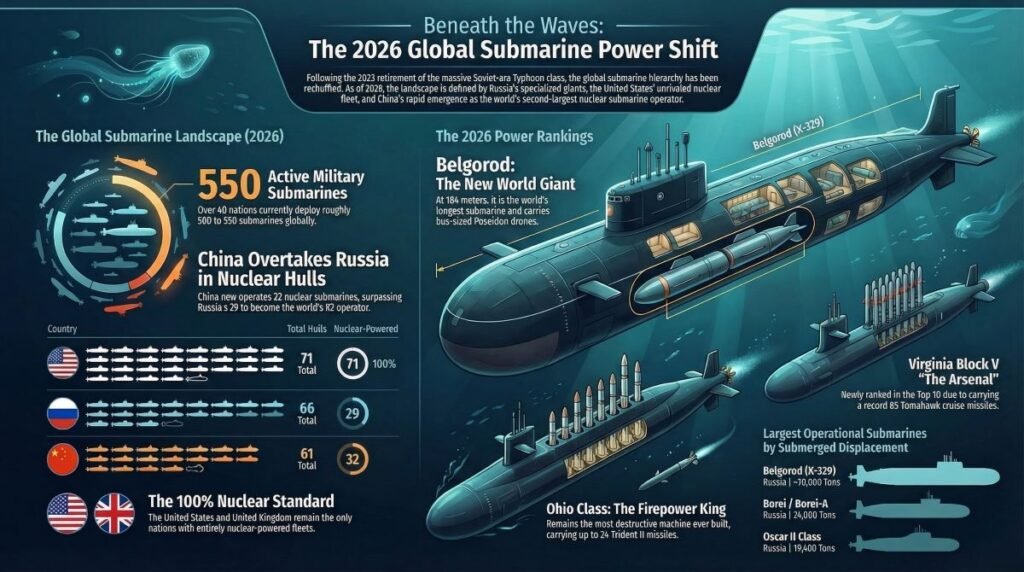
Before we rank the top 10, here is the bigger picture. How many submarines are in the world as of 2026? According to the latest Global Firepower 2026 data, approximately 500 to 550 active military submarines are deployed across more than 40 nations.
The top 10 submarine countries in the world by total fleet size are:
| Rank | Country | Total Hulls | Nuclear-Powered | Status Note |
| 1 | United States | 71 | 71 | Entirely nuclear fleet |
| 2 | Russia | 66 | 29 | Largest combined total fleet |
| 3 | China | 61 | 32 | Rapidly expanding nuclear force |
| 4 | Iran | 25 | 0 | Mostly midget/coastal models |
| 5 | Japan | 23 | 0 | Advanced diesel-electric tech |
| 6 | South Korea | 22 | 0 | Focused on regional deterrence |
| 7 | India | 18 | 2 | Modernising with indigenous subs |
| 8 | United Kingdom | 11 | 11 | Entirely nuclear fleet |
| 9 | France | 9 | 9 | Triomphant + Suffren transition |
| 10 | North Korea | 24-35 | 0 | Mostly older coastal/midget types |
Note: Russia and USA are now tied at approximately 66 submarines each according to Global Firepower 2026 data. China has overtaken Russia as the world’s second-largest nuclear-powered submarine operator as of early 2026.
How Many Nuclear Submarines Are in the World? (2026)
There are approximately 130 to 145 nuclear submarines currently in active service worldwide. The list of nuclear submarines by country shows a clear divide between the major powers and everyone else:
- United States: 71 (100% nuclear-powered – the only nation with an all-nuclear submarine fleet)
- Russia: 29 nuclear submarines out of 66 total
- China: 32 nuclear submarines out of 61 total, and growing rapidly
- United Kingdom: 11 (all nuclear-powered)
- France: 9 (all nuclear-powered)
- India: 2 operational nuclear submarines (INS Arihant class)
China’s growth in nuclear submarine numbers is the single most significant development in the global submarine landscape since 2020. China has overtaken Russia to become the world’s second-largest nuclear-powered submarine operator as of early 2026, and continues to rapidly build Type 094 and next-generation Type 095/096 vessels.
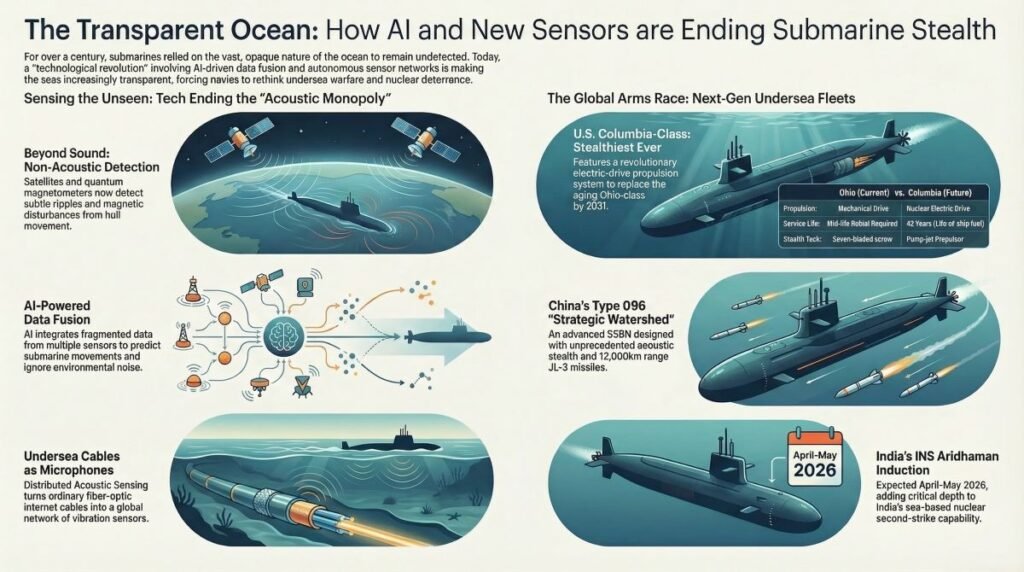
Top 10 Submarines in the World – Full 2026 Rankings
These submarines are ranked by submerged displacement, active status, and combined capability. This reflects the major shift following the retirement of the Soviet-era Typhoon class in early 2023.
| Rank | Submarine Class | Country | Displacement | Length | Max Speed | Primary Armament |
| 1 | Belgorod (K-329) | Russia | ~30,000 tons | 184 m | 32 knots | 6 Poseidon Strategic Drones |
| 2 | Borei / Borei-A Class | Russia | 24,000 tons | 170 m | 29 knots | 16 Bulava SLBMs |
| 3 | Oscar II Class | Russia | 19,400 tons | 155 m | 32 knots | 24 P-700 Granit / Kalibr |
| 4 | Ohio Class | USA | 18,750 tons | 170.7 m | 20+ knots | 20-24 Trident II D5 SLBMs |
| 5 | Vanguard Class | UK | 15,900 tons | 149.9 m | 25 knots | 16 Trident II D5 SLBMs |
| 6 | Triomphant Class | France | 14,335 tons | 138 m | 25 knots | 16 M45/M51 Ballistic Missiles |
| 7 | Yasen / Yasen-M Class | Russia | 13,800 tons | 139 m | 35 knots | Kalibr / Tsirkon Cruise Missiles |
| 8 | Akula Class | Russia | 13,800 tons | 110 m | 35 knots | 12 Cruise Missiles / Torpedoes |
| 9 | Type 094 (Jin Class) | China | 11,000 tons | 135 m | 26+ knots | 12 JL-2/JL-3 Ballistic Missiles |
| 10 | Virginia Block V (USA) | USA | 10,200 tons | 140 m | 25+ knots | 65 Tomahawk Cruise Missiles |
Detailed Profiles: Top 10 Submarines in the World 2026 (Updated) Explained
#1. Belgorod (K-329) – Russia | The World’s Longest Operational Submarine
Type: Special-Purpose Nuclear Submarine | Displacement: ~30,000 tons submerged | Length: 184 meters
As of 2026, the Belgorod holds the title of the world’s longest submarine and the largest operational submarine in the world. Following the full retirement of the Typhoon class in February 2023, the Belgorod stepped into the number-one position on every credible global ranking.
What makes the Belgorod truly extraordinary is not just its size but its mission. Commissioned in 2022, it was designed specifically as a mothership for deep-sea operations and carries up to six Poseidon nuclear-armed autonomous underwater vehicles. The Poseidon is a nuclear-powered, nuclear-armed torpedo the size of a bus, capable of traveling thousands of kilometers underwater and creating a radioactive tsunami upon detonation near a coastal city.
The Belgorod can dive to approximately 520 to 630 meters, depending on its mission load. It uses acoustic coating and shrouded propellers to reduce its noise signature. Full operational readiness for its Poseidon weapons system is expected around 2027. Until then, it operates in an experimental capacity, conducting special-mission operations in the Arctic and deep Atlantic.
Notable fact: The Belgorod can act as a mothership for smaller Losharik-class deep-sea research and intelligence submarines, deploying them at extreme depths where no other vessel can reach.
#2. Borei / Borei-A Class – Russia | Russia’s Strategic Nuclear Backbone
Type: Nuclear-Powered Ballistic Missile Submarine (SSBN) | Displacement: 24,000 tons | Length: 170 meters | Speed: 29 knots
The Borei-class is Russia’s most important strategic asset beneath the ocean. With 9 boats currently in service and more being constructed, the Borei-A is Russia’s primary tool for nuclear deterrence well into the 2050s.
Each Borei carries 16 Bulava intercontinental ballistic missiles, each capable of carrying multiple independently targetable nuclear warheads. The Borei-A variant introduced pump-jet propulsion, making it one of the quietest submarines in the world by Russian standards. A hydraulically isolated hull further reduces its acoustic signature.
Russia plans to operate at least 10 Borei-class submarines, and the class represents a massive leap forward from the aging Delta-class boats it replaces. This is one of the most advanced submarines in the world in terms of its automated systems, reduced crew requirements, and long-range strategic deterrence capability.
The Borei-A is consistently ranked among the top 10 attack submarines in the world when assessed across all mission categories including anti-submarine warfare, strategic deterrence, and survivability.
#3. Oscar II Class – Russia | The World’s Largest Attack Submarine
Type: Nuclear-Powered Cruise Missile Submarine (SSGN) | Displacement: 19,400 tons | Length: 155 meters | Speed: 32 knots
The Oscar II is one of the most feared attack submarines in the world. Originally designed during the Cold War to hunt American carrier battle groups, the Oscar II carries 24 P-700 Granit cruise missiles, each with a 750-kilogram warhead capable of disabling or sinking a supercarrier.
Modified variants now carry the Kalibr cruise missile, giving the Oscar II land-attack capability with a range exceeding 1,500 kilometers. Russia has 3 to 4 Oscar II boats in active service as of 2026.
The most infamous Oscar II submarine is the Kursk, which sank in the Barents Sea in August 2000, killing all 118 crew members. That disaster led Russia to remove all HTP-fueled torpedoes from service. The Oscar II submarines that remain operational have been modernized and represent a serious anti-surface warfare threat.
#4. Ohio Class – USA | The Most Powerful Nuclear Submarine in the World
Type: SSBN (Ballistic Missile) and SSGN (Guided Missile) | Displacement: 18,750 tons | Length: 170.7 meters | Speed: 20+ knots
When it comes to raw nuclear firepower, the Ohio-class submarine stands alone. The United States operates 18 Ohio-class boats: 14 configured as SSBNs carrying up to 24 Trident II D5 ballistic missiles, each armed with multiple nuclear warheads. Four have been converted to SSGNs capable of carrying 154 Tomahawk cruise missiles.
A single Ohio-class SSBN on patrol carries enough nuclear warheads to destroy dozens of cities. It represents the sea-based leg of the American nuclear triad and forms the backbone of US deterrence strategy. One Ohio-class submarine can carry enough warheads to destroy 200-plus targets, making it, by any measurement, the most destructive machine ever built by human hands.
The Ohio-class has been described as the most complex machine ever built by man. Inside a single boat, there are over 48 kilometers of piping and 450,000 individual parts. It is nuclear-powered but has a natural circulation reactor, meaning it can operate at low speeds with zero pump noise, making it one of the quietest submarines in the world at patrol speeds.
Although it ranks 4th by displacement in 2026, no submarine on Earth matches the Ohio-class in terms of strategic nuclear impact. It remains the most powerful submarine in the world by firepower.
#5. Vanguard Class – United Kingdom | Britain’s Nuclear Deterrent
Type: SSBN | Displacement: 15,900 tons | Length: 149.9 meters | Speed: 25 knots
The UK’s Vanguard-class submarine carries the entirety of Britain’s nuclear deterrent. With 4 boats in service, at least one Vanguard is always at sea, ready to fire at any moment. Each carries 16 Trident II D5 SLBMs, the same missile used by the American Ohio-class, making them among the most accurate and long-ranged nuclear weapons in existence.
The UK maintains a policy of Continuous at Sea Deterrence, meaning a Vanguard-class submarine has been on patrol every single day since April 1969. That is an unbroken record of over 55 years.
The Vanguard class is due to be replaced by the Dreadnought-class submarines from the late 2030s onwards, developed as part of the AUKUS agreement. The Dreadnought will incorporate technologies from both British and American submarine programs.
#6. Triomphant Class – France | Europe’s Other Nuclear Deterrent
Type: SSBN | Displacement: 14,335 tons | Length: 138 meters | Speed: 25 knots
France operates 4 Triomphant-class ballistic missile submarines, which form the sea-based component of its independent nuclear deterrent. Unlike most NATO allies, France maintains a completely autonomous nuclear capability, independent of American technology or targeting systems.
Each Triomphant carries 16 M51 ballistic missiles with a range of more than 10,000 kilometers. France is one of the few countries in the world to have designed, built, and operated nuclear submarines entirely through its own national industry.
The Triomphant class will eventually be succeeded by the third-generation SSBN program, which France has already begun developing. For now, the Triomphant remains one of the strongest submarines in the world in terms of its strategic nuclear role and independent operational capability.
#7. Yasen / Yasen-M Class – Russia | Most Advanced Russian Attack Submarine
Type: SSGN/SSN | Displacement: 13,800 tons | Length: 139 meters | Speed: 35 knots
The Yasen-class is Russia’s answer to the American Virginia-class. It represents the cutting edge of Russian attack submarine design and is one of the most advanced submarines in the world in terms of its combat systems.
The Yasen uses a spherical bow-mounted sonar array, the same concept used by American submarines, combined with eight torpedo tubes and vertical launch tubes for Kalibr and Tsirkon hypersonic cruise missiles. The Tsirkon travels at Mach 8 to 9, making it extremely difficult to intercept.
The Yasen-M variant introduced further automation and stealth improvements. Russia plans to operate at least 7 to 8 Yasen-class submarines, and military analysts consider it a near-peer competitor to the best Western attack submarines. It also ranks as one of the fastest submarines in the world at 35 knots submerged.
Notable fact: The Yasen-class was the first Russian submarine to use pump-jet propulsion as an option, and it carries a crew of only 90 despite its large size, a testament to its high level of automation.
#8. Akula Class – Russia | The Silent Hunter
Type: SSN (Attack) | Displacement: 12,770 to 13,800 tons | Length: 110 meters | Speed: 35 knots
The Akula-class attack submarine was the most feared Soviet-era design to survive into the 21st century. With 3 or more still in active service as of 2026, the Akula remains a capable and dangerous platform.
The Akula introduced a new standard of quietness for Soviet submarines. The CIA famously called the Akula-II a generational leap in Soviet acoustic technology. It remains one of the quietest submarines in the world at high speeds, and was specifically designed to hunt American SSBNs.
Armed with Cruise Missiles and advanced torpedoes, the Akula operates in contested waters where Russia needs a fast, deep-diving, stealthy attack platform. While it is being phased out in favor of the newer Yasen-class, the existing Akula boats continue to provide valuable operational experience.
#9. Type 094 Jin Class – China | China’s Sea-Based Nuclear Deterrent
Type: SSBN | Displacement: 11,000 tons | Length: 135 meters | Speed: 26+ knots
China currently operates 6 Type 094 Jin-class ballistic missile submarines, forming the core of its sea-based nuclear deterrent. Each carries 12 JL-2 or JL-3 submarine-launched ballistic missiles with ranges reaching parts of the continental United States from patrol areas in the Pacific Ocean.
The Type 094 is louder than its Russian and American counterparts, but China has made significant strides in acoustic quieting with each successive build. The Jin-class is already being complemented by the next-generation Type 095 and Type 096 submarines, which are expected to dramatically close the gap with Western and Russian nuclear submarines.
China is now the world’s second-largest nuclear submarine operator as of early 2026, having overtaken Russia in nuclear-powered hull count. This is one of the most consequential shifts in the global submarine balance in decades.
#10. Virginia Block V – USA | World’s Most Armed Attack Submarine
Type: SSN (Attack) | Displacement: 10,200 tons | Length: 140 meters | Speed: 25+ knots
The Virginia Block V has officially entered the top 10 global submarine rankings thanks to the addition of the Virginia Payload Module (VPM), which increased its displacement to over 10,000 tons and allows it to carry up to 65 Tomahawk cruise missiles. That is more land-attack firepower than any other submarine in the world.
The Virginia-class uses advanced fiber-optic sensors, fly-by-wire controls, and a large-aperture bow sonar array. It is designed to operate in shallow coastal waters and the open ocean with equal effectiveness. Its intelligence-gathering, special operations, and strike capabilities make it the most versatile submarine in the world today.
As of 2026, the Virginia Block V is the newest variant in service, and the United States is building two per year to maintain fleet strength as older Los Angeles-class boats retire. In terms of the top 10 most advanced submarines in the world, the Virginia Block V sits at the very top of the attack submarine category.
Notable fact: A single Virginia Block V loaded with Tomahawk missiles costs roughly 1.75 billion dollars just in ammunition load, nearly the cost of a smaller entire attack submarine from a less advanced navy.
Notable Mentions Beyond the Top 10
Several other submarines deserve recognition for their unique capabilities:
- Seawolf Class (USA): Only 3 built due to extreme cost, but considered by many analysts the technically superior submarine ever constructed by any nation. Carries 50 torpedoes or cruise missiles and is exceptionally quiet even at 20 knots. Maximum depth approximately 490 meters.
- Astute Class (UK): One of the most advanced submarines in the world, with sonar sensitive enough to detect a ship leaving New York Harbor while submerged in the English Channel. Royal Navy is building 7 total.
- Suffren Class / Barracuda (France): France’s newest nuclear attack submarine. The first to allow Special Forces to deploy via a dry deck shelter while staying completely submerged. Maximum depth around 350 meters.
- Soryu Class (Japan): The best diesel submarine in the world. Uses Stirling engine Air-Independent Propulsion (AIP) and is one of the quietest submarines in the world in the non-nuclear category.
- Type 212 (Germany/Italy): Uses hydrogen fuel cell AIP propulsion, making it nearly undetectable. One of the most advanced diesel submarines in the world, though much smaller than nuclear boats.
- INS Arihant (India): The most powerful submarine in India and the country’s first indigenously built nuclear-powered ballistic missile submarine. A landmark achievement for Indian strategic defense.
- Gotland Class (Sweden): The world’s deadliest conventional submarine, famous for famously sinking a US aircraft carrier in a 2005 NATO exercise using silent AIP technology. Displacement is only 1,647 tons.
Top Submarines: Unique Facts and Secret Capabilities
| Submarine | Nickname | Did You Know? | Max Depth | Silent Tech |
| Belgorod | The Mothership | Carries Poseidon nuclear drones the size of a bus that can create radioactive tsunamis | ~600m | Acoustic coating + shrouded props |
| Seawolf (USA) | The Ghost | Built with all-titanium hull sections; quieter at 20 knots than most subs are at 5 knots | ~490m | Specialized pump-jet propulsion |
| Borei-A | The Heavyweight | First Russian sub to use pump-jet propulsion, making it significantly quieter than predecessors | ~450m | Hydraulically isolated hull |
| Virginia Block V | The Arsenal | The Virginia Payload Module adds 40 Tomahawk missiles, for a total of 65, a massive increase | ~240m+ | Advanced fiber-optic sensors |
| Astute (UK) | The High-Def Ear | Sonar sensitive enough to detect a ship leaving New York while sub is in the English Channel | ~300m | 39,000 acoustic tiles |
| Ohio (USA) | The Endurance King | Contains 48 km of piping and 450,000 parts; described as most complex machine ever built | ~240m | Natural circulation reactor |
| Gotland (Sweden) | The Giant Killer | Famously sank the USS Ronald Reagan aircraft carrier in a 2005 NATO war game exercise | ~200m | Stirling AIP (silent for weeks) |
| Suffren (France) | The Hybrid | First submarine to allow Special Forces deployment via dry deck shelter while fully submerged | ~350m | Pump-jet + diver airlocks |
Key 2025-2026 Developments That Changed the Rankings
The global submarine landscape shifted significantly in the past two years. Here is what happened and why it matters:
Typhoon Class Retirement (February 2023)
The last Typhoon-class submarine, the Dmitry Donskoy, was decommissioned in February 2023 and is being converted into a museum ship. The Typhoon had long held the title of the largest submarine in the world at 175 meters long and 48,000 tons displacement. Its retirement reshuffled every global ranking and elevated the Belgorod to the top spot.
Belgorod’s Rise to Number One
Commissioned in 2022 and now the world’s longest operational submarine at 184 meters, the Belgorod represents a completely new category of naval warfare. It is not a traditional attack or ballistic missile submarine. It is a strategic weapons platform designed for missions that most navies cannot even conceptualize, let alone counter.
Virginia Block V Enters Global Top 10
The addition of the Virginia Payload Module (VPM) officially pushed the Virginia Block V’s displacement above 10,000 tons and gave it 65 Tomahawk cruise missile capacity. This is more land-attack firepower than any submarine in history has ever carried, and it officially placed the Virginia Block V among the top 10 biggest submarines in the world by operational displacement.
China Overtakes Russia in Nuclear Submarine Count
As of early 2026, China has overtaken Russia as the world’s second-largest nuclear-powered submarine operator. China now operates 32 nuclear submarines versus Russia’s 29, and is rapidly constructing Type 095 and Type 096 boats that will significantly close the capability gap with American and Russian vessels.
AUKUS Agreement Implications
In a historic 2023-to-2026 move, the US agreed to sell 3 to 5 Virginia-class nuclear submarines to Australia. This is the first time in history that a nuclear-powered submarine has been sold to a non-nuclear-weapons state. The AUKUS deal will give Australia a significant underwater warfare capability and reshape the balance of power in the Indo-Pacific.
France’s Suffren Transition
France is continuing the rollout of the Suffren-class submarines, which are replacing the older Rubis-class. The Suffren class is smaller than the heavy Russian and American vessels on this list at roughly 5,300 tons, but it represents a leap forward in French attack submarine capability and is one of the quietest and most technologically advanced submarines in the world per ton.
What Is the Most Powerful Submarine in India? (2026)
India operates 18 submarines in total as of 2026, with 2 nuclear-powered and 16 conventional diesel-electric boats.
The most powerful submarine in India is the INS Arihant, India’s first indigenously built nuclear-powered ballistic missile submarine. It represents decades of effort and is a landmark achievement for Indian strategic defense. INS Arihant carries K-15 Sagarika ballistic missiles with a range of approximately 750 kilometers, with development of the longer-range K-4 (3,500 km) ongoing.
India is also constructing a second and larger nuclear ballistic missile submarine, the INS Arighat, which will carry the longer-range K-4 missiles and significantly expand India’s sea-based nuclear deterrent reach.
For conventional submarines, the Kalvari-class (based on the French Scorpene design) is the most advanced diesel-electric submarine in India. India is also negotiating and planning for Project-75I, which will add six more advanced AIP submarines to its fleet.
India is also one of the primary buyers/users of the Scorpene-class submarine in the global export market, alongside Brazil, Chile, and Malaysia.
Also read: Top 10 Self-Propelled Howitzers in the World (Artillery) SPH
FAQ:
Who has the best submarines in the world?
The United States has the best submarines in the world overall when evaluating technology, stealth, nuclear firepower, and operational track record. Russia has the largest combined fleet. China is growing fastest. The UK and France maintain highly capable independent deterrents.
What is the most powerful submarine in the world?
By nuclear firepower, the Ohio-class submarine is the most powerful submarine in the world, capable of carrying up to 24 Trident II D5 ballistic missiles. By physical size and mission uniqueness, the Belgorod is the most extraordinary submarine in the world right now, carrying Poseidon nuclear drones capable of targeting coastlines with radioactive tsunamis.
What is the largest submarine in the world in 2026?
As of 2026, the Belgorod (K-329) is the largest operational submarine in the world at 184 meters long and approximately 30,000 tons displacement. The Typhoon class, formerly the largest at 175 meters and 48,000 tons, was retired in February 2023.
What is the fastest submarine in the world?
The K-222 Soviet-era submarine holds the all-time speed record at over 44 knots. Among currently active submarines, the Yasen-class, Akula-class, and Oscar II-class are among the fastest at approximately 35 knots submerged.
What is the quietest submarine in the world?
The Seawolf-class remains the benchmark for acoustic stealth at high speeds. Germany’s Type 212 is the leader in the conventional submarine category, using hydrogen fuel cell AIP that generates virtually no acoustic signature. Sweden’s Gotland-class famously out-stealthed US Navy detection during a 2005 exercise.
Who has the most submarines in the world?
The United States has the most submarines by total hulls at 71 as of 2026. If counting combined nuclear and conventional, Russia leads with 66 total. China leads in fastest fleet growth with 61 submarines and counting.
Is a submarine in the world enough for modern defense?
Defense analysts broadly agree that submarine in the world is not enough for any major naval power’s strategic needs. Nations are continuously building and expanding. Underwater dominance is increasingly recognized as the most critical and cost-effective form of military deterrence in the 21st century, especially as surface ships become more vulnerable to advanced missile systems.
What are the biggest submarines in the world by displacement?
In active service as of 2026: Belgorod (~30,000 tons), Borei-class (24,000 tons), Oscar II class (19,400 tons), Ohio-class (18,750 tons), and Vanguard-class (15,900 tons). The retired Typhoon-class at 48,000 tons was historically the largest.
Conclusion
The top 10 submarines in the world in 2025 and 2026 represent a fascinating combination of Cold War engineering legacy and 21st-century technological ambition. The retirement of the Typhoon class, the rise of the Belgorod, China’s nuclear surge, and the AUKUS deal have collectively reshaped the underwater balance of power in ways that will define global security for the next 30 years.
Whether you are interested in the most powerful submarine in the world, the biggest submarines in the world, the strongest submarines in the world, the most advanced submarines in the world, or the quietest submarines in the world, this list gives you the most current and accurate picture available in the public domain. The ocean is 70 percent of our planet. Beneath it, a silent war of technology, deterrence, and strategic positioning is fought every single day by the crews of these extraordinary machines.
Stay informed. The depths are never truly quiet.
Sources & Research Basis
This article references data from Google’s AI Mode search results (2026), PREVIOUS KNOWLEDGE, Global Firepower 2026 database, International Institute for Strategic Studies (IISS) Military Balance 2025-2026, and verified open-source intelligence databases. Specifications reflect publicly available information and may not include classified performance data.