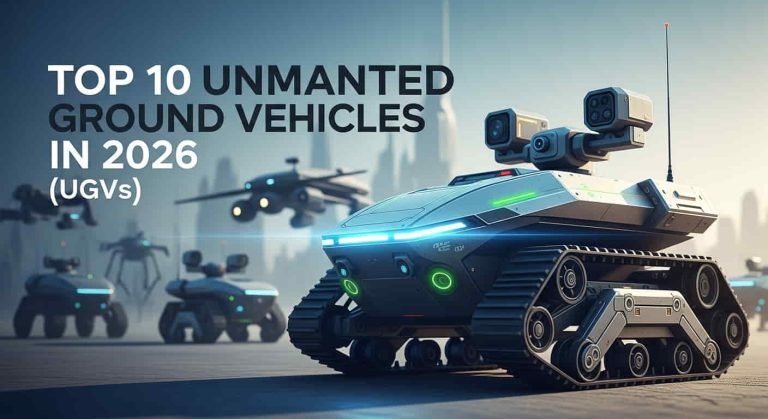
Today in this article we will discuss about The Future of Ground Warfare: Top 10 Unmanned Ground Vehicles In 2026 (UGVs) Auto Defence or Top 10 Unmanned Ground Vehicles Reshaping Modern Battlefields so, The nature of ground warfare is undergoing a fundamental transformation. Across modern battlefields, unmanned ground vehicles (UGVs) are no longer experimental concepts confined to research laboratories-they are operational realities hauling supplies, clearing mines, scouting enemy positions, and delivering lethal firepower without risking soldiers’ lives. From NATO’s most trusted robotic workhorses to combat robots forged and tested in real-world war zones, these machines represent the future of land warfare.
Table of Contents
This comprehensive analysis examines the top unmanned ground vehicles currently operating or emerging in military service worldwide. These systems are ranked by operational capability, battlefield influence, and real-world deployment, providing insight into how robotic systems are fundamentally changing battlefield risk calculations and tactical operations.
Note: This article synthesizes information from defense industry publications, military deployment reports, and publicly available specifications. All technical details are based on open-source intelligence from manufacturers, military organizations, and defense analysis reports.
Top 10 Unmanned Ground Vehicles In 2026 (UGVs) Auto Defence PPT | .PPTX
Frontline Combat Unmanned Ground Vehicles (UGVs)
The most advanced category of UGVs represents fully autonomous or remotely-operated combat platforms designed to engage enemy forces directly, fundamentally changing how militaries approach high-risk combat operations.
1. Type-X: Robotic Infantry Fighting Vehicle
The Type-X represents the clearest vision yet of a fully unmanned frontline combat vehicle-a system designed to operate alongside tanks and mechanized infantry formations without a crew inside. This heavily armored UGV demonstrates how robotic systems can assume roles traditionally requiring manned vehicles.
Technical Capabilities:
- Capable of mounting autocannons, anti-tank missiles, and advanced sensor suites
- Heavy armor protection designed for frontline combat operations
- Reduced size and low profile compared to manned infantry fighting vehicles
- Autonomous navigation capabilities for complex terrain
- AI-assisted targeting systems with remote operation capability
Strategic Significance: The Type-X fundamentally changes battlefield risk calculations. Losing the vehicle means losing equipment, not trained soldiers-a calculation that enables more aggressive tactical employment. Its ability to suppress enemy positions or conduct reconnaissance ahead of manned units provides commanders with options previously unavailable without accepting significant casualties.
While still entering service, the Type-X demonstrates where armored warfare is heading: toward formations where unmanned vehicles absorb initial contact and risk while manned platforms exploit opportunities from positions of relative safety.
2. Ripsaw M5: High-Speed Unmanned Combat Vehicle
The Ripsaw M5 represents America’s approach to unmanned combat vehicles: speed, flexibility, and advanced autonomy. Designed to race ahead of troops, scout danger zones, and deliver strikes without human crews, the M5 combines cutting-edge propulsion with modular mission capabilities.
System Characteristics:
- Hybrid diesel-electric drivetrain providing exceptional speed and quiet operation
- Highly agile across rough terrain with superior mobility
- Flat modular deck accommodating sensors, electronic warfare systems, missiles, or remote weapon stations
- Advanced autonomy enabling navigation, threat detection, and coordination with manned units
- Mission-configurable payload capacity for diverse operational requirements
Tactical Application: The Ripsaw M5’s design philosophy emphasizes the ‘robotic wingman’ concept-operating alongside manned units as a force multiplier. Its speed allows it to scout ahead of advancing forces, its flexibility permits rapid mission reconfiguration, and its autonomy enables it to operate in environments where communications might be degraded or contested.
Unlike support robots designed primarily for logistics, the Ripsaw M5 is a frontline trailblazer built to take risks human operators should avoid. Its deployment represents a fundamental shift toward platforms that lead rather than follow.
3. Wiesel Autonomous Combat Warrior: Compact Precision Platform
The autonomous combat warrior variant of Germany’s legendary Wiesel light armored vehicle represents the evolution of a proven platform into the autonomous warfare domain. Small, fast, and deceptively lethal, the Wiesel’s transition to unmanned operations demonstrates how existing successful designs can be adapted for robotic employment.
Operational Features:
- Compact size makes detection and targeting significantly more difficult
- Weapon options ranging from cannons to anti-tank missiles provide versatility
- AI-assisted navigation and sensor integration for autonomous operation
- Remote command links enabling human-in-the-loop control when required
- Designed for scouting ahead of manned forces and engaging high-risk targets
Design Philosophy: The autonomous Wiesel represents a shift toward expendable precision combat vehicles-robots designed not to replace soldiers entirely but to undertake missions where soldiers shouldn’t go. Its compact profile and autonomous capabilities enable it to infiltrate contested areas, deliver precision strikes, and withdraw without exposing human operators to direct fire.
The platform exemplifies a growing military philosophy: in modern warfare, it’s often better to risk a robot than a soldier, particularly when the robot can accomplish the mission as effectively or more so than a manned alternative.
4. Uran-9: Russia’s Heavy-Firepower Combat Robot
The Uran-9 represents one of the world’s most heavily armed unmanned ground vehicles, showcasing Russia’s approach to robotic combat systems. Designed specifically for urban combat and fire support missions, this platform demonstrates both the potential and challenges of remotely-operated combat vehicles.
Armament and Capabilities:
- 30mm autocannon for engaging light armor and fortifications
- Anti-tank guided missiles (ATGMs) for destroying heavy armor
- Rocket systems for area suppression
- Designed specifically for urban warfare and supporting assault operations
Combat Experience and Lessons: The Uran-9 saw actual combat deployment, providing invaluable real-world data on UGV performance. While its firepower proved undeniable, early versions struggled with communications reliability and situational awareness-particularly in electronic warfare environments where communications could be disrupted or jammed.
These challenges highlighted a critical lesson: remote combat vehicles require robust, redundant communication systems and enhanced autonomous capabilities to maintain effectiveness when communications are degraded. The platform’s combat experience demonstrated that UGVs can carry serious firepower traditionally reserved for manned vehicles, but successful employment requires solving complex technical challenges around command, control, and situational awareness.
Despite early limitations, the Uran-9 proved a critical concept and continues to influence global UGV development, representing a milestone in robotic warfare evolution.
Multi-Purpose and Logistics Unmanned Ground Vehicles
While combat UGVs capture headlines, multi-purpose platforms often prove more immediately valuable by solving persistent battlefield challenges in logistics, reconnaissance, and force multiplication. These systems excel at keeping soldiers supplied, informed, and protected.
5. THeMIS: NATO’s Modular Workhorse
Developed by Estonia’s Milrem Robotics, THeMIS (Tracked Hybrid Modular Infantry System) has become the gold standard for Western military forces seeking versatile unmanned ground vehicles. Its widespread adoption by over a dozen countries, including multiple NATO members and Ukraine, demonstrates its proven value in real combat conditions.
Modular Capabilities:
- Logistics: Carries supplies and equipment to frontline positions
- Medical evacuation: Retrieves wounded soldiers from dangerous areas
- Mine clearance: Detects and neutralizes explosive hazards
- Reconnaissance: Conducts surveillance with sensor packages
- Weapon platform: Mounts remote weapon stations when combat capability required
Technical Advantages:
- Hybrid diesel-electric drive offers quiet operations and extended endurance
- Remote and semi-autonomous control modes provide operational flexibility
- Tracked chassis ensures mobility across diverse terrain
- Ruggedized design proven in harsh operational environments
Strategic Value: THeMIS demonstrates a fundamental military principle: logistics wins wars. By keeping troops supplied and supported while remaining off the casualty list, the platform acts as a battlefield multiplier. Its combat validation in Ukraine-where it has operated under artillery fire, drone attacks, and electronic warfare-proves the concept’s viability under the most demanding conditions.
The platform’s adaptability means a single system can fill multiple roles across a mission, reducing the logistical burden of maintaining separate specialized vehicles while providing commanders with tactical flexibility.
Also read: Taiwan’s Top 20 Formidable Defense Weapons in 2026
6. Oshkosh RCV: U.S. Army’s Manned-Unmanned Teaming Platform
The Oshkosh Robotic Combat Vehicle (RCV) represents the U.S. Army’s vision for future armored formations where unmanned vehicles operate seamlessly alongside tanks and infantry. This platform embodies the manned-unmanned teaming (MUM-T) concept that is reshaping American ground warfare doctrine.
Platform Versatility:
- Reconnaissance configuration: Scout ahead of main formations
- Electronic warfare variant: Detect and counter enemy electronic systems
- Logistics support: Automated resupply operations
- Direct combat: Remote weapon stations and missile systems
Advanced Autonomy:
- Navigate complex terrain independently
- Detect and classify threats autonomously
- Support human commanders with real-time data and analysis
- Coordinate with other unmanned and manned platforms
Operational Impact: The RCV changes battlefield risk calculations fundamentally. It can lead assaults into dangerous areas, scout potential ambush zones, and absorb enemy fire-missions that traditionally resulted in casualties. By placing unmanned systems at the point of maximum danger, commanders can preserve their most valuable asset: trained soldiers.
This isn’t a support robot relegated to rear areas-it’s a frontline warfighter representing the future of American armored warfare, rolling into battlefields without a driver but fully integrated into combined arms operations.
Combat-Proven Unmanned Ground Vehicles
Several unmanned ground vehicles have moved beyond testing and evaluation to prove themselves under actual combat conditions. These battle-tested systems provide invaluable data on UGV performance in real-world warfare.
7. Droid THW-12.7: Ukraine’s Combat-Forged Robot
Built in the crucible of active warfare, the Droid THW-12.7 represents the pragmatic, combat-driven approach to robotic warfare emerging from Ukraine’s conflict. This tracked combat UGV, armed with a .50 caliber (12.7mm) machine gun, demonstrates how necessity drives innovation in modern warfare.
Combat Specifications:
- Primary armament: .50 caliber heavy machine gun
- Design purpose: Frontline defense and ambush operations
- Provides devastating suppressing fire without exposing soldiers
- Remote operation from protected positions
Battlefield Validation: What sets the Droid THW apart from laboratory prototypes is extensive combat experience. This platform has operated under live fire, surviving artillery bombardments, drone attacks, and electronic warfare-the full spectrum of modern battlefield threats. Its continued operation under these conditions validates the design’s durability and operational effectiveness.
Ukraine’s rapid innovation cycle has transformed the Droid THW into a symbol of pragmatic, combat-driven robotics where battlefield effectiveness matters more than aesthetics or theoretical capabilities. Operators control the system remotely from protected positions, effectively creating a lethal robotic sentry that can hold defensive positions or execute ambushes without risking human lives.
The platform demonstrates that effective combat UGVs don’t require cutting-edge AI or exotic technologies-they require robust design, reliable communications, adequate firepower, and the ability to survive in contested environments. These lessons are influencing UGV development worldwide.
8. Protector UGV: Wheeled Combat Platform
The Protector UGV takes a different approach to unmanned combat vehicles by utilizing a wheeled truck chassis rather than tracks. This design choice reflects a growing trend in military robotics: adapting proven civilian platforms into lethal robotic systems quickly and cost-effectively.
Platform Characteristics:
- Heavy machine gun turret as primary armament
- Wheeled chassis provides superior road speed
- Extended operational range compared to tracked vehicles
- High payload capacity for equipment and ammunition
Operational Advantages:
- Simplicity and scalability: Easier and cheaper to produce than specialized tracked platforms
- Faster to repair: Utilizes common truck components
- Ideal for road-heavy environments and convoy operations
- Lower operational costs than purpose-built combat robots
Mission Applications: The Protector excels at convoy escort duties, perimeter defense, and remote fire missions. Its wheeled configuration makes it particularly valuable in areas with developed road networks where its speed and range advantages outweigh the superior cross-country mobility of tracked alternatives.
The platform reflects a pragmatic approach to UGV warfare: leverage existing civilian technology and industrial capacity to rapidly field capable robotic systems rather than waiting for perfect custom solutions. This approach enables faster deployment and easier sustainment in the field.
Next-Generation Autonomous Systems
The most advanced unmanned ground vehicles integrate cutting-edge artificial intelligence, sensor fusion, and multi-domain coordination capabilities. These systems represent the future direction of autonomous warfare.
9. Robust: AI-Powered 6×6 Combat Vehicle
Robust represents the integration of advanced artificial intelligence with traditional combat vehicle design. This 6×6 medium robotic combat vehicle is designed to fight, scout, and survive in the most challenging environments through a combination of autonomous systems and lethal firepower.
Advanced Systems Integration:
- 30mm autonomous turret capable of independent target engagement
- AI systems detect, track, and engage targets with or without remote command
- Powerful cannon and machine gun supplemented by optional anti-tank missiles
- Robotic arm enables launch and recovery of reconnaissance drones
- All-terrain mobility with autonomous navigation capability
Force Multiplication Capability: What distinguishes Robust from simpler UGVs is its integration of unmanned aerial systems. The robotic arm allows Robust to deploy and recover drones for forward scouting, providing commanders with 360-degree battlefield awareness. This creates a synergistic effect where the ground vehicle serves as a mobile base for aerial reconnaissance assets.
The autonomous targeting capability represents a significant technological achievement-the system can independently identify and engage threats while still maintaining human oversight for final engagement authorization. This balance between autonomy and human control reflects current military doctrine on lethal autonomous systems.
Robust demonstrates the future of unmanned combat vehicles: platforms that blend lethal force, advanced sensing, and tactical flexibility into systems that can think, adapt, and dominate across multiple battlefield dimensions.
10. Kuna: Multi-Domain Robotic System
Kuna represents a groundbreaking approach to unmanned systems by integrating air and land robotics into a single cohesive platform. Unlike traditional UGVs that operate solely in the ground domain, Kuna is designed as a multi-domain system that coordinates aerial and ground operations seamlessly.
Multi-Domain Integration:
- Modular system designed to team with aerial drones
- Real-time scouting and targeting through integrated drone operations
- Advanced sensors and autonomous navigation systems
- Rugged chassis capable of carrying diverse payloads
- Can launch drones and serve as mobile command node
Tactical Capabilities:
- Scouts ahead of manned forces using integrated aerial assets
- Relays intelligence and coordinates unmanned air assets
- Pinpoints threats before they can engage friendly forces
- Provides commanders with unprecedented situational awareness
Strategic Innovation: Kuna represents the future of warfare where robots don’t just follow orders-they think, connect, and dominate across multiple domains simultaneously. By integrating ground and air operations into a single system, Kuna demonstrates how unmanned platforms can achieve effects greater than the sum of their parts.
The platform’s quick deployment, adaptive intelligence, and cross-domain coordination capability exemplify next-generation autonomous warfare. Rather than operating in isolation, Kuna serves as a node in a broader network of sensors and effectors, enabling commanders to build comprehensive battlefield awareness and coordinate responses across air and ground domains.
This integration of unmanned air and ground systems represents a paradigm shift in how militaries approach autonomous operations-moving from single-domain platforms to integrated multi-domain systems that multiply combat effectiveness through coordination and data fusion.

Strategic Analysis: The UGV Revolution
The proliferation of unmanned ground vehicles across modern militaries represents more than technological advancement-it signals a fundamental transformation in how nations approach ground warfare. Several strategic themes emerge from examining these ten platforms.
Risk Recalculation
The most profound impact of UGVs is how they change battlefield risk calculations. Traditionally, military operations required accepting that trained soldiers would be placed in danger to accomplish objectives. UGVs fundamentally alter this equation-commanders can now send robots into situations previously requiring human exposure to enemy fire.
This doesn’t eliminate risk entirely but redistributes it. Losing a UGV means losing equipment that can be replaced; losing a trained soldier means losing years of investment and irreplaceable human life. This calculation enables more aggressive tactics, more thorough reconnaissance, and willingness to probe defenses that might previously have been avoided due to expected casualties.
From Logistics to Lethality
The evolution of UGVs demonstrates a clear progression from logistics support to lethal combat roles. Early unmanned systems focused on tasks like bomb disposal or supply transport-valuable but non-combat functions. Modern UGVs like the Type-X, Ripsaw M5, and Robust represent fully combat-capable platforms designed to engage enemies directly.
However, platforms like THeMIS demonstrate that logistics UGVs remain critically important. The ability to keep frontline units supplied without risking resupply convoys provides sustained operational capability. Modern militaries are learning they need both types: logistics platforms to maintain operations and combat platforms to prosecute operations.
The Autonomy Spectrum
Current UGVs operate across a spectrum of autonomy levels. Some, like the Protector UGV, function primarily as remotely-operated platforms where human operators make all decisions. Others, like Robust with its AI-assisted targeting, incorporate higher levels of autonomy while maintaining human oversight for critical decisions.
This spectrum reflects both technological capabilities and policy decisions. While technology enables increasing autonomy, military doctrine and international law considerations shape how much autonomy is actually employed, particularly regarding lethal force decisions. The trend is toward greater autonomy for navigation, threat detection, and self-protection, with continued human control over engagement decisions.
Multi-Domain Integration
Platforms like Kuna and Robust demonstrate that future UGVs won’t operate in isolation. Instead, they’ll serve as nodes in networks integrating ground, air, and potentially naval unmanned systems. This multi-domain integration multiplies effectiveness by enabling coordinated operations that leverage each domain’s strengths.
A ground vehicle coordinating with aerial drones achieves reconnaissance and targeting capabilities impossible for either platform alone. Similarly, UGVs networked with manned vehicles create combined formations where unmanned systems can take risks while manned platforms exploit opportunities from positions of relative safety.
Combat Validation vs. Laboratory Testing
The Ukraine conflict has provided invaluable real-world data on UGV performance under actual combat conditions. Platforms like THeMIS and the Droid THW have operated under artillery fire, electronic warfare, and drone attacks-conditions impossible to fully replicate in peacetime testing.
This combat validation has revealed both capabilities and limitations. Communication reliability, particularly in electronic warfare environments, emerged as a critical challenge. Systems proven in testing sometimes struggled when facing sophisticated jamming or when operating in communications-denied environments. These lessons are driving development toward more robust communications systems and greater onboard autonomy that allows operations even when connectivity is degraded.
Future Trends in Unmanned Ground Vehicles
Several clear trends are shaping the next generation of unmanned ground vehicles:
- Increased Autonomy: AI capabilities will continue advancing, enabling UGVs to handle more complex tasks with less human intervention. However, lethal force decisions will likely remain under human control for the foreseeable future due to policy and ethical considerations.
- Swarming Capabilities: Multiple UGVs operating in coordinated groups, sharing information and dividing tasks autonomously. This enables overwhelming defensive positions through distributed attacks from multiple directions simultaneously.
- Enhanced Electronic Warfare Resistance: Future systems will incorporate better communications security, frequency-hopping capabilities, and autonomous operation modes that function even when communications are jammed.
- Smaller, More Expendable Platforms: Alongside sophisticated platforms like Type-X, militaries are developing smaller, cheaper UGVs designed to be expendable. These can probe defenses or conduct suicide missions without risking expensive assets.
- Greater Modularity: The success of modular platforms like THeMIS will drive toward standardized interfaces allowing rapid mission reconfiguration. A single chassis might serve as logistics hauler, reconnaissance platform, or weapons carrier depending on installed modules.
- Civilian Platform Adaptation: The Protector UGV approach-adapting civilian vehicles-will accelerate as militaries seek rapid deployment of capable systems without waiting for custom military designs. Commercial autonomous vehicle technology will increasingly transfer to military applications.

The End of the Human Frontline: How Robots Are Redefining Modern Warfare
Modern warfare is traversing a critical inflection point. For over a century, the infantryman in the trench has been the ultimate arbiter of victory, but we are now witnessing the rapid dehumanization of the frontline. The traditional concept of ‘boots on the ground’ is being fundamentally rewritten as Unmanned Ground Vehicles (UGVs) transition from laboratory experiments to mission-critical battlefield assets. This shift represents a move from human-centric operations to a model defined by ‘attritability’-the strategic use of high-tech assets that are lethal yet ultimately expendable. The calculus of modern conflict is changing: where once military commanders measured costs in human casualties and political will, they now calculate in terms of industrial output and silicon. When losing a machine becomes a manageable budget line item rather than a strategic tragedy that erodes national resolve, the very threshold for kinetic engagement transforms. This paradigm shift raises profound questions: As the cost of war shifts from family grief to factory output, does the barrier to entering conflict become dangerously low? The following analysis examines six critical ways robotic systems are actively removing the human-in-the-loop from the attrition zone, ensuring that the next major conflict may be decided not by the courage of soldiers, but by the capacity of assembly lines.
The table below details the 6 transformative ways UGVs are redefining the modern battlefield, LAWS (Lethal Autonomous Weapon Systems), From Human-Centric to Machine-Dominated Battlefields:
| Warfare Transformation | Platform Example & Strategic Impact |
| 1. Changing the Calculus of Human Risk | Platform: Milrem Type X Robotic Infantry Fighting Vehicle Revolutionary Concept: The Type X represents a fundamental shift in the ‘math’ of military command. As a heavily armored robotic IFV capable of mounting autocannons and missiles without a crew inside, it radically lowers the threshold for kinetic engagement. Technical Evolution: Prioritizes sensor fusion and AI-assisted navigation for situational awarenessFocuses on autonomous survivability after lessons from Russia’s Uran-9Addresses the liability of heavy firepower when remote command links fail. Strategic Impact: Losing a machine becomes a manageable tactical loss-a budget line item. Losing a human soldier remains a strategic tragedy that erodes national resolve. This mathematical transformation fundamentally changes commanders’ willingness to engage in high-risk operations. |
| 2. The ‘Silent Speed’ of the Robotic Wingman | Platform: Ripsaw M5 Unmanned Combat Vehicle Manned-Unmanned Teaming (MUM-T) Concept: The M5 represents the physical manifestation of future warfare doctrine. Unlike traditional armored columns, its hybrid diesel-electric drivetrain provides exceptional speed, quiet operation, and deceptive agility. Operational Philosophy: Not intended to replace human soldiers, but serve as a ‘robotic wingman’Accelerates the OODA loop (Observe, Orient, Decide, Act)Races ahead to detect threats and absorb initial fireHandles high-speed, high-risk tactical processing autonomously. Division of Labor: The machine provides the speed and risk-taking capability; the human commander remains at safe distance to provide moral and strategic oversight. This represents more effective use of technology than total replacement. |
| 3. Logistics as the Foundation of Victory | Platform: THeMIS (Tracked Hybrid Modular Infantry System) Western Gold Standard: Developed by Estonia’s Milrem Robotics, THeMIS has been adopted by over a dozen countries including NATO members and Ukraine. Its deployment in Ukraine provides unparalleled real-world combat validation. Modular Mission Configurations: Medical Evacuation: Extracting wounded personnel from active fire zonesEngineer Support: Detecting and clearing mines with robotic precisionSupply Chain Resilience: Hauling ammunition and gear across exhausting terrainPersistent Reconnaissance: Monitoring enemy movements in EW-saturated environments. Proven Principle: While combat robots capture headlines, THeMIS demonstrates that logistics wins wars. By automating the most dangerous ‘dull, dirty, and dangerous’ tasks, it keeps human soldiers off the casualty list-the true measure of success. |
| 4. Pragmatism Over Aesthetics in the Crucible of War | Platform: Droid THW-12.7 Combat UGV Combat-Driven Robotics: Born in the crucible of active warfare, the Droid THW-12.7 embodies the principle that effectiveness trumps aesthetics. This tracked UGV, armed with a .50-caliber machine gun, serves as a lethal robotic sentry prioritizing survival and lethality over high-tech appearance. Battlefield Validation in EW Environments: Designed to survive artillery barrages in active war zonesMaintains remote link while enemy attempts spectrum-wide jammingOperates effectively in Electronic Warfare (EW) saturated environmentsSurvives relentless drone surveillance and counter-battery fire. Critical Lesson: In modern peer-to-peer conflict, a robot doesn’t need to look like a tech expo prototype; it needs to maintain functionality under conditions that would destroy less robust systems. In the crucible of war, effectiveness is the only metric that matters. |
| 5. Scalability Through Simplicity | Platform: Protector UGV (‘Robotic Pickup Truck’) The Cost-to-Quantity Bottleneck: The primary constraint in robotic warfare today is achieving battlefield mass. To deploy UGVs at scale, militaries must move away from bespoke, hyper-expensive tracked systems toward scalable solutions utilizing wheeled civilian platforms. Advantages of Wheeled Platforms: Inherently cheaper to manufacture than custom tracked vehiclesFaster to repair using common truck componentsIdeal for road-heavy environments, convoy escort, and rear-area defenseEnables rapid adaptation of civilian platforms into lethal systems. Strategic Principle: Mass is its own quality. By achieving the scale necessary to saturate battlefields, robotic capabilities transition from luxury equipment for elite units to standard tools for entire forces. This democratization of robotic warfare represents a fundamental shift in military capability distribution. |
| 6. The Converged Battlefield: Multi-Domain Integration | Platform: Kuna Multi-Domain System Beyond Isolated Robots: The ultimate evolution is not the individual robot, but the converged battlefield. Kuna integrates air and land robotics into a unified node, serving not merely as a ground vehicle but as a mobile command center coordinating aerial drones. Network-Centric Warfare Capabilities: Acts as mother ship for unmanned air Assets Pinpoints threats before they become visible to ground Sensors Creates comprehensive web of awareness across Domains Renders traditional human-led scouting obsolete. Future of Domain Dominance: Kuna represents a world where robots don’t just follow orders-they think, connect, and dominate across domains. In this environment, the side with the most integrated network wins. This is the future of warfare: not individual platforms, but comprehensive systems where the human element becomes a liability to be managed rather than a presence to be protected. |
The Battlefield of 2026 and Beyond: Critical Questions
As we look toward 2026, the transition is unambiguous: Unmanned Ground Vehicles are no longer experimental novelties but decisive, mission-critical assets. We are moving toward a paradigm where the first ‘person’ through a door or across a minefield will never be a person at all. The technology is ready-from heavily armed tank-killers to silent wingmen to integrated logistics nodes. Each represents a different vision of autonomous warfare’s future.
However, as we embrace the ‘robotic killer’ as a standard tool of statecraft, we must confront profound ethical questions about the dehumanization of the frontline. When the cost of war is reduced to a factory’s output rather than a family’s grief, does the threshold for entering conflict drop dangerously low? When human casualties no longer constrain military operations, what prevents escalation? When the political and moral tragedy of human loss is removed from the equation, do we risk making warfare too acceptable, too routine, too divorced from its human consequences?
The next decade of conflict will be defined not just by which military possesses the most advanced autonomous systems, but by how societies grapple with warfare where the human element has become a variable to be minimized rather than a sacred trust to be protected. The question is no longer whether this future will arrive-it’s already here. The question is whether our ethics and international norms can evolve as rapidly as our technology.
Conclusion
Unmanned ground vehicles have transitioned from experimental curiosities to operational necessities across modern militaries. The ten platforms examined in this analysis-from NATO’s trusted THeMIS to Ukraine’s combat-proven Droid THW, from America’s sophisticated Ripsaw M5 to the multi-domain Kuna system-demonstrate that UGVs are no longer theoretical future capabilities. They are current realities reshaping how ground forces operate.
These machines represent more than technological advancement. They embody a fundamental shift in military thinking about risk, about the relationship between humans and machines on the battlefield, and about how future conflicts will be fought. From logistics mules ensuring supply lines remain intact to robotic warriors absorbing enemy fire that would otherwise target soldiers, UGVs are multiplying combat effectiveness while reducing casualties.
The evolution continues. As artificial intelligence advances, as communications become more secure, as multi-domain integration deepens, unmanned ground vehicles will become even more capable and more central to military operations. The platforms operating today are just the beginning-precursors to more sophisticated systems that will define land warfare for decades to come.
One certainty emerges from examining these ten UGVs: the future of ground warfare will be increasingly unmanned, increasingly autonomous, and increasingly networked. Militaries that successfully integrate these capabilities will possess significant advantages over those that don’t. The boots on the ground won’t always be human-and that reality is already here.
About This Analysis
This analysis is based on public information from defense publications, Wikipedia, Notebooklm, Chatgpt, Google, official government sources, and reputable military analysis organizations. Weapon specifications and capabilities are derived from open-source intelligence and may not reflect classified performance parameters. The strategic assessments presented are informed analyses based on available information and should not be construed as official policy positions.
This comprehensive analysis draws from publicly available information including defense industry publications, manufacturer specifications, military deployment reports, and combat operations data. Technical specifications and capabilities are based on open-source intelligence from official sources and reputable defense analysis organizations.
The rankings and assessments reflect operational deployment, combat validation, technological sophistication, and strategic impact. As unmanned systems continue to evolve rapidly, readers should consult primary sources including manufacturer technical documentation, military doctrine publications, and recent deployment reports for the most current information.