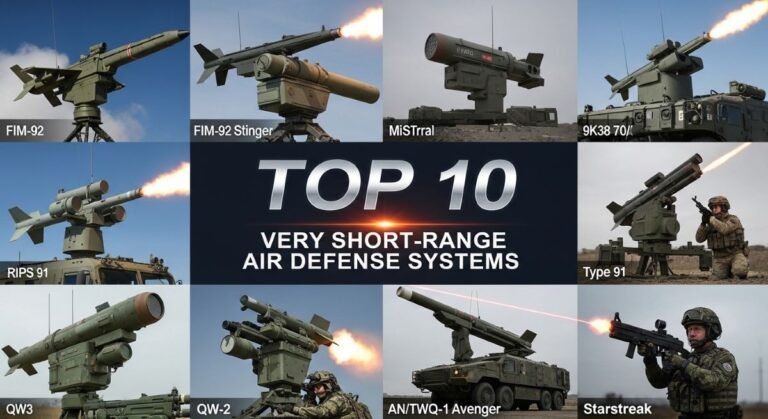
Today we will discuss about the Top 10 Very Short Range Air Defense Systems in the World (VSHORAD) with PPT, PDF and Infographic and A Complete Guide to the Best VSHORAD & Short Range Air Defence Systems so, As modern warfare continues to evolve, the ability to neutralise low-flying aerial threats – drones, helicopters, cruise missiles, and low-altitude aircraft – has become a decisive factor on the battlefield. Very Short-Range Air Defence Systems (VSHORAD) represent the frontline answer to these threats. Lightweight, mobile, and rapidly deployable, these systems form the last layer of point air defence for troops and critical infrastructure.
Table of Contents
In this article, we rank and review the top 10 very short range air defense systems in the world, examining their features, range, country of origin, and operational effectiveness. Whether you are a defence analyst, a student, or simply curious about the best short-range air defense systems globally, this guide covers everything you need to know. We also explore air defence mechanisms with a primer on India and Pakistan, highlight man-portable air defense systems (MANPADS), discuss Chinese short range air defense systems, the Mistral short range air defense system, the Spyder short range air defense system, and more – incorporating all the critical keywords that matter in today’s global defence landscape.
Why Very Short Range Air Defence Matters in 2026?
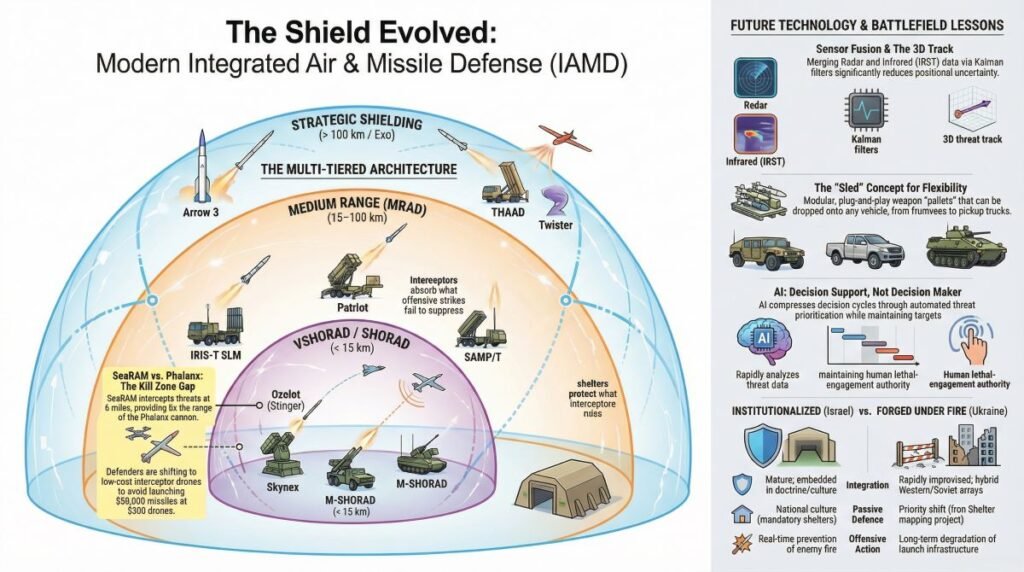
Modern battlefields are increasingly defined by low-altitude aerial threats – armed drones, loitering munitions, attack helicopters, and cruise missiles flying beneath traditional radar coverage. Very Short-Range Air Defence Systems (VSHORAD) form the critical last layer of protection against these threats, providing point defence for frontline troops, armoured formations, strategic installations, and naval assets.
This comprehensive guide ranks and reviews the top 10 very short range air defense systems in the world, examining their technical specifications, seeker technology, operational history, and strategic significance. We also cover the latest India VSHORADS 2026 developments, air defence mechanisms in India and Pakistan, man-portable air defense systems (MANPADS), and the technology trends shaping the future of close-range air defence.
What Is a Very Short-Range Air Defence (VSHORAD) System?
A Very Short-Range Air Defence System is a short-range, lightweight, and portable surface-to-air missile (SAM) platform designed to engage low-altitude aerial threats at ranges typically between 1 and 10 kilometres and at altitudes up to 6,000 metres. These systems are distinct from medium-range SAM systems due to their portability, rapid deployment, and ability to operate without fixed radar or command infrastructure.
Man-portable air defense systems (MANPADS) are the most mobile subset of VSHORAD – shoulder-launched weapons carried and operated by one to three soldiers. They have fundamentally changed the risk calculus for low-altitude aviation in every conflict since the 1980s, from Afghanistan to Ukraine.
VSHORAD systems are used by armies, navies, and air forces worldwide and come in three primary configurations: shoulder-launched MANPADS, vehicle-mounted systems, and multi-barrel turret launchers. Each configuration offers a different balance of mobility, firepower, and response time.
Top 10 Very Short Range Air Defense Systems in the World (VSHORAD) – 88 PPT SLIDES
Comprehensive Capabilities Comparison: Top 10 Very Short Range Air Defense Systems in the World (VSHORAD)
The table below provides a side-by-side technical comparison of all 10 systems covered in this article, allowing defence analysts, researchers, and military procurement planners to evaluate them at a glance.
| System | Country | Type | Range (km) | Altitude (m) | Guidance | Speed | Key Strength |
| FIM-92 Stinger | USA | MANPADS | Up to 8 | Up to 3,800 | Passive IR / UV | Mach 2.2 | All-aspect, combat-proven globally |
| Mistral (MBDA) | France | MANPADS/Multi | Up to 7 | Up to 3,000 | Imaging IR | Mach 2.6 | 93%+ kill probability |
| Igla-S (9K338) | Russia | MANPADS | Up to 6 | Up to 3,500 | Dual-band IR | Mach 1.9 | ECCM; 30+ nation users |
| Spyder SR | Israel | Quick-reaction SAM | Up to 15 | Up to 9,000 | Imaging IR / Active radar | Mach 3+ | Python-5 + Derby; 360° |
| HQ-17 / FL-2000 | China | Vehicle-mounted SAM | Up to 10 | Up to 6,000 | Phased-array radar | Mach 2.5 | Dual-target simultaneous engage |
| VSHORADS (India) | India | MANPADS | Up to 6 | Up to 4,000 | Dual-band Imaging IR | Mach 1.8+ | Indigenous; tested Feb 2026 |
| Starstreak HVM | UK | MANPADS/Vehicle | Up to 7 | Up to 5,000 | Laser beam-riding | Mach 3.5+ | IR flare-immune; fastest VSHORAD |
| Piorun | Poland | MANPADS | Up to 6.5 | Up to 4,000 | Passive IR (ECCM) | Mach 2.0 | Combat-proven in Ukraine |
| Pantsir-S1 | Russia | Gun-missile system | Up to 20 | Up to 15,000 | Radar + optical | Mach 2.8 | Combined guns + missiles |
| Mistral TETRAL | France | Multi-barrel turret | Up to 7 | Up to 3,000 | Imaging IR | Mach 2.6 | 4-missile turret; point defence |
Top 10 Very Short Range Air Defense Systems in the World (VSHORAD) – Detailed Reviews
#1. FIM-92 Stinger (USA) – The World’s Most Battle-Proven MANPADS
Country: United States | Developer: Raytheon Technologies | Range: Up to 8 km | Altitude: Up to 3,800 m | Speed: Mach 2.2
The FIM-92 Stinger remains the benchmark very short range air defense system globally. Combat-proven since the Soviet-Afghan War of the 1980s, where it earned legendary status by bringing down Soviet gunships, the Stinger has since been continuously upgraded and now serves with over 30 nations.
The Stinger uses a dual-waveband passive infrared and ultraviolet seeker that provides significant resistance to countermeasures and infrared flares. Its proximity fuse and blast-fragmentation warhead deliver lethal effect against helicopters, drones, and low-flying fixed-wing aircraft. In Ukraine since 2022, Stingers have been indispensable in disrupting low-altitude Russian air operations, confirming their enduring relevance as the best short-range air defense system available to infantry.
The latest Stinger RMP (Reprogrammable Microprocessor) variant allows software updates to counter new threats and countermeasures in the field, giving it a major upgrade path advantage over older MANPADS. The US Army is also developing the IM-SHORAD (Interim Maneuver Short-Range Air Defence) system to mount Stingers on vehicles for mechanised formations.
Key Features: Passive IR/UV seeker, all-aspect engagement, software-reprogrammable, 15.7 kg ready to fire, compatible with AN/VRC vehicle launcher.
#2. Mistral Short Range Air Defense System (France) – Europe’s Most Versatile VSHORAD
Country: France | Developer: MBDA | Range: Up to 7 km | Altitude: Up to 3,000 m | Kill Probability: 93%+
The Mistral short range air defense system, developed by European missile consortium MBDA, is deployed across more than 40 nations and represents the pinnacle of European VSHORAD technology. Its modular design allows deployment as a shoulder-launched MANPADS, in the ATLAS two-round launcher, the TETRAL four-round turret, vehicle-mounted configurations, and even as an air-to-air missile on helicopters (ATAM variant).
The Mistral 3, the latest version, features an advanced dual infrared imaging seeker with electro-optical target recognition that dramatically improves discrimination between real targets and decoys in cluttered environments. Its laser proximity fuze and tungsten-sphere fragmentation warhead deliver a kill probability exceeding 93 percent in independent testing – the highest of any MANPADS-class system. India, France, Germany, Singapore, South Korea, and Qatar are among its major operators.
Key Features: Imaging IR seeker, 93%+ single-shot kill probability, multi-platform deployment, all-weather day and night operation, laser proximity fuze.
#3. Igla-S / 9K338 (Russia) – The World’s Most Widely Proliferated MANPADS
Country: Russia | Developer: KBM | Range: Up to 6 km | Altitude: Up to 3,500 m | In service: 30+ nations
Russia’s Igla-S (NATO: SA-24 Grinch) is the most advanced iteration of the Igla family of man-portable air defense systems. Its two-colour passive IR seeker operates across two spectral bands, significantly increasing resistance to decoy flares compared to earlier single-band systems. The dual-channel seeker analyses the spectral ratio of the target signature to discriminate real engine heat from flares.
The Igla-S has seen combat use in Syria, Libya, Yemen, Ukraine, and other conflict zones. It is deployable as a MANPADS, in the Dzhigit two-round pedestal launcher, or in vehicle-integrated configurations. Russia has also incorporated the Igla-S missile into the Verba next-generation MANPADS programme. However, Russia’s production capacity and export reliability have been significantly affected by Western sanctions following the 2022 Ukraine invasion.
Key Features: Two-colour IR seeker, all-aspect engagement, widely proliferated, compatible with Dzhigit launcher, operational in all weather.
#4. Spyder Short Range Air Defense System (Israel) – The Most Technologically Advanced Quick-Reaction SAM
Country: Israel | Developer: Rafael / IAI | Range: Up to 15 km (SR) | Altitude: Up to 9,000 m | Reaction time: Under 5 seconds
The Spyder short range air defense system by Israel’s Rafael Advanced Defense Systems is arguably the most technologically sophisticated quick-reaction SAM in the VSHORAD/short-range category. It fires two proven air-to-air missiles adapted for ground launch – the Python-5 (imaging IR guided) and the Derby (active radar homing) – from a single mobile launcher, giving it unmatched engagement flexibility.
The Spyder’s Python-5 seeker uses advanced imaging infrared technology to recognise the shape and thermal profile of targets, making it extraordinarily resistant to countermeasures. The Derby missile’s active radar seeker gives Spyder true all-weather, beyond-visual-range engagement capability. Combined, these dual-missile options give operators a choice between stealth (no radar emissions from the missile) and all-weather reliability on a single platform.
India, Singapore, the Philippines, Vietnam, Georgia, and Azerbaijan are among Spyder’s operators. India deployed Spyder batteries along its northern border with China following the 2020 Galwan clashes, highlighting its strategic importance to India’s air defence architecture.
Key Features: Python-5 imaging IR + Derby active radar, dual-missile choice, reaction time under 5 seconds, 360-degree coverage, fully mobile.
#5. HQ-17 / FL-2000 – China’s Best Short Range Air Defense System
Country: China | Developer: CASIC | Range: Up to 10 km | Altitude: Up to 6,000 m | Reaction time: Under 8 seconds
China’s HQ-17 and its export variant FL-2000 are the most capable Chinese short range air defense systems within the VSHORAD bracket. Developed as a domestic evolution of the Russian Tor-M1 concept, the HQ-17 features a phased-array radar mounted on a wheeled platform, giving it superior mobility and radar performance compared to older Chinese SAM systems.
The HQ-17 can track up to 48 targets simultaneously and engage 2 simultaneously, with a reaction time under 8 seconds from target detection to missile launch. All launcher, radar, and command functions are integrated on a single vehicle, making it fully self-sufficient. China has also developed the QW-1, QW-2, and FN-6 as man-portable air defense systems for Chinese infantry – the QW-2 and FN-6 have been exported to multiple nations including Pakistan, Sudan, and Cambodia.
Key Features: Phased-array radar, vertical launch, 2-target simultaneous engagement, wheeled mobile platform, fully autonomous operation.
#6. India VSHORADS (DRDO) – The Most Significant Indigenous MANPADS Breakthrough of 2026
Country: India | Developer: DRDO Research Centre Imarat | Range: Up to 6 km | Altitude: Up to 4,000 m | Status: User validation trials complete February 2026
BREAKING – February 27, 2026: DRDO successfully conducted THREE successive flight trials of the VSHORADS system at the Integrated Test Range (ITR), Chandipur, off the coast of Odisha. This is the most recent and most significant VSHORAD news globally as of the date of this article.
India’s Defence Research and Development Organisation (DRDO) completed a landmark milestone on February 27, 2026, conducting three back-to-back successful flight trials of its Very Short-Range Air Defence System (VSHORADS) or India VSHORAD at the Integrated Test Range in Chandipur, Odisha. The tests were conducted to revalidate the system’s capability to neutralise high-speed threats at varying speeds, ranges, and altitudes.
During all three flight tests, the missiles intercepted and completely destroyed high-speed aerial targets mimicking enemy aircraft and low-flying drones with reduced thermal signatures – the most challenging class of modern aerial threats. The trials were conducted in full deployment configuration, with field operators carrying out weapon readiness checks, target acquisition, and missile firing under realistic battlefield conditions. Flight data captured by telemetry, electro-optical tracking systems, and radar at Chandipur confirmed pinpoint accuracy across all engagement scenarios.
VSHORADS is a man-portable air defence system designed and developed indigenously by Research Centre Imarat (RCI) in collaboration with other DRDO laboratories and development-cum-production partners Adani Defence and Aerospace and ICOMM Tele Limited. The missile incorporates a state-of-the-art dual-band imaging infrared seeker that can distinguish between real targets and decoys even under complex countermeasure environments. A miniaturised reaction control system and dual-pulse solid propellant rocket motor provide exceptional mid-air manoeuvrability.
Defence Minister Rajnath Singh personally congratulated DRDO, the Armed Forces, and the industry partners, stating that the three consecutive successful trials represent a great success and that the system is expected to be inducted into the Indian Army, Navy, and Air Force in the near term. This development significantly advances India’s Atmanirbhar Bharat (self-reliance) defence programme and reduces dependence on Russian Igla imports.
Key Features: Dual-band imaging IR seeker, miniaturised RCS, dual-pulse solid motor, shoulder-fired man-portable, tested against drone and aircraft targets, all three armed forces compatible.
#7. Starstreak HVM (UK) – The Fastest VSHORAD on Earth
Country: United Kingdom | Developer: Thales UK | Range: Up to 7 km | Speed: Mach 3.5+ | Guidance: Laser beam-riding
The Starstreak High Velocity Missile (HVM) is Britain’s primary very short range air defense system and the fastest VSHORAD weapon in the world at Mach 3.5+. Its defining advantage is its laser beam-riding guidance system – instead of homing on the target’s heat signature, the Starstreak follows a laser beam projected by the operator, making it completely immune to infrared flares and other IR countermeasures.
The Starstreak’s unique triple-dart warhead releases three high-density tungsten sub-munitions that penetrate the target structure before detonating internally – a design that ensures destruction of even armoured aircraft. Starstreak is deployable as a MANPADS, from the lightweight multiple launcher (LML), and vehicle-mounted on the Stormer HVM armoured vehicle. The UK supplied Starstreak systems to Ukraine in 2022, where they have been used to engage Russian aircraft and helicopters.
Key Features: Mach 3.5+ speed (fastest VSHORAD), laser guidance (immune to IR flares), triple-dart internal detonation warhead, three deployment modes.
#8. Piorun (Poland) – NATO’s Most Combat-Proven Eastern European MANPADS
Country: Poland | Developer: MESKO | Range: Up to 6.5 km | Altitude: Up to 4,000 m | Weight: Under 16 kg
Poland’s Piorun (meaning ‘Thunderbolt’) has become one of the most discussed very short range air defense systems in the world following its combat deployment in Ukraine. A major upgrade over its Soviet-derived Grom predecessor, Piorun features an enhanced passive IR seeker with electronic counter-countermeasure (ECCM) capabilities, a larger and more powerful warhead, and an improved propulsion system that increases both range and maximum engagement altitude.
In Ukrainian hands since 2022, Piorun has demonstrated a strong operational record against low-flying Russian aircraft, attack helicopters, and Shahed-series drones. Its combat performance has validated Poland’s investment in modern VSHORAD technology and has driven significant export interest from other NATO members and partner nations. Poland is now one of the top 10 countries with the best air defence systems in a broader context, having invested heavily across all tiers.
Key Features: Enhanced IR seeker with ECCM, improved warhead, Mach 2.0 speed, combat-proven in Ukraine 2022-2026, under 16 kg total weight.
#9. Pantsir-S1 (Russia) – The Combined Gun-Missile Short Range Air Defense System
Country: Russia | Developer: KBP Instrument Design Bureau | Missile Range: Up to 20 km | Gun Range: 4 km | Altitude: Up to 15,000 m
The Pantsir-S1 earns its place on this list through its unique dual-mode capability: two 30mm autocannons combined with 12 57E6 radar-guided missiles on a single wheeled vehicle. This combination provides layered point defence from 0 metres altitude upward, closing the gap between MANPADS-range threats and medium-altitude SAM coverage.
The Pantsir’s radar simultaneously tracks up to 20 targets and can engage 4 simultaneously. Russia has exported the Pantsir to the UAE, Syria, Iraq, Serbia, Algeria, and other nations. However, its performance in Ukraine has been mixed – multiple Pantsir systems have been destroyed by Ukrainian anti-radiation missiles and drones exploiting gaps in its radar management. These losses have generated debate about the system’s vulnerability when operating in isolation without supporting electronic warfare assets.
Key Features: Combined 30mm autocannons and 12 missiles, simultaneous 4-target engagement, self-contained radar, all-weather operation.
#10. Mistral TETRAL / ATLAS (France) – The Premier Multi-Barrel VSHORAD Turret System
Country: France | Developer: MBDA | Range: Up to 7 km | Missiles per launcher: 4 (TETRAL) / 2 (ATLAS) | Platforms: Ground turret, vehicle
The Mistral TETRAL system fires four Mistral missiles from a lightweight automated turret, providing a significant increase in firepower and saturation engagement capability compared to single-shot MANPADS. Combined with the Mistral 3’s imaging IR seeker and 93%+ kill probability, the TETRAL represents one of the most capable static and semi-static point-defence very short range air defense systems available.
France, India, Qatar, Singapore, and Cyprus operate various Mistral platform variants. India has integrated vehicle-mounted Mistral launchers into its rapid reaction air defence force for mechanised formations. The TETRAL’s ability to engage multiple simultaneous threats – including drone swarms – with a burst-fire launch capability has made it increasingly relevant in the post-2022 threat environment. This system consistently ranks among the top 10 air defence systems in the world at the VSHORAD tier.
Key Features: 4-missile burst capability, Mistral 3 imaging IR seeker, automated target tracking, 40+ nation user base, modular vehicle integration.
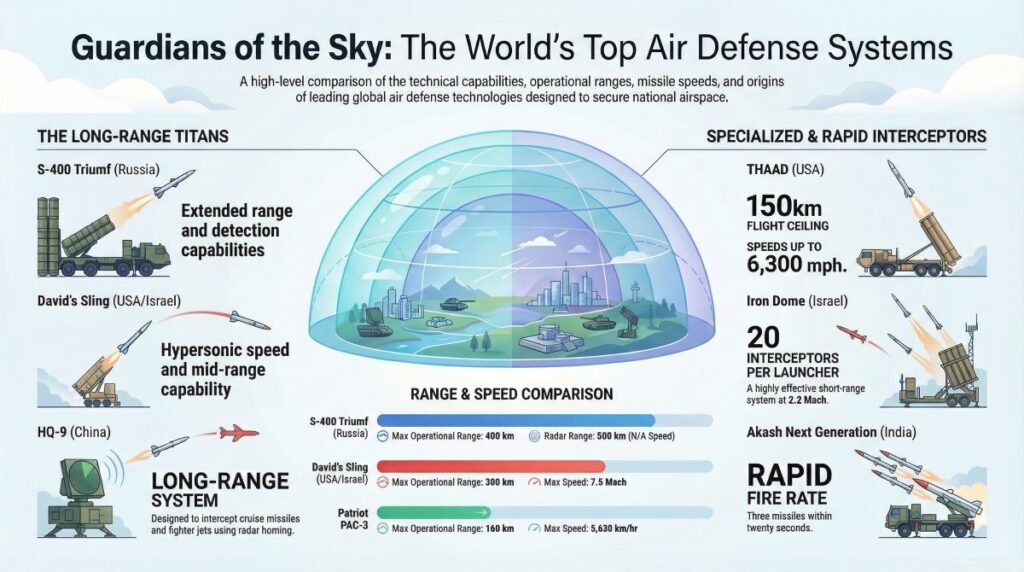
Seeker Technology and Guidance Trends: The Science Behind VSHORAD Accuracy
One of the most critical differentiators among very short range air defense systems is the seeker and guidance technology used. The seeker is the missile’s ‘eye’ – it determines what the missile can detect, track, and hit, and how well it can distinguish real targets from decoys and flares.
The 5 Major Seeker Technologies in Modern VSHORAD Systems
| Seeker Type | How It Works | Strengths | Used In |
| Passive IR | Detects heat signature of target engine | Simple, lightweight, no emissions | Stinger (Gen 1-2), Igla, Piorun |
| Dual-band IR | Tracks two IR wavelengths simultaneously | Better flare rejection | Igla-S, VSHORADS (India) |
| Imaging IR (IIR) | Full infrared image of target shape | Excellent countermeasure resistance | Mistral 3, Stinger RMP, Spyder |
| Laser Beam-Riding | Missile follows laser beam pointed at target | Completely immune to IR flares | Starstreak HVM |
| Active Radar (ARH) | Missile emits and tracks its own radar return | All-weather; fire-and-forget | Spyder (Derby), HQ-17 |
Guidance Technology Trends to Watch in 2026 and Beyond
The shift toward Imaging Infrared (IIR) seekers is the dominant trend in modern VSHORAD development. Unlike simple IR seekers that track heat blobs, IIR seekers produce a detailed infrared image of the target, allowing onboard algorithms to recognise the shape of aircraft, helicopters, and drones with high confidence. This dramatically reduces false engagement and increases resistance to flares.
Dual-band seekers, like those used in India’s VSHORADS and Russia’s Igla-S, operate across two infrared spectral bands simultaneously. The missile’s processor analyses the ratio of energy in each band – real targets produce a predictable spectral signature while flares produce a different ratio, enabling reliable discrimination.
The counter-drone challenge is now shaping VSHORAD seeker development. Small commercial drones have minimal heat signatures, making traditional IR seekers less effective. Systems like India’s VSHORADS explicitly tested against targets mimicking low thermal signature drones in the February 2026 trials – a direct response to the drone threat proven in Ukraine and the Middle East. Future VSHORAD systems are expected to combine IIR seekers with radio-frequency detection for drone-specific engagement.
Laser beam-riding guidance, as used by the Starstreak HVM, offers a completely different approach – one that is entirely immune to IR countermeasures. Future systems may combine IIR acquisition with laser beam-riding terminal guidance to get the best of both worlds.
Air Defence Mechanisms: A Primer on India and Pakistan
The air defence capabilities of India and Pakistan represent one of the most closely analysed bilateral military competitions in Asia. Both nations maintain layered air defence architectures from strategic long-range systems down to VSHORAD and MANPADS coverage, though their approaches, technology sources, and capability levels differ significantly.
India’s Air Defence Architecture
India operates a diversified and increasingly indigenous air defence system at the India VSHORAD level. Current inventory includes Russian Igla-1M and Igla-S MANPADS under emergency procurement, the Israeli Spyder short range air defense system deployed along the China and Pakistan borders, French Mistral MANPADS and vehicle-mounted systems, and the domestically developed VSHORADS from DRDO – which completed a landmark three-round successful test series on February 27, 2026.
India’s VSHORAD layer is complemented at higher tiers by the Akash medium-range SAM, the S-400 Triumf long-range system (acquired from Russia), and ongoing development of the indigenous Akash-NG and longer-range systems. India’s strategy increasingly prioritises indigenous development under the Atmanirbhar Bharat programme, reducing reliance on any single foreign supplier.
Pakistan’s Air Defence Architecture
Pakistan relies predominantly on Chinese short range air defense systems and Chinese MANPADS at the VSHORAD level. Pakistan operates the HQ-7 short-range SAM (a Chinese derivative of the French Crotale), various QW-series MANPADS, and the LY-80 medium-range SAM from China. China’s FL-2000 and HQ-17 platforms are likely to feature in future Pakistani procurement given the deep China-Pakistan defence relationship.
Pakistan’s heavier dependence on Chinese air defence technology versus India’s more diversified Israeli, French, Russian, and indigenous mix gives India a broader technology base and arguably greater resilience against supply disruption. The air defence mechanisms comparison between India and Pakistan consistently shows India holding a quantitative and qualitative advantage at the short-range tier, a gap that is widening with India’s indigenous VSHORADS approaching induction.
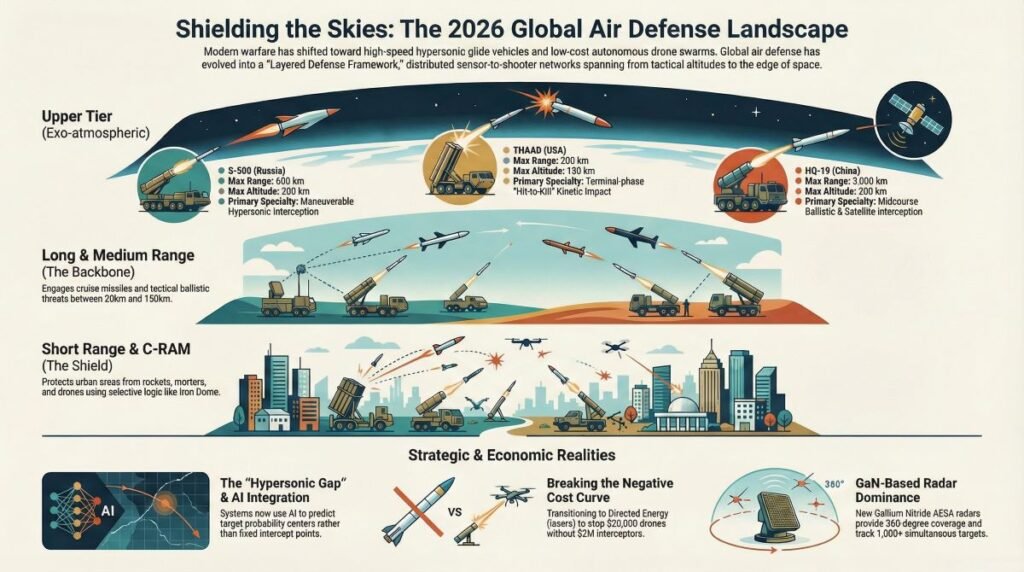
Which Country Has the Best Air Defence System in the World?
This is one of the most commonly searched questions in global defence research: which country has the best defence system in the world? The answer depends on the tier being evaluated, but across all metrics the following countries consistently lead.
The United States holds the most technologically advanced and numerically largest air defence inventory, encompassing the Patriot PAC-3, THAAD, Aegis naval system, Iron Dome (co-developed with Israel), and the SHORAD/Maneuver-SHORAD programme. Israel is considered a world leader in layered air defence concept and operational experience, with Iron Dome, David’s Sling, Arrow-2, and Arrow-3 providing coverage at every altitude band.
For top 10 countries with the best air defence systems globally, the ranking broadly falls as: United States, Israel, Russia, France, China, United Kingdom, Germany, India, South Korea, and Japan. Russia still operates the world’s largest air defence network by volume, though battlefield losses in Ukraine 2022-2026 have exposed systemic vulnerabilities in its Pantsir and Buk systems when operated without adequate support.
Among Asian powers, India is the fastest-rising nation in domestic air defence capability, while China is making the most rapid advances in top-tier long-range SAM technology.
Also read: Top 10 Biggest Aircraft Carriers in the World 2026 (.PPTX)
(FAQ)
Q1: What is a very short range air defense system?
A very short range air defense system (VSHORAD) is a portable or vehicle-mounted surface-to-air missile platform designed to intercept low-flying aerial threats – including drones, helicopters, cruise missiles, and aircraft – at ranges typically between 1 and 10 kilometres and altitudes up to 6,000 metres.
Q2: What is the best short range air defense system in the world?
As of 2026, the FIM-92 Stinger (USA) and Mistral 3 (France/MBDA) are widely considered the best short-range air defense systems available, based on combat performance, kill probability, technological sophistication, and global operational experience. Israel’s Spyder is the leading quick-reaction SAM system in the broader short-range category.
Q3: What is the difference between VSHORAD and MANPADS?
VSHORAD (Very Short-Range Air Defence) is the broader category that covers all short-range point-defence surface-to-air missile systems. MANPADS (Man-Portable Air Defence Systems) is a specific subcategory of VSHORAD that refers to shoulder-launched weapons carried and fired by individual soldiers. All MANPADS are VSHORAD, but not all VSHORAD systems are MANPADS – vehicle-mounted systems like the Pantsir-S1 are VSHORAD but not MANPADS.
Q4: What is India’s VSHORADS system and what happened in February 2026?
India’s VSHORADS (Very Short-Range Air Defence System) is an indigenous man-portable surface-to-air missile developed by DRDO’s Research Centre Imarat (RCI). On February 27, 2026, DRDO conducted three successive successful flight trials of the VSHORADS at the Integrated Test Range in Chandipur, Odisha. The missiles intercepted high-speed aerial targets mimicking drones and aircraft in all engagement scenarios, validating the system’s readiness for imminent induction into the Indian Army, Navy, and Air Force.
Q5: What is the Chinese short range air defense system?
China operates several short-range and VSHORAD systems. The HQ-17 (export: FL-2000) is China’s most capable VSHORAD, featuring a phased-array radar and vertical launch capability. At the MANPADS level, China’s QW-1, QW-2, QW-18, and FN-6 are widely deployed domestically and exported globally. China is also upgrading to the HQ-17A and developing next-generation systems under a major military modernisation programme.
Q6: What is the Mistral short range air defense system?
The Mistral short range air defense system is a French surface-to-air missile developed by MBDA. It is one of the most capable VSHORAD systems globally, featuring an imaging IR seeker with a kill probability exceeding 93 percent. Mistral is deployed in MANPADS, vehicle-mounted, naval, and helicopter-launched (ATAM) configurations and is operated by over 40 nations including India, France, Singapore, and Qatar. The Mistral 3 is the current production standard.
Q7: What is the Spyder short range air defense system?
The Spyder short range air defense system is an Israeli quick-reaction surface-to-air missile system developed by Rafael Advanced Defense Systems and IAI. It fires Python-5 (imaging IR) and Derby (active radar homing) missiles from a mobile launcher, giving it unique dual-engagement mode capability. It is operated by India, Singapore, the Philippines, Vietnam, Azerbaijan, and several other nations.
Q8: Which country has the best air defence system in the world?
The United States and Israel are generally considered to have the world’s best layered air defence systems. The US leads in technology breadth and numerical scale across all tiers. Israel leads in operational experience, integration sophistication, and the proven effectiveness of its Iron Dome, David’s Sling, and Arrow systems in real combat. In the VSHORAD-specific category, the USA (Stinger) and France (Mistral) have the most operationally proven systems.
Q9: What is the top 20 air defence system in the world?
Beyond the top 10 VSHORAD systems listed in this article, notable additional short-range and air defence systems include Russia’s Tor-M2, Germany’s Gepard SPAAG, South Korea’s Biho, Japan’s Type 91 Kin-SAM, Sweden’s RBS 70 NG, Turkey’s Sungur, Ukraine’s Igla-based systems, Singapore’s SPYDER, France’s Crotale NG, and the US Avenger vehicle-mounted Stinger platform.
Q10: Are MANPADS a threat to civilian aircraft?
Yes, the proliferation of man-portable air defense systems to non-state actors is considered a significant global aviation security threat. Several civilian aircraft have been targeted by MANPADS in conflict zones over the decades. The Wassenaar Arrangement and other multilateral export control regimes work to restrict MANPADS transfers to verified government end-users only. Modern civilian aircraft do not carry countermeasure systems, making them vulnerable to older IR-guided MANPADS at low altitudes during approach and departure.
Conclusion
The world of very short range air defense systems is more dynamic, competitive, and strategically critical than ever before. From the iconic FIM-92 Stinger to the technologically advanced Mistral 3, from China’s HQ-17 to India’s breakthrough indigenous VSHORADS tested successfully just days before this article was published, these systems collectively define the lowest and most immediate layer of ground-based air protection for nations worldwide.
The February 27, 2026 successful testing of India’s VSHORADS marks a turning point not just for India but for the broader global VSHORAD market – demonstrating that the circle of nations capable of developing indigenous fourth-generation MANPADS is expanding. Combined with Ukraine’s lessons validating the Stinger, Piorun, Mistral, and Starstreak, and China’s rapid development of domestic systems, 2026 is a pivotal year for VSHORAD technology.
As drone warfare, loitering munitions, and low-altitude saturation attacks become the dominant form of modern tactical air threat, investment in the top 10 very short range air defense systems in the world will only intensify. Nations that maintain robust, modern, and layered VSHORAD capabilities will hold decisive tactical advantages on the battlefields of the future.
Stay informed. Stay defended.
Disclaimer: This article is published for educational and informational purposes only. All information is sourced from publicly available government statements, official press releases, and verified open-source defence publications. The author does not represent any government, defence organisation, or arms manufacturer. The India VSHORADS section is based on official Press Information Bureau releases dated February 27, 2026.