

Today in this article we will discuss about the Top 8 Highest Helicopter Altitude Records in History with PPT, PDF and Infographics, From Conquering Everest to the Edge of the Sky – The Most Remarkable Rotorcraft Feats Ever Achieved so, Achieving extreme altitude in a helicopter is one of aviation’s most demanding challenges. Unlike fixed-wing aircraft that generate lift through forward speed over a wing, helicopters depend on spinning rotor blades – and as altitude increases, the air grows dangerously thin. At very high elevations, there are fewer air molecules for the rotor to grab onto, making it progressively harder to generate enough lift to maintain controlled flight. Add sub-zero temperatures that can freeze mechanical components, powerful unpredictable winds, and the physiological effects of altitude on pilots, and you begin to understand why every record on this list represents a remarkable convergence of extraordinary engineering, meticulous preparation, and exceptional human skill.
Table of Contents
From the pioneering military test flights of the late 1940s to record-breaking summits of Mount Everest itself, helicopter altitude records chart the history of rotorcraft development over seven decades. Each achievement pushed the known boundaries of what rotorcraft could do, influenced helicopter design for generations, and in several cases saved lives by proving capabilities needed for high-altitude rescue, military operations, and exploration.
This comprehensive guide covers the eight most significant helicopter altitude records in history. For each record we examine the pilot, the helicopter, the date, the altitude achieved, the technical specifications of the aircraft, the challenges overcome, and the lasting significance of the achievement.
Note: All altitude figures are drawn from official Fédération Aéronautique Internationale (FAI) world record certifications and verified aviation historical sources including the National Aeronautic Association (NAA), Helicopter Association International, and authoritative aviation reference publications. The FAI is the world governing body for air sports and aeronautical record-keeping, established in 1905 and recognised by the International Olympic Committee.
Top 8 Highest Helicopter Altitude Records in History (.PPTX)
Understanding Helicopter Altitude: Why It Is So Difficult
Before examining each record, understanding the physics and engineering challenges of high-altitude helicopter flight provides essential context for appreciating these achievements.
The Density Altitude Problem:
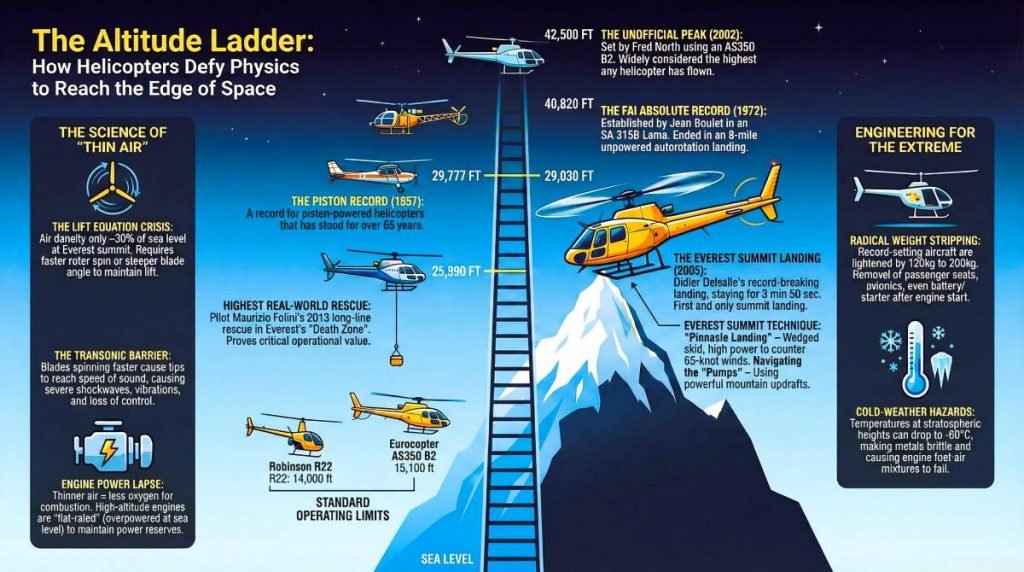
Air density decreases with altitude. At sea level, the atmosphere contains enough air molecules per cubic metre that a helicopter’s rotor blades – spinning at high speed – can generate sufficient lift to support the aircraft’s weight. As altitude increases, air density falls. By 8,000 metres (26,247 ft) – approximately the altitude of most of the records on this list – air density has fallen to roughly one-third of sea level values. This means the rotor must work three times as hard to produce the same lift. Since rotor blade speed is limited by the speed of sound at the blade tips, there is a physical ceiling beyond which conventional rotor systems simply cannot generate adequate lift.
Engine Performance Degradation:
Turbine engines that power most modern helicopters also suffer at altitude. These engines combust fuel with oxygen drawn from the surrounding air. With less oxygen available at high altitude, engines produce less power – the exact opposite of what is needed when the rotor is already struggling to generate lift. High-altitude flight requires either specially tuned engines optimised for thin-air operation, or accepting dramatically reduced performance compared to sea level.
Temperature Extremes:
Extreme cold at high altitude affects lubricants, hydraulic fluids, and mechanical components throughout the aircraft. Metal contracts, seals harden, and systems designed and tested at moderate temperatures can fail. Pilots face physiological risks from cold and from hypoxia (oxygen deprivation) requiring supplemental oxygen systems above approximately 4,000 metres (13,123 ft).
Wind and Turbulence:
High altitude environments – particularly near mountain summits – experience unpredictable and powerful wind conditions. Jet stream winds, mountain wave turbulence, and summit-level gusts can exceed the aircraft’s structural limits or overpower the pilot’s ability to control the aircraft. Every high-altitude record flight required careful meteorological planning and often narrow weather windows of only minutes or hours.
With these challenges established, the achievements on this list become truly extraordinary.
Top 8 Highest Helicopter Altitude Records in History
#8. Sikorsky S-52: The Record That Started It All – 6,468 metres (21,220 ft)
The Sikorsky S-52 flight of 1949 holds special historical significance as one of the earliest formally certified helicopter altitude world records. It demonstrated to military and civilian aviation authorities worldwide that helicopters were not limited to low-altitude nap-of-the-earth operations but could operate at altitudes previously associated exclusively with fixed-wing aircraft.
The Record:
- Pilot: Captain Hubert Dale Gadis, United States Army Field Artillery
- Date: May 21, 1949
- Location: Bridgeport, Connecticut, United States
- Altitude achieved: 6,468 metres (21,220 feet)
- Category: FAI World Record – Altitude Without Payload
- Observers: Walter Godard and Charles Loon, National Aeronautic Association representatives
The Aircraft – Sikorsky S-52:
- Manufacturer: Sikorsky Aircraft Corporation, Stratford, Connecticut
- Type: Light utility helicopter – prototype configuration for record attempt
- Rotor configuration: Single main rotor with anti-torque tail rotor
- Engine: Franklin 6V4-200-C32 piston engine, 245 horsepower
- Rotor diameter: 10.0 metres (32 ft 10 in)
- Empty weight: 862 kg (1,900 lbs)
- Maximum takeoff weight: 1,179 kg (2,600 lbs)
- Normal service ceiling: Approximately 4,875 metres (16,000 ft) – the record far exceeded standard capability
- Cruise speed: 160 km/h (99 mph)
- First flight: February 12, 1947
- Notable feature: First helicopter to perform an outside loop; exceptional for its era in aerobatic and altitude capability
Significance and Legacy:
Captain Gadis’s achievement in the S-52 was not simply a sporting record. In the post-World War II period, military establishments worldwide were evaluating the operational utility of helicopters. Many planners viewed rotorcraft as confined to low-altitude roles such as liaison, observation, and casualty evacuation close to the battlefield. The 6,468-metre record – flown in a relatively small, piston-engined helicopter – fundamentally challenged this assessment. It demonstrated that helicopters could potentially operate in mountain terrain, conduct high-altitude reconnaissance, and provide support in environments previously considered inaccessible to rotorcraft. The record contributed directly to the expanding military and civilian operational doctrines for helicopter utilisation throughout the 1950s.
Historical Context: In 1949, most military helicopters were being evaluated for limited roles. This record helped transform how military planners thought about the helicopter’s potential operational envelope, influencing procurement decisions that shaped the development of dedicated high-altitude helicopter variants throughout the following decade.
#7. Hughes YOH-6A: Vietnam Era Scout Sets Altitude Mark – 8,061 metres (26,447 ft)
The Hughes YOH-6A altitude record emerged during one of the most intensive periods of military helicopter development in history – the lead-up to and early years of the Vietnam War. The record was set by a prototype of what would become one of the most important and beloved light observation helicopters in U.S. military history.
The Record:
- Pilot: Jack Lewis Zimmerman
- Date: March 27, 1966
- Altitude achieved: 8,061 metres (26,447 feet)
- Category: FAI World Record – Altitude Without Payload
- Development context: U.S. Army Light Observation Helicopter (LOH) competition
The Aircraft – Hughes YOH-6A (OH-6 Cayuse):
- Manufacturer: Hughes Helicopters, Culver City, California
- Military designation: OH-6A Cayuse (production version); YOH-6A (prototype/competition variant)
- Nicknames: ‘Loach’ (from LOH acronym), ‘Little Bird’ (special operations variants)
- Type: Light observation and reconnaissance helicopter
- Rotor configuration: Single four-bladed semi-rigid main rotor
- Engine: Allison T63-A-5A turboshaft, 317 shaft horsepower
- Main rotor diameter: 8.03 metres (26 ft 4 in)
- Empty weight: 493 kg (1,087 lbs)
- Maximum takeoff weight: 1,225 kg (2,700 lbs)
- Maximum speed: 241 km/h (150 mph)
- Service ceiling: 4,815 metres (15,800 ft) standard; record far exceeded operational limit
- Range: 611 km (380 miles)
- Crew: Pilot plus up to 3 passengers or equivalent cargo
- First flight: February 27, 1963
- Production: Over 1,400 built for U.S. military; widely exported
Design Innovation:
The OH-6’s most distinctive engineering feature was its exceptionally compact, egg-shaped fuselage designed with structural efficiency as the primary goal. The fuselage was constructed to be both extremely strong and extremely light, with the rotor and transmission system integrated tightly to minimise weight and drag. This revolutionary design approach, led by Hughes engineers including Ren Hoover, produced a power-to-weight ratio far superior to competing designs in the Army’s LOH competition. The compact design also made the helicopter exceptionally manoeuvrable at all altitudes.
Vietnam War Role:
The OH-6 became the primary light observation helicopter of the Vietnam War, flying thousands of low-level reconnaissance missions in search of North Vietnamese Army and Viet Cong positions. Flying at treetop level and below, OH-6 pilots developed a reputation for extraordinary bravery and skill. The helicopter’s compact size, agility, and relatively quiet operation made it suited to dangerous hunter-killer operations conducted alongside AH-1 Cobra gunships.
Significance: Zimmerman’s altitude record proved the YOH-6A’s capability far exceeded its designed operational envelope, which helped Hughes win the original LOH contract competition. The OH-6 lineage continues today in the MD 500 series and the MH-6 Little Bird used by U.S. Army special operations forces.
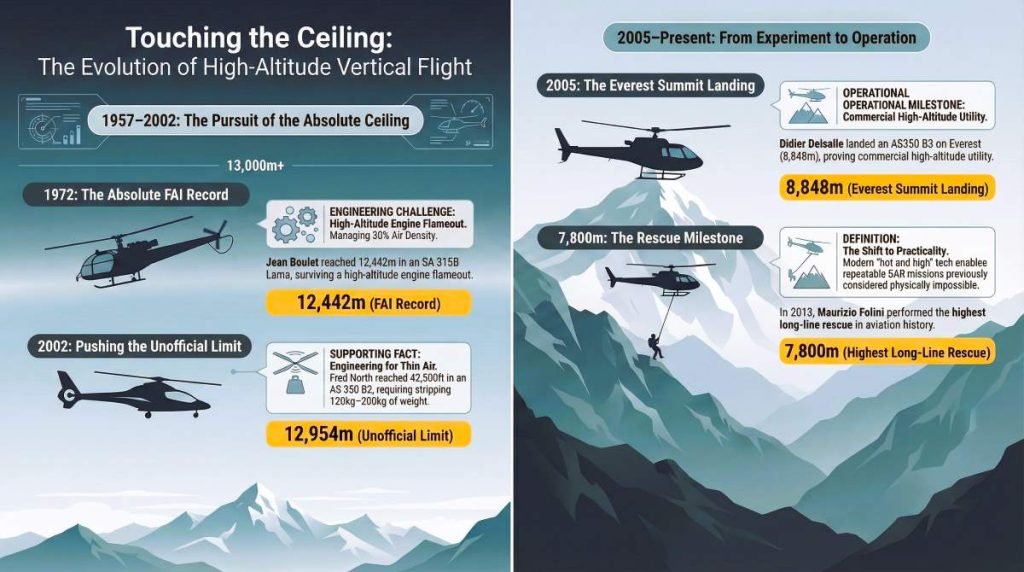
#6. Eurocopter AS 350 Squirrel: Landing on Top of the World – 8,848 metres (29,029 ft) – (H125 HELICOPTER, FRANCE)
On May 14, 2005, Didier Delsalle accomplished something no pilot had ever done before and few believed possible: he landed a helicopter on the summit of Mount Everest – the highest point on Earth. This was not a record of altitude achieved in a controlled test environment, but a precision landing on a narrow ice-covered ridge at 8,848 metres (29,029 ft), in extreme conditions, at a location where no mechanical rescue would have been possible if anything had gone wrong.
The Record:
- Pilot: Didier Delsalle, Eurocopter test pilot, France
- Date: May 14, 2005 (landing); May 15, 2005 (second landing to confirm record)
- Location: Summit of Mount Everest, Nepal/Tibet border – 8,848 metres (29,029 ft)
- Category: FAI World Record – Highest Altitude Landing AND Highest Altitude Takeoff
- Duration on summit: 3 minutes and 50 seconds (first landing)
- Wind conditions: 65-knot winds with severe updrafts and downdrafts
- Temperature: Minus 35 degrees Celsius (minus 31 degrees Fahrenheit)
- Additional records: Highest altitude landing, highest altitude takeoff – three records set simultaneously
The Aircraft – Eurocopter AS 350 B3 Squirrel:
- Manufacturer: Eurocopter (now Airbus Helicopters), Marignane, France
- Full designation: AS 350 B3 – high-altitude optimised variant of the Ecureuil (Squirrel) family
- Type: Light utility helicopter, optimised for hot-and-high performance
- Rotor configuration: Single three-bladed Starflex semi-rigid main rotor
- Engine: Turbomeca Arriel 2B1 turboshaft, 847 shaft horsepower
- Main rotor diameter: 10.69 metres (35 ft 1 in)
- Empty weight: 1,220 kg (2,690 lbs)
- Maximum takeoff weight: 2,250 kg (4,960 lbs)
- Maximum speed: 287 km/h (178 mph)
- Service ceiling: 7,010 metres (23,000 ft) standard – record exceeded by 1,838 metres
- Range: 666 km (414 miles) standard
- Special modifications for Everest attempt: Stripped to minimum weight, fuel load optimised, oxygen system for pilot, all non-essential equipment removed
- Rotor blade modification: Standard production blades – no special high-altitude modifications
The Flight in Detail:
Delsalle’s Everest landing was years in preparation. He conducted extensive high-altitude testing at progressively higher elevations in the Himalayas to characterise the AS 350 B3’s performance envelope at extreme altitude. The summit approach required navigating violent and unpredictable winds that change direction and intensity within seconds near Everest’s peak. At 8,848 metres, air density is approximately one-third of sea level, meaning the rotor was operating at the very edge of its ability to generate adequate lift.
The landing surface was a narrow, sloping ridge of snow and ice – not a prepared landing pad. Delsalle had to maintain precise hover control while descending to the surface, fighting crosswinds of up to 65 knots. After holding on the summit for 3 minutes and 50 seconds with the engine running, he executed a clean takeoff. To officially certify the record, he repeated the feat the following day, May 15, landing again at the Everest summit.
Significance and Legacy:
The Everest landing transformed the understanding of high-altitude rescue potential. Before 2005, conventional wisdom held that helicopter rescue operations above approximately 6,000 metres were impractical. Delsalle’s demonstration proved that with the right aircraft and pilot, helicopter operations at extreme Himalayan altitude were possible – knowledge that has since been applied in real mountain rescue operations. The AS 350 B3 became the helicopter of choice for Himalayan rescue and high-altitude operations worldwide following this demonstration.
Why This Record Is Different: Unlike the other records on this list achieved in controlled test conditions, Delsalle’s landing was on the actual summit of Mount Everest – the most challenging possible environment for any aircraft operation. The 65-knot winds and minus 35°C temperature made the technical achievement even more remarkable.
Q: H125 Helicopter and AS 350 B3 Squirrel Helicopter are same?
Yes, the Airbus Helicopters H125 and the Eurocopter AS350 B3 Squirrel (Écureuil) refer to essentially the same helicopter platform. The H125 is the modern name given to the AS350 B3e after rebranding. In North America, it is commonly known as the AStar.
Key Information About the H125 / AS350 B3
- Rebranding: In 2015, Airbus Helicopters renamed the AS350 B3e to H125 as part of a new, simplified naming system.
- Performance: The H125 is the latest and most powerful version in the Écureuil (Squirrel) series. It is especially recognized for its strong high-altitude performance, reliability, and versatility in challenging environments.
- Engine & Specifications: It is typically powered by the Turbomeca Arriel 2D engine and includes a dual-hydraulic flight control system for improved safety and handling.
- Designation Difference: Although “H125” is the current official name, many operators and industry professionals still use AS350 B3e interchangeably, since the aircraft’s core design remains the same.
Overall, both designations describe the same helicopter family, offering excellent capability for utility work, passenger transport, aerial operations, and high-altitude missions.
#5. Bell 214A Isfahan: Iranian Military Sets Altitude Milestone – 9,144 metres (29,528 ft)
In 1975, an Iranian Air Force officer piloted a specially configured Bell helicopter to an altitude that exceeded Mount Everest itself, setting a formal FAI world record that stood as a significant benchmark in military helicopter performance.
The Record:
- Pilot: Major General Manucher Khosrodad, Imperial Iranian Air Force
- Date: April 29, 1975
- Altitude achieved: 9,144 metres (29,528 feet)
- Category: FAI World Record – Altitude (specific category)
- Significance: Demonstrated advanced hot-and-high performance of the Bell 214A series
The Aircraft – Bell 214A Isfahan:
- Manufacturer: Bell Helicopter Textron, Fort Worth, Texas
- Designation: Bell 214A Isfahan – export military designation for Iran
- Basis: Advanced development of Bell 205 / UH-1H Huey platform
- Type: Medium utility helicopter – high-altitude and heavy-lift optimised
- Rotor configuration: Single two-bladed semi-rigid teetering main rotor
- Engine: Lycoming T53-L-703 turboshaft, 2,930 shaft horsepower – significantly more powerful than UH-1 variants
- Main rotor diameter: 15.24 metres (50 ft)
- Empty weight: 3,266 kg (7,200 lbs)
- Maximum takeoff weight: 7,258 kg (16,000 lbs)
- Maximum speed: 259 km/h (161 mph)
- Service ceiling: 5,090 metres (16,700 ft) standard
- Hover ceiling in ground effect: 3,595 metres (11,800 ft)
- Range: 440 km (273 miles)
- Production: Approximately 296 built primarily for Imperial Iranian Air Force
Development History:
The Bell 214A was developed specifically in response to requirements from the Imperial Iranian Air Force for a helicopter capable of operating in Iran’s challenging geography – combining high-altitude mountain terrain with extreme desert heat. Iran’s military had extensive experience using Bell 205s (the military UH-1H) and identified a need for a significantly more powerful variant capable of operating effectively in both the Zagros and Alborz mountain ranges and the Persian Gulf coastal regions.
Bell developed the 214A with a dramatically uprated powerplant – the 2,930 shp Lycoming T53-L-703, producing nearly twice the power of the standard UH-1H engine. This engine gave the Bell 214A exceptional performance in hot-and-high conditions where other helicopters lost significant capability. The Iranians named the aircraft ‘Isfahan’ after the historic Persian city.
Significance and Legacy:
Major General Khosrodad’s altitude record demonstrated that a military utility helicopter – not a lightweight speed machine or purpose-built altitude record aircraft – could exceed 9,000 metres. This had significant implications for high-altitude military operations in mountain warfare scenarios. The Bell 214 family also found commercial application, particularly in offshore oil industry operations where the combination of power, range, and hot-and-high performance was valuable.
Context: The record was set during the height of the Imperial Iranian Air Force’s modernisation programme under Shah Mohammad Reza Pahlavi, which saw Iran operate one of the largest and best-equipped air forces in Asia. The Bell 214A programme was a centrepiece of that modernisation effort.
#4. Kaman H-43B Husky (Two-Pilot): First Two-Pilot Altitude Record – 9,097 metres (29,845 ft)
The Kaman H-43 Husky holds a unique place in helicopter history for its unconventional engineering approach – and the altitude record set by this aircraft in 1959 is especially notable as the first FAI-certified helicopter altitude world record achieved with two pilots on board.
The Record:
- Pilots: U.S. Air Force Captain Walter J. Hudson and Major William J. Davis
- Date: December 9, 1959
- Location: Bloomfield, Connecticut
- Altitude achieved: 9,097 metres (29,845.8 feet)
- Category: FAI World Record – Altitude Without Payload
- Historical distinction: First helicopter altitude world record achieved with two pilots simultaneously
- Aircraft registration: 58-1848
The Aircraft – Kaman H-43B Husky:
- Manufacturer: Kaman Aircraft Corporation, Bloomfield, Connecticut
- Military designation: HH-43B Husky (rescue variant); H-43B (base variant)
- Type: Local base rescue helicopter; fire suppression support
- Rotor configuration: UNIQUE – Intermeshing twin rotor (‘synchropter’) – two rotors mounted on angled shafts, meshing together without a tail rotor
- Engine: Lycoming T53-11A turboshaft, 825 shaft horsepower
- Main rotor diameter: 14.33 metres (47 ft) each rotor
- Empty weight: 2,070 kg (4,563 lbs)
- Maximum takeoff weight: 4,150 kg (9,150 lbs)
- Maximum speed: 193 km/h (120 mph)
- Service ceiling: 7,740 metres (25,400 ft) – record exceeded operational ceiling
- Range: 451 km (280 miles)
- Primary role: Local base rescue (crash-fire rescue near airfields); Fire suppression
- Production: Approximately 263 built for U.S. Air Force, Navy, Marines
The Synchropter Design Explained:
The Kaman H-43’s most remarkable feature is its intermeshing twin-rotor configuration – a design found on no other widely produced military helicopter in history. Instead of a conventional single main rotor with an anti-torque tail rotor, the Husky mounts two rotors on shafts angled apart at approximately 6 degrees, rotating in opposite directions and intermeshing – passing through each other’s arc without collision through precise mechanical synchronisation.
This arrangement eliminates the need for a tail rotor entirely. In a conventional helicopter, the tail rotor consumes approximately 15-30% of engine power simply to counteract the torque of the main rotor. By using counter-rotating intermeshing rotors, the Husky channels all engine power directly into lift generation, making it significantly more efficient than conventional designs at high altitude where every fraction of available power is critical.
Rescue Role and Operational History:
The H-43 Husky served as the primary local base rescue helicopter for the U.S. Air Force from the late 1950s through the 1970s. Stationed at air bases worldwide, it was designed to reach a downed aircraft at the end of a runway within minutes of an emergency. During the Vietnam War, HH-43 Huskies flew thousands of rescue missions recovering downed pilots. The helicopter’s ability to hover stably with external loads – facilitated by the twin-rotor efficiency – made it particularly effective for rescue hoist operations.
Significance: The twin-pilot altitude record demonstrated not only the Husky’s exceptional high-altitude capability but proved that the synchropter design’s efficiency advantage translated directly into altitude performance. No other helicopter design of the era achieved comparable altitude efficiency relative to installed engine power.
#3. Kaman HH-43B Husky (Single Pilot): Breaking the 10,000-Metre Barrier – 10,010 metres (32,841 ft)
A decade after the two-pilot altitude record, the same Kaman HH-43B Husky – same tail number – returned to set an even more remarkable record: the first helicopter to exceed 10,000 metres (32,808 ft) in altitude, breaking what had seemed like an insurmountable psychological and aeronautical barrier for rotorcraft.
The Record:
- Pilot: Lieutenant Colonel Francis M. Carney, U.S. Air Force
- Date: October 18, 1961
- Altitude achieved: 10,010 metres (32,841 feet)
- Category: FAI World Record – Altitude Without Payload
- Aircraft tail number: 62-63 – the same aircraft used in the 1959 two-pilot record
- Historical distinction: First helicopter ever to exceed 10,000 metres altitude
Why the Same Aircraft:
The use of the same HH-43B Husky (tail number 62-63) for two separate world altitude records is remarkable and speaks to the exceptional capability of the Kaman synchropter design. Kaman had identified through the 1959 two-pilot record that the aircraft possessed altitude potential well beyond standard operational parameters. The decision to attempt to break 10,000 metres used the proven airframe rather than a new prototype, reflecting confidence in both the design and the accumulated test data from the earlier record.
The Challenge of 10,000 Metres:
Reaching 10,000 metres in a helicopter in 1961 was an extraordinary technical achievement for several reasons. At 10,000 metres, atmospheric pressure is approximately 27% of sea level values – meaning the rotor was operating in air nearly four times less dense than at ground level. The turboshaft engine’s power output was dramatically reduced from its sea-level rating. Temperatures at altitude would have been in the range of minus 50 degrees Celsius.
Lieutenant Colonel Carney flew the record attempt essentially solo – without payload – to minimise weight to the absolute minimum. Every kilogram of unnecessary weight reduced the altitude ceiling achievable. The flight required supplemental oxygen for the pilot and careful management of the aircraft’s systems in extreme cold.
Aircraft Specifications (same as Record 4 above):
- Engine: Lycoming T53 turboshaft – same type but potentially in high-altitude tuned configuration
- Rotor configuration: Intermeshing synchropter – key to achieving this altitude
- Weight: Stripped to minimum possible for record attempt
- Key advantage: Synchropter efficiency – no tail rotor power loss – provided decisive altitude advantage over conventional designs
Significance and Legacy:
The 10,010-metre record was both a technical milestone and a proof of concept. It demonstrated that rotorcraft could operate above 10,000 metres – an altitude at which aircraft carriers then operated, where jet aircraft routinely cruised, and where conventional helicopters were considered completely incapable of flight. The record influenced thinking about high-altitude helicopter rescue capabilities and contributed to the development of more powerful turboshaft engines for subsequent generations of rotorcraft.
The Synchropter Advantage: Both Kaman altitude records (Records 3 and 4 on this list) were achieved by the same unusual synchropter design. The elimination of tail rotor power loss gave the H-43 a structural altitude advantage over conventional designs that could not be replicated until much more powerful turboshaft engines became available.
#2. Aérospatiale SA 315B Lama: A World Record AND an Autorotation Record – 12,442 metres (40,820 ft)
The Aérospatiale SA 315B Lama’s altitude record of June 21, 1972 stands as one of the most dramatic and technically extraordinary events in helicopter history. Not only did pilot Jean Boulet set the absolute helicopter altitude world record, but during the descent, the flight produced an unplanned additional world record of a completely different category – the highest-ever autorotation landing.
The Record:
- Pilot: Jean Boulet, Chief Test Pilot, Aérospatiale, France
- Date: June 21, 1972
- Location: Aérospatiale test facility, France
- Altitude achieved: 12,442 metres (40,820 feet – approximately 40,000 ft)
- Category: FAI World Absolute Helicopter Altitude Record
- Secondary record: Highest altitude autorotation (power-off) landing in history
- What happened: Engine flame-out during descent; Boulet executed successful power-off autorotation landing from record altitude
The Aircraft – Aérospatiale SA 315B Lama:
- Manufacturer: Aérospatiale (now Airbus Helicopters), Marignane, France
- Type: High-altitude light utility helicopter – specifically optimised for mountain operations
- Design concept: Combined the airframe of the Alouette II with the rotor system and powerplant of the more powerful Alouette III
- Rotor configuration: Single three-bladed semi-rigid main rotor
- Engine: Turbomeca Artouste IIIB turboshaft, 870 shaft horsepower
- Main rotor diameter: 11.02 metres (36 ft 2 in)
- Empty weight: 1,021 kg (2,251 lbs) – very lightweight for the power installed
- Maximum takeoff weight: 1,950 kg (4,299 lbs) at sea level
- Maximum speed: 192 km/h (119 mph)
- Service ceiling: 5,100 metres (16,728 ft) standard – record exceeded by 7,342 metres
- Hover ceiling in ground effect (HIGE): 7,500 metres (24,606 ft) – itself an extraordinary figure
- Range: 515 km (320 miles)
- Design heritage: Developed specifically for Indian Army mountain operations at high Himalayan altitude
- Production operators: India, Pakistan, Peru, Chile, France, Switzerland – mountainous terrain nations
The Flight and the Engine Flame-Out:
Jean Boulet’s record flight took the Lama to 12,442 metres – nearly double the aircraft’s standard certified service ceiling. At this extreme altitude, with air density at approximately 20% of sea level values, the Turbomeca Artouste engine was operating far outside its normal parameters. During the descent from the record altitude, extreme cold caused the engine to flame out – a complete power failure.
An engine flame-out in a helicopter is one of aviation’s most dangerous emergencies. Without engine power, the rotor loses its driven rotation and begins to slow. If the pilot does not react immediately and correctly, the rotor will decelerate below the minimum RPM needed to generate lift, and the helicopter will fall uncontrolled. The correct response is autorotation – the pilot lowers the collective pitch control to reduce rotor blade angle of attack, allowing the downward airflow through the slowing rotor to maintain rotor RPM through auto-rotation physics, similar to how a falling maple seed spins as it descends.
Boulet executed a flawless autorotation from an altitude that had never been attempted before – using only the kinetic energy stored in the rotor system and the physics of autorotation to control the descent from over 12,000 metres and land safely with no engine power. This descent itself became an official FAI world record: the highest altitude power-off touchdown autorotation ever recorded.
Why the Lama Was Chosen:
The SA 315B Lama was specifically engineered for the highest-altitude helicopter operations then required – primarily in support of the Indian Army’s mountain warfare requirements in the Himalayas. By combining a lightweight Alouette II fuselage with the more powerful Alouette III rotor system and engine, Aérospatiale created an aircraft with an exceptionally favourable power-to-weight ratio for altitude work. The Lama went on to set numerous commercial high-altitude records in addition to the official FAI certification, including external load operations at over 7,500 metres in the Himalayas.
The Double Record: No other entry on this list produced two world records in a single flight. Boulet’s engine flame-out and subsequent autorotation landing turned a potential catastrophe into aviation history. The combination of extreme altitude record and the world’s highest autorotation landing makes this flight uniquely significant in helicopter history.
#1. Eurocopter AS 350 B2 Squirrel: The Absolute Helicopter Altitude World Record – 12,954 metres (42,500 ft)
On March 23, 2002, Fred North accomplished the most extreme altitude achievement in the entire history of rotorcraft: he piloted an Eurocopter AS 350 B2 to 12,954 metres (42,500 feet) – setting the FAI absolute world altitude record for helicopters that stands to this day. This is the highest any helicopter has ever flown.
The Record:
- Pilot: Fred North, accomplished test and record pilot
- Date: March 23, 2002
- Altitude achieved: 12,954 metres (42,500 feet)
- Category: FAI Absolute World Altitude Record – Helicopters (all classes)
- Status: Current – this record has not been broken since 2002
- Significance: The highest any helicopter has ever flown in history
- Preparation: Extensive high-altitude testing programme over multiple years preceding record attempt
The Aircraft – Eurocopter AS 350 B2 Squirrel:
- Manufacturer: Eurocopter (now Airbus Helicopters), Marignane, France
- Full designation: AS 350 B2 – intermediate-altitude variant of the Ecureuil (Squirrel) series
- Relationship to Everest record: The AS 350 B3 used by Delsalle for the Everest landing is a more powerful derivative of the B2
- Type: Light utility helicopter
- Rotor configuration: Single three-bladed Starflex semi-rigid main rotor
- Engine: Turbomeca Arriel 1D1 turboshaft, 732 shaft horsepower
- Main rotor diameter: 10.69 metres (35 ft 1 in)
- Number of main rotor blades: 3 – composite construction
- Empty weight: 1,157 kg (2,551 lbs)
- Maximum takeoff weight: 2,250 kg (4,960 lbs) at sea level
- Maximum speed: 287 km/h (178 mph) at sea level
- Service ceiling (standard): 6,400 metres (20,997 ft) – record exceeded by 6,554 metres
- Hover ceiling in ground effect: 4,572 metres (15,000 ft) standard
- Range: 667 km (414 miles) standard
- Configuration for record: Stripped to absolute minimum weight – no passenger seats, reduced fuel to minimum necessary, all non-essential equipment removed
- Pilot oxygen: Supplemental oxygen system essential – at 12,954 metres, ambient oxygen is approximately 25% of sea level
Preparation and Planning:
Fred North’s record was not achieved through improvisation but through a methodical, multi-year programme of progressive high-altitude testing. North and his team characterised the AS 350 B2’s performance at incrementally higher altitudes, identifying the limits of engine performance, rotor effectiveness, and aircraft controllability at extreme altitude. This approach is consistent with best practice in aviation record attempts – establishing a complete performance envelope rather than simply attempting the maximum on a single flight.
At 12,954 metres, the atmosphere is extraordinarily hostile to aviation. Air density is approximately 25% of sea level. The Arriel engine’s power output falls dramatically as air pressure decreases. The three-bladed Starflex rotor system must spin at its maximum permissible RPM to generate adequate lift from the thin air, while blade tip speed approaches the speed of sound – the absolute limit of rotor effectiveness. Temperatures at this altitude fall to approximately minus 60 degrees Celsius, presenting severe challenges for engine components, hydraulic systems, and pilot physiology.
The Achievement in Context:
To appreciate the scale of North’s achievement, consider what 12,954 metres represents in terms of geography and aviation: the summit of Mount Everest is at 8,849 metres – North’s record altitude is 4,105 metres higher than Everest. Commercial jet aircraft cruise at approximately 10,000–12,000 metres – North’s helicopter reached altitudes where passenger jets operate. The record exceeded the previous world record set by the SA 315B Lama in 1972 by 512 metres.
Technical Achievement Analysis:
- Air density at 12,954 m: Approximately 25% of sea level – rotor generating lift in near-vacuum conditions
- Engine power at altitude: Estimated 30-40% of sea level rated power available
- Rotor tip speed: Approaching Mach 1 at blade tips – the physical upper limit of rotor aerodynamics
- Temperature: Approximately minus 60°C – severe mechanical stress on all components
- Oxygen level: 25% of sea level – supplemental oxygen essential; unaided flight physically impossible
- Previous record beaten: Aérospatiale SA 315B Lama record (12,442 m) exceeded by 512 metres
- Current record status: Unbroken since March 23, 2002 – over two decades as the absolute record
The Starflex Rotor System – Key to the Record:
A significant contributor to the AS 350 series’ exceptional altitude performance is the Starflex rotor head – a semi-rigid rotor hub design developed by Eurocopter (then Aérospatiale) that uses elastomeric bearings to replace conventional mechanical bearings and hinges. This design reduces maintenance significantly but, more importantly for altitude performance, is lighter than equivalent mechanical systems and provides precise, consistent rotor blade pitch control even in the extreme mechanical stress conditions of very high-altitude flight. The composite rotor blades are designed for broad aerodynamic efficiency across a wide range of atmospheric densities.
Fred North – The Pilot:
Fred North brought the combination of technical knowledge and practical piloting skill required for this extreme undertaking. Operating at the absolute limits of the aircraft’s capability demanded a pilot who understood the helicopter’s performance envelope intimately, could recognise and respond to early warnings of approaching limits, and had the experience to manage a complex aircraft in conditions no prior pilot had encountered. The record flight required North to push the AS 350 B2 into altitude regimes where no design data existed – relying on progressive testing and exceptional pilot judgement.
Significance and Legacy:
North’s record has now stood for over two decades – making it the longest-standing absolute helicopter altitude record in the FAI’s history during the modern turbine era. The AS 350 family’s dual appearance in this list (B2 for the altitude record, B3 for the Everest landing record) confirms the Eurocopter design as the benchmark platform for extreme high-altitude helicopter operations.
The record has had direct practical impact. It demonstrated that the AS 350 series could operate effectively at altitudes previously considered completely beyond rotorcraft capability, contributing to the deployment of AS 350 variants in Himalayan rescue operations, high-altitude military support, and mountain exploration. When Didier Delsalle landed on Everest in 2005, he did so knowing that the AS 350 B3’s more powerful derivative of the B2 could reach those altitudes – knowledge ultimately validated by North’s record three years earlier.
Note: AS350 B3 and H125 Helicopter are same (Rebranded).
The Ultimate Achievement: 12,954 metres. 42,500 feet. Higher than any helicopter before or since. Fred North and the AS 350 B2 Squirrel set a benchmark that has defined the limits of helicopter aviation for more than twenty years. It remains the most extreme altitude achievement in the history of rotorcraft.
Also read: Top 20 Future Weapons and Secret Programs (2030s Warfare)
Summary: The Eight Records Ranked
Here is a consolidated reference of all eight altitude records covered in this guide:
Complete Rankings Table:
- 1st: Fred North – AS 350 B2 Squirrel – 12,954 m (42,500 ft) – March 23, 2002
- 2nd: Jean Boulet – Aérospatiale SA 315B Lama – 12,442 m (40,820 ft) – June 21, 1972 + autorotation world record
- 3rd: Lt Col Carney – Kaman HH-43B Husky – 10,010 m (32,841 ft) – October 18, 1961 – first to break 10,000m
- 4th: Hudson & Davis – Kaman H-43B Husky – 9,097 m (29,845 ft) – December 9, 1959 – first two-pilot altitude record
- 5th: Maj Gen Khosrodad – Bell 214A Isfahan – 9,144 m (29,528 ft) – April 29, 1975
- 6th: Didier Delsalle – AS 350 B3 Squirrel – 8,848 m (29,029 ft) – May 14, 2005 – highest landing AND takeoff on Everest
- 7th: Jack Zimmerman – Hughes YOH-6A – 8,061 m (26,447 ft) – March 27, 1966
- 8th: Capt Hubert Gadis – Sikorsky S-52 – 6,468 m (21,220 ft) – May 21, 1949 – pioneering record
Conclusion: Engineering Ingenuity and Human Skill Combined
The eight records documented in this guide span over five decades of helicopter development – from the pioneering piston-engined Sikorsky S-52 of 1949 to the turbine-powered AS 350 B2 that claimed the ultimate record in 2002. Across those decades, a consistent theme emerges: the limits of helicopter altitude performance have always been pushed by a combination of innovative engineering and exceptional pilot skill.
The Kaman H-43 Husky’s synchropter design gave it an inherent altitude efficiency advantage that translated directly into two world records. The Aérospatiale Lama’s extraordinary power-to-weight ratio enabled Jean Boulet to reach 12,442 metres – and his skill in executing a flawless autorotation from that altitude after an engine flame-out turned potential catastrophe into a second world record. Fred North’s meticulous preparation and methodical altitude expansion programme enabled the ultimate record. And Didier Delsalle’s precision landing on Everest’s summit in 65-knot winds remains perhaps the most dramatic single helicopter achievement in history.
These records are not merely historical curiosities. Each advance in high-altitude helicopter capability translated into real-world operational improvements: better military capabilities in mountain warfare, expanded rescue potential at Himalayan altitude, improved understanding of helicopter performance limits that informed subsequent design generations. The AS 350 family’s dominance of the extreme altitude record books directly influenced its selection as the primary helicopter for Himalayan rescue operations worldwide.
As helicopter technology continues to advance – with new composite materials, more fuel-efficient turbine engines, advanced rotor designs, and increasingly sophisticated flight control systems – future generations of pilots and engineers will inevitably push these boundaries further. But for now, 12,954 metres stands as the mark against which all other altitude achievements are measured, set by Fred North and the AS 350 B2 Squirrel on March 23, 2002.
About This Article
All altitude figures are drawn from official Fédération Aéronautique Internationale (FAI) record certifications. Aircraft specifications are sourced from manufacturer documentation, Jane’s All the World’s Aircraft reference editions, U.S. military aircraft specification documents, and authoritative aviation historical archives. The FAI, established in 1905 and headquartered in Lausanne, Switzerland, is the internationally recognised governing body for aviation record certification. Record dates, altitudes, and pilot details have been cross-referenced against multiple historical sources. Where minor discrepancies exist between sources, FAI certified figures have been used as the definitive reference.