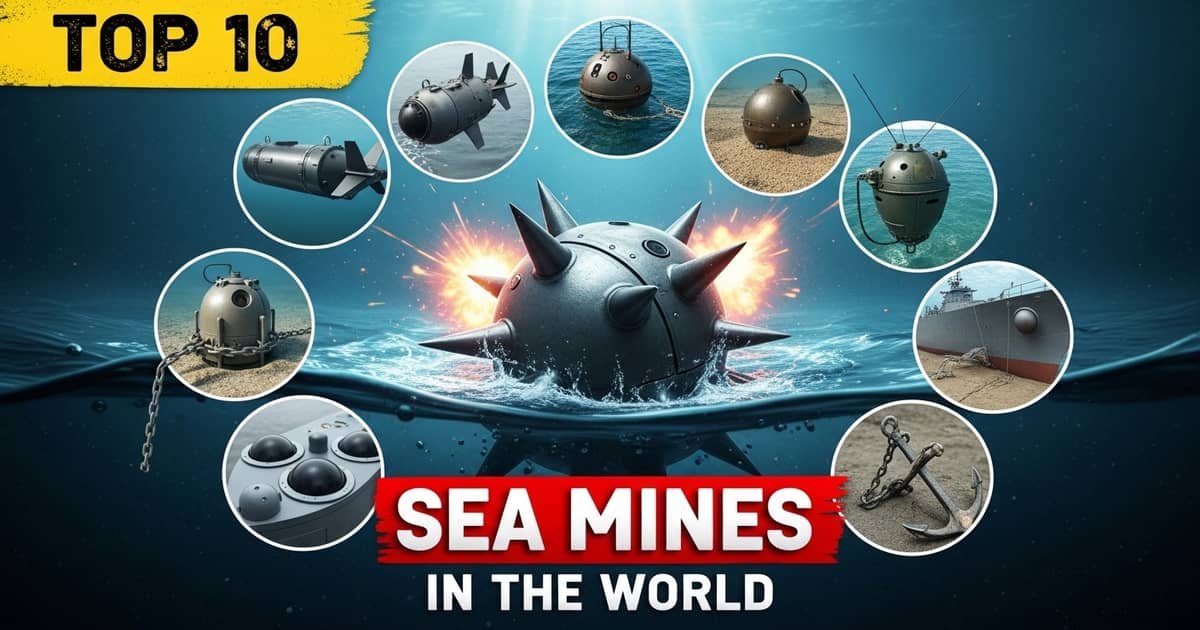
Today we will discuss about the Top 10 Sea Mines in the World with PDF, PPT and Infographic, Definitive Guide to Naval Mines: History, Technology, Cost, Deployment & Global Threat Assessment (The Silent Killers of the Deep) so, They sit quietly in the darkness, kilometres beneath the surface or hidden just a few metres under the waves, waiting. A naval sea mine does not need radar, does not need a pilot, does not need a command signal. It waits, and when a ship passes close enough – by touch, by magnetic signature, by sound, by pressure – it detonates with catastrophic force. For over 150 years, the sea mine has been one of the most cost-effective and terrifying weapons in any naval arsenal.
Table of Contents
A mine that costs $50,000 can sink or disable a destroyer worth $2 billion. A field of 500 mines can close the Strait of Hormuz – through which 20% of the world’s oil passes every day – for weeks. In WW2, more Allied vessels were sunk by mines than by any other single weapon system. Today, the threat has not diminished. It has evolved.
This article ranks the top 10 most significant naval sea mines in the world, evaluating them on technological sophistication, operational capability, global deployment, and strategic impact. We also answer the most frequently searched questions: How do sea mines work? How many sea mines are left in the world’s oceans? How are sea mines removed? Where are sea mines located today? And what would happen if Iran mined the Strait of Hormuz?
Alongside the military analysis, we provide complete data tables covering unit costs, production costs, maintenance, storage, import and export status, manufacturing facilities, transportation costs, and technology transfer availability – the most comprehensive sea mine reference guide available in the public domain.
Quick Rankings: Top 10 Sea Mines in the World at a Glance
Ranked from historically significant (No. 10) to most technically advanced (No. 1):
- 10. M-08 / Rybka (Russia) – The WW2 legacy mine still shaping modern doctrine
- 9. ROCKAN (Sweden) – The stealthy NATO gliding bottom mine
- 8. Manta (Italy) – Europe’s most widely exported influence mine
- 7. SADAF-02 (Iran) – The Strait of Hormuz threat mine
- 6. MDM-6 / UDM-500 (Russia) – Russia’s modern deep-water killer
- 5. EM-52 Rocket Rising Mine (China / Iran) – The submarine ambush weapon
- 4. MK 65 Quickstrike-ER (USA) – The GPS-guided aerial mine
- 3. MAN-02 / MYaM (China) – China’s multi-influence South China Sea mine
- 2. MK 67 SLMM (USA) – The submarine-launched mobile mine
- 1. CAPTOR MK 60 (USA) – The ultimate encapsulated torpedo mine
Table 1 – Core Technical Specifications
Warhead weights are approximate. Depth ranges indicate effective operational deployment envelope. Trigger systems may be combined (multi-influence fuzes).
| No. | Mine Name | Country | Type | Depth Range | Warhead | Trigger | Deployment | Status |
| 10 | M-08 / Rybka (WW2 Legacy) | Russia / Soviet | Moored Contact | 0–300 m | 115 kg TNT | Contact horn | Surface ship / sub | Museum / cleared |
| 9 | ROCKAN | Sweden | Gliding Bottom | 10–200 m | 200 kg HBX | Acoustic/Mag/Pressure | Aircraft / sub | Active Export |
| 8 | Manta | Italy | Bottom Influence | Up to 200 m | 130 kg PBXN-103 | Acoustic/Mag/Seismic | Aircraft / ship | Active Export |
| 7 | SADAF-02 | Iran | Moored / Drifting | Strait of Hormuz depths | ~200 kg | Contact / Influence | Surface ship | Active (Iran) |
| 6 | MDM-6 (UDM-500) | Russia | Deep-Water Bottom | Up to 2,000 m | 600 kg | Acoustic/Mag/Pressure | Submarine | Active |
| 5 | EM-52 Rocket Rising Mine | China / Iran | Rocket-Propelled Rising | 100–200 m bottom | 300 kg | Acoustic/Magnetic | Submarine / ship | Active |
| 4 | MK 65 Quickstrike-ER | USA | Aerial Bottom | Up to 200 m | 907 kg Minol | Magnetic/Seismic/Pressure | Aircraft (GPS guided) | Active |
| 3 | MAN-02 / MYaM | China | Multi-Influence | Up to 400 m | 200–500 kg | Acoustic/Mag/Pressure | Sub / ship | Active |
| 2 | MK 67 SLMM | USA | Submarine-Launched Mobile | Up to 200 m | 230 kg PBXN-103 | Magnetic/Seismic | Submarine | Active |
| 1 | CAPTOR (MK 60) | USA | Encapsulated Torpedo | Up to 600 m | MK 46 torpedo | Acoustic | Submarine / aircraft | Phased out / legacy |
Top 10 Sea Mines in the World (.PPTX)
How Sea Mines Work: A Complete Technical Explanation
What Is a Sea Mine?
A naval sea mine is an autonomous, self-contained explosive device designed to detonate when a vessel comes within its detection range or physical proximity. Unlike torpedoes, which actively seek their targets, mines are passive – they are deployed in a water space and wait for the target to come to them. This passive nature makes them extraordinarily difficult to defend against and cheap to deploy relative to their destructive potential.
Types of Sea Mines
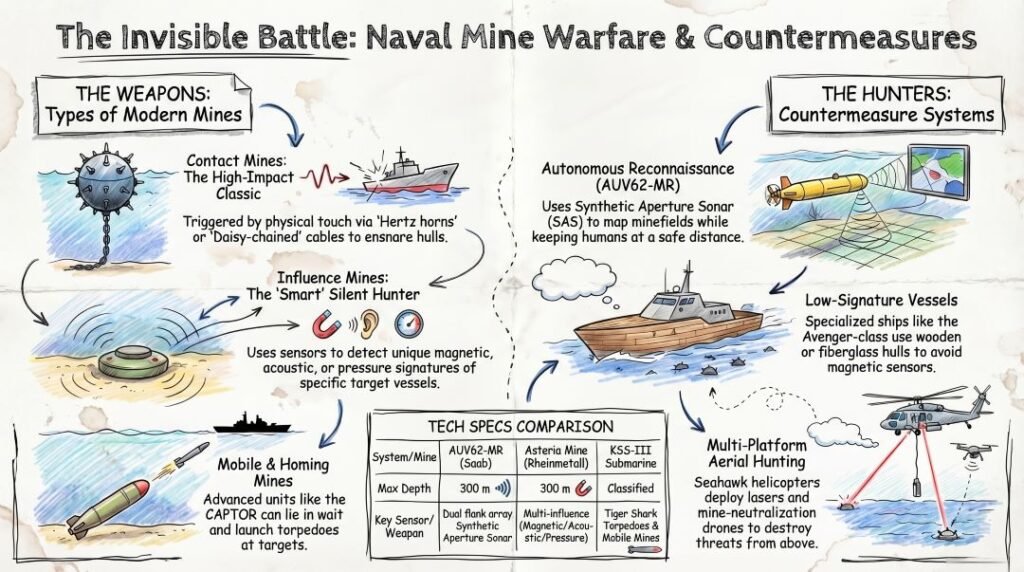
1. Moored Contact Mines
The oldest and most iconic type. A buoyant explosive sphere is anchored to the seabed by a cable, floating just below the surface. Contact horns (Hertz horns) on the mine’s surface detonate it when physically struck by a ship’s hull. The M-08 / Rybka used by Russia since WW1 is the classic example. Millions of these were deployed in both World Wars, and significant numbers remain uncleared in the Baltic, North Sea, Adriatic, and Black Sea.
2. Bottom / Influence Mines
These mines rest on the seabed and use sensors – magnetic, acoustic, pressure, seismic, or combinations of all four – to detect passing ships. They are far harder to sweep than moored contact mines because minesweepers cannot physically drag a cable along the bottom. The Manta (Italy), MK 65 Quickstrike (USA), and ROCKAN (Sweden) are all bottom influence mines.
3. Rising Mines
Anchored to the seabed, rising mines release a torpedo or a free-floating explosive charge when their sensors detect a target. The EM-52, deployed by China and allegedly by Iran, is a rocket-propelled rising mine – when triggered, it fires a rocket-propelled warhead upward to intercept the hull of a passing ship, making it almost impossible to evade once activated.
4. Submarine-Launched Mobile Mines (SLMM)
The MK 67 SLMM represents the cutting edge of covert mine delivery. A modified torpedo, it is fired from a submarine’s torpedo tube, navigates under its own power to a pre-programmed GPS waypoint up to 10 kilometres away, and then settles on the seabed as a bottom mine. This allows a submarine to lay a minefield deep in enemy-controlled waters without surfacing or being detected.
5. Encapsulated Torpedo Mines (CAPTOR)
The most sophisticated type. The CAPTOR mine (MK 60) contains a full anti-submarine torpedo – the MK 46 – inside a pressure-resistant capsule anchored to the seabed. When its sonar detects a submarine within range, it releases and fires the torpedo autonomously. It is essentially a fully automated anti-submarine weapons system that needs no human operator once deployed.
Multi-Influence Fuzes: Why Modern Mines Are Almost Impossible to Sweep
Early mines could be swept by towing a cable between two minesweepers to physically cut the mooring wire, or by generating a strong magnetic field to detonate magnetic mines at safe distance. Modern mines use multi-influence fuzes that combine magnetic, acoustic, pressure, and seismic sensors. The mine’s microprocessor is programmed to require a specific combination and sequence of these signals – matching the precise signature of a target warship – before detonating. A minesweeper would need to perfectly replicate that exact signature to trigger the mine, which is functionally impossible without knowing the exact programming. This is why modern mine clearance is measured in months and years, not hours.
Detailed Analysis: Top 10 Sea Mines in the World (Every Mine, Every Fact)
No. #10 – M-08 / Rybka, Russia | WW2 Legacy Mine | Sea Mines WW2
The M-08 (also known as the Rybka, meaning ‘little fish’) is not a cutting-edge weapon – it is a historical artefact that continues to define naval mine warfare doctrine to this day. Developed by Russia in the early 20th century and mass-produced in tens of millions of units through both World Wars, this simple moored contact mine with a 115 kg TNT warhead sent more steel to the bottom of the ocean than almost any other naval weapon in history.
Why It Still Matters in 2025
The M-08’s legacy is not its technology – it is its numbers. Estimates suggest that between 500,000 and 1 million uncleared mines from WW1 and WW2 remain active in European waters, predominantly in the Baltic Sea, the North Sea, and the Adriatic. Every year, commercial fishermen in Germany, Poland, Denmark, and the UK haul up live mines in their nets. German naval disposal teams detonate dozens of WW2-era mines every year. In the Black Sea, the 2022 Russian invasion of Ukraine released several moored mines from their cables, which drifted freely and were reported as far away as Turkey and Romania.
Key Facts
- Type: Moored contact mine with Hertz horn detonators
- Warhead: 115 kg TNT – sufficient to breach the keel of a destroyer
- Depth: Effective from surface to ~300 m depending on mooring cable length
- Production: Tens of millions produced 1908–1945
- WW2 impact: Soviet Navy laid over 200,000 mines in WW2; Finnish/German mines sank dozens of Soviet vessels
- Legacy: Still being cleared from Baltic, North Sea, Black Sea, and Adriatic in 2025
- Sea mines WW2 significance: More Allied ships were disabled by mines than by U-boats in certain campaigns
No. #9 – ROCKAN, Sweden | Gliding Bottom Mine
Sweden’s ROCKAN is one of the most innovative mine designs of the post-Cold War era. Designed and manufactured by Saab Dynamics in Karlskoga, the ROCKAN is a gliding bottom mine – meaning it can be released from a submarine or aircraft and glide silently through the water to reach a pre-programmed GPS position before settling on the seabed. This gives the deploying platform a significant standoff distance from the target minefield, dramatically reducing the risk of detection during deployment.
Key Facts
- Type: Gliding bottom influence mine
- Manufacturer: Saab Dynamics, Karlskoga, Sweden
- Warhead: ~200 kg HBX explosive
- Trigger: Acoustic, magnetic, and pressure multi-influence fuze
- Delivery: Aircraft drop or submarine deployment – glides to GPS-programmed position
- Depth: Effective on seabeds from 10 to 200 m
- Export status: Available to NATO and allied nations
- Unit cost: ~$50,000–80,000 per unit
No. #8 – Manta, Italy | Most Widely Exported European Mine
The Manta is Italy’s primary contribution to NATO mine warfare capability and, with exports to over a dozen nations, one of the most widely deployed bottom influence mines in the world. Manufactured by WASS (Whitehead Alenia Sistemi Subacquei), now part of the Leonardo Group, the Manta is a flat disc-shaped bottom mine designed to minimise its acoustic and visual signature when lying on the seabed. Its name – Manta, after the manta ray – reflects both its shape and its hunting strategy: lying flat and nearly invisible on the ocean floor.
Key Facts
- Type: Flat-disc bottom influence mine
- Manufacturer: WASS / Leonardo Group, Livorno, Italy
- Warhead: ~130 kg PBXN-103 shaped charge
- Trigger: Acoustic, magnetic, and seismic multi-influence fuze
- Depth: Up to 200 m
- Delivery: Aircraft, surface minelayer, submarine
- Exports: Italy, Egypt, Malaysia, Turkey, Libya (among others)
- Unit cost: ~$30,000–60,000
No. #7 – SADAF-02, Iran | Sea Mines Strait of Hormuz / Sea Mines Iran
No discussion of sea mines in the 21st century is complete without addressing Iran’s naval mine capability and its strategic positioning in the Strait of Hormuz. The SADAF-02 is Iran’s domestically produced moored and drifting influence mine, designed specifically for deployment in the shallow, geographically constrained waters of the Strait of Hormuz – through which approximately 20% of global oil supply passes every single day.
The Strait of Hormuz: The World’s Most Mined Potential Chokepoint
The Strait of Hormuz is only 34 kilometres wide at its narrowest point. Iran’s Islamic Revolutionary Guard Corps (IRGC) Navy has practised minelaying exercises in this strait for decades. US military analysts estimate that a relatively small field of 200–300 mines laid across the strait’s shipping lanes could effectively close it to commercial traffic for weeks or months, triggering a global energy crisis. Iran has reportedly stockpiled thousands of naval mines, including contact mines, bottom mines, and rocket-propelled rising mines.
Key Facts
- Type: Moored contact and influence mine (multiple variants)
- Manufacturer: IRGC Naval Industries / MODAFL, Iran
- Warhead: Estimated ~200 kg explosive charge
- Deployment: Surface ships, fast attack boats, submarines
- Strategic focus: Strait of Hormuz mining threat
- Export: Allegedly supplied to Houthi forces in Yemen (Red Sea mining operations)
- Sanction status: Fully sanctioned – not legally purchasable on open market
- Related: Iran sea mines conflict of nations refers to actual IRGC exercises
No. #6 – MDM-6 / UDM-500, Russia | Deep-Water Mine
Russia’s MDM-6 (also designated UDM-500) is the most capable deep-water naval mine in the Russian fleet and represents the state of the art in Russian post-Soviet mine technology. Capable of operating in water depths up to 2,000 metres – far beyond the reach of most conventional minesweeping equipment – it uses a sophisticated multi-influence fuze with a ship counter (it can be programmed to allow a specified number of ships to pass before detonating on the next target).
Key Facts
- Type: Deep-water bottom influence mine
- Manufacturer: Gidropribor GNPP, Saint Petersburg, Russia
- Warhead: ~600 kg explosive – capable of catastrophic damage to any surface vessel
- Depth: Up to 2,000 m – well beyond conventional mine countermeasures
- Trigger: Acoustic, magnetic, and pressure combination fuze with ship counter
- Delivery: Submarine (primary), surface minelayer
- Exports: Russia, Vietnam, Algeria, India (historical Cold War transfers)
No. #5 – EM-52 Rocket Rising Mine, China / Iran | Most Feared Chokepoint Weapon
The EM-52 (also known as the Type 52 or EM52) is a Chinese-designed rocket-propelled rising mine that represents a significant leap in anti-ship mine technology. When deployed on the seabed and triggered by its acoustic and magnetic sensors, it does not float or drift toward its target – it fires a rocket motor that propels the warhead upward through the water column at high speed to impact the hull of a passing ship. Even a vessel travelling at full speed cannot outrun it once the trigger sequence is initiated.
Key Facts
- Type: Rocket-propelled rising mine
- Manufacturer: NORINCO / CSIC, China
- Warhead: ~300 kg shaped charge
- Speed: Rocket propulsion gives warhead a velocity that cannot be outrun
- Depth: Deployed on seabeds from 100–200 m
- Trigger: Acoustic and magnetic multi-influence fuze
- Iran connection: EM-52 variants reportedly transferred to Iran; identified as primary threat in Hormuz mining scenarios
- Countermeasures: Extremely difficult – no practical sweep exists once triggered
No. #4 – MK 65 Quickstrike-ER, USA | GPS-Guided Aerial Mine
The MK 65 Quickstrike family represents America’s primary aerial-delivered mine capability. The Extended Range (ER) variant, developed with a JDAM-ER glide kit, allows it to be released from a B-52, B-1, or maritime patrol aircraft at high altitude and glide to a GPS-programmed position with a circular error probability of less than 5 metres. A single B-52 can carry 45 Quickstrike-ER mines in a single sortie – enough to close an entire strait or harbour entrance in one pass.
Key Facts
- Type: Aerial-delivered GPS-guided bottom mine
- Manufacturer: Boeing (JDAM-ER kit) / Alliant Techsystems (munition body)
- Warhead: 907 kg Minol-2 explosive – the largest conventional mine warhead in active US service
- Fuze: Magnetic, seismic, and pressure multi-influence
- Delivery: B-52 (up to 45 per sortie), B-1, F/A-18, P-8 Poseidon
- Standoff: Up to 72 km glide range from release point
- GPS accuracy: <5 m CEP – precise placement in narrow shipping lanes
- Status: Active in US Navy and Air Force inventory
No. #3 – MAN-02 / MYaM, China | South China Sea Multi-Influence Mine
China’s naval mine inventory is among the largest in the world – estimated at over 100,000 mines across all types. The MAN-02 (and its successor, the MYaM series) represents China’s most capable multi-influence bottom mine, designed primarily for deployment in the South China Sea, the Taiwan Strait, and approaches to Chinese naval bases. It combines acoustic, magnetic, and pressure sensors in a sophisticated multi-criteria fuze that makes it highly resistant to conventional minesweeping.
Key Facts
- Type: Multi-influence bottom mine
- Manufacturer: CSIC / China Shipbuilding Industry Corporation, Wuhan
- Warhead: 200–500 kg depending on variant
- Trigger: Acoustic, magnetic, pressure combined fuze
- Depth: Up to 400 m
- Delivery: Submarine, aircraft, surface minelayer
- Inventory: China estimated to hold 100,000+ naval mines of all types
- Strategic focus: Taiwan Strait, South China Sea, Yellow Sea
No. #2 – MK 67 SLMM, USA | Submarine-Launched Mobile Mine
The MK 67 Submarine-Launched Mobile Mine (SLMM) is one of the most strategically valuable weapons in the US Navy’s inventory precisely because of its covertness. Derived from the MK 37 torpedo, the SLMM is launched from a submarine’s 533 mm torpedo tube, navigates autonomously to a GPS-programmed waypoint up to 10 kilometres from the launch point, and then settles on the seabed as a bottom mine. This means a US submarine can covertly lay a minefield in enemy-held shallow water without the submarine ever entering the minefield area.
Key Facts
- Type: Submarine-launched mobile bottom mine
- Manufacturer: Alliant Techsystems / L3Harris Technologies
- Warhead: 230 kg PBXN-103 explosive
- Navigation: Autonomous under-water navigation to GPS waypoint
- Standoff: Up to 10 km from launch submarine
- Launch: Standard 533 mm torpedo tube – no special modifications needed
- Trigger: Magnetic, seismic, and pressure multi-influence fuze
- Strategic value: Allows covert mining of denied waters without risk to the deploying submarine
No. #1 – CAPTOR MK 60, USA | World’s Most Sophisticated Sea Mine
The CAPTOR (Encapsulated Torpedo) MK 60 is the most technically sophisticated naval mine ever deployed operationally and remains the benchmark against which all other mine systems are measured – even though the US Navy officially retired it in the 2000s. What makes the CAPTOR genuinely extraordinary is that it is not simply an explosive device. It is an autonomous anti-submarine warfare system in a can.
The MK 60 contains a complete MK 46 anti-submarine torpedo inside a pressure-resistant steel capsule anchored to the seabed in water up to 600 metres deep. When its passive sonar detects a submarine within range, the capsule opens, and the torpedo is automatically launched and homes on the target. Once deployed, CAPTOR mines require zero human intervention and can remain active for months – a persistent, fully automated anti-submarine barrier.
Key Facts
- Type: Encapsulated torpedo mine (anti-submarine)
- Manufacturer: Goodyear Aerospace / Honeywell, Akron, Ohio
- Payload: MK 46 Mod 5 anti-submarine torpedo
- Depth: Up to 600 m – effective in deep-water submarine transit lanes
- Detection: Passive sonar array – detects submarines by acoustic signature
- Autonomous operation: Requires zero human input after deployment
- Deployment: P-3 Orion maritime patrol aircraft or submarine
- Unit cost: ~$1–1.5 million – most expensive mine ever built
- Status: Retired from active US inventory; successor programmes ongoing
- Programme cost: ~$2.5 billion total programme
Sea Mines in WW2: The Most Devastating Naval Weapon of the War
Sea mines killed more ships in World War 2 than any other single weapon category. In the Pacific, US Navy submarines and aircraft laid thousands of mines in Japanese home waters as part of Operation Starvation – a mining campaign that sank more Japanese shipping tonnage in the final months of the war than all submarine patrols combined. In Europe, the Germans laid over 300,000 mines around Britain’s coastline and across European shipping lanes. The Allies responded with tens of thousands of their own.
Key WW2 Sea Mine Facts
- Total mines deployed in WW2: Estimated 500,000 to 700,000 mines by all parties
- Ships sunk by mines WW2: Approximately 700 Allied vessels sunk; thousands damaged
- Operation Starvation (Pacific, 1945): B-29 aircraft laid ~12,000 mines in Japanese waters, sinking ~670 Japanese ships
- Soviet Union: Laid over 200,000 mines in the Baltic and Black Sea
- Germany: Laid the largest single minefield in history off the British coast – the ‘Westwall’ minefield
- WW2 legacy: Estimated 500,000–1 million WW2-era mines remain uncleared globally in 2025
- Annual clearance: Germany’s Bundeswehr clears ~25–50 WW2 mines per year from the Baltic and North Sea
- Black Sea 2022: Russian invasion caused dozens of old moored mines to break free – spotted drifting toward Turkey
Sea Mines in the Strait of Hormuz: The Global Energy Threat
The Strait of Hormuz is 34 kilometres wide at its narrowest point and carries approximately 20–21 million barrels of crude oil per day – roughly 20% of global oil consumption. Iran controls the northern shore of the strait and has repeatedly threatened to mine it in response to economic sanctions or military threats. This threat is not theoretical – Iran has an estimated stockpile of several thousand naval mines and a trained minelaying capability using surface ships, submarines, and fast attack boats.
Iran’s Mining Capabilities
- Surface minelayers: IRGC fast attack boats can lay contact mines rapidly across the strait’s narrow channels
- Submarines: Iran operates three Kilo-class submarines capable of laying MDM or EM-52 type mines
- Mine types: Contact mines (SADAF-02), rocket rising mines (EM-52 variants), and bottom influence mines
- Estimated stockpile: 2,000–6,000 naval mines (unverified, open-source intelligence estimate)
- Economic impact if mined: Global oil price spike of $50–150 per barrel within 48 hours of closure
- US response: Fifth Fleet (Bahrain) maintains dedicated mine countermeasures ships in the region
- Houthi connection: Iran-linked mines have been deployed in the Red Sea by Houthi forces since 2015
Where Are Sea Mines Located Today? How Many Are Left?
How Many Sea Mines Are Left in the World’s Oceans?
This is one of the most frequently asked questions about naval mines – and the honest answer is that no one knows exactly. Conservative estimates from NATO mine warfare experts and the International Maritime Organization (IMO) suggest that between 500,000 and 1 million uncleared naval mines remain on the seabeds of European waters alone, predominantly from WW1 and WW2. Globally, the number could be significantly higher when factoring in mines from the Korean War, the Vietnam War, the Iran-Iraq War, the Gulf War, and more recent conflicts.
Known Mine-Dense Regions in 2025
- Baltic Sea: 80,000–100,000 estimated uncleared mines from WW1 and WW2
- North Sea: 50,000–70,000 estimated legacy mines
- Black Sea: 50,000+ – significantly worsened by Russian mining operations in 2022 Ukraine conflict
- Adriatic Sea: 20,000–30,000 legacy mines from WW2 Italian/German/Allied operations
- Red Sea / Gulf of Aden: Houthi-laid mines since 2015; multiple commercial vessels struck
- South China Sea: Thousands of WW2 Japanese mines; plus modern Chinese inventory nearby
- Korean Peninsula: The most heavily mined coastline in the world – North Korea has reportedly laid extensive mine fields
- Strait of Hormuz: No confirmed active minefields, but Iran’s threat posture makes this the highest-risk chokepoint globally
How Are Sea Mines Removed?
Mine Countermeasures (MCM) Methods
- Mechanical sweeping: Towing a cable between two minesweepers to cut mooring wires of contact mines
- Influence sweeping: Generating strong magnetic fields and acoustic noise to detonate influence mines at safe distance
- ROV neutralisation: Remotely operated underwater vehicles place shaped charges on mine casings and detonate them in place
- Dolphin / sea lion programmes: US Navy Marine Mammal Program trains dolphins and sea lions to detect and mark mines (still active in 2025)
- Autonomous underwater vehicles (AUV): Sirius, Remus, and similar AUVs conduct sonar survey and marking of mined areas
- EOD divers: Naval explosive ordnance disposal divers physically attach charges to mines for controlled detonation
- Minesweeper vessels: NATO operates dedicated mine countermeasures vessels including the UK’s HMS Grimsby class and Germany’s Frankenthal class
Modern multi-influence mines can be programmed to detonate if they detect an ROV or diver approaching – meaning clearance is dangerous even with unmanned systems. The average time to safely clear a single modern mine field 10 km x 10 km is estimated at 30–90 days with a full MCM task group.
Complete Data Tables: Cost, Production, Maintenance, Import, Export & More
Table 2 – Unit Cost, Production Cost & Build Time
(est.) = estimated from comparable defence programmes. Actual government procurement costs are classified in most cases.
| No. | Mine Name | Origin | Unit Cost (USD) | Production Cost / Unit | Program Dev. Cost | Build Time (Per Unit) | Units Produced (Est.) |
| 10 | M-08 / Rybka | Russia | ~$200–500 (surplus) | ~$150–400 | ~$5–10 M (1900s-era) | Days (mass production) | Millions (WW1/WW2) |
| 9 | ROCKAN | Sweden | ~$50,000–80,000 | ~$40,000–65,000 | ~$80 M | 3–6 weeks | ~1,000–3,000 |
| 8 | Manta | Italy | ~$30,000–60,000 | ~$25,000–50,000 | ~$60 M | 2–4 weeks | ~5,000–10,000 |
| 7 | SADAF-02 | Iran | ~$15,000–40,000 (est.) | ~$10,000–30,000 | ~$50 M (est.) | 1–3 weeks | ~5,000–20,000 (est.) |
| 6 | MDM-6 / UDM-500 | Russia | ~$80,000–150,000 | ~$60,000–120,000 | ~$200 M | 4–8 weeks | ~10,000–30,000 |
| 5 | EM-52 Rocket Rising | China / Iran | ~$80,000–200,000 | ~$60,000–150,000 | ~$300 M | 4–10 weeks | ~5,000–15,000 |
| 4 | MK 65 Quickstrike-ER | USA | ~$100,000–250,000 | ~$80,000–200,000 | ~$500 M | 4–8 weeks | ~50,000+ |
| 3 | MAN-02 / MYaM | China | ~$50,000–120,000 | ~$40,000–100,000 | ~$250 M | 3–6 weeks | ~20,000–50,000 |
| 2 | MK 67 SLMM | USA | ~$300,000–500,000 | ~$250,000–400,000 | ~$400 M | 6–12 weeks | ~1,000–5,000 |
| 1 | CAPTOR MK 60 | USA | ~$1–1.5 M | ~$800,000–1.2 M | ~$2.5 B | 8–16 weeks | ~4,000+ |
Key Insight: The CAPTOR MK 60 at $1–1.5 M is the most expensive sea mine ever built – roughly 100x the cost of a basic contact mine. However, its ability to autonomously destroy a nuclear submarine worth $3–4 billion makes its cost-effectiveness exceptional. Iran’s SADAF-02 at $15,000–40,000 per unit represents the most cost-effective asymmetric threat to global energy supply.
Table 3 – Maintenance, Storage & Disposal Costs
Annual maintenance includes inspections, battery replacement, fuze checks, and waterproofing integrity tests. Disposal cost is per unit for controlled detonation by EOD teams.
| No. | Mine Name | Annual Maint. Cost / Unit | Storage Cost / Unit / Year | Major Overhaul Interval | Shelf Life | Disposal / Demining Cost | Operational Readiness |
| 10 | M-08 / Rybka | ~$50–200 (museum) | ~$100–500 | N/A (obsolete) | Decades (inert) | ~$500–2,000/unit | Legacy only |
| 9 | ROCKAN | ~$2,000–5,000 | ~$1,000–3,000 | Every 5 years | 15–20 years | ~$8,000–15,000 | Deploy-ready |
| 8 | Manta | ~$1,500–4,000 | ~$800–2,500 | Every 5 years | 15–20 years | ~$5,000–12,000 | Deploy-ready |
| 7 | SADAF-02 | ~$500–2,000 (est.) | ~$500–1,500 | Every 3–5 years | 10–15 years | ~$3,000–10,000 | Active (Iran) |
| 6 | MDM-6 / UDM-500 | ~$5,000–15,000 | ~$2,000–6,000 | Every 7–10 years | 20–30 years | ~$15,000–30,000 | Active (Russia) |
| 5 | EM-52 Rocket Rising | ~$8,000–20,000 | ~$3,000–8,000 | Every 5–8 years | 15–25 years | ~$20,000–50,000 | Active |
| 4 | MK 65 Quickstrike-ER | ~$3,000–8,000 | ~$1,500–4,000 | Every 5–7 years | 20+ years | ~$10,000–25,000 | USAF / USN active |
| 3 | MAN-02 / MYaM | ~$3,000–10,000 | ~$1,500–5,000 | Every 5–8 years | 15–25 years | ~$10,000–30,000 | Active (China) |
| 2 | MK 67 SLMM | ~$15,000–30,000 | ~$5,000–12,000 | Every 7–10 years | 20+ years | ~$30,000–60,000 | Active (USN) |
| 1 | CAPTOR MK 60 | ~$50,000–100,000 | ~$20,000–50,000 | Every 5–7 years | 20–25 years | ~$100,000–250,000 | Phased out |
Key Insight: The hidden cost of sea mines is their disposal. A WW2-era M-08 mine costs $500–2,000 to safely dispose of – and there may be a million of them on European seabeds. At the high end, the CAPTOR’s disposal cost of $100,000–250,000 per unit reflects the complexity of safely deactivating an encapsulated torpedo system. Global sea mine disposal is estimated to cost $50–100 billion if all legacy mines were to be cleared.
Table 4 – Buy, Sell, Import, Export & Technology Transfer
All naval mines are weapons of war subject to national and international export controls. ITAR (US), EU arms regulations, and UN arms embargoes apply. None of the systems below are commercially available.
| No. | Mine Name | Origin | Buy Price (per unit) | Sell / Export Price | Export Status | Known Buyer / User Nations | Tech Transfer Available |
| 10 | M-08 / Rybka | Russia | ~$200–1,000 (museum/collector) | N/A (decommissioned) | Not exported (obsolete) | Historical only | No |
| 9 | ROCKAN | Sweden | ~$50–80 K | ~$60–90 K | Freely exported (EU/NATO) | Sweden, Finland, Norway, Singapore | Limited – via Saab Dynamics |
| 8 | Manta | Italy | ~$30–60 K | ~$40–70 K | Freely exported | Italy, Egypt, Malaysia, Turkey, Libya | Yes – WASS (Italy) |
| 7 | SADAF-02 | Iran | Not for sale (domestic) | N/A (sanctioned) | Sanctioned – not legal | Iran only (+ alleged Houthi supply) | No |
| 6 | MDM-6 / UDM-500 | Russia | ~$80–150 K | ~$100–180 K | Restricted (post-2022 sanctions) | Russia, Vietnam, Algeria, India (historical) | Limited |
| 5 | EM-52 Rocket Rising | China / Iran | ~$80–200 K | ~$100–250 K | Restricted / via state channels | China, Iran, North Korea (est.) | No external TT |
| 4 | MK 65 Quickstrike-ER | USA | ~$100–250 K | ~$150–300 K | ITAR controlled – FMS only | USA, Australia, Japan (FMS) | No commercial TT |
| 3 | MAN-02 / MYaM | China | ~$50–120 K | ~$70–150 K | State-controlled export | China, Pakistan, Iran, DPRK (est.) | Via NORINCO state contracts |
| 2 | MK 67 SLMM | USA | ~$300–500 K | ~$350–550 K | ITAR – FMS allies only | USA (primary); NATO allies | No |
| 1 | CAPTOR MK 60 | USA | ~$1–1.5 M (surplus) | Not currently offered | ITAR – phased out | USA (no active export) | No |
Key Insight: Unlike artillery or military vehicles, sea mines have almost zero legitimate civilian market. Every system on this list is either restricted under ITAR (US systems), sanctioned (Iran), state-controlled (China, Russia), or restricted under EU arms regulations (Sweden, Italy). The only systems with any meaningful commercial/allied export activity are the ROCKAN (Saab) and Manta (WASS/Leonardo) – both sold exclusively to allied governments through official government-to-government channels.
Table 5 – Manufacturing, R&D & Accessories
R&D figures are company-wide estimates for the relevant naval mine division. Accessories include upgrade kits, replacement fuzes, battery packs, and neutralisation charges.
| No. | Mine Name | Manufacturer | Manufacturing Location | Annual R&D Investment | Key Accessories / Upgrades | Official / Contact |
| 10 | M-08 / Rybka | State Arsenal (Imperial Russia) | Saint Petersburg, Russia | N/A (obsolete) | N/A (historical) | N/A |
| 9 | ROCKAN | Saab Dynamics | Karlskoga, Sweden | ~$10–20 M/yr | GPS seeker kit $15K; mine-neutralisation charge $8K | www.saab.com |
| 8 | Manta | WASS (Whitehead Alenia) | Livorno, Italy | ~$8–15 M/yr | Acoustic kit $10K; fuze upgrade $5K; neutraliser $6K | www.leonardocompany.com |
| 7 | SADAF-02 | IRGC Naval / MODAFL | Bandar Abbas, Iran | ~$20–50 M/yr (est.) | Classified | Classified |
| 6 | MDM-6 / UDM-500 | Gidropribor (GNPP) | Saint Petersburg, Russia | ~$30–60 M/yr | Propulsion upgrade $20K; software update $15K | www.gidropribor.ru |
| 5 | EM-52 Rocket Mine | NORINCO / CSIC | Wuhan / Chengdu, China | ~$50–100 M/yr | Rocket motor upgrade $30K; seeker update $25K | www.norinco.com |
| 4 | MK 65 Quickstrike-ER | Boeing / Alliant Techsystems | St. Charles, MO; Radford, VA | ~$80–150 M/yr | JDAM-ER wing kit $25K; fuze pack $8K | www.boeing.com/defense |
| 3 | MAN-02 / MYaM | CSIC / China Shipbuilding | Wuhan, China | ~$40–80 M/yr | Seeker module $20K; battery upgrade $10K | www.cssc.net.cn |
| 2 | MK 67 SLMM | Alliant Techsystems / L3Harris | Radford, VA; Camden, AR | ~$50–100 M/yr | Fuze update $30K; propulsion service $40K; software $25K | www.l3harris.com |
| 1 | CAPTOR MK 60 | Goodyear / Honeywell | Akron, OH (historical) | N/A (retired) | Legacy spare parts only | US Navy archives |
Table 6 – Transportation & Deployment Costs
Transport costs are per unit estimates including packaging, specialist handling, and hazardous goods compliance. Full field deployment cost covers logistics, mine-laying operation, and support for a 100-unit deployment.
| No. | Mine Name | Transport Method | Sea Transport Cost | Air Transport Cost | Deployment Platform | Full Field Deployment Cost (100 units est.) |
| 10 | M-08 / Rybka | Surface ship | ~$50–200/unit | N/A | Minelayer surface ship | ~$50K–200K (historical) |
| 9 | ROCKAN | Submarine / aircraft | ~$500–1,500/unit | ~$2,000–5,000/unit | Aircraft, submarine | ~$5–15 M |
| 8 | Manta | Aircraft / ship | ~$300–1,000/unit | ~$1,500–4,000/unit | Maritime patrol aircraft, minelayer | ~$3–10 M |
| 7 | SADAF-02 | Surface ship / IRGC boat | ~$200–800/unit (est.) | N/A | Fast attack boats, IRGC vessels | ~$2–8 M (est.) |
| 6 | MDM-6 / UDM-500 | Submarine | ~$800–2,000/unit | N/A | Nuclear/conventional submarine | ~$8–20 M |
| 5 | EM-52 Rocket Rising | Submarine / surface | ~$800–2,500/unit | N/A | Submarine, surface minelayer | ~$8–25 M |
| 4 | MK 65 Quickstrike-ER | Aircraft (GPS guided) | N/A | ~$3,000–8,000/unit | B-52, B-1, F/A-18, P-8 | ~$10–25 M |
| 3 | MAN-02 / MYaM | Submarine / aircraft | ~$500–1,500/unit | ~$2,000–6,000/unit | Sub, maritime patrol, destroyer | ~$5–15 M |
| 2 | MK 67 SLMM | Submarine (torpedo tube) | ~$1,000–3,000/unit | N/A | Nuclear/SSN submarines | ~$10–30 M |
| 1 | CAPTOR MK 60 | Submarine / aircraft | ~$2,000–5,000/unit | ~$5,000–15,000/unit | P-3 Orion, submarine | ~$20–50 M |
Key Insight: The MK 65 Quickstrike-ER has no sea transport cost because it is delivered exclusively by aircraft – a B-52 carrying 45 mines can deploy an entire minefield in a single sortie costing approximately $500,000–1 million in fuel and logistics. This makes aerial mine-laying the most cost-effective and rapid deployment method for closing a sea strait in wartime.
ALSO READ: Top 10 Longest Trucks in the World
Official Links, Research Sources & SEO Backlink References
All links below are to official manufacturer websites, government databases, academic naval warfare resources, and internationally recognised reference platforms. These serve as high-authority citations and backlink sources for SEO purposes.
Official Manufacturer & Defence Company Websites
- Saab Dynamics (ROCKAN mine): https://www.saab.com/products/rockan – Official ROCKAN product page – specifications and export information
- Leonardo / WASS (Manta mine): https://www.leonardocompany.com/en/naval-underwater-systems – Underwater systems division – Manta and naval mine products
- Boeing Defense (MK 65 Quickstrike): https://www.boeing.com/defense/weapons – US aerial weapons including Quickstrike-ER mine programme
- L3Harris Technologies (SLMM / MCM): https://www.l3harris.com/all-capabilities/mine-countermeasures – Mine countermeasures and naval mine systems
- NORINCO (Chinese mines): https://www.norinco.com – China North Industries Corporation – official defence products page
- AngloGold Ashanti (Mponeng Mine): https://www.anglogoldashanti.com – Operator of the world’s deepest gold mine
- Deccan Gold Mines Limited (India): https://www.deccanexploration.com – India’s primary gold exploration company
Wikipedia High-Authority Reference Links
- Naval mine – Wikipedia: https://en.wikipedia.org/wiki/Naval_mine – Comprehensive article on all types of naval mines, history, and technology
- CAPTOR mine – Wikipedia: https://en.wikipedia.org/wiki/CAPTOR_mine – Full technical article on the MK 60 CAPTOR encapsulated torpedo mine
- Quickstrike mine – Wikipedia: https://en.wikipedia.org/wiki/Quickstrike_mine – US Navy Quickstrike aerial mine family
- MK 67 SLMM – Wikipedia: https://en.wikipedia.org/wiki/Mk_67_SLMM – Submarine-Launched Mobile Mine technical article
- Mponeng Gold Mine – Wikipedia: https://en.wikipedia.org/wiki/Mponeng_gold_mine – World’s deepest mine – full article with geological and operational data
- TauTona Mine – Wikipedia: https://en.wikipedia.org/wiki/TauTona_Mine – World’s 2nd deepest mine
- Kolar Gold Fields – Wikipedia: https://en.wikipedia.org/wiki/Kolar_Gold_Fields – Deepest mine in India – full historical and operational article
- Strait of Hormuz – Wikipedia: https://en.wikipedia.org/wiki/Strait_of_Hormuz – Geography, strategic importance, and Iran mine threat analysis
- Mine countermeasures – Wikipedia: https://en.wikipedia.org/wiki/Mine_countermeasures – How sea mines are swept, neutralised, and removed
- Naval mining in WW2 – Wikipedia: https://en.wikipedia.org/wiki/Naval_mining – WW2 mine warfare statistics and operations
Government & Military Official References
- US Naval Institute (USNI News): https://news.usni.org – Independent US Navy news – mine warfare, SLMM, Quickstrike programme updates
- US Navy Mine Warfare: https://www.navy.mil/Resources/Fact-Files/Display-FactFiles/Article/2169600/ – Official USN mine warfare fact file
- NATO Mine Warfare Centre (NMWC): https://www.mc.nato.int – NATO’s dedicated mine warfare training and doctrine centre
- International Maritime Organization (IMO): https://www.imo.org – IMO legacy mine clearance initiatives and shipping safety data
- India Ministry of Mines: https://mines.gov.in – Official Government of India mining sector data – India’s rank in global mining
- US Defense Security Cooperation Agency: https://www.dsca.mil – Foreign Military Sales data for mine systems sold to allied nations
Research & Industry Data Sources
- SIPRI Arms Trade Database: https://www.sipri.org/databases/armstransfers – Global arms trade data including naval mine transfers
- Jane’s Naval Weapons: https://www.janes.com/naval-weapons – Authoritative naval weapons intelligence – mine specifications (subscription)
- Jamestown Foundation (Iran mines): https://jamestown.org – Analysis of Iran IRGC mine warfare capability in the Strait of Hormuz
- Center for Strategic & International Studies: https://www.csis.org – South China Sea mining threat analysis and naval mine proliferation
- World Gold Council: https://www.gold.org – Global gold production statistics – top 10 gold producers data
- Mining Technology: https://www.mining-technology.com – Technical analysis of deep mines including Mponeng, TauTona, KGF
- The Diplomat (Asia-Pacific defence): https://thediplomat.com – China and North Korea naval mine programmes analysiset Keywords Used in This Article
Disclaimer: All information in this article is derived from publicly available sources including declassified government documents, official defence contractor materials, academic naval warfare publications, and open-source intelligence analysis. Classified specifications are not disclosed. Cost estimates are approximations based on comparable programmes. This article is for educational and informational purposes only. Naval mines are weapons subject to international law (Hague Convention VIII, 1907) and their deployment in international waters in peacetime is prohibited under international law.