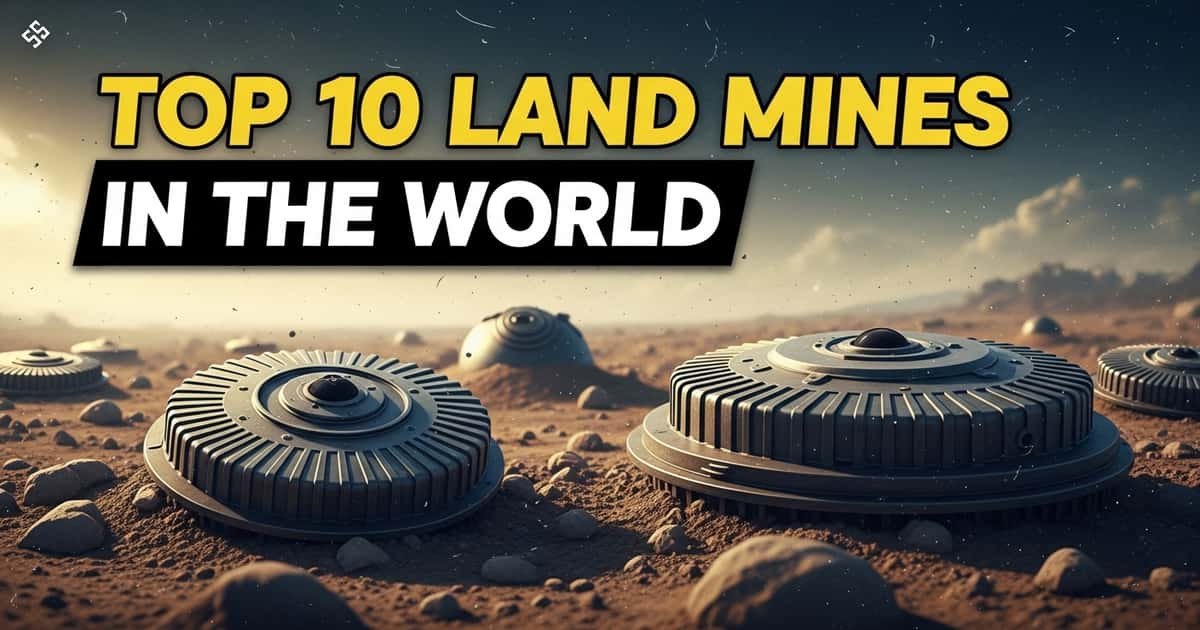
In this article we will give you info about the Top 10 Land Mines in the World, Types, History, Cost, Deployment, Demining & Global Threat Assessment (The Ground-Level Weapon That Never Forgets) with PPT, PDF and Infographic so, A landmine is buried. It is armed. And then, whoever buried it walks away. The mine does not know when the war ends. It does not know whether the next person to step on it is a soldier, a farmer, a child, or a de-mining technician. It simply waits -sometimes for decades -and then detonates. That single characteristic -complete indifference to the identity of its victim -is what makes the landmine one of the most controversial, most lethal, and most enduring weapons in human history.
Table of Contents
There are an estimated 110 million landmines still in the ground across 64 countries today. Every year, between 5,000 and 7,000 people are killed or maimed by landmines -the vast majority of them civilians, often in countries where the original conflict ended decades ago. Angola, Cambodia, Afghanistan, Bosnia, Iraq, Ukraine, Ethiopia, and Yemen all contain millions of uncleared mines. In Ukraine alone, the 2022 Russian invasion has created what experts estimate is the largest newly contaminated minefield since the Second World War.
This article is a complete, honest, and factually grounded guide to the top 10 military landmines in the world. We cover their technical specifications, real-world deployments, costs of production and acquisition, the global trade and treaty landscape, and the extraordinary challenge of clearing them after a conflict ends. We also answer the most commonly searched questions: What are military landmines called? Which country has the most landmines? Does the US military still use landmines? How powerful is a landmine? And what exactly are the 3 basic types of landmines?
What Are Military Land Mines Called?
Military landmines are officially referred to by several terms depending on their function and the context:
- Anti-Personnel Mine (APM or AP mine): Designed to wound or kill soldiers on foot
- Anti-Tank Mine (ATM or AT mine): Designed to disable or destroy vehicles and armoured platforms
- Anti-Handling Device (AHD): A secondary fuze designed to detonate the mine if it is disturbed during demining
- Bounding Mine (Bouncing Mine): An AP mine that springs into the air before detonating, maximising fragmentation radius
- Directional Fragmentation Mine: Projects fragments in a controlled arc -the Claymore is the defining example
- Scatterable Mine (SCATMINE): Delivered by artillery, aircraft, or helicopter over a wide area
- Improvised Explosive Device (IED): A home-made or improvised explosive triggered by pressure, wire, or remote control -often called a landmine in media coverage but technically distinct
- Mine or Land Mine: The common term used in journalism, legal documents (Ottawa Treaty), and everyday language
Top 10 Land Mines in the World (.PPTX)
3 Basic Types of Landmines
Every military landmine falls into one of three fundamental categories:
1. Blast Mines
The simplest type. When sufficient pressure is applied to the pressure plate (typically 5–25 kg for AP mines, 120–500 kg for AT mines), the fuze initiates and detonates the main explosive charge. Blast mines primarily injure by concussive force and ground fragmentation directly beneath the victim’s foot. The PMN-2 (Russia), VS-50 (Italy), and Type 72 (China) are all blast mines. They account for the majority of civilian mine casualties globally because their small size and shallow burial make them almost invisible.
2. Fragmentation Mines
These mines project metal fragments -steel balls, wire, or the mine casing itself -across a lethal radius, killing or wounding anyone within that area. They include bounding mines (like the M16 ‘Bouncing Betty’) that eject themselves into the air before detonating at waist height, maximising casualty area. Directional fragmentation mines (like the M18A1 Claymore) project their fragments in a focused 60-degree arc with controlled directionality, making them a defensive weapon that can be oriented toward the enemy.
3. Anti-Tank Mines
Designed to disable or destroy vehicles by detonating under the track or hull, anti-tank mines use large main charges (typically 5–10 kg of TNT or equivalent) triggered by the weight of a vehicle. Modern anti-tank mines often include anti-disturbance fuzes that detonate the mine if it is lifted or tilted -making manual clearance extremely dangerous. The TM-62M (Russia) and M15 (USA) are the most widely deployed examples.
4 Types of Military Minefields
1. Protective Minefields
Laid around a defensive position, base, or installation to slow or channel attacking forces. Usually documented with a minefield record for safe lane clearance by friendly forces.
2. Barrier Minefields
Laid across a broad frontage to block or delay enemy advance along a wide axis. Often combined with wire obstacles and covered by direct fire weapons.
3. Nuisance Minefields
Small, scattered minefields laid to slow enemy movement, cause casualties, and impose a psychological burden. Often used in irregular warfare and guerrilla campaigns.
4. Phoney Minefields
Fake minefields with no actual mines -merely warning signs and disturbed ground -used to channel enemy movement into ambushes or pre-registered artillery fire zones. A highly effective psychological warfare tool.
Quick Rankings: Top 10 Land Mines in the World at a Glance
Ranked from widely deployed (No. 10) to most iconic and strategically significant (No. 1):
- 10. Type 72 AP Mine (China) -Most proliferated Chinese AP blast mine
- 9. MON-50 (Russia) -Russian directional fragmentation mine (Claymore equivalent)
- 8. PROM-1 (Yugoslavia) -The Balkan bounding fragmentation mine
- 7. VS-50 (Italy) -Europe’s most exported AP blast mine
- 6. PFM-1 Butterfly Mine (Russia) -The air-scattered controversial ‘toy’ mine
- 5. TM-62M (Russia) -The Soviet Union’s primary anti-tank mine
- 4. M15 (USA) -America’s primary heavy anti-tank mine
- 3. PMN-2 (Russia) -The world’s most proliferated landmine
- 2. M16 ‘Bouncing Betty’ (USA) -The most feared infantry mine in history
- 1. M18A1 Claymore (USA) -The world’s most widely used defensive mine
Table 1 -Core Technical Specifications
Warhead weights are approximate. Lethal radius figures are based on standard test conditions and may vary in real terrain. N/A (vehicle) indicates the primary target is vehicles, not personnel.
| No. | Mine Name | Country | Type | Warhead | Trigger | Lethal Radius | Year | Status |
| 10 | Type 72 AP Mine | China | Anti-Personnel Blast | 50 g TNT | Pressure (5–25 kg) | 1–3 m | 1972 | Widely deployed |
| 9 | MON-50 | USSR / Russia | Directional Fragmentation | 500 g TNT + 485 steel balls | Command / tripwire | 50 m arc (60°) | 1970s | Active |
| 8 | PROM-1 | Yugoslavia | Bounding Fragmentation | 425 g TNT | Tripwire / pressure | 50 m radius | 1960s | Widespread legacy |
| 7 | VS-50 | Italy | Anti-Personnel Blast | 40 g PETN | Pressure (8–25 kg) | 3–5 m | 1980s | Widely exported |
| 6 | PFM-1 Butterfly Mine | USSR / Russia | Scatterable AP Blast | 40 g liquid explosive | Pressure (5 kg) | 3 m | 1970s | Banned but active |
| 5 | TM-62M | USSR / Russia | Anti-Tank Blast | 7–8 kg TNT | Pressure (120–500 kg) | N/A (vehicle) | 1962 | Widely deployed |
| 4 | M15 | USA | Anti-Tank Blast | 10.3 kg Composition B | Pressure (160–360 kg) | N/A (vehicle) | 1953 | Active (USA) |
| 3 | PMN-2 | USSR / Russia | Anti-Personnel Blast | 100 g TNT | Pressure (8–25 kg) | 3–5 m | 1960s | Most proliferated |
| 2 | M16 (Bouncing Betty) | USA | Bounding Fragmentation | 500 g Composition B + 650 steel balls | Pressure / tripwire | 27 m radius | 1955 | Legacy / active |
| 1 | M18A1 Claymore | USA | Directional Fragmentation | 680 g C-4 + 700 steel balls | Command / tripwire | 50 m arc (60°) | 1960 | Most widely used |
Detailed Analysis: Top 10 Land Mines in the World (Every Mine, Every Fact)
No. #10 -Type 72 Anti-Personnel Mine, China | Most Proliferated Chinese Mine
The Type 72 is China’s primary anti-personnel blast mine and one of the most widely manufactured mines in history. Designed to be inexpensive, simple, and mass-producible, it entered service with the People’s Liberation Army in 1972 and has since been exported -legally and through grey-market channels -to dozens of nations. Its green plastic casing makes it difficult to detect with conventional metal detectors, a design characteristic that has made it particularly dangerous in post-conflict demining operations across Southeast Asia, Africa, and Central America.
Key Facts
- Type: Anti-personnel blast mine
- Warhead: 50 g TNT -sufficient to blow off a foot or lower leg
- Trigger: Pressure plate -activates at 5–25 kg
- Diameter: 78 mm -very compact, easily concealed
- Casing: Plastic -difficult to detect with standard metal detectors
- Deployment: Cambodia, Vietnam, Angola, Mozambique, Ethiopia, Sudan, Afghanistan, and dozens more
- Status: Banned under Ottawa Treaty -but China has not signed the treaty
- Unit cost: ~$3–8 -making it one of the cheapest weapons ever manufactured
The Type 72’s legacy is measured in amputees and orphans. Cambodia alone, which was saturated with Type 72 mines during the Vietnam War era and subsequent conflicts, has over 40,000 landmine amputees -the highest per-capita rate of any country on Earth. Clearance operations in Cambodia have cost over $1 billion and are expected to continue for decades.
No. #9 -MON-50 Directional Mine, Russia | Soviet Claymore
The MON-50 is the Soviet Union’s answer to the American M18A1 Claymore -a directional fragmentation mine designed to project a lethal wave of metal fragments in a controlled arc. MON stands for Mina Oskolochno Napravlennaya (directional fragmentation mine). Unlike the Claymore, the MON-50 was designed primarily for autonomous deployment with tripwires rather than for command-detonation, making it particularly dangerous in post-conflict environments where tripwires remain hidden in vegetation.
Key Facts
- Type: Directional fragmentation mine
- Warhead: 500 g TNT with 485 steel balls, 6 mm diameter
- Lethal radius: 50 m in a 60-degree arc
- Trigger: Command detonation (wire) or tripwire -can also be set with infrared sensor
- Manufacturer: Bazalt Scientific and Production Association, Krasnoarmeysk, Russia
- Variants: MON-90 (larger, 90-degree arc); MON-100; MON-200
- Deployment: Russia, Ukraine conflict (extensively used 2022–present), former Soviet states
- Status: Not banned under Ottawa Treaty (does not meet AP mine definition when command-detonated)
No. #8 -PROM-1 Bounding Mine, Yugoslavia | Balkan Nightmare
The PROM-1 (Protivpešadijska Rasprskavajuca Odskocna Mina 1) is a Yugoslav-designed bounding fragmentation mine -a close relative of the feared German ‘S-Mine’ from WW2 and the American M16 ‘Bouncing Betty’. When a soldier triggers its tripwire or pressure fuze, a propellant charge ejects the mine body to a height of approximately 50–60 cm before the main fragmentation charge detonates. The resulting explosion scatters lethal steel fragments across a 50-metre radius, making it one of the most lethal anti-personnel mines ever designed.
Key Facts
- Type: Bounding fragmentation mine
- Warhead: 425 g TNT with pre-formed fragmentation sleeve
- Lethal radius: Up to 50 m after bounding
- Trigger: Tripwire (primary); pressure alternative fuze available
- Manufacturer: Yugoimport SDPR, Belgrade, Yugoslavia (now Serbia)
- Deployment: Balkans conflicts extensively (Bosnia, Kosovo, Croatia); exported to 50+ nations
- Status: Banned under Ottawa Treaty -but legacy minefields remain in former Yugoslavia
- Clearance challenge: Extreme -the bounding mechanism can be triggered by demining equipment
No. #7 -VS-50 Anti-Personnel Mine, Italy | Europe’s Most Exported Blast Mine
Italy’s VS-50 is a small, lightweight, plastic-cased blast mine that became one of the most commercially successful -and subsequently most controversial -mine exports in European history. Manufactured by Valsella Meccanotecnica (later Tecnovar) and widely exported during the Cold War era, the VS-50 found its way into conflicts across the Middle East, Africa, Central America, and Asia. Its near-complete plastic construction makes it almost impossible to detect using conventional metal-detection demining equipment.
Key Facts
- Type: Anti-personnel blast mine
- Warhead: 40 g PETN -small charge designed to injure rather than kill (maximises medical burden on enemy)
- Trigger: Pressure plate -activates at 8–25 kg
- Casing: 99% plastic -extremely difficult to detect with metal detectors
- Diameter: 90 mm
- Export nations: Egypt, Iraq, Iran, Libya, Somalia, Nicaragua, and 30+ others
- Status: Banned -Italy signed Ottawa Treaty in 1997 and destroyed its stockpiles
- Legacy: VS-50 mines found in conflict zones on every inhabited continent
No. #6 -PFM-1 Butterfly Mine, Russia | The Airdrop Controversy
The PFM-1 (Protivopekhotnaya Fugasnaya Mina 1) is the most controversial mine on this list, earning its nickname ‘butterfly mine’ or ‘parrot mine’ from its distinctive wing-shaped plastic body -which some observers have claimed resembles a toy, potentially attracting curious children. The Soviet military developed it as a scatterable mine to be deployed in massive quantities from aircraft, artillery shells, or rockets over a wide area, denying terrain to enemy forces rapidly without manual laying.
The mine was used extensively in Afghanistan from 1979, where millions were scattered over rural farmland. Decades later, Afghanistan remains one of the most mine-contaminated countries on Earth. In 2022, the US and UK governments accused Russia of using PFM-1 variants in Ukraine, a charge denied by Moscow but documented by independent investigators including Human Rights Watch.
Key Facts
- Type: Scatterable anti-personnel blast mine
- Warhead: ~40 g of liquid explosive (DMDNB-sensitised nitrocellulose)
- Trigger: Pressure -activates at approximately 5 kg
- Delivery: Aircraft, artillery shell, BM-21 Grad rockets (each rocket carries ~312 mines)
- Self-destruct: Some variants have a self-destruct timer -others do not
- Controversy: Wing shape has been alleged to attract children; Soviet/Russian government denies deliberate child-targeting design
- Status: Banned under Ottawa Treaty -Russia has not signed
- Afghanistan legacy: Millions remain uncleared; estimated 40+ years to clear
No. #5 -TM-62M Anti-Tank Mine, Russia | The Soviet Tank Killer
The TM-62M (Tankovy Mina 1962, Metal casing) is the Soviet Union’s primary and most widely produced anti-tank blast mine, developed in 1962 and deployed in virtually every major conflict involving Soviet or Russian forces since then. With a main charge of 7–8 kg of TNT -or up to 10 kg in some variants -it carries enough explosive energy to destroy the track and running gear of any main battle tank, and to completely destroy lighter armoured vehicles. It is the mine that has defined Soviet and Russian defensive doctrine for over 60 years.
Key Facts
- Type: Anti-tank blast mine
- Warhead: 7–8 kg TNT (steel casing variant); up to 10 kg in TM-62P (plastic)
- Trigger: Pressure plate -activates at 120–500 kg vehicle weight
- Diameter: 320 mm
- Anti-handling: Can be fitted with MUV-2 anti-lift fuze in secondary fuze well
- Variants: TM-62M (metal); TM-62P (plastic); TM-62B (bakelite)
- Deployment: Russia, Ukraine (extensively 2022–present), Afghanistan, Middle East, Africa
- Clearance: Anti-lift variants require EOD attention -cannot be manually extracted safely
No. #4 -M15 Anti-Tank Mine, USA | America’s Primary Anti-Armour Mine
The M15 is the United States Army’s primary heavy anti-tank mine, designed in the early 1950s and still in active service. Its 10.3 kg Composition B main charge makes it the most powerful anti-tank mine in the US Army’s conventional inventory, capable of destroying the track, hull, and running gear of any vehicle that triggers it -including the heaviest main battle tanks. Unlike the smaller M14 anti-personnel mine, the M15 requires a pressure of 160–360 kilograms to activate, ensuring it is not triggered by personnel.
Key Facts
- Type: Anti-tank blast mine
- Warhead: 10.3 kg Composition B (RDX + TNT mixture)
- Trigger: Pressure plate -160–360 kg activation threshold
- Diameter: 337 mm
- Anti-handling: Secondary fuze well accepts M4 or M5 anti-disturbance fuze
- Deployment: US Army, Saudi Arabia, Taiwan, multiple NATO allies (via FMS)
- ITAR status: Controlled export -Foreign Military Sales only
- Does the US military still use land mines? Yes -the M15 is an active component of US Army combat engineer doctrine
The United States withdrew from the Ottawa Treaty negotiation process in 1997 under President Clinton, and has not signed it. The US military continues to develop and deploy anti-tank mines, which are explicitly exempted from the Ottawa Treaty’s definition (the treaty bans anti-personnel mines, not anti-vehicle mines). However, US anti-personnel mine use is restricted under the 2014 and 2020 Presidential Policy Directives to non-persistent, self-destructing/self-deactivating types only.
No. #3 -PMN-2 Anti-Personnel Mine, Russia | The World’s Most Proliferated Landmine
If one single mine has shaped the global landmine crisis more than any other, it is the PMN series -and specifically the PMN-2. Designed in the Soviet Union, the PMN (Protivopekhownaya Mina Nazhimnaya -pressure-activated anti-personnel mine) first appeared in the 1950s and has been manufactured in quantities estimated at 50–100 million units across all variants. The PMN-2, introduced in the 1960s, features a large rubber pressure plate and a 100 g TNT main charge that is large enough to cause an immediate below-knee amputation, severe traumatic injury, or death.
Key Facts
- Type: Anti-personnel blast mine (large charge)
- Warhead: 100 g TNT -almost triple the charge of the Type 72 or VS-50
- Trigger: Large rubber pressure plate -activates at 8–25 kg
- Diameter: 112 mm
- Casing: Bakelite/plastic -difficult to detect by metal detection
- Deployment: 80+ countries -Afghanistan, Angola, Mozambique, Cambodia, Iraq, Bosnia, Chechnya, Ukraine, and many more
- Casualty profile: Designed to cause maximum injury -the 100 g TNT charge reliably destroys the foot and lower leg
- Global clearance status: The single mine type cleared in the largest quantities by demining organisations worldwide
No. #2 -M16 ‘Bouncing Betty’, USA | The Most Feared Infantry Mine in History
No mine in history has struck more fear into the hearts of infantrymen than the M16. Its nickname, ‘Bouncing Betty’, comes from a simple and terrifying mechanism: step on it, and a propellant charge fires the mine body upward to a height of approximately 60–90 centimetres. Then it detonates, spraying 650 steel balls in a lethal radius of up to 27 metres. Standing, kneeling, or lying flat makes no difference -the fragmentation pattern covers every option. American soldiers in Vietnam described the sound of the M16’s initial ejection charge as the last sound many of them heard.
What Makes the M16 So Feared?
- Type: Bounding fragmentation mine (AP)
- Warhead: 500 g Composition B + 650 steel balls (6.35 mm)
- Trigger: Pressure plate (8–20 kg) or tripwire attached to three prongs
- Bounce height: 60–90 cm -detonates at torso/head height for standing soldiers
- Lethal radius: Up to 27 metres in all directions
- Origin: Derived from the German WW2 S-Mine (Schu-Mine), which the USA reverse-engineered
- Vietnam deployment: An estimated 80,000+ M16 mines were laid in Vietnam by US forces; unknown millions by South Vietnamese forces
- Status: Banned under Ottawa Treaty -USA no longer produces AP mines of this type
- Does the US military still use land mines? The M16 is officially decommissioned; the US retains anti-tank mines and self-destructing AP mines
No. #1 -M18A1 Claymore, USA | The World’s Most Widely Deployed Defensive Mine
The M18A1 Claymore is the most recognised, most widely deployed, and most effective defensive mine in the history of modern warfare. Since its adoption by the US Army in 1960, it has been produced in over 10 million units, exported to more than 30 nations, and copied or reverse-engineered by China, Russia, the Soviet Union, South Korea, Israel, and at least a dozen other countries. Its concept -projecting a controlled blast of steel balls in a specific direction -is so effective that it has become the defining template for directional mine design worldwide.
The Claymore’s design is elegantly simple. A curved plastic case contains 680 g of C-4 explosive behind a matrix of 700 steel balls (each 3.2 mm diameter). When detonated -by a command wire, a tripwire, or a remote control -the explosion propels those 700 balls in a 60-degree horizontal arc to a maximum range of 100 metres, with a lethal range of 50 metres. A single Claymore can kill or incapacitate every unprotected person in a 50-metre arc in front of it in milliseconds.
Why the Claymore Is Number 1?
- Type: Directional fragmentation mine / command-detonated munition
- Warhead: 680 g C-4 + 700 steel balls (3.2 mm)
- Lethal range: 50 m in a 60-degree arc; fragments reach 250 m
- Trigger: M57 firing device (command wire); tripwire; remote control
- Dimensions: 216 mm × 35 mm × 83 mm (curved rectangular)
- Weight: 1.58 kg complete
- Manufacturer: Alliant Techsystems (ATK) / Day Industries, Camden, AR and Radford, VA
- Unit cost: ~$119–250 per unit (US government contract price)
- Nations using it: USA, UK, Australia, Canada, Germany, France, Japan, South Korea, Israel, and 20+ others
- Ottawa Treaty status: Command-detonated Claymoors are NOT banned -only tripwire-initiated use is restricted
- Famous front inscription: ‘FRONT TOWARD ENEMY’ -considered the most practical safety instruction ever printed on a weapon
The Claymore’s staying power comes from its versatility. It can be used as a command-detonated ambush weapon (perfectly legal under international law), a perimeter defence system, a route-clearing initiator, or a booby trap (when equipped with a tripwire -this use is restricted under the Ottawa Treaty for signatory nations). No infantry unit that has used the Claymore has ever asked to go back to conventional barbed wire perimeters. It is the gold standard of defensive mine systems.
Which Country Has the Most Landmines in the World?
Global Landmine Distribution
The International Campaign to Ban Landmines (ICBL) and the Landmine Monitor -the most authoritative sources on global mine contamination -estimate that over 110 million landmines are still in the ground across 64 countries. The distribution is not even, and some countries bear a catastrophically disproportionate burden.
Top 10 Most Mine-Contaminated Countries
- 1. Egypt -Estimated 23 million mines -primarily WW2-era minefields in the Western Desert; heaviest contamination per square kilometre
- 2. Iran -Estimated 16 million mines -Iran-Iraq War (1980–1988) minefields in western provinces
- 3. Afghanistan -Estimated 10–15 million mines -Soviet-Afghan War (1979–89), civil war, Taliban conflict, US/NATO campaign
- 4. Angola -Estimated 10–15 million mines -27-year civil war ended 2002; still one of most contaminated countries on Earth
- 5. Iraq -Estimated 10+ million mines -Gulf War, Iraq War, ISIS conflict, plus unexploded ordnance
- 6. Cambodia -Estimated 4–6 million mines -Vietnam War era, Khmer Rouge era, 1980s conflicts
- 7. Ukraine -Estimated 3–5 million mines (and growing rapidly) -2022 Russian invasion; now possibly the largest active minefield in the world
- 8. Bosnia & Herzegovina -Estimated 2–3 million mines -1992–1995 Balkan War
- 9. Somalia -Estimated 1–2 million mines -decades of civil war
- 10. Yemen -Estimated 500,000–1 million mines -Houthi conflict; rapidly expanding since 2015
Which Country Has the Most Landmines in Europe?
Bosnia and Herzegovina is the most mine-contaminated country in Europe, with an estimated 2–3 million anti-personnel and anti-tank mines remaining from the 1992–1995 war. Over 1,000 square kilometres of Bosnian territory remains classified as mine-suspected, and demining operations are expected to continue until at least 2035. Croatia and Kosovo are also significantly contaminated. However, as of 2023–2025, Ukraine has rapidly overtaken all European nations as the most heavily mined country on the continent, with new minefields being laid continuously in active conflict zones across the Zaporizhzhia, Kherson, Donetsk, and Kharkiv regions.
Does the US Military Still Use Land Mines?
This is one of the most searched questions about American military landmine policy -and the answer requires nuance. The United States has not signed the Ottawa Treaty (1997), which bans anti-personnel mines. The US military’s official position is:
- The US does NOT use or produce non-self-destructing, non-self-deactivating anti-personnel mines
- The US DOES retain and use self-destructing/self-deactivating AP mines (which have a built-in timer that renders them safe after a set period)
- The US DOES use and produce anti-tank mines (M15, M19, M21) -anti-tank mines are NOT banned by the Ottawa Treaty
- The M18A1 Claymore in command-detonated mode is NOT banned and remains in active US service
- In 2020, the Trump administration reversed a 2014 Obama-era policy that restricted US AP mine use globally -the US can now use AP mines outside the Korean Peninsula
- In 2022, the Biden administration stated the US would not supply anti-personnel mines to Ukraine
- The US Army’s official position: landmines are a ‘legitimate military tool’ when used in accordance with international humanitarian law
How Powerful Is a Landmine?
Anti-Personnel Mine Power
An anti-personnel blast mine containing 50–100 g of TNT equivalent generates a peak overpressure wave of 2,000–5,000 PSI at the point of detonation. This is sufficient to completely sever a foot below the ankle, shatter the tibia and fibula, and cause traumatic wounds up to the knee from fragmentation and ground debris projected upward. For context, human bones begin to fracture at approximately 1,700 PSI. A simple $3–8 Type 72 mine can cause injuries requiring 15–20 surgical operations, years of rehabilitation, and a lifetime of prosthetic care costing $100,000–500,000.
Anti-Tank Mine Power
An anti-tank mine containing 7–10 kg of TNT equivalent generates a blast impulse capable of removing a 500–800 kg section of armoured vehicle hull. Against a main battle tank, a bottom-attack anti-tank mine typically destroys the track, road wheels, and suspension, immobilising the vehicle. Against lighter vehicles -trucks, APCs, mine-resistant vehicles -the same charge can fully destroy the vehicle and kill all occupants. The M15’s 10.3 kg charge generates a crater approximately 1–2 metres wide and 0.5 metres deep in soil.
IED vs Landmine: Key Difference
An IED (Improvised Explosive Device) is a homemade explosive device assembled from readily available materials. It can be as simple as a artillery shell triggered by a pressure plate, or as sophisticated as a remotely detonated bomb with multiple sensors. Technically, many IEDs function exactly like landmines -buried, pressure-triggered, and waiting for a victim. The key distinction is manufacturing origin: a factory-made mine is a landmine; a battlefield-improvised device is an IED. In media coverage, the terms are often used interchangeably, which is technically imprecise but colloquially understood.
Landmine Military Press: The Gym Exercise Explained
Note: This section addresses the frequently searched term ‘landmine military press’, ‘landmine gym’, and ‘what muscles does landmine work’ -a popular strength training exercise that shares the ‘landmine’ name with the military weapon.
In the fitness world, a ‘landmine’ refers to a gym apparatus -a metal sleeve anchored to the floor or attached to a rack that holds one end of a barbell, allowing it to pivot through an arc of motion. The landmine military press is one of the most popular exercises using this apparatus.
Landmine Military Press: How It Works
- Setup: One end of a barbell is anchored in a landmine attachment; the lifter holds the free end at shoulder height
- Movement: Press the barbell upward and slightly forward in an arc until the arm is fully extended
- Primary muscles (landmine benefits): Deltoids (front and lateral heads), triceps, upper chest (pectoralis major clavicular head)
- Secondary muscles: Core stabilisers, serratus anterior, upper trapezius
- Landmine vs military press: The angled press path of the landmine military press is more shoulder-joint-friendly than the strict vertical barbell overhead press, making it popular for athletes with shoulder mobility limitations
- Landmine Netflix reference: The term ‘Landmine’ also refers to various films and Netflix productions about landmine survivors and demining operations
Complete Data Tables: Cost, Production, Maintenance, Import, Export & More
Table 2 -Unit Cost, Production Cost & Build Time
All cost estimates are based on publicly available procurement data, SIPRI records, and comparable military production programmes. Actual government contract prices are classified.
| No. | Mine Name | Origin | Unit Cost (USD) | Production Cost / Unit | Program Dev. Cost | Build Time | Units Produced (Est.) |
| 10 | Type 72 AP Mine | China | ~$3–8 | ~$2–6 | ~$10 M | Minutes (mass prod.) | ~50–100 million |
| 9 | MON-50 | Russia | ~$30–80 | ~$20–60 | ~$30 M | Hours | ~5–10 million |
| 8 | PROM-1 | Yugoslavia | ~$15–50 | ~$10–40 | ~$20 M | Hours | ~10–20 million |
| 7 | VS-50 | Italy | ~$8–25 | ~$5–18 | ~$15 M | Minutes–hours | ~10–20 million |
| 6 | PFM-1 Butterfly | Russia | ~$2–10 | ~$1–8 | ~$50 M | Minutes | ~100+ million |
| 5 | TM-62M | Russia | ~$30–80 | ~$20–60 | ~$40 M | Hours | ~30–50 million |
| 4 | M15 Anti-Tank | USA | ~$100–200 | ~$80–160 | ~$100 M | Hours | ~5–10 million |
| 3 | PMN-2 | Russia | ~$3–10 | ~$2–8 | ~$20 M | Minutes | ~50–100 million |
| 2 | M16 Bouncing Betty | USA | ~$50–120 | ~$40–100 | ~$80 M | Hours | ~10–20 million |
| 1 | M18A1 Claymore | USA | ~$119–250 | ~$100–200 | ~$200 M | Hours | ~10–15 million |
Key Insight: The asymmetry between mine cost and demining cost defines the landmine crisis. A Type 72 mine costs $3–8 to produce. Clearing it costs $300–1,000 -a 100x ratio. A PMN-2 costing $3–10 will cost a victim $100,000–500,000 in lifetime medical care. The Claymore at $119–250 is the most expensive mine on the list -reflecting its sophisticated design, quality control, and multi-component assembly compared to simple blast mines.
Table 3 -Maintenance, Storage & Demining Costs
Annual maintenance includes periodic fuze inspection, waterproofing checks, and storage environment control. Demining cost per unit reflects all-in EOD clearance cost including survey, detection, and controlled disposal.
| No. | Mine Name | Annual Maint. Cost / Unit | Storage Cost / Unit / Year | Shelf Life | Demining Cost / Unit | Demining Method | Operational Readiness |
| 10 | Type 72 AP Mine | ~$0.50–2 | ~$0.50–1 | 10–30 years | ~$300–1,000 | Manual / mechanical | Legacy -widely laid |
| 9 | MON-50 | ~$5–15 | ~$2–8 | 15–20 years | ~$500–1,500 | EOD removal; tripwire cut | Active stockpile |
| 8 | PROM-1 | ~$3–10 | ~$2–5 | 20–30 years | ~$500–2,000 | EOD -bounding risk | Legacy minefields |
| 7 | VS-50 | ~$2–8 | ~$1–4 | 15–25 years | ~$300–800 | Manual / mechanical | Legacy -widely exported |
| 6 | PFM-1 Butterfly | ~$0.50–2 | ~$0.50–2 | 10–20 years | ~$200–800 | Manual (high risk) | Banned; still found |
| 5 | TM-62M | ~$5–20 | ~$3–10 | 20–30 years | ~$400–1,200 | Mechanical flail / EOD | Active Russian use |
| 4 | M15 Anti-Tank | ~$10–30 | ~$5–15 | 25–35 years | ~$600–1,500 | Mechanical / EOD | Active (USA) |
| 3 | PMN-2 | ~$1–5 | ~$1–3 | 20–30 years | ~$300–1,000 | Manual EOD | Most cleared globally |
| 2 | M16 Bouncing Betty | ~$5–20 | ~$3–10 | 20–30 years | ~$800–2,500 | Extreme EOD caution | Legacy minefields |
| 1 | M18A1 Claymore | ~$10–30 | ~$5–15 | 10–15 years | ~$200–600 | Manual recovery / EOD | Active -all NATO |
Key Insight: The M16 Bouncing Betty has the highest demining cost ($800–2,500 per mine) because its bounding mechanism can be triggered by demining equipment, requiring extreme manual care. The PFM-1 Butterfly Mine, while cheap to dispose of individually ($200–800), requires the longest clearance time because millions were scattered over vast rural areas -the total clearance cost for Afghanistan’s PFM-1 contamination alone is estimated at $500 million–$2 billion.
Table 4 -Buy, Sell, Import, Export & Technology Transfer
Ottawa Treaty signatories (160+ nations) are prohibited from producing, stockpiling, or transferring anti-personnel mines. Non-signatories (USA, Russia, China, India, Pakistan, Myanmar, and others) are not legally bound.
| No. | Mine Name | Origin | Buy Price | Sell / Export Price | Export Status | Known User Nations | Tech Transfer |
| 10 | Type 72 AP Mine | China | ~$3–10 | ~$5–15 | State-controlled; widely proliferated | China, Vietnam, Cambodia, Africa, LatAm | Via NORINCO state deals |
| 9 | MON-50 | Russia | ~$30–80 | ~$40–100 | Restricted post-2022 | Russia, former Soviet states | Limited |
| 8 | PROM-1 | Yugoslavia | ~$15–50 | ~$20–60 | Banned (Ottawa Treaty) | 50+ nations (legacy) | Obsolete |
| 7 | VS-50 | Italy | ~$8–25 | ~$10–35 | Banned (Ottawa Treaty) | 40+ nations (legacy) | None |
| 6 | PFM-1 Butterfly | Russia | ~$2–10 | ~$5–15 | Banned (Ottawa Treaty) | Russia, Afghanistan (legacy) | None |
| 5 | TM-62M | Russia | ~$30–80 | ~$40–100 | Restricted post-2022 | Russia, former Soviet states, Middle East | Limited |
| 4 | M15 Anti-Tank | USA | ~$100–200 | ~$120–250 | ITAR / FMS allies only | USA, Saudi Arabia, Taiwan | No commercial TT |
| 3 | PMN-2 | Russia | ~$3–10 | ~$5–15 | Banned (Ottawa Treaty); stockpiles remain | Russia, 80+ nations (legacy) | None |
| 2 | M16 Bouncing Betty | USA | ~$50–120 | Not exported (banned) | Banned (Ottawa Treaty) | USA (legacy); many nations (WW2 surplus) | None |
| 1 | M18A1 Claymore | USA | ~$119–250 | ~$150–300 | ITAR / FMS -Ottawa Treaty exempted | USA, UK, Australia, Japan, S.Korea, NATO | No commercial TT |
Key Insight: The M18A1 Claymore occupies a unique legal position -command-detonated, it is explicitly NOT banned by the Ottawa Treaty and remains in active legal production and export. This makes it the only mine on this list that can be legally purchased by any nation without treaty violation. The PMN-2 and VS-50 are technically banned for state-to-state transfer under Ottawa, but millions remain in stockpiles in non-signatory states and continue to be found in new conflict zones.
Table 5 -Manufacturing Units, R&D & Accessories
R&D figures reflect estimated annual investment in the mine’s production division. Accessories include fuze variants, carrying cases, initiating systems, and countermeasure upgrades.
| No. | Mine Name | Manufacturer | Manufacturing Location | Annual R&D Invest. | Key Accessories / Upgrades | Official Website |
| 10 | Type 72 AP Mine | NORINCO | Multiple factories, China | ~$5–10 M | Fuze variants; anti-lift device | www.norinco.com |
| 9 | MON-50 | Bazalt / Splav | Krasnoarmeysk, Russia | ~$8–15 M | Tripwire kits; remote detonator; IR sensor add-on | www.bazalt.su |
| 8 | PROM-1 | Yugoimport SDPR | Belgrade, Serbia (historical) | Obsolete | Legacy spare fuzes only | www.yugoimport.com |
| 7 | VS-50 | Valsella / Tecnovar | Brescia, Italy (historical) | Obsolete | None (banned) | N/A -banned |
| 6 | PFM-1 Butterfly | Bazalt | Krasnoarmeysk, Russia | ~$5–10 M | None (banned) | www.bazalt.su |
| 5 | TM-62M | Bazalt | Krasnoarmeysk, Russia | ~$10–20 M | Anti-lift fuze; remote detonator | www.bazalt.su |
| 4 | M15 Anti-Tank | General Dynamics | Scranton, PA; Clarksburg, WV | ~$20–40 M | Electronic fuze kit; anti-disturbance; RAAM dispenser | www.gd.com |
| 3 | PMN-2 | GNPP Bazalt | Krasnoarmeysk, Russia | ~$5–10 M | None (banned / legacy) | www.bazalt.su |
| 2 | M16 Bouncing Betty | US Army Arsenals (hist.) | Joliet, IL (historical) | Obsolete | Legacy parts only | N/A -banned |
| 1 | M18A1 Claymore | Alliant Techsystems / Day Industries | Camden, AR; Radford, VA | ~$30–60 M | M57 firing device $15; M4 blasting cap set; night sight $80 | www.atk.com / www.l3harris.com |
Table 6 -Transportation, Deployment & Demining Costs
Deployment cost covers logistics, engineering labour, and mine-laying equipment for 1,000 units. Minefield cost covers a standard 1 km² minefield with average mine density. Demining cost is estimated all-in clearance cost for 1 km² contaminated area.
| No. | Mine Name | Transport Method | Deployment Cost (1,000 units) | Mechanical Laying Cost | Full Minefield Cost (1 km²) | Demining Cost (1 km²) |
| 10 | Type 72 AP Mine | Infantry backpack; airdrop | ~$3,000–10,000 | ~$5,000–20,000 | ~$10,000–50,000 | ~$300K–1.5 M |
| 9 | MON-50 | Infantry; vehicle | ~$30,000–80,000 | ~$50,000–120,000 | ~$50,000–150,000 | ~$400K–2 M |
| 8 | PROM-1 | Infantry | ~$15,000–50,000 | ~$30,000–80,000 | ~$30,000–100,000 | ~$500K–2.5 M |
| 7 | VS-50 | Infantry; airdrop | ~$8,000–25,000 | ~$15,000–50,000 | ~$20,000–80,000 | ~$300K–1.5 M |
| 6 | PFM-1 Butterfly | Aircraft scatter; artillery | ~$2,000–10,000 | ~$5,000–20,000 | ~$5,000–30,000 | ~$500K–3 M (high difficulty) |
| 5 | TM-62M | Vehicle / infantry | ~$30,000–80,000 | ~$50,000–150,000 | ~$50,000–200,000 | ~$300K–1.5 M |
| 4 | M15 Anti-Tank | Vehicle / engineer | ~$100,000–200,000 | ~$150,000–300,000 | ~$100,000–300,000 | ~$400K–2 M |
| 3 | PMN-2 | Infantry backpack | ~$3,000–10,000 | ~$5,000–20,000 | ~$10,000–50,000 | ~$400K–2 M |
| 2 | M16 Bouncing Betty | Infantry | ~$50,000–120,000 | ~$80,000–200,000 | ~$80,000–250,000 | ~$1 M–5 M (extreme hazard) |
| 1 | M18A1 Claymore | Infantry (manual placement) | ~$119,000–250,000 | N/A (manual only) | ~$100,000–250,000 | ~$200K–800K (recoverable) |
Key Insight: The economic case against landmines is stark. Laying a 1 km² anti-personnel minefield with Type 72 mines costs approximately $10,000–50,000. Clearing it costs $300,000–1,500,000 -a 30–150x ratio. When you factor in the lifetime medical costs of casualties, lost agricultural productivity, and economic deterrence in contaminated regions, every dollar spent laying a mine creates $50–500 in long-term economic damage.
ALSO READ: Top 10 Sea Mines in the World (PPT & PDF)
Official Links, Research Sources References
The following links are provided for further research, fact verification, and as high-authority SEO reference sources. All links point to official government agencies, treaty organisations, manufacturers, academic sources, or internationally recognised reference platforms.
Official Treaty & Humanitarian Organisations
- International Campaign to Ban Landmines (ICBL): https://www.icbl.org -Nobel Peace Prize-winning organisation -annual Landmine Monitor report
- Landmine Monitor (annual report): https://www.the-monitor.org/en-gb/reports/2024/landmine-monitor-2024.aspx -Most authoritative global data on mine contamination and casualties
- Ottawa Treaty (Mine Ban Treaty) -ICRC: https://www.icrc.org/en/doc/assets/files/other/icrc-002-0818.pdf -Full text of the 1997 Convention on the Prohibition of Anti-Personnel Mines
- UN Mine Action Service (UNMAS): https://www.unmas.org -UN agency coordinating global demining operations
- Halo Trust: https://www.halotrust.org -World’s largest demining charity -operations in 25 countries
- MAG (Mines Advisory Group): https://www.maginternational.org -UK demining NGO -landmine clearance data and country reports
Official Government & Military Sources
- US Army Landmine Policy: https://www.army.mil/article/252413 -US Army official statement on landmine use policy and Ottawa Treaty
- US Department of State -Mine Action: https://www.state.gov/political-military-affairs/office-of-weapons-removal-and-abatement/ -US funding for global mine action programmes
- NATO Mine Awareness: https://www.nato.int/cps/en/natohq/topics_48777.htm -NATO policy on landmines and explosive remnants of war
- US Defense Security Cooperation Agency (DSCA): https://www.dsca.mil -FMS data for M15, Claymore, and other controlled mine exports
- India Ministry of Defence: https://www.mod.gov.in -India landmine policy and procurement (India not signatory to Ottawa Treaty)
Manufacturer Official Websites
- L3Harris Technologies (Claymore / SLMM): https://www.l3harris.com -US defence manufacturer -current Claymore production and accessories
- General Dynamics Ordnance & Tactical Systems: https://www.gd-ots.com -M15, M19 anti-tank mine production and US Army EOD equipment
- Saab Dynamics (defence mines): https://www.saab.com/products/bofors-defence-systems -Swedish defence systems -mine and counter-mine technology
- Bazalt Scientific Production Association: https://www.bazalt.su -Russian manufacturer of MON-50, TM-62M, PMN-2, PFM-1 -Russian language
- NORINCO (Chinese mines): https://www.norinco.com -China North Industries Corporation -Type 72 and other mine systems
- Leonardo / WASS (Italian defence): https://www.leonardocompany.com -Italian defence -legacy manufacturer of VS-50 and related systems
Wikipedia High-Authority Backlink Sources
- Land mine -Wikipedia: https://en.wikipedia.org/wiki/Land_mine -Comprehensive article on all landmine types, history, and treaty status
- M18A1 Claymore -Wikipedia: https://en.wikipedia.org/wiki/M18A1_Claymore_mine -Full technical and operational history of the Claymore
- M16 mine (Bouncing Betty) -Wikipedia: https://en.wikipedia.org/wiki/M16_mine -Full article on the Bouncing Betty -design, deployment, casualties
- Anti-personnel mine -Wikipedia: https://en.wikipedia.org/wiki/Anti-personnel_mine -Overview of all AP mine types and the Ottawa Treaty
- Anti-tank mine -Wikipedia: https://en.wikipedia.org/wiki/Anti-tank_mine -AT mine types, history, and modern use
- PMN mine -Wikipedia: https://en.wikipedia.org/wiki/PMN_mine -Most proliferated mine series in history
- Ottawa Treaty -Wikipedia: https://en.wikipedia.org/wiki/Ottawa_Treaty -Full treaty history, signatories, non-signatories, and compliance data
- PFM-1 mine (Butterfly Mine) -Wikipedia: https://en.wikipedia.org/wiki/PFM-1_mine -Butterfly mine -design, Afghanistan deployment, humanitarian impact
- Landmine (exercise) -Wikipedia: https://en.wikipedia.org/wiki/Landmine_(exercise) -The gym exercise -setup, technique, muscles worked
- Mine clearance -Wikipedia: https://en.wikipedia.org/wiki/Mine_clearance -Demining methods, equipment, and organisations
Research & Data Sources
- SIPRI Arms Trade Database: https://www.sipri.org/databases/armstransfers -Global arms trade data including landmine transfer records
- Human Rights Watch -Landmines: https://www.hrw.org/topic/arms/landmines -Investigative reporting on PFM-1 use in Ukraine; cluster munitions and mines
- Jane’s Mines & Mine Clearance: https://www.janes.com -Authoritative technical specifications for all mine systems (subscription)
- Geneva International Centre for Humanitarian Demining (GICHD): https://www.gichd.org -International demining standards, research, and training
- Landmine & Cluster Munition Monitor: https://www.the-monitor.org -Annual country-by-country mine contamination and casualty data
- Handicap International / Humanity & Inclusion: https://www.hi.org -Victim assistance and prosthetic support for landmine survivors
Disclaimer: All information in this article is derived from publicly available sources: declassified government documents, official treaty texts, UN reports, manufacturer public disclosures, and recognised academic/humanitarian publications. No classified specifications are disclosed. Cost estimates are approximations. This article is published for educational and informational purposes only. Landmines are subject to international humanitarian law including the Ottawa Treaty (1997), Protocol II of the CCW, and customary IHL. Manufacture, stockpiling, or use of anti-personnel mines by Ottawa Treaty signatories is prohibited.