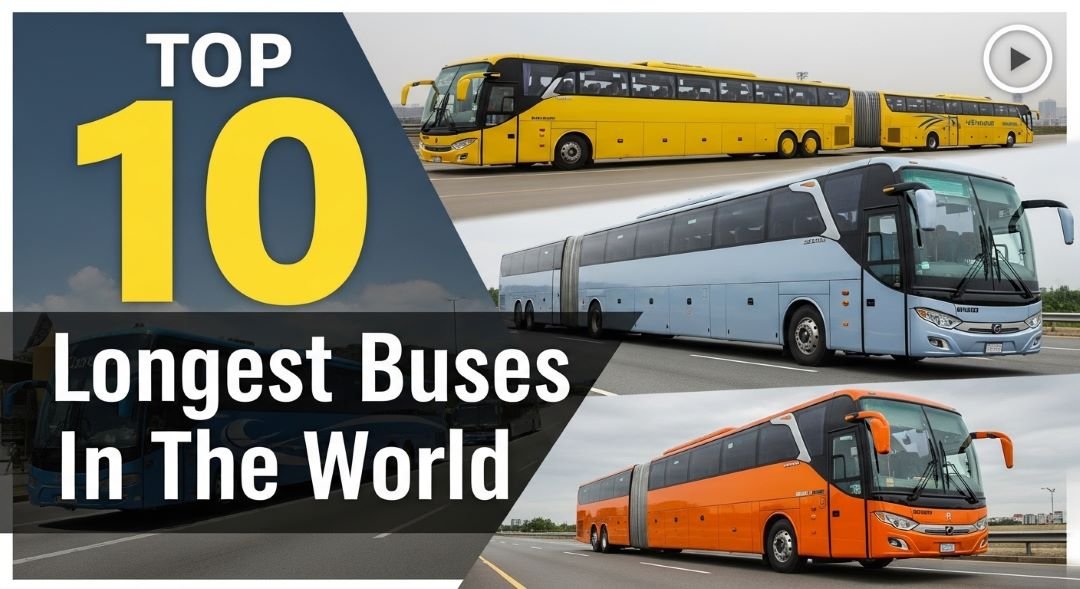
Today in this article we will discuss about the Top 10 Longest Buses in the World with PPT, PDF, Table and Infographic so, A standard city bus is 12 metres long, seats around 50 people, and does the job in most cities. But in the world’s mega cities, “just doing the job” is no longer enough. Engineers and urban planners have been forced to think bigger – much bigger. The result? Road-legal monsters that blur the line between a bus and a train.
Table of Contents
These are not your average vehicles. We are talking about articulated double-decker giants, bi-articulated electric leviathans, and record-breaking machines capable of carrying hundreds of passengers at a single time. Whether you are searching for the longest bus in the world, the largest bus in India comparison, or the top 10 biggest buses in the world, you are in the right place.
In this article, we count down the top 10 absolute longest buses ever made, ranked purely by their length – and we include detailed tables covering production costs, manufacturing units, import/export data, maintenance, and market buying/selling data for each bus.
Top 10 Longest Buses in the World (.PPTX)
Quick Reference: Top 10 Longest Buses in the World
| Rank | Bus Name | Length | Capacity | Origin | Type | Status |
| #1 | DAF Super City Train | 32.2 m | 600 (peak) | Congo (DRC) | Road Train | Record Holder |
| #2 | AutoTram Extra Grand | 30.7 m | 256 | Germany | Quad-Articulated | Prototype |
| #3 | Volvo Grand Artic 300 | 30 m | 300 | Brazil | Bi-Articulated BRT | In Service |
| #4 | BYD K12A | 27 m | 250 | China | Triple-Articulated EV | In Service |
| #5 | Yutong JNP 6250G | 25 m | 290 | China | Bi-Articulated BRT | In Service |
| #6 | Van Hool AGG300 | 24.8 m | 200 | Belgium | Bi-Articulated | In Service |
| #7 | Hess Lighttram 25 | 24.7 m | 190 | Switzerland | Trolleybus / EV | In Service |
| #8 | Solaris Urbino 24 Electric | 24 m | 200 | Poland | Bi-Articulated EV | In Service |
| #9 | Mercedes-Benz CapaCity L | 21 m | 191 | Germany | Single-Articulated | In Service |
| #10 | Neoplan Jumbo Cruiser | 18 m | 170 | Germany | Artic. Double-Decker | Discontinued |
Table 1: Production Cost & Unit Price Comparison
The cost of manufacturing and purchasing these mega-buses varies significantly based on size, technology (diesel vs. electric), and customisation level. Below is an estimated cost comparison based on publicly available procurement data and industry reports.
| Bus Name | Estimated Unit Price (USD) | Production Cost Est. | Price vs Standard Bus | Cost Per Passenger Seat |
| DAF Super City Train | $180,000 – $250,000 | Custom / One-Off | 3x – 4x | ~$400 – $600 |
| AutoTram Extra Grand | $10,000,000 (prototype) | $10M (R&D + build) | 200x | ~$39,000 |
| Volvo Grand Artic 300 | $700,000 – $900,000 | $600,000 – $800,000 | 12x – 15x | ~$2,500 |
| BYD K12A | $1,200,000 – $1,600,000 | $1,000,000 – $1,400,000 | 20x – 26x | ~$5,200 |
| Yutong JNP 6250G | $500,000 – $700,000 | $400,000 – $600,000 | 9x – 12x | ~$1,900 |
| Van Hool AGG300 | $650,000 – $800,000 | $550,000 – $700,000 | 11x – 14x | ~$3,400 |
| Hess Lighttram 25 | $700,000 – $950,000 | $600,000 – $850,000 | 12x – 16x | ~$4,100 |
| Solaris Urbino 24 Electric | $900,000 – $1,200,000 | $800,000 – $1,100,000 | 15x – 20x | ~$5,000 |
| Mercedes-Benz CapaCity L | $550,000 – $700,000 | $450,000 – $600,000 | 9x – 12x | ~$3,100 |
| Neoplan Jumbo Cruiser | $180,000 – $300,000 (hist.) | $150,000 – $250,000 | 3x – 5x | ~$1,500 |
| Standard City Bus (12m) | $55,000 – $100,000 | $45,000 – $85,000 | Baseline | ~$1,600 |
Note: Prices are approximate estimates based on procurement contracts, government tenders, and industry publications. Electric variants typically cost 30–50% more than diesel equivalents.
Table 2: Manufacturing Units, Headquarters & Annual Production
Understanding where these giants are manufactured helps identify the global supply chain of mega-bus production. Here is a breakdown of each manufacturer’s key details.
| Manufacturer | Country | HQ City | Founded | Annual Capacity (All Models) | Est. Units of This Model | Employees |
| DAF Trucks | Netherlands | Eindhoven | 1928 | N/A (trucks, not buses) | ~50 (custom trailers) | 9,000+ |
| Fraunhofer IVI | Germany | Dresden | 1991 | R&D Institute – no production | 1 (prototype only) | 180+ |
| Volvo Buses | Sweden/Brazil | Gothenburg | 1927 | ~8,000 buses/year (global) | ~200/year (Grand Artic) | 100,000+ |
| BYD Auto | China | Shenzhen | 2003 | ~50,000 buses/year | ~150/year (K12A) | 900,000+ |
| Yutong Bus | China | Zhengzhou | 1963 | ~80,000 buses/year | ~300/year (6250G) | 30,000+ |
| Van Hool | Belgium | Koningshooikt | 1947 | ~1,300 buses/year | ~80/year (AGG300) | 5,000+ |
| Hess AG | Switzerland | Bellach | 1882 | ~300 buses/year | ~60/year (Lighttram) | 600+ |
| Solaris Bus | Poland | Bolechowo | 1996 | ~2,000 buses/year | ~50/year (Urbino 24) | 3,000+ |
| Mercedes-Benz (EvoBus) | Germany | Stuttgart | 1995 | ~9,000 buses/year | ~300/year (CapaCity L) | 190,000+ |
| Neoplan (MAN) | Germany | Munich | 1935 | ~600 coaches/year (Neoplan) | Discontinued (1992) | 39,000+ |
Table 3: Import & Export Market Data
The global market for articulated and bi-articulated buses is heavily concentrated in a few key regions. Here is an overview of the primary import and export flows for each vehicle.
| Bus Name | Primary Export Markets | Primary Import Countries | Key Trade Regions | Export Volume Est. (Units/Yr) |
| DAF Super City Train | N/A (local operation only) | N/A | Sub-Saharan Africa | N/A |
| AutoTram Extra Grand | N/A (prototype, not exported) | N/A | Germany only | N/A |
| Volvo Grand Artic 300 | Latin America, Europe, Asia | Brazil, Colombia, Chile, Mexico | South America, Europe | 100 – 200 |
| BYD K12A | China domestic + SE Asia, Europe | China, Singapore, Europe | Asia-Pacific, EU | 100 – 180 |
| Yutong JNP 6250G | China domestic + Middle East, Africa | China, Egypt, Saudi Arabia | Asia, Middle East, Africa | 200 – 350 |
| Van Hool AGG300 | Europe (Netherlands, Belgium, FR) | Netherlands, Belgium, Switzerland | Western Europe | 60 – 100 |
| Hess Lighttram 25 | Europe, Oceania | Switzerland, Germany, Australia | Europe, Oceania | 40 – 80 |
| Solaris Urbino 24 Electric | Europe (Poland, Germany, Italy) | EU member states, Scandinavia | European Union | 30 – 60 |
| Mercedes-Benz CapaCity L | Europe, Middle East, SE Asia | Germany, Austria, Turkey, Gulf | Europe, GCC, Asia | 200 – 350 |
| Neoplan Jumbo Cruiser | Europe (historical) | Germany, Austria, Switzerland | Western Europe (historical) | Discontinued |
Source: Industry estimates based on publicly available procurement data, UITP (International Association of Public Transport) reports, and national tender databases.
Table 4: Buy & Sell Market – New vs. Used Pricing
For city transit authorities and private operators considering purchasing these mega-buses, here is a comparative breakdown of new and used market pricing, along with lead times and financing options.
| Bus Name | New Price (USD Est.) | Used / Refurbished (USD) | Typical Lead Time | Financing Available | Resale Value (5 Yrs) |
| DAF Super City Train | Not available / custom | $50,000 – $120,000 | 6 – 12 months | No | 20% – 30% |
| AutoTram Extra Grand | Not for sale (prototype) | Not available | N/A | N/A | N/A |
| Volvo Grand Artic 300 | $700,000 – $900,000 | $200,000 – $400,000 | 12 – 18 months | Yes (Volvo Finance) | 35% – 45% |
| BYD K12A | $1.2M – $1.6M | $400,000 – $700,000 | 9 – 14 months | Yes (BYD Finance) | 30% – 40% |
| Yutong JNP 6250G | $500,000 – $700,000 | $150,000 – $350,000 | 8 – 12 months | Yes | 30% – 40% |
| Van Hool AGG300 | $650,000 – $800,000 | $180,000 – $400,000 | 12 – 24 months | Yes | 30% – 40% |
| Hess Lighttram 25 | $700,000 – $950,000 | $200,000 – $450,000 | 12 – 18 months | Yes | 35% – 45% |
| Solaris Urbino 24 Electric | $900,000 – $1.2M | $300,000 – $600,000 | 10 – 16 months | Yes (EU Funding) | 35% – 45% |
| Mercedes-Benz CapaCity L | $550,000 – $700,000 | $150,000 – $350,000 | 8 – 14 months | Yes (MB Finance) | 35% – 45% |
| Neoplan Jumbo Cruiser | Discontinued | $30,000 – $150,000 | N/A | No | Collector value |
Table 5: Maintenance Cost & Service Requirements
Operating these mega-buses is only part of the story. Maintenance costs for articulated and bi-articulated buses can be significantly higher than standard buses, particularly for electric and prototype models. Here is a detailed breakdown.
| Bus Name | Annual Maintenance Cost | Service Interval | Major Overhaul Cycle | Parts Availability | Specialised Technician Required | Estimated Lifespan |
| DAF Super City Train | $15,000 – $30,000 | Every 15,000 km | Every 5 years | Limited (custom) | Yes (specialised) | 15 – 20 years |
| AutoTram Extra Grand | N/A (prototype) | N/A | N/A | Unique / custom | Yes (Fraunhofer only) | N/A |
| Volvo Grand Artic 300 | $40,000 – $70,000 | Every 20,000 km | Every 7 years | Good (Volvo global) | Yes (Volvo certified) | 20 – 25 years |
| BYD K12A | $25,000 – $45,000 | Every 25,000 km | Battery at 8 yrs | Good (BYD network) | Yes (EV certified) | 15 – 20 years |
| Yutong JNP 6250G | $30,000 – $55,000 | Every 18,000 km | Every 6 years | Moderate | Yes | 18 – 22 years |
| Van Hool AGG300 | $35,000 – $60,000 | Every 20,000 km | Every 7 years | Good (EU network) | Yes (Van Hool certified) | 20 – 25 years |
| Hess Lighttram 25 | $30,000 – $55,000 | Every 20,000 km | Every 8 years | Moderate (Europe) | Yes | 20 – 25 years |
| Solaris Urbino 24 Electric | $20,000 – $40,000 | Every 25,000 km | Battery at 8 yrs | Good (EU network) | Yes (EV certified) | 15 – 20 years |
| Mercedes-Benz CapaCity L | $35,000 – $65,000 | Every 20,000 km | Every 8 years | Excellent (global) | Standard MB service | 20 – 25 years |
| Neoplan Jumbo Cruiser | $20,000 – $40,000 | Every 15,000 km | N/A (discontinued) | Very Limited | Yes (specialised vintage) | 25 – 35 years |
Note: Electric buses generally have lower annual maintenance costs than diesel counterparts due to fewer mechanical components. However, battery replacement at Year 8 can cost $80,000 – $200,000 depending on capacity.
Table 6: Fuel, Energy & Emissions Comparison
| Bus Name | Fuel / Energy Type | Fuel Cost Per 100km (Est.) | CO2 Emissions | Annual Fuel/Energy Cost | Energy Efficiency |
| DAF Super City Train | Diesel | $80 – $120 | ~900 g/km | $45,000 – $70,000 | Low |
| AutoTram Extra Grand | Electric / Diesel hybrid | $20 – $40 | ~150 g/km | N/A (prototype) | Very High |
| Volvo Grand Artic 300 | Diesel / CNG / BioFuel | $60 – $100 | ~750 g/km | $35,000 – $58,000 | Moderate |
| BYD K12A | Electric (300 km range) | $12 – $20 | Zero direct emissions | $7,000 – $12,000 | Very High |
| Yutong JNP 6250G | Diesel / CNG | $65 – $95 | ~800 g/km | $38,000 – $55,000 | Moderate |
| Van Hool AGG300 | Diesel / CNG / Hybrid | $55 – $85 | ~700 g/km | $32,000 – $49,000 | Moderate – High |
| Hess Lighttram 25 | Electric / Trolley | $10 – $18 | Zero direct emissions | $6,000 – $10,500 | Very High |
| Solaris Urbino 24 Electric | Electric | $11 – $19 | Zero direct emissions | $6,400 – $11,000 | Very High |
| Mercedes-Benz CapaCity L | Diesel / CNG / Hybrid | $50 – $80 | ~650 g/km | $29,000 – $46,000 | High |
| Neoplan Jumbo Cruiser | Diesel | $70 – $110 | ~850 g/km | $40,000 – $64,000 | Low – Moderate |
Detailed Bus Profiles: Top 10 Longest Buses In The World
#10 – Neoplan Jumbo Cruiser (18 Metres) | Germany
The Only Articulated Double-Decker Coach Ever Built
The Neoplan Jumbo Cruiser is the shortest on this list but remains one of the most unique vehicles ever produced. Built between 1975 and 1992 in Germany, it was designed as a luxury touring coach – not a city transit bus – capable of carrying 170 passengers across two full decks. It was the only articulated double-decker coach ever manufactured, and that feat has never been replicated.
One famous unit was converted into a sleeper bus for rock stars on tour. Today, surviving units are considered collector items, with resale prices rising due to rarity.
- Length: 18 metres
- Capacity: 170 passengers (2 decks)
- Production: 1975 – 1992 (discontinued)
- Manufacturer: Neoplan (now part of MAN Truck & Bus)
Official Links – Neoplan / MAN
#9 – Mercedes-Benz CapaCity L (21 Metres) | Germany
The King of Single Articulation
The Mercedes-Benz CapaCity L is a 21-metre, single-articulated masterpiece. It carries up to 191 passengers with just one joint – a rare engineering achievement at this size. Its independently steering rear axle gives it a turning circle barely larger than an 18-metre bus, making it ideal for dense BRT systems in European cities like Hamburg.
- Length: 21 metres
- Capacity: 191 passengers
- Type: Single-articulated low-floor bus
- Manufacturer: Mercedes-Benz / EvoBus GmbH
Official Links – Mercedes-Benz Buses
- Mercedes-Benz Buses (Official Website)
- EvoBus GmbH – Bus & Coach Manufacturer
- Wikipedia: Mercedes-Benz CapaCity
- UITP – International Association of Public Transport
#8 – Solaris Urbino 24 Electric (24 Metres) | Poland
The Silent Giant – Zero Emission Bi-Articulated Bus
The Solaris Urbino 24 Electric is one of the most technically advanced buses on this list. At 24 metres with bi-articulation, it uses a distributed electric drive system and sophisticated software to control its two articulation joints – ensuring perfect alignment through tight city turns. It carries up to 200 passengers with zero direct emissions.
- Length: 24 metres
- Capacity: 200 passengers
- Type: Bi-articulated electric bus
- Manufacturer: Solaris Bus & Coach (Poland)
Official Links – Solaris Bus & Coach
#7 – Hess Lighttram 25 / SwissAde (24.7 Metres) | Switzerland
The Bus That Looks Like a Tram
The Hess Lighttram 25 is so sleek and low-profile that it is nearly indistinguishable from a tram on rails. Typically built as a trolleybus drawing overhead power, newer models (like Brisbane Metro) are flash-charging electric vehicles. It provides light rail capacity – around 190 passengers – without the cost of laying steel tracks.
- Length: 24.7 metres
- Capacity: ~190 passengers
- Type: Bi-articulated trolleybus / electric
- Manufacturer: Hess AG (Switzerland)
Official Links – Hess AG
- Hess AG Buses (Official Website)
- Wikipedia: Hess Swisstrolley
- Brisbane Metro Project (Australian Reference)
#6 – Van Hool AGG300 (24.8 Metres) | Belgium
The Bi-Articulated Workhorse of European Transit
The Van Hool AGG300 is Belgium’s gift to high-capacity transit. For years, units running in the Netherlands were among the busiest buses in all of Europe. Its three-compartment, low-floor design was engineered around a single principle: move the maximum number of people. It routinely replaced two to three standard articulated buses on a single route.
- Length: 24.8 metres
- Capacity: 200 passengers
- Type: Bi-articulated low-floor bus
- Manufacturer: Van Hool NV (Belgium)
Official Links – Van Hool
#5 – Yutong JNP 6250G (25 Metres) | China
China’s Mega-City Surface Subway
At 25 metres, the Yutong JNP 6250G was purpose-built for Chinese mega-cities. While seating is only around 40, its true load of 290 people fills the widened aisles of its three massive sections. Due to its size, it cannot turn on standard streets – China built dedicated BRT superbus corridors specifically for it.
- Length: 25 metres
- Capacity: Up to 290 passengers
- Type: Bi-articulated BRT bus
- Manufacturer: Yutong Bus Co., Ltd. (Zhengzhou, China)
Official Links – Yutong Bus
#4 – BYD K12A (27 Metres) | China
The World’s Longest Pure Electric Bus
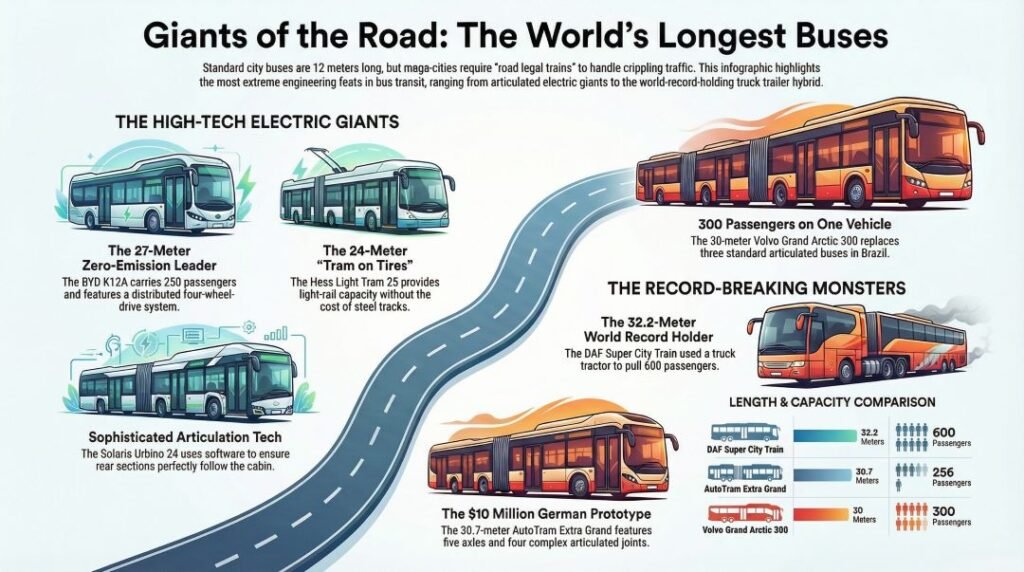
The BYD K12A is a triple-articulated 27-metre electric giant from Shenzhen, China. It is the world’s longest fully electric bus, with a 300 km range on a single charge. It was also the first bus equipped with a distributed four-wheel drive system – switching between 2WD and 4WD automatically to handle hills and wet roads. It saves an estimated 80 tonnes of CO2 per year per vehicle.
- Length: 27 metres
- Capacity: 250 passengers
- Type: Triple-articulated electric bus
- Manufacturer: BYD Auto Co., Ltd. (Shenzhen, China)
Official Links – BYD
- BYD Auto (Official Website)
- BYD Electric Buses Global
- Wikipedia: BYD Auto
- Bloomberg Green – BYD Electric Fleet
#3 – Volvo Grand Artic 300 (30 Metres) | Brazil
Brazil’s 300-Passenger BRT Backbone
The Volvo Grand Artic 300 is a 30-metre bi-articulated bus developed specifically for Latin America’s high-capacity BRT systems. Its model number is not marketing – it literally carries 300 passengers. It replaces three standard articulated buses on a single route, dramatically reducing traffic and emissions per passenger kilometre.
- Length: 30 metres
- Capacity: 300 passengers
- Type: Bi-articulated BRT bus
- Manufacturer: Volvo Buses (Brazil production facility)
Official Links – Volvo Buses
- Volvo Buses (Official Website)
- Wikipedia: Volvo Buses
- ITDP – Institute for Transportation and Development Policy (BRT Data)
#2 – AutoTram Extra Grand (30.7 Metres) | Germany
The EUR 10 Million German Prototype
The AutoTram Extra Grand is the most technologically sophisticated vehicle on this list. Developed by the Fraunhofer Institute in Dresden at a cost of approximately EUR 10 million, this quad-articulated prototype used computer-controlled steering on all five axles – ensuring every wheel followed the exact path of the first. Despite worldwide attention and a capacity of 256 passengers, it never went into production due to infrastructure costs.
- Length: 30.7 metres
- Capacity: 256 passengers
- Type: Quad-articulated rubber-tyre tram (prototype)
- Developer: Fraunhofer Institute for Transportation and Infrastructure Systems (IVI)
Official Links – Fraunhofer Institute
#1 – DAF Super City Train (32.2 Metres) | Democratic Republic of Congo
The Guinness World Record Holder – The Longest Bus Ever Made
The DAF Super City Train is the undisputed longest bus ever made. At 32.2 metres, it holds the Guinness World Record for length. Introduced in Kinshasa, Congo in 1989 following the collapse of the National Bus Company, it was a truck tractor pulling two custom trailers – not a conventional bus at all. Its official capacity was 250, but witnesses reported up to 600 passengers at peak times – filling seats, standing in aisles, and even hanging from doors and the roof.
It is the ultimate expression of what transportation looks like when driven not by luxury or innovation, but by pure, desperate necessity.
- Length: 32.2 metres (Guinness World Record)
- Official capacity: 250 / Reported peak: 600 passengers
- Type: Road train (truck tractor + 2 custom trailers)
- Country: Democratic Republic of Congo (Kinshasa, 1989)
- Manufacturer: DAF Trucks
Official Links – DAF & Guinness Records
- DAF Trucks (Official Website)
- Wikipedia: DAF Trucks
- Guinness World Records (Bus Records)
- Wikipedia: Kinshasa Transport History
Length vs Capacity: How These Giants Compare to a Standard Bus
| Bus | Length | Capacity | Times Longer than Std Bus | Times More Passengers |
| Standard City Bus (12m) | 12 m | 50 | 1x (baseline) | 1x (baseline) |
| Neoplan Jumbo Cruiser | 18 m | 170 | 1.5x | 3.4x |
| Mercedes-Benz CapaCity L | 21 m | 191 | 1.75x | 3.8x |
| Solaris Urbino 24 Electric | 24 m | 200 | 2x | 4x |
| Hess Lighttram 25 | 24.7 m | 190 | 2.1x | 3.8x |
| Van Hool AGG300 | 24.8 m | 200 | 2.1x | 4x |
| Yutong JNP 6250G | 25 m | 290 | 2.1x | 5.8x |
| BYD K12A | 27 m | 250 | 2.25x | 5x |
| Volvo Grand Artic 300 | 30 m | 300 | 2.5x | 6x |
| AutoTram Extra Grand | 30.7 m | 256 | 2.6x | 5.1x |
| DAF Super City Train | 32.2 m | 600 (pk) | 2.7x | 12x (peak) |
Read Also: Top 10 Fastest Missiles in the World 2026 (PDF & PPT)
Authoritative Resources & Reference Links
For further research, verification, and deeper reading, the following official and authoritative sources are recommended:
Global Transport & Industry Bodies
- UITP – International Association of Public Transport
- ITDP – Institute for Transportation and Development Policy
- IRU – International Road Transport Union
- APTA – American Public Transportation Association
- European Bus & Coach Federation (EBSF)
Wikipedia Reference Pages
- Wikipedia: Articulated Bus
- Wikipedia: Bus Rapid Transit (BRT)
- Wikipedia: Neoplan Jumbo Cruiser
- Wikipedia: Mercedes-Benz CapaCity
- Wikipedia: BYD Auto
- Wikipedia: Volvo Buses
- Wikipedia: Van Hool
- Wikipedia: Guinness World Records
Manufacturer Official Websites
- MAN Truck & Bus – man.eu
- Mercedes-Benz Buses – mercedes-benz-buses.com
- Solaris Bus & Coach – solarisbus.com
- Hess AG – hess-ag.ch
- Van Hool – vanhool.be
- Yutong Bus – yutong.com
- BYD Auto – byd.com
- Volvo Buses – volvobuses.com
- DAF Trucks – daf.com
- Fraunhofer IVI – ivi.fraunhofer.de
(FAQs)
What is the longest bus in the world?
The longest bus in the world is the DAF Super City Train from the Democratic Republic of Congo, measuring 32.2 metres. It holds the Guinness World Record for length and reportedly carried up to 600 passengers at peak.
What is the largest bus in India?
India’s bus market is dominated by Tata Motors and Ashok Leyland. For articulated BRT buses, cities like Ahmedabad and Pune operate some of the longest models in regular service in India. However, none currently match the global giants on this top 10 list.
What is the biggest coach bus in the world?
The Neoplan Jumbo Cruiser is the biggest coach bus ever built – the only articulated double-decker touring coach ever manufactured, seating 170 passengers across two levels.
What is the world’s tallest bus?
Double-decker buses typically stand 4.2 to 4.5 metres tall. Famous examples include London’s iconic double-deckers (Alexander Dennis Enviro400) and Volvo B9TL used across Asia. The Neoplan Jumbo Cruiser on this list combined both height and length for a unique record.
What is the smallest bus in the world?
Micro shuttle buses and minibuses can measure as little as 5 – 6 metres. Common examples include airport shuttle vans and rural transit vehicles. By comparison, even the #10 bus on this list is three times longer.
What is the largest bus stand in the world?
Some of the world’s largest bus stations include Millennium Bus Station in Ghent (Belgium), and Kempegowda Bus Station (Majestic) in Bangalore, India – one of the largest in Asia, serving over 100,000 passengers daily.
What is the longest bus route in the world?
The longest scheduled bus route in the world is the Transoceánica route in Peru, operated by Ormeño, covering over 6,200 km from Lima, Peru to Buenos Aires, Argentina over several days.
Conclusion: More Than Buses – They Are Engineering Solutions for a Crowded Planet
The next time you are waiting at a bus stop, think about the sheer scale of what human engineering has achieved. From the 18-metre luxury of the Neoplan Jumbo Cruiser to the 32.2-metre necessity of the DAF Super City Train, these vehicles tell the story of a planet that is crowded, ambitious, and constantly innovating.
These are not just the top 10 biggest buses in the world or Top 10 Longest Buses in the World – they are engineering solutions for the unique transit challenges of mega-cities. Whether it is the zero-emission sophistication of the BYD K12A or the raw necessity of the DAF Super City Train carrying 600 people through Kinshasa, every bus on this list represents the answer engineers found to one of the oldest questions in urban planning:
How do you move the most people in the least space? The answer, it turns out, is to build a monster.