Today we will discuss about the Top 10 5th Generation Fighter Jets in the World or TOP 10 FIFTH GENERATION and 4.5 GEN FIGHTER JETS IN THE WORLD with PPT, PDF, Infographic, Table of Rankings, Specifications, Costs & Buyer’s Data etc. so, Fifth-generation fighter jets are the most advanced, most expensive, and most strategically significant combat aircraft ever built. They are not simply faster or more powerful than older jets. They represent a complete reimagining of what an aircraft can do: combining all-aspect stealth so effective that enemy radar systems cannot detect them, sensor fusion technology that gives pilots a real-time picture of the entire battlefield, and integrated network warfare systems that link them to satellites, ships, other aircraft, and ground forces simultaneously.
Table of Contents
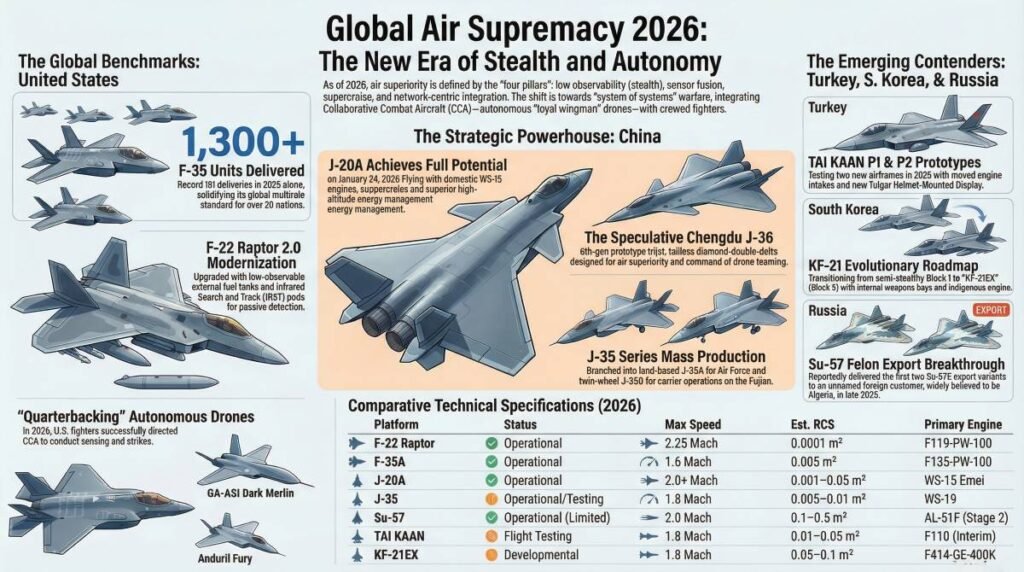
As of early 2026, the global landscape of 5th-generation fighters is both more exclusive and more dynamic than most people realize. Only five aircraft on Earth are in active, combat-ready service and meet all the established criteria for the fifth generation: the American F-22 and F-35, China’s J-20 and the newly operational J-35A, and Russia’s Su-57. A second group of five advanced platforms – from South Korea, Turkey, China, Russia, and India – are in flight testing, early production, or prototype construction, each approaching or targeting full 5th-generation capability.
This guide covers all ten aircraft in detail. For each, we provide full technical specifications, combat analysis, and – critically – a complete cost breakdown that answers the question every government procurement office asks: what does it actually cost to buy, receive, and operate one of these aircraft? We include unit purchase price, estimated manufacturing cost, transport and delivery cost, and pilot training cost, giving you the most complete buyer’s picture available in open-source reporting.
What Defines a Fifth-Generation Fighter?
The term ‘fifth-generation’ is frequently misused in media coverage and marketing materials. Aviation experts and the United States Air Force use a precise definition with five core requirements, all of which must be present for an aircraft to qualify:
- All-Aspect Low-Observable Stealth Design: The aircraft must have a low radar cross-section from every angle, not just the front. This requires careful shaping of every surface, edge, and panel gap, plus the use of radar-absorbent materials throughout the airframe.
- Advanced AESA Radar and Sensor Fusion: An Active Electronically Scanned Array radar that can simultaneously track multiple targets while conducting electronic warfare, combined with a fusion system that integrates all sensor data into a single unified picture for the pilot.
- Supercruise or Very High-Performance Propulsion: The ability to sustain supersonic flight without afterburner (supercruise), or at minimum, propulsion systems that deliver performance significantly beyond 4th-generation fighters.
- Fully Integrated Avionics and Network-Centric Warfare Capability: The aircraft must function as a node in a broader battle network, sharing and receiving data with other aircraft, ships, satellites, and ground stations in real time.
- Internal Weapons Bays: All weapons must be carried internally to preserve the stealth signature. External weapons create radar reflections that defeat the purpose of stealth shaping.
Every aircraft in this guide is evaluated against these five criteria, and we clearly note where each platform meets, partially meets, or is working toward meeting them.
Important Note: Only 5 True Operational 5th-Gen Fighters Exist in 2026
Before proceeding to the rankings, readers should understand a fact that is often obscured in popular coverage: as of February 2026, only five aircraft are in active, combat-ready service as genuine 5th-generation fighters. These are the F-22 Raptor, F-35 Lightning II, J-20 Mighty Dragon, J-35A, and Su-57 Felon. The remaining five aircraft on this list are advanced prototypes, near-service platforms, or aircraft in early testing phases. They are included because they are the most significant emerging platforms shaping the future of air power, and because their cost data is relevant for nations currently evaluating their options. But their operational status is clearly labeled throughout this article.
Top 10 5th Generation Fighter Jets in The World | .PPTX
PART ONE: FULLY OPERATIONAL Top 10 5th Generation Fighter Jets in the World
The following five aircraft are in active combat-ready service with their respective air forces as of 2026. They have completed development and passed operational testing.
#1. Lockheed Martin F-22 Raptor – United States
Operational Status: Fully Operational – USAF (In Service Since December 2005)
Primary Role: Air Superiority / Stealth Strike
Overview
The F-22 Raptor is the aircraft that all other 5th-generation fighters are measured against. Developed by Lockheed Martin in partnership with Boeing, the Raptor entered service with the United States Air Force in December 2005 and has remained the unchallenged benchmark for pure air-superiority performance ever since. No other operational aircraft in the world matches its combination of all-aspect stealth, supercruise speed, and thrust-vectored maneuverability.
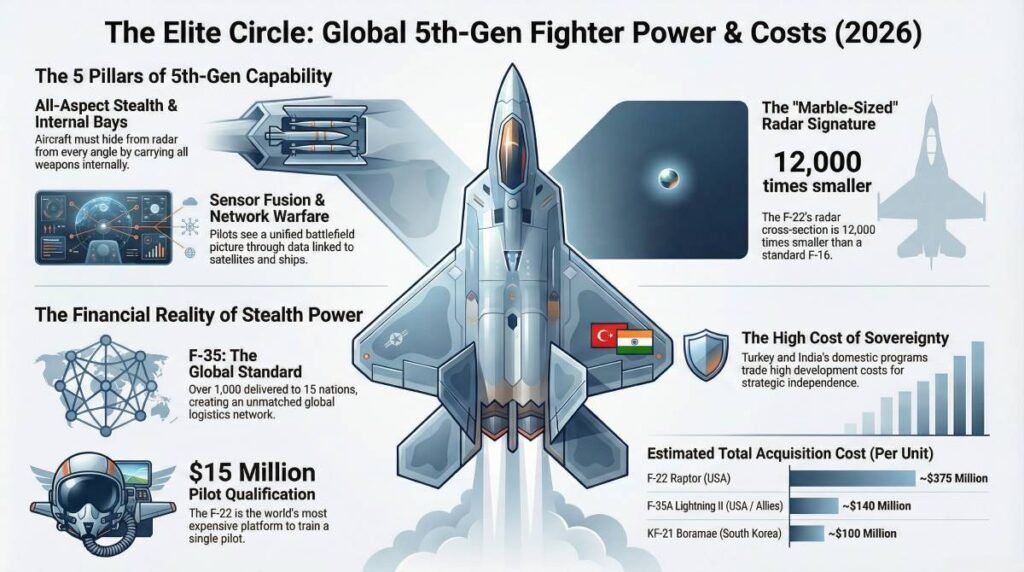
The F-22 was the world’s first aircraft to meet every single 5th-generation criterion simultaneously. Its radar cross-section – the measure of how detectable an aircraft is to radar – is estimated by Western analysts at less than 0.0001 square meters: roughly the radar signature of a marble. To put that in context, a conventional 4th-generation fighter like the F-16 has a radar cross-section of approximately 1.2 square meters – more than 12,000 times larger.
Production was controversially capped at 187 aircraft against an Air Force requirement of 381, a decision driven by cost overruns and shifting threat assessments. Many defense analysts regard this as a strategic mistake that leaves the USAF with insufficient numbers of its best air-superiority fighter at a time when China is fielding J-20s at significant scale.
Technical Specifications
| Manufacturer | Lockheed Martin / Boeing |
| Service Entry | December 2005 |
| Max Speed | Mach 2.25 (approximately 1,500 mph / 2,414 km/h) |
| Supercruise Speed | Mach 1.82 – without afterburner (best of any production fighter) |
| Service Ceiling | 65,000 feet (19,812 meters) |
| Combat Radius | Approximately 590 miles (950 km) on internal fuel |
| Stealth (RCS) | Extremely Low Observable – estimated less than 0.0001 m² |
| Radar | AN/APG-77 AESA – one of the most powerful airborne radars ever fielded |
| Engines | Two Pratt & Whitney F119-PW-100 with 3D thrust vectoring |
| Weapons | AIM-120D AMRAAM, AIM-9X Sidewinder, 20mm M61A2 Vulcan cannon (all internal) |
| Units Built | 187 operational aircraft – production ended |
| Crew | 1 pilot |
Combat Analysis
The F-22’s superiority in air-to-air combat is a function of three integrated advantages working together. First, its stealth allows it to approach within weapons range before the enemy even knows it is there. Second, its AN/APG-77 AESA radar can track dozens of targets simultaneously while remaining nearly undetectable itself, because it can switch frequencies and transmission patterns faster than enemy radar warning receivers can identify it. Third, its 3D thrust-vectoring nozzles allow it to perform post-stall maneuvers that violate conventional aerodynamic limits – giving it a decisive advantage if any engagement does reach close-range visual combat.
The F-22 has been deployed to Syria and other operational theaters, but has not engaged in air-to-air combat against a peer adversary. Simulated exercises between the F-22 and 4th-generation fighters have typically produced kill ratios so lopsided that they are classified. Exercises against other advanced fighters have occasionally produced surprising results, but independent analysts universally agree that the Raptor’s integrated package is unmatched.
Key Strengths
- World’s most effective stealth performance – RCS smaller than a marble
- Mach 1.82 supercruise without afterburner – no other production fighter comes close
- 3D thrust vectoring enables maneuvers impossible for any rival aircraft
- AN/APG-77 AESA radar with simultaneous multi-target track and near-zero emissions
- Still the gold standard for air superiority after 20 years of service
#2. Lockheed Martin F-35 Lightning II – United States and Allied Nations
Operational Status: Fully Operational – USAF, USN, USMC + 15 Allied Nations (Since 2015)
Primary Role: Multi-Role Stealth Strike / Sensor Fusion Platform
Overview
The F-35 Lightning II is the most widely deployed 5th-generation fighter in the world and the most important Western defense program of the 21st century. Where the F-22 was built for pure air-to-air dominance, the F-35 was designed for multi-role versatility: a single platform that can replace aging fleets of F-16s, F/A-18s, AV-8B Harriers, and Tornado GR4s across more than fifteen allied nations, while delivering genuine 5th-generation stealth and sensor capability at a significantly lower unit cost.
The F-35 surpassed 1,000 deliveries globally in late 2025, making it the most mass-produced stealth jet in history. Fifteen nations now operate or have ordered the aircraft, creating a logistics and maintenance network of unprecedented scale. This network effect is one of the F-35’s most underappreciated strategic advantages: parts, software updates, and operational data are shared across the entire allied fleet, continuously improving every aircraft without additional cost.
The F-35’s most revolutionary feature is not its stealth but its sensor fusion architecture. The aircraft integrates data from its AN/APG-81 AESA radar, AN/AAQ-37 Distributed Aperture System, Electro-Optical Targeting System, and electronic warfare suite into a single operational picture displayed through a helmet-mounted display that allows pilots to effectively see through the aircraft’s fuselage in any direction.
Technical Specifications
| Manufacturer | Lockheed Martin (Fort Worth, Texas) |
| Variants | F-35A (conventional), F-35B (short take-off/vertical landing), F-35C (carrier) |
| Service Entry | 2015 (F-35B USMC) / 2016 (F-35A USAF) |
| Max Speed | Mach 1.6 (approximately 1,200 mph / 1,930 km/h) |
| Combat Radius | Approximately 740 miles (1,190 km) on internal fuel – F-35A |
| Stealth (RCS) | Very Low Observable – less than 0.005 m² (frontal aspect optimized) |
| Radar | AN/APG-81 AESA with simultaneous air-to-air and air-to-ground modes |
| Sensor Suite | AN/AAQ-37 DAS (360-degree awareness), AN/AAQ-40 EOTS, AN/ASQ-239 EW |
| Engines | One Pratt & Whitney F135 (F-35A/C) / F135 with Rolls-Royce LiftFan (F-35B) |
| Weapons | AIM-120D, AIM-9X, GBU-31 JDAM, GBU-12, B61-12 nuclear (internal bays) |
| Total Deliveries | Over 1,000 aircraft globally (as of late 2025) |
| Crew | 1 pilot |
Combat Analysis
The F-35 has a genuine combat record that no other 5th-generation fighter outside the United States possesses. Israeli F-35Is – designated ‘Adir’ – have conducted multiple strike missions in Syria and against Iran-linked targets since 2018, flying through airspace defended by Russian-supplied S-300 and Pantsir-S1 systems without a single loss. This operational validation is more meaningful than any exercise result because it represents real performance against real adversary air defenses.
The aircraft’s primary limitation – its top speed of Mach 1.6 and lower thrust-to-weight ratio compared to dedicated air superiority fighters – is a real trade-off. In a pure dogfight against an F-22 or Su-57, the F-35 would be at a disadvantage. But F-35 advocates correctly point out that the aircraft’s sensor fusion advantage means it should never find itself in a dogfight: it should detect, identify, and engage the enemy first, from beyond visual range, before the adversary even knows the F-35 is present.
Key Strengths
- Most widely deployed stealth fighter – over 1,000 delivered to 15 nations
- Sensor fusion and situational awareness system is the most advanced ever fielded operationally
- F-35B STOVL variant can operate from amphibious assault ships and austere forward bases
- Combat-proven: Israeli Adirs operating successfully against Russian-supplied air defenses
- Network effect of global allied fleet continuously improves every aircraft in service
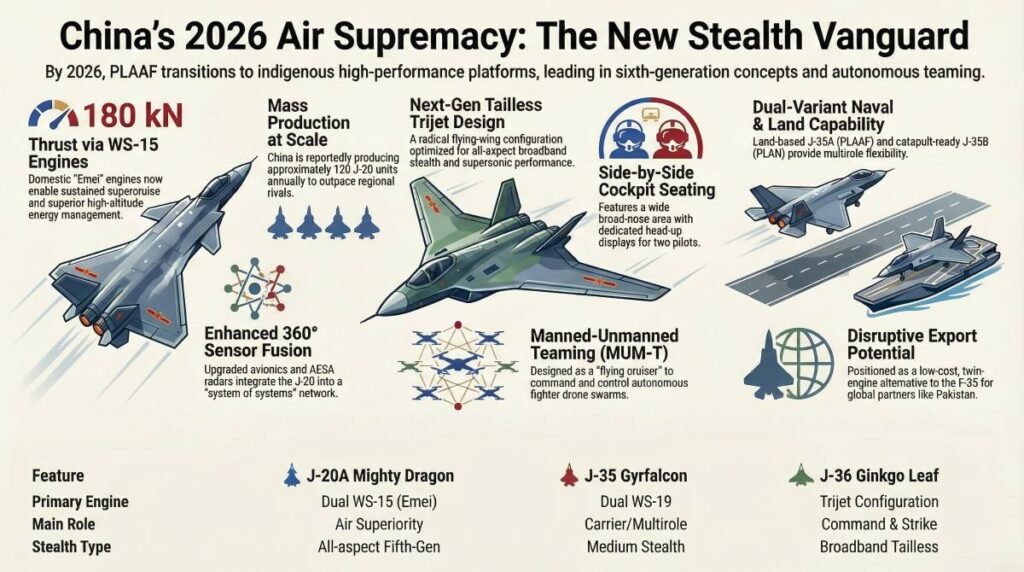
#3. Chengdu J-20 Mighty Dragon – China
Operational Status: Fully Operational – PLAAF (In Service Since 2017, Mass Production Ongoing)
Primary Role: Long-Range Air Superiority / Anti-Access Area Denial
Overview
China’s J-20 Mighty Dragon is the aircraft that changed the Western world’s understanding of Chinese aerospace capability. When it made its first public flight in 2011, many defense analysts predicted it would take another decade before China had anything resembling a true stealth fighter. The J-20 proved them wrong, entering operational service in 2017 and entering mass production at a rate that has alarmed American air power planners. With an estimated 150 to 200 or more aircraft in service by 2025, it is already the most numerous non-American 5th-generation fighter ever built.
The J-20 is a large aircraft, notably longer than the F-22, and this size reflects its design philosophy. It is built for range, payload, and long-duration air superiority missions over the vast distances of the Western Pacific – exactly the operating environment China needs to contest in any conflict over Taiwan or the South China Sea. Its enormous internal fuel capacity gives it a combat radius that rivals twin that of the F-22, allowing it to threaten American supporting assets like tankers and airborne early warning aircraft that currently operate far from the front lines.
Technical Specifications
| Manufacturer | Chengdu Aircraft Corporation (CAC) |
| Service Entry | 2017 (PLAAF) – ongoing mass production |
| Max Speed | Mach 2.0+ (estimated) |
| Combat Radius | Approximately 1,200 miles (2,000 km) estimated – large internal fuel volume |
| Stealth (RCS) | Low Observable – strong frontal aspect; rear aspect less optimized than F-22 |
| Engines (Current) | WS-10C turbofans (production aircraft) |
| Engine (Future) | WS-15 supercruise-capable engine – in advanced development |
| Radar | KLJ-5 AESA radar (estimated) |
| Weapons | PL-15 BVRAAM (500+ km range), PL-10 short-range AAM (all internal bays) |
| Special Variant | J-20A: Two-seat variant for manned-unmanned drone teaming |
| Estimated Numbers | 150 to 200+ operational aircraft (2025 estimate) |
| Crew | 1 (J-20) / 2 (J-20A twin-seat variant) |
Combat Analysis
The J-20 has not been used in combat, but its design intent is clear from its specifications. The PL-15 beyond-visual-range missile integrated into its internal bays reportedly has a range exceeding 500 kilometers – longer than any Western production air-to-air missile. In a Western Pacific conflict, a J-20 armed with PL-15s could threaten American tanker aircraft and AWACS surveillance planes that currently operate well behind the front line, forcing them to move further back and dramatically reducing the operational radius of F-22s and F-35s that depend on aerial refueling.
The J-20A two-seat variant, unique among 5th-generation fighters, appears designed to allow one crew member to manage loyal wingman drones while the other handles the primary air-superiority mission. This manned-unmanned teaming concept would give PLAAF formations a significant force-multiplication advantage that no current Western 5th-generation platform matches in service.
Key Strengths
- Most numerous non-American 5th-gen fighter – China producing at a scale no rival outside the US matches
- PL-15 BVRAAM with 500+ km range – longer reach than any current Western production AAM
- J-20A twin-seat variant enables manned-unmanned drone teaming – a first for the class
- Combat radius vastly greater than F-22 – designed for the distances of the Western Pacific
- Mass production ramp continues – numbers advantage over any single Western 5th-gen type
#4. Sukhoi Su-57 Felon – Russia
Operational Status: Fully Operational – Russian Aerospace Forces (VKS), Limited Numbers (Since 2020)
Primary Role: Air Superiority / Multi-Role Strike
Overview
Russia’s Su-57 Felon is a technically impressive aircraft constrained by a frustratingly small production run. As Russia’s first true 5th-generation fighter, it embodies decades of Sukhoi aeronautical expertise applied to the challenges of stealth, supercruise, and modern avionics. In several performance dimensions – particularly maneuverability and operational range – it equals or exceeds its American counterparts. The core problem is quantity: approximately 20 Su-57s are in operational service as of 2026, a number that limits the aircraft’s strategic impact regardless of its individual capability.
The Su-57 reflects a deliberate Russian design philosophy that differs from the American approach. Where American 5th-generation fighters prioritize all-aspect stealth above almost everything else, the Su-57 trades some stealth optimization for better raw performance in other areas: higher top speed, greater weapons payload, and longer range without external tanks. This reflects Russia’s assessment that stealth alone is not sufficient and that future adversary sensors may reduce its effectiveness.
Technical Specifications
| Manufacturer | Sukhoi / United Aircraft Corporation (UAC) |
| Service Entry | 2020 (Russian Aerospace Forces – VKS) |
| Max Speed | Mach 2.0 (approximately 1,520 mph / 2,440 km/h) |
| Supercruise | Estimated Mach 1.3 with AL-41F1 engines |
| Service Ceiling | 65,000 feet (20,000 meters) |
| Range | Approximately 2,175 miles (3,500 km) on internal fuel |
| Stealth (RCS) | Low Observable – significant but less optimized than F-22 or F-35 |
| Radar | N036 Byelka AESA – four arrays (forward + three side-looking) for 360-degree coverage |
| Electronic Warfare | L402 Himalayas – Russia’s most advanced airborne jamming system |
| Weapons | Internal bays: R-77M BVRAAM, Kh-58UShKE anti-radiation missile, Kh-59MK2 cruise missile |
| Numbers in Service | Approximately 20 operational aircraft (76 on order as of 2024) |
| Crew | 1 pilot |
Combat Analysis
The Su-57’s N036 Byelka radar system is one of its genuine technical achievements. Unlike most AESA radars that use a single forward-facing antenna array, the Byelka uses four arrays – one primary forward-facing and three side-looking – giving the aircraft active radar coverage across 360 degrees without turning. This gives the Su-57 a situational awareness capability that in raw angular coverage terms exceeds even the F-22’s single-array AN/APG-77.
The Su-57 has been used in limited strike operations in Syria and reportedly in Ukraine, though Russia appears to have kept it away from heavily contested airspace – suggesting either awareness of its limitations or unwillingness to risk losing an irreplaceable asset. Its true combat capability against a peer adversary remains untested. The aircraft’s small fleet size means that even a single combat loss would represent a significant percentage of Russia’s entire 5th-generation capability.
Key Strengths
- 3D thrust vectoring nozzles deliver world-class close-combat maneuverability
- N036 Byelka: four-array AESA gives 360-degree active radar coverage unique in the class
- Longest combat range of any operational 5th-generation fighter – 3,500 km without external tanks
- L402 Himalayas electronic warfare suite is Russia’s most advanced airborne jamming system
- High top speed and powerful weapons payload across a wide range of mission types
#5. Shenyang J-35A – China
Operational Status: Fully Operational – PLAAF land-based (2025) / PLAN carrier variant in service
Primary Role: Multi-Role Stealth Strike (PLAAF) / Naval Strike Fighter (PLAN)
Overview
The J-35A is the newest member of the 5th-generation operational club, officially debuting with the People’s Liberation Army Air Force in late 2024 and entering service in 2025. Its commissioning gives China something previously unique to the United States: two distinct operational 5th-generation fighter platforms serving complementary roles. The J-20 handles long-range air superiority. The J-35A covers multi-role strike for the PLAAF on land and, in its carrier-based J-35 variant, brings stealth to PLAN carrier battle groups for the first time.
The J-35A’s introduction is one of the most significant developments in global air power in the past five years. It means that any future conflict in the Western Pacific would involve Chinese forces operating stealth fighters from both land bases and aircraft carriers simultaneously – a combined arms air power capability that only the United States has previously possessed, and one that fundamentally changes the calculus for any nation planning to contest Chinese military power in the region.
Technical Specifications
| Manufacturer | Shenyang Aircraft Corporation (SAC) |
| Variants | J-35A (PLAAF land-based) / J-35 (PLAN carrier-based) |
| Service Entry | Late 2024/2025 (PLAAF J-35A) / J-35 aboard CNS Fujian carrier |
| Max Speed | Mach 1.8 (estimated) |
| Combat Radius | Approximately 750 miles (1,200 km) estimated |
| Stealth (RCS) | High – DSI inlets, internal weapons bays, edge-aligned surfaces |
| Engines | Two WS-19 turbofans |
| Carrier Platform | CNS Fujian – China’s first CATOBAR (catapult) carrier |
| Weapons | PL-15 BVRAAM, PL-10 SRAAM (internal bays), precision-guided munitions |
| Inlet Design | Diverterless Supersonic Inlet (DSI) – reduces radar signature and maintenance |
| Crew | 1 pilot |
Combat Analysis
The J-35’s carrier variant and its integration with the CNS Fujian represents a qualitative leap in Chinese naval aviation. The Fujian is China’s first carrier equipped with electromagnetic catapult launch systems – the same CATOBAR technology used on American Nimitz-class carriers. Aircraft launched by catapult can carry heavier weapons loads at higher speeds than those launched from ski-jump ramps, giving J-35-equipped Chinese carrier groups genuine long-range strike capability against well-defended targets.
The J-35A’s Diverterless Supersonic Inlet design eliminates the complex moveable ramps and shock cones found on older fighters. This produces both stealth benefits – no sharp hardware edges creating radar reflections at the intake – and maintenance advantages from fewer moving parts. Its twin-engine configuration provides survivability advantages over single-engine designs in combat scenarios where engine damage from a missile hit would otherwise be immediately fatal to the aircraft.
Key Strengths
- China’s second operational 5th-gen platform – only the US previously achieved this simultaneously
- Carrier variant on CNS Fujian gives PLAN its first genuine stealth naval strike capability
- DSI inlet design provides stealth advantage and reduces maintenance burden
- Twin-engine configuration improves survivability in high-threat combat environments
- Simultaneous land and carrier deployment creates new multi-domain threat for adversaries
PART TWO: ADVANCED PROTOTYPES AND NEAR-SERVICE PLATFORMS
The following five aircraft are in flight testing, early production, or prototype construction as of February 2026. Each represents a nation’s strategic commitment to indigenous stealth airpower and is expected to enter service within the next five to fifteen years.
#6. KAI KF-21 Boramae – South Korea
Operational Status: Entering Service 2026 (Block I) – Full 5th-Gen Upgrade Targeting 2030
Current Classification: 4.75-Generation (external weapons in Block I; internal bays in Block III)
Overview
South Korea’s KF-21 Boramae is one of the most remarkable aerospace development achievements of the past decade. A country that had no indigenous fighter design capability in 2010 has produced – in partnership with Indonesia – an advanced combat aircraft that combines a reduced-RCS stealth airframe, a domestically developed AESA radar, and avionics that rival those of much more expensive platforms. Primary flight testing was successfully completed in January 2026, keeping the program on track for Block I service entry later that year.
The KF-21 is currently classified as ‘4.75-generation’ rather than a full 5th-generation aircraft because Block I aircraft carry weapons externally on underwing and fuselage hardpoints, creating radar reflections that compromise the stealth profile. The aircraft’s airframe and avionics are fully capable of 5th-generation performance; it is the weapons carriage configuration that determines the current classification. Block III upgrades, planned for around 2030, will add true internal weapons bays and optimize the stealth coating, delivering full 5th-generation capability.
Technical Specifications
| Manufacturer | Korea Aerospace Industries (KAI) – with Indonesia |
| First Flight | July 19, 2022 |
| Block I Service Entry | 2026 (Republic of Korea Air Force) |
| Block III Target | Approximately 2030 – internal bays, full stealth optimization |
| Max Speed | Mach 1.81 |
| Combat Radius | Approximately 1,860 miles (3,000 km) with external fuel |
| Stealth | Reduced RCS in Block I – full low-observable in Block III |
| Radar | Domestic AESA radar – developed by KAI and LIG Nex1 |
| Engines | Two GE F414-GE-400K turbofans (same engine as F/A-18E Super Hornet) |
| Planned Quantity | 120 for Republic of Korea Air Force; export ambitions beyond |
| Crew | 1 pilot (single-seat version) / 2 (twin-seat trainer version) |
Key Strengths
- Remarkably fast development – from program launch in 2015 to service entry in 2026
- Full domestic AESA radar and electronic warfare suite – sovereign avionics capability
- Block III pathway to full 5th-generation capability by approximately 2030
- Twin GE F414 engines from a proven, multi-source supply chain
- Cost-effective platform with strong export potential in Southeast Asia and beyond
#7. TAI TF-X KAAN – Turkey
Operational Status: Prototype Testing – Multiple Prototypes Flying; IOC Target 2028
Primary Role: Air Superiority / Multi-Role Strike (replacing F-16 fleet)
Overview
Turkey’s KAAN fighter was born from geopolitical necessity. When Ankara purchased the Russian S-400 air defense system in 2019, the United States removed Turkey from the F-35 program, depriving the Turkish Air Force of access to the most advanced Western fighter available. Turkey’s response was to build its own fifth-generation fighter domestically. The result – KAAN – made its first flight on February 21, 2023, making Turkey only the seventh nation to solo-develop and fly a twin-engine combat aircraft in this performance class.
The KAAN is a large twin-engine design with advanced domestic avionics developed primarily by ASELSAN, Turkey’s premier defense electronics company. Multiple prototypes are currently in active flight testing, with the second prototype (P1) completing significant portions of the envelope expansion program through 2025 and a third prototype (P2) scheduled for first flight in early 2026. The program is targeting initial operational capability in 2028, though analysts note this schedule is ambitious.
Technical Specifications
| Manufacturer | TAI – Turkish Aerospace Industries |
| First Flight | February 21, 2023 |
| Prototypes Flying | P0 and P1 active; P2 scheduled for early 2026 |
| Planned IOC | 2028 |
| Max Speed | Mach 1.8 (planned with domestic engine) |
| Engines (Current) | Two GE F110-GE-129 – the same engine that powers Turkey’s F-16s |
| Engine (Future) | TF-X indigenous turbofan – in development by TEI |
| Stealth | Low Observable design with internal weapons bays on production aircraft |
| Radar | Domestic AESA radar – ASELSAN development |
| Weapons | GOKDOGAN BVRAAM and BOZDOGAN SRAAM – both domestically developed |
| Target Quantity | 100+ for Turkish Air Force |
| Crew | 1 pilot |
Key Strengths
- Seventh nation to solo-develop and fly a twin-engine 5th-generation-class fighter
- ASELSAN domestic AESA radar provides full sovereignty in the most critical aircraft system
- Complete domestic weapons ecosystem – GOKDOGAN and BOZDOGAN missiles developed in parallel
- Multiple prototypes now flying and expanding the test envelope
- Strategic independence from Western platforms following F-35 program exclusion
#8. Shenyang FC-31 Gyrfalcon – China (Export Variant)
Operational Status: Testing – Export Variant Under Development; No Confirmed Sales as of 2026
Primary Role: Export-Oriented Medium Stealth Multi-Role Fighter
Overview
The FC-31 Gyrfalcon is China’s export-oriented stealth fighter, developed by Shenyang Aircraft Corporation as a lower-cost alternative to the J-35A for nations that cannot obtain F-35 approval or seek to diversify away from Western defense dependence. It shares a design lineage with the J-35 and J-35A but is a distinct aircraft configured specifically for the export market, with price point and maintainability as key priorities alongside stealth performance.
The FC-31 has been aggressively marketed at international defense exhibitions, with Pakistan being most frequently cited as a potential launch customer. However, as of early 2026, no confirmed export sale has been announced. The program continues in development, with the operational J-35A variants serving as technology demonstrators for the capabilities that a future FC-31 export customer would receive in simplified form.
Technical Specifications
| Manufacturer | Shenyang Aircraft Corporation (SAC) |
| Status | Active export development – no confirmed buyers as of 2026 |
| Max Speed | Mach 1.8 (estimated) |
| Engines | Two WS-13 or WS-19 variant turbofans |
| Stealth | Low Observable – DSI inlets, internal weapons bays, edge-aligned surfaces |
| Target Markets | Pakistan, Middle East, Southeast Asia, Africa |
| Distinction | FC-31 is the export name; J-35 and J-35A are the PLAN and PLAAF operational versions |
| Crew | 1 pilot |
Key Strengths
- Positioned as cost-effective stealth alternative for nations excluded from F-35 program
- DSI inlet design provides stealth benefit and reduced maintenance complexity
- Twin-engine survivability advantage over single-engine stealth competitors
- Backed by China’s established defense export infrastructure and financing options
#9. Sukhoi Su-75 Checkmate – Russia
Operational Status: Prototype Stage – First Flight Delayed; Funding Challenges from Sanctions
Primary Role: Lightweight Export Stealth Fighter / Affordable 5th-Gen Alternative
Overview
Russia’s Su-75 Checkmate was unveiled with considerable fanfare at the MAKS airshow in July 2021 and immediately attracted global attention for one reason: its price. Sukhoi and Rostec positioned the Checkmate as a single-engine stealth fighter targeting a procurement cost of approximately 25 to 30 million US dollars per aircraft – dramatically lower than any other 5th-generation platform and designed specifically for air forces priced out of the Su-57, F-35, or J-35A market.
The program’s progress has been significantly complicated by the economic and industrial consequences of Russia’s 2022 invasion of Ukraine and the resulting Western sanctions. The originally announced 2023 first-flight target has slipped, and as of early 2026, no confirmed first flight has occurred. Prototype construction is reportedly ongoing but on a delayed and uncertain timeline. Despite these challenges, the concept remains strategically relevant: a 5th-generation-class stealth fighter at one-quarter the price of an F-35 would find a significant market if Russia can actually deliver it.
Technical Specifications
| Manufacturer | Sukhoi / United Aircraft Corporation |
| Unveiled | July 2021 (MAKS Airshow, Moscow) |
| Status | Prototype under construction – first flight delayed beyond original 2023 target |
| Configuration | Single-engine, single-seat light stealth fighter |
| Max Speed | Mach 1.8+ (planned) |
| Engine | One AL-41F1 turbofan (modified Su-57 engine) |
| Target Export Price | Approximately $25 to $30 million per aircraft |
| Stealth | Low Observable design – internal weapons bay, edge alignment |
| Target Markets | UAE, Vietnam, Argentina, India, African Union members |
| Crew | 1 pilot |
Key Strengths
- Most affordable 5th-gen class fighter concept – targets mass export markets at one-quarter of F-35 price
- Single-engine simplicity significantly reduces operational and maintenance costs
- Designed with DSI inlet and internal weapons bay from the ground up – genuine stealth intent
- Targets nations priced out of Western platforms and seeking alternatives to Chinese hardware
#10. HAL Advanced Medium Combat Aircraft (AMCA) – India
Operational Status: Under Construction – Private Manufacturers Shortlisted February 2026; First Flight Target 2028
Primary Role: Air Superiority / Multi-Role Stealth Strike
Overview
India’s Advanced Medium Combat Aircraft reached a significant milestone in February 2026 when private sector manufacturers – including Tata Advanced Systems, Larsen and Toubro, and Bharat Forge – were shortlisted for prototype manufacturing, marking the program’s transition from design to physical construction. The AMCA is India’s most ambitious aerospace undertaking and carries enormous strategic significance: it represents India’s bet on achieving genuine 5th-generation air power independence rather than perpetual dependence on imported platforms.
The AMCA’s design demonstrates genuine stealth engineering sophistication. S-duct engine inlets prevent radar energy from directly illuminating the compressor face. A diamond-like wing planform, carefully edge-aligned panel gaps, and planned conformal fuel tanks reflect purpose-built low-observable design discipline rather than simply a reduced-RCS adaptation of a conventional airframe. The AMCA Mk-1 will use imported GE F414 engines for reliability while the Mk-2 variant targets a domestically developed engine derived from the Kaveri program.
Technical Specifications
| Manufacturer | HAL / ADA – with Tata, L&T, Bharat Forge (prototype manufacturing) |
| Status | Prototype manufacturing phase – Feb 2026 milestone |
| First Flight Target | 2028 (optimistic) / 2030-2032 (historically realistic estimate) |
| Service Entry Estimate | 2035 (optimistic) / 2037-2040 (realistic) |
| Max Speed | Mach 1.8+ (Mk-1) / Mach 2.0+ with domestic engine (Mk-2) |
| Engines (Mk-1) | Two GE F414 turbofans (imported) |
| Engines (Mk-2) | Domestic Kaveri-derived engine (advanced development) |
| Stealth | Full Low Observable – S-duct inlets, internal weapons bays, edge-aligned surfaces |
| Weapons | Astra Mk-II BVRAAM, anti-ship missiles, precision-guided munitions (all internal) |
| Planned Quantity | 100+ for Indian Air Force |
| Crew | 1 pilot |
Key Strengths
- February 2026: private manufacturers shortlisted – tangible manufacturing progress
- S-duct inlets and edge-aligned airframe show genuine 5th-gen stealth engineering discipline
- Private sector integration accelerates production capability beyond HAL’s historical pace
- Twin-engine design provides range and survivability suited to India’s strategic geography
- Domestic development builds the aerospace engineering base for future 6th-generation work
COMPLETE COST BREAKDOWN OF Top 10 5th Generation Fighter Jets in the World: What It Costs to Buy, Receive, and Operate Each Fighter
One of the most frequently asked questions about 5th-generation fighters – particularly from governments evaluating procurement decisions – is not simply ‘how much does it cost to buy?’ but ‘what is the true total cost of acquiring and operating this aircraft?’ The sticker price of a fighter is only the beginning. Manufacturing cost underlies the unit price and determines long-term pricing trends. Transport and delivery costs are often overlooked but can add tens of millions of dollars for overseas buyers. Pilot training costs are substantial and ongoing. Together, these figures determine the true economic burden of a 5th-generation fighter program.
The following table consolidates all available public data on procurement prices, estimated manufacturing costs, delivery logistics, and pilot training. Where official figures are unavailable – which is frequently the case given the classified nature of defense contracts – we have synthesized estimates from credible open-source defense reporting including Jane’s Defence Weekly, Aviation Week and Space Technology, the Stockholm International Peace Research Institute (SIPRI), official government budget documents, and specialist defense economics analysis. All costs are expressed in US dollars for direct comparability.
| Aircraft | Unit Purchase Price (USD) | Est. Manufacturing Cost (USD) | Delivery / Transport Cost (USD) | Pilot Training Cost Per Pilot (USD) | Total Estimated Acquisition Cost (Per Aircraft, excl. Ops) |
| F-22 Raptor | $334 Million (FY2009 – production ended) | $150–$170 Million (underlying production cost before program overhead) | $15–$25 Million (N/A for export – not sold abroad) | $10–$15 Million (full F-22 qualification: approx. 450+ flight hours) | ~$360–$375 Million (US only – not available for foreign purchase) |
| F-35A Lightning II | $80–$110 Million (FY2023, F-35A variant) | $65–$80 Million (Lockheed Martin production cost estimate) | $8–$20 Million (varies by buyer nation distance and delivery method) | $8–$12 Million (JSF pilot training pipeline: approx. 300 flight hours) | ~$100–$140 Million (unit cost + delivery + initial training per aircraft) |
| F-35B (STOVL) | $115–$135 Million (FY2023) | $90–$105 Million | $10–$22 Million | $9–$13 Million (additional STOVL qualification) | ~$135–$170 Million |
| F-35C (Carrier) | $115–$130 Million (FY2023) | $88–$100 Million | $10–$25 Million (carrier delivery logistics) | $10–$14 Million (carrier qualification adds cost) | ~$135–$165 Million |
| J-20 Mighty Dragon | $100–$120 Million (estimated – not available for export) | $70–$90 Million (estimated based on PLAAF budget data) | N/A – not offered for export | N/A – PLAAF internal training only | ~$110–$130 Million (PLAAF internal cost estimate only) |
| Su-57 Felon | $35–$50 Million (estimated domestic Russian contract) | $40–$60 Million (development overhead inflates reported price) | $5–$15 Million (Russia has offered for export; no confirmed buyer) | $5–$8 Million (Russian Air Force qualification program) | ~$55–$75 Million (estimated if exported) |
| J-35A / J-35 | $80–$110 Million (estimated – PLAAF/PLAN internal) | $60–$80 Million (estimated) | N/A – carrier version requires ship integration | N/A – PLAN internal training only | ~$90–$120 Million (internal estimate only – not available for export) |
| KF-21 Boramae | $65–$80 Million (target export price – Block I) | $50–$65 Million (KAI production cost estimate) | $5–$15 Million (South Korea has export ambitions – delivery costing TBD) | $4–$7 Million (ROKAF qualification program; export training TBD) | ~$75–$100 Million (estimated total for export buyer – attractive price point) |
| TAI KAAN | $100–$130 Million (estimated – early production cost) | $80–$100 Million (high early-run costs; will reduce at scale) | $8–$18 Million (Turkey is marketing for export) | $5–$9 Million (Turkish Air Force qualification; export program TBD) | ~$115–$155 Million (estimated – depends on production maturity at time of order) |
| FC-31 Gyrfalcon | $70–$90 Million (estimated export target price) | $55–$70 Million (estimated Shenyang production cost) | $5–$15 Million (export-oriented – China offers delivery and offset packages) | $4–$7 Million (China typically includes training packages in export deals) | ~$80–$110 Million (estimated total for export buyer including training) |
| Su-75 Checkmate | $25–$35 Million (Russia’s stated target export price) | $30–$45 Million (estimated – single-engine simplicity reduces cost) | $3–$10 Million (Russia promises streamlined export delivery) | $3–$5 Million (single-engine – simpler qualification than twin-engine) | ~$30–$50 Million (most affordable 5th-gen class option if program delivers) |
| HAL AMCA | $80–$120 Million (IAF target – Mk-1 with F414 engines) | $70–$100 Million (Indian industrial cost basis – early estimate) | $3–$8 Million (domestic program – no export at this stage) | $5–$9 Million (IAF pilot qualification expected to use Tejas experience as baseline) | ~$90–$130 Million (domestic IAF estimate – no export pricing established) |
Pilot Training Cost OF Top 10 5th Generation Fighter Jets in the World: Detailed Breakdown
Pilot training for 5th-generation fighters is substantially more expensive than for 4th-generation platforms, for three reasons. First, the aircraft themselves cost far more per flight hour to operate – meaning every training sortie is more expensive. Second, 5th-generation avionics and sensor fusion systems require significantly more classroom and simulator instruction before a pilot can operate them effectively in combat. Third, many 5th-generation aircraft have specialized qualification requirements – carrier landings for the F-35C, STOVL operations for the F-35B, or network integration training for all of them – that add time and cost.
The costs below represent the full pipeline cost per pilot: ground school, simulator hours, and live flight training from initial type qualification through to combat-ready status. Ongoing currency and proficiency costs after initial qualification are not included in these figures but typically add one to three million dollars per pilot per year in operational flying costs.
| Aircraft | Simulator Hours Required | Flight Hours Required (Initial Qual) | Ground School / Classroom | Total Training Cost Per Pilot (USD) | Notes |
| F-22 Raptor | ~300 simulator hours | ~450 flight hours | ~6 months | $10–$15 Million | Most expensive – classified systems require extensive clearance and specialist instruction |
| F-35A | ~250 simulator hours | ~300 flight hours | ~5 months | $8–$12 Million | Sensor fusion training is the most time-consuming element |
| F-35B (STOVL) | ~300 simulator hours | ~350 flight hours | ~6 months | $9–$13 Million | STOVL qualification adds significant time and cost |
| F-35C (Carrier) | ~300 simulator hours | ~370 flight hours | ~6 months | $10–$14 Million | Carrier landing qualification is the most demanding single element |
| J-20 (PLAAF) | Classified | Classified | Classified | Estimated $6–$10 Million | Limited open-source data available – estimate based on PLAAF training doctrine |
| Su-57 (VKS) | ~200 simulator hours | ~350 flight hours | ~5 months | $5–$8 Million | Lower cost reflects lower Russian pilot pay scales and less expensive training infrastructure |
| J-35A (PLAAF/PLAN) | Classified | Classified | Classified | Estimated $6–$10 Million | Carrier qualification (J-35 naval variant) adds significant cost |
| KF-21 Boramae | ~150 simulator hours (Block I) | ~250 flight hours | ~4 months | $4–$7 Million | Block I training less complex than full 5th-gen – cost will rise with Block III upgrades |
| TAI KAAN | TBD – program in testing | TBD | TBD | Estimated $5–$9 Million | Training program not yet established – estimate based on comparable platforms |
| FC-31 (Export) | ~150–200 simulator hours | ~250 flight hours | ~4–5 months | $4–$7 Million | China typically bundles training with export deals at discounted or no additional cost |
| Su-75 Checkmate | ~100–150 simulator hours | ~200 flight hours | ~3–4 months | $3–$5 Million | Single-engine, simpler systems – lowest training cost of any 5th-gen class platform |
| HAL AMCA | TBD – prototype stage | TBD | TBD | Estimated $5–$9 Million | IAF experience with Tejas will accelerate training program development |
Buyer’s Guide OF Top 10 5th Generation Fighter Jets in the World: What a Country Actually Gets When It Purchases
Beyond the headline price, nations purchasing 5th-generation fighters receive (or must separately procure) a range of supporting items that are essential for operational capability but are often not reflected in the per-aircraft price. The table below outlines what is typically included in each platform’s purchase package based on publicly available information from defense contracts and government procurement announcements.
| Aircraft | Available to Export? | Simulator Included? | Weapons Package | Maintenance Support | Software Updates | Offset / Industrial Participation |
| F-22 Raptor | NO – US law prohibits export | N/A | N/A | N/A | N/A | N/A |
| F-35A/B/C | YES – allied nations only | Yes – F-35 Full Mission Trainer standard | AIM-120D, AIM-9X, JDAM, country-specific | Global sustainment network via Lockheed | Continuous Block 4 updates included | Yes – partner nations get production workshare |
| J-20 | NO – PLAAF only, not offered | N/A | N/A | N/A | N/A | N/A |
| Su-57 | YES – offered but no confirmed sales | Yes – Su-57 simulator offered with sale | R-77M, Kh-58, country-negotiated weapons | Russian technical advisors + local MRO setup | Updates negotiated per contract | Russia typically offers offset in resource deals |
| J-35A | NO – PLAAF/PLAN only currently | N/A | N/A | N/A | N/A | N/A |
| KF-21 Boramae | YES – export ambitions confirmed | TBD – likely included per contract | Domestic ROK missiles + country options | KAI proposes joint MRO arrangements | Updates per Block upgrade schedule | KAI open to co-production for large orders |
| TAI KAAN | YES – Turkey actively marketing | TBD – simulator in development | GOKDOGAN, BOZDOGAN, plus buyer weapons | Turkish MRO + local training center setup | Updates per Turkish program schedule | Turkey offers industrial participation packages |
| FC-31 (Export) | YES – primary purpose is export | Yes – China includes simulators in packages | PL-15, PL-10, negotiated weapons mix | China provides full technical support team | Updates per contract terms | China offers turnkey packages with offset |
| Su-75 Checkmate | YES – if program delivers | Yes – planned as part of export package | R-73, R-77 class, domestic weapons | Russia proposes joint MRO arrangements | Updates per contract | Russia offers barter and offset arrangements |
| HAL AMCA | NOT YET – domestic program only | N/A – not at export stage | Astra Mk-II, domestic weapons | HAL MRO | IAF program updates | N/A – domestic program |
Cost Comparison Summary OF Top 10 5th Generation Fighter Jets in the World: Cheapest to Most Expensive
For governments and defense planners trying to compare options at a glance, the following ranking orders the ten aircraft from lowest to highest estimated total acquisition cost per aircraft (unit purchase price plus typical delivery and initial training costs). This ranking uses the midpoint of the estimated ranges and assumes a hypothetical export purchaser where applicable. The F-22 and J-20 are included for reference only as they are not available for export.
| Rank (Cheapest First) | Aircraft | Country | Est. Total Cost Per Aircraft (USD) | Export Available? |
| 1 | Su-75 Checkmate | Russia | ~$30–$50 Million (if program delivers) | Yes (if delivered) |
| 2 | FC-31 Gyrfalcon | China | ~$80–$110 Million | Yes |
| 3 | KF-21 Boramae | S. Korea | ~$75–$100 Million | Yes |
| 4 | Su-57 Felon | Russia | ~$55–$75 Million (export estimate) | Yes (no confirmed sales) |
| 5 | F-35A Lightning II | USA | ~$100–$140 Million | Yes (allied nations only) |
| 6 | HAL AMCA | India | ~$90–$130 Million (IAF internal only) | Not yet |
| 7 | J-35A (reference) | China | ~$90–$120 Million (internal only) | No |
| 8 | J-20 (reference) | China | ~$110–$130 Million (internal only) | No |
| 9 | TAI KAAN | Turkey | ~$115–$155 Million | Yes |
| 10 | F-35C (Carrier) | USA | ~$135–$165 Million | Yes (allied nations only) |
| 11 (reference) | F-22 Raptor | USA | ~$360–$375 Million (US only) | No – by law |
Also read: Top 10 Maneuverable Re-entry Vehicles in the World (MaRVs)
Buying Decision Analysis: Which Fighter Makes Sense for Which Nation?
The cost tables above reveal something important: the price of a 5th-generation fighter is only one dimension of the procurement decision. Strategic alignment, technological access, maintenance infrastructure, and political relationships are equally or more important for most governments. Below is a framework for how different types of nations should think about their options.
For NATO and Western-Aligned Nations
The F-35 in its appropriate variant is the clear choice. The global sustainment network, continuous software upgrades, proven combat record, and interoperability with allied forces create a cumulative advantage that no competitor matches at comparable cost. The F-35A at approximately $80 to $110 million is competitive with non-stealth 4.5-generation fighters when lifecycle costs are properly compared. The network effect – where shared data from thousands of F-35s continuously improves every aircraft in the fleet – is a strategic advantage that deepens over time and cannot be replicated by any other platform.
For Nations Seeking Stealth at Lower Cost
The KF-21 Boramae from South Korea represents the most credible lower-cost pathway toward stealth-adjacent capability for nations that cannot afford or access the F-35. At a target export price of $65 to $80 million in Block I configuration, it delivers genuine AESA radar, advanced avionics, and a stealth-optimized airframe at a competitive price point. Its Block III upgrade pathway means buyers are not locked into a less capable platform forever. South Korea’s political alignment with the West also makes it an acceptable option for nations wary of Chinese or Russian entanglement.
For Nations Outside the Western Orbit
Nations that cannot access F-35 or are not aligned with Western purchasing frameworks have three realistic options. The FC-31 from China offers genuine stealth characteristics at an estimated $70 to $90 million with China’s typical turnkey package approach. The Su-57 at $35 to $50 million domestically is theoretically available but has no confirmed export customers, raising questions about its support infrastructure outside Russia. The Su-75 Checkmate would be the most affordable option at $25 to $35 million if Russia delivers on its promises, but program delays and sanctions-related uncertainty make it a high-risk bet.
For Nations with Domestic Industrial Ambitions
Turkey’s KAAN and India’s AMCA represent the most expensive path – not just in acquisition cost but in development investment – but also the most strategically autonomous. Both programs are building domestic aerospace design and manufacturing capability that will serve each nation for generations. The KAAN, if it successfully enters service at or near its 2028 target, will be the only non-American, non-Chinese, non-Russian 5th-generation fighter available in the 2030s, giving Turkey a unique export position. The AMCA’s success would similarly give India both strategic independence and an eventual export platform.
Master Comparison Table: Top 10 5th Generation Fighter Jets in the World
| # | Aircraft | Country | Max Speed | RCS / Stealth | Operational Status (2026) | Export Available | Unit Price (USD) |
| 1 | F-22 Raptor | USA | Mach 2.25 | Extreme (<0.0001m²) | In Service | No (by law) | $334M (FY2009) |
| 2 | F-35 Lightning II | USA+Allies | Mach 1.6 | High (<0.005m²) | In Service | Yes – allies only | $80–$110M |
| 3 | J-20 Mighty Dragon | China | Mach 2.0+ | High (0.01–0.05m²) | In Service | No | ~$100–$120M |
| 4 | Su-57 Felon | Russia | Mach 2.0 | Moderate (0.1–0.5m²) | In Service (limited) | Yes (no sales) | ~$35–$50M |
| 5 | J-35A | China | Mach 1.8 | High (Classified) | In Service 2025 | No | ~$80–$110M |
| 6 | KF-21 Boramae | S. Korea | Mach 1.81 | Moderate (evolving) | Entering 2026 | Yes | ~$65–$80M |
| 7 | TAI KAAN | Turkey | Mach 1.8 | Moderate-High | Testing (2028 IOC) | Yes | ~$100–$130M |
| 8 | FC-31 Gyrfalcon | China | Mach 1.8 | High (targeted) | Testing (export) | Yes | ~$70–$90M |
| 9 | Su-75 Checkmate | Russia | Mach 1.8+ | Moderate-High | Prototype (delayed) | Yes (if delivered) | ~$25–$35M |
| 10 | HAL AMCA | India | Mach 2.15 | High (targeted) | Construction | Not yet | ~$80–$120M |
Conclusion
The global 5th-generation fighter landscape in 2026 is more competitive, more geographically diverse, and more strategically consequential than at any point since the F-22 first flew in 1997. The United States retains a clear qualitative lead through the combination of the F-22’s unmatched air-superiority performance and the F-35’s unprecedented global deployment scale. But the gap is narrowing in ways that matter.
China’s achievement of operating two distinct 5th-generation platforms simultaneously – the J-20 for long-range air superiority and the J-35A for multi-role and carrier missions – represents the single most significant shift in global air power balance of the past decade. Russia’s Su-57 remains a technically impressive aircraft constrained by production limitations that the Ukraine war has only worsened. And the emergence of credible programs in South Korea, Turkey, and India demonstrates that the barriers to 5th-generation fighter development, while still immense, are being cleared by more nations than was considered possible a generation ago.
For governments evaluating procurement decisions, the cost data in this guide makes clear that there is no cheap path to genuine 5th-generation capability. Even the least expensive credible option – the Su-75 Checkmate, if Russia delivers it – represents a commitment of $30 to $50 million per aircraft before training and support costs. The most comprehensive package – the F-35A with its allied logistics network and continuous software improvements – runs $100 to $140 million per aircraft total but delivers capabilities and interoperability that no competitor matches.
The decision is ultimately not just a procurement decision but a statement of strategic alignment. Which nation a country buys its fighters from will shape its military relationships, its technological dependencies, and its foreign policy options for the next three to four decades. In that context, the cost of any of these aircraft is not simply a line item in a defense budget – it is a down payment on a nation’s strategic future.
FAQs:
Q1. Why is the F-22 so much more expensive than other fighters?
The F-22’s unit cost of approximately $334 million (in 2009 dollars) reflects three factors. First, it was designed with no compromises: every system – engines, radar, stealth coating, avionics – was built to be the best in its class regardless of cost. Second, production was capped at 187 aircraft, meaning the enormous development cost was spread across a very small number of airframes. Third, it entered service in 2005 and costs have since inflated further. The aircraft itself is estimated to have a manufacturing cost of $150 to $170 million – the remainder is development overhead amortized into each unit.
Q2. What does pilot training actually include for a 5th-generation fighter?
Full 5th-generation pilot qualification involves four major phases. The first is ground school: classroom instruction on the aircraft’s systems, avionics, sensor fusion, electronic warfare, and tactical employment concepts, typically lasting four to six months. The second is simulator training: extensive hours in high-fidelity flight simulators that replicate the aircraft’s cockpit and sensors without the cost or risk of live flight. The third is initial flight training: live sorties beginning with basic airwork and progressing through formation flying, weapons employment, and advanced combat maneuvering. The fourth is mission qualification: unit-level tactical training specific to the aircraft’s missions. Total cost per pilot ranges from $3 million for simpler platforms to $15 million for the most complex.
Q3. Can any country buy an F-35?
No. The F-35 is available only to allied nations approved by the United States government through the Foreign Military Sales process or as formal program partners. As of 2026, approved operators and customers include the UK, Australia, Canada, Netherlands, Italy, Norway, Denmark, Belgium, Israel, Japan, South Korea, Singapore, Poland, Finland, Switzerland, Germany, and several others. Nations outside this approved group – regardless of their ability to pay – cannot purchase the F-35. The F-22 is additionally prohibited from export by a specific provision of US law.
Q4. What is included in transport and delivery costs?
Delivery costs for military aircraft are more complex than simply flying the aircraft to the buyer. They include ferry flights with supporting tanker aircraft, disassembly and shipping if the aircraft must be transported by sea or transport aircraft, customs and diplomatic clearance costs, initial spare parts inventory shipped with the aircraft, and in many cases the cost of deploying the seller nation’s technical representatives to support initial operations at the buyer’s base. For an aircraft like the F-35, delivery also includes integration into the global sustainment network and the initial shipment of classified software and mission data files. Total delivery costs typically range from $5 million to $25 million per aircraft depending on distance and complexity.
Q5. Does buying a fighter mean a country gets the full technology?
Almost never, for the most advanced platforms. Nations purchasing the F-35 receive a fully operational aircraft but do not receive the source code for its software, the specifications of its stealth coatings, or the classified details of its radar system. Maintenance is conducted through the global F-35 sustainment network under strict access controls. Similarly, Chinese and Russian export aircraft are typically sold with technology controls that prevent buyers from accessing the most sensitive elements. Full technology transfer is rare and usually only occurs between very close allies or as part of co-development programs like the GCAP agreement between Japan, the UK, and Italy.
Sources and Disclaimer
All specifications, cost figures, and operational status information in this article are drawn from publicly available open-source materials as of February 2026. Primary sources include Jane’s All the World’s Aircraft, Aviation Week and Space Technology, The War Zone, SIPRI Military Expenditure Database, official government defense budget documents and parliamentary testimony, manufacturer press releases and airshow presentations, and specialist defense economics analysis from RAND Corporation, IISS, and CSIS.
Cost figures for aircraft that are not sold commercially – including the F-22, J-20, and J-35A – are estimates synthesized from defense budget analysis and comparable program data. Classified performance details have not been speculated upon. Specifications for aircraft still in development are planning targets subject to change as programs mature.
NOTE: This content is provided for informational and educational purposes only. It does not constitute military, government, investment, or procurement advice. Readers making defense procurement decisions should consult with official government channels and cleared defense advisors.