
Today we will discuss about the Top 10 Air-Launched Ballistic Missiles in the World (ALBMs) (2026) with PPT, PDF and Infographic, From Israel’s Classified Golden Horizon to Russia’s Combat-Proven Kinzhal – The Most Advanced Air-Launched Strategic Weapons, Air-launched ballistic missiles represent one of the most specialized and strategically significant weapon categories in modern military arsenals. Unlike conventional cruise missiles that maintain powered flight at lower altitudes, ALBMs follow ballistic or quasi-ballistic trajectories after being released from aircraft-combining the flexibility and survivability of airborne platforms with extreme speed, extended range, and the ability to penetrate even the most sophisticated air defense systems. These weapons blur the traditional boundaries between cruise missiles, ballistic missiles, and hypersonic systems, creating a hybrid category that challenges conventional defense paradigms.
Table of Contents
Recent years have seen dramatic advances in ALBM technology, particularly from Israel, Russia, and China. Israel has emerged as the global leader in operational ALBM systems, fielding multiple sophisticated platforms including the highly classified Golden Horizon system recently offered to India. Russia’s Kh-47M2 Kinzhal has been extensively combat-tested in the Ukraine conflict, demonstrating that modern ALBMs are practical battlefield weapons rather than theoretical concepts. China’s development of air-launched anti-ship ballistic missiles threatens to fundamentally alter naval warfare in the Pacific.
This comprehensive guide examines the ten most significant air-launched ballistic and quasi-ballistic missile systems currently operational or in advanced development. For each system, we provide complete technical specifications, operational status, strategic implications, combat history where applicable, and analysis of how these weapons are reshaping modern warfare.
Note: This analysis incorporates the latest intelligence assessments and open-source reporting as of February 2026. Many ALBM systems remain highly classified; specifications represent best available information from defense industry sources, intelligence assessments, verified military reports, and academic research. The term ‘ALBM’ in modern usage includes true ballistic missiles, quasi-ballistic systems, and hypersonic weapons launched from aircraft that incorporate ballistic flight phases-reflecting how defense professionals and media currently classify these weapons.
Also read: Top 10 Fastest Military Trainer Aircraft in the World (PPT)
Understanding Modern ALBMs: Beyond Pure Ballistic Trajectories
Modern military professionals and defense analysts use the term ‘ALBM’ more broadly than the strict technical definition might suggest. This practical classification recognizes that the most effective air-launched weapons combine characteristics of multiple missile types.
What Is an ALBM?
A true air-launched ballistic missile is a weapon system that follows a ballistic trajectory-a parabolic flight path determined primarily by gravity and initial velocity after its rocket motor burns out. The weapon is carried to altitude by an aircraft (typically a strategic bomber or heavy fighter), released, and its rocket motor ignites propelling it to high altitude before the motor cuts off. The missile then follows an unpowered ballistic arc to its target, similar to an artillery shell or ground-launched ballistic missile, though at much higher velocities and longer ranges.
This differs fundamentally from cruise missiles, which maintain powered flight throughout their journey, fly at lower altitudes, and follow aerodynamic rather than ballistic trajectories. It also differs from purely air-to-surface missiles which follow direct attack profiles without the distinctive ballistic flight phase.
What Qualifies as a Modern ALBM:
- True ballistic missiles: Weapons following unpowered parabolic trajectories after rocket motor burnout (rare)
- Quasi-ballistic missiles: Weapons with ballistic phases but retaining maneuverability and control throughout flight
- Aero-ballistic missiles: Systems combining ballistic ascent with aerodynamic maneuvering during descent
- Hypersonic glide vehicles: Air-launched systems reaching hypersonic speeds through ballistic boost phases
- Standoff ballistic weapons: Long-range precision strike systems using ballistic trajectories for terminal phase
Why This Broader Definition Matters:
Pure ballistic missiles-following completely unpowered arcs like artillery shells-proved too inflexible for modern combat. Today’s ALBMs incorporate maneuverability, precision guidance, and adaptive targeting while retaining the speed and altitude advantages of ballistic flight. This combination makes them far more effective than either pure ballistic missiles or conventional cruise missiles alone.
Strategic Advantages of ALBMs:
- Extreme speed: Mach 5-10+ velocities during terminal phase severely compress defender reaction times
- Standoff range: Launch from hundreds or thousands of kilometers outside enemy air defenses
- High-altitude approach: Ballistic trajectories complicate detection and tracking compared to low-flying cruise missiles
- Penetration capability: Speed and maneuverability combined overwhelm most air defense systems
- Flexible deployment: Aircraft can position optimally before launch, unlike fixed ground launchers
- Survivability: Bombers can launch from safe airspace and return, unlike one-way cruise missiles
The Modern Era: Hypersonic and Quasi-Ballistic Systems
Most contemporary ‘air-launched ballistic missiles‘ are technically aero-ballistic or hypersonic weapons that incorporate ballistic characteristics while retaining maneuverability throughout flight. These systems blur the traditional distinction between ballistic missiles and cruise missiles, creating a hybrid category that is far more difficult to defend against than either type alone.
Israel’s ALBM Arsenal: The World’s Most Advanced Portfolio
Israel has developed the world’s most diverse and sophisticated air-launched ballistic missile arsenal, driven by unique strategic requirements. Surrounded by hostile nations with increasingly advanced air defenses, Israel requires standoff weapons capable of striking high-value targets-particularly Iranian nuclear facilities-from maximum distance while penetrating layered defenses. This strategic imperative has produced multiple operational systems with capabilities unmatched elsewhere.
Top 10 Air-Launched Ballistic Missiles in the World (ALBMs) | PPT SLIDES
#1. Golden Horizon (Blue Sparrow Combat Variant) – Israel’s Most Advanced ALBM
The Golden Horizon represents the pinnacle of Israeli air-launched ballistic missile technology-a highly classified system that gained international attention following leaked U.S. intelligence documents in late 2024. Developed by Rafael Advanced Defense Systems as an operational combat variant of the Blue Sparrow target missile originally designed to simulate Iranian Shahab-series ballistic threats for Arrow missile defense testing, Golden Horizon transforms target drone technology into a precision strategic strike weapon.
Complete Technical Specifications:
- Designation: Golden Horizon (unofficial name; official designation classified)
- Alternative names: Blue Sparrow combat variant; Silver Sparrow operational version
- Developer: Rafael Advanced Defense Systems, Israel
- Development period: Estimated 2015-2022 (classified program)
- Operational status: Active; reportedly used in combat strikes against Iran (October 2024) and Qatar (September 2025)
- Type: Air-launched quasi-ballistic missile with maneuvering reentry vehicle
- Length: Approximately 8-9 metres (estimated based on Blue Sparrow target missile)
- Diameter: Approximately 0.6 metres
- Launch weight: Estimated 1,500-2,000 kg
- Warhead: Conventional precision warhead; estimated 300-500 kg high-explosive penetrator
- Propulsion: Two-stage solid-propellant rocket motor
- Range: 800-1,500+ km depending on launch altitude and flight profile
- Maximum speed: Mach 5 to Mach 9 during terminal phase (hypersonic)
- Flight ceiling: Estimated 100+ km during ballistic phase (exo-atmospheric)
- Launch platforms: F-15I Ra’am (Thunder); potentially F-16I Sufa (Storm); future F-35I Adir integration planned
- Guidance: Inertial navigation with GPS updates; Divert Attitude Control System (DACS) with thrusters for terminal maneuvering
- CEP (accuracy): Estimated ~3 metres with DACS terminal guidance
- Key feature: Detachable maneuvering reentry vehicle with pinpoint precision against hardened targets
Development from Blue Sparrow Target Missile:
The Blue Sparrow missile was originally developed by Rafael as a target drone to simulate Iranian Shahab-3 medium-range ballistic missiles for testing Israel’s Arrow 2 and Arrow 3 missile defense systems. The target missile replicates a ballistic missile’s flight profile-rapid ascent, exo-atmospheric ballistic arc, and high-speed reentry-providing realistic testing conditions. These same characteristics make the platform ideal for conversion into an offensive weapon.
Intelligence assessments suggest Rafael developed an operational combat variant incorporating precision guidance, a maneuvering reentry vehicle with the Divert Attitude Control System, a conventional warhead optimized for penetrating hardened structures, and enhanced range through propellant and trajectory optimization. The conversion leverages mature technology from the target missile program while adding offensive capabilities.
Divert Attitude Control System (DACS) – The Game Changer:
Golden Horizon’s most significant technological feature is its DACS-a system of small thrusters integrated into the detachable warhead section enabling precise maneuvers during the final seconds of flight. As the reentry vehicle descends at hypersonic velocity, DACS thrusters fire in coordinated patterns to adjust the warhead’s trajectory, compensating for atmospheric variations, GPS refinements, or even targeting moving objectives like ships.
This terminal maneuverability transforms what would be a relatively inaccurate ballistic missile (CEP of 50-200 metres without terminal guidance) into a precision weapon with approximately 3-metre accuracy. This precision enables strikes against specific buildings, bunker entrances, or even individual vehicles-capabilities essential for missions against high-value targets where collateral damage must be minimized.
Reported Combat Employment:
According to intelligence reports and media accounts, Israel employed Golden Horizon in at least two confirmed operations. In October 2024, Israeli F-15I aircraft reportedly launched Golden Horizon missiles against Iranian nuclear-related facilities and Revolutionary Guard command centers, striking from positions over the Mediterranean Sea-approximately 1,000-1,200 km from targets. The missiles reportedly penetrated Iranian air defenses without being intercepted.
In September 2025, reports indicate Golden Horizon was used in a strike against high-value targets in Qatar, again launched from aircraft operating well outside Qatari airspace. These operations demonstrate the weapon’s strategic value: Israel can strike targets throughout the Middle East from safe standoff distances without risking aircraft penetration of enemy airspace.
Offer to India – Strategic Implications:
In February 2026, multiple defense media sources reported that Israel offered Golden Horizon to India for integration with Indian Air Force Su-30MKI Flanker fighters. If completed, this would make India the first and only foreign operator of Israel’s most advanced ALBM technology. The strategic implications are profound: Su-30MKI aircraft carrying Golden Horizon could strike high-value targets in Pakistan (including nuclear command facilities and strategic weapons sites) or China (including military installations along the disputed border) from deep within Indian airspace, dramatically expanding India’s precision strike capability while minimizing aircraft exposure to air defenses.
The offer reflects Israel’s deepening strategic partnership with India and recognition that India faces similar challenges to Israel-surrounded by adversaries with advancing air defenses and requiring long-range precision strike capability against hardened, high-value targets.
Comparison to Other Israeli ALBMs:
Golden Horizon occupies a unique niche in Israel’s arsenal. Air LORA provides shorter-range precision strike (400 km) with quasi-ballistic trajectory. ROCKS and RAMPAGE are standoff missiles with extended range but lower terminal velocity. Golden Horizon combines exceptional range (1,500+ km), hypersonic terminal speed (Mach 5-9), and pinpoint accuracy (3-metre CEP), making it Israel’s premier deep-strike weapon against the most challenging targets-particularly Iranian underground nuclear facilities protected by reinforced concrete and air defense coverage.
Why It Ranks #1: Golden Horizon represents the world’s most advanced operational ALBM combining extreme range, hypersonic speed, pinpoint accuracy, and proven combat effectiveness. Its offer to India marks the first export of this cutting-edge technology, validating its strategic significance.
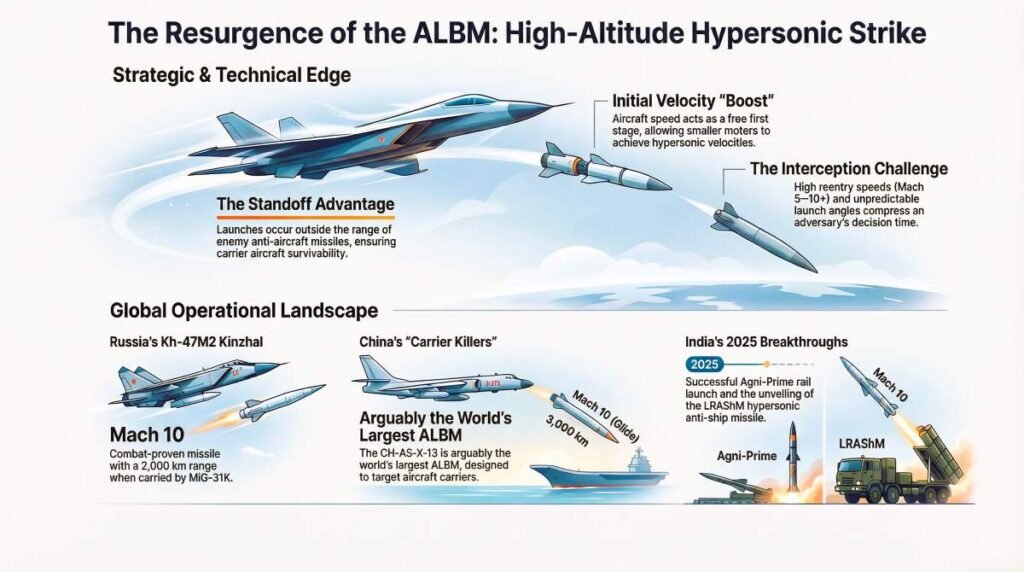
#2. Kh-47M2 Kinzhal – Russia’s Combat-Proven Hypersonic ALBM
The Kh-47M2 Kinzhal (‘Dagger’) stands as Russia’s most significant operational air-launched ballistic missile and has achieved global prominence as one of the few hypersonic weapons deployed in actual combat. First revealed by President Vladimir Putin in March 2018 and extensively employed during the Ukraine conflict beginning in 2022, Kinzhal demonstrates that modern ALBMs are practical, combat-effective weapons rather than experimental concepts.
Complete Technical Specifications:
- Designation: Kh-47M2 Kinzhal (Russian designation)
- NATO designation: No official NATO reporting name yet assigned
- Developer: MKB Raduga Design Bureau / Russian Aerospace Forces
- Development period: Approximately 2012-2017
- First revealed: March 1, 2018 (Putin state address)
- Introduction to service: December 2017 (reported operational deployment)
- Status: Operational; extensively combat-employed in Ukraine (2022-present)
- Type: Air-launched hypersonic aero-ballistic missile
- Basis: 9M723 Iskander-M short-range ballistic missile (air-launched adaptation)
- Length: Approximately 8.0 metres
- Diameter: Approximately 1.0 metre
- Launch weight: Approximately 4,000 kg (8,818 lbs)
- Warhead options: Conventional: 480-500 kg high-explosive/penetrator; Nuclear: unconfirmed but widely assessed as capable
- Propulsion: Single-stage solid-propellant rocket motor
- Range: 2,000 km (official Russian claim with optimal launch parameters); Western assessments suggest 1,500-2,000 km
- Maximum speed: Mach 10+ (12,350 km/h / 7,673 mph) claimed by Russia; Western assessments vary from Mach 4-8 depending on flight phase
- Flight ceiling: 20,000+ metres during ballistic phase
- Launch platforms: MiG-31K Foxhound interceptor (primary carrier); Tu-22M3M Backfire bomber (reported but unconfirmed)
- Guidance: Inertial navigation system with GLONASS satellite updates; potential optical or active radar terminal guidance
- CEP: Estimated 5-10 metres for fixed targets with precision guidance
- Maneuverability: Capable of in-flight trajectory adjustments and terminal maneuvering to evade defenses
Development – Iskander Adaptation:
Western intelligence agencies assess Kinzhal as an air-launched variant of Russia’s 9M723 Iskander-M short-range ballistic missile, which entered service in 2006 as a ground-launched system. The Iskander design provided a mature, combat-proven platform with solid propellant propulsion, precision guidance, and maneuvering capability. Adapting it for air launch involved modifications to the missile structure to survive high-speed separation from the aircraft, integration with MiG-31K avionics and weapon systems, and trajectory optimization to exploit the aircraft’s altitude and velocity at release.
This adaptation approach dramatically reduced development time and risk compared to designing an entirely new system from scratch. Russia leveraged over a decade of Iskander operational experience, fielded technology, and established production to create Kinzhal relatively quickly-consistent with reports of development starting around 2012-2015 and operational deployment by 2017.
MiG-31K Launch Platform:
Russia’s selection of the MiG-31 Foxhound interceptor as Kinzhal’s primary carrier is strategically significant. The MiG-31 offers several critical advantages: maximum speed exceeding Mach 2.8 at altitude imparts substantial initial velocity to the missile upon release, extending range significantly; service ceiling above 20,000 metres enables launch from high altitude, further extending range and complicating enemy early warning; exceptional range (3,000+ km ferry range) allows deep penetration toward launch positions; and the centerline weapon station was already designed for heavy stores including long-range air-to-air missiles.
Russian Aerospace Forces operate a dedicated squadron of approximately 10-15 MiG-31K aircraft modified specifically for Kinzhal operations, based primarily at Akhtubinsk Air Base in southern Russia. These aircraft provide strategic strike capability against high-value targets throughout Europe, the Middle East, and potentially as far as the North Atlantic.
Combat Employment in Ukraine – Operational Validation:
Since March 2022, Russia has employed Kinzhal extensively in the Ukraine conflict, claiming dozens of strikes against high-value targets. Russian Ministry of Defense statements cite Kinzhal strikes against underground ammunition storage facilities in western Ukraine, command bunkers, air defense sites, and infrastructure targets. Ukraine initially claimed inability to intercept Kinzhal, describing it as effectively invulnerable to existing air defenses.
However, in May 2023, Ukraine announced the first confirmed intercept of a Kinzhal missile using U.S.-supplied MIM-104 Patriot PAC-3 air defense systems. Ukrainian forces detected the incoming missile, tracked it, and successfully engaged it with Patriot interceptors-a claim Russia disputed but which Western intelligence confirmed. Multiple subsequent interceptions have occurred, demonstrating that Kinzhal, while challenging to intercept, is not invulnerable as originally claimed.
Performance Assessment – Separating Claims from Reality:
Russian official claims state Kinzhal achieves Mach 10 throughout its flight and cannot be intercepted by any existing air defense system. Western analysis suggests more nuanced reality: the missile likely achieves highest velocities (potentially approaching Mach 10) during the unpowered ballistic phase at high altitude where air resistance is minimal. During terminal descent through denser atmosphere, aerodynamic drag reduces velocity-Western estimates suggest terminal speeds of Mach 4-8 depending on trajectory and target location.
Successful Patriot intercepts validate that modern air defense systems with hit-to-kill interceptors can engage Kinzhal, though interception remains challenging requiring early detection, precise tracking, and optimal intercept geometry. The missile’s maneuvering capability complicates defense but does not render it immune.
Strategic Role:
Kinzhal provides Russia with long-range precision strike capability against high-value targets throughout Europe. Its combination of speed, range, and air-launch flexibility makes it valuable for missions against NATO air defense sites, command facilities, critical infrastructure, and potentially carrier strike groups. The weapon’s combat employment in Ukraine provides Russia with operational data and validation unavailable to most nations developing similar systems.
Why It Ranks #2: Kinzhal is the only air-launched hypersonic ballistic missile with extensive combat employment, providing real-world validation of ALBM effectiveness. Its proven operational capability and strategic significance place it among the world’s most important weapon systems.
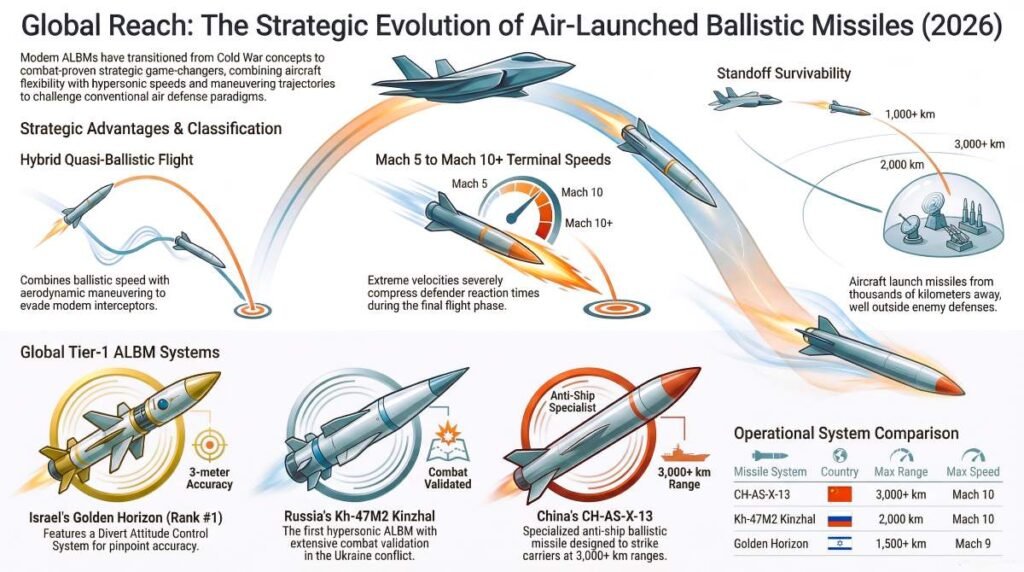
#3. CH-AS-X-13 – China’s Anti-Ship Ballistic Missile Threat
The CH-AS-X-13 (Chinese designation uncertain; Western reporting designation) represents one of the most strategically significant weapons developments in the Pacific theater-an air-launched anti-ship ballistic missile specifically designed to target U.S. carrier strike groups from extreme range. Carried by China’s H-6N strategic bomber, this system combines the striking power of ballistic missiles with the flexibility of airborne platforms, creating a capability that fundamentally challenges U.S. naval dominance in the Western Pacific.
Complete Technical Specifications:
- Designation: CH-AS-X-13 (Western reporting designation); official Chinese designation unknown
- Alternative designations: YJ-21 (reported but uncertain); DF-21D air-launched variant (assessed basis)
- Developer: China Aerospace Science and Technology Corporation (CASC), People’s Republic of China
- Development status: Assessed as operational or near-operational; first publicly displayed carried by H-6N bomber in 2019 parade
- Type: Air-launched anti-ship ballistic missile (ASBM)
- Estimated length: 10-12 metres (scaled estimates based on photographic analysis)
- Estimated diameter: 1.0-1.2 metres
- Estimated launch weight: 8,000-10,000 kg
- Warhead: Conventional maneuvering reentry vehicle; estimated 300-600 kg high-explosive warhead
- Warhead guidance: Multi-mode terminal guidance: active radar seeker, infrared seeker, optical seeker for ship targeting
- Propulsion: Two-stage solid-propellant rocket motor
- Estimated range: 3,000+ km from release point (potentially exceeding 3,500 km with optimal launch parameters)
- Maximum speed: Mach 10+ during terminal phase
- Launch platform: H-6N bomber (modified variant with centerline fuselage station and aerial refueling capability)
- Guidance: Inertial navigation with Beidou (Chinese GPS) satellite updates during midcourse; active multi-mode guidance during terminal phase
- Target type: Aircraft carriers, large surface combatants, high-value naval vessels
Strategic Context – The Carrier Threat:
U.S. carrier strike groups have provided American power projection capability in the Western Pacific since World War II, enabling the United States to intervene in regional crises and defend allies. China’s military modernization has focused intensively on developing capabilities to hold these carriers at risk, creating what military analysts call Anti-Access/Area Denial (A2/AD) strategy. The ground-launched DF-21D and DF-26 anti-ship ballistic missiles represent the most publicized elements of this strategy.
However, ground-launched ASBMs are geographically limited-they can only cover areas within range of their fixed or road-mobile launchers on mainland China. An air-launched ASBM carried by H-6N bombers dramatically expands coverage area. H-6N bombers can patrol thousands of kilometers from Chinese bases, positioning to attack carrier strike groups anywhere in the Western Pacific, South China Sea, Indian Ocean, or even approaching the Central Pacific. This forces U.S. carriers to defend against threats from any direction at extreme ranges-a defensive challenge orders of magnitude more complex than defending against ground-launched missiles from known locations.
H-6N Bomber – Purpose-Built Carrier:
The H-6N variant-China’s latest iteration of the venerable H-6 bomber derived from the 1950s Soviet Tu-16 Badger-incorporates specific modifications indicating development for air-launched ballistic missile operations. Most significantly, the aircraft features a large semi-recessed centerline fuselage station apparently designed to carry a large missile partially recessed into the fuselage, reducing aerodynamic drag. The H-6N also adds an aerial refueling probe enabling extended-range missions, upgraded engines for greater range and payload capacity, and strengthened structure suggesting heavy external stores capability.
Photographs from Chinese military parades show H-6N bombers carrying what appears to be a large ballistic missile-shaped weapon under the fuselage centerline-the missile Western analysts designate CH-AS-X-13. The weapon’s size, configuration, and carriage method all suggest an air-launched ballistic missile rather than a conventional cruise missile.
Technical Challenges and Capabilities:
Targeting moving ships with ballistic missiles presents extraordinary technical challenges. Unlike fixed ground targets with known coordinates, ships move continuously at 30+ knots (55+ km/h), meaning that during the 10-15 minutes between missile launch and impact, a carrier can move 10+ kilometers from its launch-time position. Successfully engaging requires real-time or near-real-time targeting data transmitted to the missile during flight, sophisticated onboard guidance systems that can locate and identify the target during terminal approach, and maneuvering capability to adjust trajectory to intercept the moving target.
The CH-AS-X-13 is assessed to incorporate multi-mode terminal guidance combining active radar (detecting large metal ships against ocean background), infrared sensors (detecting heat from ship propulsion and systems), and potentially optical sensors (visual ship identification). The maneuvering reentry vehicle can make trajectory corrections during final descent, enabling interception of moving targets. Whether these systems function reliably in combat remains unproven, but the technical approach is sound.
Defensive Countermeasures:
U.S. carrier strike groups employ layered defenses against ballistic missile threats. Aegis cruisers and destroyers equipped with Standard Missile-3 (SM-3) and Standard Missile-6 (SM-6) interceptors can engage ballistic missiles during midcourse and terminal phases. Electronic warfare systems can jam or spoof missile seekers. Carriers can maneuver evasively during the missile’s flight time. However, the combination of extreme speed (Mach 10+ terminal velocity), maneuvering capability, and saturation attacks (multiple missiles launched simultaneously from multiple bombers) creates defensive challenges that may overwhelm even advanced Aegis systems.
Why It Ranks #3: If operational, the CH-AS-X-13 represents the world’s first air-launched anti-ship ballistic missile-a capability that fundamentally changes naval warfare in the Pacific. Its strategic significance and potential to neutralize U.S. carrier superiority make it one of the most important weapons developments of the 21st century.
#4. Air LORA – Israel’s Quasi-Ballistic Precision Strike System
Air LORA represents the air-launched variant of Israel Aerospace Industries’ (IAI) LORA (Long Range Attack) quasi-ballistic missile, providing the Israeli Air Force with long-range precision strike capability against heavily defended targets. As a quasi-ballistic system, LORA follows a ballistic trajectory during portions of its flight while retaining guidance and maneuverability throughout-combining ballistic missile speed with precision cruise missile accuracy.
Complete Technical Specifications:
- Designation: Air LORA (air-launched variant); LORA (baseline ground/sea-launched system)
- Developer: Israel Aerospace Industries (IAI), Israel
- First revealed: 2017 (air-launched variant demonstrated)
- Operational status: Active with Israeli Air Force; offered for export
- Type: Air-launched quasi-ballistic precision strike missile
- Length: 4.35 metres (14 ft 3 in)
- Diameter: 0.56 metres (1 ft 10 in)
- Launch weight: 1,200 kg (2,646 lbs)
- Warhead: Conventional penetrator warhead; 400 kg (882 lbs) high-explosive
- Propulsion: Solid-propellant rocket motor
- Range: 400 km (249 miles) from air-launched configuration – extended from ground-launched version’s 300 km
- Maximum speed: Supersonic throughout flight (exact Mach number classified)
- Launch platforms: F-15I Ra’am; F-16I Sufa; potentially F-35I Adir
- Guidance: Inertial navigation system (INS) with GPS updates; terminal electro-optical guidance for precision targeting
- CEP: Less than 10 metres – extremely high accuracy
- Flight profile: Quasi-ballistic trajectory with mid-course and terminal guidance corrections
Quasi-Ballistic Flight Profile Explained:
Unlike pure ballistic missiles that become unguided projectiles after motor burnout, Air LORA maintains guidance and control throughout its flight. After release from the aircraft, the solid rocket motor ignites and the missile climbs to high altitude following a ballistic-like trajectory. However, throughout this ascent and the subsequent descent, the missile’s guidance system continuously updates its trajectory based on GPS and inertial navigation data, making corrections to compensate for winds, atmospheric variations, and targeting refinements.
During terminal approach, the electro-optical seeker activates, providing visual identification of the target and enabling final precision corrections. This combination of quasi-ballistic trajectory (providing speed and altitude advantages) with continuous guidance (providing accuracy) creates a weapon far more capable than either pure ballistic missiles or conventional cruise missiles.
Penetration Capability Against Hardened Targets:
Air LORA’s 400 kg penetrator warhead is specifically designed to destroy hardened underground facilities, reinforced concrete bunkers, and other protected structures. The warhead’s combination of kinetic energy from the missile’s high-speed impact and explosive charge enables penetration of multiple meters of reinforced concrete before detonation. This capability is essential for Israel’s strategic targeting requirements against Iranian nuclear facilities, Hezbollah command bunkers in Lebanon, and Hamas underground infrastructure in Gaza.
Operational Flexibility:
Air LORA provides operational flexibility through its compatibility with multiple launch platforms. Israeli F-15I and F-16I aircraft can carry Air LORA on underwing hardpoints, enabling two missiles per aircraft. The integration with F-35I Adir stealth fighters (reported but unconfirmed) would provide truly penetrating strike capability-F-35s could approach defended airspace with reduced detection risk, launch Air LORA from standoff range, and egress before defenses react.
Export Potential:
IAI has actively marketed Air LORA to international customers seeking long-range precision strike capability without the cost and political complications of ballistic missile programs. The system’s relatively modest weight (1,200 kg) makes it compatible with most modern fighter aircraft, and its quasi-ballistic design avoids some arms control treaty restrictions applicable to pure ballistic missiles.
Why It Makes the List: Air LORA combines practical range (400 km), pinpoint accuracy (sub-10 metre CEP), and hardened target penetration capability in a system compatible with standard fighter aircraft. Its operational status with Israeli forces and proven technology make it one of the world’s most capable tactical ALBM systems.
#5. ROCKS – Israel’s Long-Range Standoff Precision Weapon
ROCKS (also known as Rampage Extended Range or RAMPAGE-ER in some sources, though designations vary) represents Israel’s long-range air-to-surface standoff missile using a quasi-ballistic trajectory for high-velocity terminal engagement. Designed specifically for precision strikes against high-value, hardened, or time-sensitive targets, ROCKS extends Israel’s strike reach throughout the Middle East while maintaining the precision necessary for surgical strikes in complex operational environments.
Complete Technical Specifications:
- Designation: ROCKS (official Israeli designation); potentially related to RAMPAGE family
- Developer: Israel Military Industries (IMI) Systems, now part of Elbit Systems, Israel
- Operational status: Active with Israeli Air Force; limited public information due to classification
- Type: Long-range air-to-surface standoff missile with ballistic terminal phase
- Estimated length: 4.5-5.0 metres
- Estimated diameter: 0.45-0.55 metres
- Launch weight: Estimated 600-900 kg
- Warhead: Precision penetrator warhead; estimated 150-200 kg high-explosive
- Propulsion: Solid-propellant rocket motor
- Range: Estimated 250+ km (long-range variant potentially exceeding 300 km)
- Speed: High subsonic to low supersonic for cruise phase; high-velocity ballistic terminal phase
- Launch platforms: F-15I Ra’am; F-16I Sufa; F-35I Adir reported
- Guidance: Inertial navigation with GPS; electro-optical or imaging infrared terminal guidance
- CEP: Estimated 3-5 metres
- Key feature: Ballistic terminal dive for increased kinetic energy and penetration capability
Design Philosophy – Standoff Precision:
ROCKS embodies Israel’s approach to standoff warfare: engage high-value targets from maximum safe distance while maintaining precision sufficient to minimize collateral damage. The missile’s extended range allows Israeli aircraft to launch from outside the engagement envelope of most surface-to-air missile systems, significantly improving aircraft survivability. Simultaneously, the precision guidance enables strikes on specific buildings or bunker entrances even in dense urban environments-critical when targeting adversaries like Hezbollah that position command centers and weapons caches within civilian areas.
Ballistic Terminal Phase – Penetration Enhancement:
ROCKS’ distinctive ballistic terminal phase provides several advantages. After cruising toward the target area, the missile transitions to a steep ballistic dive for the final approach. This near-vertical attack profile increases kinetic energy at impact-the combination of the missile’s velocity and the vertical descent multiplies penetration capability compared to horizontal approaches. The steep angle also complicates air defense engagement as many surface-to-air missiles are optimized for engaging targets at shallow angles rather than steep diving trajectories.
Operational Context:
While Israeli military policy maintains ambiguity about specific weapons systems and their employment, ROCKS is assessed by defense analysts to have been used in strikes against Hezbollah weapons facilities in Lebanon, Iranian military positions in Syria, and potentially in operations against Iranian nuclear-related sites. The weapon’s combination of range, precision, and penetration capability makes it ideal for Israel’s strategic targeting requirements against adversaries possessing sophisticated air defenses.
Why It Makes the List: ROCKS provides Israel with standoff precision strike capability combining extended range, high accuracy, and enhanced penetration through its ballistic terminal phase. Its operational deployment and integration with multiple fighter platforms validate its effectiveness as a practical ALBM system.
#6. RAMPAGE – Israel’s Supersonic Precision Strike Missile
RAMPAGE (also designated IMI Precision Strike Missile) represents a family of Israeli air-launched supersonic missiles designed for long-range precision strikes against high-value, time-sensitive targets. While related to ROCKS, RAMPAGE emphasizes speed and survivability through supersonic flight throughout its trajectory, providing rapid engagement capability against fleeting targets or targets requiring immediate neutralization.
Complete Technical Specifications:
- Designation: RAMPAGE / IMI Precision Strike Missile
- Developer: Israel Military Industries (IMI) Systems, now Elbit Systems, Israel
- Operational status: Active; reported combat employment in multiple operations
- Type: Long-range supersonic air-to-surface precision strike missile
- Length: Approximately 4.7 metres
- Diameter: Approximately 0.5 metres
- Launch weight: Estimated 570 kg
- Warhead: Penetrating high-explosive warhead; approximately 150 kg
- Propulsion: Solid-propellant rocket motor with sustainer
- Range: 250+ km (potentially exceeding 300 km from high-altitude launch)
- Speed: Supersonic throughout flight – estimated Mach 2-3+
- Launch platforms: F-15I Ra’am; F-16I Sufa; F-35I Adir (reported)
- Guidance: Inertial navigation with GPS; imaging infrared (IIR) seeker for terminal homing
- CEP: Estimated 1-3 metres with IIR terminal guidance
- Target types: Air defense radars, command centers, hardened facilities, mobile targets
Supersonic Advantage:
RAMPAGE’s supersonic speed throughout flight provides several tactical advantages. The high velocity reduces time-of-flight to the target, critical when engaging mobile targets like transporter-erector-launchers (TELs) carrying ballistic missiles or mobile command vehicles that may relocate after detection. The speed also compresses defender reaction time-from target detection to impact, defenses have only minutes to respond, track, and engage the incoming missile. Many air defense systems optimized for engaging subsonic cruise missiles struggle to engage supersonic targets at extended range.
Terminal Imaging Infrared Guidance:
RAMPAGE’s imaging infrared seeker provides all-weather, day-night precision targeting capability. Unlike GPS-guided weapons that strike pre-programmed coordinates, the IIR seeker generates a visual thermal image of the target area during terminal approach, enabling the missile’s guidance computer to identify and lock onto the specific target structure. This capability is essential when engaging targets surrounded by similar structures (a specific building in a compound), when targets have moved slightly from expected locations (mobile systems that relocated after mission planning), or when environmental conditions obscure visual or radar signatures.
Export and International Interest:
IMI/Elbit has marketed RAMPAGE internationally as a cost-effective alternative to more expensive cruise missiles while providing superior capability to most air-to-ground rockets and short-range missiles. The system’s compatibility with standard fighter weapon stations and relatively modest per-unit cost make it attractive to nations seeking to expand precision strike capability without enormous investment. India, Azerbaijan, and several other nations have expressed interest or reportedly acquired RAMPAGE systems.
Why It Makes the List: RAMPAGE’s combination of supersonic speed, extended range, and precision guidance creates a highly effective weapon for time-sensitive strikes. Its operational success and growing international adoption validate its position among top ALBM systems.
#7. Kh-15 (AS-16 ‘Kickback’) – Soviet Cold War ALBM (Historical Operational)
The Kh-15 represents the Soviet Union’s most successful air-launched ballistic missile program, achieving operational deployment and service from 1988 through the early 2000s. As a short-range ballistic missile designed for tactical nuclear strikes or conventional attacks against high-value targets, the Kh-15 validated the ALBM concept during the Cold War era and influenced subsequent Russian developments including Kinzhal.
Complete Technical Specifications:
- Designation: Kh-15 (Russian designation); AS-16 ‘Kickback’ (NATO reporting name)
- Alternative designation: Kh-15A (nuclear variant); Kh-15P (anti-radar variant)
- Developer: MKB Raduga Design Bureau, Soviet Union / Russia
- Development period: 1975-1980
- First flight: 1980
- Introduction to service: 1988
- Retirement: Early 2000s – phased out and replaced by more modern systems
- Type: Short-range air-launched ballistic / aero-ballistic missile
- Length: 4.78 metres (15 ft 8 in)
- Diameter: 0.455 metres (1 ft 6 in)
- Launch weight: 1,200 kg (2,646 lbs)
- Warhead options: Nuclear: 150-350 kiloton yield; Conventional: 300 kg high-explosive
- Propulsion: Single-stage solid-propellant rocket motor
- Range: 150-300 km depending on flight profile
- Maximum speed: Mach 5+ during terminal phase
- Flight ceiling: 40,000 metres (131,000 feet) in ballistic mode
- Launch platforms: Tu-22M Backfire bomber; Tu-160 Blackjack bomber; Tu-95MS Bear bomber
- Guidance: Inertial navigation with radar altimeter for terrain following
- CEP: 50-150 metres with nuclear warhead; improved precision with conventional
Cold War Mission – Suppression of Enemy Air Defenses:
The Kh-15 was designed to support Soviet strategic bomber penetration missions during potential nuclear conflict with NATO. Its primary mission: destroy NATO air defense radars, command centers, and airfields in advance of Soviet bomber strikes, clearing a path for follow-on waves carrying nuclear cruise missiles and bombs. The Kh-15’s ballistic trajectory and high speed made it difficult for 1980s-era air defense systems to intercept, providing high-probability target destruction.
Tu-22M Backfire bombers could carry up to four Kh-15 missiles on underwing pylons, providing substantial firepower for suppression missions. Tu-160 Blackjack strategic bombers could carry 12 Kh-15 missiles in rotating internal launchers, enabling saturation attacks overwhelming air defense capacity.
Operational Service:
The Kh-15 entered Soviet Long Range Aviation service in 1988, operating throughout the final years of the Cold War and the early post-Soviet period. Unlike many ambitious Soviet weapons programs that suffered reliability problems or remained limited to experimental status, the Kh-15 demonstrated reliable performance and achieved genuine operational capability. The system’s successful service validated that practical ALBMs were achievable when requirements were realistic and technology available rather than pushing beyond state-of-the-art.
The Kh-15 was gradually phased out in the early 2000s as Russia’s strategic aviation forces contracted following Soviet collapse and as newer systems entered development. However, the experience and technology from the Kh-15 program directly influenced development of the Kh-47M2 Kinzhal two decades later.
Why It Makes the List: The Kh-15 holds historical significance as the Soviet Union’s only operational ALBM that achieved widespread deployment. Its successful service demonstrated that ALBMs were practical weapons when properly designed and validated the concept for future Russian developments.
#8. Oreshnik – Russia’s New Intermediate-Range Ballistic Missile
Oreshnik (‘Hazel’) emerged dramatically in November 2024 when Russia employed the system in a strike against a Ukrainian military target, revealing a new intermediate-range ballistic missile with exceptional speed and multiple warhead capability. While primarily deployed as a ground-launched system, Russian sources have indicated air-launch variants are under consideration, and the technology represents the cutting edge of modern ballistic missile development with clear applicability to ALBM configurations.
Complete Technical Specifications (Ground-Launched):
- Designation: Oreshnik (Russian name; official designation unknown)
- Developer: Russian Federation defense industry (specific bureau unclear)
- First revealed: November 21, 2024 (combat employment in Ukraine)
- Status: Operational (ground-launched); air-launched variant assessed as under development
- Type: Intermediate-range ballistic missile (IRBM) with multiple independently targetable warheads
- Estimated length: 12-15 metres (ground version)
- Launch weight: Estimated 10,000-15,000 kg (ground version)
- Warhead: Multiple reentry vehicles (MIRVs); number estimated at 6-8 submunitions per missile
- Propulsion: Multi-stage solid-propellant rocket motor
- Range: 5,500 km (estimated from official Russian statements)
- Maximum speed: Mach 10 during terminal phase (Russian official claims)
- Guidance: Inertial navigation with satellite updates; independent guidance for each submunition
Combat Employment – November 2024 Strike:
On November 21, 2024, Russia employed Oreshnik in a strike against a Ukrainian industrial facility in Dnipro, marking the first confirmed use of an intermediate-range ballistic missile in the Ukraine conflict. Video footage captured by civilians showed multiple high-velocity reentry vehicles descending simultaneously in a distinctive cluster pattern-consistent with MIRV technology where multiple submunitions separate from the missile bus and independently target different aimpoints within a target area.
The strike demonstrated several advanced capabilities: extremely high terminal velocity (Mach 10) creating visual effects of glowing reentry vehicles; multiple simultaneous impacts overwhelming local air defenses; and precision sufficient to strike a specific industrial facility. President Putin confirmed the Oreshnik designation in subsequent public statements and warned that the system could reach targets anywhere in Europe.
Air-Launch Potential:
While Oreshnik has been deployed exclusively as a ground-launched IRBM, Russian defense industry sources have indicated interest in developing air-launched variants. The primary technical challenge is the missile’s size and weight-at an estimated 10,000-15,000 kg, it exceeds the payload capacity of most Russian bomber aircraft. However, a scaled-down air-launched variant leveraging Oreshnik’s advanced MIRV technology, hypersonic reentry vehicles, and guidance systems could create an extraordinarily capable ALBM.
Such a system would provide Russia with flexibility comparable to Kinzhal but with multiple warheads enabling saturation attacks against single high-value targets or strikes against multiple targets from a single launch. Development of air-launched Oreshnik variants would represent a significant strategic advancement in Russian ALBM capability.
Strategic Implications:
Oreshnik’s deployment signals Russia’s willingness to employ intermediate-range ballistic missiles in conventional conflicts-a significant escalation from previous Russian practice. The system’s 5,500 km range places all of Europe within reach from Russian territory. An air-launched variant would extend this threat throughout the Atlantic and potentially portions of North America when launched from aircraft operating near Russian borders.
Why It Makes the List: Oreshnik represents the latest technology in Russian ballistic missile development with clear potential for air-launched variants. Its MIRV capability and Mach 10 terminal velocity demonstrate advances applicable to future ALBM systems.
#9. Indian Hypersonic and Quasi-Ballistic Missile Programs
India is developing multiple hypersonic and quasi-ballistic missile systems with potential air-launch applications as part of its broader strategic weapons modernization. While primarily focused on ground-launched systems, India’s advances in hypersonic technology and precision ballistic missiles create foundations for air-launched variants that could significantly enhance Indian strike capability against Pakistan and China.
Key Systems Under Development:
Shaurya Missile:
- Type: Hypersonic surface-to-surface tactical ballistic missile with canister launch
- Developer: Defence Research and Development Organisation (DRDO), India
- Status: Operational with Indian Army (ground-launched)
- Length: 10 metres
- Diameter: 0.74 metres
- Launch weight: 6,200 kg
- Range: 700-1,900 km (depending on variant)
- Speed: Mach 7.5 (approximately 9,200 km/h)
- Warhead: Conventional or nuclear; 1,000 kg
- Guidance: Inertial navigation with terminal guidance
- Air-launch potential: Size and weight require adaptation; smaller air-launched derivative possible
Hypersonic Technology Demonstrator Vehicle (HSTDV):
- Type: Hypersonic technology demonstrator for scramjet propulsion
- Developer: DRDO with assistance from Russian NPO Mashinostroyenia
- Status: Developmental – successful tests conducted in 2019, 2020
- Objective: Validate hypersonic cruise missile technology; scramjet propulsion for Mach 6+ sustained flight
- Speed: Mach 6+ demonstrated in tests
- Range: Developmental platform; operational system would achieve 1,000+ km
- Significance: Technology demonstrator for future hypersonic cruise missiles and potentially hypersonic ALBMs
BrahMos-II / BrahMos-NG Hypersonic Variant:
- Type: Next-generation hypersonic cruise missile under Indo-Russian development
- Developer: BrahMos Aerospace (joint Indo-Russian venture)
- Status: Early development; potential air-launched variant planned
- Projected speed: Mach 7-8
- Range: 600-800 km projected
- Launch platforms: Su-30MKI, potential Rafale and future AMCA indigenous fighter integration
Strategic Context – Two-Front Challenge:
India faces unique strategic challenges confronting two nuclear-armed adversaries-Pakistan to the west and China to the north-while maintaining limited strategic depth (distance between borders and major cities/military installations). This geography creates urgent requirements for long-range precision strike capability enabling Indian forces to hold at-risk high-value targets in both Pakistan and China without requiring aircraft penetration of hostile airspace.
Air-launched ballistic and hypersonic missiles provide exactly this capability. Su-30MKI fighters carrying such weapons could patrol near India’s borders, launch against targets hundreds of kilometers inside Pakistan or China, and return to base-all while remaining within the protection of Indian air defenses. This standoff capability is especially critical along the mountainous Sino-Indian border where terrain limits conventional strike options.
Golden Horizon Offer – Technology Transfer Potential:
Israel’s reported offer of Golden Horizon ALBM technology to India (February 2026) could significantly accelerate Indian hypersonic ALBM development. Israeli expertise in terminal guidance, maneuvering reentry vehicles, and integrating advanced missiles with combat aircraft would complement India’s solid rocket motor and guidance system expertise. A joint development or licensed production arrangement could produce an Indian ALBM within 5-7 years rather than the 10-15 years typical for indigenous development.
Why India’s Programs Make the List: India’s multi-pronged approach to hypersonic and quasi-ballistic missile development, combined with potential Israeli technology transfer, positions India to become a major ALBM power by the early 2030s. The strategic imperative created by two-front challenges ensures sustained investment in these capabilities.
#10. GAM-87 Skybolt – The ALBM That Shaped Cold War Strategy (Historical)
The Douglas GAM-87 Skybolt holds unique historical significance as the most ambitious Western ALBM program ever attempted and the weapon whose cancellation fundamentally altered NATO nuclear strategy. Though never operationally deployed, Skybolt’s development and subsequent termination in 1962 drove Britain to develop submarine-based nuclear deterrence and demonstrated the formidable technical and political challenges of ALBM programs.
Complete Technical Specifications:
- Designation: GAM-87 Skybolt / AGM-48A
- Developer: Douglas Aircraft Company, United States
- Development period: 1958-1962
- Status: Cancelled December 1962 before operational deployment
- Type: Two-stage solid-propellant air-launched ballistic missile
- Length: 11.66 metres (38 ft 3 in)
- Diameter: 0.89 metres (2 ft 11 in)
- Launch weight: 5,000 kg (11,000 lbs)
- Warhead: W59 thermonuclear warhead, 1.2 megaton yield
- Propulsion: Two-stage solid rocket: Aerojet General first stage, Thiokol second stage
- Range: 1,850 km (1,150 miles) from release
- Flight ceiling: Over 100,000 feet ballistic arc
- Launch platforms: Boeing B-52 Stratofortress (primary); Avro Vulcan (intended for RAF)
- Guidance: Inertial navigation – 1960s technology limited accuracy
- CEP: 1,850 metres – relatively poor by modern standards but acceptable for megaton-yield nuclear warhead
Strategic Rationale – Bomber Survivability:
Skybolt emerged from U.S. Air Force concerns that advancing Soviet air defenses would render manned bombers unable to penetrate Soviet airspace to deliver nuclear weapons. Surface-to-air missiles like the SA-2 Guideline could engage bombers at high altitude, forcing them to fly dangerously low where they faced anti-aircraft artillery and interceptor fighters. B-52s flying on continuous airborne alert patterns risked destruction if Soviet air defenses continued improving.
Skybolt promised to solve this vulnerability: B-52s orbiting safely over the Atlantic, Pacific, or Arctic could launch nuclear ballistic missiles from 1,850 km outside Soviet borders, striking Moscow, ICBM silos, and other strategic targets without penetrating Soviet airspace. Each B-52 would carry four Skybolts on underwing pylons, providing substantial nuclear firepower while remaining beyond Soviet defensive reach.
Technical Failures – Five Tests, Four Failures:
Skybolt encountered severe development problems. The missile’s two-stage configuration required precise ignition sequencing-the first stage had to burn out completely and separate cleanly before the second stage ignited, all while the missile maintained correct trajectory. Separation at high altitude and high speed created unpredictable aerodynamic forces. The inertial guidance system struggled with vibration and extreme G-forces during powered flight.
Of five flight tests conducted between April 1962 and December 1962, four failed completely: missiles tumbled after release, rocket motors failed to ignite, and guidance systems malfunctioned. Only one test approached partial success. These failures occurred despite massive investment ($500 million-equivalent to $5+ billion today) and involvement of America’s top aerospace firms.
Cancellation and the Nassau Agreement:
In December 1962, Secretary of Defense Robert McNamara recommended Skybolt cancellation, citing technical failures, cost overruns, and changing strategic priorities. The United States was shifting emphasis toward submarine-launched Polaris missiles aboard nuclear submarines, which offered better survivability than bombers without Skybolt’s technical risks.
Cancellation created a political crisis with Britain. The Royal Air Force had planned to equip Avro Vulcan bombers with Skybolt, maintaining Britain’s independent nuclear deterrent after British ground-launched missiles proved too vulnerable. Cancellation left Britain without viable strategic weapons. The Nassau Agreement (December 1962) resolved the crisis: the U.S. would provide Polaris submarine-launched missiles to Britain. This agreement led directly to Britain’s Continuous At-Sea Deterrent (CASD)-nuclear submarines continuously patrolling with Polaris (later Trident) missiles-maintained to this day.
Legacy – Why Skybolt Matters Despite Failure:
Skybolt’s cancellation validated the strategic shift toward submarine-based deterrence, which proved far more survivable and reliable than bomber-based systems. The program demonstrated that 1960s technology could not reliably overcome ALBM technical challenges. No subsequent U.S. ALBM program reached deployment until recent hypersonic efforts decades later.
Politically, Skybolt’s cancellation and the resulting Nassau Agreement shaped NATO nuclear strategy for over 60 years. Britain’s submarine deterrent, France’s decision to develop independent nuclear forces after witnessing U.S. unreliability, and broader NATO reliance on U.S. extended deterrence all trace partially to Skybolt’s failure.
Why It Makes the List: Skybolt’s historical significance exceeds its technical achievement. The program’s cancellation fundamentally shaped Western nuclear strategy and validated SLBMs’ superiority over ALBMs-lessons that remain relevant six decades later.
Performance Comparison – Complete Specifications Table
Ranked by Range (Longest to Shortest):
- 1st: CH-AS-X-13 (China) – 3,000+ km
- 2nd: Kh-47M2 Kinzhal (Russia) – 2,000 km
- 3rd: GAM-87 Skybolt (USA-Historical) – 1,850 km
- 4th: Golden Horizon (Israel) – 800-1,500 km
- 5th: Air LORA (Israel) – 400 km
- 6th: Kh-15 (Russia-Historical) – 150-300 km
Ranked by Maximum Speed:
- 1st (tie): Kinzhal, CH-AS-X-13, Oreshnik – Mach 10 claimed
- 2nd: Golden Horizon – Mach 5-9 hypersonic
- 3rd: Kh-15 – Mach 5+
- 4th: Indian systems – Mach 6-7.5 developmental
- 5th: RAMPAGE – Mach 2-3 supersonic
Ranked by Operational Status (Most to Least Mature):
- Operational: Kinzhal, Golden Horizon, Air LORA, ROCKS, RAMPAGE, CH-AS-X-13
- Historical/Retired: Kh-15, GAM-87 Skybolt
- Recently Deployed: Oreshnik (ground; air variant potential)
- Developmental: Indian hypersonic systems
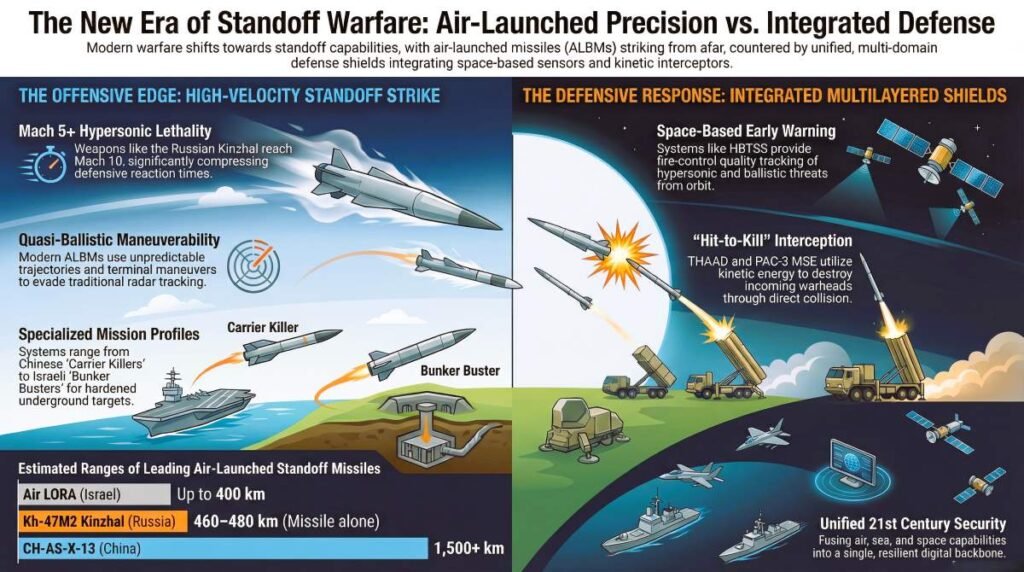
Strategic Implications: How ALBMs Are Changing Modern Warfare
Air Defense Challenges:
Modern ALBMs create defensive dilemmas for even the most advanced air defense systems. The combination of extreme speed (Mach 5-10), high-altitude ballistic approach, terminal maneuvering, and saturation attack potential overwhelms traditional air defense architecture designed primarily for slower cruise missiles and aircraft. While systems like Patriot PAC-3, THAAD, and S-400 can engage ballistic missiles under optimal conditions, the compressed timelines, limited intercept opportunities, and attacking nation’s ability to employ decoys and saturation tactics create scenarios where successful defense is uncertain.
Proliferation Concerns:
As ALBM technology matures and becomes more accessible, proliferation to additional nations appears inevitable. Israel’s willingness to export Golden Horizon to India establishes precedent for technology transfer. China’s development of air-launched ASBMs may lead to exports to nations seeking anti-access capabilities against superior naval forces. Russia’s employment of Kinzhal validates ALBM combat effectiveness, encouraging other nations to pursue similar capabilities. The next decade will likely see ALBM arsenals expand from the current handful of nations to potentially a dozen or more-particularly in regions with active arms races like South Asia, the Middle East, and East Asia.
Impact on Power Projection:
ALBMs fundamentally challenge military power projection-particularly U.S. carrier strike group operations that have provided the backbone of American global military presence since World War II. China’s CH-AS-X-13 anti-ship ballistic missile launched from H-6N bombers creates defensive challenges that may push carrier operations farther from hostile shores, reducing their effectiveness. Russian Kinzhal threatens NATO airfields and support infrastructure throughout Europe. Israeli ALBMs enable strikes throughout the Middle East without requiring aircraft penetration of hostile airspace. These capabilities collectively reduce the operational freedom of expeditionary forces and complicate intervention planning.
Future Developments: The Next Generation of ALBMs
U.S. Hypersonic Programs:
The United States is pursuing multiple air-launched hypersonic weapons including the Hypersonic Attack Cruise Missile (HACM) for fighters and bomber-launched systems under classified programs. While the AGM-183A ARRW was recently cancelled after test failures, development continues on alternative systems. U.S. entry into operational ALBM deployment would significantly alter the strategic balance, particularly given American airpower’s global reach.
China’s Expanding Arsenal:
China is assessed to be developing multiple additional air-launched ballistic and hypersonic systems beyond CH-AS-X-13. Potential systems include an air-launched variant of the DF-17 hypersonic glide vehicle, improved anti-ship ballistic missiles with enhanced terminal guidance, and weapons specifically optimized for strikes against U.S. bases in Japan, South Korea, and Guam.
Technology Trends:
- Artificial intelligence integration: Enhanced autonomous targeting and evasive maneuvering
- Hypersonic glide vehicles: Combining ballistic boost with extended-range gliding
- Multi-mode seekers: Radar, infrared, and optical sensors enabling engagement of diverse target types
- Improved propulsion: Advanced solid propellants and scramjet technology extending range
- Miniaturization: Smaller, lighter systems compatible with more aircraft types
The Mach 10 Mirage: 5 Surprising Ways Defense Tech is Rewriting the Rules of War
In the theater of modern conflict, the speed of sound is no longer the ultimate benchmark; the speed of relevance is. We are witnessing a fundamental transformation in global security dynamics where the traditional, hardened static architecture of the 20th century-the silo and the “defense island”-is being replaced by a distributed, cloud-native shield. This shift is not merely about incremental engineering; it is about a wholesale rewrite of the geometry of power projection. Here are five ways the next generation of defense technology is fundamentally altering the rules of engagement.
1. The “Air-Launch” Renaissance: Why Artillery is Taking to the Skies
For decades, the ballistic missile was a weapon of the terrestrial hegemon, defined by massive concrete silos or heavy, multi-axle Transporter Erector Launchers (TELs). Today, we are seeing a strategic “air-launch” renaissance that provides smaller nations with a “strategic-lite” power projection capability. Systems like the Israeli Air LORA and the Indian Rudram series are leading this charge, effectively turning multi-role fighters into high-speed, mobile artillery batteries.By mounting these systems on aircraft like the Su-30MKI or F-16, militaries gain a massive “stand-off” advantage. Launching from high altitudes allows these munitions to strike from hundreds of kilometers away-effectively remaining invisible to traditional short-range air defenses while bypassing the infrastructure requirements of ground-based systems.According to Israel Aerospace Industries (IAI), Air LORA is a “deep standoff air-to-ground missile” engineered to strike high-value, well-defended targets and respond to “pop-up” threats with “unparalleled efficiency and precision.”The technological disparity within this class is notable: while the Rudram-1 offers a range of 100–250km and the Rudram-2 reaches 300–350km, the Air LORA provides a stand-off reach of up to 400km. This allows a nation to shape the battlefield from a distance that renders enemy littoral and ground defenses nearly irrelevant.
2. The Hypersonic Hype vs. Reality: Debunking the Mach-Speed Label
“Hypersonic” has become the premier buzzword of the 2020s, yet it is often used to obfuscate a lack of novel propulsion. Technically, the achievement of Mach 5 is a historical milestone, not a modern one. The German V-2 achieved Mach 5 in the 1940s and became the first human-made object to reach outer space on June 20, 1944. Nearly all ballistic missiles are “hypersonic” during their flight phases; the term is often a marketing strategy to distract from existing technological lineages.The real innovation isn’t the velocity-it is the departure from a predictable parabolic arc. While a missile like the Russian Kh-47M2 Kinzhal can reach Mach 10, it is essentially an air-launched version of the ground-based Iskander. The strategic differentiator lies in the transition between flight phases:
- Standard Ballistic Trajectory: Follows a predictable, gravity-governed parabolic path through the Boost, Mid-course, and Terminal phases.
- Quasi-Ballistic Trajectory: Utilizes atmospheric drag and control surfaces to perform erratic, lateral maneuvers during the Terminal phase, complicating radar tracking and interceptor calculations.Systems like the Hwasong-11Ma and the Kinzhal use these “quasi-ballistic” maneuvers to outsmart current theater defenses. However, as the 2023 interceptions of the Kinzhal by Patriot batteries in Ukraine demonstrated, the “invincible” label is often more aspirational than operational.
3. From Silos to the “Golden Dome”: The Death of the Defense Island
The 20th-century model of defense was built on “siloed” systems-isolated batteries of interceptors protecting specific assets. That model is being dismantled by Lockheed Martin’s vision of “21st Century Security” and the “Golden Dome for America” concept. This is a shift toward a unified shield, designed to handle “saturation attacks” where an adversary arrives with a diverse mix of drones, cruise missiles, and ballistic threats simultaneously.This new architecture relies on a “digital backbone” that fuses once-disparate nodes into a single, resilient ecosystem. In this network, the “Defense Island” dies, and a cross-domain shield is born, utilizing sea-based Aegis vessels, PAC-3 MSE batteries, and THAAD units as interchangeable sensors and shooters.As Lockheed Martin notes, this represents a “unified, rapid-production ecosystem” where combat-proven systems are no longer isolated but are integrated into a seamless, cross-domain network that can detect, track, and neutralize threats wherever they arise.This connectivity alters the “cost-exchange ratio” for the U.S. and its allies, allowing for a more efficient allocation of expensive interceptors against high-value threats while utilizing lower-tier systems for mass-produced drones.
4. The GPS-Denied Arena: Fighting When the Satellites Go Dark
Electronic warfare is the new vanguard. In a peer-level conflict, the first casualty will be the Global Positioning System (GPS). High-tech missiles are therefore being designed to maintain surgical precision even when the satellites go dark. Systems like the Israeli ROCKS and Air LORA utilize a triple-layered navigation architecture to ensure a “soft kill” against electronic jamming.Inertial Navigation (INS) Internal sensors calculate the missile’s position based on its launch point and movement, acting as a completely autonomous, unjammable baseline.Satellite Backup (GPS) Utilized as a secondary layer when the environment is “clean,” but these systems are increasingly designed to be “insensitive” to GPS spoofing.Terminal Scene-Matching and Anti-Radiation In the final seconds of flight, the ROCKS missile uses an electro-optical seeker to compare real-time terrain with pre-loaded topographic imagery-a process that enables a Circular Error Probable (CEP) of just 3 meters. Furthermore, “Anti-Radiation” homing allows the missile to “hunt” the enemy’s own jamming signals, turning an adversary’s electronic defense into a homing beacon for their own destruction. While the ROCKS achieves 3m precision, the Air LORA maintains a CEP of less than 10 meters, ensuring that both remain lethal in the most contested electronic environments.
5. The Space-Based “Decision Engine”: Artemis as a Military Milestone
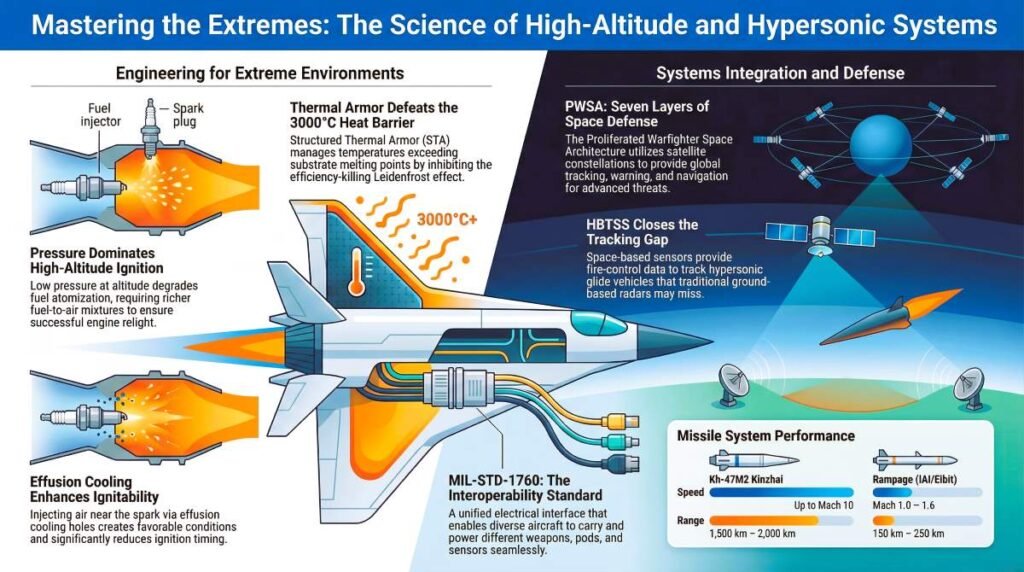
The most profound shift in global security is happening in orbit, where the line between civilian exploration and national security is effectively disappearing. The industrial muscle required for Artemis II and the Orion spacecraft provides the manufacturing scale needed to deploy the Proliferated Warfighter Space Architecture (PWSA) .Space is no longer a vacuum of surveillance; it is the “fire control” center of the terrestrial battlespace. The Tranche 2 satellites provide the “relentless coverage” and real-time data flow that act as a global “decision engine.” These LEO constellations are designed for resilience-hundreds of smaller, cheaper satellites are far harder to decapitate than a handful of massive, expensive legacy platforms.This shift addresses the “cost-effectiveness” crisis: using a multi-million dollar SM-3 or THAAD interceptor against a low-cost offensive threat is an economic losing game. By utilizing space-based infrared systems (SBIRS) and digital twin technology, commanders can achieve the “speed of certainty”-identifying, tracking, and assigning the most cost-effective interceptor to a threat before it even clears the boost phase.
The Speed of Certainty
The future of defense is found in the “quiet courage” of digital transformation. The victory of tomorrow will not be won by the nation with the fastest missile, but by the one with the most integrated sensor-to-shooter loop. As we fuse the industrial lessons of deep-space exploration with the precision of anti-radiation seekers, the very nature of deterrence changes.Final Ponder: In an era defined by autonomous decision engines and digital twins, does the ultimate tactical advantage lie in the “hard kill” of a Mach 10 interceptor, or the “soft kill” of a superior electronic warfare algorithm that renders the interceptor unnecessary?
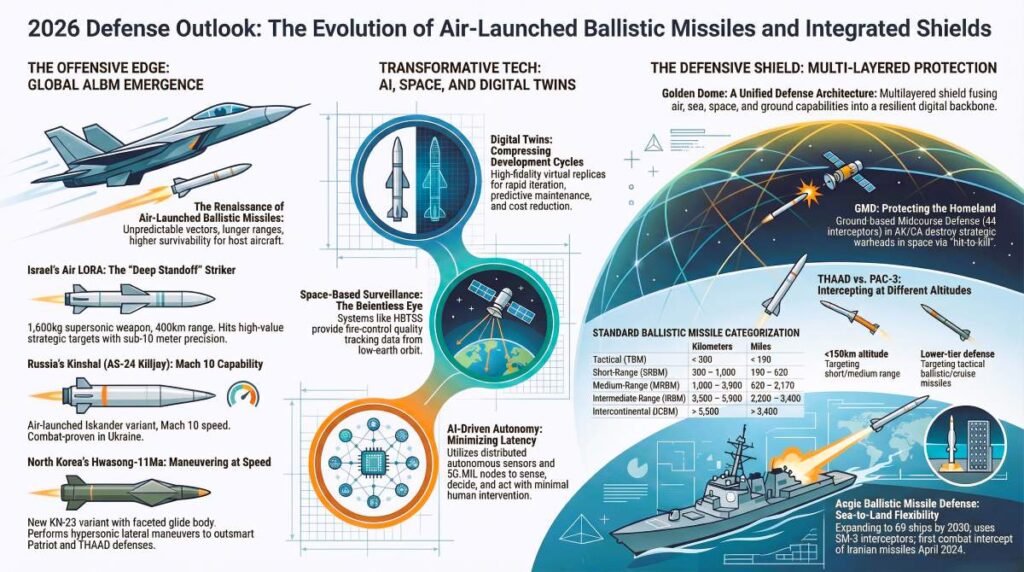
Conclusion: ALBMs in Modern Strategic Competition
Air-launched ballistic missiles have evolved from rare, technically challenging weapons attempted unsuccessfully in the 1960s to proven, combat-effective systems reshaping modern warfare. The past five years particularly have seen dramatic developments: Israel’s deployment of multiple sophisticated ALBM systems including the classified Golden Horizon now offered to India; Russia’s extensive combat employment of Kinzhal validating ALBM effectiveness; China’s development of air-launched anti-ship ballistic missiles threatening U.S. carrier superiority; and renewed American interest in air-launched hypersonic weapons after decades of neglect.
These developments reflect broader strategic trends. Great power competition between the United States, China, and Russia drives investment in capabilities challenging adversary strengths-ALBMs provide precisely such capability. Regional powers like Israel face increasingly sophisticated air defenses requiring standoff weapons combining range, speed, and precision-ALBMs fulfill these requirements. Nations across South Asia, the Middle East, and East Asia seek asymmetric capabilities offsetting adversaries’ conventional superiority-ALBMs offer such asymmetry.
The ALBM arsenal documented in this guide represents only the beginning. Over the next decade, additional nations will field similar systems. Technology will advance-today’s Mach 5-10 weapons will evolve into even faster, more maneuverable systems with enhanced guidance and greater penetration capability. Proliferation will spread ALBM technology to nations currently lacking such capabilities, complicating regional security across multiple theaters.
Defensively, this proliferation will drive investment in advanced air defense systems, early warning networks, electronic warfare capabilities, and potentially directed energy weapons offering engagement solutions against hypersonic threats. The offensive-defensive competition that has characterized missile development since World War II will continue-but at hypersonic speeds with compressed decision timelines measured in seconds rather than minutes.
Air-launched ballistic missiles have transitioned from experimental concepts to essential components of modern military power. They represent the intersection of aerospace technology, precision guidance, hypersonic flight, and strategic competition-a combination defining 21st-century warfare. The ten systems profiled in this guide showcase this evolution from the cancelled Skybolt program of 1962 to Israel’s classified Golden Horizon and Russia’s combat-proven Kinzhal of 2026. They collectively demonstrate that ALBMs are not merely weapons but strategic game-changers reshaping how nations project power, how conflicts may be fought, and how strategic balance is maintained in an increasingly contested world.
About This Article
This comprehensive analysis of air-launched ballistic missiles incorporates the latest intelligence assessments, defense industry reporting, and open-source information as of February 2026. Primary sources include Jane’s Strategic Weapon Systems, Jane’s Air-Launched Weapons, IHS Jane’s Defence Weekly, Aviation Week & Space Technology, official Israeli Ministry of Defense statements, Russian Ministry of Defense announcements, Chinese military publications, U.S. Department of Defense assessments, verified intelligence reporting from authoritative media including Bloomberg, Reuters, The New York Times, and The Washington Post, academic research from the Middlebury Institute of International Studies at Monterey, Center for Strategic and International Studies (CSIS), RAND Corporation, International Institute for Strategic Studies (IISS), and verified open-source intelligence (OSINT) analysis. Many ALBM systems remain highly classified; specifications represent best available assessments from multiple corroborating sources. Combat employment data for Kinzhal is drawn from verified military reports from the Ukraine conflict. Information on Golden Horizon is compiled from leaked U.S. intelligence documents and subsequent media reporting. The broader definition of ‘ALBM’ used in this article reflects current defense industry and military usage encompassing true ballistic missiles, quasi-ballistic systems, and air-launched hypersonic weapons-consistent with how defense professionals currently classify these weapons.