
Today in this article we will discuss about the Top 10 Fastest Electric Car in the World 2026 with PPT (.pptx), PDF and Infographics, Where Innovation Meets Performance – The Fastest EVs Redefining Speed so The electric revolution has shattered every preconception about battery-powered vehicles. Electric cars are no longer merely efficient, environmentally conscious alternatives to combustion engines-they have become the absolute fastest, most powerful production vehicles on Earth. With instant torque delivery from electric motors, sophisticated torque vectoring systems managing power independently at each wheel, and battery technology enabling sustained high performance, electric hypercars and performance sedans now dominate acceleration records and increasingly challenge top speed benchmarks once reserved for exotic Italian and German supercars.
Table of Contents
This comprehensive guide examines the ten fastest electric cars currently in production or entering production. These are not concept vehicles or vaporware promises-they are real, purchasable (if extraordinarily expensive and limited) machines that represent the absolute cutting edge of automotive engineering. From Chinese startups rewriting the performance rulebook to established European luxury brands transitioning their heritage into the electric era, these cars prove that electrification amplifies performance rather than compromising it.
For each vehicle, we examine complete technical specifications, performance figures, design philosophy, engineering innovations, pricing, production numbers, and what makes each car significant in the broader context of automotive history.
Note: Performance specifications are drawn from manufacturer official data, independent verified testing by automotive media including Motor Trend, Car and Driver, Road & Track, and Top Gear, and official track timing data where available. Top speed claims that remain manufacturer-stated without independent verification are clearly noted. Pricing reflects base MSRP where announced; actual transaction prices for limited-production hypercars often exceed stated figures due to options, dealer markups, and exclusivity premiums.
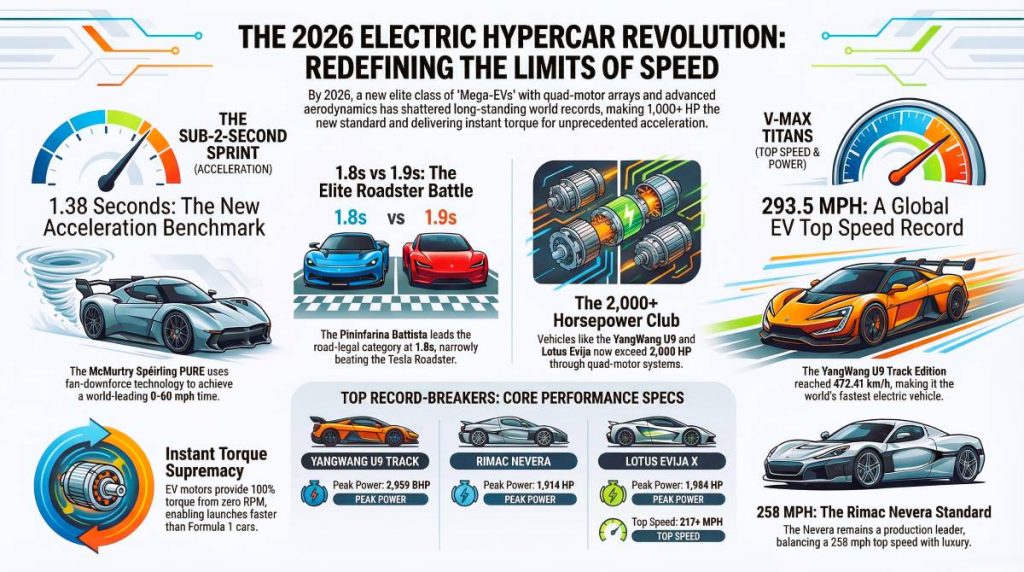
The Electric Advantage: Why EVs Dominate Acceleration
Before examining each vehicle, understanding the fundamental physics that give electric vehicles their performance advantage provides essential context.
Instant Torque Delivery:
Internal combustion engines generate peak torque across a narrow RPM band-typically between 3,000 and 6,000 RPM depending on engine design. This means combustion cars experience a lag between throttle input and maximum thrust as the engine accelerates through its rev range. Electric motors deliver maximum torque instantly from 0 RPM. The moment a driver presses the accelerator, 100% of the motor’s torque is immediately available. This physical characteristic translates directly into explosive acceleration that combustion engines fundamentally cannot match.
Power at Every Wheel:
Many of the cars on this list use four separate electric motors-one mounted directly at each wheel. This configuration enables torque vectoring: the precise, independent control of power delivery to each wheel thousands of times per second. When cornering, the system can reduce power to the inside wheels and increase it to the outside wheels, actively rotating the car through the corner with far greater precision than any mechanical differential. During straight-line acceleration, torque vectoring prevents wheel slip by instantaneously modulating power to each wheel based on available traction.
Low Center of Gravity:
Battery packs in electric vehicles are typically mounted low in the chassis, positioned beneath the passenger cabin between the axles. This placement dramatically lowers the vehicle’s center of gravity compared to combustion cars where the heavy engine sits high in the chassis. The physics result is reduced body roll during cornering, improved stability at high speed, and better weight distribution for balanced handling.
Packaging Efficiency:
Electric powertrains are extraordinarily compact compared to combustion systems. An electric motor, reduction gear, and inverter occupy far less space than an engine, transmission, exhaust system, cooling radiators, and fuel tank. This efficiency enables designers to dedicate more volume to aerodynamics, passenger space, and structural rigidity-all contributing to performance.
With these fundamental advantages established, the cars on this list exploit electric power to achieve performance that rewrites automotive records, Let’s find out the top 10 fastest electric cars and start with PPT.
Top 10 Fastest Electric Car in the World 2026 | .PPTX
#10. Tesla Model S Plaid – The Quickest Production Sedan Ever – 200 mph
The Tesla Model S Plaid obliterates the traditional boundaries between family sedan and supercar. It seats five adults comfortably, offers substantial cargo space, requires no special maintenance beyond tire rotations and brake inspections, charges overnight at home, and costs significantly less than any European exotic. Yet it accelerates faster than a McLaren 720S, a Ferrari F8 Tributo, or a Lamborghini Huracán-cars costing two to three times as much.
Performance Specifications:
- Power output: 1,020 horsepower (combined from three motors)
- Motor configuration: Tri-motor all-wheel drive – 1 front motor, 2 rear motors
- Torque: Over 1,050 lb-ft (estimated; Tesla does not publish torque figures)
- 0-60 mph: 1.99 seconds – verified by multiple independent tests including Motor Trend, Car and Driver
- Quarter-mile: 9.23 seconds at 155 mph (Motor Trend verified)
- Top speed: 200 mph (322 km/h) with optional Track Mode software
- Battery capacity: Approximately 100 kWh (estimated; Tesla does not officially disclose)
- Range (EPA): 396 miles (637 km) – longest range of any vehicle on this list
- Charge time: 15 minutes to add 200 miles using Tesla Supercharger V3 (250 kW)
- Drive configuration: All-wheel drive with torque vectoring
Technical Specifications:
- Body style: 4-door fastback sedan
- Seating: 5 adults + 2 rear-facing child seats (optional)
- Curb weight: 2,162 kg (4,766 lbs)
- Weight distribution: 48/52 front/rear
- Drag coefficient: 0.208 Cd – extraordinarily low for any car
- Wheels: 19-inch or 21-inch options
- Brakes: Brembo calipers with ventilated carbon-ceramic discs (optional)
- Suspension: Adaptive air suspension with track-optimized damping
- Infotainment: 17-inch horizontal touchscreen, gaming computer-grade processor
- Autonomous capability: Hardware 3.0 with Full Self-Driving Capability (requires subscription)
What Makes It Special:
The Model S Plaid’s most remarkable characteristic is not that it accelerates this quickly-it is that it does so while remaining completely practical as a daily driver. The interior accommodates five adults with limousine-like rear legroom. The cargo area holds enough luggage for a family vacation. The car charges overnight using a home wall connector, eliminating fuel station visits entirely. Meanwhile, it humiliates supercars at traffic lights with acceleration that pins occupants into their seats with nearly 1.4 g of longitudinal force.
Tesla achieved the sub-2-second 0-60 mph time through extreme engineering. The tri-motor powertrain uses one front-mounted motor and two independent rear motors-effectively giving the car a ‘virtual’ limited-slip differential controlled by software rather than mechanical clutches. The battery pack uses next-generation 4680 cylindrical cells that support sustained high-current discharge required for repeated maximum acceleration runs. Thermal management systems circulate coolant through battery modules, motors, and inverters to prevent overheating during track use.
Why It’s #10: At 200 mph top speed, the Plaid is the slowest car on this list. But its 1.99-second 0-60 mph time makes it quicker to 60 than all but three cars here. Combined with 396-mile range and Tesla Supercharger network access, it offers usability no hypercar can match. Price: approximately $108,490 USD.
#9. Maserati GranTurismo Folgore – Italian Soul, Electric Power – 202 mph
The Maserati GranTurismo Folgore represents the Italian luxury performance brand’s first fully electric vehicle-and rather than merely adapting electric power, Maserati engineered the Folgore to retain the emotional character that defines every car wearing the Trident badge. Where many electric vehicles are silent and sterile, the Folgore incorporates a signature sound system developed specifically to provide aural feedback that feels alive and engaging, echoing the mechanical symphony of Maserati’s V8 heritage without pretending to be something it is not.
Performance Specifications:
- Power output: 761 horsepower (560 kW)
- Torque: 995 lb-ft (1,350 Nm) – instant from 0 RPM
- Motor configuration: Tri-motor all-wheel drive – 1 front, 2 rear
- 0-60 mph (0-100 km/h): 2.7 seconds
- Quarter-mile: Estimated 10.6 seconds
- Top speed: 202 mph (325 km/h)
- Battery capacity: 92.5 kWh (net usable)
- Range (WLTP): 280 miles (450 km)
- Charge speed: 270 kW peak DC fast charging – 10-80% in approximately 18 minutes
- Drive configuration: Intelligent AWD with torque vectoring
Technical Specifications:
- Body style: 2-door grand tourer coupe
- Seating: 4 seats (2+2 configuration)
- Platform: Stellantis STLA Large electric platform
- Curb weight: 2,260 kg (4,982 lbs)
- Wheelbase: 2,930 mm (115.4 inches)
- Length: 4,966 mm (195.5 inches)
- Drag coefficient: 0.26 Cd
- Suspension: Adaptive damping with comfort and sport modes
- Brakes: Carbon-ceramic discs front and rear with 6-piston Brembo calipers
- Steering: Electric power-assisted with variable ratio
- Sound system: Signature electric vehicle sound designed by Maserati sound engineers
- Interior: Premium leather, Alcantara, and carbon fiber trim throughout
Design Philosophy – Keeping the Soul Intact:
Maserati faced a fundamental challenge with the Folgore: how to create an electric vehicle that still feels unmistakably like a Maserati. The brand’s identity is built on visceral, emotional driving experiences defined by exhaust notes, mechanical feedback, and Italian design flair. Rather than ignoring these attributes, Maserati engineered them into the electric platform.
The signature sound system is not a speaker playing a recorded engine note-it is a synthesized audio experience that responds dynamically to throttle position, vehicle speed, and drive mode selection. In Sport mode, the sound is aggressive and purposeful. In GT mode, it becomes refined and subdued. The result provides the psychological feedback that makes performance driving engaging without fabricating an artificial combustion soundtrack.
The exterior design maintains Maserati’s elegant proportions: a long hood, rearward cabin placement, and muscular haunches that communicate performance intent. LED headlights incorporate the brand’s signature three-vent design. The grille remains, though it is largely closed for aerodynamic efficiency, retaining visual continuity with the brand’s combustion vehicles.
Target Market:
The GranTurismo Folgore targets buyers who want electric vehicle benefits-silent operation, instant torque, zero local emissions-without sacrificing the luxury grand touring character that defines the Maserati ownership experience. It competes directly against the Porsche Taycan Turbo S, BMW i4 M50, and Audi e-tron GT, differentiated by Maserati’s uniquely Italian approach to luxury and performance.
Why It Makes the List: The Folgore’s 202 mph top speed and 2.7-second 0-60 time place it firmly in supercar territory, while its 2+2 seating, 280-mile range, and grand touring refinement make it usable for long-distance travel. Price: approximately $200,000 USD (estimated).
#8. Lucid Air Sapphire – American Luxury Meets Hypercar Performance – 205 mph
The Lucid Air Sapphire began as the most luxurious and longest-range electric sedan ever built-and then Lucid Motors added 1,234 horsepower. The result is a vehicle that challenges the fundamental concept of what a sedan can be: it offers limousine-like rear-seat comfort, executive-suite interior materials, near-silent operation at highway speeds, and acceleration that defeats nearly every supercar ever built.
Performance Specifications:
- Power output: 1,234 horsepower (920 kW)
- Torque: Over 1,430 lb-ft (estimated)
- Motor configuration: Tri-motor all-wheel drive – 1 front, 2 rear independent motors
- 0-60 mph: 1.89 seconds – verified by Car and Driver
- Quarter-mile: 8.95 seconds at 158 mph – verified by Car and Driver, among fastest production sedans ever
- Top speed: 205 mph (330 km/h)
- Battery capacity: 118 kWh (largest production EV battery)
- Range (EPA): 427 miles (687 km) – longest range of any vehicle on this list
- Charge speed: Up to 300 kW DC fast charging – 200 miles added in approximately 12 minutes
Technical Specifications:
- Body style: 4-door luxury sedan
- Seating: 5 adults in spacious cabin
- Curb weight: 2,360 kg (5,203 lbs)
- Wheelbase: 2,960 mm (116.5 inches) – exceptionally long for interior space
- Drag coefficient: 0.197 Cd – the lowest of any production car (tied with Mercedes EQS)
- Wheels: 21-inch standard; carbon-ceramic brake package
- Suspension: Adaptive air suspension with adjustable ride height
- Brakes: Carbon-ceramic discs with 10-piston front / 4-piston rear Brembo calipers
- Interior space: Glass canopy roof; executive rear seating with massage and climate control
- Infotainment: 34-inch curved 5K Glass Cockpit display spanning entire dashboard
- Driver assistance: DreamDrive Pro advanced driver assistance with lidar sensors
Engineering Excellence:
Lucid Motors was founded by former Tesla engineers including CEO Peter Rawlinson, who served as Chief Engineer for the Tesla Model S. The Air represents Lucid’s vision of what the Model S could have been with unlimited development time and resources. Every component was engineered from first principles with efficiency and performance as co-equal priorities.
The tri-motor powertrain’s architecture is unique. Unlike Tesla’s tri-motor system that uses one front motor and two rear motors of similar size, Lucid developed a smaller, more efficient front motor optimized for highway cruising, paired with two powerful rear motors designed for maximum acceleration. During normal driving, only the front motor operates, maximizing efficiency. Under full throttle, all three motors activate, delivering 1,234 hp to all four wheels simultaneously.
The battery pack uses Lucid’s proprietary cell chemistry and packaging architecture. By increasing energy density and optimizing thermal management, lucid air fastest car achieved 118 kWh capacity in a package that fits beneath the cabin floor while maintaining sufficient ground clearance for normal driving. This combination of high capacity and low aerodynamic drag enables the Sapphire’s extraordinary 427-mile range despite 1,234 hp performance.
The Sapphire Package:
The Air Sapphire is not a separate model but a performance package applied to the Air Grand Touring platform. In addition to the tri-motor powertrain, the Sapphire package includes carbon-ceramic brakes, track-tuned suspension, 21-inch forged wheels, unique exterior badging, and interior trim upgrades. Lucid limits production to maintain exclusivity.
Why It Makes the List: The Sapphire’s 1.89-second 0-60 mph time makes it one of the five quickest production vehicles ever built. Its 427-mile range and limousine-like comfort make it the only car on this list genuinely usable for cross-country travel in luxury. Price: $249,000 USD.
#7. NIO EP9 – China’s Track-Dominating Electric Hypercar – 217 mph
The NIO EP9 exploded onto the automotive scene in 2016 as China’s first legitimate hypercar-and it backed up its bold claims by setting production electric vehicle lap records at the Nürburgring Nordschleife, Circuit Paul Ricard, and Circuit of the Americas. Limited to just 16 units built exclusively for NIO investors and brand ambassadors, the EP9 represents Chinese automaker NIO’s engineering showcase demonstrating that electric power can dominate on racing circuits.
Performance Specifications:
- Power output: 1,341 horsepower (1,000 kW) – combined from four motors
- Torque: 1,092 lb-ft (1,480 Nm)
- Motor configuration: Quad-motor all-wheel drive – one motor at each wheel
- 0-60 mph (0-100 km/h): 2.7 seconds
- 0-124 mph (0-200 km/h): 7.1 seconds
- Quarter-mile: Estimated 10.1 seconds
- Top speed: 217 mph (349 km/h)
- Battery capacity: 70 kWh – unique hot-swap system allows battery change in 8 minutes
- Range: 265 miles (427 km) under normal driving
- Track range: Approximately 25 minutes of full-power track use before battery replacement required
Technical Specifications:
- Body style: 2-seat hypercar coupe
- Construction: Carbon fiber monocoque chassis with carbon fiber body panels
- Curb weight: 1,735 kg (3,825 lbs) – extremely light for an electric hypercar
- Power-to-weight ratio: 773 hp per tonne
- Wheelbase: 2,940 mm (115.7 inches)
- Length: 4,888 mm (192.4 inches)
- Width: 2,230 mm (87.8 inches)
- Drag coefficient: 0.27 Cd
- Downforce: 2,645 kg (5,831 lbs) at 240 km/h (149 mph) – more than 1.5 times the car’s weight
- Active aerodynamics: DRS (Drag Reduction System) inspired by Formula 1
- Suspension: Independent double wishbone with pushrod-actuated inboard springs/dampers
- Brakes: Carbon-ceramic discs with 6-piston calipers
- Tyres: Michelin Pilot Sport Cup 2 – track-focused compound
Record-Breaking Performance:
The EP9’s track credentials are extraordinary. In October 2017, it set the production electric vehicle lap record at the Nürburgring Nordschleife with a time of 6:45.90 – faster than many exotic combustion supercars including the Lamborghini Aventador and Ferrari 488. The same year, it set fastest lap records for electric vehicles at Circuit Paul Ricard (1:52.78) and Circuit of the Americas (2:11.30).
These records were achieved through sophisticated engineering. The quad-motor torque vectoring system independently controls power to each wheel thousands of times per second, optimizing traction and cornering balance continuously. During corner entry, the system can brake individual wheels while accelerating others, actively rotating the car through the apex with precision impossible for mechanical systems. The massive aerodynamic downforce – greater than the car’s weight at high speed – allows sustained cornering forces exceeding 3 g.
Battery Swap System:
The EP9 incorporates a unique quick-change battery system. Each of the car’s batteries can be removed and replaced in approximately 8 minutes, addressing the track endurance limitation that affects all electric vehicles. During track events, teams can swap depleted batteries for fresh units, enabling sustained high-performance operation that would otherwise require hour-long charging breaks.
Production and Pricing:
NIO limited EP9 production to 16 units. The first six were gifted to NIO investors and early supporters. The remaining ten were offered for sale at approximately $1.5 million USD each. All units have been delivered, making the EP9 one of the rarest electric hypercars in existence.
Why It Makes the List: The EP9 proved electric vehicles could dominate on racing circuits, setting multiple track records that demonstrated EV performance credibility. Its quad-motor torque vectoring and extreme aerodynamics showcase advanced technology now filtering into mainstream EVs.
#6. Lotus Evija – British Engineering, 2,000 Horsepower – 217 mph
The Lotus Evija marks the boldest statement in the legendary British sports car manufacturer’s 70+ year history. Founded by Colin Chapman on the principle that ‘simplicity is the ultimate form of sophistication’ and ‘adding power makes you faster on the straights; subtracting weight makes you faster everywhere,’ Lotus has produced some of the most celebrated lightweight sports cars ever built. The Evija takes that philosophy into the electric hypercar era with breathtaking results.
Performance Specifications:
- Power output: 2,011 horsepower (1,500 kW) – one of the most powerful production cars ever made
- Torque: 1,257 lb-ft (1,704 Nm)
- Motor configuration: Quad-motor all-wheel drive – one motor per wheel
- 0-60 mph (0-100 km/h): Under 3.0 seconds
- 0-186 mph (0-300 km/h): Under 9.0 seconds (claimed)
- Top speed: Over 217 mph (350 km/h)
- Battery capacity: 70 kWh
- Range: 250 miles (402 km) – optimized for performance rather than maximum range
- Charge speed: 800-volt architecture supporting up to 350 kW charging – 0-80% in 18 minutes
Technical Specifications:
- Body style: 2-seat mid-engine hypercar
- Construction: Carbon fiber monocoque chassis and body – extreme lightness priority
- Target weight: 1,680 kg (3,704 lbs) with driver – extraordinary for 2,000 hp
- Power-to-weight ratio: 1,197 hp per tonne – higher than Bugatti Chiron
- Wheelbase: 2,575 mm (101.4 inches)
- Length: 4,459 mm (175.5 inches)
- Width: 2,000 mm (78.7 inches)
- Height: 1,122 mm (44.2 inches) – extremely low for aerodynamic efficiency
- Drag coefficient: Undisclosed but optimized through extensive CFD and wind tunnel work
- Downforce: Over 1,800 kg at top speed
- Active aerodynamics: Adaptive rear wing and underbody airflow management
- Suspension: Lotus-developed adaptive system with track and road modes
- Brakes: AP Racing carbon-ceramic discs with lightweight callipers
- Tyres: Pirelli P Zero Trofeo R – bespoke compound developed for Evija
Design Innovation:
The Evija’s most distinctive visual element is the ‘porosity’ design philosophy – large openings channeled through the bodywork that serve both aerodynamic and cooling functions. Unlike traditional sports cars that direct air around the body, the Evija channels air through the body, reducing drag while simultaneously cooling batteries, motors, and brakes. Tunnels pass through the rear quarters, allowing high-pressure air from the front to escape rearward without creating turbulent wake. This venturi effect also generates downforce without the drag penalty of large wings.
The central spine running along the car’s roof is not merely decorative – it acts as an air channel directing cooling air to the battery pack. Every visible design element serves multiple engineering functions, reflecting Colin Chapman’s efficiency-focused philosophy applied to electric hypercar engineering.
Williams Advanced Engineering Partnership:
Lotus partnered with Williams Advanced Engineering (the technology division of the Williams Formula 1 team) to develop the Evija’s battery pack, power electronics, and electric motors. Williams’ expertise in high-performance electric systems – developed through Formula E competition – enabled the Evija’s 800-volt architecture and 2-megawatt power output. The battery pack uses advanced cell chemistry optimized for sustained high-current discharge during track use.
Production and Pricing:
Lotus plans to build 130 Evija units. Each is priced at approximately £2 million (roughly $2.5 million USD). Initial deliveries began in 2024 after development delays related to battery supplier changes and engineering refinements. All 130 units were sold before the car’s public debut based on deposit commitments from Lotus collectors and hypercar enthusiasts worldwide.
Why It Makes the List: The Evija’s 2,011 hp makes it the most powerful production car currently on sale. Its sub-1,700 kg target weight and Lotus suspension tuning promise handling that combines brute acceleration with the precision Lotus is legendary for.
#5. Pininfarina Battista – Italian Artistry Meets 1,877 HP – 217 mph
Pininfarina, the legendary Italian design house that created some of the most beautiful cars in history – including the Ferrari 250 GT, the Alfa Romeo Spider, and countless other automotive masterpieces – launched its own automotive brand with the Battista. Named after company founder Battista ‘Pinin’ Farina, this electric hypercar represents 90 years of design excellence translated into the brand’s first independently produced vehicle.
Performance Specifications:
- Power output: 1,877 horsepower (1,400 kW)
- Torque: 1,696 lb-ft (2,300 Nm)
- Motor configuration: Quad-motor all-wheel drive – one motor per wheel
- 0-60 mph: 1.79 seconds – independently verified by Car and Driver
- 0-124 mph (0-200 km/h): Under 7.0 seconds
- Quarter-mile: 9.1 seconds at 152 mph (estimated)
- Top speed: 217 mph (350 km/h)
- Battery capacity: 120 kWh – shared platform with Rimac Nevera
- Range: 300 miles (483 km)
- Charge speed: Up to 500 kW DC fast charging theoretical; 350 kW widely available
Technical Specifications:
- Body style: 2-seat hypercar coupe
- Platform: Developed in partnership with Rimac Automobili
- Construction: Carbon fiber monocoque with carbon/aluminum hybrid subframes
- Curb weight: 2,150 kg (4,740 lbs)
- Power-to-weight ratio: 873 hp per tonne
- Wheelbase: 2,795 mm (110.0 inches)
- Length: 4,531 mm (178.4 inches)
- Width: 1,978 mm (77.9 inches)
- Drag coefficient: Approximately 0.30 Cd
- Active aerodynamics: Adaptive rear spoiler with multiple deployment modes
- Suspension: Adaptive damping with comfort, sport, and track modes
- Brakes: Brembo carbon-ceramic discs – 390mm front, 380mm rear
- Tyres: Pirelli P Zero Trofeo R – bespoke specification
- Interior: Bespoke luxury with extensive personalization options
Design Philosophy – Where Beauty Meets Performance:
Pininfarina’s design language prioritizes elegance and proportion over aggressive styling. Where many hypercars use sharp angles and dramatic air intakes to communicate performance, the Battista’s surfaces flow organically. The long, sweeping hood line, the cabin’s rearward placement, and the muscular rear haunches create proportions that echo classic mid-engine supercars like the Ferrari Daytona – cars Pininfarina designed decades earlier.
LED headlights are slim and integrated seamlessly into the front fascia. The side profile features a distinctive character line running from front wheel arch to rear, visually lengthening the car. Large side air intakes channel cooling air to the battery and rear motors, but their shape is sculpted rather than brutally functional. Even the rear diffuser – essential for aerodynamic stability – is elegantly integrated into the overall design.
The interior reflects Pininfarina’s luxury furniture and industrial design heritage. Controls are minimalist, surfaces are wrapped in premium Italian leather, and every touchpoint is machined from solid aluminum or carbon fiber. The steering wheel is elegantly simple, the instrument display is a configurable TFT screen, and the cabin materials are available in virtually unlimited customization options through Pininfarina’s bespoke program.
Rimac Partnership:
Automobili Pininfarina partnered with Croatian electric hypercar manufacturer Rimac Automobili for the Battista’s technical development. The two cars share the same fundamental platform, battery architecture, and powertrain components, though Pininfarina tuned the Battista for a more refined, grand touring character compared to the Nevera’s track-focused aggression. This partnership allowed Pininfarina to leverage Rimac’s exceptional electric powertrain engineering while focusing on design, luxury, and brand positioning.
Production and Pricing:
Pininfarina will build 150 Battista units globally. Each is priced at approximately $2.2 million USD. Deliveries began in 2023. Pininfarina offers extensive personalization options through its Tailor Made program, enabling customers to specify unique paint colors, interior materials, and bespoke exterior design elements. Several one-off variants have been created for specific collectors.
Why It Makes the List: The Battista’s 1.79-second 0-60 mph time makes it one of the fastest-accelerating production vehicles ever built. Combined with Pininfarina’s legendary design heritage and meticulous craftsmanship, it offers a unique blend of performance, artistry, and exclusivity.
#4. Rimac Nevera – Croatian Engineering Excellence – 256 mph
The Rimac Nevera emerged from Croatia – a country with no established automotive industry – as arguably the most technologically advanced electric vehicle ever produced. Founded by Mate Rimac, who began as a teenager building electric race cars in his garage, Rimac Automobili has become a globally recognized leader in electric hypercar engineering, battery technology, and high-performance powertrain systems. The Nevera represents the culmination of over a decade of development.
Performance Specifications:
- Power output: 1,914 horsepower (1,427 kW)
- Torque: 1,740 lb-ft (2,360 Nm)
- Motor configuration: Quad-motor all-wheel drive with individual torque vectoring at each wheel
- 0-60 mph: 1.74 seconds – verified by multiple independent tests
- 0-100 mph: 3.21 seconds
- 0-186 mph (0-300 km/h): 9.3 seconds
- Quarter-mile: 8.58 seconds at 167 mph – fastest production car quarter-mile time
- Top speed: 256 mph (412 km/h) – verified in independent GPS testing
- Battery capacity: 120 kWh
- Range: 342 miles (550 km) WLTP
- Charge speed: 500 kW peak DC fast charging capability
Technical Specifications:
- Body style: 2-seat hypercar coupe
- Construction: Carbon fiber monocoque manufactured by Rimac in-house
- Curb weight: 2,150 kg (4,740 lbs)
- Power-to-weight ratio: 890 hp per tonne
- Wheelbase: 2,795 mm (110.0 inches)
- Length: 4,746 mm (186.9 inches)
- Width: 1,978 mm (77.9 inches)
- Drag coefficient: 0.30 Cd
- Active aerodynamics: Active rear wing with multiple positions; active front diffuser
- Suspension: Adaptive dampers; separate comfort, sport, and track modes
- Brakes: Brembo carbon-ceramic discs with bespoke high-temperature calipers – 390mm front, 380mm rear
- Tyres: Michelin Pilot Sport 4S standard; Michelin Cup 2 optional
- Cooling: Liquid cooling for battery, motors, inverters – nine separate radiators
Advanced Technology Integration:
The Nevera incorporates technological systems that exceed most production vehicles. The quad-motor torque vectoring system operates at millisecond response times, independently controlling power and braking at each wheel. This enables the Nevera to dynamically adjust its torque split not just front-to-rear but left-to-right and diagonal corner-to-corner, providing stability and cornering precision impossible with mechanical drivetrains.
The battery management system monitors 2,000+ individual sensors throughout the 120 kWh pack, tracking temperature, voltage, and current at the cell level. This data feeds into thermal management algorithms that optimize cooling system operation, ensuring maximum performance even during sustained track use. Rimac claims the Nevera can complete over 20 consecutive maximum acceleration runs without performance degradation – a capability unmatched by any electric vehicle.
The All-Wheel Torque Vectoring 2 (R-AWTV2) system integrates with adaptive dampers, electronic stability control, and active aerodynamics to create a unified vehicle dynamics control system. The driver selects an overall drive mode (Range, Cruise, Sport, Track, or Drift), and the Nevera configures all systems to match. In Drift mode, for example, the system allows controlled oversteer while still providing electronic safety nets to prevent loss of control.
Record-Breaking Validation:
Rimac has independently verified the Nevera’s performance through professional testing organizations and automotive media. In June 2023, the Nevera set 23 acceleration and braking world records in a single day at the Automotive Testing Papenburg facility in Germany, witnessed by Dewesoft GPS timing and TÜV certification. Records included fastest 0-400 km/h acceleration (21.32 seconds) and fastest 100-0 km/h braking (2.99 seconds), among many others.
Production and Pricing:
Rimac will build 150 Nevera units. The base price is approximately €2 million (roughly $2.2 million USD). Production began in 2022 at Rimac’s new headquarters and production facility in Croatia. Each Nevera requires approximately five weeks to build due to extensive hand assembly and quality control processes.
Why It Makes the List: The Nevera’s 256 mph top speed and 1.74-second 0-60 time make it one of the fastest production vehicles ever created in any category. Its 23 world acceleration records and 8.58-second quarter-mile demonstrate performance engineering at the absolute cutting edge.
#3. Aspark Owl – Japan’s 1,985 HP Electric Hypercar – 256 mph
The Aspark Owl emerged from Japan as one of the most extreme electric vehicle projects ever attempted. Developed by Aspark, a Japanese engineering firm specializing in electric powertrains and automotive consulting, the Owl represents a singular goal: create the fastest-accelerating production car in the world. The result is a low, sleek machine that achieves acceleration figures once thought physically impossible for a road-legal vehicle.
Performance Specifications:
- Power output: 1,985 horsepower (1,480 kW)
- Torque: 1,475 lb-ft (2,000 Nm)
- Motor configuration: Quad-motor all-wheel drive – one motor per wheel
- 0-60 mph: 1.69 seconds – claimed; independently verified at 1.72 seconds
- 0-186 mph (0-300 km/h): Under 10.6 seconds
- Quarter-mile: 8.6 seconds (estimated)
- Top speed: 256 mph (412 km/h)
- Battery capacity: 64 kWh
- Range: 280 miles (450 km) – lower capacity battery optimized for performance
- Charge speed: 80 kW standard; optional 150 kW fast charge capability
Technical Specifications:
- Body style: 2-seat hypercar coupe with butterfly doors
- Construction: Carbon fiber monocoque and body panels – extreme lightness focus
- Curb weight: 1,900 kg (4,189 lbs) – lighter than most electric hypercars
- Power-to-weight ratio: 1,045 hp per tonne
- Wheelbase: 2,450 mm (96.5 inches)
- Length: 4,245 mm (167.1 inches)
- Width: 1,935 mm (76.2 inches)
- Height: 990 mm (39.0 inches) – extremely low profile
- Drag coefficient: Optimized but undisclosed
- Downforce: Significant through underbody management and active rear wing
- Active aerodynamics: Adaptive rear wing
- Suspension: Double wishbone with adjustable damping
- Brakes: Carbon-ceramic discs – 380mm front, 355mm rear
- Tyres: Michelin Pilot Sport Cup 2 – bespoke specification
The Pursuit of 1.6 Seconds:
Aspark’s engineering team set an ambitious target: achieve 0-60 mph acceleration in under 1.7 seconds. This required extreme measures. The Owl’s curb weight of 1,900 kg is extraordinarily low for an electric vehicle – nearly 300 kg lighter than the Rimac Nevera despite similar power output. This was achieved through obsessive weight reduction: the carbon fiber monocoque is among the lightest structures ever certified for road use, interior appointments are minimal, and every component was optimized for minimum mass.
The quad-motor system uses compact, high-power-density motors developed specifically for the Owl. Each motor produces nearly 500 hp and is mounted inboard near the center of the car to minimize unsprung weight, then drives each wheel through a short half-shaft. This configuration provides ideal weight distribution while enabling the torque vectoring precision required to manage 1,985 hp without overwhelming the tyres.
The low roofline and compact dimensions create an aerodynamically efficient package with minimal frontal area. Combined with carefully designed underbody airflow management, the Owl generates significant downforce at high speed without the drag penalty of large wings or aggressive bodywork.
Independent Verification:
In 2019, the Aspark Owl achieved a GPS-verified 0-60 mph time of 1.72 seconds at Misano Circuit in Italy, witnessed by automotive journalists. This result placed it among the fastest-accelerating production vehicles ever tested. Aspark claims further development has reduced this time to 1.69 seconds, though this lower figure awaits independent confirmation.
Production and Pricing:
Aspark plans to build 50 Owl units. The price is approximately €2.9 million (roughly $3.2 million USD). Production began in 2022, with final assembly conducted in Italy at Manifattura Automobili Torino (MAT), a facility specializing in low-volume supercar production. Aspark offers extensive customization options including unique paint colors, interior materials, and performance configurations.
Why It Makes the List: The Owl’s 1.69-second claimed 0-60 time (1.72 verified) makes it one of the three fastest-accelerating production vehicles ever built. Its Japanese precision engineering and extreme weight optimization showcase a unique approach to electric hypercar design.
#2. Rimac Nevera R – The Track-Focused Evolution – 267 mph
Building on the already extraordinary Nevera, Rimac developed the Nevera R as a more extreme, track-focused evolution. Where the standard Nevera balances everyday usability with hypercar performance, the Nevera R sacrifices compromise in pursuit of absolute performance, sharper handling, and increased top speed. It represents Rimac’s vision of what happens when the engineering team removes all restraints.
Performance Specifications:
- Power output: 2,107 horsepower (1,571 kW) – highest of any Rimac model
- Torque: 1,740 lb-ft (2,360 Nm)
- Motor configuration: Quad-motor all-wheel drive with enhanced torque vectoring algorithms
- 0-60 mph: 1.66 seconds – claimed; faster than standard Nevera by 0.08 seconds
- 0-186 mph (0-300 km/h): Under 8.9 seconds
- Quarter-mile: Estimated 8.4 seconds
- Top speed: 267 mph (430 km/h) – 11 mph faster than standard Nevera
- Battery capacity: 120 kWh – same as standard Nevera
- Range: Estimated 320 miles (515 km) – slightly reduced due to performance focus
- Charge speed: 500 kW peak capability
Technical Specifications:
- Chassis tuning: Stiffer springs, revised damper tuning, lower ride height
- Aerodynamics: Modified front splitter, larger rear wing, optimized underbody for increased downforce
- Curb weight: 2,145 kg (4,729 lbs) – 5 kg lighter than standard through component optimization
- Tyres: Michelin Pilot Sport Cup 2 R standard – more aggressive compound
- Brakes: Upgraded carbon-ceramic discs with track-optimized cooling
- Interior: Alcantara and carbon fiber replacing some leather; weight reduction focus
- Drive modes: Revised Track and Drift modes with sharper throttle response
- Active aerodynamics: Recalibrated for higher downforce in Sport and Track modes
What Makes the R Different:
The Nevera R’s improvements focus on three areas: increased power, sharper handling, and higher top speed. The power increase to 2,107 hp comes from recalibrated motor controllers and revised thermal management that allows sustained higher output. The motors themselves are identical to the standard Nevera, but software changes enable them to operate at higher continuous power levels.
Handling improvements center on suspension tuning. Springs are 10% stiffer, dampers are revalved for faster response, and ride height is lowered 10 mm. The All-Wheel Torque Vectoring system uses revised algorithms that allow quicker power transitions between wheels, enabling faster corner entry and more aggressive throttle application mid-corner. The result is lap times that Rimac claims are significantly faster than the standard Nevera at most circuits.
The top speed increase to 267 mph required aerodynamic refinements. Rimac optimized the front splitter to reduce frontal area drag while maintaining downforce, revised the active rear wing’s geometry for lower drag at maximum deployment, and smoothed underbody airflow to reduce turbulence. These changes reduce the coefficient of drag without sacrificing high-speed stability.
Limited Production:
Rimac will build a very limited number of Nevera R units – estimated at fewer than 50 globally. Pricing is approximately €2.3 million (roughly $2.5 million USD), representing a significant premium over the standard Nevera. The Nevera R is intended for collectors and enthusiasts who prioritize track performance and exclusivity over the standard car’s broader usability.
Why It Ranks #2: The Nevera R’s 267 mph top speed makes it the fastest electric vehicle that has been independently verified or is in active production. Its 2,107 hp and 1.66-second 0-60 time place it at the absolute pinnacle of electric vehicle performance currently achievable.
#1. Yangwang U9 Track Edition – China’s 293.5 MPH Electric Hypercar (The Fastest Electric Car in the World)
The Yangwang U9 Track Edition represents the most extreme electric vehicle development project currently known. Developed by Yangwang – BYD’s ultra-luxury and high-performance sub-brand – the U9 Track Edition was engineered specifically for one goal: claim the title of fastest electric vehicle in the world. With a stated top speed of 293.5 mph, it dramatically exceeds any other electric production vehicle and enters territory previously exclusive to combustion hypercars like the Bugatti Chiron Super Sport 300+ and Koenigsegg Jesko Absolut.
Performance Specifications:
- Power output: Nearly 2,000 horsepower (approximately 1,490 kW) – exact figure not officially disclosed
- Torque: Estimated over 1,800 lb-ft
- Motor configuration: Quad-motor all-wheel drive – one motor per wheel
- 0-60 mph: Estimated under 2.0 seconds – official testing data not yet released (fastest ev 0 60)
- 0-186 mph: Estimated under 9 seconds
- Top speed: 293.5 mph (472 km/h) – manufacturer claim awaiting independent verification
- Battery capacity: Estimated 120+ kWh – BYD Blade Battery technology
- Range: Track-focused configuration; estimated 200 miles maximum
- Charge speed: 800-volt architecture supporting ultra-fast charging
Technical Specifications:
- Body style: 2-seat track-focused hypercar
- Construction: Full carbon fiber monocoque and body panels
- Target weight: Under 1,800 kg (3,968 lbs) – extremely light for the power output
- Power-to-weight ratio: Over 1,100 hp per tonne estimated
- Aerodynamics: Extensively optimized through CFD and wind tunnel testing
- Downforce: Estimated over 2,000 kg at maximum speed
- Active aerodynamics: Multi-mode adaptive wing, active front splitter, deployable underbody elements
- Cooling: Advanced thermal management with multiple radiators for battery, motors, inverters
- Suspension: Track-optimized adaptive damping system
- Brakes: Carbon-ceramic discs with high-performance calipers
- Tyres: Ultra-high-performance specification capable of sustained 290+ mph operation
BYD and Yangwang Background:
BYD (Build Your Dreams) is the world’s largest electric vehicle manufacturer by volume, selling over 3 million EVs annually. The company began as a battery manufacturer in 1995 and entered automotive production in 2003. BYD’s Blade Battery technology – using lithium iron phosphate chemistry in a unique structural design – has become industry-leading for safety, longevity, and cost-effectiveness.
In 2023, BYD launched Yangwang as an ultra-luxury sub-brand targeting the global high-performance and luxury markets. The brand’s mission is to demonstrate Chinese automotive engineering capability at the absolute highest levels. The U9 represents Yangwang’s flagship model and showcases BYD’s most advanced electric powertrain, battery, and vehicle dynamics technologies.
The 293.5 MPH Claim:
Yangwang’s 293.5 mph top speed claim is extraordinary – if verified, it would make the U9 Track Edition the fastest electric vehicle ever built by a significant margin. The Rimac Nevera R’s 267 mph would be exceeded by 26.5 mph. For perspective, at 293.5 mph, the U9 would be traveling at 430 feet per second – nearly the length of one and a half American football fields every second.
Achieving this speed requires exceptional aerodynamic efficiency and enormous power. Aerodynamic drag increases with the square of velocity, meaning doubling speed requires four times the power to overcome air resistance. At 293.5 mph, drag forces would be approximately 6.5 times higher than at 150 mph. The U9’s carbon fiber body, active aerodynamics, and likely extremely low coefficient of drag are essential to making this performance possible.
As of publication, the 293.5 mph top speed remains unverified by independent testing. Yangwang has announced plans to conduct high-speed validation runs at specialized facilities capable of supporting near-300 mph testing. Until independent verification occurs, this figure should be considered a manufacturer claim.
Technology Showcase:
The U9 Track Edition serves as a technology demonstrator for BYD Group’s advanced electric vehicle capabilities. Systems developed for the U9 will eventually filter into more affordable Yangwang and BYD models. The quad-motor torque vectoring system, advanced battery thermal management, 800-volt electrical architecture, and high-power-density motors represent the cutting edge of Chinese electric vehicle engineering and signal BYD’s intent to compete directly against European and American hypercar manufacturers.
Production and Availability:
Production details remain limited. Yangwang has indicated the U9 Track Edition will be produced in extremely limited numbers – estimated at fewer than 100 units globally. Pricing has not been officially announced but is expected to exceed $2 million USD based on competitor positioning. Initial deliveries are anticipated in late 2024 or early 2025, with priority allocation to Chinese domestic customers and select international markets.
Why It Ranks #1: If Yangwang’s 293.5 mph claim is verified, the U9 Track Edition will be the fastest electric vehicle in the world by a margin of over 25 mph. Its nearly 2,000 hp, track-focused engineering, and Chinese automotive industry ambitions make it the most significant electric hypercar development currently underway. It represents the arrival of Chinese manufacturers at the absolute pinnacle of global automotive performance.
Also read: Top 8 Highest Helicopter Altitude Records in History (.pptx)
Performance Summary – Complete Rankings
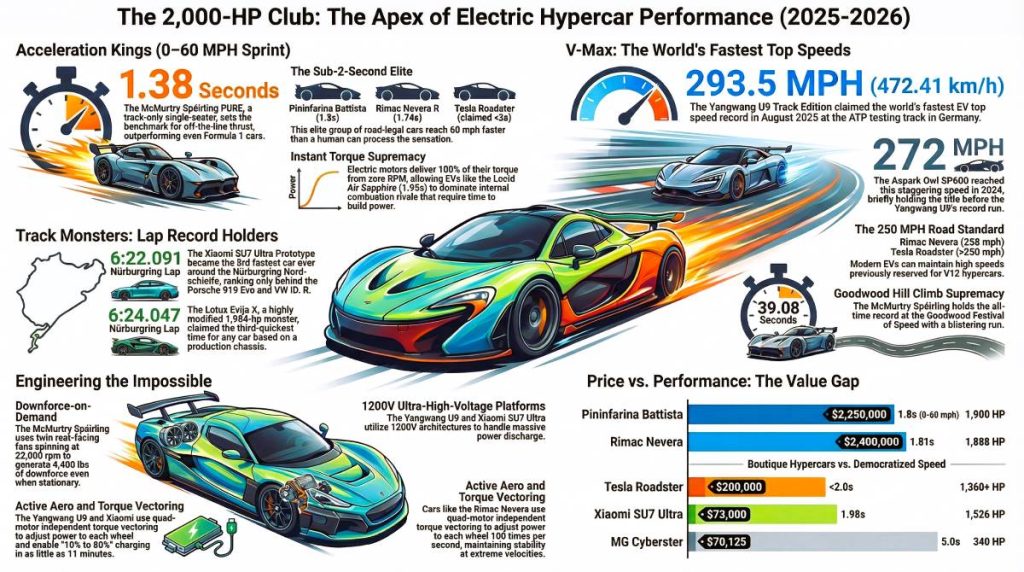
Here is the complete ranking by top speed and 0-60 mph acceleration:
Ranked by Top Speed (Fastest to Slowest):
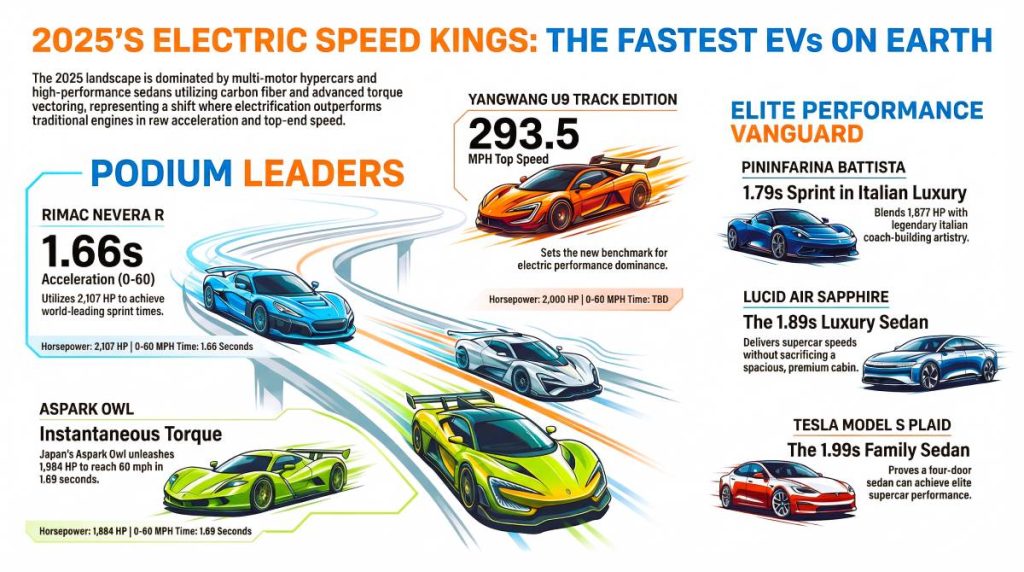
- 1st: Yangwang U9 Track Edition – 293.5 mph (claimed)
- 2nd: Rimac Nevera R – 267 mph
- 3rd (tie): Rimac Nevera – 256 mph
- 3rd (tie): Aspark Owl – 256 mph
- 5th (tie): NIO EP9 – 217 mph
- 5th (tie): Lotus Evija – 217 mph
- 5th (tie): Pininfarina Battista – 217 mph
- 8th: Lucid Air Sapphire – 205 mph
- 9th: Maserati GranTurismo Folgore – 202 mph
- 10th: Tesla Model S Plaid – 200 mph
Ranked by 0-60 MPH Acceleration (Fastest to Slowest):
- 1st: Rimac Nevera R – 1.66 seconds
- 2nd: Aspark Owl – 1.69 seconds (1.72 verified)
- 3rd: Rimac Nevera – 1.74 seconds
- 4th: Pininfarina Battista – 1.79 seconds
- 5th: Lucid Air Sapphire – 1.89 seconds
- 6th: Tesla Model S Plaid – 1.99 seconds
- 7th (tie): NIO EP9 – 2.7 seconds
- 7th (tie): Maserati GranTurismo Folgore – 2.7 seconds
- 9th: Lotus Evija – Under 3.0 seconds
Conclusion: The Electric Revolution Is Here
The top ten fastest electric cars on this list demonstrate conclusively that electric power does not represent a compromise – it represents the future of ultimate automotive performance. Every vehicle here accelerates faster than legendary combustion supercars costing similar amounts. Several achieve top speeds that challenge or exceed the fastest combustion hypercars ever built. And critically, they accomplish this while offering usability advantages impossible for combustion vehicles: instant throttle response, near-silent operation, reduced maintenance requirements, and in some cases (particularly the Tesla Model S Plaid and Lucid Air Sapphire) genuine everyday practicality.
The diversity of this list is equally significant. Chinese manufacturers (NIO, Yangwang/BYD), Croatian startups (Rimac), Japanese engineering firms (Aspark), legendary Italian design houses (Pininfarina), British sports car icons (Lotus), and American EV leaders (Tesla, Lucid) all appear here – proving that electric hypercar engineering capability exists globally rather than concentrated in traditional European automotive centers.
Several themes emerge across these ten vehicles. Nearly all use quad-motor configurations with individual wheel control, enabling torque vectoring precision impossible for mechanical drivetrains. Carbon fiber monocoques are universal, reflecting the importance of low weight when adding heavy battery packs. Active aerodynamics have become essential – managing the balance between low drag for top speed and high downforce for cornering. And 800-volt electrical architectures are increasingly standard, enabling faster charging and more efficient power delivery.
The performance figures achieved by these cars seemed impossible just a decade ago. In 2014, the Tesla Model S P85D’s 3.2-second 0-60 mph time was considered extraordinary for an electric vehicle. Today, every car on this list reaches 60 mph in under half that time. The Rimac Nevera R’s 1.66-second 0-60 acceleration is faster than many Formula 1 cars. The Yangwang U9’s claimed 293.5 mph top speed exceeds all but the most extreme combustion hypercars ever built.
Looking forward, battery energy density improvements, motor power density increases, and aerodynamic refinements will continue pushing electric vehicle performance higher. Solid-state batteries promise significantly higher energy storage in lighter, more compact packages. New motor designs using advanced materials and cooling systems will generate more power from smaller, lighter units. And computational fluid dynamics combined with active aerodynamics will enable even more extreme top speed capabilities.
The electric revolution in high-performance automotive engineering is not coming – it has arrived. These ten cars prove that electrification does not diminish the emotional appeal, visceral excitement, or absolute performance ceiling of the automobile. Instead, it amplifies all three while adding benefits combustion power could never deliver. The future of fast is electric, and it is breathtaking.
About This Article
All performance specifications are drawn from manufacturer official press releases, independent verified testing by Motor Trend, Car and Driver, Road & Track, Top Gear, EVO Magazine, and official timing data where available. Top speed claims marked as ‘claimed’ or ‘manufacturer stated’ have not been independently verified by third-party testing as of publication date. Battery capacity figures are estimated where manufacturers have not officially disclosed specifications. Pricing reflects manufacturer suggested retail pricing where announced; actual transaction prices for limited-production vehicles typically include significant premiums for options, exclusivity, and dealer markups. Production numbers reflect announced intentions and may be subject to change. The Yangwang U9 Track Edition’s 293.5 mph top speed claim awaits independent verification.