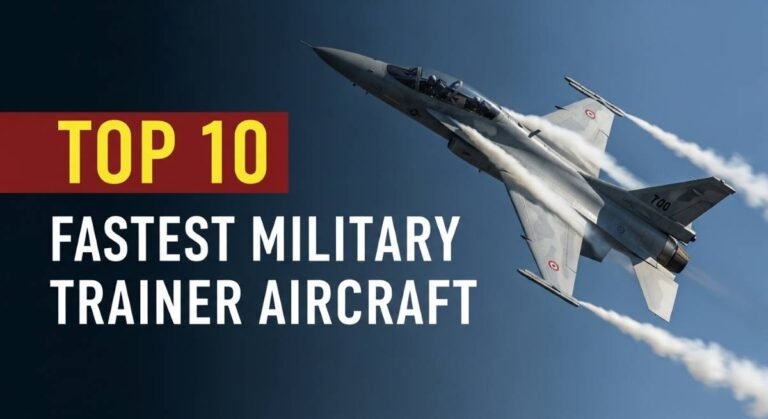
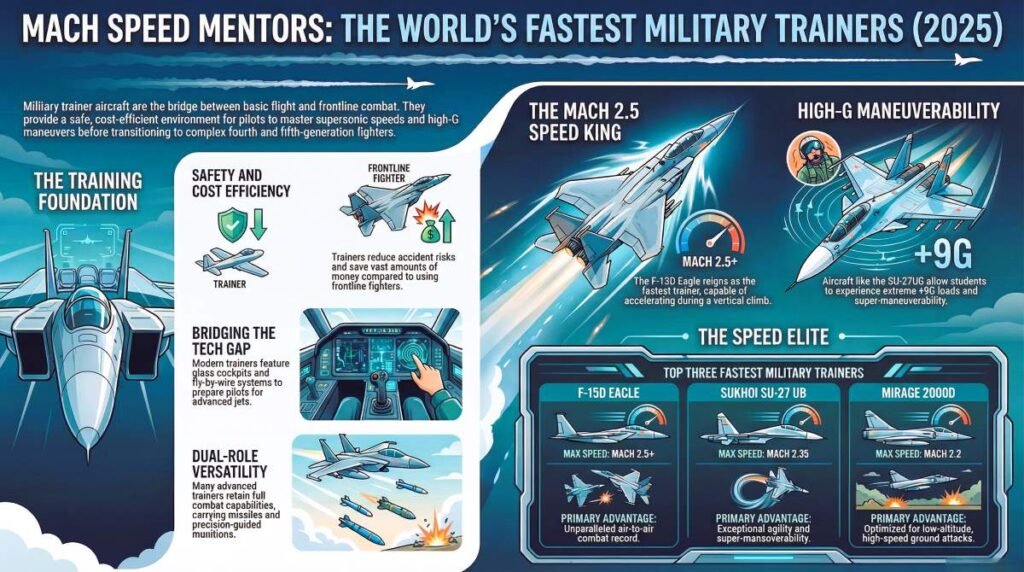
Today in this article we will discuss about the Top 10 Fastest Military Trainer Aircraft in the World with PPT, PDF and Infographics so From Supersonic Speed Demons to Advanced Fighter Conversion – The Most Capable Training Jets Ever Built, Military trainer aircraft represent one of the most critical-yet often underappreciated-components of modern air power. These specialized aircraft serve as the bridge between basic flight instruction and operational combat duty, preparing pilots to handle the extreme performance, complex systems, and demanding flight characteristics of frontline fighters and strike aircraft. Without capable, safe, and cost-effective trainers, no air force can maintain the pipeline of skilled aviators essential to national defense.
Table of Contents
The fastest military trainers on this list are not merely educational tools-many are combat-capable aircraft in their own right, able to carry weapons, conduct air-to-air and air-to-ground missions, and operate in hostile environments. Some are two-seat variants of legendary fighters like the F-15 Eagle, Su-27 Flanker, and Eurofighter Typhoon. Others are purpose-built advanced jet trainers designed to simulate fighter performance while maintaining safer handling characteristics and lower operating costs.
This comprehensive guide examines the ten fastest military trainer aircraft currently in service or recently retired, ranked by maximum speed. For each aircraft, we provide complete technical specifications, development history, operational roles, performance capabilities, and why each design earned its place among the world’s most capable training platforms.
Note: Aircraft specifications are compiled from official military aviation sources including Jane’s All the World’s Aircraft, U.S. Air Force and Navy technical documentation, manufacturer specifications, military aviation journals including Flight International and Aviation Week, and authoritative aerospace reference databases. Maximum speed figures represent high-altitude performance; actual operational speeds may be lower. Some specifications remain classified and are estimated based on publicly available data.
Why Military Trainers Matter: Safety, Cost, and Capability
Before examining specific aircraft, understanding the critical role military trainers play in air force operations provides essential context for appreciating their design priorities and performance requirements.
Safety Through Progressive Training:
Modern fighter aircraft like the F-22 Raptor, F-35 Lightning II, and Su-57 Felon are extraordinarily complex machines with flight characteristics that can be unforgiving to inexperienced pilots. Attempting to transition pilots directly from basic flight training to these advanced fighters would result in catastrophic accident rates and massive loss of life and equipment. Military trainers provide a progressive training pathway where each aircraft exposes pilots to incrementally higher performance levels, more complex systems, and more demanding flight regimes-all while maintaining safer handling characteristics, redundant systems, and forgiving flight dynamics that reduce accident risk.
Cost Efficiency:
Operating a frontline fighter for training purposes is extraordinarily expensive. An F-35A costs approximately $36,000 per flight hour to operate. A T-38 Talon trainer costs approximately $7,000-9,000 per flight hour. For initial advanced jet training where hundreds of hours are required per pilot, using dedicated trainers rather than operational fighters saves tens of millions of dollars per pilot trained. When multiplied across an entire air force training hundreds of pilots annually, the cost savings reach into the billions.
Maintenance complexity compounds the cost difference. Fighters require extensive maintenance after every flight-engine inspections, avionics diagnostics, weapons system checks, and structural inspections. Trainers are designed for simplified maintenance, longer component life between overhauls, and reduced support equipment requirements. This translates to higher aircraft availability rates, fewer maintenance personnel required, and lower logistics costs.
Combat Capability – Dual-Role Trainers:
Many modern trainers are designed for dual roles: training in peacetime and light combat operations during conflict. Advanced jet trainers equipped with modern avionics, radar systems, precision weapons capability, and self-defense systems can conduct close air support, battlefield interdiction, air patrol, and ground attack missions. For nations with limited defense budgets or facing lower-intensity threats, combat-capable trainers provide affordable airpower without the expense of maintaining large fighter fleets.
Types of Military Trainers:
- Basic Trainers: Low-performance propeller or turboprop aircraft for initial flight instruction (examples: T-6 Texan II, PC-9)
- Advanced Trainers: Subsonic jets introducing pilots to jet flight characteristics (examples: BAE Hawk, Aero L-39)
- Lead-In Fighter Trainers (LIFT): High-performance jets simulating fighter capabilities; often supersonic (examples: T-50 Golden Eagle, M-346 Master)
- Operational Conversion Units: Two-seat variants of frontline fighters used for transition training to specific aircraft types (examples: F-15D, Su-27UB)
The ten aircraft on this list represent the fastest trainers across all categories, with maximum speeds ranging from Mach 1.3 to over Mach 2.5.
Top 10 Fastest Military Trainer Aircraft in the World (PPT SLIDES)
#10. Northrop T-38 Talon – ‘The White Rocket’ (Mach 1.3)
The Northrop T-38 Talon holds legendary status as the world’s first supersonic jet trainer and remains in frontline service over six decades after its introduction. Nicknamed ‘The White Rocket’ for its distinctive white paint scheme and exceptional performance, the T-38 has trained more U.S. military pilots than any other aircraft in history. It continues to serve as the U.S. Air Force’s primary advanced jet trainer and is used by NASA to maintain astronaut flight proficiency.
Complete Technical Specifications:
- Manufacturer: Northrop Corporation (now Northrop Grumman)
- First flight: April 10, 1959
- Introduction to service: 1961
- Total production: 1,187 aircraft (production ended 1972)
- Still in service: Approximately 500+ aircraft (2026) – upgraded variants
- Crew: 2 (student pilot and instructor in tandem seating)
- Length: 14.14 metres (46 ft 4.5 in)
- Wingspan: 7.70 metres (25 ft 3 in)
- Height: 3.92 metres (12 ft 10.5 in)
- Empty weight: 3,254 kg (7,174 lbs)
- Maximum takeoff weight: 5,670 kg (12,500 lbs)
- Powerplant: 2× General Electric J85-GE-5 turbojet engines with afterburners
- Thrust per engine: 12.13 kN (2,725 lbf) dry; 17.1 kN (3,850 lbf) with afterburner
- Maximum speed: Mach 1.3 (1,381 km/h / 858 mph at altitude)
- Cruise speed: Mach 0.85
- Rate of climb: 33,600 feet per minute (170.7 m/s) – extraordinary for any aircraft
- Service ceiling: 55,000+ feet (16,765+ metres)
- Range: 1,759 km (1,093 miles)
- G-limits: +7.33 g / -3.0 g
- Fuel capacity: 1,550 litres internal
Design and Development:
Northrop developed the T-38 in response to a U.S. Air Force requirement for a supersonic trainer to prepare pilots for the Century Series fighters entering service in the late 1950s-aircraft like the F-100 Super Sabre, F-104 Starfighter, and F-105 Thunderchief. The T-38 was designed alongside the F-5 Freedom Fighter lightweight fighter, sharing the same basic fuselage and engine configuration. This commonality reduced development costs and created parts compatibility benefits.
The resulting design emphasized simplicity, reliability, and forgiving handling characteristics combined with performance approaching that of operational fighters. The T-38’s small size, lightweight construction, and powerful twin engines created an exceptional thrust-to-weight ratio enabling its phenomenal rate of climb and acceleration. The aircraft can accelerate from subsonic to supersonic speed in level flight without afterburner under ideal conditions-a capability few trainers possess.
Operational History and Upgrades:
Over 60 years in service, the T-38 has trained tens of thousands of U.S. Air Force pilots, Navy aviators (who used it briefly), NATO pilots, and astronauts. NASA operates approximately 32 T-38s at its flight operations facilities to maintain astronaut proficiency and simulate high-performance flight profiles. Every U.S. astronaut since the early 1960s has trained in T-38s.
Multiple upgrade programs have modernized the fleet. The Pacer Classic program in the 1980s-90s strengthened the wing structure and replaced engines with improved J85-GE-5R models. The Avionics Upgrade Program (AUP) installed modern digital cockpit displays, GPS navigation, and updated communication systems. The most recent modification-the T-38C Talon configuration-incorporates glass cockpit instruments, head-up displays, and enhanced flight control systems making the aircraft compatible with modern fighter training syllabi.
Why It Remains in Service:
Despite being designed in the 1950s, the T-38 continues flying because it excels at its primary mission: preparing pilots for high-performance jet flight. Its supersonic capability, high service ceiling, and exceptional maneuverability allow students to experience flight characteristics similar to fighters while maintaining significantly safer handling and lower operating costs. The U.S. Air Force plans to operate upgraded T-38s until they are replaced by the new Boeing-Saab T-7A Red Hawk trainer currently entering service.
Why It Makes the List: The T-38’s Mach 1.3 capability and 33,600 fpm climb rate make it one of the highest-performing dedicated trainers ever built. Over 60 years in service and tens of thousands of pilots trained demonstrate exceptional design quality and enduring capability.
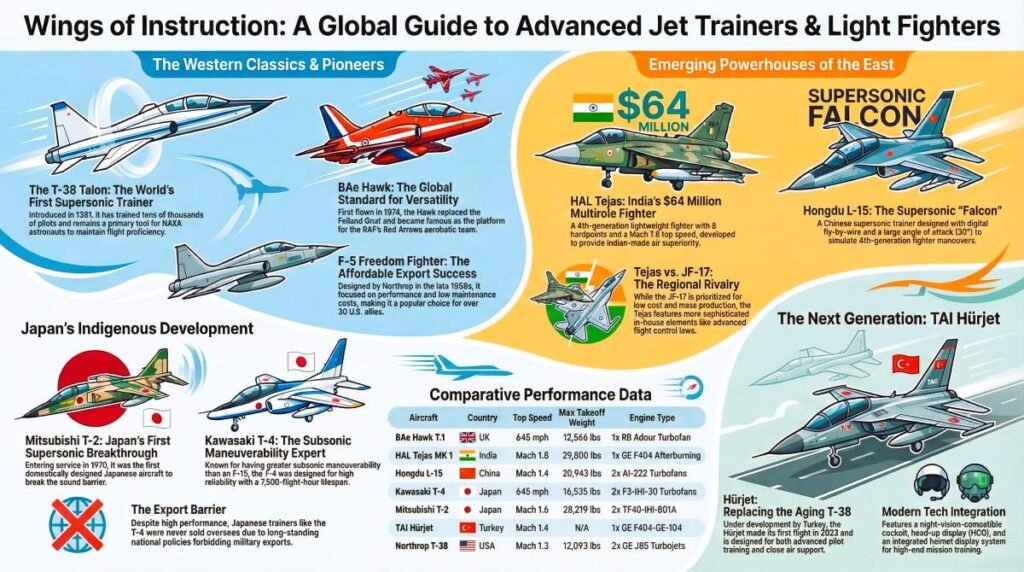
#9. Hongdu JL-10 / L-15 Falcon – China’s Advanced Trainer (Mach 1.4)
The Hongdu JL-10-also known as the L-15 Falcon in export designation-represents China’s entry into the advanced supersonic trainer market. Designed to prepare pilots for fourth and fifth-generation fighters including the J-10, J-11, J-15, J-16, J-20, and FC-31, the L-15 combines modern avionics, advanced aerodynamics, and combat capability in a cost-effective package optimized for the training requirements of the People’s Liberation Army Air Force (PLAAF).
Complete Technical Specifications:
- Manufacturer: Hongdu Aviation Industry Corporation (AVIC subsidiary)
- First flight: March 13, 2006
- Introduction to service: 2010 (initial); widespread service from 2015+
- Production: Ongoing; estimated 100+ built
- Crew: 2 (student and instructor in tandem)
- Length: 12.27 metres (40 ft 3 in)
- Wingspan: 9.48 metres (31 ft 1 in)
- Height: 4.80 metres (15 ft 9 in)
- Empty weight: 4,500 kg (9,921 lbs)
- Maximum takeoff weight: 9,800 kg (21,605 lbs)
- Powerplant: 2× ZMKB Progress/Motor Sich AI-222K-25F turbofan engines with afterburners (standard L-15); or 2× Guizhou WS-17 turbofans (domestic engine variant)
- Thrust per engine: 21.58 kN (4,850 lbf) dry; 42.3 kN (9,500 lbf) with afterburner (AI-222)
- Maximum speed: Mach 1.4 (1,715 km/h / 1,066 mph) – L-15B variant with afterburners
- Maximum speed (L-15A): Mach 0.9 (subsonic variant without afterburners)
- Service ceiling: 16,000 metres (52,493 feet)
- Range: 2,800 km (1,740 miles) with external tanks
- G-limits: +8 g / -3 g
- Hardpoints: 9 total – 8 underwing + 1 centreline for weapons and external stores
- Maximum external load: 3,000 kg (6,614 lbs)
Design Philosophy – Fourth and Fifth-Gen Preparation:
The L-15 was developed with specific focus on preparing pilots for China’s advanced fighters. The PLAAF operates a diverse fleet including fourth-generation aircraft (J-10, J-11 variants based on Su-27/30, and J-16) and fifth-generation stealth fighters (J-20). Training pilots for these sophisticated aircraft requires advanced trainers with modern glass cockpits, fly-by-wire flight controls, and performance characteristics approaching operational fighters.
The L-15 incorporates a digital fly-by-wire system eliminating mechanical linkages between pilot controls and flight control surfaces. Instead, computers interpret pilot inputs and command hydraulic actuators to move control surfaces-the same approach used in modern fighters. The glass cockpit features multifunction displays presenting flight data, tactical information, weapons status, and navigation-familiarizing students with the interfaces they will encounter in frontline aircraft.
Two Main Variants:
The L-15A is the subsonic advanced trainer variant powered by non-afterburning engines with a maximum speed of approximately Mach 0.9. This variant focuses on systems training, instrument flight, and formation flying without the complexity and cost of supersonic operations.
The L-15B is the supersonic lead-in fighter trainer (LIFT) variant equipped with afterburning engines enabling Mach 1.4 maximum speed. This variant prepares pilots for supersonic flight, high-G maneuvering, and weapon employment, bridging the gap between advanced training and operational conversion to fighters.
Combat Capability:
Both L-15 variants can be armed for light attack and air defense roles. The nine hardpoints can carry a variety of weapons including PL-5 and PL-9 short-range air-to-air missiles, unguided rockets, precision-guided bombs, and gun pods. This combat capability makes the L-15 attractive to export customers seeking affordable multi-role aircraft capable of both training and operational missions.
Export Success:
China has aggressively marketed the L-15 to international customers as an alternative to Western trainers like the T-50 Golden Eagle and M-346 Master. The aircraft’s lower acquisition cost, combat capability, and willingness of Chinese manufacturers to offer favorable financing terms have generated significant international interest, particularly from nations seeking to modernize air forces without the expense of Western systems.
Why It Makes the List: The L-15B’s Mach 1.4 capability, modern fly-by-wire controls, and nine hardpoint weapon capacity make it one of the most capable supersonic trainers currently in production. It represents China’s maturation as an advanced military aircraft manufacturer.
#8. KAI T-50 Golden Eagle – South Korea’s Supersonic Trainer (Mach 1.5)
The KAI T-50 Golden Eagle represents South Korea’s emergence as a sophisticated military aircraft manufacturer and stands as one of the most successful modern advanced jet trainers on the international market. Co-developed by Korea Aerospace Industries (KAI) and Lockheed Martin, the T-50 family combines proven American technology with Korean manufacturing efficiency to create a highly capable supersonic trainer and light fighter optimized for transitioning pilots to fourth and fifth-generation fighters.
Complete Technical Specifications:
- Manufacturer: Korea Aerospace Industries (KAI) with Lockheed Martin technical partnership
- First flight: August 20, 2002 (T-50 prototype)
- Introduction to service: 2005 (Republic of Korea Air Force)
- Production: Ongoing; over 200 built including all variants
- Operators: South Korea, Indonesia, Iraq, Philippines, Thailand, Poland, United States (T-50A variant competed for T-X trainer program)
- Crew: 2 in tandem (T-50); 1 (FA-50 light fighter variant)
- Length: 13.14 metres (43 ft 1 in)
- Wingspan: 9.45 metres (31 ft)
- Height: 4.94 metres (16 ft 2.5 in)
- Empty weight: 6,474 kg (14,274 lbs)
- Maximum takeoff weight: 12,300 kg (27,116 lbs)
- Powerplant: 1× General Electric F404-GE-102 afterburning turbofan
- Thrust: 53.07 kN (11,930 lbf) dry; 78.7 kN (17,700 lbf) with afterburner
- Maximum speed: Mach 1.5 (1,837 km/h / 1,141 mph at altitude)
- Service ceiling: 14,800 metres (48,556 feet)
- Range: 1,851 km (1,150 miles)
- G-limits: +8 g / -3 g
- Hardpoints: 7 total (T-50/TA-50); 8 (FA-50) for weapons and external stores
- Maximum weapons load: 4,500 kg (9,920 lbs)
Development History – Lockheed Martin Partnership:
South Korea initiated the KTX-2 program in the late 1990s to develop an indigenous supersonic advanced trainer replacing aging T-38 Talons and T-59 Hawks in Korean Air Force service. KAI partnered with Lockheed Martin, leveraging American expertise in fighter design and systems integration. Lockheed Martin contributed design assistance, avionics architecture based on F-16 systems, and transferred manufacturing technology enabling Korean production.
The resulting T-50 design borrows heavily from the F-16 Fighting Falcon’s aerodynamic configuration-a single-engine, mid-mounted wing design optimized for transonic and supersonic performance. The use of the proven General Electric F404 engine (the same powerplant used in F/A-18 Hornets) ensured reliability and performance while leveraging an existing global support infrastructure.
Glass Cockpit and Fly-By-Wire:
The T-50 features a fully digital glass cockpit with three multifunction displays providing comprehensive flight, navigation, weapons, and systems information. The layout deliberately mirrors the F-16 cockpit arrangement, familiarizing students with the interface they will encounter if progressing to Vipers. Head-up display (HUD) projects flight data onto the pilot’s forward field of view, enabling eyes-out navigation and weapons delivery-essential for combat flying.
The quadruplex digital fly-by-wire flight control system provides precise handling characteristics, inherent stability augmentation, and protection against dangerous flight conditions. Unlike mechanical controls where pilot inputs directly move control surfaces, the FBW system interprets commands and optimizes control surface deflections for safe, efficient flight across the entire performance envelope.
The T-50 Family – Multiple Variants:
- T-50 Golden Eagle: Baseline advanced trainer with limited weapons capability
- T-50B: Aerobatic demonstration variant flown by Republic of Korea Air Force Black Eagles demonstration team
- TA-50: Light attack variant with enhanced weapons systems and combat capability
- FA-50: Single-seat light fighter with radar, beyond-visual-range missile capability, and full multirole combat systems
- T-50A: Variant proposed for U.S. Air Force T-X trainer competition (lost to Boeing T-7A)
Export Success:
The T-50 family has achieved significant export success, appealing to air forces seeking affordable supersonic training capability and light combat aircraft. Indonesia operates both T-50i trainers and TA-50 light attack variants. Iraq acquired FA-50s for counterinsurgency operations. The Philippines operates FA-50s as their primary fighter aircraft. Poland recently ordered FA-50s as interim fighters while awaiting F-35A deliveries. Thailand operates the T-50TH variant.
This export success validates the design’s combination of proven Western technology, Korean quality manufacturing, competitive pricing, and willingness to integrate customer-specific systems and weapons.
Why It Makes the List: The T-50’s Mach 1.5 capability, F-16-derived design, and successful transition into combat-capable FA-50 variants demonstrate exceptional versatility. Over 200 aircraft delivered to seven nations validate its position as one of the world’s most capable supersonic trainers.
#7. PAC JF-17B Thunder – Pakistan’s Multirole Trainer (Mach 1.6)
The JF-17B Thunder represents the two-seat trainer and operational combat variant of the JF-17 Thunder single-seat multirole fighter jointly developed by Pakistan Aeronautical Complex (PAC) and China’s Chengdu Aerospace Corporation. While primarily serving as an advanced conversion trainer preparing pilots for the single-seat JF-17, the B variant retains full combat capability including air-to-air, air-to-ground, and anti-ship roles, making it a genuine multirole combat aircraft in its own right.
Complete Technical Specifications:
- Manufacturer: Pakistan Aeronautical Complex (PAC) and Chengdu Aerospace Corporation (CAC), China
- First flight: April 27, 2017 (JF-17B prototype)
- Introduction to service: 2019 (Pakistan Air Force)
- Production: Ongoing; estimated 25+ JF-17B built (part of overall JF-17 program producing 150+ aircraft)
- Operators: Pakistan Air Force, Myanmar Air Force
- Crew: 2 in tandem seating (pilot and weapons systems officer or student/instructor)
- Length: 14.4 metres (47 ft 3 in) – slightly longer than single-seat JF-17 due to extended nose
- Wingspan: 9.45 metres (31 ft)
- Height: 4.75 metres (15 ft 7 in)
- Empty weight: 6,586 kg (14,520 lbs)
- Maximum takeoff weight: 13,500 kg (29,762 lbs)
- Powerplant: 1× Klimov RD-93 afterburning turbofan (Russian engine; Chinese WS-13 alternative under development)
- Thrust: 49.4 kN (11,106 lbf) dry; 84.4 kN (18,973 lbf) with afterburner
- Maximum speed: Mach 1.6 (1,960 km/h / 1,217 mph at altitude)
- Service ceiling: 16,700 metres (54,790 feet)
- Combat radius: 1,200 km (746 miles)
- Ferry range: 3,840 km (2,386 miles) with external tanks
- G-limits: +8.5 g / -3.0 g
- Hardpoints: 7 total for weapons and external stores
- Maximum weapons load: 3,629 kg (8,000 lbs)
Joint Development – Sino-Pakistani Cooperation:
The JF-17 Thunder program emerged from Pakistan’s requirement for an affordable, modern, multirole fighter to replace aging Mirage III/5, F-7, and A-5 aircraft in Pakistan Air Force service. Unable to afford Western fighters like F-16s in sufficient numbers and seeking independence from potential sanctions, Pakistan partnered with China to develop an indigenous lightweight fighter based on China’s cancelled Super-7 program.
The resulting aircraft combines Chinese aerodynamic design and avionics with Russian propulsion (the RD-93 engine is a variant of the MiG-29’s RD-33) and Pakistani specific requirements including the ability to carry Western weapons alongside Chinese systems. Cost sharing between China and Pakistan kept development expenses manageable while both nations gained manufacturing capability and export opportunities.
The JF-17B Configuration – Dual-Role Design:
The JF-17B’s tandem seating configuration serves multiple purposes. As an advanced trainer, it allows instructor pilots to teach students the aircraft’s systems, handling characteristics, weapons employment, and mission profiles before transitioning to the single-seat variant. The rear cockpit duplicates all essential flight controls and displays, enabling instructors to demonstrate techniques and intervene if students make errors.
In operational roles, the two-seat configuration enables task sharing between pilot and weapons systems officer during complex missions. The rear seat operator can manage sensors, weapons targeting, defensive systems, and communications while the pilot focuses on flying-particularly valuable during low-altitude strike missions, anti-ship attacks, and suppression of enemy air defenses where workload is high.
Combat Systems and Weapons:
The JF-17B is equipped with a KLJ-7A AESA (Active Electronically Scanned Array) radar providing simultaneous air-to-air and air-to-ground modes with improved detection range and resistance to jamming compared to older mechanically scanned radars. The comprehensive avionics suite includes radar warning receiver, missile approach warning system, electronic countermeasures, and targeting pod capability for precision weapons.
Weapons compatibility includes Chinese systems (PL-5, SD-10, C-802 anti-ship missiles, various precision-guided bombs) and Western weapons (potentially including AIM-9 Sidewinder air-to-air missiles and precision munitions depending on customer). This flexibility appeals to export customers who may operate mixed inventories of Chinese and Western equipment.
Why It Represents an Emerging Trend:
The JF-17B exemplifies a growing category: multirole fighters designed from inception with two-seat variants that serve dual purposes as both operational combat aircraft and conversion trainers. This approach eliminates the need for separate advanced Military trainer aircraft-pilots transition directly from basic/intermediate trainers to two-seat combat aircraft before qualifying on single-seat variants. The model reduces fleet complexity and total aircraft numbers required while maintaining combat capability across all airframes.
Why It Makes the List: The JF-17B’s Mach 1.6 capability, full multirole combat systems, and modern AESA radar make it one of the fastest and most capable dual-role trainer/fighters currently in production. It represents the future trend of combat-capable trainers eliminating dedicated advanced trainer requirements.
#6. Dassault Rafale B – French Omnirole Excellence (Mach 1.8)
The Dassault Rafale B represents the two-seat variant of France’s premier omnirole fighter-a multirole aircraft designed to excel across air superiority, interdiction, reconnaissance, and nuclear strike missions. While the Rafale C single-seat variant is the French Air and Space Force’s primary fighter, the B model serves critical roles in complex missions where two-crew operation provides decisive advantages and in training pilots transitioning to the Rafale family.
Complete Technical Specifications:
- Manufacturer: Dassault Aviation, France
- First flight: 1993 (Rafale B prototype); 1999 (production B model)
- Introduction to service: 2006 (French Air Force); 2010 (French Navy – Rafale M carrier variant)
- Production: Ongoing; over 250 Rafale aircraft delivered including all variants
- Operators: France, Egypt, India, Qatar, Greece, Croatia, Indonesia, United Arab Emirates
- Crew: 2 in tandem seating (Rafale B/M two-seat); 1 (Rafale C single-seat)
- Length: 15.27 metres (50 ft 1 in)
- Wingspan: 10.90 metres (35 ft 9 in)
- Height: 5.34 metres (17 ft 6 in)
- Empty weight: 10,300 kg (22,710 lbs) – Rafale B
- Maximum takeoff weight: 24,500 kg (54,013 lbs)
- Powerplant: 2× Snecma M88-2 afterburning turbofan engines
- Thrust per engine: 50 kN (11,240 lbf) dry; 75 kN (16,870 lbf) with afterburner
- Maximum speed: Mach 1.8+ (2,200+ km/h / 1,367+ mph at altitude)
- Supercruise capability: Yes – Mach 1.4 sustained without afterburner
- Service ceiling: 15,240 metres (50,000 feet)
- Combat radius: 1,850+ km (1,150+ miles) on hi-lo-hi interdiction profile
- Ferry range: 3,700+ km (2,300+ miles) with external tanks
- G-limits: +9 g / -3.6 g
- Hardpoints: 14 total for weapons and external stores
- Maximum weapons load: 9,500 kg (20,944 lbs) – among highest of any fighter
Omnirole Design Philosophy:
Dassault developed the Rafale under France’s requirement for a single aircraft type capable of replacing seven distinct aircraft in French military service-the Jaguar strike aircraft, Mirage F1 interceptor, Mirage 2000 multirole fighter, Super Étendard carrier strike fighter, and others. The ‘omnirole’ designation reflects the Rafale’s ability to conduct multiple mission types during a single sortie without reconfiguration-switching seamlessly between air-to-air combat, precision strike, reconnaissance, and suppression of enemy air defenses as tactical situations demand.
This versatility stems from sophisticated avionics integrating the RBE2 AESA radar, Thales Spectra electronic warfare suite, OSF (Optronique Secteur Frontal) infrared search and track system, and advanced sensor fusion presenting pilots with comprehensive tactical awareness. The aircraft can simultaneously track air threats, identify ground targets, and manage defensive countermeasures-distributing workload that would overwhelm a single pilot, making the two-seat Rafale B configuration valuable for complex missions.
Rafale B Two-Seat Roles:
Approximately one-third of French Rafale procurement consists of B-model two-seaters, reflecting their importance across multiple mission types. During strike missions, the rear-seat weapons systems operator manages targeting pod imagery, coordinates weapons release, monitors threats, and handles communications while the pilot flies low-altitude penetration profiles-distributing workload that reduces pilot fatigue and improves mission effectiveness.
For reconnaissance missions, the rear-seat operator manages the RECO-NG pod (New Generation Reconnaissance Pod) capturing high-resolution imagery and infrared data while the pilot navigates and maintains situational awareness. During suppression of enemy air defenses (SEAD), the rear operator manages SPECTRA electronic warfare systems identifying, classifying, and targeting enemy radar sites.
As a trainer, the Rafale B prepares pilots for transition to single-seat Rafale C variants or maintains currency for experienced pilots. The rear cockpit duplicates all essential controls and displays, enabling comprehensive instruction across all mission profiles.
Combat Record and Operational Deployments:
French Rafales have seen extensive combat including operations over Afghanistan, Libya, Mali, Iraq, and Syria. The aircraft demonstrated exceptional operational availability, precision strike capability, and sensor performance. During Operation Serval in Mali (2013), Rafales conducted long-range strike missions from French bases, demonstrating the type’s strategic reach. In Operation Chammal against ISIS, Rafales delivered precision weapons while simultaneously conducting reconnaissance and providing air cover-showcasing genuine omnirole capability.
Export Success – International Validation:
The Rafale initially struggled in export markets but has achieved significant success since 2015 with sales to Egypt (54 aircraft), India (36 with additional orders for 26 carrier-capable Rafale-M variants), Qatar (36), Greece (24), Croatia (12), Indonesia (42), and UAE (80). This export success validates the design’s capabilities and Dassault’s ability to integrate customer-specific systems and weapons.
Why It Makes the List: The Rafale B’s Mach 1.8 capability, supercruise performance, and genuine omnirole combat capability make it one of the world’s most capable multirole fighters. Its two-seat configuration enables complex mission profiles impossible for single-seat aircraft while serving as an advanced trainer for one of the world’s most sophisticated fighter types.
#5. Eurofighter Typhoon T.2 – Europe’s Agile Canard Delta (Mach 2.0)
The Eurofighter Typhoon represents Europe’s premier air superiority and multirole fighter developed through unprecedented multinational collaboration between the United Kingdom, Germany, Italy, and Spain. The two-seat T.2 variant (formerly designated T.1) serves as both an operational combat aircraft with full weapons capability and a conversion trainer preparing pilots for the extreme performance and complex systems of this highly agile canard-delta wing design.
Complete Technical Specifications:
- Manufacturer: Eurofighter Jagdflugzeug GmbH consortium (BAE Systems UK, Airbus Defence and Space Germany/Spain, Leonardo Italy)
- First flight: March 27, 1994 (DA1 technology demonstrator); April 6, 1997 (production Typhoon)
- Introduction to service: 2003 (Royal Air Force and German Luftwaffe)
- Production: Ongoing; over 660 Typhoons delivered to 10 nations
- Operators: UK, Germany, Italy, Spain, Austria, Saudi Arabia, Oman, Kuwait, Qatar, (plus future orders)
- Crew: 2 in tandem (Typhoon T.2/T.3); 1 (single-seat variants)
- Length: 15.96 metres (52 ft 4 in)
- Wingspan: 10.95 metres (35 ft 11 in)
- Height: 5.28 metres (17 ft 4 in)
- Empty weight: 11,150 kg (24,582 lbs)
- Maximum takeoff weight: 23,500 kg (51,809 lbs)
- Powerplant: 2× Eurojet EJ200 afterburning turbofan engines
- Thrust per engine: 60 kN (13,490 lbf) dry; 90 kN (20,230 lbf) with afterburner
- Maximum speed: Mach 2.0+ (2,450+ km/h / 1,522+ mph at altitude)
- Supercruise capability: Yes – Mach 1.5 sustained cruise without afterburner in air defense configuration
- Service ceiling: 19,812 metres (65,000 feet)
- Combat radius: 1,389 km (863 miles) on air-to-air mission
- Ferry range: 3,790 km (2,355 miles)
- G-limits: +9 g / -3 g
- Hardpoints: 13 total (12 under-wing and fuselage + 1 under-fuselage for targeting pod or fuel tank)
- Maximum weapons load: 7,500 kg (16,535 lbs)
Canard-Delta Wing Design and Relaxed Stability:
The Typhoon’s most distinctive aerodynamic feature is its canard-delta configuration combining small forward control surfaces (canards) positioned ahead of the main delta wing. This layout provides exceptional maneuverability across the entire flight envelope, particularly at high angles of attack where conventional aircraft lose control effectiveness.
The design incorporates intentional aerodynamic instability-the aircraft is inherently unstable in pitch, meaning without computer control it would tumble uncontrollably. The quadruplex digital fly-by-wire flight control system makes thousands of control surface adjustments per second to maintain stability while simultaneously optimizing performance. This relaxed stability approach enables extreme maneuverability-the Typhoon can point its nose at angles conventional stable aircraft cannot achieve, providing decisive advantages in close-range air combat.
Thrust-to-Weight Ratio and Supercruise:
The twin EJ200 engines produce a combined 180 kN (40,460 lbf) of thrust with afterburner. In air-to-air configuration with four BVR missiles and two short-range missiles, the Typhoon achieves a thrust-to-weight ratio exceeding 1.15:1-meaning the aircraft can accelerate vertically. This extraordinary power enables supercruise (sustained supersonic flight without afterburner) at Mach 1.5, conserving fuel while maintaining tactical speed advantages over subsonic adversaries.
The high thrust-to-weight ratio also produces exceptional acceleration and energy management in air combat. The Typhoon can regain energy (speed and altitude) faster than most competitors after defensive maneuvers, maintaining initiative in extended engagements.
Sensor Fusion and Multirole Capability:
Modern Typhoons integrate the Captor-E AESA radar providing simultaneous air-to-air and air-to-ground modes, long-range detection, electronic attack capabilities, and resistance to jamming. The Praetorian defensive aids subsystem combines radar warning receivers, missile approach warning systems, and countermeasures dispensers into an integrated self-protection suite. The PIRATE infrared search and track system provides passive target detection without emitting radar signals that reveal the Typhoon’s position.
These sensors feed into a comprehensive data fusion system presenting pilots with a synthesized tactical picture rather than raw sensor data-reducing workload and improving decision-making speed. The system can automatically prioritize threats, recommend engagement solutions, and coordinate with other friendly aircraft exchanging tactical data through datalinks.
Two-Seat T.2 Operational Roles:
The Typhoon T.2 serves multiple critical functions. As an operational conversion trainer, it prepares pilots transitioning from advanced trainers like the BAE Hawk to the Typhoon’s extreme performance and complex systems. The rear cockpit enables instructors to demonstrate tactics, monitor student performance, and intervene if necessary.
In combat operations, T.2 variants participate in all mission types-air defense, ground attack, reconnaissance, and SEAD. The two-seat configuration distributes workload during complex missions. Some operators prefer two-seat variants for long-duration missions where task sharing reduces fatigue, and for SEAD missions where managing electronic warfare systems and precision weapons simultaneously benefits from crew coordination.
Combat Deployments:
Typhoons have seen combat over Libya (Operation Unified Protector, 2011), where RAF and Italian Typhoons conducted ground attack missions destroying military targets. They regularly conduct air policing missions intercepting Russian aircraft approaching NATO airspace. Saudi Typhoons have conducted extensive combat operations in Yemen. These deployments validated the aircraft’s multirole capability and reliability in sustained combat operations.
Why It Makes the List: The Typhoon T.2’s Mach 2.0+ capability, supercruise at Mach 1.5, and exceptional thrust-to-weight ratio enabling vertical acceleration make it one of the world’s most capable air superiority fighters. Its canard-delta aerodynamics and relaxed stability provide unmatched agility while the two-seat configuration maintains full combat capability.
#4. Mikoyan MiG-21UM – The Legendary ‘Mongol’ Trainer (Mach 2.05)
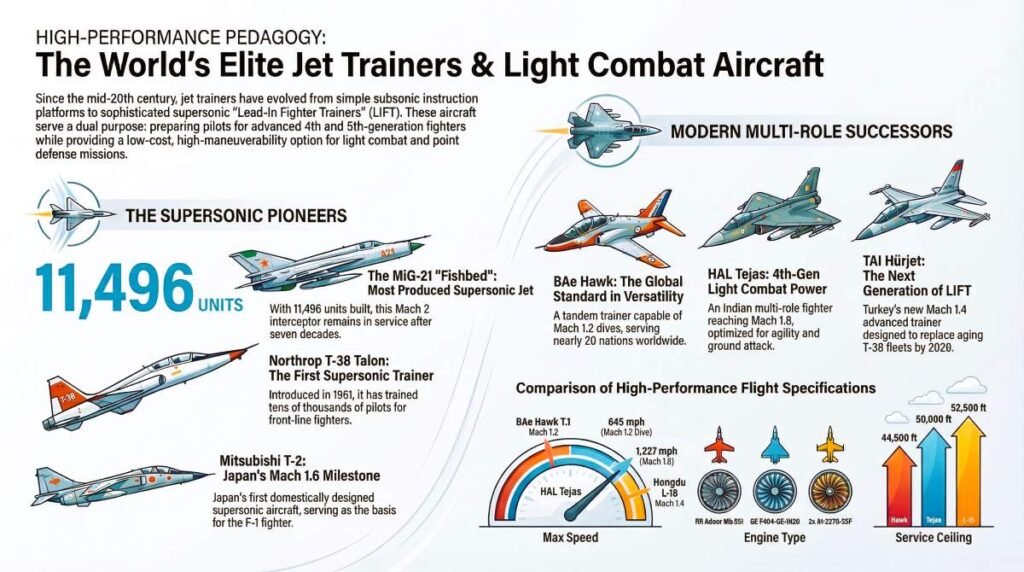
The Mikoyan MiG-21UM-NATO reporting name ‘Mongol’-represents the two-seat training variant of one of the most produced fighter aircraft in aviation history. As the trainer version of the legendary MiG-21 ‘Fishbed,’ the UM variant prepared thousands of pilots worldwide for the challenging high-speed, high-altitude performance characteristics of this iconic Soviet fighter. Despite the MiG-21’s design dating to the 1950s, the trainer variants remained in service with numerous air forces well into the 21st century.
Complete Technical Specifications:
- Manufacturer: Mikoyan-Gurevich (now Mikoyan), Soviet Union/Russia; license-produced in multiple countries
- First flight: 1966 (MiG-21US prototype, predecessor to MiG-21UM)
- Introduction to service: Late 1960s (MiG-21US); 1971 (improved MiG-21UM)
- Production: Approximately 1,000-1,200 MiG-21UM/US variants produced (estimates vary); over 11,000 total MiG-21 family aircraft produced
- Operators: Formerly: Soviet Union, Warsaw Pact nations, India, Egypt, Syria, Iraq, Vietnam, and 60+ other nations; Currently: Several nations retain limited numbers in training roles
- Crew: 2 in tandem seating (student and instructor)
- Length: 15.76 metres (51 ft 8.5 in)
- Wingspan: 7.15 metres (23 ft 5.5 in)
- Height: 4.50 metres (14 ft 9 in)
- Empty weight: 5,450 kg (12,015 lbs)
- Maximum takeoff weight: 9,400 kg (20,725 lbs)
- Powerplant: 1× Tumansky R-13-300 afterburning turbojet engine
- Thrust: 40.21 kN (9,038 lbf) dry; 64.73 kN (14,550 lbf) with afterburner
- Maximum speed: Mach 2.05 (2,175 km/h / 1,351 mph at altitude) – retained from single-seat fighter variants
- Service ceiling: 17,500 metres (57,415 feet)
- Combat radius: Approximately 450 km (280 miles) on hi-lo-hi mission
- G-limits: +8.5 g / -2.5 g
- Armament: 2× underwing hardpoints for training weapons (rocket pods, short-range missiles); no internal cannon
Design Compromises – Trainer Configuration:
Converting the single-seat MiG-21 Fishbed into a two-seat trainer required significant modifications. The second cockpit was created by extending the forward fuselage and relocating avionics previously housed behind the pilot. This extended nose accommodation for tandem seating forced designers to eliminate the aircraft’s combat radar-the RP-21 Sapfir radar system fitted to frontline interceptor variants was removed entirely. The trainer thus lacked beyond-visual-range combat capability and could only conduct basic air-to-air training using infrared-guided short-range missiles or unguided rockets.
The internal 23mm GSh-23 cannon fitted to most fighter variants was also deleted to save weight and complexity, though underwing gun pods could be fitted if required for weapons training. These compromises meant the MiG-21UM functioned purely as a trainer rather than a combat-capable operational conversion trainer like modern equivalents.
Training Role – Preparing for Extreme Performance:
The MiG-21 family earned a reputation as a demanding aircraft requiring precise pilot technique. Its delta wing configuration provided excellent high-altitude, high-speed performance but created challenging low-speed handling-high landing speeds, rapid speed decay in turns, and limited low-speed maneuverability. The aircraft was optimized for point defense interceptor missions: rapid acceleration to altitude, supersonic dash to intercept bombers, and quick missile engagement before returning to base. This specialized performance envelope differed dramatically from subsonic trainers.
The MiG-21UM’s role was to safely transition pilots from intermediate trainers to the extreme performance characteristics of single-seat MiG-21 fighters. Students learned supersonic flight techniques, high-speed intercept profiles, high-altitude operations, and the delta wing’s specific handling quirks-all under instructor supervision from the rear cockpit. The UM retained the fighter’s Mach 2+ performance, enabling realistic high-speed training impossible in subsonic aircraft.
Global Service and Legacy:
The MiG-21 became the most widely exported Soviet fighter, serving with over 60 air forces across six continents. MiG-21UM trainers accompanied these fighter exports, training thousands of pilots in nations aligned with the Soviet Union during the Cold War. India operated the largest MiG-21 fleet outside the Soviet Union and flew MiG-21 trainers extensively. Many nations continued operating MiG-21UMs as advanced trainers long after retiring single-seat fighters, reflecting the trainers’ ongoing value and durability.
The aircraft’s simplicity, reliability, and extreme performance made it ideal for preparing pilots for high-performance jets despite technological obsolescence. Even today, a handful of air forces retain small numbers of MiG-21UMs in training roles, though most have transitioned to modern trainers.
Why It Makes the List: The MiG-21UM’s Mach 2.05 capability-matching its single-seat fighter counterpart-made it one of the fastest trainers ever built. Over 1,000 produced and service with 60+ nations demonstrate its significance in preparing generations of pilots for supersonic fighter operations.
#3. Dassault Mirage 2000D – Strike-Optimized Two-Seater (Mach 2.2)
The Dassault Mirage 2000D represents a specialized evolution of France’s Mirage 2000 fighter family, optimized specifically for conventional precision strike and interdiction missions. Derived from the nuclear-capable Mirage 2000N, the D variant excels in low-altitude, high-speed penetration strikes utilizing terrain-following radar and advanced navigation/attack systems operated by a dedicated two-person crew.
Complete Technical Specifications:
- Manufacturer: Dassault Aviation, France
- First flight: February 19, 1991 (Mirage 2000D prototype)
- Introduction to service: 1993 (French Air Force)
- Production: 86 aircraft built (1991-1999)
- Operators: French Air and Space Force exclusively
- Crew: 2 – pilot and weapons systems officer (WSO) in tandem seating
- Length: 14.55 metres (47 ft 9 in)
- Wingspan: 9.13 metres (29 ft 11.5 in)
- Height: 5.15 metres (16 ft 11 in)
- Empty weight: 7,600 kg (16,755 lbs)
- Maximum takeoff weight: 17,000 kg (37,479 lbs)
- Powerplant: 1× Snecma M53-P2 afterburning turbofan engine
- Thrust: 64.3 kN (14,460 lbf) dry; 95.1 kN (21,380 lbf) with afterburner
- Maximum speed: Mach 2.2 (2,338 km/h / 1,453 mph at high altitude)
- Low-level maximum speed: Mach 1.2 (1,470 km/h / 913 mph)
- Service ceiling: 17,060 metres (55,970 feet)
- Combat radius: 1,480 km (920 miles) on hi-lo-hi interdiction mission
- Ferry range: 3,335 km (2,073 miles) with external tanks
- G-limits: +9 g / -3.2 g
- Hardpoints: 9 total for weapons and external stores
- Maximum weapons load: 6,300 kg (13,889 lbs)
Development from Mirage 2000N Nuclear Strike Aircraft:
The Mirage 2000D evolved from the Mirage 2000N, which was designed as France’s primary tactical nuclear strike platform carrying the ASMP (Air-Sol Moyenne Portée) nuclear-tipped cruise missile. When the Cold War ended and requirements shifted from nuclear deterrence to conventional precision strike, Dassault developed the 2000D variant optimized for non-nuclear attack missions while retaining the two-seat configuration and low-level penetration capability.
The D model received upgraded avionics replacing nuclear weapon systems with modern conventional attack systems. The Antilope 5 terrain-following radar was retained, enabling automatic low-altitude flight following terrain contours to avoid enemy radar detection. A modernized glass cockpit replaced analog instruments, and compatibility with precision-guided munitions including laser-guided bombs and GPS/INS-guided weapons provided standoff strike capability.
Two-Person Crew – Pilot and Weapons Systems Officer:
The Mirage 2000D’s two-seat configuration reflects the extreme workload demands of low-altitude, high-speed strike missions. The pilot in the front cockpit focuses on flying the aircraft-managing navigation, maintaining terrain-following parameters, avoiding threats, and executing weapons delivery maneuvers. The weapons systems officer (WSO) in the rear cockpit manages mission systems: operating the terrain-following radar, monitoring defensive systems, managing targeting pods, coordinating weapons employment, and handling communications.
This task division is essential during demanding mission profiles. Flying at 200-300 feet above ground at 600+ mph through mountainous terrain at night or in bad weather requires complete pilot concentration on flying. Attempting to simultaneously manage weapons systems would create unacceptable workload and danger. The WSO enables mission success by offloading non-flying tasks, monitoring systems, and calling out threats or hazards.
Antilope 5 Terrain-Following Radar:
The Antilope 5 radar represents one of the Mirage 2000D’s key capabilities. Terrain-following radar continuously scans the terrain ahead of the aircraft, computing a safe flight path that maintains minimum altitude above ground while avoiding obstacles. The system can fly the aircraft automatically in terrain-following mode, maintaining preset clearance heights (typically 200-500 feet) over varied terrain-climbing to clear ridges and descending into valleys while maintaining constant ground clearance.
This capability enables low-altitude penetration beneath enemy radar coverage and surface-to-air missile engagement envelopes, dramatically improving survivability during missions into heavily defended airspace. Combined with high speed, the aircraft becomes extraordinarily difficult to detect and engage during the brief period it is exposed over the target area.
Weapons and Combat Missions:
The Mirage 2000D carries a diverse conventional weapons load including laser-guided bombs (GBU-12, GBU-24), GPS/INS-guided AASM modular precision weapons providing standoff capability, unguided bombs, rocket pods, and SCALP-EG cruise missiles with 250+ km range. The aircraft can conduct precision strike, interdiction, close air support, and suppression of enemy air defenses missions.
French Mirage 2000Ds have seen extensive combat including operations over Afghanistan, Libya, Mali, Iraq, and Syria. During Operation Serval in Mali (2013), Mirage 2000Ds conducted precision strikes against insurgent targets in desert environments. In operations against ISIS, the aircraft delivered precision weapons while operating from distant bases, demonstrating long-range strike capability.
Why It Makes the List: The Mirage 2000D’s Mach 2.2 capability and Mach 1.2 low-level speed, combined with terrain-following radar and two-crew configuration, make it one of the most capable strike aircraft ever designed. Its specialized low-altitude attack optimization demonstrates the value of purpose-built multirole platforms.
#2. Sukhoi Su-27UB – The ‘Flanker’ Trainer with Combat Capability (Mach 2.35)
The Sukhoi Su-27UB represents the two-seat operational conversion trainer variant of the legendary Su-27 Flanker air superiority fighter-one of the most capable and agile combat aircraft ever designed. While serving primarily as a trainer preparing pilots for the demanding flight characteristics and complex systems of single-seat Su-27s, the UB variant retains full aerodynamic performance and combat capability, making it a formidable fighter in its own right.
Complete Technical Specifications:
- Manufacturer: Sukhoi Design Bureau (now United Aircraft Corporation), Russia
- First flight: March 7, 1986 (Su-27UB prototype)
- Introduction to service: 1986 (Soviet Air Force)
- Production: Approximately 350+ Su-27UB/UBK variants built; production ongoing in Chinese-licensed J-11BS variant
- Operators: Russia, China (license-produced J-11BS), Ukraine, Belarus, Kazakhstan, Uzbekistan, Vietnam, Indonesia, Ethiopia, Angola, Eritrea
- Crew: 2 in tandem seating (student/operational pilot in front, instructor/WSO in rear)
- Length: 21.935 metres (71 ft 11.5 in)
- Wingspan: 14.70 metres (48 ft 2.75 in)
- Height: 5.932 metres (19 ft 5.5 in)
- Empty weight: 16,380 kg (36,112 lbs)
- Maximum takeoff weight: 30,450 kg (67,131 lbs)
- Powerplant: 2× Saturn/Lyulka AL-31F afterburning turbofan engines
- Thrust per engine: 74.5 kN (16,750 lbf) dry; 122.6 kN (27,560 lbf) with afterburner
- Maximum speed: Mach 2.35 (2,500 km/h / 1,553 mph at altitude)
- Service ceiling: 19,000 metres (62,336 feet)
- Combat radius: 1,340 km (833 miles) on air-to-air mission
- Ferry range: 3,530 km (2,193 miles)
- G-limits: +9 g / -3 g
- Hardpoints: 10 total for weapons and external stores
- Maximum weapons load: 6,000 kg (13,228 lbs)
Su-27 Design Philosophy – Supermaneuverability:
The Su-27 was designed during the Cold War as the Soviet Union’s answer to American fourth-generation fighters like the F-15 Eagle and F-16 Fighting Falcon. The design brief demanded exceptional air-to-air combat capability: long-range radar, heavy missile armament, sustained high-altitude performance, and-critically-aerodynamic agility exceeding Western fighters.
The resulting design incorporated several revolutionary features. The blended wing-body configuration creates exceptional lift at high angles of attack. Large leading-edge root extensions (LERX) generate powerful vortices flowing over the wings, maintaining lift and control at extreme angles where conventional aircraft would stall. The widely-spaced twin engines and twin tail configuration provide redundancy and allow extreme maneuvers without engine flameout risks.
These features enable supermaneuverability-controlled flight at angles of attack exceeding 30 degrees and execution of post-stall maneuvers impossible for conventional fighters. The famous Pugachev’s Cobra-where the aircraft pitches nose-up to 90+ degrees, briefly flying tail-first before recovering to level flight-demonstrates this capability. While controversial in practical combat value, such maneuvers demonstrate extraordinary control authority and pilot confidence in the aircraft’s handling.
Su-27UB Modifications and Capabilities:
The UB variant incorporates a second cockpit by slightly shortening the internal fuel capacity and relocating avionics. Despite this modification, the aircraft retains the single-seat variant’s full flight performance including the Mach 2.35 maximum speed. The rear cockpit provides complete flight controls and instruments, enabling instructors to demonstrate techniques or take control if students make dangerous errors.
Unlike some trainer variants that sacrifice combat capability, the Su-27UB carries the full Flanker weapons suite including R-27 medium-range radar-guided missiles, R-73 highly-agile short-range infrared missiles, and a 30mm GSh-301 internal cannon with 150 rounds. The N001 Myech radar provides look-down/shoot-down capability, enabling engagement of low-altitude targets against ground clutter.
Training and Operational Roles:
The Su-27UB serves multiple functions across its operational life. As a conversion trainer, it transitions pilots from advanced jet trainers or previous-generation fighters to the Flanker’s extreme performance and complex systems. Students experience supersonic flight, high-G maneuvering, beyond-visual-range radar intercepts, and close-in dogfighting under instructor supervision.
In operational service, many air forces employ UB variants for continuation training, maintaining pilot currency and proficiency. Some nations use two-seat Flankers for combat missions where task sharing between pilot and weapons systems operator provides advantages-particularly during complex strike missions, maritime patrol, or SEAD operations.
Chinese License Production – J-11BS:
China acquired Su-27SK fighters and Su-27UBK trainers from Russia in the 1990s and negotiated license production rights. The Shenyang Aircraft Corporation produces the J-11B single-seat variant and J-11BS two-seat variant with Chinese avionics, weapons, and engines replacing Russian systems. This domestic production enables China to operate hundreds of Flanker-derivative aircraft without depending on Russian supply chains.
Why It Makes the List: The Su-27UB’s Mach 2.35 capability matching its single-seat counterpart, combined with supermaneuverability enabling the Pugachev’s Cobra and full combat weapons systems, make it one of the most capable and fastest operational conversion trainers ever built. Its continued production and global service validate the design’s exceptional performance.
#1. McDonnell Douglas F-15D Eagle – The Two-Seat Air Superiority King (Mach 2.5+)
The McDonnell Douglas F-15D Eagle stands at the pinnacle of this list as the fastest military trainer aircraft in the world. As the two-seat variant of the legendary F-15C air superiority fighter-an aircraft with an unmatched combat record of over 100 victories and zero losses in air-to-air combat-the F-15D combines unparalleled performance, formidable weapons capability, and the training functionality required to prepare pilots for one of the most capable fighters ever designed.
Complete Technical Specifications:
- Manufacturer: McDonnell Douglas (now Boeing Defense, Space & Security)
- First flight: July 8, 1978 (F-15D prototype)
- Introduction to service: 1979 (U.S. Air Force)
- Production: Approximately 340 F-15D aircraft built (part of over 1,600 total F-15 family production)
- Operators: United States, Israel, Saudi Arabia, Japan (as F-15DJ), South Korea
- Crew: 2 in tandem seating (student/operational pilot in front, instructor/weapons systems officer in rear)
- Length: 19.43 metres (63 ft 9 in)
- Wingspan: 13.05 metres (42 ft 9.75 in)
- Height: 5.63 metres (18 ft 5.5 in)
- Empty weight: 12,973 kg (28,600 lbs)
- Maximum takeoff weight: 30,845 kg (68,000 lbs)
- Powerplant: 2× Pratt & Whitney F100-PW-220 or F100-PW-229 afterburning turbofan engines
- Thrust per engine (F100-PW-229): 79.2 kN (17,800 lbf) dry; 129.7 kN (29,160 lbf) with afterburner
- Maximum speed: Mach 2.5+ (2,655+ km/h / 1,650+ mph at altitude)
- Service ceiling: 65,000+ feet (19,812+ metres)
- Combat radius: 1,967 km (1,222 miles) on air-to-air mission
- Ferry range: 5,745 km (3,570 miles) with conformal fuel tanks and external tanks
- G-limits: +9 g / -3 g
- Hardpoints: 11 total (4 fuselage, 4 wing, 2 wing tip, 1 centreline) for weapons and external stores
- Maximum weapons load: 10,705 kg (23,600 lbs)
- Armament: 1× M61A1 Vulcan 20mm rotary cannon with 940 rounds; mix of AIM-120 AMRAAM, AIM-9 Sidewinder, AIM-7 Sparrow missiles
Design Philosophy – Not a Pound for Air-to-Ground:
The F-15 was designed under a specific philosophy articulated by its designers: ‘Not a pound for air-to-ground.’ Unlike multirole fighters optimized for both air superiority and ground attack, the F-15 was purpose-built for one mission-dominating enemy aircraft in aerial combat. This single-minded focus enabled optimization across every design parameter: thrust-to-weight ratio, wing loading, sustained turn performance, acceleration, climb rate, and weapons capacity.
The resulting aircraft achieves performance characteristics unmatched by multirole competitors. The high thrust-to-weight ratio (exceeding 1.0:1 with partial fuel load) enables the F-15 to accelerate in a vertical climb-an extraordinary capability meaning the aircraft generates more thrust than weight even when pointed straight up. This translates to decisive combat advantages: the F-15 can out-accelerate, out-climb, and maintain energy better than adversaries, controlling engagement geometry and dictating combat terms.
Unmatched Combat Record:
The F-15 family’s combat record speaks definitively: over 100 confirmed air-to-air victories against zero losses in aerial combat. U.S. F-15s achieved kills during Operation Desert Storm. Israeli F-15s dominated Syrian fighters during conflicts in Lebanon and Syria. Saudi F-15s shot down Iraqi aircraft during the Gulf War. This perfect record across multiple air forces, combat theaters, and adversary types validates the design’s superiority in the air-to-air mission.
F-15D Two-Seat Configuration:
The F-15D differs from the single-seat F-15C only in the addition of a second cockpit and slight reduction in internal fuel capacity (approximately 400 pounds less fuel). All performance characteristics-maximum speed, acceleration, maneuverability, weapons capacity-remain identical to the C model. The rear cockpit provides complete flight controls and duplicate instruments, enabling the instructor to fly from the rear seat if required.
The D variant serves two primary roles. As a trainer, it prepares pilots transitioning from advanced jet trainers to the F-15’s extreme performance. Students learn BVR (beyond-visual-range) intercepts using the APG-63 or APG-70 radar, practice close-in dogfighting, experience 9-G maneuvering, and master the aircraft’s complex systems under instructor supervision.
In operational service, F-15D variants conduct combat missions alongside C models. Some missions benefit from crew coordination-long-range strike escort missions, suppression of enemy air defenses, or complex training scenarios where an instructor pilot accompanies a newer pilot during real-world operations. The rear seat occupant can manage radar and weapons systems while the pilot focuses on flying and situational awareness.
Thrust Vectoring and Sustained Performance:
The F-15’s performance advantages stem from fundamental physics. Low wing loading (pounds of weight per square foot of wing area) enables high sustained turn rates without excessive energy loss. The large wing area generates ample lift at high altitudes where adversaries struggle. The powerful engines provide acceleration authority at all speeds and altitudes, ensuring the F-15 maintains initiative.
Notably, several experimental F-15 variants demonstrated thrust vectoring-engine nozzles that can deflect thrust direction to enhance maneuverability. While not standard on production aircraft, these experiments validated technologies later applied to aircraft like the F-22 Raptor.
Longevity and Continued Service:
F-15s remain in frontline service with the U.S. Air Force and allied nations over 45 years after introduction-a testament to exceptional design. Continuous upgrades including AESA radar, modern electronic warfare systems, advanced datalinks, and weapons compatibility keep the aircraft relevant against modern threats. The F-15EX-the newest production variant ordered by the U.S. Air Force-demonstrates continued F-15 evolution and the design’s enduring value.
Why It Ranks #1:
The F-15D’s maximum speed exceeding Mach 2.5, service ceiling above 65,000 feet, and ability to accelerate vertically combine to create the ultimate performance profile. Its perfect combat record (100+ kills, zero losses), extraordinary thrust-to-weight ratio enabling vertical acceleration, and sustained high-G maneuverability make it not just the fastest military trainer but one of the most capable combat aircraft ever built.
Unlike some entries on this list where ‘trainer’ is the primary role with secondary combat capability, the F-15D is first a supreme air superiority fighter that also happens to serve training functions. This dual nature-ultimate performance combined with training versatility-earns it the top position.
Final Word: The F-15D proves that the ultimate trainer is simply the ultimate fighter with a second seat added. No compromises, no limitations-just pure, unmatched air combat capability combined with the ability to prepare pilots for that same excellence.
Performance Comparison (Complete Rankings)
Ranked by Maximum Speed (Fastest to Slowest):
- 1st: McDonnell Douglas F-15D Eagle – Mach 2.5+ (2,655+ km/h)
- 2nd: Sukhoi Su-27UB Flanker – Mach 2.35 (2,500 km/h)
- 3rd: Dassault Mirage 2000D – Mach 2.2 (2,338 km/h)
- 4th: Mikoyan MiG-21UM Mongol – Mach 2.05 (2,175 km/h)
- 5th: Eurofighter Typhoon T.2 – Mach 2.0+ (2,450+ km/h)
- 6th: Dassault Rafale B – Mach 1.8+ (2,200+ km/h)
- 7th: PAC JF-17B Thunder – Mach 1.6 (1,960 km/h)
- 8th: KAI T-50 Golden Eagle – Mach 1.5 (1,837 km/h)
- 9th: Hongdu JL-10/L-15 Falcon – Mach 1.4 (1,715 km/h)
- 10th: Northrop T-38 Talon – Mach 1.3 (1,381 km/h)
By Service Ceiling (Highest to Lowest):
- 1st: F-15D – 65,000+ feet
- 2nd: Su-27UB – 62,336 feet
- 3rd: Typhoon T.2 – 65,000 feet (tied with F-15D)
- 4th: MiG-21UM – 57,415 feet
- 5th: Mirage 2000D – 55,970 feet
By Year of Introduction (Oldest to Newest):
- Oldest: T-38 Talon – 1961
- MiG-21UM – Late 1960s/1971
- F-15D – 1979
- Su-27UB – 1986
- Mirage 2000D – 1993
- Typhoon T.2 – 2003
- T-50 Golden Eagle – 2005
- Rafale B – 2006
- L-15 Falcon – 2010
- Newest: JF-17B – 2019
Also read: Top 10 Longest and largest Yachts in the world 2026 (.PPTX)
Conclusion: Speed, Safety, and the Future of Military Training
The ten aircraft profiled in this guide demonstrate the remarkable diversity of military trainer design philosophy and operational requirements. From the 1961 T-38 Talon-still flying after six decades-to the brand-new JF-17B Thunder entering service in 2019, these aircraft span over 60 years of aviation technology evolution while sharing a common mission: preparing pilots for the demanding realities of high-performance jet combat.
Several trends emerge when examining this list. First, the line between ‘trainer’ and ‘combat aircraft’ has blurred significantly. While early trainers like the T-38 and MiG-21UM were dedicated training platforms with limited combat capability, modern designs like the JF-17B, FA-50, and Rafale B are full-capability multirole fighters that also happen to have two seats for training purposes. This evolution reflects economic realities-maintaining separate fleets of trainers and operational fighters is expensive, and combining both functions in a single airframe type reduces total aircraft numbers required while maintaining combat capability across the entire fleet.
Second, the fastest trainers are invariably two-seat variants of frontline fighters rather than purpose-built trainers. The top five aircraft on this list-F-15D, Su-27UB, Mirage 2000D, MiG-21UM, and Typhoon T.2-are all operational conversion trainers derived from single-seat fighters. These aircraft achieve maximum speeds exceeding Mach 2 because they inherit the performance characteristics of their fighter parents. Purpose-built advanced trainers like the T-38, L-15, and T-50, while supersonic, top out at Mach 1.3-1.5 because they prioritize safety, economy, and training-specific features over absolute maximum performance.
Third, international collaboration and technology transfer have democratized advanced trainer capability. The T-50 Golden Eagle emerged from Korean-American partnership. The JF-17B represents Sino-Pakistani cooperation. The Eurofighter Typhoon was built by a four-nation consortium. These collaborative programs enable nations without indigenous fighter development capability to field sophisticated trainers and fighters through technology sharing and cost distribution. This trend will likely accelerate as development costs for advanced aircraft continue rising beyond individual nations’ budgets.
Fourth, combat records validate design excellence. The F-15’s perfect 100+ kills, zero losses record proves its air superiority design optimization. The Rafale’s successful combat deployments across Afghanistan, Libya, Mali, and Syria demonstrate omnirole capability. Combat experience drives continuous upgrades-modern F-15s, Rafales, Typhoons, and Su-27s bear little resemblance to their 1970s-1990s predecessors in avionics, sensors, and weapons despite sharing the same basic airframes. This iterative improvement process ensures these trainers prepare pilots for current-generation systems rather than obsolete technology.
Looking forward, the future of military training will likely emphasize simulation over live flying for routine training, reserving expensive aircraft flight hours for complex training scenarios impossible to replicate in simulators. Advanced simulators with high-fidelity visual systems, realistic flight models, and networking enabling multi-aircraft missions provide cost-effective training for systems management, procedures, and basic tactics. Aircraft hours then focus on high-G maneuvering, live weapons employment, formation flying, and other training requiring actual flight.
The trend toward multirole trainers that are also combat-capable will likely accelerate. As defense budgets face pressure and aircraft procurement costs rise, maintaining separate advanced trainer and light fighter fleets becomes economically difficult. Designs like the T-50/FA-50 family, where the same basic airframe serves as trainer, light attack aircraft, and interim fighter, offer compelling economics and operational flexibility.
Ultimately, these 10 aircraft-from the venerable T-38 ‘White Rocket’ to the Mach 2.5+ F-15D air superiority champion-represent humanity’s ongoing quest to master flight at the extremes of performance. They stand as monuments to engineering excellence, testaments to the courage of pilots who fly them, and essential tools maintaining the pipeline of skilled aviators defending nations worldwide. The fastest military trainers are not merely educational tools-they are the guardians of tomorrow’s air superiority, training the warriors who will dominate the skies in conflicts yet to come.
About This Article
All aircraft specifications compiled from authoritative military aviation sources including Jane’s All the World’s Aircraft, official U.S. Air Force and international military aviation technical publications, manufacturer specifications, Flight International, Aviation Week & Space Technology, and military aircraft databases. Maximum speed figures represent high-altitude performance under optimal conditions. Combat records verified through official military sources and aviation historical records. Production numbers represent best available estimates from multiple sources. Some specifications remain classified; publicly available data is used where official figures are unavailable. Export customer lists reflect confirmed deliveries as of 2026.