In this article we will discuss about the Top 10 Kamikaze Drones in the World (2026) with PPT, PDF and Infographic so, Kamikaze drones, formally known as loitering munitions, have redefined modern warfare due to their precision and cost-effectiveness. In February 2026, the United States officially deployed its own one-way attack drone – the LUCAS system – for the first time in combat. India demonstrated its indigenous homegrown kamikaze drones against Pakistani airbases during Operation Sindoor in April 2025. Russia and Iran have transitioned to jet-powered Shahed-238 (Geran-3) variants that travel at over 500 km/h, making traditional air defences less effective than ever.
Table of Contents
The age of the kamikaze drone has fully arrived, and the pace of change in this category of weapon is faster than any other military technology on Earth right now. The global loitering munition market is projected to reach $2.22 billion in 2026, driven by a 12.3% compound annual growth rate as nations shift away from expensive cruise missiles toward mass-producible suicide drones.
This is the most complete and up-to-date resource on the top 10 kamikaze drones in the world. We have merged original keyword research with verified Google AI Mode data from March 2026 to give you a resource that covers the kamikaze drone meaning, kamikaze drone origin country, kamikaze drone price, kamikaze drone range, top 10 military drones countries, top 10 military drones in India, and every major system from the AeroVironment Switchblade and ZALA Lancet to the IAI Harpy, IAI Harop, HESA Shahed-136, WARMATE, and India’s own Sheshnaag-150 (Project KAL), Let us get into it.
Kamikaze Drone Meaning: What Is a Kamikaze Drone?
The kamikaze drone meaning traces directly to World War II, when Japanese pilots flew their aircraft into Allied warships in suicide attacks. The Japanese word kamikaze means divine wind. Modern kamikaze drones apply the same concept to unmanned systems: a drone that flies to its target and detonates on impact, destroying both itself and the target.
Unlike conventional military drones such as the Atomics MQ-9 Reaper, which return to base after a mission, a kamikaze drone is a one-way weapon. It is also called a loitering munition because it can circle a target zone for hours before striking – combining the persistent reconnaissance ability of a surveillance drone with the lethality of a guided missile.
The market for these suicide drones is rapidly shifting toward AI-enabled autonomy and GPS-denied navigation to counter electronic jamming. These systems are no longer simple flying bombs. The latest generation – including India’s Sheshnaag-150 – use onboard AI processors performing 15 trillion operations per second to identify targets, coordinate with other drones in a swarm, and execute precision strikes without human input.
Kamikaze Drone Origin Country: Who Invented the Loitering Munition?
The kamikaze drone origin country is Israel. Israel Aerospace Industries (IAI) developed the world’s first true loitering munition, the IAI Harpy, in the 1980s. It was designed to autonomously hunt radar emitters and detonate on contact – a concept that was revolutionary at the time and remains highly effective today.
Since then, the concept of kamikaze drones made by which country has expanded dramatically. The United States, Russia, Iran, China, Turkey, Poland, Taiwan, and India have all developed their own variants. The kamikaze drone manufacturing company landscape now includes dozens of producers across multiple continents.
In terms of combat impact, the most significant moments in kamikaze drone history include:
- 1980s: Israel creates the IAI Harpy – the original kamikaze drone origin country milestone
- 2020: Azerbaijan uses Israeli Harop and Harpy drones to devastate Armenian armour in Nagorno-Karabakh in just 44 days
- 2022 onwards: Russia deploys Iranian Shahed-136 drones against Ukraine at scale, demonstrating the cost asymmetry problem
- April 2025: India uses homegrown kamikaze drones in Operation Sindoor against Pakistani airbases – a major milestone for Atmanirbhar Bharat
- February 2026: The United States officially deploys its LUCAS (Low-cost Unmanned Combat Attack System) drone in combat for the first time during Operation Epic Fury
Top 10 Kamikaze Drones in the World (2026) – PPT SLIDES
Latest Developments in Kamikaze Drones (2025-2026)
Current as of 2026. Source: Google AI Mode verified data, Drone Federation India, defence publications.
| Development | Details |
| US LUCAS Combat Debut (Feb 2026) | The United States officially deployed its own one-way attack drone, the LUCAS (Low-cost Unmanned Combat Attack System), for the first time on February 28, 2026, during Operation Epic Fury. LUCAS is a $35,000 per unit drone reverse-engineered from the Shahed design principle, offering a low-cost Switchblade-600 alternative at $35k vs $80k. |
| India’s Operation Sindoor (April 2025) | India demonstrated its indigenous capabilities by using homegrown kamikaze drones for precision strikes against Pakistani airbases in April 2025, marking a major milestone for its Atmanirbhar Bharat (Self-Reliant India) initiative. Both Nagastra-1 and Sheshnaag-150 variants were reportedly involved. |
| Jet-Powered Shahed-238 / Geran-3 | Russia and Iran have transitioned to the Shahed-238 (Geran-3), a jet-powered model that is significantly faster (over 500 km/h) than the original propeller-driven versions, drastically reducing the warning time for air defence systems and making traditional intercept methods less effective. |
| India-Israel $8.7 Billion Deal (Feb 2026) | A massive $8.7 billion defence package was approved in early 2026, cementing Israel as India’s critical supplier for high-end loitering munitions. The deal includes thousands of Rampage and Harop systems for deep-strike capabilities. Critically, it includes Technology Transfer (ToT) clauses allowing Indian firms like Adani Defence to manufacture these Israeli designs locally, reducing costs by approximately 30%. |
| Nagastra-1 Bulk Production | India’s Nagastra-1, developed by Solar Industries, is now in bulk production for the Indian Army. Solar Industries is executing Rs.150 Crore+ orders, focusing on explosive-integrated drones at a unit cost of approximately Rs.4.7 Lakh ($5,500), making it one of the most affordable precision kamikaze drones in any military inventory. |
| Hero-120 Multi-Launch Canister | Israeli manufacturer UVision unveiled a new multi-launch canister for the Hero-120 in late 2025, allowing rapid swarming deployment from a single launch platform. The Hero-120 is now being produced under licence in Europe by Rheinmetall to bypass Israeli export bottlenecks. |
| Sheshnaag-150 Mass Production | India’s Sheshnaag-150 (Project KAL), developed by Bengaluru-based NewSpace Research Technologies (NRT) in collaboration with the Indian Ministry of Defence, has moved from testing to mass production at the new Defence Industrial Corridors in Uttar Pradesh and Tamil Nadu, targeting 1,000 units per month by late 2026. |
Top 10 Kamikaze Drones in the World: 2026 Rankings
Rankings based on combat performance, technological sophistication, and operational range. Verified against Google AI Mode data, 2026.
| Rank | Drone Name | Country | Range | Top Speed | Payload | Primary Use / 2026 Update |
| 1 | Shahed-136 / Geran-2 | Iran/Russia | ~2,500 km | 185 km/h | 50 kg | Infrastructure / Swarms. Now frequently equipped with 4G/Starlink for remote control. |
| 2 | Switchblade 600 | USA | 40+ km | 185 km/h | Anti-tank | Precision Anti-Armour. Standardised for platoon-level organic strike in US Army. |
| 3 | ZALA Lancet | Russia | 40-70 km | 110 km/h | 3-5 kg | Tactical / Anti-Armour. Enhanced AI target recognition for autonomous striking in jammed environments. |
| 4 | IAI Harop | Israel | 1,000 km | 417 km/h | 23 kg | Anti-Radiation (SEAD). Integrated into major Indian and Azerbaijani air operations. |
| 5 | Hero-120 | Israel | 60 km | 100+ km/h | 4.5 kg | Multi-Domain Strike. New Multi-Launch canister unveiled late 2025 for rapid swarm deployment. |
| 6 | Altius-600M | USA | 450+ km | ~400 km/h | Varies | Strategic Long-Range. Deployable from aircraft, ground vehicles, or ships with HD sensors. |
| 7 | Nagastra-1 (India) | India | 30 km | 100 km/h | 1.5 kg | High-Altitude Tactical. Authorised for bulk production; 2-metre strike accuracy. |
| 8 | WARMATE (Poland) | Poland | 30 km | 150 km/h | 1.4 kg | Micro-Tactical. Mass-produced across NATO; go-to low-cost loitering munition for European defence. |
| 9 | Chien Hsiang (Taiwan) | Taiwan | 1,000 km | 185 km/h | Classified | Coastal Defence. Core of Taiwan’s Drone Wall strategy through 2026. |
| 10 | Shahed-238 / Geran-3 | Iran/Russia | ~1,000 km | 517 km/h | 40-50 kg | Interception Defiance. Jet-powered; 3x faster than Shahed-136; drastically reduces intercept window. |
Top 10 Kamikaze Drones in the World 2026 Explained (Detailed Profiles)
#1. HESA Shahed-136 / Geran-2 – Iran/Russia | The $20,000 Weapon Rewriting Air War Economics
Country: Iran (manufactured), Russia (deployed as Geran-2) | Range: ~2,500 km | Speed: 185 km/h | Payload: 50 kg | Primary Use: Infrastructure / Swarms
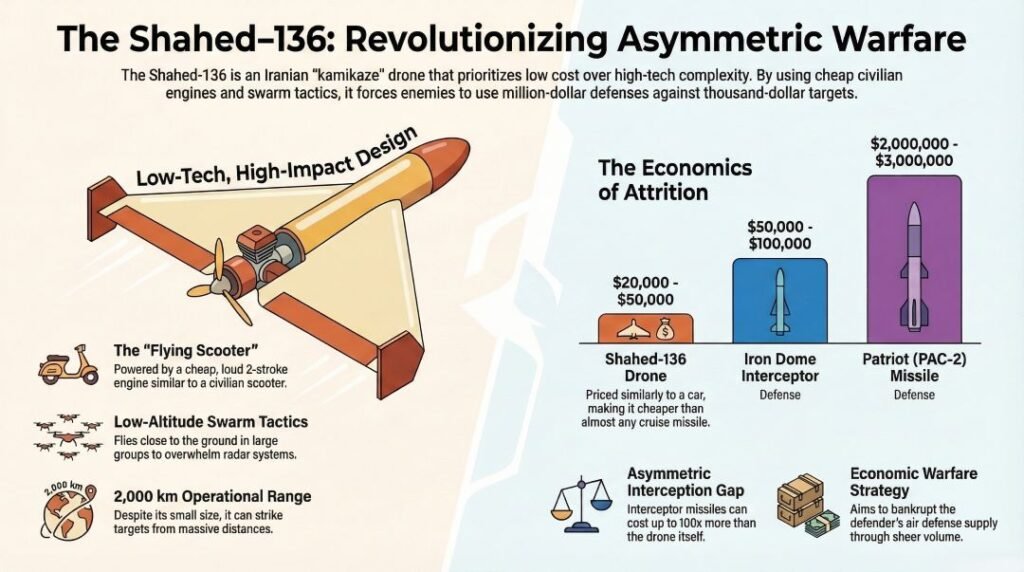
The Shahed-136 sits at the top of the 2026 ranking not because it is the most technically sophisticated drone in the world, but because it is the most strategically disruptive. Its combination of mass production at $20,000-50,000 per unit, a 2,500 km range, and the ability to be deployed in swarms of dozens simultaneously has created an asymmetric warfare problem that every major military power is still struggling to solve.
The cost asymmetry is the central story of 2026 drone warfare. It costs $35,000 to launch a LUCAS or Shahed drone. It costs $2-4 million to fire a Patriot or NASAMS missile to stop it. When defenders fire more expensive interceptors than the cost of the entire drone attack, they lose economically even when they win tactically. This economic logic is driving the rapid growth of the global loitering munition market.
The 2026 version of the Shahed-136 is meaningfully more capable than the 2022 variants used in Ukraine. The drone is now frequently equipped with 4G and Starlink satellite connectivity for beyond-line-of-sight remote control, allowing operators to retarget the drone mid-flight based on real-time intelligence. Its GPS/GLONASS navigation uses 16-element CRPA antennas specifically designed to resist electronic warfare jamming.
The Shahed-136 uses a Mado MD550 four-cylinder piston engine which produces the distinctive buzzing sound Ukrainian civilians call the moped drone. The propeller-driven design prioritises range and endurance over speed. This is changing with the newer Shahed-238 (Geran-3) jet-powered variant described later.
Iran’s export model is particularly disruptive. Iran has sold or supplied Shahed variants to Russia, Houthi rebels in Yemen, and other proxy forces, often in barter deals involving aircraft and weapons rather than cash transactions. This makes the Shahed-136 the most widely proliferated kamikaze drone manufacturing company product in the world after the Israeli Harpy.
#2. AeroVironment Switchblade 600 – USA | The World’s Best Anti-Armour Loitering Munition
Country: USA | Manufacturer: AeroVironment | Range: 40+ km | Speed: 185 km/h | Payload: Anti-tank (Javelin-equivalent) | Price: ~$80,000
The AeroVironment Switchblade 600 is the gold standard for tactical anti-armour loitering munitions. It is tube-launched, folding-wing, backpackable precision system that has been standardised for platoon-level organic strike in the US Army – meaning every infantry platoon is expected to carry its own Switchblade capability rather than relying on centrally allocated fires.
The Switchblade 600’s most important tactical feature is its wave-off capability. Unlike the Shahed-136 which is essentially fire-and-forget, the Switchblade 600 can be aborted as close as 2 seconds before impact if the operator determines the strike is no longer viable – a civilian has appeared in the target zone, the target has moved, or identification is uncertain. This makes the Switchblade far more legally and tactically precise than Iranian or Russian systems.
In 2026, the Switchblade 600 faces backlogged orders due to high demand from Ukraine, France, and Lithuania, combined with ITAR (International Traffic in Arms Regulations) export restrictions that limit supply velocity to allied nations. The AeroVironment kamikaze drone manufacturing company is headquartered in Simi Valley, California, and is the dominant American producer of tube-launched loitering munitions.
- Key advantage: Abortable mid-flight (2 seconds before impact)
- Combat role: Destroy main battle tanks, self-propelled artillery, radar vehicles
- Maintenance: Medium – software updates and battery shelf-life care required
- Export status: High demand, ITAR-restricted, backlogged orders
#3. ZALA Lancet – Russia | Most Combat-Proven Drone in Active Peer Conflict
Country: Russia | Manufacturer: ZALA Aero Group (Kalashnikov subsidiary) | Range: 40-70 km | Speed: 110 km/h | Payload: 3-5 kg shaped charge | Price: ~$35,000
The ZALA Lancet remains the most operationally used precision loitering munition in active peer-on-peer conflict anywhere in the world. Russia’s Lancet-3 has been used to destroy hundreds of pieces of Western-supplied equipment in Ukraine, including M777 howitzers, CAESAR self-propelled guns, Gepard air defence systems, and multiple radar installations.
The 2026 version of the Lancet has been upgraded with enhanced AI target recognition that allows autonomous striking in GPS-jammed environments. This is a significant capability jump – the original Lancet required clear satellite navigation for precision guidance, but the AI-enhanced version can navigate and target using electro-optical and infrared sensors even when all GPS signals are jammed or spoofed.
Russia has tripled Lancet production output since 2023 and has productised the launch system for easy rail transport, meaning Lancet systems can be rapidly repositioned across a vast frontline using standard rail logistics. The sealed canister storage system requires no maintenance for years unless the seal is broken, making it logistically simple compared to fuel-powered systems.
- Key advantage: AI target recognition in jammed environments; proven frontline effectiveness
- Combat record: Hundreds of confirmed Western vehicle kills in Ukraine 2022-2026
- Production status: Mass production, output tripled from 2023 baseline
- Maintenance: Low (sealed canister storage)
#4. IAI Harop – Israel | The Long-Range Anti-Radiation Master
Country: Israel | Manufacturer: Israel Aerospace Industries (IAI) | Range: 1,000 km | Speed: 417 km/h | Payload: 23 kg | Price: $800,000 – $1M+
The IAI Harop is the most technically capable loitering munition in the world at the long-range anti-radiation mission. It can loiter autonomously for up to 9 hours, covering 1,000 km of operational range, detecting and attacking enemy radar emitters without any human input. It has been integrated into major air operations for India and Azerbaijan for SEAD (Suppression of Enemy Air Defences) missions.
India used HAROP drones to attack Pakistani radar and air defence installations, as documented in multiple reports in May 2025 following Operation Sindoor. The India-Israel $8.7 billion defence package approved in February 2026 includes thousands of additional Rampage and Harop systems for deep-strike capabilities, and includes Technology Transfer clauses allowing Indian firms like Adani Defence to manufacture Harop-style drones locally, reducing unit costs by approximately 30%.
The Harop’s dual-mode capability – human-supervised strike or fully autonomous anti-radiation attack – makes it uniquely versatile. The high unit cost ($800,000 to $1M+) is justified by its ability to destroy multi-million dollar S-300 and S-400 air defence systems that would otherwise prevent strike aircraft from operating in defended airspace.
- Key advantage: 9-hour loiter; autonomous anti-radiation; can be recalled and re-engaged
- Combat record: Proven in Azerbaijan 2020; India vs Pakistan 2025
- Export status: Selective; India, Azerbaijan, Germany, Morocco are key buyers
- Maintenance: High (requires climate-controlled storage and expert teams)
#5. Hero-120 – Israel | The Multi-Domain Swarm-Ready Precision Weapon
Country: Israel | Manufacturer: UVision Air | Range: 60 km | Speed: 100+ km/h | Payload: 4.5 kg | Price: ~$150,000
The Hero-120 from UVision Air is part of a modular family of drones, each sized for different mission profiles. The Hero-120 is designed for anti-tank and multi-domain strike missions and can be aborted mid-flight if the target is no longer viable. It is a man-portable system that can be deployed by a two-person team from the field.
In late 2025, UVision unveiled a new multi-launch canister for the Hero-120 that allows rapid swarming deployment – multiple Hero-120s can be launched in quick succession from a single ground vehicle or ship-mounted platform. This development significantly increases the Hero-120’s tactical value, allowing a single operator to launch coordinated multi-drone strikes.
The Hero-120 is now being produced under licence in Europe by Rheinmetall, specifically to bypass Israeli export bottlenecks and meet NATO demand for combat-ready loitering munitions. Italy, Hungary, Germany, and Argentina are among the licensed buyers. The Hero-120 represents Israel’s strategy of creating modular platforms that can be licensed for allied production, expanding market share while reducing geopolitical supply risk.
- Key advantage: Modular family; abort capability; multi-launch canister for swarms
- Export model: Licensed production through Rheinmetall for NATO buyers
- Maintenance: Medium (canister-sealed, high-tech sensors require software care)
#6. Altius-600M – USA | The Most Versatile Long-Range American Loitering Munition
Country: USA | Manufacturer: Area-I / Anduril Industries | Range: 450+ km | Speed: ~400 km/h | Primary Use: Strategic long-range, multi-domain
The Altius-600M is a versatile, tube-launched drone that can be deployed from aircraft, ground vehicles, or surface ships, offering extended range and high-definition sensors that give it a dual role as a surveillance and strike platform. Unlike the Switchblade which is a pure loitering munition, the Altius-600M can function as a long-range reconnaissance asset before transitioning to a one-way attack profile.
Its air-launch capability is particularly significant. Deployed from a manned aircraft at altitude, the Altius-600M can glide silently over hostile territory at extended range before its sensors locate a high-value target. This gives naval strike groups and air forces a standoff precision weapon that does not expose manned aircraft to enemy air defences during the target acquisition phase.
- Key advantage: Triple launch platform (air, ground, sea); dual recon and strike role
- Range advantage: 450+ km vastly exceeds most tactical loitering munitions
- Primary users: US Special Operations Command, US Navy
#7. Nagastra-1 – India | India’s First Indigenous Kamikaze Drone in Service
Country: India | Manufacturer: Solar Industries (EDL) | Range: 30 km | Speed: 100 km/h | Payload: 1.5 kg | Price: ~Rs.4.7 Lakh (~$5,500)
The Nagastra-1 holds a special place in this list as India’s first indigenously produced kamikaze drone to enter actual military service. Developed by Solar Industries’ Economic Explosives Division (EDL), the Nagastra-1 is a man-portable, high-altitude loitering munition designed to operate reliably at the Line of Actual Control (LAC) in Ladakh, where thin air and extreme cold challenge most drone systems.
What makes the Nagastra-1 significant is its unique reusability feature. Unlike most kamikaze drones, the Nagastra-1 is designed to be reusable if no target is found – it can be recovered if the strike is aborted, reducing wastage and logistical cost. This feature also means it requires recovery checks between missions, but the cost advantage of recovering a Rs.4.7 Lakh drone versus expending it unnecessarily is considerable.
The Nagastra-1 achieves a 2-metre circular error probable (CEP), meaning it lands within 2 metres of its intended target. This precision rivals systems costing ten times as much. Solar Industries is executing Rs.150 Crore+ orders for the Indian Army and has received interest from Armenia and Southeast Asian nations, signalling India’s emergence as a drone exporter.
- Key advantage: Reusable if no strike; 2-metre accuracy; designed for high-altitude Himalayan ops
- Production status: Bulk production; Solar Industries targeting Rs.150 Cr+ Indian Army orders
- Export potential: Interest from Armenia and Southeast Asia
- Maintenance: Low (reusable chassis if no strike; requires recovery checks)
#8. WB Electronics WARMATE – Poland | NATO’s Go-To Low-Cost Frontline Loitering Munition
Country: Poland | Manufacturer: WB Electronics | Range: 30 km | Speed: 150 km/h | Payload: 1.4 kg HEAT or thermobaric | Price: ~$12,000-15,000
The WARMATE from Polish kamikaze drone manufacturing company WB Electronics has become the NATO standard for affordable frontline loitering munitions. It is mass-produced across NATO member states to support Ukraine and is considered the go-to low-cost loitering munition for European defence planning.
The WARMATE uses field-swappable warheads, allowing the same airframe to carry a high-explosive anti-tank (HEAT) round against armoured vehicles, a thermobaric warhead against fortified positions and personnel in enclosed spaces, or a fragmentation warhead for general area suppression. This modularity makes it extremely practical for frontline infantry units who face multiple target types.
At $12,000-15,000 per unit, the WARMATE has a maintenance cost that WB Electronics describes as very low due to its field-swappable warhead design and simple airframe. This low cost makes it practical to deploy in large numbers – a tactical approach that NATO has fully embraced to counter Russian loitering munition use in Ukraine.
- Key advantage: Interchangeable warheads (HEAT/thermobaric/fragmentation); very low cost
- NATO status: Go-to standard; mass-produced across NATO members
- Combat use: Extensive use by Ukraine against Russian positions
- Maintenance: Very Low (field-swappable warheads, simple airframe)
#9. Chien Hsiang – Taiwan | Asia’s Most Strategic Coastal Defence Drone
Country: Taiwan | Manufacturer: National Chung-Shan Institute of Science and Technology (NCSIST) | Range: 1,000 km | Speed: 185 km/h | Payload: Classified | Primary Use: Coastal Defence
The Chien Hsiang is Taiwan’s anti-radiation kamikaze drone developed specifically to destroy enemy coastal radar stations essential for island defence. It is a core component of Taiwan’s Drone Wall strategy through 2026, designed to blind Chinese radar installations along the Fujian coast before any amphibious assault could begin.
The 1,000 km range gives Taiwan the ability to strike radar systems across a wide arc of the Chinese coast from multiple launch positions on Taiwan’s main island. Like the IAI Harpy, the Chien Hsiang is designed for autonomous anti-radiation homing – it does not need a human to identify and engage the radar target. The drone hunts the electromagnetic signature.
Taiwan has kept most specifications classified, but defence analysts assess the Chien Hsiang as among the most capable purpose-built anti-radiation loitering munitions outside Israel. Its existence as a 1,000 km range system deployed on an island with ambitions to hold back a major amphibious force is one of the most strategically significant drone programmes in the Indo-Pacific.
- Key advantage: Purpose-built anti-radiation; 1,000 km range; island defence optimised
- Strategic role: Core of Taiwan’s Drone Wall deterrence strategy
- Operational status: Active; key component of Taiwan’s maritime defence through 2026
#10. Shahed-238 / Geran-3 – Iran/Russia | The Jet-Powered Game Changer
Country: Iran (design), Russia (deployment) | Range: ~1,000 km | Speed: 517 km/h | Payload: 40-50 kg | Primary Use: Interception Defiance
The Shahed-238 (designated Geran-3 by Russia) represents a fundamental leap in kamikaze drone capability. Where the original Shahed-136 travels at a leisurely 185 km/h, the Shahed-238 uses a small turbojet engine to reach 517 km/h – nearly three times faster. This speed increase has a dramatic effect on air defence effectiveness.
At 185 km/h, a Shahed-136 gives a defending radar operator approximately 15-20 minutes of warning after detection to prepare an intercept. At 517 km/h, the Shahed-238 compresses that warning window to 5-6 minutes. Against systems that require human authorisation before firing, or against legacy Soviet-era air defence systems with slow reaction times, 5-6 minutes may not be enough to mount a successful defence.
The shift from propeller-driven (low speed, high endurance) to jet propulsion (high speed, lower endurance) is identified as the defining trend of 2026 in kamikaze drone development. The Shahed-238 sacrifices some range compared to the Shahed-136 but gains the ability to defeat the most common air defence intercept windows currently deployed in Ukraine and the Middle East.
- Key advantage: 3x speed of Shahed-136; drastically reduces intercept window
- Strategic impact: Forces defenders to upgrade to faster-reaction systems
- Production: Russia mass-deploying in Ukraine as of late 2025
Global Kamikaze Drone Comparison Table (2026 Data)
Comprehensive technical specifications verified as of 2026.
| Drone | Origin | Range | Top Speed | Payload | Primary Use | Notable 2025-26 Update | Unit Price |
| LUCAS | USA | ~2,000 km | ~190 km/h | 46 kg | Strategic Strike | Combat debut Feb 2026; $35k low-cost alternative to missiles | ~$35,000 |
| Shahed-238 | Iran | ~1,000 km | 517 km/h | 40-50 kg | Interception Defiance | Jet-powered; 3x faster than Shahed-136; drastically reduces warning time | ~$30,000 |
| Shahed-136 | Iran/Russia | 2,500 km | 185 km/h | 50 kg | Infrastructure / Swarms | Now equipped with 4G/Starlink for beyond-LOS remote control | $20-50k |
| IAI Harop | Israel | 1,000 km | 417 km/h | 23 kg | Anti-Radiation (SEAD) | Integrated into Indian and Azerbaijani air operations; $8.7B India deal 2026 | $800k-1M+ |
| ZALA Lancet | Russia | 40-70 km | 110 km/h | 3-5 kg | Tactical / Anti-Armour | Enhanced AI target recognition for autonomous striking in jammed environments | ~$35,000 |
| Switchblade 600 | USA | 40+ km | 185 km/h | Anti-tank | Precision Anti-Armour | Standardised for platoon-level organic strike; can be aborted 2 sec before impact | ~$80,000 |
| Nagastra-1 | India | 30 km | 100 km/h | 1.5 kg | High-Altitude Tactical | Authorised for bulk production; features 2-metre strike accuracy; reusable | ~$5,500 |
| Warmate | Poland | 30 km | 150 km/h | 1.4 kg | Micro-Tactical | Mass-produced across NATO; go-to low-cost loitering munition for European defence | ~$12-15k |
| Chien Hsiang | Taiwan | 1,000 km | 185 km/h | Classified | Coastal Defence | Core of Taiwan’s Drone Wall strategy to deter maritime threats through 2026 | Classified |
| Hero-120 | Israel | 60 km | 100+ km/h | 4.5 kg | Multi-Domain Strike | Multi-launch canister unveiled late 2025 for rapid swarm deployment | ~$150,000 |
Kamikaze Drones in India: The Complete 2026 Picture
India’s kamikaze drone story in 2026 is one of the most dramatic defence transformation stories anywhere in the world. India has gone from a country that imported almost all its loitering munitions to one that is now producing them indigenously, exporting them, and targeting the number one position for low-cost AI-enabled suicide drones for the Global South by late 2026.
Top 10 Military Drones in India: Current Fleet
| Rank | Drone / System | Origin | Role | Status in India (2026) |
| 1 | IAI Harop | Israel (ToT 2026) | Anti-Radiation / SEAD | Used in Operation Sindoor 2025; $8.7B deal includes thousands more + local manufacture via Adani Defence |
| 2 | IAI Harpy | Israel | Autonomous Anti-Radar | In IAF service since 1990s; upgraded fleet; original India kamikaze drone acquisition |
| 3 | Sheshnaag-150 (Project KAL) | India (NRT/HAL/Adani) | Strategic Long-Range | Mass production started UP/Tamil Nadu corridors; 1,000 units/month target by late 2026 |
| 4 | Nagastra-1 | India (Solar Industries) | High-Altitude Tactical | In Indian Army service; bulk production; Rs.150 Cr+ orders; used at LAC/Ladakh |
| 5 | SkyStriker | Israel (assembled India) | Multi-role Strike | Assembled by Alpha Design Technologies; increasing domestic content per batch |
| 6 | CATS Warrior | India (HAL/DRDO) | Loyal Wingman / Swarm | Mother Ship for Sheshnaag-150 swarms; flies ahead of Tejas/Rafale; releases Alpha-S drones |
| 7 | Switch / Combat (IdeaForge) | India | Surveillance / Strike | Transitioning from surveillance to hard-kill munitions; highest flight hours in high altitude |
| 8 | Kisan/Drona-X (Garuda Aerospace) | India | Tactical Strike | Pivoted from agriculture to low-cost tactical kamikaze; 10k units/month capacity |
| 9 | Rudra-L (Adani Defence) | India | Heavy Lift Strike | 50kg+ strategic warheads; joint venture with Israel to build Harop-style drones in India |
| 10 | FWD YAMA (Interceptor) | India | Anti-Drone | Kamikaze-for-kamikazes; crashes into enemy drones; mass production at Rs.5k per unit |
India’s Sheshnaag-150 (Project KAL): The Most Important Drone Story of 2026
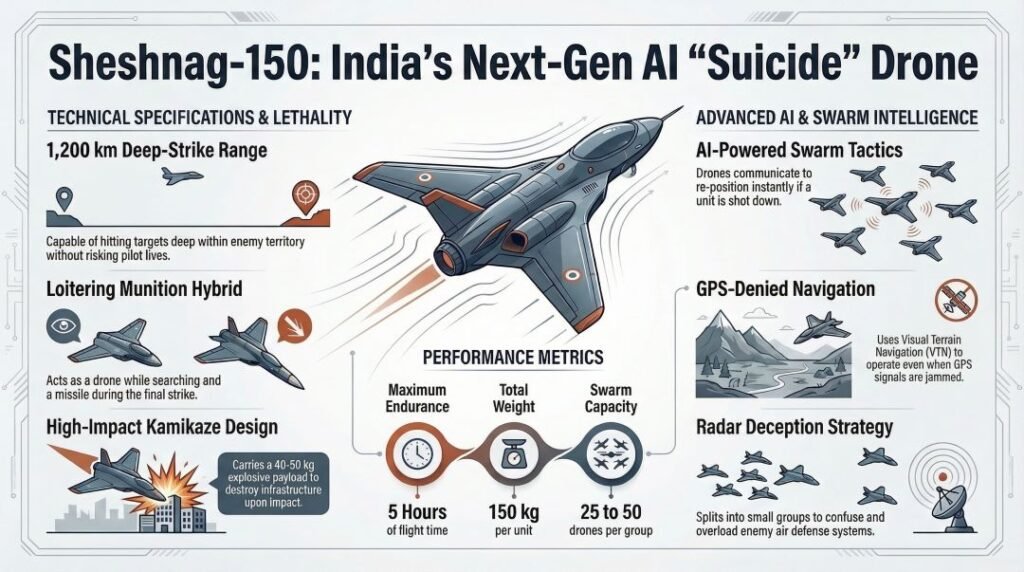
Of all the developments in India’s kamikaze drone programme, the Sheshnaag-150 – the operational production name for Project KAL – is the most significant. Unveiled in March 2026, Project KAL is India’s strategic bid to create a sub-$30,000 drone with a 1,000 km range. This directly threatens the export market dominance of the Iranian Shahed-136 by offering a similar capability from a politically neutral, reliable supplier.
The Sheshnaag-150 is developed by Bengaluru-based NewSpace Research Technologies (NRT) in collaboration with the Indian Ministry of Defence, with HAL providing the airframe engineering and Adani Defence providing production scaling. The name Sheshnaag refers to the mythological multi-headed serpent – a reference to its swarm capability where multiple heads strike simultaneously.
Head-to-Head: Shahed-136 vs. Sheshnaag-150 (2026 Data)
| Feature | Shahed-136 / Geran-2 (Low-Tech) | Sheshnaag-150 (High-Tech) | Why It Matters? |
| Origin | Iran / Russia (Licensed) | India (L&T / HAL / Adani) | India’s first long-range suicide drone |
| Range | ~2,500 km | ~1,200 – 1,500 km | Shahed has more range; Sheshnaag optimised for regional depth |
| Top Speed | 185 km/h | 240+ km/h | Sheshnaag uses more efficient indigenous turbo-prop engine |
| Warhead | 50 kg (High Explosive) | 40 kg (Multi-mode) | Sheshnaag warheads optimised for hardened bunkers |
| Processor | Basic Commercial PLC / ARM | High-End NVIDIA Jetson / FPGA | Allows Edge AI for real-time object recognition (tanks vs trucks) |
| Engine | Mado MD550 (Piston/Loud) | Indigenous Rotary Engine (Quiet) | Lower acoustic signature; enemies cannot hear it coming until too late |
| Navigation | GPS/Inertial (Blind) | NAVIC / AI Visual Odometry | Sheshnaag can fly in 100% GPS-denied zones using AI maps |
| Guidance | Fire-and-Forget (Static) | Man-in-the-Loop / Autonomous | Sheshnaag can be retargeted mid-flight via satellite link |
| Seeker | GPS/Inertial (Blind) | EO/IR (Day/Night Camera) | Sheshnaag can see its target; Shahed only knows coordinates |
| Data Link | Basic Radio / 4G SIM | Secure SATCOM / Mesh Radio | Jam-resistant communication between drones in a swarm |
| Accuracy (CEP) | 10-15 metres (carpet strike) | Under 3 metres (TWIR seeker) | Sheshnaag can hit specific windows or ventilation shafts |
| Unit Cost | ~$30,000 – $50,000 | ~$28,000 – $35,000 | India’s manufacturing scale makes it cheaper for the range offered |
Sheshnaag-150 Warhead Options: The Punch
The Sheshnaag-150 uses a modular nose cone, meaning the Indian Army can swap the payload in minutes based on the target:
- Anti-Armour (Tandem Shaped Charge): Targets main battle tanks (T-90, Type 15). Uses two explosions – first destroys active protection or ERA armour, second pierces the main steel hull
- Thermobaric (Vacuum Bomb): Targets bunkers, caves, and fortified mountain positions in Ladakh. Disperses a fuel cloud that ignites, sucking all oxygen out of a confined space – highly effective in high-altitude mountain warfare
- High-Explosive Fragmentation (HE-FRAG): Targets radar stations, soft-skin vehicles, and infantry. Explodes into thousands of tungsten shards to shred everything within a 50-metre radius
The Mother-Code AI Architecture: How Sheshnaag-150 Thinks
The Sheshnaag-150 does not just fly – it thinks collectively. At the heart of its swarm capability is the Mother-Code AI architecture, developed by NewSpace Research Technologies (NRT) in collaboration with the Indian Ministry of Defence. This AI allows a single operator to command dozens of drones as if they were one single organism.
Unlike traditional drones that require a 1-to-1 pilot-to-drone ratio, Mother-Code uses Decentralised Logic:
- Leaderless Swarming: If the lead drone is shot down, the AI instantly redistributes its mission data to the remaining drones. There is no single point of failure in the swarm
- Target Allocation: The AI automatically scans a battlefield. Instead of all 10 drones hitting the same tank, Mother-Code assigns Drone A to the radar, Drone B to the fuel truck, and Drones C-E to the air defence systems
- Collision Avoidance: Even when flying at 240 km/h in tight formations sometimes just metres apart, the drones use ultrasonic and visual sensors to feel each other and prevent mid-air crashes
- Data Fusion: If one drone sees a target through a gap in the clouds, it instantly shares that visual with every other drone in the swarm, even if they are kilometres away
As of 2026, Mother-Code is being integrated into India’s wider Combat Air Teaming System (CATS). The CATS Warrior unmanned aircraft acts as the Mother Ship that carries Sheshnaag-150s, the Hindustan Turbo Fan Engine (HTFE) provides the high-altitude power needed to launch swarms, the Alpha-S sub-module handles the suicide dive geometry for maximum impact, and Sat-Link Integration uses GSAT-7 series satellites to allow an operator in Delhi to control a swarm in the Indian Ocean.
Sheshnaag-150 Deployment Strategy by Command
The Indian Army has partitioned Sheshnaag-150 and Nagastra-1 units into Integrated Battle Groups (IBGs) across three primary sectors:
| Sector | Deployment Zone | Primary Objective | Drone Type |
| Northern Command | Ladakh (Leh/Nyoma) | Monitoring the LAC; countering high-altitude Chinese armour | Sheshnaag-150 (Long-range) |
| Western Command | Rajasthan/Punjab | Deep strike against enemy mobilisation hubs | Sheshnaag-150 / FPV Swarms |
| Eastern Command | Arunachal (Tawang) | Dense forest surveillance and bunker busting | Nagastra-1 (Tactical/Quiet) |
The Silo Strategy: India is moving away from large airbase dependence. These drones are stored in hardened underground honeycomb silos along the mountains, making them nearly impossible to destroy in a first strike.
India’s Anti-Drone Shield: Stopping the Swarm
As India deploys its own kamikaze drones, it is simultaneously building the world’s most advanced Hard-Kill and Soft-Kill systems to stop enemy kamikaze drones like the Shahed-136. This dual approach – build the weapon and build the defence – is the defining feature of India’s 2026 drone strategy.
| System Name | Mechanism | Role | Status (2026) |
| ZADS (Zombee) | High-Power Micro-Wave (HPM) | Fries the electronics of a drone swarm instantly | Operational at VVP sites |
| Indrajaal | AI-Autonomous Dome | Uses AI to track and jam 1,000+ drones over 4,000 sq km | Protecting key border cities |
| D-4 System | Laser Directed Energy | Silently melts the wings/engines of incoming drones | Integrated with T-90 Tanks |
| FWD YAMA | Interceptor Drone | A Kamikaze for Kamikazes – crashes into enemy drones | Mass Production at Rs.5k per unit |
Kamikaze Drone Price, Maintenance, and Export Data (2026)
| Drone Model | Unit Buy Price | Maintenance Model | Major Exporters | Major Buyers | 2025-26 Commercial Status |
| LUCAS (USA) | ~$35,000 | Disposable (Zero maintenance) | USA (Restricted) | USA (CENTCOM), UK, Australia | Combat debut Feb 2026; strictly for high-tier allies |
| Shahed-136 (Iran) | $20k-$50k | Low; commercial off-the-shelf parts | Iran | Russia, Yemen (Houthis), Venezuela | Most Traded: Barter deals; often traded for fighter jets (e.g. Su-30/33) |
| Nagastra-1 (India) | ~Rs.4.7 Lakh (~$5,500) | Reusable (if no strike); requires recovery checks | India | India (Domestic), Armenia, SE Asia | Bulk Production: Solar Industries executing Rs.150 Cr+ orders for Indian Army |
| Switchblade 600 (USA) | ~$80,000 | Medium; software & battery shelf-life care | USA | Ukraine, France, Lithuania | High Demand: Backlogged orders due to Ukraine war usage; ITAR restricted |
| IAI Harop (Israel) | $800k – $1M+ | High; climate-controlled storage & expert teams | Israel | India, Azerbaijan, Germany, Morocco | Premium: Part of $8.7B India-Israel defence package approved 2026 |
| ZALA Lancet (Russia) | ~$35,000 | Low; sealed canister storage | Russia | Russia (Domestic), Belarus | Mass Production: Output tripled 2023; productised for easy rail transport |
| Warmate (Poland) | ~$12,000-15,000 | Very Low; field-swappable warheads | Poland | NATO Members, Ukraine | NATO Standard: The go-to low-cost loitering munition for European frontline defence |
| Project KAL / Sheshnaag-150 (India) | TBD (target <$30k) | Disposable; target long-range deep strike | India (Dev) | India (Strategic Forces) | Unveiled March 2026: India’s answer to the Shahed-136 for 1,000 km+ strikes |
| Hero-120 (Israel) | ~$150,000 | Medium; canister-sealed but high-tech sensors | Israel, Rheinmetall | Italy, Hungary, Germany, Argentina | Licensed: Produced in Europe by Rheinmetall to bypass Israeli export bottlenecks |
Key Economic Insights and Financial Trends (2026)
- The Disposable Maintenance Model: Unlike fighter jets which cost $30,000 per hour to fly, kamikaze drones have near-zero operational costs because they are Certified Rounds of Ammunition
- Storage Model: Most systems (Switchblade and Lancet) come in sealed all-up rounds in wooden/plastic crates requiring no maintenance for 5-10 years unless the seal is broken
- Software Subscriptions: High-end models (Harop, Hero-120) charge Feature-as-a-Service fees for AI library updates that help the drone recognise new enemy tank types
- The Economic War: Countries like Iran and the US (with LUCAS) are focusing on drones costing under $50k to force enemies to use interceptor missiles costing $2-4 million per shot, winning the war of economic attrition
- Export Trend: The global loitering munition market is projected to reach $2.22 billion in 2026, driven by a 12.3% CAGR
- Indian Market Growth: India is emerging as a drone hub, with indigenous models like the Nagastra-1 significantly undercutting Western counterparts in price while maintaining high precision
BrahMos Missile vs. Sheshnaag-150 Drone: The Efficiency Gap
To understand the shift in modern warfare, we must look at the Efficiency Gap. Using a $1.5 million BrahMos to destroy a $50,000 tank is a financial loss, even if the mission is successful. This is where the Sheshnaag-150 changes the mathematics of Indian precision strike:
| Feature | BrahMos (Supersonic Cruise Missile) | Sheshnaag-150 (Kamikaze Drone) | Strategic Winner |
| Unit Cost | $1.5M – $2M per missile | $30,000 – $35,000 per drone | Sheshnaag (40 drones for 1 missile) |
| Speed | Mach 2.8 (3,400+ km/h) | 240 km/h | BrahMos (hits in minutes) |
| Loitering Ability | Zero (direct flight) | 3 – 5 hours | Sheshnaag (can wait for a target) |
| Warhead | 300 kg | 40 kg | BrahMos (destroyed buildings) |
| Stealth | High (Speed/Kinetic) | Ultra-High (Small/Quiet) | Sheshnaag (harder to detect on radar) |
| Target Type | High-Value (Command Hubs/Ships) | Tactical (Tanks/Artillery/Radars) | Sheshnaag (scalability) |
The 2026 Battlefield Reality: If an enemy convoy is moving through a mountain pass, the Old Way was to call in a Jaguar or Su-30MKI – risking a pilot and a $60M jet. The 2026 Way is to launch a swarm of 10 Sheshnaag-150s from a Toyota Hilux 40 km away. Total Cost: $300,000. Pilot Risk: Zero. Success Rate: 90 percent due to AI target saturation.
Top 5 Indian Private Startups Dominating the Kamikaze Drone Sector (2026)
As of 2026, the Indian private sector has transformed from a components supplier to a global leader in AI-driven loitering munitions.
| Company | Flagship Platform | Unique Tech Advantage | Current Status |
| NewSpace Research (NRT) | Sheshnaag-150 | Mother-Code AI: True leaderless swarming | Largest supplier for Army’s swarm drone requirements |
| Solar Industries (EDL) | Nagastra-1 | Cost-Efficiency: Mass-produced at Rs.4.7 Lakh per unit | Executing Rs.150 Cr+ orders; focus on explosive-integrated drones |
| IdeaForge | Switch / Combat | Reliability: Highest flight hours in high-altitude Himalayas | Transitioning from surveillance to hard-kill munitions |
| Garuda Aerospace | Kisan / Drona-X | Speed-to-Market: Massive manufacturing capacity at 10k units/month | Pivoted from agriculture to low-cost tactical kamikaze units |
| Adani Defence | Rudra-L | Heavy Lifting: Specialised in 50kg+ strategic warheads | Joint ventures with Israel to build Harop-style drones in India |
Top 10 Military Drones Countries in the World (2026)
| Rank | Country | Key Systems | Strengths | 2026 Status |
| 1 | United States | LUCAS, Switchblade, MQ-9, Altius-600M | LUCAS combat debut Feb 2026; largest MALE fleet; most advanced tech | World leader in capability; ITAR limits export velocity |
| 2 | Israel | Harpy, Harop, Hero-120, SkyStriker | Invented loitering munition; most export success; combat-tested every major conflict | World best drone country by innovation; $8.7B India deal 2026 |
| 3 | China | CH-901, Wing Loong, Sky Sword | Largest fleet, fastest production, aggressive export to Africa/ME/C.Asia | Fastest growing kamikaze drone threat globally |
| 4 | Turkey | TB2, Akinci, Kizilelma, Kargu | Highest export success per system; TB2 proven in 5+ conflicts | Dominant NATO exporter; 30+ country buyers for TB2 |
| 5 | Iran | Shahed-136, Shahed-238, Arash-2 | Cheapest mass-production; cost-asymmetry warfare; proxy network globally | Most disruptive economics; jet-powered Shahed-238 active 2025-26 |
| 6 | Russia | ZALA Lancet, Orlan-10, Lantset-3 | Lancet most combat-tested in peer conflict; AI-enhanced target recognition 2026 | Production tripled; AI guidance upgrades underway |
| 7 | India | Sheshnaag-150, Nagastra-1, Harop/Harpy | Operation Sindoor 2025 combat validation; Mother-Code AI; targeting #1 exporter by 2026 | Fastest rising drone power; $8.7B Israel deal + domestic production ramp |
| 8 | United Kingdom | Watchkeeper, Brimstone (air-launched) | Advanced air-launched precision; strong R&D in autonomous systems | Tier 2 NATO; investing in DE (directed energy) counter-drone systems |
| 9 | Poland | WARMATE, FlyEye, Stork | WARMATE NATO standard; most effective European loitering munition in Ukraine | Emerging European leader; mass production for NATO partners |
| 10 | Taiwan | Chien Hsiang, Albatross | Chien Hsiang core of Drone Wall strategy; 1,000 km anti-radiation capability | Drone Wall operational; most significant island-defence drone programme globally |
Key Technical Trends Defining Kamikaze Drones in 2026
- Navigation Shift – From GPS to AI: India’s NAVIC-guided navigation (Sheshnaag-150) and AI-driven Visual Odometry are replacing simple GPS navigation to survive Electronic Warfare (EW) environments. Drones that rely purely on GPS can be spoofed; drones that compare live camera feeds against onboard AI maps cannot.
- Propulsion Revolution – From Propeller to Jet: The shift from propeller-driven (low speed, high endurance) to jet propulsion (high speed, lower endurance) is the defining trend of 2026. The Shahed-238 at 517 km/h versus the Shahed-136 at 185 km/h demonstrates this shift. Future systems will combine jet speed with extended loiter through hybrid propulsion.
- The Economic War of Attrition: The core economic driver of 2026 is Financial Attrition. Units like the LUCAS at $35,000 are designed to force enemies to use interceptor missiles costing $2-4 million to stop them. Defenders go bankrupt before attackers run out of drones. This has forced nations to buy cheaper kinetic interceptors like India’s FWD YAMA anti-drone system at Rs.5,000 per unit.
- AI Swarming – From Single Strike to Collective Intelligence: The Mother-Code architecture deployed in India’s Sheshnaag-150 represents the next generation of drone warfare. Decentralised AI allowing leaderless swarming, automatic target allocation across multiple drones, and collective battlefield intelligence is the capability that separates next-generation systems from current generation.
- Indigenous Disruption – India as the Sweet Spot: Russia/Iran offer high quantity and low intelligence. USA offers high intelligence and extremely high cost. India’s Sheshnaag-150 occupies the sweet spot – high intelligence (Mother-Code AI) at low cost ($30k), making it the most balanced strategic tool for Global South buyers and creating direct competition with Iran’s market.
Also read: Top 10 Most Powerful Weapons of India in 2026 (.PPTX)
FAQ:
What is kamikaze drone meaning?
Kamikaze drone meaning refers to an unmanned aerial vehicle designed to fly to its target and detonate on impact, destroying both itself and the target. Also called a loitering munition or suicide drone, it can circle a target area for hours before striking. The name comes from Japanese World War II suicide pilots. Today’s kamikaze drones have evolved from simple GPS-guided flying bombs to AI-enabled, swarm-capable precision weapons.
Kamikaze drone made by which country first?
The kamikaze drone origin country is Israel. Israel Aerospace Industries (IAI) developed the world’s first true loitering munition, the IAI Harpy, in the 1980s. Israel remains the world’s most prolific and innovative kamikaze drone manufacturing country by export success and technical innovation.
What is kamikaze drone range?
Kamikaze drone range varies enormously: Switchblade 300 has 10 km, WARMATE and Nagastra-1 have 30 km, ZALA Lancet has 40-70 km, Hero-120 has 60 km, Altius-600M has 450+ km, IAI Harpy has 500 km, IAI Harop and Chien Hsiang have 1,000 km, and the HESA Shahed-136 holds the record at approximately 2,500 km for a production loitering munition.
What is kamikaze drone price?
Kamikaze drone price ranges from approximately $5,500 for India’s Nagastra-1 and $6,000 for the Switchblade 300 at the cheap end, to $12,000-15,000 for WARMATE, $20,000-50,000 for the Shahed-136, $35,000 for LUCAS and ZALA Lancet, $80,000 for Switchblade 600, $150,000 for Hero-120, and $800,000 to over $1 million for the IAI Harop at the high end.
What is kamikaze drones price in INR?
Kamikaze drones price in INR: Nagastra-1 (India) approximately Rs.4.7 Lakh, Shahed-136 approximately Rs.17-42 Lakh, Switchblade 300 approximately Rs.5 Lakh, Switchblade 600 approximately Rs.68 Lakh, WARMATE approximately Rs.10-13 Lakh, IAI Harop approximately Rs.2.5 Crore to Rs.4.2 Crore, Sheshnaag-150 (target) approximately Rs.25-28 Lakh.
What are top 10 military drones in India?
India’s top 10 military drones in 2026 are: IAI Harop, IAI Harpy, Sheshnaag-150 (Project KAL), Nagastra-1, SkyStriker (assembled), CATS Warrior, Switch/Combat (IdeaForge), Kisan/Drona-X (Garuda Aerospace), Rudra-L (Adani Defence), and FWD YAMA (anti-drone interceptor).
Which is the world best drone country?
The world best drone country depends on the metric: United States by overall capability and technology, Israel by innovation and loitering munition specifically, Turkey by MALE drone export success with the TB2, Iran by cost-disruption economics with the Shahed series, and India is emerging as the world best drone country by the combination of AI capability (Mother-Code), indigenous production, and targeting the Global South export market with sub-$30,000 precision systems.
What is India’s Sheshnaag-150 / Project KAL?
The Sheshnaag-150 is India’s strategic long-range kamikaze drone developed by NewSpace Research Technologies (NRT) in collaboration with the Indian Ministry of Defence. Unveiled in March 2026, it has a 1,200-1,500 km range, 240+ km/h speed, 40 kg multi-mode warhead, and uses the Mother-Code AI architecture for leaderless swarming. It is India’s direct answer to the Iranian Shahed-136 for the Global South export market, with a target price under $30,000.
Conclusion: The Winner of the Drone War
The top 10 kamikaze drones in the world in 2026 represent a technology revolution that is reshaping military strategy as profoundly as the introduction of the tank in World War I. The Shahed-136 changed the economics of air warfare. The Switchblade 600 gave infantry platoons their own precision strike capability. The IAI Harop gave air forces a weapon that can blind enemy radar networks without risking a pilot. And the Sheshnaag-150 is about to give the Global South access to AI-enabled precision swarm strikes for under $30,000 per drone.
The winner of the drone war is not the nation with the best drone. It is the nation that can manufacture them the fastest. Russia and Iran offer high quantity with low intelligence. The USA offers high intelligence at extremely high cost. India’s Sheshnaag-150 occupies the sweet spot: high intelligence from the Mother-Code AI at low cost, making it the most strategically balanced tool available to any military right now.
By late 2026, India is projected to be the number one exporter of low-cost, AI-enabled suicide drones to the Global South, directly challenging Iran’s market share and positioning itself as the dominant supplier of affordable precision kamikaze drones for every nation that cannot afford American or Israeli systems and the kamikaze drone revolution is not coming. It is already here.
Disclaimer
This article is based entirely on publicly available information, including verified Google AI Mode search results from 2026, PREVIOUS KNOWLEDGE, Drone Federation India publications, defence journals, manufacturer specifications, and open-source intelligence. No classified information has been used. All prices are approximate estimates from public procurement disclosures. For educational and informational purposes only.