
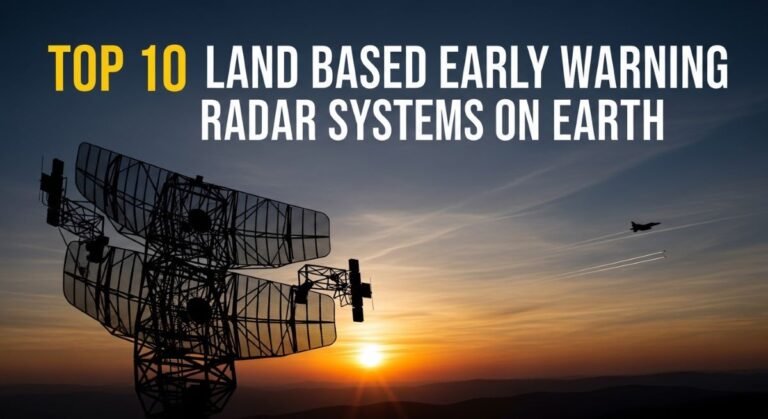
In this article we will know about the Top 10 Land Based Early Warning Radar Systems on Earth with PPT, PDF and Infographic, Why Land Based Early Warning Radar Systems Matter, A Complete Guide to the World’s Most Powerful Military Radar Systems so, Strategic ground-based early warning radar (EWR) systems are the electronic eyes of global defense. Designed to detect ballistic missiles, aircraft, and space objects at ranges of thousands of kilometers, these massive installations represent some of the most impressive engineering feats on the planet.
Table of Contents
When people search for the top 10 radar systems in the world, they are often trying to understand which nations hold the most critical technological advantages in defense. This article delivers exactly that – a detailed, fact-based breakdown of the top 10 land based early warning radar systems currently operational on Earth, combining verified specifications, country-by-country analysis, and expert context that helps you understand what these systems actually do and why they matter.
From the upgraded early warning radars of Russia’s Voronezh program to the best radar system in India (Swordfish), and from U.S. early warning radar installations spanning Greenland to Alaska to the anti-stealth JY-26 Skywatch-U of China, this guide covers the full spectrum of military radar types currently keeping watch over our planet.
What Are Land Based Early Warning Radar Systems?
Land based early warning radar systems are fixed or semi-permanent ground installations designed to detect, track, and characterize airborne threats at extreme ranges. Unlike early warning radar aircraft that operate from the air, these systems operate from fixed positions on the Earth’s surface, giving them far more power, aperture, and endurance than any airborne platform.
There are 3 types of radar most relevant to the early warning mission: (1) Surveillance radars that provide wide-area detection across thousands of kilometers; (2) Tracking radars that follow specific targets with precision; and (3) Discrimination radars that determine whether an incoming object is a real warhead or a decoy. The most advanced systems combine all three functions.
Understanding Early Warning Radar Frequency Band Choices
- UHF/VHF Band: Great for long-distance detection and anti-stealth performance, but less precise for discrimination. Used by Voronezh-DM, AN/FPS-132 UEWR.
- S-Band: The sweet spot for long-range tracking and target identification. Used by LRDR (SPY-7), offering exceptional clarity and heat efficiency.
- L-Band: Ideal for tracking ballistic missiles in boost phase. Used by EL/M-2080 Green Pine, Swordfish (India).
- X-Band: High frequency, high precision. Used for final lock-on before interceptors hit a target. Used by AN/TPY-2, Globus II.
- OTHR (Over-the-Horizon): These systems are massive in kilometers of width and use the ionosphere as a mirror to look thousands of miles over the horizon. Used by Australia’s JORN.
Top 10 Land Based Early Warning Radar Systems on Earth (PPT SLIDES)
The Top 10 Land Based Early Warning Radar Systems on Earth (LBEWRS)
Below are the 10 most powerful and significant land based early warning radar systems currently in operation, ranked and profiled based on detection range, technological sophistication, strategic significance, and operational status.
#1. Voronezh Series (Russia) – Estimated Range: 6,000 km
Country: Russian Federation
Frequency Band: UHF (Decimeter) | Radar Type: Phased Array (PESA)
Estimated Acquisition Cost: $4 Billion (export) / ~$70M (domestic)
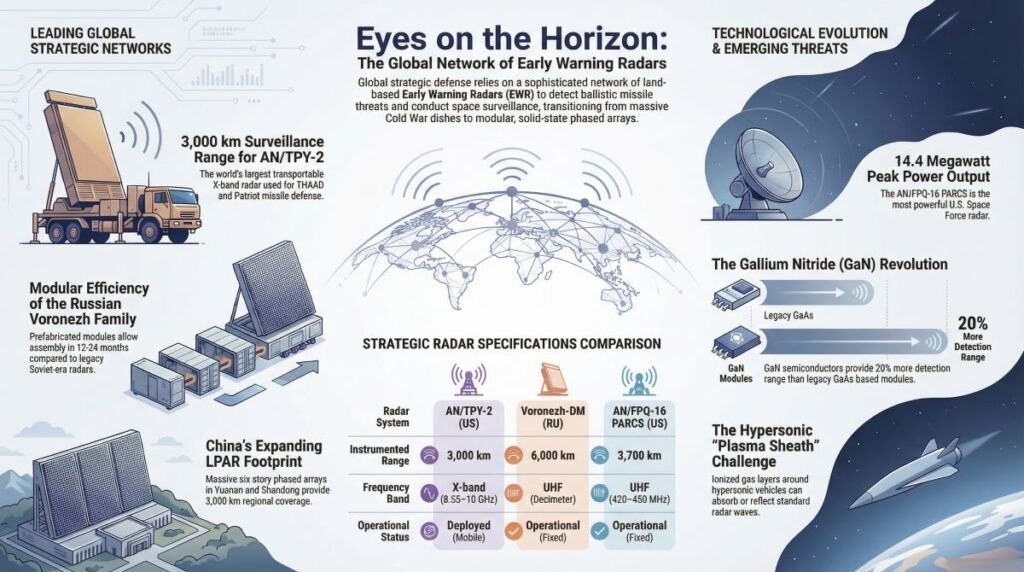
The Voronezh series – including Voronezh-M and Voronezh-DM variants – forms the backbone of Russia’s missile warning network. These massive phased-array radars have a reported range of up to 6,000 km and can monitor up to 500 targets simultaneously. They are deployed at several strategic border locations, including Armavir and Kaliningrad.
What makes the Voronezh program remarkable is its modular, Lego-style construction approach. A full station can be built in just 18 to 24 months – a fraction of the time required for older Soviet-era systems. This speed of deployment is itself a strategic advantage. The Voronezh-DM monitors the Mediterranean and North Atlantic threat corridors, making it one of the most geographically important early warning radar locations in the Russian network.
Fun fact: The Voronezh-DM is so powerful it can reportedly detect an object the size of a football at a distance of thousands of kilometers around the Earth’s curve. Annual maintenance runs approximately $5M–$15M per site.
#2. AN/FPS-132 UEWR (USA/UK/Qatar) – Estimated Range: 5,000 km
Country: United States of America (with allied deployments in UK and Qatar)
Frequency Band: UHF | Radar Type: PESA (Passive Electronically Scanned Array)
Estimated Acquisition Cost: $1.1 Billion – $1.3 Billion per site
The Upgraded Early Warning Radar (UEWR), designated AN/FPS-132, is a strategic UHF system with a range of approximately 5,000 km. It is used for ballistic missile defense and space surveillance, with critical sites at Beale Air Force Base, RAF Fylingdales, and Thule Air Base.
The iconic “golf ball” domes at Fylingdales were replaced by a Solid-State Building (The Pyramid) – one of the most recognizable pieces of defense infrastructure in the world. The system provides 240° to 360° coverage for ICBM detection and is designed to track missiles moving at Mach 20+ while simultaneously tracking space junk. Qatar’s purchase of an AN/FPS-132 system in 2013 was valued at $1.1 Billion.
Annual maintenance cost: $30M–$50M per site. The radar faces are tilted back to look into space rather than just along the horizon, reflecting its dual missile warning and space surveillance mission.
#3. Long-Range Discrimination Radar / SPY-7 (USA) – Estimated Range: 5,000 km+
Country: United States of America (Alaska)
Frequency Band: S-Band | Radar Type: AESA (Active Electronically Scanned Array) using Gallium Nitride (GaN)
Estimated Acquisition Cost: $1.5 Billion+
The Long-Range Discrimination Radar (LRDR) in Alaska features two massive faces over 20 meters tall, providing high-resolution tracking and discrimination capability – meaning it can tell the difference between actual warheads and decoys. Its technology is the basis for the advanced SPY-7 platform.
What sets the LRDR apart is its use of Gallium Nitride (GaN) technology – the same material used in LED lights but at a massive scale. GaN allows the radar to achieve extreme clarity and heat efficiency, making it one of the most advanced S-band systems ever built. The system is designed to withstand extreme Arctic earthquakes and temperatures of -50°C.
Annual maintenance is estimated at $50M–$80M, making it among the most expensive land-based early warning radar systems to sustain. However, its discrimination capability is unmatched, directly enabling effective missile defense intercepts.
#4. Jindalee Operational Radar Network / JORN (Australia) – Estimated Range: 1,000–3,000 km
Country: Australia
Frequency Band: HF (3–30 MHz) | Radar Type: OTHR (Over-the-Horizon)
Estimated Acquisition Cost: $1.8 Billion (Total Project)
The Jindalee Operational Radar Network (JORN) is an Over-the-Horizon Radar (OTHR) that bounces high-frequency radio waves off the ionosphere to see targets beyond the Earth’s curvature. It can monitor air and sea targets across Australia’s northern approaches at distances of 1,000 to 3,000 km.
JORN is essentially a giant telescope that uses radio waves instead of light to look thousands of miles over the horizon. It uses wavelengths that are so long that they can see through the upper atmosphere and reflect off the sky, giving Australia eyes that can look far beyond what conventional radar could detect. It is so sensitive it can detect the wake left by a ship’s hull in the water from 3,000 km away.
Australia’s Phase 6 upgrade alone is a $1.2 Billion program, reflecting ongoing investment in this unique capability. Historical maintenance for a 46-month period was roughly $921.4 Million, illustrating the operational cost of sustaining OTHR technology.
#5. EL/M-2080 Green Pine (Israel/India) – Estimated Range: 500–900 km
Country: Israel / India
Frequency Band: L-Band | Radar Type: AESA
A transportable L-band AESA radar, the EL/M-2080 Green Pine is a core component of Israel’s Arrow missile defense system. It can detect and track ballistic missiles at ranges exceeding 500 km. India operates an indigenous derivative known as Swordfish (LRTR), which reportedly has a range of 1,500 km.
The Green Pine is specifically optimized for intercepting medium-range tactical missiles, making it a combat-proven sensor in Israel’s defense architecture. It has reportedly been used in actual operational conditions during regional conflicts. The system can track multiple incoming ballistic missiles simultaneously and cue interceptors with the precision needed to achieve hit-to-kill intercepts.
#6. AN/TPY-2 (USA/Global) – Estimated Range: 1,000 km+
Country: United States (deployed globally, including UAE)
Frequency Band: X-Band | Radar Type: AESA
Estimated Acquisition Cost: $180M–$200M per unit
Commonly associated with the THAAD (Terminal High Altitude Area Defense) system, the AN/TPY-2 is highly mobile but operates primarily as a ground-based sensor. It has a tracking range of approximately 1,000 km and is capable of detecting missile launches in their early boost phase.
The AN/TPY-2 is the world’s most powerful mobile X-band radar. Despite its power, it can be folded up and transported anywhere in the world by a single C-17 aircraft – making it the Sniper of the radar world due to its incredibly narrow and precise beam. It is often called the Sniper of radars because of its ability to provide a high-frequency micro-look at interceptors in final flight. It operates in high-frequency X-band for precision identification and terminal phase guidance.
Annual maintenance cost: $10M–$20M. While cheaper per unit than strategic wall systems, these require frequent logistics support as they are often deployed in forward, harsh environments.
#7. JY-26 Skywatch-U (China) – Estimated Range: 500 km+
Country: People’s Republic of China
Frequency Band: VHF / UHF | Radar Type: AESA
China’s premier anti-stealth radar, the JY-26 is a long-range 3D surveillance system designed to detect low-observable aircraft like the F-22 and F-35. It has a reported range of up to 500 km and is built to withstand heavy electronic jamming.
The JY-26 uses VHF waves, which are so long that they spill over the edges of stealth aircraft coatings, exploiting a physics phenomenon called resonance. This means that aircraft designed to be invisible to conventional X or S-band radars can still be seen by VHF systems like the JY-26. It made headlines when it reportedly tracked a U.S. F-22 flying over South Korea from mainland China.
It is marketed as the F-22 Hunter because it targets the physical shape of the plane, not its coating. This system represents China’s growing capability as a world best radar system country, directly challenging U.S. stealth dominance.
#8. EL/M-2090 Terra (Israel/India) – Estimated Range: 3,000 km+
Country: Israel / India
Frequency Band: UHF / S-Band (Dual Band) | Radar Type: Dual AESA
The EL/M-2090 Terra is a dual-band system combining UHF (Ultra) and S-band (Spectra) radars to autonomously detect and track satellites and ballistic missiles at very long ranges. India has deployed these systems at strategic locations like Bhopal and Udaipur, giving it a strategic early warning capability that covers key regional threat corridors.
What makes the Terra unique is its dual-band architecture, which combines two different frequency bands for ultra-high-resolution tracking. The UHF band provides long-range detection while the S-band delivers precision tracking data, enabling the system to maintain lock on highly maneuverable targets over ranges exceeding 3,000 km. This makes it one of the most advanced systems in the best radar system in India lineup.
#9. S-500 Prometheus Acquisition Radar (Russia) – Estimated Range: 2,000 km
Country: Russian Federation
The 91N6E(M) acquisition radar, part of the S-500 Prometheus system, is designed to detect ballistic targets at 2,000 km and engage hypersonic missiles. It can also track targets in near-space, including satellites.
The S-500 Prometheus represents Russia’s answer to the hypersonic missile challenge, designed specifically to engage targets moving at hypersonic speeds (Mach 5+). The system’s radar can track objects in near-space and is designed to destroy ballistic missiles in the midcourse and terminal phases, as well as hypersonic glide vehicles – a capability no other operational system in the world currently matches. India is reportedly on the verge of agreeing a $4 billion deal for the S-500 system.
#10. Globus II / AN/FPS-129 (Norway/USA) – Estimated Range: 4,000 km+
Country: Norway (operated jointly with United States)
Frequency Band: X-Band | Radar Type: Mechanically steered dish
Located in Vardo, Norway – a tiny town of only 2,000 people – the Globus II (also known as AN/FPS-129 Have Stare) is a powerful X-band radar used for high-precision space surveillance and missile tracking. While its primary role is space domain awareness, it is an essential node in the global early warning network.
Russia often conducts mock bombing runs near this site because it sits right on their doorstep. The Globus II is essentially a giant telescope that uses radio waves instead of light to image satellites. It provides high-resolution intelligence near the Russian border, making it one of the most geopolitically sensitive early warning radar locations on the planet. Russia regularly conducts simulated attack exercises near Vardo due to the system’s strategic sensitivity.
Comprehensive Comparison of All 10 Systems: Top 10 Land Based Early Warning Radar Systems on Earth
The table below compares all ten land based early warning radar systems by system name, country, primary role, estimated detection range, and key strategic feature:
| System Name | Country | Primary Role | Est. Range | Key Feature |
| Voronezh-DM | Russia | Strategic Ballistic Missile Warning | 6,000 km | Backbone of Russia’s Ground-Based EWR network |
| AN/FPS-132 UEWR | USA / UK | Missile Defense & Space Surveillance | 5,000 km | Giant phased-arrays at RAF Fylingdales and Thule Air Base |
| LRDR (SPY-7) | USA (Alaska) | Precision Discrimination | 5,000 km+ | Located in Alaska; identifies lethal warheads from decoys using GaN technology |
| JORN (Jindalee) | Australia | Over-the-Horizon Surveillance | 3,000 km | Bounces signals off the ionosphere to see beyond Earth’s curve |
| EL/M-2080 Green Pine | Israel / India | Arrow Missile Defense System | 500–900 km | Combat-proven sensor for detecting tactical missiles |
| AN/TPY-2 | USA / Global | Mobile Missile Defense (THAAD) | 1,000 km+ | High-resolution X-band used for forward-based detection; air-transportable |
| JY-26 Skywatch-U | China | Anti-Stealth Surveillance | 500 km | Designed specifically to track F-22 and F-35 stealth aircraft |
| EL/M-2090 Terra | Israel / India | Strategic Early Warning | 3,000 km+ | Massive dual-band system for autonomous satellite tracking |
| S-500 Prometheus Radar | Russia | Hypersonic Missile Defense | 2,000 km | Designed to engage hypersonic missiles and near-space targets |
| Globus II (AN/FPS-129) | Norway / USA | Space Domain Awareness | 4,000 km+ | Located in Vardo; high-resolution intelligence near the Russian border |
Technical Specifications: Frequency Band and Radar Type Comparison
This table covers the Frequency Band, Type of Technology (AESA vs. PESA vs. OTHR), and Strategic Advantage for each of the world’s most significant land-based early warning radar systems:
| System Name | Primary Operator | Frequency Band | Radar Type | Strategic Advantage |
| Voronezh-DM | Russia | UHF (Decimeter) | Phased Array | Monitors Mediterranean and North Atlantic; modular build allows rapid deployment |
| AN/FPS-132 UEWR | USA / UK | UHF | PESA | 240° to 360° coverage for ICBM detection; dual missile warning and space surveillance |
| LRDR (SPY-7) | USA (Alaska) | S-Band (GaN) | AESA | Uses Gallium Nitride (GaN) for extreme clarity and heat efficiency; warhead vs. decoy discrimination |
| JORN | Australia | HF (3–30 MHz) | OTHR | Can see through the Earth’s curvature by reflecting off the sky; covers vast ocean areas |
| EL/M-2080 Green Pine | Israel / India | L-Band | AESA | Optimized for intercepting medium-range tactical missiles; combat-proven in live operations |
| AN/TPY-2 | USA / UAE | X-Band | AESA | High-frequency micro-look to guide interceptors in final flight; fully air-transportable by C-17 |
| Swordfish (India) | India | L-Band | AESA | Tracks targets moving at over Mach 12 (hypersonic speeds); indigenous development based on Green Pine |
| JY-26 (China) | China | VHF / UHF | AESA | Operates on wavelengths that negate many stealth coatings; designed to track F-22 and F-35 |
| EL/M-2090 Terra | Israel / India | UHF / S-Band | Dual AESA | Combines two different bands for ultra-high-resolution tracking of satellites and hypersonic threats |
| Green Pine | Israel / S. Korea | L-Band | AESA | Optimized for intercepting medium-range tactical missiles in active conflict scenarios |
Estimated Costs and Maintenance of Top 10 Land Based Early Warning Radar Systems
Strategic land-based early warning radars include massive initial construction (acquisition) costs and significant annual sustainment. High-power phased-array systems require specialized cooling, high electricity loads, and constant software updates:
| System Name | Estimated Acquisition Cost | Annual Maintenance | Economic/Support Context |
| AN/FPS-132 UEWR | $1.1 Billion – $1.3 Billion | $30M – $50M+ per site | Qatar’s 2013 purchase was valued at $1.1 Billion. Maintenance includes high-op-tempo spares due to corrosive environments. |
| Voronezh-DM/M | $4 Billion (export) / ~$70M (domestic) | $5M – $15M (estimated) | India’s recent Voronezh deal with Russia is valued at $4 Billion. Domestic Russian production is ~1.5–4.3 billion rubles due to modular off-the-shelf parts. |
| JORN (Jindalee) | $1.8 Billion (Total Project) | $30M – $40M | Australia’s Phase 6 upgrade alone is a $1.2 Billion program. Historical maintenance for a 46-month period was roughly $921.4 Million. |
| AN/TPY-2 | $180M – $200M | $10M – $20M | While cheaper per unit than strategic wall systems, these require frequent logistics support as they are deployed in forward, harsh environments. |
| Swordfish (India) | $200M – $300M | $10M – $15M | Based on Green Pine technology; costs are moderated by local manufacturing and long-term obsolescence management by firms like TASL. |
| LRDR (Alaska) | $1.5 Billion+ | $50M – $80M | This high-resolution S-band system is one of the most expensive due to its massive power requirements and extreme Arctic location. |
Key Maintenance Factors for All Strategic Radars
- Electricity Consumption: These radars consume megawatts of power. A single Voronezh-DM station reportedly uses 0.7 MW, while older Soviet designs used up to 50 MW.
- Sustainment Cycles: Systems like the AN/FPS-132 are budgeted over 20-year lifecycles, where sustainment cost often equals or exceeds the original production cost.
- Software Updates: Modern AESA radars are software-defined. A significant portion of maintenance cost goes toward cybersecurity hardening and algorithm updates to detect new threats like hypersonic missiles.
Fascinating Facts: Things Most People Don’t Know About These Radars
Strategic land-based radars are some of the most impressive engineering feats on the planet. Beyond their military utility, their sheer scale and physics-defying capabilities are fascinating:
| System Name | Mind-Blowing Fact | Engineering Marvel | Oddity / Trivia |
| Voronezh-DM | Can detect an object the size of a football at a distance of thousands of km | Uses modular Lego-style design, allowing a full station to be built in just 18-24 months | So powerful it can monitor the flight of a bird across the Mediterranean from Russia |
| JORN (Australia) | Can see thousands of km around the curve of the Earth | Uses the ionosphere as a mirror, bouncing radio waves off the upper atmosphere | So sensitive it can detect the wake left by a ship’s hull in the water from 3,000 km away |
| AN/FPS-132 | The golf ball domes at Fylingdales were replaced by a Solid-State Building (The Pyramid) | Designed to track missiles moving at Mach 20+ while simultaneously tracking space junk | Radar faces are tilted back specifically to look into space, not just along the horizon |
| LRDR (Alaska) | Uses Gallium Nitride (GaN) – the same material used in LED lights – but at a massive scale | Can tell the difference between a real nuclear warhead and a decoy balloon in deep space | Built to withstand extreme Arctic earthquakes and temperatures of -50°C |
| AN/TPY-2 | It is the world’s most powerful mobile X-band radar | Despite its power, can be folded up and transported anywhere in the world by a C-17 aircraft | Often called the Sniper of radars because of its incredibly narrow and precise beam |
| Globus II (Norway) | Located in a tiny Norwegian town (Vardo) with a population of only 2,000 people | Essentially a giant telescope that uses radio waves instead of light to image satellites | Russia often conducts mock bombing runs near this site because it sits right on their doorstep |
| JY-26 (China) | Marketed as the F-22 Hunter because it targets the physical shape of the plane, not its coating | Uses VHF waves, which are so long that they spill over the edges of stealth aircraft coatings | Made headlines when it reportedly tracked a U.S. F-22 flying over South Korea from mainland China |
3 Things Most People Don’t Realize About These Radars
- They Are Time Machines: Because radio waves take time to travel, these radars see the world a few milliseconds in the past. At 3,000 km, the delay is roughly 0.01 seconds.
- They Are Huge Power Hogs: A single strategic radar station can consume enough electricity to power a small city. This is why they often have their own dedicated power substations.
- They Don’t Rotate: Unlike the spinning bars you see on ships or at airports, these strategic radars are Phased Arrays. They use electronics to steer the beam at the speed of light while the antenna stays perfectly still.
Which Is the World Best Radar System Country?
Determining the single world best radar system country depends heavily on the metric you choose. Here is how the major powers rank across different dimensions:
- United States: The most technologically advanced and geographically distributed radar network on Earth. The combination of AN/FPS-132 UEWR, LRDR/SPY-7, Cobra Dane, PARCS, and globally deployed AN/TPY-2 systems gives the U.S. unparalleled missile warning coverage and discrimination capability.
- Russia: The widest national coverage in terms of raw detection range, with Voronezh stations providing near 360-degree ballistic missile warning. The S-500 system also positions Russia as a leader in hypersonic threat detection.
- China: Rapidly closing the gap, particularly in anti-stealth radar technology through systems like the JY-26. China’s investment pace and the breadth of its radar development program make it a legitimate contender for world best radar system country within the next decade.
- India: Building a credible national radar architecture anchored by Swordfish, EL/M-2090 Terra, and ongoing indigenous development programs. India’s best radar system in India (Swordfish/LRTR) capability at 1,500 km represents a significant indigenous achievement.
- Australia: Uniquely placed with JORN’s over-the-horizon capability, giving it surveillance coverage of the entire Indo-Pacific theater that no other nation in the region can match.
The Future of Land Based Early Warning Radar Systems
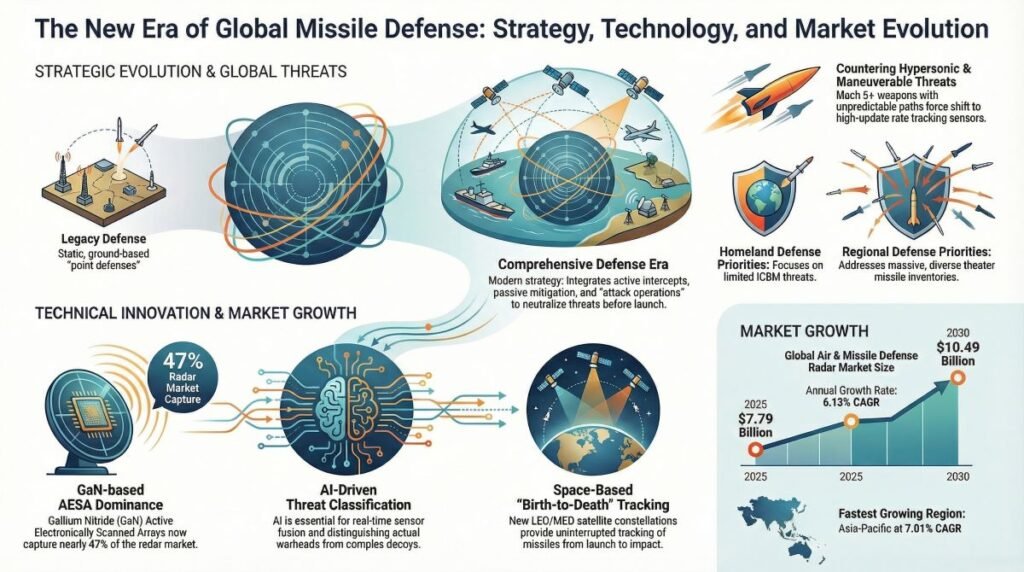
The next generation of land based early warning radar systems will need to address a fundamentally changed threat environment. Hypersonic glide vehicles (HGVs), maneuvering reentry vehicles, and long-range cruise missiles all challenge the detection and tracking assumptions built into legacy systems. As a result, all major powers are pursuing upgraded early warning radars with broader frequency coverage, improved signal processing, and artificial intelligence-driven target discrimination.
The United States is investing heavily in the Next Generation Overhead Persistent Infrared (OPIR) program in addition to modernizing ground-based radars. Russia’s Voronezh program expansion is ongoing. China continues expanding its radar network as part of its anti-access/area-denial (A2/AD) strategy. And emerging defense nations – Japan, South Korea, Saudi Arabia, Australia, and multiple NATO members – are all acquiring or developing advanced radar capabilities.
Key technologies shaping the next generation of military radar types include Gallium Nitride (GaN) solid-state transmitters (already in LRDR), AI-enabled signal processing for faster target discrimination, multi-band hybrid systems like the EL/M-2090 Terra, and space-based infrared cueing systems that give ground-based radars earlier launch detection.
The Invisible Wall: 5 Surprising Ways Modern Radar is Redefining Global Power
In the high-stakes theater of global security, a silent revolution is unfolding just beyond the visible spectrum. While hypersonic gliders and fifth-generation stealth fighters command the headlines, a far more pervasive architecture is quietly shifting the world’s tectonic plates of power: the modern radar. We are witnessing the construction of an “invisible wall”-a multi-layered, digital surveillance net that ensures no launch, no orbit, and no maneuver goes unnoticed. This is no longer the era of mechanical dishes laboriously sweeping the sky. Today’s sensors are solid-state sentinels that interrogate the horizon with millionth-of-a-second precision. From the brutalist pyramids of the Cold War to the emerging economics of laser defense, modern radar systems are fundamentally rewriting the rules of national survival. Here are five surprising ways modern radar is redefining the global balance of power.
1. The 5,000-Kilometer Gaze: Surveillance Without Borders
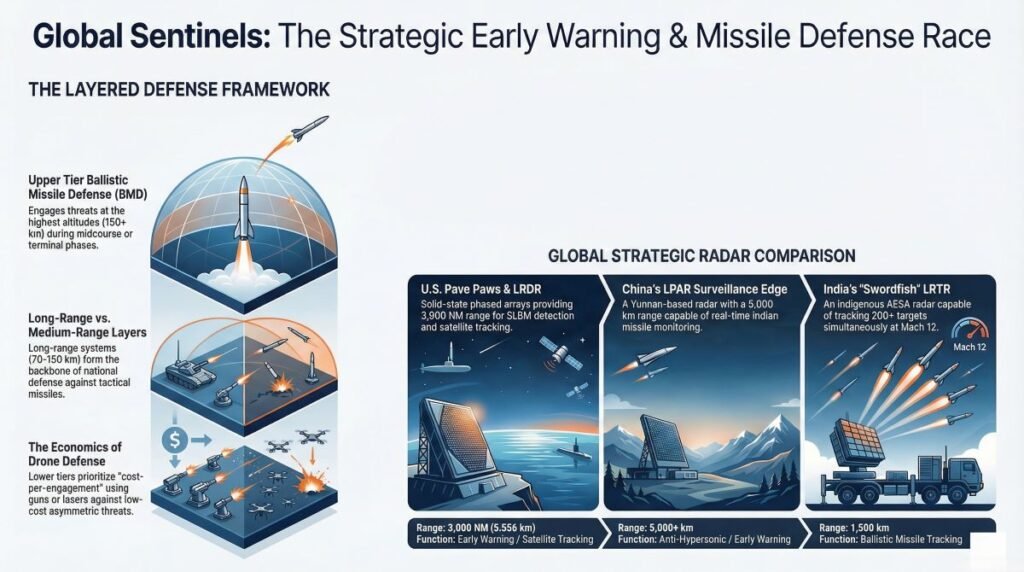
Geopolitical borders have become electronically porous. In China’s Yunnan province, near the border with Myanmar, a new Large Phased Array Radar (LPAR) has effectively extended Beijing’s reach deep into the Indian subcontinent. With a range exceeding 5,000 km, this installation allows the People’s Liberation Army (PLA) to monitor real-time ballistic missile tests conducted at India’s Abdul Kalam Island-over 2,000 km away. This is not merely a tracking station; it is a strategic asset under the command of Base 37 , a specialized unit of the PLA Aerospace Force responsible for Space Situational Awareness (SSA). By saturating the regional battlespace with high-frequency energy, Base 37 can analyze the trajectory of Agni-V intercontinental missiles or K-4 submarine-launched weapons from the moment of ignition. “This system allows Beijing to detect, track, and analyse every missile test India conducts, giving them insights into our strategic capabilities,” stated a senior Indian defense official. The transition from mechanical rotation to electronic scanning allows this “invisible eye” to interweave tracking and surveillance pulses almost instantly, granting Beijing an unprecedented intelligence advantage that erodes the traditional sanctuary of distance.
2. Tracking “Cricket Balls” in Space: The Swordfish Precision
The sensitivity of modern tracking is staggering. India’s Swordfish Long Range Tracking Radar (LRTR) -a derivative of the Israeli Green Pine-exemplifies this technical evolution. However, the Swordfish is far from a mere copy; it is a superior indigenous upgrade. By utilizing domestic Transmit-Receive modules and advanced signal processing, India has created a system significantly more powerful than the base Israeli model. The Swordfish is famously capable of spotting an object as small as a 3-inch cricket ball at a distance of 800 to 1,000 km. This precision is the bedrock of India’s Ballistic Missile Defense (BMD) program, allowing for successful “exo-atmospheric hit-to-kill missions” at altitudes exceeding 80 km. The Swordfish Performance Profile:
- Target Velocity: Engages threats traveling at speeds exceeding Mach 12 .
- Tracking Volume: Simultaneously monitors and discriminates more than 200 targets .
- Future Reach: The new VLRTR (Very Long-Range Tracking Radar) utilizes Gallium Nitride (GaN) -based modules to push detection ranges beyond 3,000 km.
3. The Geometry of Defense: Why Some Radars Look Like Pyramids
Strategic early warning sites like the AN/FPS-115 “Pave Paws” do not look like traditional military hardware; they look like brutalist monuments to the Cold War. Standing as 32-meter-high triangular buildings, these stationary pyramids remain the gold standard for detecting Sea-Launched Ballistic Missiles (SLBMs) in the age of hypersonics. The “phased array” concept is the secret to their longevity. Each face contains thousands of elements that aim radar beams by electronically controlling the phase of the signal. Because there are no moving parts, the radar can redirect its energy in millionths of a second. This allows a single building to maintain a constant “invisible wall” over the horizon while simultaneously focusing a narrow, high-energy beam on a specific threat. This lineage is granular and site-specific to maximize coverage. The AN/FPS-120 at Thule, Greenland, and the AN/FPS-123 at Beale AFB and Clear AFS utilize two-faced arrays, while the unique AN/FPS-126 at RAF Fylingdales features three faces for 360-degree surveillance. The ultimate evolution, the AN/FPS-132 Upgraded Early Warning Radar (UEWR), provides critical minutes of warning, allowing command centers to cue fire control systems long before a re-entry vehicle touches the atmosphere.
4. The Economic Mismatch: Million-Dollar Missiles vs. $500 Drones
Modern air defense is currently facing a dire “Economics Crisis.” The cost-asymmetry of 21st-century warfare has placed global powers on the wrong side of the ledger. While a single Patriot battery costs roughly $1.1 billion, it is being forced to defend against threats that cost less than a laptop. High-tier interceptors like THAAD (Terminal High Altitude Area Defense) are marvels of engineering, but at $12 million to $15 million per shot, they are a ruinous solution for small-scale threats. Using a million-dollar missile to down a $500 commercial drone is a strategic failure of sustainability. Threat Cost vs. Interceptor Cost:
- High-Tier Defense: THAAD Interceptor ( $12M–$ 15M) vs. Ballistic Missiles.
- Mid-Tier Asymmetry: Iron Dome Tamir Interceptor (~ $40K–$ 50K) vs. $500 Drone ( 80:1 defender disadvantage ).
- The Directed Energy Shift: Iron Beam / Dragonfire (~$0.10 per shot) vs. $500 Drone (5,000:1 defender advantage). The “Laser Solution” represents a paradigm shift. By moving from kinetic interceptors to directed energy, defenders can finally flip the economic script, neutralizing swarms for the mere cost of the electricity required to fire the beam.
5. Beyond the Horizon: The Resilience of AESA and GaN
The technical standard for military dominance has shifted from Passive (PESA) to Active Electronically Scanned Arrays (AESA). In an AESA system, the radar’s functions are distributed across thousands of independent solid-state transmit/receive modules. Tech Insight: The AESA Advantage Modern AESA systems, particularly those now incorporating Gallium Nitride (GaN) semiconductors, offer:
- High Resilience: With no single point of failure, the radar can lose dozens of modules and continue its mission.
- Jamming Immunity: AESA radars can “frequency hop” so rapidly that they become nearly impossible for enemy EW suites to blind.
- Low Probability of Intercept (LPI): They can manipulate their signals to appear as background noise, allowing them to “see” the enemy without being detected themselves. As the industry moves toward these GaN-based architectures and “soft-launch” vertical modules, the goal is total integration-a “system-of-systems” where ground, naval, and space-based sensors share a single, unified digital picture.
The Future of the Unseen
In modern warfare, the winner is almost always the one who sees first. As radar technology moves toward complete digital integration and directed energy solutions, the “invisible wall” is becoming both taller and more transparent to those who control it. Yet the “Economics Crisis” remains the ultimate hurdle. If a nation can see a threat 5,000 km away but cannot afford the kinetic cost to shoot it down, is the wall truly effective? As we enter an era of multi-layered digital eyes, the ultimate question is whether traditional stealth can survive against a 4D surveillance net that never blinks. In the chess match of global power, the pulse of a signal is now as lethal as the flight of a missile.
Also read: Mach to Light Speed Chart (Mach Number Conversion Calculator)
Conclusion
Land based early warning radar systems are among the most consequential technologies on Earth. The ten systems covered in this guide represent the current state of the art in global missile defense and airspace surveillance – from the massive phased arrays of the Voronezh and AN/FPS-132 programs, to the precision discrimination of America’s LRDR, to the anti-stealth innovation of China’s JY-26, to the unique over-the-horizon architecture of Australia’s JORN.
Understanding early warning radar range, early warning radar frequency band, and early warning radar locations is no longer just for defense professionals. In a world where ballistic missile threats, hypersonic weapons, and space-based challenges are rapidly multiplying, these systems are the first and most important line of defense for billions of people.
If this deep-dive into the top 10 land based early warning radar systems was valuable to you, share it with others interested in defense technology, military radar live operations, and international security. The world’s early warning network operates 24 hours a day, 365 days a year – and understanding how it works is the first step to understanding modern deterrence.
About This Article
This article was researched and written using publicly available defense sources including Google AI Mode defense research, Jane’s Defence Weekly, Breaking Defense, official government and military publications, Previous Knowledge and Wikipedia open-source radar system data. All technical specifications represent open-source estimates. This content is intended for informational and educational purposes only.