Today in this article we will discuss about the Top 10 Most Expensive Military Drones with PPT and infographics: From Millions to Hundreds of Millions, These Military Tech are So Expensive Even Billionaires Would Think Twice, Welcome to the extraordinary world of military drone technology, where unmanned aerial vehicles cost as much as small fleets of fighter jets. Today’s military drones represent some of the most sophisticated and expensive machines ever built-flying platforms packed with cutting-edge sensors, stealth technology, satellite communications, and in many cases, lethal Weaponry capable of striking targets thousands of miles from their operators.
Table of Contents
This comprehensive ranking examines the ten most expensive military drones currently in service or development, from the ‘affordable’ million-dollar platforms to drones costing over $200 million per unit. These unmanned systems have fundamentally transformed modern warfare, enabling persistent surveillance, precision strikes, oceanic patrol, and even aerial refueling-all without risking pilot lives.
From the legendary MQ-1 Predator that pioneered armed drone warfare to the futuristic MQ-25 Stingray that refuels fighters mid-flight, from the combat-proven Bayraktar TB2 to the ocean-watching BAMS-D surveillance platform, each drone on this list represents a unique solution to specific military challenges. The price tags might seem astronomical-and they are-but these platforms provide capabilities that would be impossible or far more expensive to achieve with traditional manned aircraft.
Note: Cost figures reflect publicly available procurement data and may not include research and development expenses, ground control stations, support equipment, or total program costs. Actual unit costs vary significantly based on production quantities, configuration options, and specific contract terms. All technical specifications represent unclassified publicly available information.
Top 10 Most Expensive Military Drones in the World (.PPTX)
Understanding Military Drone Technology and Costs
Before diving into the rankings, it’s essential to understand what drives military drone costs to such extraordinary levels. These aren’t consumer quadcopters scaled up-they’re sophisticated weapons systems and intelligence platforms designed to operate in the most demanding environments imaginable.
Key Cost Drivers:
- Advanced Sensor Systems: Electro-optical/infrared cameras, synthetic aperture radar, signals intelligence equipment, and maritime surveillance systems costing millions per platform
- Satellite Communications: Beyond-line-of-sight control requiring encrypted, anti-jamming satellite links enabling global operations
- Extended Endurance: 24-30+ hour flight times demanding efficient propulsion, large fuel capacity, and ultra-reliable systems
- Stealth Technology: Radar-absorbing materials, specialized design geometries, and low-observable features for survivability
- Weapons Integration: Precision-guided munitions capability with advanced targeting, fire control, and weapons release systems
These capabilities transform what might be a $50,000 commercial platform into multi-million or hundred-million-dollar military systems. As we’ll see in the rankings, costs escalate dramatically as capabilities expand from basic reconnaissance to stealth penetration, from tactical strikes to oceanic surveillance, and from conventional operations to revolutionary missions like autonomous aerial refueling.
The Top 10 Most Expensive Military Drones: Complete Rankings
#10. RQ-170 Sentinel: ‘The Beast of Kandahar’ (~$4 Million)
Starting at number 10 is the stealthy, mysterious, and thoroughly secretive RQ-170 Sentinel. Estimated at around $4 million per unit-though the real price could be significantly higher because the U.S. government won’t reveal actual costs-this drone represents the entry point into high-end unmanned aerial surveillance.
Platform Profile:
- Estimated cost: ~$4 million (actual cost classified)
- Operator: U.S. Air Force
- Nickname: ‘Beast of Kandahar’
- Configuration: Flying wing stealth design
- Primary mission: Deep penetration intelligence, surveillance, reconnaissance
Stealth and Secrecy: The RQ-170 Sentinel earned its mysterious reputation when aviation enthusiasts first photographed it at Kandahar Airfield in Afghanistan, marking the public’s first glimpse of this classified platform. Built with smooth edges, stealth materials, and no vertical surfaces, the Sentinel is designed for deep infiltration missions that would be suicidal for conventional drones.
Mission Capability: This drone specializes in spying on nuclear facilities, tracking high-value targets, and gathering intelligence in places where other unmanned aircraft would get swatted out of the sky by air defenses. The flying wing configuration and radar-absorbing materials make it extremely difficult to detect, enabling operations deep inside denied territory.
If James Bond needed a drone, this would be it. The platform gained unwanted fame in 2011 when Iran claimed to have captured one intact, providing the world with rare details about this otherwise classified system. Even at the bottom of our cost rankings, the RQ-170 Sentinel represents elite stealth technology prioritizing survivability over payload capacity.
#9. MQ-1 Predator: The OG of Modern Drone Warfare ($6.7 Million)
At number nine sits the OG of modern drone warfare-the MQ-1 Predator. Costing approximately $6.7 million per system, this drone literally changed the world by pioneering the concept of long-endurance armed unmanned aerial vehicles.
Revolutionary Platform:
- Cost: Approximately $6.7 million per system
- Operator: U.S. Air Force (retired 2018)
- Endurance: Over 24 hours of continuous flight
- Armament: Two AGM-114 Hellfire missiles
- Control: Satellite communications for global reach
Historical Impact: The Predator was the first UAV to combine long endurance, high-quality surveillance, and missile-carrying capability into one platform. Originally developed for reconnaissance in the 1990s, the Predator was armed with Hellfire missiles after 9/11, conducting the first armed drone strike in 2001. This capability fundamentally transformed military operations.
24/7 Persistence: With over 24 hours of flight time, satellite control enabling global operations, and the ability to carry Hellfire missiles, the Predator gave militaries 24/7 eyes and strike power without risking pilots. This platform could loiter over targets for an entire day, waiting for the perfect moment to strike or simply gathering intelligence on enemy movements.
Legacy: Even though it’s retired from U.S. service as of 2018, the Predator remains legendary-the granddaddy of every major combat drone flying today. If drones had a hall of fame, this one would be the first inducted. Its operational concepts, design philosophy, and mission profiles directly influenced all subsequent armed UAV development, establishing paradigms that continue defining unmanned warfare.
#8. Hermes 900: The Reliable Workhorse (~$8 Million)
At number eight is the Hermes 900, priced at approximately $8 million and used by multiple countries worldwide. This Israeli-made drone eschews flashy specifications for something more valuable-proven reliability, operational versatility, and mission flexibility.
Operational Excellence:
- Cost: Approximately $8 million
- Manufacturer: Elbit Systems (Israel)
- Operators: Multiple nations including Chile, Brazil, Mexico, Switzerland, Azerbaijan
- Endurance: 30+ hours
- Missions: Border control, search and rescue, battlefield surveillance, maritime patrol
Modular Flexibility: The Hermes 900 is known for reliability, versatility, and staying power. It can fly long missions, carry different payloads, and support everything from border control to search and rescue to battlefield surveillance. Its modular design means operators can swap sensors like Lego blocks-radar, thermal cameras, communication relays, signals intelligence equipment, maritime surveillance packages.
The Hermes 900 is like the practical workhorse of the drone world. Not flashy, not huge, but consistently excellent. That’s why so many militaries choose it over pricier giants-it delivers reliable performance across diverse mission sets without breaking the bank. For nations seeking capable long-endurance surveillance without American price tags, the Hermes 900 represents the gold standard.
#7. Bayraktar TB2: The Combat-Proven Game-Changer ($5-10 Million)
Flying into number seven is the world-famous Bayraktar TB2. Costing between $5-10 million (estimated at the high end for this ranking), this Turkish-made drone has become a global icon thanks to devastating real-world combat performance across multiple conflicts.
Combat Credentials:
- Cost: $5-10 million (approximately $8 million average)
- Manufacturer: Baykar (Turkey)
- Operators: Over 20 countries worldwide
- Armament: MAM-L and MAM-C precision-guided munitions
- Endurance: 27 hours
Battlefield Success: The TB2 has earned legendary status through combat performance, taking out tanks, artillery, air defense systems, convoys, and even warships in conflicts from Syria to Libya to Nagorno-Karabakh to Ukraine. Dramatic footage of TB2 strikes destroying Russian armor in Ukraine made this platform internationally famous, demonstrating that effective drones don’t require American or Israeli price tags.
The TB2’s affordability combined with precision strike capability made it a game-changer for nations that needed effective drones without spending Triton or Reaper money. With excellent optics, long endurance, and deadly accurate munitions, the TB2 proved that a drone doesn’t need to cost hundreds of millions to be devastating on the battlefield. Its export success-over 20 countries and counting-demonstrates how combat-proven capability sells itself.
#6. MQ-8 Fire Scout: The Robotic Helicopter ($12.6 Million)
At number six is the MQ-8 Fire Scout, costing $12.6 million. This platform breaks the conventional fixed-wing mold-it’s a drone helicopter that takes off vertically, hovers, lands on ships, and provides reconnaissance capabilities impossible for traditional drones.
Vertical Flight Advantage:
- Cost: $12.6 million
- Operators: U.S. Navy and Marine Corps
- Configuration: Unmanned autonomous helicopter
- Advantage: Vertical takeoff and landing from small ship decks
- Missions: Reconnaissance, targeting, force protection, convoy security
Naval Operations: The Fire Scout provides reconnaissance for the Navy and Marines from platforms where fixed-wing drones simply cannot operate. Think of it like a robotic lookout that never gets tired. It uses powerful sensors to track targets over land and sea, relay intelligence to commanders, and support ground forces with persistent overhead surveillance.
Being able to operate from tiny ship decks is a huge advantage-destroyers and littoral combat ships gain organic aerial reconnaissance without requiring aircraft carriers. That capability, combined with the complexity of autonomous helicopter flight control, explains the $12.6 million price tag. It’s one of the coolest unmanned aircraft in the fleet: versatile, agile, and mission-ready for naval and littoral operations.
#5. MQ-9 Reaper: The Combat Truck with Wings ($28-32 Million)
Crashing into number five with a massive price tag of $28-32 million is the MQ-9 Reaper, one of the most famous drones ever built. This isn’t a scout drone-it’s a combat truck with wings designed to carry substantial payloads, fly extended missions, and deliver devastating firepower.
Combat Powerhouse:
- Cost: $28-32 million
- Operator: U.S. Air Force and multiple allied nations
- Payload capacity: 3,800 pounds of weapons and sensors
- Armament: Hellfire missiles, GBU-12 Paveway II bombs, GBU-38 JDAMs
- Endurance: 27+ hours
Versatile Arsenal: The Reaper carries bigger payloads, flies longer, and hits harder than its Predator predecessor. It can carry bombs, sensors, missiles, radar pods-you name it. The platform can be configured with electro-optical/infrared cameras, synthetic aperture radar, laser designators, and enough precision-guided munitions to prosecute multiple targets in a single mission.
Militaries love the Reaper because it can do surveillance, reconnaissance, and precision strikes all in one mission. The Reaper is basically the quarterback of the drone world, calling plays and taking action. Its combination of persistence (loitering for over a day), precision (laser-guided weapons), and payload flexibility makes it irreplaceable for counter-terrorism operations, close air support, and armed reconnaissance.
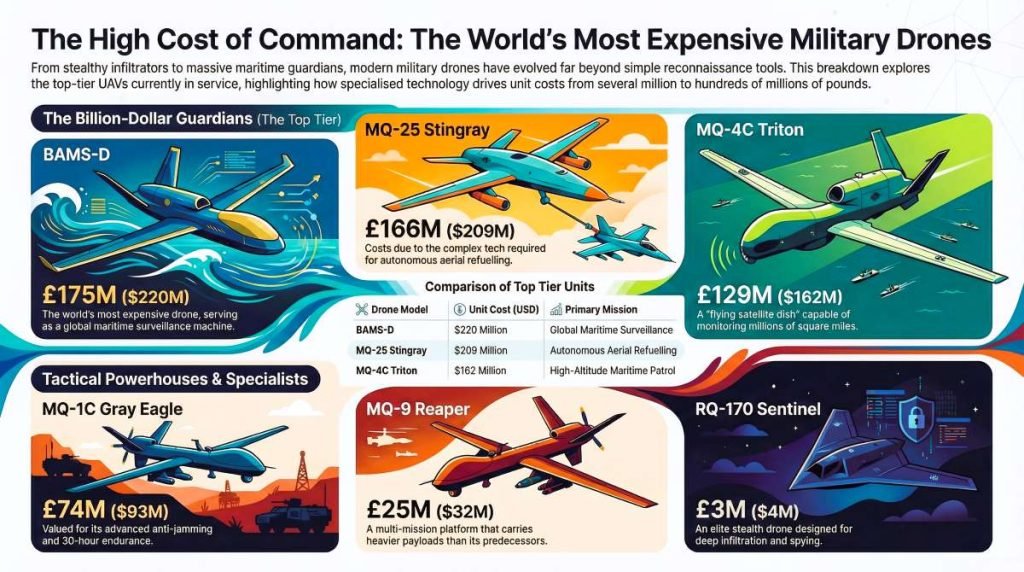
#4. MQ-1C Grey Eagle: The Army’s All-Seeing Eye ($93 Million)
Number four takes a huge leap in price. The MQ-1C Grey Eagle costs an insane $93 million per unit. Why so much? Because this represents the U.S. Army’s ultra-advanced battlefield drone packed with cutting-edge technology designed for the most contested operational environments.
Advanced Battlefield Platform:
- Cost: $93 million per unit
- Operator: U.S. Army
- Endurance: Over 30 hours
- Technology: Anti-jamming systems, advanced encrypted communications, high-end sensors
- Mission: Battlefield ISR, precision strikes, command support
Electronic Warfare Resilience: The massive price reflects anti-jamming systems crucial in contested electromagnetic environments where adversaries attempt to disrupt satellite communications and GPS signals. The Grey Eagle incorporates advanced communication gear that maintains connectivity even when enemies try to jam signals, encrypted data links that prevent interception, and high-end sensors providing unprecedented battlefield awareness.
The Grey Eagle can stay airborne for over 30 hours, track enemy activity continuously, feed commanders real-time battlefield information, and deliver precise strikes when required. It’s basically the Army’s all-seeing, always-watching airborne commander providing the situational awareness necessary for modern combined arms operations. Expensive? Absolutely. Worth it for the Army operating in high-threat environments? Definitely yes.
#3. MQ-4C Triton: The Ocean Guardian ($162 Million)
We’re now in mega-money territory. At number three is the MQ-4C Triton, priced at $162 million. This drone serves as the Navy’s Ocean Guardian, designed to patrol massive stretches of water that would require multiple manned aircraft to cover.
Maritime Surveillance Specialist:
- Cost: $162 million
- Operator: U.S. Navy
- Operating altitude: Up to 56,000 feet
- Coverage: Millions of square miles per mission
- Endurance: 30+ hours
Ocean Surveillance: The Triton flies at 56,000 feet, covering millions of square miles with high-end radar, sensors, and maritime monitoring equipment. Think of it like a flying satellite dish mixed with a spy aircraft. It tracks ships, detects submarines through surface anomalies, monitors coastal activities, and keeps entire oceans under persistent surveillance.
Operating at extreme altitude above weather systems, the Triton provides capabilities that would require numerous P-8 Poseidon manned patrol aircraft to replicate. A single Triton can monitor vast ocean areas continuously for over 30 hours, identifying vessels of interest, tracking submarine activity, and providing maritime domain awareness critical for naval operations. With its size, range, and sophisticated technology, the Triton is one of the most advanced unmanned aircraft ever created.
#2. MQ-25 Stingray: The Flying Gas Station ($229 Million)
At number two is the futuristic MQ-25 Stingray, costing $229 million per unit. This drone represents one of the most revolutionary concepts in naval aviation-a fully autonomous aerial refueling platform that extends carrier strike group combat radius by thousands of miles.
Revolutionary Capability:
- Cost: $229 million
- Operator: U.S. Navy
- Primary mission: Carrier-based aerial refueling
- Fuel transfer capacity: 15,000+ pounds
- Secondary role: Intelligence, surveillance, reconnaissance
Extending Carrier Power: The Stingray’s job is extending the range of F/A-18 Super Hornets and F-35C Lightning IIs by pumping fuel into them while they’re still in the air. This massively boosts the Navy’s capability to strike far-away targets without relying on land bases or dedicating valuable F/A-18s configured as tankers. Previously, Super Hornets had to serve as tankers, reducing available strike aircraft. The Stingray solves this problem.
The technology needed to fully automate aerial refueling is insane-autonomously maneuvering a drogue system to connect with receiving aircraft traveling at hundreds of miles per hour requires extraordinary precision. That complexity, combined with carrier deck operations, sophisticated sensor suites, and the ability to perform secondary ISR missions, explains why the price is sky-high. The Stingray is one of the most important drones shaping the next generation of naval aviation by fundamentally extending carrier strike range.
#1. BAMS-D: The Ultimate Surveillance Machine ($220 Million)
Taking the crown, the most expensive military drone on Earth is the BAMS-D (Broad Area Maritime Surveillance-Demonstrator), costing a staggering $220 million. This beast represents the ultimate maritime surveillance platform-a fully-equipped MQ-4C Triton variant configured for the most demanding oceanic monitoring missions.
Ultimate Surveillance Platform:
- Cost: $220 million
- Operator: U.S. Navy
- Endurance: 30+ hours continuously
- Altitude: Extremely high-above weather systems
- Detection: Submarines, surface vessels, aircraft, coastal activities
Global Ocean Monitoring: BAMS-D can watch entire oceans for over 30 hours straight, using advanced radar and sensors to detect everything from submarines to tiny boats. Operating at extremely high altitudes above weather systems, it provides a non-stop stream of intelligence to naval commanders coordinating fleet operations across vast maritime theaters.
Sensor Integration: The BAMS-D configuration includes the most advanced sensor suite available: multi-function active sensor (MFAS) radar providing 360-degree coverage, electro-optical/infrared cameras with extreme magnification, automatic identification system (AIS) receivers tracking ship transponders, electronic support measures detecting radar and communication emissions, and data links feeding information directly to fleet command centers.
BAMS-D isn’t just a drone-it’s a global surveillance machine capable of monitoring millions of square miles of ocean simultaneously. It can track submarine periscope wakes, identify surface vessels by radar signature, monitor coastal installations, and provide maritime domain awareness that would require numerous manned aircraft to replicate. At $220 million per aircraft, it better be extraordinary-and it is, representing the absolute pinnacle of unmanned maritime surveillance technology.
Also read: Top 10 Most Powerful Tank Rounds in the World (.pptx)
The Billion-Dollar Paradox: Why Military Drones Cost More Than Fighter Jets (UAV, UCAV)
Military Drones also known as Unmanned combat aerial vehicle (UCAV), Unmanned aerial vehicle (UAV), Combat drone (CD) and Fighter drone (FD). These Military drones were supposed to be cheap and expendable-the ultimate “attritable” weapon that could saturate battlefields without risking pilots or breaking budgets. That promise has completely inverted.
Today’s strategic drones have evolved into multi-hundred-million-dollar assets that rival or exceed the cost of fifth-generation fighter jets. The most shocking example? The MQ-4C Triton maritime surveillance drone carries a $618 million price tag-while a used F-16 fighter costs just $15 million.
This isn’t just expensive-it’s a fundamental paradox. We’re building unmanned systems that are now too expensive to lose, completely undermining the doctrine that birthed the drone revolution. From procurement “death spirals” to political gold-plating, from Western component dependencies to vulnerability in modern warfare, the world’s most advanced drones have become cautionary tales in aerospace economics.
The Major Players and Their Problems
The $618 Million Death Spiral: MQ-4C Triton
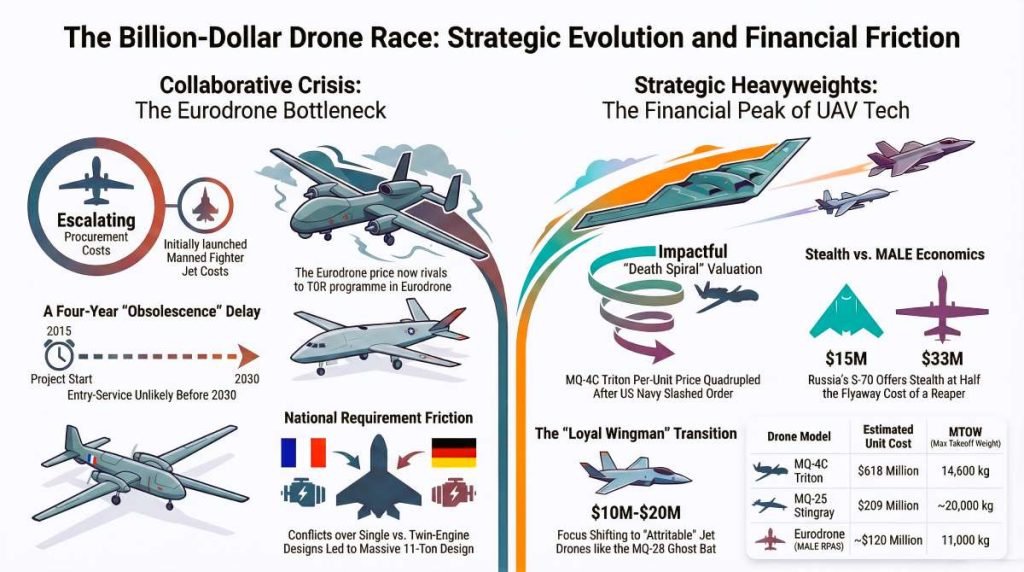
The U.S. Navy’s MQ-4C Triton is the definitive case study in procurement disaster. Originally planned as a 68-unit fleet at $30 million per airframe, budget cuts slashed the order to just 27 units. The result? Front-loaded R&D costs spread across fewer aircraft quadrupled the per-unit cost to $618 million-the same “death spiral” economics that plagued the B-2 Spirit bomber.
Despite the astronomical price, the Triton offers unique capabilities: cruising at 50,000 feet for 30+ hours before descending to 10,000 feet for target identification. This “up-and-down” mission profile requires massive wing reinforcement to handle structural stress in dense oceanic air.
The “Obese” Eurodrone: Gold-Plating Gone Wrong
The European Eurodrone (MALE RPAS) is a €7.1 billion collaboration between Germany, France, Italy, and Spain that’s become a poster child for political dysfunction. Germany’s insistence on a twin-engine design for civilian airspace safety forced the platform to a massive 11-ton takeoff weight.
Analysts have labeled it “obsolete on arrival”:
- Prohibitive cost: $115-120 million per unit-rivaling a Eurofighter jet
- Four years behind schedule: Entry into service delayed until 2030+
- Too fat and slow: Critics argue it won’t survive contested environments
- Strategic misalignment: Built for persistence but lacks survivability
France’s Sovereignty Crisis: Forced to Buy American
Despite championing European “strategic autonomy” and previously retiring U.S. equipment like the E-3F AWACS, France has been forced back to American technology due to Eurodrone failures. Paris is consolidating around the General Atomics MQ-9 Reaper for one critical reason: it has no European equivalent.
The MQ-9B is NATO STANAG 4671 certified, meaning it can fly in non-segregated civilian airspace alongside commercial airliners-a capability European competitors can’t match. Operational reality has finally outweighed political symbolism.
Russia’s “Stealth Discount” with a Western Brain
Russia’s S-70 Okhotnik-B (Hunter) appears to be a bargain at just $15 million for a 20-ton stealth flying wing designed as a “loyal wingman” for the Su-57 fighter. It can carry 2.8-6.2 tons of internal ordnance.
But there’s a fatal flaw: after a friendly fire incident in October 2024 where an S-70 was shot down over Ukraine, wreckage analysis revealed critical dependency on Western components-navigation and targeting systems from Texas Instruments, STMicroelectronics, and Infineon Technologies. Without these sanctioned imports, the drone’s autonomous capabilities are neutralized.
The End of the HALE Era
Iran’s 2019 shoot-down of a U.S. RQ-4 Global Hawk marked a turning point. Large, non-stealthy High-Altitude Long-Endurance (HALE) drones are increasingly viewed as liabilities in Anti-Access/Area Denial (A2/AD) environments. Multi-hundred-million-dollar assets are simply too vulnerable for great power conflicts.
The future belongs to:
- Attritable wingman systems like Boeing’s MQ-28 Ghost Bat-capable but affordable enough to risk
- Jet-powered stealth UAVs like Turkey’s Anka-3 and Kızılelma-prioritizing speed and survivability
- EW-hardened platforms that can operate in GPS-denied, contested environments
Complete Drone Comparison: Cost, Capability, and Vulnerabilities
| Platform | Country | Unit/Program Cost | Weight/Type | Primary Mission | Critical Weakness |
|---|---|---|---|---|---|
| MQ-4C Triton | USA | $618 million (program unit) | 14.6 tons / HALE | Maritime ISR; 30+ hr endurance | “Death spiral” economics; vulnerable in A2/AD |
| MQ-25 Stingray | USA | $209 million (acquisition unit) | ~15 tons | Carrier-based refueling/ISR | Cobham refueling store integration complexity |
| RQ-4 Global Hawk | USA | $140 million (flyaway) | 14.6 tons / HALE | Strategic ISR | High vulnerability; Iran shoot-down 2019 |
| Eurodrone (MALE RPAS) | EU (DE/FR/IT/ES) | $115-120 million | 11 tons / MALE | Multi-role ISR | “Obese” design; 4 years delayed; obsolete on arrival |
| MQ-9B SkyGuardian | USA | ~$100 million (full package) | 6.8 tons / MALE | Multi-role ISR | Slower than jet-powered alternatives |
| S-70 Okhotnik-B | Russia | $15 million (flyaway) | 20 tons / Stealth flying wing | Loyal wingman; hunter-killer | Western component dependency (TI, Infineon, STMicro) |
| MQ-28 Ghost Bat | Australia | ~$15-20 million (est.) | 3 tons / Stealth | Attritable loyal wingman | Still in development/testing |
| Anka-3 | Turkey | ~$20-30 million (est.) | ~7 tons / Stealth jet | Strike/ISR in A2/AD | Limited combat testing |
| Kızılelma | Turkey | ~$25-35 million (est.) | 6 tons / Jet-powered | Fighter escort/strike | Emerging technology |
Technical Capabilities Breakdown
| Platform | Max Altitude | Endurance | Speed | Payload Capacity | Stealth/Survivability |
|---|---|---|---|---|---|
| MQ-4C Triton | 50,000+ ft | 30+ hours | 330 mph | 1,450 kg | Non-stealthy; vulnerable |
| RQ-4 Global Hawk | 60,000 ft | 34+ hours | 310 mph | 1,360 kg | Non-stealthy; proven vulnerable |
| Eurodrone | 45,000 ft | 40+ hours | 370 mph | 2,300 kg | Non-stealthy; civilian-certified |
| MQ-9B SkyGuardian | 40,000 ft | 40+ hours | 210 mph | 2,155 kg | NATO certified; low survivability |
| S-70 Okhotnik-B | 40,000 ft | ~6 hours | 620 mph | 2,800-6,200 kg | Stealth flying wing design |
| MQ-28 Ghost Bat | 38,000 ft | ~3 hours | 600+ mph | 1,000 kg | Attritable stealth design |
| Kızılelma | 40,000 ft | ~5 hours | 590 mph | 1,500 kg | Jet-powered; low observable |
Cost-Per-Mission Comparison: The Economics of Risk
| Platform Type | Procurement Cost | Operational Risk | Mission Profile | Strategic Value |
|---|---|---|---|---|
| HALE (Triton, Global Hawk) | $140-618M | Too expensive to lose | Uncontested ISR; maritime patrol | Obsolete in A2/AD environments |
| MALE (Eurodrone, MQ-9B) | $100-120M | High in contested space | Multi-role ISR; strike in permissive environments | Limited against peer adversaries |
| Stealth Heavy (S-70) | $15M | Moderate (component dependency) | Loyal wingman; penetrating strike | Viable if supply chain secure |
| Attritable (Ghost Bat, Turkish jets) | $15-35M | Acceptable loss rate | Swarm coordination; high-risk missions | Future of contested warfare |
Procurement Philosophy Comparison
| Country/Region | Philosophy | Result | Current Status |
|---|---|---|---|
| USA | High-capability, high-cost strategic assets | Death spiral economics; fleet reductions | Pivoting to attritable systems (MQ-28) |
| Europe | Political consensus + safety requirements | Gold-plating; “obese” designs | Forced to buy American (Reaper) |
| Russia | Low-cost with Western tech | Sanctions vulnerability exposed | Supply chain crisis post-Ukraine |
| Turkey | Rapid development; indigenous supply chain | Cost-effective innovation | Emerging as viable alternative |
| Australia | Partner with USA; attritable focus | Practical modernization | Leading loyal wingman development |
The Bottom Line: Tiered Procurement is the Future
We’re entering an era of “hybrid” or “tiered” air warfare. The lesson is clear: modern forces cannot rely on a few “billion-dollar sentries” too expensive to risk, nor can they depend solely on small tactical drones.
The future belongs to integrated systems where:
- A handful of high-end strategic assets coordinate operations
- Vast swarms of lower-cost, jet-powered “loyal wingmen” execute high-risk missions
- Electronic warfare and GPS-independent navigation enable operations in contested environments
- Procurement costs allow for acceptable loss rates without strategic collapse
As we approach 2030, the defining question remains: Does the ultimate advantage lie with the singular billion-dollar sentry, or with the thousand-dollar swarm?
The answer will likely determine the survival of traditional defense industrial complexes-and possibly the outcome of the next great power conflict. The unmanned revolution hasn’t failed; it’s just discovered that “cheap and expendable” and “strategically capable” exist in fundamentally different tiers of warfare. The winners will be those who master both.
Conclusion: Understanding Value in Military Drone Technology
This ranking-from the $4 million RQ-170 Sentinel to the $220 million BAMS-D surveillance platform-demonstrates the extraordinary range of military drone capabilities and costs. While the price tags might make even billionaires think twice, these unmanned systems provide capabilities that would be impossible or far more expensive to achieve with traditional manned aircraft.
Key insights from these rankings:
- Mission Specialization Drives Cost: From the Fire Scout’s ship-based helicopter operations to the Stingray’s autonomous aerial refueling, each platform solves specific operational challenges
- Combat Effectiveness ≠ Maximum Cost: The $8 million TB2 proved devastatingly effective in multiple conflicts, demonstrating that tactical success doesn’t always require the most expensive platforms
- Technology Integration Justifies Prices: Higher costs reflect advanced sensors, stealth materials, anti-jamming systems, extended endurance, and autonomous capabilities
- Pilot Safety Remains Invaluable: Even $220 million drones cost less than losing trained pilots and manned aircraft worth similar amounts
The legendary MQ-1 Predator pioneered armed drone operations at $6.7 million, establishing operational concepts that defined unmanned warfare. Its successor, the MQ-9 Reaper, expanded capabilities significantly for $30 million, becoming the workhorse of U.S. and allied counter-terrorism operations. The MQ-1C Grey Eagle’s $93 million price reflects Army requirements for contested electromagnetic environments where adversaries actively jam communications.
At the top end, the MQ-4C Triton and BAMS-D represent unprecedented maritime surveillance capabilities, monitoring entire oceans continuously. The MQ-25 Stingray introduces revolutionary aerial refueling automation, extending carrier strike group range by thousands of miles. These platforms justify their astronomical costs by providing capabilities simply unavailable through any other means.
Looking forward, drone technology continues advancing rapidly. Future platforms will likely incorporate artificial intelligence for greater autonomy, advanced stealth for survivability in contested airspace, hypersonic capabilities for time-sensitive missions, and increasingly sophisticated sensors for intelligence collection. Whether costs continue escalating or technology maturation enables more affordable capabilities remains to be seen.
What’s clear is that unmanned aerial systems have become indispensable for modern militaries. From the ‘bargain’ millions to wallet-crying hundreds of millions, these drones represent investments in capabilities that fundamentally changed how nations project power, gather intelligence, and conduct operations worldwide. The question isn’t whether these costs are justified-it’s which capabilities each military prioritizes based on their specific strategic requirements and operational circumstances.
Which drone impressed you the most? The combat-proven TB2 demonstrating effectiveness at modest cost? The legendary Predator that started it all? The futuristic Stingray revolutionizing naval refueling? Or the ultimate BAMS-D surveillance platform watching entire oceans? Each represents a unique solution to military challenges, and collectively they demonstrate how unmanned systems have transformed 21st-century warfare.
About This Analysis
This analysis compiles information from U.S. Department of Defense budget documents, congressional testimony, defense industry publications, manufacturer announcements, and aviation trade media. Cost figures represent publicly available procurement data and may not include research and development expenses, ground control stations, support equipment, training systems, or total program costs. Actual unit costs vary significantly based on production quantities, specific configuration options, contract structures, and whether figures reflect flyaway costs or fully-burdened system costs.
Technical specifications reflect unclassified publicly available information. Classified capabilities, particularly for platforms like the RQ-170 Sentinel and certain BAMS-D sensor systems, remain unknown to the public. Readers seeking detailed technical information should consult official military fact sheets, defense industry publications such as Aviation Week and Jane’s Defence Weekly, congressional budget justification documents, and Government Accountability Office reports on major defense acquisition programs.