

Today in this article, we will discuss about the Top 10 Most Powerful Electronic Attack Aircraft with .pptx and infographic, The Invisible Warriors: Top 10 Electronic Attack Aircraft or Electronic warfare Aircraft Dominating Modern Air Warfare (MAW), Top 10 Electronic Attack Aircraft Dominating Modern Air Warfare perform in Future after upgradation so, Electronic attack aircraft represent one of the most strategically important yet least visible capabilities in modern air warfare. While traditional fighters capture attention with missiles and bombs, these specialized platforms fight in a dimension most people never see-the electromagnetic spectrum. This invisible battlefield encompasses radars, communications systems, navigation signals, and data networks that modern militaries depend upon for coordinated operations.
Table of Contents
The primary mission of electronic attack aircraft is to disrupt, deceive, or completely disable enemy electronics, fundamentally degrading adversaries’ ability to detect friendly forces or coordinate effective responses. At the core of electronic warfare lies information control-using powerful jammers, sophisticated receivers, and advanced signal-processing systems to interfere with hostile radar, block command communications, and inject false signals that create confusion across enemy networks.
What makes electronic attack so powerful is its ability to achieve effects without kinetic weapons. A well-executed electronic attack can neutralize entire air defense networks without firing a single missile, allowing strike aircraft to penetrate defended airspace with dramatically reduced risk. As warfare becomes increasingly dependent on electronic systems, these aircraft have evolved from niche support assets to critical enablers that can determine the outcome of air campaigns.
Understanding Electronic Attack Capabilities
Before examining specific platforms, it’s important to understand the core capabilities that define electronic attack aircraft and how they differ from other military aviation assets.
Electronic Warfare Mission Categories:
- Electronic Attack (EA): Active jamming and disruption of enemy electronics
- Electronic Protection (EP): Defending friendly systems from enemy jamming
- Electronic Support (ES): Detecting and analyzing enemy electronic emissions
- SEAD/DEAD: Suppression or Destruction of Enemy Air Defenses
The aircraft examined in this analysis represent the current state-of-the-art in these mission areas, ranging from large airborne platforms providing theater-wide electronic support to tactical jets conducting direct electronic attack against sophisticated air defense systems.
Regional and Emerging Electronic Warfare Platforms
10. Dassault Rafale F3-R: France’s Multi-Role Electronic Warrior
The Dassault Rafale F3-R represents France’s approach to integrating sophisticated electronic warfare capabilities into a multi-role fighter platform. Unlike dedicated electronic attack aircraft, the Rafale combines fighter, strike, reconnaissance, and electronic warfare missions in a single airframe, demonstrating the trend toward multi-domain integration in modern combat aircraft.
Platform Specifications:
- Maximum speed: Mach 1.8 (approximately 1,912 km/h)
- Combat radius: Approximately 1,850 km with external tanks
- Operating altitude: Up to 50,000 feet
- Propulsion: Twin Snecma M88 turbofan engines
- Configuration: Single-seat or two-seat variants
Electronic Warfare Systems:
- SPECTRA integrated electronic warfare system
- Threat detection and identification across wide frequency spectrum
- Active jamming capabilities with solid-state transmitters
- Missile approach warning system
- Decoy dispensers and active radar cancellation
- Integration with AASM precision-guided munitions for SEAD missions
Multi-Domain Capabilities: What distinguishes the Rafale from dedicated electronic attack aircraft is its true multi-role capability. The SPECTRA system provides comprehensive self-protection and offensive electronic warfare while the aircraft maintains full air-to-air and air-to-ground combat effectiveness. This integration means a single Rafale can conduct SEAD missions, engage enemy fighters, strike ground targets, and provide electronic support-all within a single sortie.
The SPECTRA system employs advanced techniques including active radar cancellation-detecting incoming radar waves and emitting canceling signals that reduce the aircraft’s effective radar cross-section. Combined with the Rafale’s inherently low observability design, this creates a platform extremely difficult to detect and track with conventional radar systems.
Strategic Significance: The Rafale’s combat-proven electronic warfare systems have demonstrated effectiveness in operations over Libya, Mali, Syria, and Iraq. Its ability to penetrate sophisticated air defense networks while conducting strike missions demonstrates that multi-role fighters with advanced EW systems can complement dedicated electronic attack platforms. For nations unable to afford separate specialized aircraft for each mission, the Rafale represents a cost-effective approach to achieving comprehensive electronic warfare capability within a versatile airframe.
9. Embraer R-99: Brazil’s Electronic Intelligence Platform
The Embraer R-99 represents Brazil’s investment in electronic warfare and surveillance capabilities, demonstrating that electronic attack capabilities are no longer exclusively the domain of major military powers. Derived from the successful ERJ-145 regional jet, this platform adapts proven commercial aviation technology for military electronic warfare missions.
Platform Specifications:
- Maximum speed: Approximately 833 km/h
- Operational range: Near 3,500 km
- Operating altitude: Above 37,000 feet
- Mission endurance: Exceeding 7 hours
- Propulsion: Twin turbofan engines
Electronic Systems:
- Advanced side-looking airborne radar (SLAR)
- Electronic intelligence (ELINT) suites for detecting radar emissions
- Communications intelligence (COMINT) systems
- Real-time data transmission to command centers
Strategic Value: The R-99’s significance extends beyond its technical capabilities. By adapting commercial aircraft for military electronic warfare roles, Brazil demonstrated a cost-effective approach to developing sovereign electronic warfare capabilities. The high operating altitude improves sensor coverage and survivability, while the platform’s extended endurance enables persistent surveillance over large geographic areas-critical for a country of Brazil’s size.
8. Shaanxi Y-9 (Electronic Warfare Variant): China’s Theater-Level Platform
The electronic warfare variant of China’s Shaanxi Y-9 represents Beijing’s approach to theater-level electronic operations. Built on a transport-sized airframe, this platform provides the space and electrical power necessary for powerful jamming systems and comprehensive signal intelligence capabilities.
Platform Characteristics:
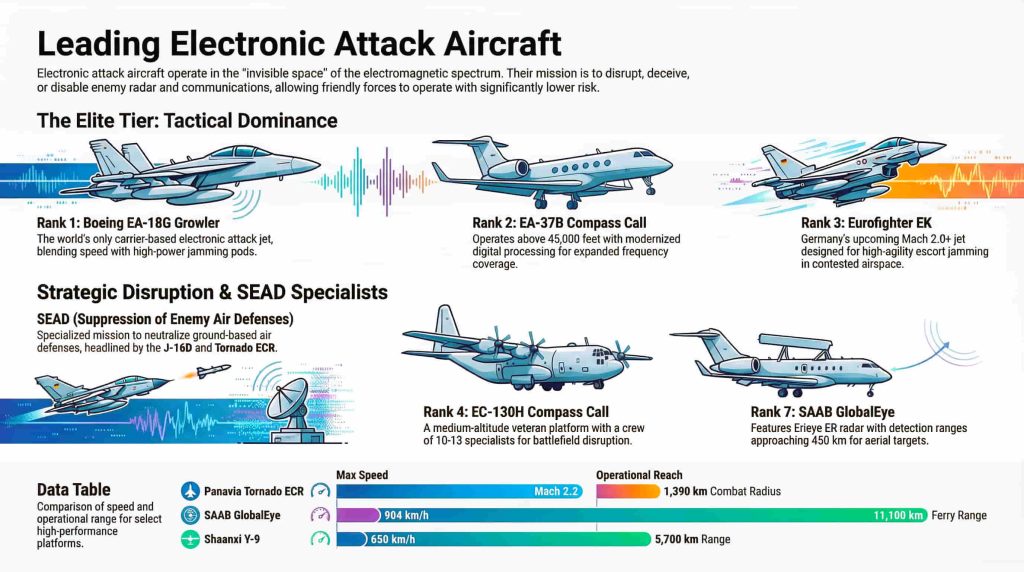
- Maximum speed: Roughly 650 km/h
- Range: Exceeding 5,700 km
- Operating altitude: Approximately 25,000–30,000 feet
- Mission endurance: 8–10 hours
- Propulsion: Four turboprop engines
Electronic Warfare Systems:
- Large external fairings housing antenna arrays
- High-power jamming systems for radar disruption
- Signals intelligence (SIGINT) receivers
- Multiple internal operator consoles
- Substantial electrical generation capacity
Operational Significance: The Y-9’s transport-sized airframe provides advantages that smaller platforms cannot match. The extensive internal volume accommodates multiple operator stations and sophisticated electronic equipment, while powerful electrical systems support high-energy jamming transmitters. The extended endurance enables persistent electronic coverage across theater-sized areas, making it suitable for sustained operations during extended campaigns. This platform reflects China’s growing emphasis on comprehensive electronic warfare capabilities as integral to modern military operations.
7. SAAB GlobalEye: Sweden’s Multi-Domain Sensor Platform
The SAAB GlobalEye represents a different approach to electronic warfare-emphasizing sensor reach and data fusion over direct jamming capability. Based on the Bombardier Global 6000 business jet, this platform demonstrates how advanced sensors can provide critical electronic warfare support even without heavy jamming equipment.
Platform Performance:
- Maximum speed: Near 904 km/h
- Ferry range: Approximately 11,100 km
- Operating altitude: Above 41,000 feet
- Mission endurance: Approximately 11 hours
Sensor Systems:
- Erieye ER AESA radar
- Detection range: Approaching 450 km for aerial targets
- Simultaneous air and maritime tracking
- Integrated SIGINT suite
- Advanced data links for command node operations
- Modern glass cockpit reducing crew workload
Strategic Role: While not a heavy jammer, the GlobalEye’s exceptional sensor reach makes it a critical component of electronic warfare ecosystems. Its high operating altitude provides extraordinary radar horizon coverage, enabling detection and tracking far beyond what ground-based systems can achieve. The integrated SIGINT suite collects electronic emissions for threat analysis and targeting support, feeding data to other platforms that can conduct direct electronic attack. Operating as a high-capacity command node, GlobalEye demonstrates that electronic warfare effectiveness depends not just on jamming power but on information superiority-seeing the electromagnetic battlefield before adversaries do.
Also read: Top 10 Unmanned Ground Vehicles In 2026 (UGVs) Auto Defence
Tactical Electronic Attack Fighter Aircraft
Unlike large airborne platforms that operate from stand-off distances, tactical electronic attack fighters penetrate contested airspace directly, combining electronic warfare capabilities with fighter performance and weapons delivery.
6. Panavia Tornado ECR: Dedicated SEAD Platform
The Panavia Tornado ECR (Electronic Combat and Reconnaissance) represents a generation of purpose-built SEAD aircraft developed during the Cold War. Operated by Germany and Italy, this platform demonstrates the enduring value of aircraft specifically designed for suppression of enemy air defenses.
Aircraft Performance:
- Maximum speed: Mach 2.2 (approximately 2,400+ km/h)
- Combat radius: Near 1,390 km
- Propulsion: Twin turbofan engines
- Variable-sweep wing design
- Crew: Two (pilot and weapons systems officer)
SEAD Systems:
- ECR-90 sensor suite for detecting hostile radar emissions
- AGM-88 HARM anti-radiation missiles
- Terrain-following radar for low-altitude penetration
- Electronic warfare self-protection systems
Tactical Capabilities: The Tornado ECR’s mission concept involves penetrating defended airspace at low altitude using terrain-masking and high speed to avoid detection. The ECR-90 system detects enemy radar emissions, allowing the crew to locate air defense sites. Once identified, these threats can be engaged with AGM-88 HARM missiles, which home in on radar emissions to physically destroy the systems.
The swing-wing design provides tactical flexibility-swept back for high-speed dash at low altitude, extended for better low-speed handling during complex maneuvering. While aging, the platform remains effective in its specialized role, demonstrating that dedicated SEAD design continues to provide capabilities not easily replicated by multi-role aircraft.
5. Shenyang J-16D: China’s Dedicated Electronic Warfare Fighter
The Shenyang J-16D represents China’s entry into dedicated electronic warfare fighters, often compared to the U.S. EA-18G Growler. This platform demonstrates Beijing’s determination to develop comprehensive electronic attack capabilities matching Western standards.
Aircraft Specifications:
- Maximum speed: Approximately Mach 2.0
- Combat radius: Estimated near 1,500 km
- Configuration: Twin-seat tandem
- Propulsion: Twin turbofan engines
Electronic Warfare Features:
- Large wingtip jamming pods
- Altered nose radome housing advanced sensors
- No infrared search and track (IRST) system or internal cannon
- Advanced AESA radar for electronic disruption
- Significant onboard electrical power generation
- Advanced data links for cooperative engagement
Operational Concept: The J-16D is designed specifically for SEAD missions, supporting advanced Chinese fighters like the J-20 and J-10C by securing electronic superiority. The removal of the internal cannon and IRST system reflects the platform’s specialized mission focus-the space and weight are better utilized for electronic equipment rather than traditional fighter systems.
The large airframe provides substantial electrical power generation capacity necessary for powerful electronic transmitters. Advanced data links enable cooperative jamming with other aircraft, multiplying effectiveness through coordinated electronic attack. The J-16D represents China’s growing sophistication in electronic warfare, demonstrating capabilities that approach parity with Western systems.
Specialized Electronic Attack Platforms
4. Lockheed EC-130H Compass Call: Communications Jamming Specialist
The EC-130H Compass Call represents one of the U.S. military’s most effective non-kinetic warfare tools, specializing in disrupting enemy command and control communications. For decades, this platform has provided commanders with the ability to silence adversary networks without firing weapons.
Platform Characteristics:
- Cruising speed: Near 480 km/h
- Mission endurance: Often exceeding 10 hours
- Crew: Can exceed 10–13 specialists
- Based on: C-130 Hercules airframe
Compass Call System:
- Primary weapon: Command and control communications jamming
- Early-warning network disruption
- Multiple high-gain antennas for targeted disruption
- Wide frequency spectrum coverage
- Continuous upgrades improving processing power and signal precision
- Defensive countermeasures protecting the large airframe
Operational Impact: The EC-130H’s mission focuses on severing enemy command and control-preventing commanders from communicating with subordinate units and disrupting coordination between different elements. By operating at medium altitudes while maintaining stand-off distance from threats, the platform can cover large geographic areas with electronic attack.
The large crew reflects the complexity of electronic attack missions-multiple specialists manage different aspects of signal detection, analysis, and jamming. This specialization enables sophisticated electronic attack techniques impossible with smaller crews. The platform’s extended endurance allows sustained operations throughout extended missions, maintaining continuous pressure on enemy communications networks. For decades, it has been one of the most effective tools for non-kinetic battlefield disruption.
Next-Generation Electronic Attack Aircraft
3. Eurofighter EK: Germany’s Future Electronic Combat Fighter
The Eurofighter EK (Electronic Combat) represents Germany’s next-generation approach to electronic warfare, intended to replace the aging Tornado ECR fleet. This platform demonstrates how modern multi-role fighters can be adapted for specialized electronic attack missions while retaining combat flexibility.
Expected Performance:
- Maximum speed: Above Mach 2.0
- Operating altitude: Beyond 55,000 feet
- Exceptional agility for operations within contested airspace
Planned Electronic Warfare Systems:
- Advanced escort-jamming pods (likely derived from Arexis EW system)
- Next-generation anti-radiation missiles for SEAD missions
- Enhanced power generation for energy-intensive jamming equipment
- Sensor fusion improving threat detection and response times
Strategic Advantages: The EK variant’s agility allows it to operate within contested airspace rather than purely from stand-off range-a significant tactical advantage when dealing with sophisticated, mobile air defense systems. The Eurofighter platform’s inherent maneuverability and speed provide survivability that larger, less agile platforms cannot match.
Once fielded, the EK should significantly strengthen Europe’s tactical electronic attack capability, providing NATO with a modern platform optimized for SEAD operations in high-threat environments. The combination of fighter performance with dedicated electronic warfare systems represents the future direction for tactical electronic attack platforms.
2. EA-37B Compass Call: Next-Generation Electronic Attack
The EA-37B represents the U.S. Air Force’s next-generation approach to airborne electronic attack, replacing the EC-130H with a platform offering dramatically improved performance while maintaining mission effectiveness.
Platform Performance:
- Maximum speed: Around Mach 0.9
- Operating altitude: Above 45,000 feet
- Based on: Gulfstream G550 business jet
- Extended range and mission endurance
Advanced Systems:
- Modernized Compass Call baseline
- Improved digital processing capabilities
- Expanded frequency coverage
- Reduced crew requirements through automation
- Advanced mission software
- Open-architecture systems for future upgrades
Operational Advantages: The higher operating altitude significantly increases both jamming effectiveness and sensor reach-electromagnetic signals propagate farther when transmitted from high altitude, while the platform itself gains protection from altitude. The business-jet performance enables rapid deployment across continents, providing combatant commanders with responsive electronic attack capabilities.
The reduced crew requirement reflects advances in automation and signal processing-tasks requiring multiple specialists on the EC-130H can now be managed by fewer operators supported by advanced software. Open-architecture systems ensure the platform can be upgraded as electronic warfare threats evolve, extending operational relevance far into the future. The EA-37B is designed to dominate the electromagnetic spectrum in high-threat environments where the EC-130H’s survivability would be questionable.
1. Boeing EA-18G Growler: The Benchmark Electronic Attack Fighter
The Boeing EA-18G Growler stands as the world’s premier tactical electronic attack aircraft-the only fully dedicated carrier-based electronic warfare fighter in operation. Derived from the F/A-18F Super Hornet, this platform combines fighter performance with sophisticated electronic warfare capabilities that set the standard for modern tactical electronic attack.
Aircraft Performance:
- Maximum speed: Near Mach 1.8
- Combat radius: Around 1,500 km
- Propulsion: Twin turbofan engines
- Crew: Pilot and Electronic Warfare Officer
- Carrier-capable for naval operations
Electronic Warfare Systems:
- AN/ALQ-218 receiver for comprehensive threat detection
- ALQ-99 or Next Generation Jammer (NGJ) pods
- High-power electronic attack capability
- AGM-88 HARM anti-radiation missiles
- Advanced cockpit supporting two-person crew
- Networked data links for cooperative jamming
Unique Capabilities: The Growler’s combination of fighter performance and electronic attack capability is unmatched. The platform can simultaneously jam enemy radar while launching AGM-88 HARM missiles against air defense systems-suppressing threats electronically while destroying them kinetically. This dual capability provides tactical flexibility impossible with platforms limited to either electronic attack or weapons delivery.
The AN/ALQ-218 receiver provides comprehensive threat detection across a wide frequency spectrum, identifying enemy emitters and providing targeting data. The jamming pods generate powerful electronic interference that can blind enemy radars or spoof them with false targets. The Next Generation Jammer represents a quantum leap in capability, offering greater power, precision, and frequency agility than previous systems.
Carrier Integration: As the only dedicated carrier-based electronic attack aircraft, the Growler provides carrier strike groups with organic electronic warfare capability. This eliminates dependence on land-based electronic attack platforms and ensures that naval forces can operate independently in contested electromagnetic environments.
The networked data links enable cooperative jamming with other Growlers or compatible platforms, multiplying effectiveness through coordinated electronic attack. Multiple aircraft can synchronize their jamming to create effects impossible for single platforms, overwhelming sophisticated air defense systems through sheer electromagnetic power.
Combat-proven in multiple conflicts, the EA-18G Growler remains the benchmark against which all other tactical electronic warfare aircraft are measured. Its blend of speed, sensors, and jamming strength, combined with carrier operations capability, makes it the world’s premier electronic attack fighter.
Strategic Analysis: The Electromagnetic Battlefield
Electronic warfare has evolved from a supporting capability to a mission-critical requirement that can determine the outcome of air campaigns. Several strategic themes emerge from examining these nine platforms.
The Spectrum Advantage
Modern warfare is fundamentally dependent on electromagnetic systems-radar for detection, communications for coordination, navigation signals for precision weapons, and data networks for information sharing. Electronic attack aircraft exploit this dependency by denying adversaries access to the electromagnetic spectrum.
The advantage these platforms provide is asymmetric: degrading enemy electronics multiplies the effectiveness of friendly forces while reducing their risk. Strike aircraft can penetrate defenses more safely, ground forces can maneuver without detection, and naval forces can operate with reduced threat from anti-ship missiles-all without necessarily destroying enemy systems kinetically.
Platform Diversity and Specialization
The nine aircraft examined demonstrate that effective electronic warfare requires diverse platforms optimized for different mission profiles. Large airborne platforms like the EC-130H and Y-9 provide theater-wide communications jamming and signal intelligence. Tactical fighters like the EA-18G and J-16D conduct direct attacks against sophisticated air defenses. Sensor platforms like the GlobalEye provide the situational awareness enabling electronic attack to be employed effectively.
This diversity reflects the complexity of the electromagnetic spectrum. No single platform can excel at all electronic warfare missions simultaneously-communications jamming requires different capabilities than radar jamming, SIGINT collection demands different systems than electronic attack, and theater-level operations need different platforms than tactical missions.
Technology Evolution and Adaptation
Electronic warfare is characterized by continuous technological evolution as new threats emerge and countermeasures develop. The progression from the EC-130H to the EA-37B demonstrates how electronic attack platforms must evolve-higher altitude for better performance, greater speed for survivability, improved automation reducing crew requirements, and open architectures enabling rapid upgrades.
Similarly, the development of next-generation systems like the Eurofighter EK and the EA-18G’s Next Generation Jammer demonstrates that even successful platforms require continuous modernization. The electromagnetic threat environment changes constantly as adversaries develop new radars, communications systems, and electronic warfare capabilities.
Global Proliferation
Electronic warfare capabilities are proliferating globally. Brazil’s R-99, China’s Y-9 and J-16D, and Sweden’s GlobalEye demonstrate that sophisticated electronic warfare platforms are no longer exclusive to traditional military powers. This proliferation complicates the electromagnetic battlefield-more nations possess the ability to contest the spectrum, making electronic superiority more difficult to achieve and maintain.
This trend will continue as electronic warfare technology becomes more accessible and as nations recognize the strategic importance of electromagnetic spectrum control. Future conflicts will likely feature contested electromagnetic environments where multiple capable adversaries compete for spectrum dominance.
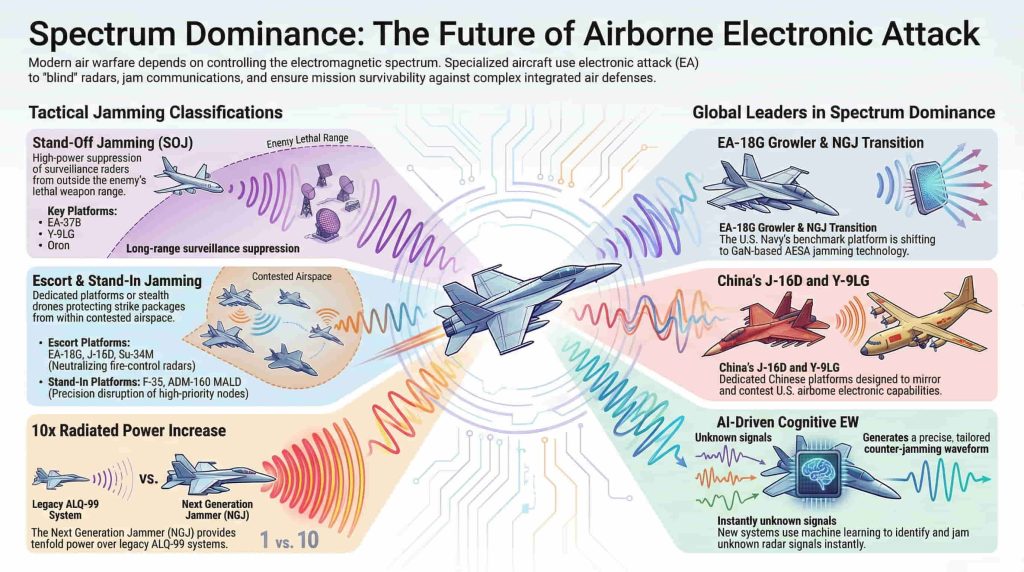
Silent Phantoms: How Electronic Attack Aircraft Are Winning the Invisible War
The Battle for the Electromagnetic Spectrum
A modern Integrated Air Defense System (IADS) can detect a target from hundreds of miles away, yet it remains fundamentally powerless against a ghost in its own circuitry. In contemporary conflict, the most decisive battles are no longer fought with high explosives alone, but within the electromagnetic spectrum-the invisible environment where radar, satellite navigation, and data networks reside. Achieving Electromagnetic Spectrum Superiority (EMSS) is now a prerequisite for any successful air campaign.Electronic Attack (EA) aircraft are the vanguard of this effort. Their mission-to disrupt, deceive, or disable an adversary’s electronic nervous system-is performed using a sophisticated blend of high-power jammers and signal-processing suites. By mastering this hidden front, these platforms can render a billion-dollar defense network blind and deaf, effectively winning the war of information before a single kinetic shot is fired.
Non-Kinetic Attrition: The Doctrine of Electromagnetic Neutralization
The strategic utility of electronic attack lies in its ability to achieve “soft kills”-neutralizing enemy capabilities without the traditional risks associated with munitions-based attrition. Through the deployment of spectrally agile jammers, EA aircraft interfere with hostile radar and sever the communication links between commanders and their frontline units.This capability creates “safe corridors” for friendly strike packages, allowing conventional assets to penetrate heavily defended airspace with significantly higher survivability rates. This transition toward non-kinetic neutralization represents a fundamental shift in air doctrine, prioritizing the suppression of the enemy’s ability to see and coordinate over the physical destruction of their assets.”In many cases, a well-executed electronic attack can neutralize an air defense network without firing a single weapon, allowing strike aircraft to operate with far lower risk.”
Carrier-Based Chaos: Why the Growler Remains the Gold Standard
The Boeing EA-18G Growler remains the undisputed benchmark for tactical Electronic Warfare (EW), standing as the world’s only dedicated carrier-based electronic attack jet. Derived from the F/A-18F Super Hornet, the Growler bridges the gap between high-performance fighter maneuvers and specialized electronic disruption.While the AN/ALQ-218 receiver provides precise threat identification and geolocation, the aircraft’s true “teeth” lie in its external pods-the legacy ALQ-99 or the cutting-edge Next Generation Jammer (NGJ). Managed by a two-person crew consisting of a Pilot and an Electronic Warfare Officer (EWO), the Growler can simultaneously jam enemy radar while launching AGM-88 HARM (High-speed Anti-Radiation Missiles). This dual-threat capability allows it to execute Suppression of Enemy Air Defenses (SEAD) missions at Mach 1.8, securing a 1,500 km combat radius from the flight deck of a carrier.
Elevating the Jam: The Strategic Shift to the EA-37B
The U.S. Air Force is currently overseeing a generational leap in stand-off jamming by transitioning from the Lockheed EC-130H Compass Call to the next-generation EA-37B. This evolution moves the mission from a slow, turboprop-driven airframe (cruising at 480 km/h) to a modified Gulfstream G550 business jet capable of Mach 0.9.This shift isn’t just about speed; it is about the physics of the radar horizon. By operating above 45,000 feet-significantly higher than the legacy C-130-the EA-37B dramatically expands the line-of-sight reach of its electronic attack suite. This altitude allows a single platform to dominate a larger geographic theater while remaining outside the lethal engagement envelope of many ground-based Surface-to-Air Missiles (SAMs). Furthermore, while the EC-130H required a massive crew of 10–13 specialists, the EA-37B leverages advanced automation to reduce manning requirements while increasing signal precision in high-threat environments.
Strategic Persistence: The GlobalEye’s Multi-Domain Command Node
The SAAB GlobalEye, based on the Bombardier Global 6000, represents the pinnacle of multi-domain surveillance. While it is not a “heavy jammer” in the tactical sense, it serves as a high-capacity command node that is indispensable to the EW ecosystem. Its Erieye ER AESA radar offers a sensor reach of 450 km, tracking aerial and maritime threats simultaneously from altitudes exceeding 41,000 feet.The GlobalEye’s true value is its persistence. With an 11-hour mission endurance and a ferry range of 11,100 km, it provides the sustained overwatch necessary for modern SIGINT (Signals Intelligence) collection. By gathering and analyzing electronic emissions in real-time, it feeds critical targeting data to tactical assets, serving as the “all-seeing eye” that coordinates the electronic battlefield.
Low-Level Lethality: The Tornado ECR and the SEAD Mission
For the German and Italian air forces, the Panavia Tornado ECR (Electronic Combat and Reconnaissance) remains the premier tool for the physical destruction of radar sites. This specialized “swing-wing” aircraft is designed for high-speed, low-altitude penetration of defended airspace, utilizing terrain-following flight to stay beneath enemy radar coverage.Operating with a crew of two, the Tornado ECR uses its ECR-90 sensor suite to home in on hostile emissions. Once a radar site is localized, the aircraft deploys AGM-88 HARM missiles to neutralize the threat. Capable of a Mach 2.2 dash and possessing a combat radius of 1,390 km, the Tornado ECR exemplifies the “hard-kill” side of the SEAD mission, physically clearing the way for subsequent waves of strike aircraft.
Asymmetric Dominance: China’s Dual-Track EW Strategy
China has developed a sophisticated, two-tiered approach to electronic superiority. At the tactical level, the Shenyang J-16D serves as a dedicated EW strike fighter. To maximize its electronic payload, the J-16D features a “no IRST/cannon” configuration, replacing the internal gun and infrared sensors with specialized internal EW equipment and an altered nose radome. Equipped with large wingtip jamming pods and AESA radar, it flies in tandem with J-20 and J-10C fighters to secure local electronic superiority.At the theater level, the Shaanxi Y-9 (EW variant) provides persistent, wide-spectrum disruption. Utilizing a large transport-sized airframe, the Y-9 possesses the massive electrical generation capacity required to power heavy transmitters for radar and communication jamming. With a mission endurance of 8–10 hours and a range exceeding 5,700 km, the Y-9 ensures that China can maintain a dominant electronic presence across an entire maritime or terrestrial theater.
The Future of the Invisible Battlefield
The trajectory of aerial combat is moving toward increasingly energy-intensive jamming and seamless sensor fusion. Germany’s upcoming Eurofighter EK, which will integrate the Arexis electronic warfare system and next-generation anti-radiation missiles, highlights the trend of “escort jamming”-high-agility platforms that operate within contested airspace rather than from the sidelines.As we move deeper into the 21st century, the distinction between a “fighter” and an “electronic attack platform” will continue to blur. In an era where information is the primary weapon and data links are the lifeblood of the military, the question remains: In an age where information is the primary weapon, can any nation truly be secure without dominating the electromagnetic spectrum? Control of the invisible war is no longer a luxury; it is the foundation of modern national defense.
Conclusion
Electronic attack aircraft represent one of modern warfare’s most critical yet least visible capabilities. The nine platforms examined in this analysis-from Brazil’s R-99 to the U.S. Navy’s EA-18G Growler-demonstrate the diversity and sophistication of current electronic warfare capabilities.
These aircraft operate in an invisible dimension that most people never consider, yet their impact on military operations is profound. By controlling the electromagnetic spectrum, they enable friendly forces to operate more effectively while degrading enemy capabilities. In many scenarios, a well-executed electronic attack can achieve strategic effects without firing a single kinetic weapon-neutralizing air defenses, disrupting command and control, and creating confusion that cascades through enemy organizations.
As warfare becomes increasingly dependent on electronic systems, the importance of these platforms will continue growing. Future conflicts will be won or lost based on which side can control the electromagnetic spectrum-detecting enemy signals while protecting friendly emissions, jamming hostile systems while maintaining own communications, and achieving information superiority that translates into operational advantage.
The electronic warriors fly missions the public rarely hears about, wielding weapons most people cannot see, achieving effects that are difficult to photograph or quantify. Yet their contribution to military effectiveness is undeniable. In the invisible battlefield of the electromagnetic spectrum, these nine aircraft and their successors will continue defining what it means to achieve air superiority in the 21st century.
About This Analysis
This comprehensive analysis is based on publicly available information from defense publications, official military sources, and manufacturer specifications. This analysis is based on public information from defense publications, Wikipedia, Notebooklm, Chatgpt, Google, official government sources, and reputable military analysis organizations. Technical details reflect open-source intelligence and may not include classified capabilities or sensitive operational information.
Electronic warfare capabilities evolve rapidly as new threats emerge and countermeasures develop. Readers seeking current information should consult primary sources including defense industry publications, official military announcements, and peer-reviewed analysis from recognized defense research organizations.