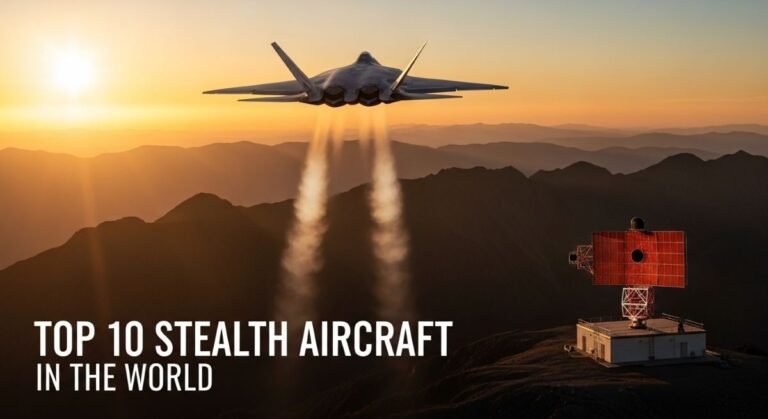
Today, we will discuss about the Top 10 Stealth Aircraft in the World 2026 with PPT, PDF and Infographic so, When we talk about the most advanced military technology on the planet, stealth aircraft always come up first. These flying machines are not just fast or powerful – they are practically invisible to radar systems, capable of penetrating enemy airspace without being detected, and they have fundamentally changed how modern warfare is conducted.
Table of Contents
In this article, we bring you a complete and up-to-date list of the top 10 stealth aircraft in the world 2026. Whether you are searching for the best stealth aircraft in the world, the fastest stealth aircraft, the most advanced stealth aircraft, or simply want to know which countries have stealth aircraft, this guide covers everything you need. We have ranked these aircraft based on their stealth capabilities, speed, payload, operational role, radar cross-section, and overall combat effectiveness. Let us dive right in.
What Is a Stealth Aircraft?
A stealth aircraft is a military aircraft designed to avoid detection using a combination of features that reduce its radar cross-section (RCS), infrared signature, visual, and acoustic footprints. The technology behind stealth aviation includes specially shaped airframes, radar-absorbing materials (RAM), internal weapons bays, and other design innovations that make the aircraft nearly invisible to radar systems.
Since the first stealth aircraft – the F-117 Nighthawk – took its historic flight in the 1970s, the technology has evolved dramatically. Today, stealth aircraft are used across multiple roles: stealth fighters, stealth bombers, stealth jets, and even stealth drones are part of modern air forces worldwide.
How Many Stealth Aircraft Are There in the World?
As of 2026, relatively few countries have stealth aircraft in their active arsenal. The United States leads by a wide margin, fielding multiple stealth platforms across its Air Force and Navy. China has made rapid strides with its J-20 and J-35 programs. Russia operates the Su-57 in limited numbers. The United Kingdom, Australia, Italy, Japan, South Korea, and several other nations fly the F-35 Lightning II as their primary stealth asset.
In total, there are approximately a few hundred operational stealth aircraft worldwide, with that number steadily growing as F-35 deliveries continue globally. The exact count of stealth aircraft in the world remains classified in many cases, but the publicly known fleet numbers are already impressive.
Top 10 Stealth Aircraft in the World (PPT SLIDES)
Top 10 Stealth Aircraft in the World 2026 – Ranked List
#1. Lockheed Martin F-22 Raptor (USA)
Role: Air Superiority Fighter | Country: United States
The F-22 Raptor is widely considered the best stealth aircraft in the world and the gold standard in air superiority. Developed by Lockheed Martin and introduced into service in 2005, the Raptor was decades ahead of its time and remains unmatched in many critical areas even in 2026.
What makes the F-22 special is its combination of supercruise capability (sustained supersonic flight without afterburners), supermaneuverability, and extraordinary stealth. Its radar cross-section is reportedly as small as a marble. No other aircraft in the world combines all these traits simultaneously.
Key Specifications:
- Top Speed: Mach 2.25+ (over 1,500 mph)
- Range: 1,800 miles (combat radius)
- Stealth Level: Extremely low radar cross-section
- Weapons: AIM-120 AMRAAM, AIM-9 Sidewinder, M61 Vulcan 20mm cannon
The United States Air Force operates 186 F-22s, and while production has ended, upgrades continue to keep it at the cutting edge. If you were to pick just one aircraft from the top 10 fighter jets in the world 2026, the Raptor would likely be on every expert’s list.
#2. Northrop Grumman B-21 Raider (USA)
Role: Strategic Stealth Bomber | Country: United States
The B-21 Raider is the newest and most advanced stealth bomber in the world. Unveiled by Northrop Grumman and officially entering its flight test phase, the B-21 is set to replace the aging B-2 Spirit as America’s primary nuclear-capable penetrating bomber. This aircraft represents the future of stealth bombing.
The B-21 features a flying wing design similar to the B-2, optimized for minimal radar reflection across a wide range of frequencies. It is designed to be optionally crewed – meaning it can fly missions autonomously or with a crew – and its open architecture allows for rapid technology upgrades.
Key Specifications:
- Top Speed: Subsonic (classified exact speed)
- Range: Intercontinental (exact range classified)
- Stealth Level: Next-generation low-observable technology
- Weapons: Nuclear and conventional precision-guided munitions
The B-21 Raider is arguably the most advanced stealth aircraft in the world today. The U.S. Air Force plans to procure at least 100 units, making it the backbone of America’s strategic bombing force for decades to come.
#3. Lockheed Martin F-35 Lightning II (USA / Multi-Nation)
Role: Multirole Stealth Fighter | Countries: USA, UK, Australia, Japan, South Korea, Israel, and more
The F-35 Lightning II is the world’s most widely deployed 5th generation stealth fighter jet. Available in three variants – the F-35A (conventional takeoff), F-35B (short takeoff/vertical landing), and F-35C (carrier-based) – this aircraft serves as the primary stealth platform for more than a dozen nations.
What sets the F-35 apart is its sensor fusion technology. The jet’s advanced avionics integrate data from multiple sensors to give pilots an unparalleled situational awareness. Its Distributed Aperture System (DAS) allows pilots to effectively see through the aircraft in any direction using their helmet-mounted display.
Key Specifications:
- Top Speed: Mach 1.6 (1,200 mph)
- Range: 1,380 miles (combat radius, F-35A)
- Stealth Level: Very low all-aspect radar cross-section
- Weapons: AIM-120D, AIM-9X, GBU-31 JDAM, F35-specific 25mm cannon
The F-35 stealth fighter jet is the most successful stealth aircraft program in history in terms of production numbers and international adoption. With over 900 aircraft delivered globally and production continuing at full pace, the F-35 Lightning II is the most common top 5 best stealth fighter jet in the world in active service.
#4. Northrop Grumman B-2 Spirit (USA)
Role: Strategic Stealth Bomber | Country: United States
The B-2 Spirit is one of the most iconic and recognizable stealth aircraft ever built. Its distinctive flying wing shape is designed specifically to minimize radar reflections, and the aircraft has the ability to carry both conventional and nuclear weapons anywhere in the world without refueling – an extraordinary strategic capability.
At an original program cost of over $2 billion per aircraft, the B-2 Spirit remains one of the most expensive military aircraft ever produced. Only 21 were built for the USAF, and they are maintained with extraordinary care due to their critical strategic value.
Key Specifications:
- Top Speed: Mach 0.95 (subsonic)
- Range: 6,000+ miles unrefueled; intercontinental with refueling
- Stealth Level: Extremely low – RCS comparable to a large bird
- Weapons: Mk 82, B61/B83 nuclear bombs, GBU-28, Massive Ordnance Penetrator (MOP)
The B-2 has seen combat action in multiple conflicts, including Operation Allied Force, Operation Enduring Freedom, and Operation Odyssey Dawn over Libya. While gradually being phased out in favor of the B-21 Raider, the Spirit remains one of the best stealth aircraft in the world in the stealth bomber category.
#5. Chengdu J-20 Mighty Dragon (China)
Role: Air Superiority / Multirole Stealth Fighter | Country: China
The Chengdu J-20 is China’s premier stealth combat aircraft and the first operational 5th generation stealth fighter developed outside the United States. Officially entering service with the People’s Liberation Army Air Force (PLAAF) in 2017, the J-20 has been continuously upgraded and is now produced in significant numbers.
The J-20 features a distinctive long fuselage optimized for carrying long-range missiles internally, making it particularly formidable in beyond-visual-range (BVR) combat. It is designed primarily as an air superiority fighter with a secondary strike capability, intended to challenge American airpower in the Pacific.
Key Specifications:
- Top Speed: Mach 2.0 (estimated)
- Range: 1,200+ miles combat radius
- Stealth Level: Advanced but reportedly inferior to F-22/F-35 in some radar bands
- Weapons: PL-15 long-range AAM, PL-10 short-range AAM, various precision munitions
With over 200 J-20s reportedly in service or production as of 2026, China is rapidly building a credible stealth air force. The J-20 is a key component in the list of stealth aircraft belonging to non-Western powers and represents a major shift in global air power balance.
#6. Sukhoi Su-57 Felon (Russia)
Role: Multirole Stealth Fighter | Country: Russia
Russia’s answer to the F-22 and F-35, the Sukhoi Su-57 Felon is a 5th generation multirole fighter combining stealth characteristics with extreme agility. While its stealth credentials have been questioned by Western analysts – particularly regarding its rear-aspect radar signature – the Su-57 represents a formidable package of performance, sensors, and weapons.
The Su-57 is capable of supercruise, carries a sophisticated radar suite including a side-looking radar, and can deploy a wide array of air-to-air and air-to-ground missiles from its internal weapons bays. Russia has deployed the Su-57 in limited numbers in operational scenarios, providing valuable combat experience data.
Key Specifications:
- Top Speed: Mach 2.0+
- Range: 1,800 miles (combat radius)
- Stealth Level: Moderate – reduced RCS but not as low as US competitors
- Weapons: R-77, R-74, Kh-59MK2 cruise missile, various precision munitions
Production of the Su-57 has been slower than originally planned, but Russia continues to invest in the program. Among the top 10 fighter jets in India and other nations considering foreign aircraft, the Su-57 has been evaluated but not yet purchased by any foreign country as of 2026.
#7. Lockheed F-117 Nighthawk (USA) – The Pioneer
Role: Stealth Attack Aircraft | Country: United States (Retired from active service)
No list of stealth aircraft in the world would be complete without the F-117 Nighthawk – the aircraft that started it all. The F-117 was the first stealth aircraft in the world to enter operational service, and its very existence was classified for years. When it was finally revealed to the public in 1988, it changed the way the world thought about air warfare.
The F-117’s angular faceted design was deliberately calculated to scatter radar waves in different directions rather than reflecting them back to enemy radar. Though it was officially retired in 2008, several F-117s were kept in storage and have been periodically observed flying, suggesting the aircraft still plays some role – possibly in stealth tactics research or adversary training.
Key Specifications:
- Top Speed: Mach 0.92 (subsonic)
- Range: 1,070 miles
- Stealth Level: Revolutionary for its time – very low RCS
- Weapons: Laser-guided bombs (GBU-10, GBU-27)
The F-117 saw combat in Panama, the Gulf War, Kosovo, and the early stages of Operation Iraqi Freedom. It is the grandfather of all stealth jets in the world, and its legacy lives on in every stealth aircraft flying today. When people ask about the first stealth aircraft in the world, the answer is always the F-117 Nighthawk.
#8. Shenyang J-35 (China)
Role: Naval Stealth Fighter | Country: China
The Shenyang J-35 (formerly FC-31) is China’s second operational stealth fighter and is designed primarily for carrier-based operations. As China rapidly expands its naval aviation capabilities, the J-35 fills the role of a multi-role carrier fighter, comparable in concept to the F-35C Lightning II.
Formally accepted into service with the People’s Liberation Army Navy (PLAN) Air Force in 2024, the J-35 represents a significant leap in Chinese carrier aviation. It features internal weapons bays for stealth missions, advanced AESA radar, and the capability to carry a diverse weapons payload including long-range air-to-air missiles.
Key Specifications:
- Top Speed: Estimated Mach 1.8
- Stealth Level: Moderate-to-high – designed for reduced RCS
- Role: Carrier-based multirole strike fighter
- Weapons: PL-15, PL-10, and various precision strike munitions
The J-35 signals China’s ambition to field a complete, modern carrier air wing with stealth capabilities. It is a key addition to any comprehensive list of stealth aircraft globally and demonstrates how rapidly China is closing the gap with Western stealth aviation technology.
#9. HAL AMCA – Advanced Medium Combat Aircraft (India)
Role: Multirole Stealth Fighter (Under Development) | Country: India
India’s entry into the world of stealth aviation is the HAL Advanced Medium Combat Aircraft (AMCA), a 5th generation stealth fighter being developed indigenously by Hindustan Aeronautics Limited and the Aeronautical Development Agency. While the AMCA has not yet entered service, it is one of the most ambitious fighter programs in Asia and deserves a place on this list.
The AMCA is designed with an internal weapons bay for stealth operations, a futuristic airframe with reduced radar cross-section, and is expected to be powered by twin engines in the 90-110 kN thrust class. The program has received full government approval and manufacturing clearance, with prototype flights expected in the near future. When people search for the top 10 fighter jets in India, the AMCA represents India’s future stealth aspirations.
Expected Specifications:
- Top Speed: Mach 1.8+ (supercruise capable)
- Range: 1,600+ miles (combat radius)
- Stealth Level: Designed for low-observable characteristics
- Weapons: Astra BVR missile, various domestic and imported munitions
The AMCA program places India in a very select group of nations capable of independently designing and building a stealth combat aircraft. Once operational, it will significantly enhance India’s air power and reduce dependence on imported aircraft. As one of the top 10 best fighter jets in the world in development, the AMCA is certainly worth watching.
#10. NGAD / F-47 – Next Generation Air Dominance (USA)
Role: 6th Generation Air Superiority Stealth Fighter | Country: United States
At the very cutting edge of stealth aviation is the United States Next Generation Air Dominance (NGAD) program – designated the F-47. This sixth-generation stealth fighter is designed to replace the F-22 Raptor as America’s premier air superiority platform and represents a quantum leap beyond current generation stealth fighters.
The F-47 NGAD is designed to operate alongside loyal wingman drones, feature advanced directed energy weapons, incorporate artificial intelligence-assisted combat systems, and achieve stealth levels that make even the F-22 look observable by comparison. Details remain highly classified, but the program has reportedly already flown a full-scale demonstrator.
Expected Capabilities:
- Speed: Estimated Mach 2.5+ with supercruise
- Stealth Level: Next-generation – far beyond current 5th gen platforms
- AI integration: Autonomous mission planning and execution
- Weapons: Directed energy, hypersonic missiles, conventional and electronic warfare
The F-47 NGAD represents the future of air combat – a platform that will shape military aviation for the next 50 years. While not yet fully operational, its confirmed existence and active development place it firmly on any list of the top 10 stealth aircraft in the world 2026. The most advanced stealth aircraft in the world title may soon pass from the F-22 to this remarkable machine.
What Is the Fastest Stealth Aircraft in the World?
Among currently operational stealth aircraft, the F-22 Raptor holds the title of fastest stealth aircraft in the world with a confirmed top speed exceeding Mach 2.25. Some analysts believe the classified top speed is even higher. In the broader context of all stealth-capable aircraft ever built, the SR-71 Blackbird – while not a combat aircraft in the traditional sense – achieved speeds exceeding Mach 3.2 and used radar-absorbing materials, making it the fastest stealth-adjacent aircraft in history.
The upcoming F-47 NGAD is expected to surpass current speed records for stealth fighters when it enters service, potentially claiming the title of fastest stealth aircraft in the world.
Which Country Has the Best Stealth Aircraft?
Without question, the United States possesses the best stealth aircraft in the world by a significant margin. America fields multiple operational stealth platforms across fighters (F-22, F-35), bombers (B-2 Spirit, B-21 Raider), and has a 6th generation stealth fighter in advanced development. No other country comes close to this breadth and depth of stealth aviation capability.
China is the second most capable country in stealth aviation, with the operational J-20 and the newer J-35 entering carrier service. Russia, while fielding the Su-57, lags behind in total stealth aircraft numbers and technology. India, Japan, and South Korea are developing or acquiring stealth capabilities that will reshape Asian air power in the coming decades.
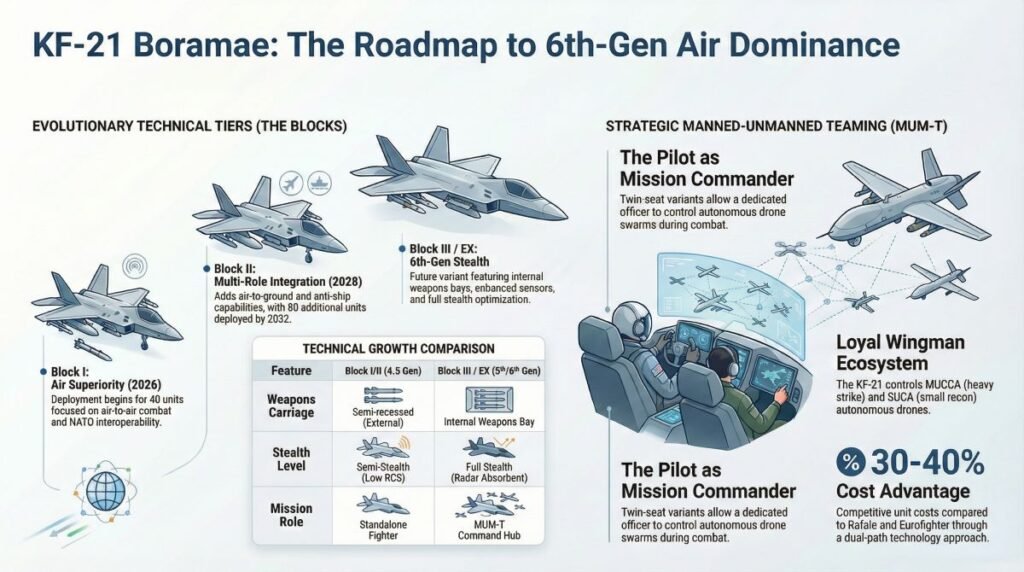
Table 1: Top 10 Stealth Aircraft in the World at a Glance (2026)
| Aircraft | Country | Primary Role | Status (2026) |
| B-21 Raider | USA | Strategic Bomber | Low-rate Production |
| F-22 Raptor | USA | Air Superiority | Operational |
| F-35 Lightning II | USA | Multirole Fighter | Operational (15+ nations) |
| B-2 Spirit | USA | Strategic Bomber | Operational (USAF) |
| J-20 Mighty Dragon | China | Air Superiority | Mass Production (300+ units) |
| J-35 / FC-31 | China | Carrier-based Fighter | Entering Service (PLAN) |
| Su-57 Felon | Russia | Multirole Fighter | Combat Proven (Ukraine) |
| TAI KAAN | Turkey | Air Superiority | Prototypes in Test |
| KF-21 Boramae | South Korea | Multirole Fighter | Deployment Start |
| F-117 Nighthawk | USA | Stealth Attack | Training / Aggressor |
Table 2: Technical Comparison – RCS, Speed & Stealth Features (2026)
| Aircraft | Est. RCS (Frontal) | Top Speed | Primary Stealth Feature | Status Q1 2026 |
| B-21 Raider | < 0.00001 m² | Mach 0.85 | Next-gen broadband RAM | Low-Rate Production |
| F-22 Raptor | 0.0001 m² | Mach 2.25 | Thrust vectoring + shape | Operational (USAF) |
| F-35 Lightning II | 0.001 m² | Mach 1.6 | Integrated sensor fusion | Global Ops (15+ nations) |
| B-2 Spirit | 0.0001 m² | Mach 0.95 | Tailless flying wing | Operational (USAF) |
| J-20 Mighty Dragon | 0.01–0.1 m² | Mach 2.0 | Diverterless Supersonic Inlet | Mass Production (300+) |
| J-35 / FC-31 | 0.01 m² | Mach 1.8 | Dual-engine carrier design | Entering Service (PLAN) |
| Su-57 Felon | 0.1–0.5 m² | Mach 2.0 | 3D Thrust Vectoring | Combat Proven (Ukraine) |
| TAI KAAN | 0.01 m² | Mach 1.8 | All-aspect stealth geometry | Prototypes in Test |
| KF-21 Boramae | 0.5 m² (Blk I) | Mach 1.81 | Internal weapons bay (v2) | Deployment Start |
| F-117 Nighthawk | 0.003 m² | Mach 0.92 | Faceted airframe design | Training / Aggressor |
Table 3: Facts & Trivia – The Hidden Side of Stealth (2026)
| Aircraft | Cool Factor / Interesting Fact | Cost Per Unit (Est. 2026) | Unique Capability |
| B-21 Raider | Designed entirely in a digital environment (Digital Twin) — flew virtually millions of times before first physical takeoff. | ~$750M | Broadband Stealth: Invisible even to low-frequency ‘anti-stealth’ radars. |
| F-22 Raptor | So advanced it has a federal law (Obey Amendment) banning its export to any country, even UK or Israel. | ~$350M | Supercruise: Flies at Mach 1.8 without fuel-hungry afterburners. |
| F-35 Lightning II | Pilot’s helmet costs $400,000 — allows them to ‘look through’ the floor of the plane via external cameras. | ~$80–$100M | The Quarterback: Can control a swarm of nearby Loyal Wingman drones. |
| B-2 Spirit | Every B-2 has its own climate-controlled hangar because its ‘skin’ (RAM) is sensitive to moisture and heat. | ~$2.1B | Global Reach: Fly from Missouri to anywhere on Earth and back without refueling. |
| J-20 Mighty Dragon | Only stealth fighter using Canards (small wings near the nose), which usually hurt stealth but China solved it with software. | ~$110M | Long-Range Sniper: Designed to take out ‘eyes’ like AWACS and tankers. |
| Su-57 Felon | Features Side-Looking radars in its cheeks — can track targets at extreme angles while the plane itself turns away. | ~$50M | Extreme Agility: Can perform Pugachev’s Cobra to flip 120° mid-air. |
| KF-21 Boramae | South Korea went from paper design to a flying stealth jet in less than 7 years. | ~$65M | Evolutionary Path: Starts as stealth-lite, becomes a ghost via future software updates. |
| TAI KAAN | Built to make Turkey fully independent of US tech after they were removed from the F-35 program. | ~$100M | Dual-Engine Power: Much higher survivability than single-engine jets like F-35. |
| J-35 / FC-31 | Called the ‘F-35’s twin’ due to similar shape; China’s first dedicated carrier-based stealth fighter. | ~$70M | Catapult Ready: Designed for electromagnetic catapults on the Fujian carrier. |
| F-117 Nighthawk | Has no computer for flight — so aerodynamically unstable it would fall out of the sky if the fly-by-wire system failed. | Retired ($43M) | The Pioneer: First plane designed for stealth, not by wind tunnels. |
Table 4: Lifecycle & Logistics Data (2026)
| Aircraft | Unit Cost (Flyaway) | Maintenance (Man-Hrs / Flight Hr) | Cost per Flight Hour | Dev Cost (Program Total) | Ferry Range |
| B-21 Raider | ~$750M | 25–30 hrs (Projected) | ~$65,000 | ~$203 Billion | 11,000+ km |
| B-2 Spirit | ~$2.1B | 50–60 hrs | ~$150,000+ | ~$45 Billion | 11,100 km |
| F-22 Raptor | ~$350M | ~43 hrs | ~$68,000 | ~$67 Billion | 3,220 km |
| F-35A | ~$82M | 12–15 hrs | ~$33,000 | ~$1.7 Trillion* | 2,200 km |
| J-20 | ~$110M | 30+ hrs (Est.) | ~$45,000 | ~$30+ Billion | 3,400 km |
| Su-57 Felon | ~$50M | ~35 hrs (Est.) | ~$40,000 | ~$10 Billion | 3,500 km |
| J-35 (FC-31) | ~$70M | 20–25 hrs | ~$35,000 | Unknown | 1,200 km |
| KF-21 | ~$65M | 10–12 hrs | ~$25,000 | ~$6.6 Billion | 2,900 km |
| TAI KAAN | ~$100M | ~20 hrs (Target) | ~$38,000 | ~$15 Billion | 2,500 km |
| F-117 Nighthawk | $43M (Orig.) | ~45 hrs | ~$42,000 | ~$6.6 Billion | 1,720 km |
*F-35 program cost includes total lifecycle for 2,400+ jets over 50 years.
Table 5: Hidden Details – Secret Sensors, Skins & Combat Tricks (2026)
| Aircraft | Hidden Electronic / Sensor Feature | Secret ‘Skin’ or Material Detail | Combat ‘Trick’ |
| B-21 Raider | Negative Signal Cancellation: Listens for enemy radar and emits a counter-pulse to erase itself from the screen. | Nano-Structure RAM: Adaptive skin that can bend electromagnetic waves around the frame. | Thermal Masking: Actively cools the airframe skin to match ambient high-altitude temperatures. |
| F-22 Raptor | Intra-Flight Data Link (IFDL): A whisper radio that lets Raptors share data without an enemy ever knowing they are communicating. | Gap Filler Tape: Specialized conductive tape covers every screw and seam for a perfectly smooth radar surface. | Super-Maneuverability: Can point its nose at a target while flying in a completely different direction. |
| F-35 Lightning II | ASQ-239 Barracuda: An advanced EW suite that can geolocate and jam enemy radars passively. | Fiber-Mat Technology: Stealth material is baked into the composite skin, not just painted on. | Cyber-Attack Hub: Can theoretically hack into an enemy radar system’s software from miles away. |
| J-20 Mighty Dragon | Retractable Luneburg Lens: A hidden reflector used in peacetime to look like a giant plane; it retracts in combat. | Diverterless Inlets (DSI): Uses a complex bump in the intake to hide the highly reflective engine fan blades. | Forward Playmaker: The twin-seat J-20S acts as a quarterback for swarms of loyal wingman drones. |
| Su-57 Felon | L-Band Wing Radars: Hidden arrays in wing leading edges specifically designed to detect other stealth aircraft. | Serrated Engine Nozzles: Jagged edges on exhaust to break up radar returns from the rear of the plane. | Multi-Bay Layout: Two massive central bays and two tiny cheek bays for quick-fire missiles. |
| B-2 Spirit | Passive Emitter Location: Can pinpoint an enemy’s location just by listening to their radio or radar chatter. | Tape and Caulk: Requires meticulous manual application of secret chemicals to every seam before every mission. | Gravity Strike: Can drop 80 independently targeted 500lb bombs in a single pass. |
| J-35 / FC-31 | Electro-Optical (EOTS): A chin-mounted sensor (similar to F-35) for silent, long-range heat tracking. | Edge Alignment: Every part of the wing and tail is set to the same angle to bounce radar away in a single spike. | Carrier Launch Ready: Designed with reinforced tailhook and landing gear for high-impact deck landings. |
| TAI KAAN | Integrated RF Suite: Turkey’s first indigenous 360-degree radar warning system that is fully software-defined. | Thermally Stable Composites: Designed to withstand the high heat of sustained Mach 1.8 flight without losing stealth. | Open-Source Brain: Uses a modular computer system that can be updated as quickly as a smartphone. |
| KF-21 Boramae | Active Cancellation: Uses its own radar to match and cancel incoming radar waves (planned for Block II). | Conformal Antennas: Radio and GPS antennas are flush-mounted under the skin to prevent any protrusions. | Modular Stealth: Can fly with external weapons today, but has a pre-carved space for a future internal bay. |
| F-117 Nighthawk | FLIR/DLIR: Retractable sensors that pop up only when needed, keeping the rest of the plane faceted and hidden. | Iron Ball Paint: Coated in a heavy magnetic paint that actually eats radar energy and turns it into heat. | Silent Run: No radar of its own — flies entirely blind and deaf to remain 100% passive. |
The Boramae Pivot: How South Korea Cracked the Code of Affordable Stealth
For decades, the narrative of elite military aviation has been defined by a paradox: the more advanced the fighter, the more likely it is to be trapped in a cycle of astronomical costs and decade-long delays. Programs like the F-35 Lightning II and Europe’s emerging sixth-generation projects (FCAS and GCAP) have become synonymous with “exquisite” technology that carries a price tag many nations simply cannot afford. While the West grapples with these complexities, a sobering reality check has emerged from the hangars of Seoul. The KF-21 Boramae is more than just a new airframe; it is a scrappy disruptor currently defying the odds by maintaining an aggressive development schedule while staying significantly under the budget of its Western peers. In an era where “combat mass” is becoming as vital as technological superiority, the Boramae offers a blueprint for a more sustainable future of air power. The center of gravity in military aviation is shifting toward the Pacific, and the world is starting to take notice. Boramae (보라매): A Korean term referring to a young hunting hawk that has been specially trained for falconry, symbolizing the combination of youthful vigor and disciplined skill.
1. The “Spiral” Secret: Why the KF-21 Succeeds Where Others Stall
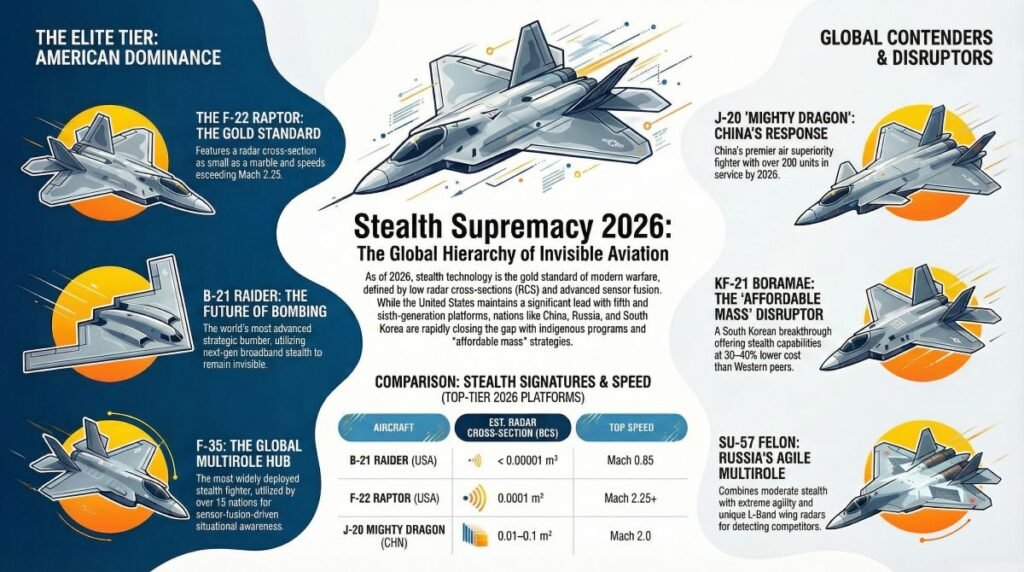
While Western programs often attempt to field a “perfect” stealth platform from day one-resulting in integration nightmares-South Korea utilized a spiral development philosophy. By breaking the program into Block I, II, and III, Korea Aerospace Industries (KAI) ensured the aircraft could enter serial production in July 2024, just five years after its first prototype flight. This approach stands as a stinging indictment of the “all-or-nothing” procurement failures that have left European and American fleets aging and over-extended. Block I serve as a highly capable 4.5-generation fighter with “semi-stealth” features and external hardpoints, allowing for rapid operational fielding. Block II evolves into a multirole platform, while Block III will eventually feature full internal weapon bays and advanced stealth coatings. This incremental evolution allowed the program to reach combat readiness far faster than competitors chasing perfection in a vacuum. In May 2023, the KF-21 was officially declared “provisionally suitable for combat,” a status achieved after more than 200 successful flight tests and the verification of its Active Electronically Scanned Array (AESA) radar.
2. The Two-Seat “Hive Mind”: Solving the Cognitive Load Crisis
One of the most strategic choices in the KF-21 program is the prioritization of a twin-seat variant. In this configuration, the back-seater isn’t merely a student pilot; they function as a mission commander for a swarm of autonomous drones. This concept, known as Manned-Unmanned Teaming (MUM-T), transforms the aircraft into a command-and-control hub for a sophisticated “Combat Cloud. “The decision to include a second seat addresses a critical “Cognitive Load” argument that single-seat platforms like the F-35 struggle to resolve. A single pilot cannot effectively manage a swarm of drones while dogfighting at high G-forces; by delegating drone management to a dedicated operator, the KF-21 achieves distributed lethality. This allows the human team to control Loyal Wingman drones like the 5.4-ton MUCCA or the ultra-light SUCA without overwhelming the pilot’s situational awareness.
3. The $96 Billion Competitive Disruption
The economic impact of the KF-21 is sending shockwaves through a global market where the European fighter sector alone is projected to reach $95.9 billion by 2030. The Boramae enters this arena with a unit cost 30–40% cheaper than legacy 4th-generation European alternatives like the Rafale or Eurofighter Typhoon. Crucially, it remains competitive even against the latest single-engine variants like the F-16V and Gripen E/F, offering twin-engine safety and growth potential for a similar price.South Korea’s determination to succeed is evidenced by its handling of the Indonesian friction. Even as Jakarta’s financial stake dropped from 20% to 7.5% due to economic constraints, Seoul chose to absorb the costs and bankroll the “disruption” themselves. This commitment has signaled to nations like Poland, the UAE, and the Philippines that South Korea is a more stable and affordable partner than traditional Western suppliers.
4. The 2,100 Kelvin Engineering Breakthrough and Strategic Sovereignty
A critical component of the KF-21’s success is its relentless focus on propulsion and engine localization. Through an ₩86 billion investment in domestic technology, Hanwha Aerospace is working to produce a 16,000 lbf thrust class engine that rivals the best in the West. A major technical achievement in this area is the engine’s ability to operate at a turbine inlet temperature of 2,100 Kelvin (1,826.85°C). This is 250 Kelvin hotter than the M88 engine powering the French Rafale, a breakthrough that necessitates massive leaps in materials science and cooling. For South Korea, this isn’t just about heat; it is about Defense Sovereignty. By developing an indigenous propulsion system, Seoul is buying its way out of the U.S. supply chain and bypassing International Traffic in Arms Regulations (ITAR). This “ITAR-free” status will allow South Korea to export the jet to nations that the U.S. might otherwise block.
5. Debunking the “Radar-less” F-35 Myth: A Meta-Commentary on Desperation
The high stakes of modern procurement have led to a rise in defense misinformation, exemplified by a rumor that new F-35s were being delivered with weight ballast instead of functional radars. The rumor gained traction because F-35 delays are so legendary that “concrete-weighted noses” sounded plausible to a frustrated public. In reality, the photo depicted a decommissioned airframe used for CDDAR (Damaged Disabled Aircraft Recovery) training at Hill Air Force Base. The weights were simply installed to simulate the aircraft’s center of gravity during emergency crane-lift drills. This incident highlights the desperation of the competition; while traditional programs face legitimate hurdles with the AN/APG-85 radar integration, the KF-21’s indigenous APY-016K AESA radar has remained on track. This reliable progression is precisely what makes the Boramae a genuine threat to the established aerospace order.
The Sky in 2040: The Era of Affordable Mass
As we look toward the 2040s, a new reality is setting in: the era of the “exquisite,” ultra-expensive manned platform is being replaced by Affordable Mass. While Europe remains split between competing visions like FCAS and GCAP, both facing shifting timelines, the KF-21 is a reality today. The 2040 sky will belong to the side that can afford to lose a few drones, not the side that is too afraid to fly its $200 million assets. The KF-21 has successfully “cracked the code” of modern procurement by being “good enough” today to become “unbeatable” tomorrow. By focusing on reliability and incremental growth, South Korea is positioning itself as the premier provider of air power for a multipolar world. The question for global air forces is no longer just “how advanced is the jet?” but “how many can we afford to put in the air?”
Note: The specifications and rankings in this article are based on publicly available information, open-source defense publications, Previous Knowledge and official government disclosures as of 2026. Much of the data regarding classified stealth aircraft programs is necessarily based on estimates. Some figures may differ from classified actual specifications.
Thoughts: The Future of Stealth Aviation in 2026 and Beyond
Stealth technology has moved from a revolutionary concept to an absolute necessity in modern air warfare. The top 10 stealth aircraft in the world 2026 represent the pinnacle of human engineering – machines that combine raw speed and power with an almost supernatural ability to evade detection.
From the legendary F-117 Nighthawk that proved stealth was possible, to the F-22 Raptor that perfected it, to the B-21 Raider and F-47 NGAD that are pushing stealth into a new generation – the evolution is relentless. Meanwhile, China’s J-20 and J-35 programs are closing the gap, and India’s AMCA promises to add another major player to the stealth club.
As we look ahead, 6th generation stealth fighters with artificial intelligence, directed energy weapons, and hypersonic capabilities will define the air battles of the mid-21st century. The list of stealth aircraft in the world will grow longer, and the technology will only get more sophisticated.
Whether you are a defense enthusiast, a student of military history, or someone trying to understand global power dynamics, understanding the best stealth aircraft in the world gives you a clearer picture of where military power truly lies in 2026.
Also read: Top 10 Land Based Early Warning Radar Systems on Earth (PPT)
(FAQs)
Q: What is the most advanced stealth aircraft in the world in 2026?
A: The B-21 Raider is currently considered the most advanced stealth aircraft in the world in the bomber category. For fighters, the F-22 Raptor and the in-development F-47 NGAD hold the top positions.
Q: How many countries have stealth aircraft?
A: As of 2026, approximately 15-20 countries operate stealth aircraft, the vast majority of which fly the F-35 Lightning II. Only the US, China, and Russia have indigenously developed stealth fighters.
Q: What is the first stealth aircraft in the world?
A: The Lockheed F-117 Nighthawk was the first stealth aircraft in the world to enter operational military service, first flying in 1981 and revealed to the public in 1988.
Q: Does India have stealth aircraft?
A: India does not currently operate a dedicated stealth aircraft, but the HAL AMCA (Advanced Medium Combat Aircraft) is in development and will become India’s first indigenous stealth fighter once it enters service. India also operates the Sukhoi Su-30MKI, which has some low-observable features but is not a true stealth aircraft.
Q: What is the best stealth fighter jet in the world?
A: Most defense experts consider the F-22 Raptor the best stealth fighter jet in the world due to its unmatched combination of stealth, supercruise, supermaneuverability, and sensors. The F-35 Lightning II is the best multirole stealth fighter in terms of overall operational flexibility and sensor fusion.