
Today in this article we will discuss about the Top 20 Future Weapons and Secret Programs with ppt and infographics, Top 20 Future Weapons (2030s AI Warfare): Technologies Reshaping Modern Warfare From Electromagnetic Weapons to Orbital Strikes – Complete Technical & Strategic Analysis so, The future of warfare extends far beyond conventional missiles and munitions. Emerging military technologies promise to fundamentally reshape how nations project power, deter adversaries, and conduct operations across all domains – land, sea, air, space, and cyber. From electromagnetic rail guns to swarms of autonomous drones, from quantum radar that defeats stealth to orbital rods delivering city-block-level kinetic devastation, these weapons systems represent not incremental improvements but revolutionary capabilities that challenge existing strategic frameworks, international law, and ethical boundaries.
Table of Contents
This comprehensive analysis examines twenty cutting-edge weapons technologies currently in development or early deployment. Each system is presented with complete technical specifications, operational advantages, engineering challenges, strategic implications, current development status, key nations involved, and the critical ethical questions they raise.
Note: This analysis draws from defense publications, military research programs, Congressional Budget Office reports, SIPRI, RAND Corporation studies, and international security literature. Technical specifications reflect publicly available unclassified information. Ethical and legal analyses reflect ongoing international debates at the UN, ICRC, and arms control forums.
Top 20 Future Weapons and Secret Programs (2030s Warfare) | .PPTX
The Top 20 Future Weapons: Complete Analysis
#1. Electromagnetic Rail Guns
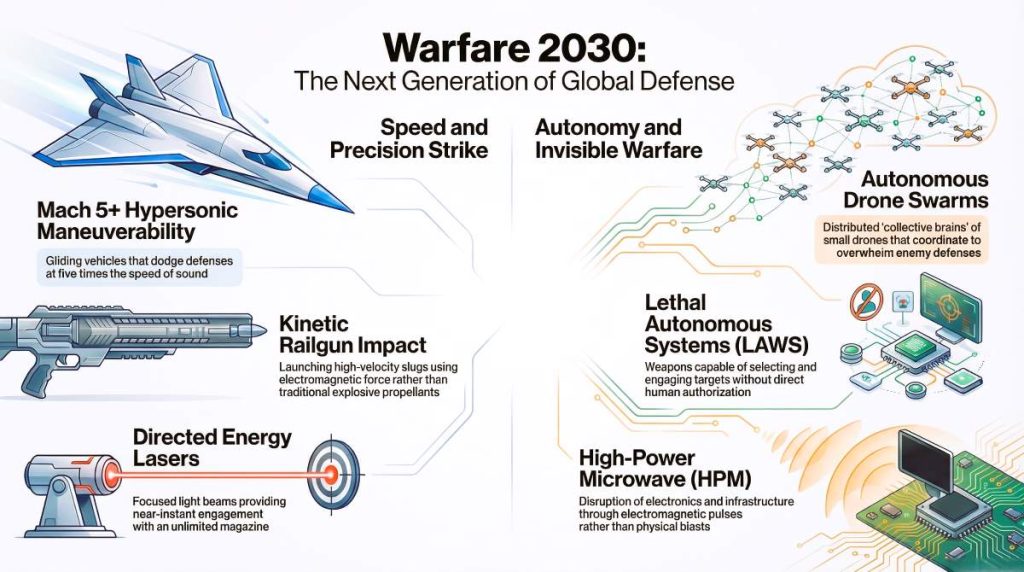
Rail guns use powerful electromagnetic forces to accelerate projectile slugs to extreme hypersonic velocities – delivering devastating kinetic energy at the point of impact without any explosive warhead. The destructive power comes entirely from the projectile’s immense speed.
Technical Specifications:
- Velocity: Muzzle velocities of Mach 6–7 (approximately 7,200 km/h or 4,500 mph)
- Range: Effective engagement range of 100–200 nautical miles (185–370 km)
- Projectile: Hypervelocity Projectile (HVP) – dense tungsten or steel kinetic penetrator, no explosive fill
- Rate of fire: Up to 10 rounds per minute in advanced designs
- Power requirement: 25–64 megajoules per shot; requires dedicated pulse power systems
- Guidance: GPS/INS-guided HVP for terminal precision against fixed and moving targets
Operational Advantages:
- Lower per-shot cost (~$25,000–$50,000 vs $500,000+ for cruise missiles)
- No explosive propellant reduces on-board magazine explosion risk
- Reduced logistics – simplified ammunition without chemical propellants
- Can engage aircraft, cruise missiles, ballistic missile re-entry vehicles, and surface targets
- Near-flat trajectory enables engagement at very low altitudes
Engineering Challenges:
- Enormous instantaneous power draw strains ship electrical systems
- Rail erosion: conducting rails degrade rapidly, requiring frequent replacement
- Thermal management: extreme heat at breach and muzzle demands advanced materials
- Achieving consistent accuracy at maximum range requires precision guidance integration
Development Status and Key Nations:
- USA: U.S. Navy tested BAE Systems rail gun prototype; program paused pending power solutions
- China: Type 072 III landing ship publicly demonstrated a rail gun at sea in 2018
- Russia: Preliminary research; less mature than U.S./China programs
Strategic Impact: Rail guns offer a cost-asymmetric solution: a $50,000 round defeating a $1.5 million missile radically changes naval engagement economics. They could defend carrier groups against saturation missile attacks at a fraction of current costs.
#2. High-Energy Laser Systems (HEL)
High-energy laser weapons engage targets at the literal speed of light (299,792 km/s), generating focused thermal energy to heat, disable, or destroy targets instantaneously. Already transitioning from laboratories to operational platforms, these directed-energy weapons are reshaping point defense doctrine.
Technical Specifications:
- Power levels: Operational systems 10–300 kilowatts; next-gen pursuing megawatt-class
- Effective range: Current systems effective to 1–5 km; advanced systems targeting 10+ km
- Beam dwell time: 2–10 seconds typically required to defeat a target depending on its heat tolerance
- Wavelength: Solid-state (1 micron) and chemical oxygen-iodine lasers (COIL) at 1.315 microns
- Cost per shot: Approximately $1–$3 per firing (essentially the cost of electricity)
Operational Advantages:
- Speed-of-light engagement eliminates lead calculations against fast targets
- Scalable effects: non-lethal dazzle, sensor blinding, warhead cook-off, structural destruction
- Effectively unlimited magazine as long as electrical power is available
- Silent, invisible firing – minimal acoustic or visual signature
- Ideal for countering drone swarms, mortars, rockets, artillery, and cruise missiles
Limitations and Challenges:
- Atmospheric effects: Rain, dust, smoke, humidity, and fog scatter and attenuate the beam
- Thermal blooming: Laser heats the air in its path, causing beam defocusing over distance
- Platform requirements: Significant electrical power generation and cooling system requirements
- Counter-measures: Ablative coatings, spinning targets, and mirror-polished surfaces reduce effectiveness
Development Status and Key Nations:
- USA: HELIOS (60kW) deployed on USS Preble; SHIELD, CLWS, and IFPC-HEL programs active
- Israel: Iron Beam – 100kW laser intercepts rockets and drones; reached operational testing 2024
- UK: DragonFire 50kW laser successfully tested 2023
- China: ZKZM-500 and other classified programs; exact capabilities not publicly confirmed
Strategic Impact: HEL weapons could neutralize the cost-exchange advantage of cheap drone swarms, forcing adversaries to either spend more on each weapon or accept degraded effectiveness against laser-defended targets.
#3. High-Power Microwave (HPM) and Counter-Electronics Weapons
High-power microwave systems are the electromagnetic equivalent of a ‘kill switch’ for electronics. Rather than destroying targets kinetically, HPM weapons overload, fry, or disrupt electronic circuits, causing operational paralysis while producing minimal physical destruction.
Technical Specifications:
- Frequency range: 1 GHz to 100 GHz (microwave spectrum)
- Peak power: Gigawatt-class pulses for military HPM; kilowatt-class for vehicle-mounted
- Pulse duration: Nanoseconds to microseconds
- Effective range: Hundreds of meters to several kilometers depending on system size
- Effect types: Temporary disruption (upset), permanent damage (burnout), or destruction
Operational Advantages:
- Simultaneous defeat of drone swarms – one pulse disables multiple targets at once
- No physical destruction means reduced collateral damage compared to kinetic weapons
- Effective against improvised explosive device (IED) triggering electronics
- Penetrates vehicle hulls to disable electronics inside without exterior damage
- Gray-zone utility: covert disruption of communications or surveillance networks
Current Applications:
- CHAMP: Counter-electronics High-powered Microwave Advanced Missile Project (USAF) – cruise missile delivering HPM along a flight path
- Active Denial System: Non-lethal 95 GHz crowd control – causes intense skin heating sensation
- Epirus Leonidas: Solid-state HPM system for counter-drone and counter-UAS missions
Ethical and Strategic Concerns:
- Indiscriminate reach can affect civilian pacemakers, vehicles, and infrastructure
- Attribution challenge: HPM strikes are invisible and leave no physical evidence
- Cascading failures in civilian infrastructure if used against urban areas
- Escalation risk from ambiguous, unattributable attacks
Strategic Impact: HPM weapons could fundamentally change anti-drone warfare by defeating swarms economically – one HPM burst can disable hundreds of cheap drones simultaneously, solving the cost-exchange problem that threatens current air defenses.
#4. Hypersonic Glide Vehicles (HGVs)
Hypersonic glide vehicles travel faster than Mach 5 while maneuvering through the upper atmosphere, combining extreme speed with unpredictable flight paths that compress defensive reaction windows to near-zero.
Technical Specifications:
- Speed: Mach 5–27 (6,200–33,000 km/h) depending on system
- Altitude: Operates in 40–80 km range – above aircraft, below orbital satellites
- Range: 3,000–15,000+ km depending on launch vehicle
- Maneuverability: Mid-course and terminal maneuvering with 3D directional changes
- Accuracy: Circular error probable (CEP) of 5–100 meters depending on maturity
- Payload: Conventional or nuclear warheads (100 kg to several hundred kg)
Operational Advantages:
- Reaction window for defenses reduced to 5–15 minutes vs 30+ for ballistic missiles
- Unpredictable gliding flight defeats fixed intercept geometry of current missile defenses
- Operates at altitudes that challenge both atmospheric and exo-atmospheric interceptors
- Suitable for time-sensitive high-value targets with precise terminal guidance
Development Status and Key Nations:
- China: DF-17 with HGV operational since 2019; DF-ZF glide vehicle tested successfully
- Russia: Avangard HGV declared operational 2019; stated speed of Mach 27
- USA: LRHW (Long-Range Hypersonic Weapon) for Army; ARRW (Air-Launched Rapid Response Weapon) for USAF
- India: Hypersonic Technology Demonstrator Vehicle (HSTDV) tested 2020
Strategic and Legal Concerns:
- Operates in legal gray zone between air and space covered by neither air defense nor space treaties
- Forces massive investment in new detection, tracking, and intercept architectures
- Dual-use (conventional/nuclear) ambiguity increases nuclear miscalculation risk
- Compresses decision timelines, potentially making crisis management more difficult
Strategic Impact: HGVs effectively nullify existing ballistic missile defense systems, forcing nations to develop entirely new detection and intercept architectures at enormous cost. They represent a fundamental shift in the offense-defense balance.
#5. Scramjet Air-Breathing Hypersonic Missiles
Scramjet-powered missiles use supersonic combustion ramjets that breathe atmospheric oxygen for propulsion at hypersonic speeds. Unlike rockets carrying all propellants internally, scramjets ingest air, enabling sustained hypersonic flight over long ranges with lower mass penalties.
Technical Specifications:
- Speed: Mach 5–10 sustained; some concepts targeting Mach 15+
- Propulsion: Supersonic Combustion Ramjet (Scramjet) – requires pre-acceleration to Mach 4+ before ignition
- Range: 500–2,000 km depending on altitude and fuel load
- Altitude: 20–35 km cruise altitude for optimal atmospheric density
- Accuracy: CEP under 1 meter with modern INS/GPS terminal guidance
Operational Advantages:
- Higher maneuverability than glide vehicles in terminal phase
- Can sustain powered flight for course corrections throughout mission
- No need to carry oxidizer reduces vehicle mass, increasing range or warhead size
- Compatible with air, sea, and ground launch platforms
- Shorter flight time than subsonic cruise missiles against same targets
Engineering Challenges:
- Maintaining stable combustion at hypersonic speeds – fuel mixing in milliseconds
- Thermal protection: leading edges reach 2,000°C+ requiring advanced ceramics
- Requires booster to accelerate to ignition speed before scramjet engages
- Control surfaces and inlet design must function across wide speed/altitude range
Development Status and Key Nations:
- Russia: 3M22 Zircon (Tsirkon) – operational; 9 Mach, 1,000+ km range, ship/submarine launched
- China: YJ-21 – carrier-launched hypersonic missile demonstrated 2022
- USA: HAWC (Hypersonic Air-breathing Weapon Concept) demonstrator; Raytheon/DARPA program
- India/Russia: BrahMos-II targeting Mach 7+ air-breathing variant in development
Strategic Impact: Operational scramjet missiles like Russia’s Zircon already threaten existing naval task forces. Their speed and maneuverability challenge every layer of current shipboard defense systems, potentially making carrier strike groups more vulnerable.
#6. Autonomous Underwater Vehicles (AUVs) and Robotic Submarines
The underwater domain is primed for autonomous robotics. AUVs and unmanned underwater vehicles (UUVs) conduct long-duration surveillance, map seabeds, and carry sensors or payloads to locations crewed submarines cannot easily access.
Technical Specifications:
- Types: Small (man-portable) to Extra-Large (XLUUV) displacing 40+ tonnes
- Endurance: Days to months depending on power source (battery, fuel cell, nuclear concepts)
- Depth: 200m to full ocean depth (6,000m+) depending on class
- Speed: 4–12 knots typical; some sprint concepts targeting 20+ knots
- Sensors: Synthetic aperture sonar, hydrophone arrays, electromagnetic sensors
Operational Capabilities:
- Persistent surveillance of chokepoints (straits, harbor approaches) for months
- Seabed mapping and cable infrastructure inspection or sabotage
- Covert shadow missions against adversary submarine or surface task groups
- Mine laying, mine detection, and explosive ordnance disposal
- Acoustic decoy and deception operations
Development Status and Key Nations:
- USA: Boeing Orca XLUUV – 51-foot, 50-tonne vehicle capable of 6,500 nm range; 5 ordered by USN
- Russia: Status-6 (Poseidon) nuclear-armed UUV; stated capability of 10,000 km range
- UK: Cetus XLUUV program; several smaller systems in service
- China: Sea Wing glider network for ocean monitoring; HSU-001 for reconnaissance
Strategic and Ethical Concerns:
- Attribution and accountability for underwater actions are inherently difficult
- Autonomous lethal UUVs operating below detection thresholds raise significant concerns
- Critical undersea infrastructure (cables, pipelines) newly vulnerable at scale
- GPS unavailability underwater limits navigation precision for lethal missions
Strategic Impact: AUV swarms could monitor entire ocean basins persistently at a fraction of crewed submarine cost, fundamentally changing anti-submarine warfare. Russia’s Poseidon represents the most extreme end – a nuclear weapon that cannot be reliably tracked or intercepted.
#7. Autonomous Drone Swarms
Drone swarms represent a paradigm shift from single expensive platforms to distributed networks of cheap, coordinated unmanned vehicles. Collective intelligence enables swarms to adapt, reassign tasks, and overwhelm defenses through redundancy and numbers.
Technical Architecture:
- Swarm coordination: Mesh networking with decentralized AI – no single command node to defeat
- Communication: RF, optical, and acoustic inter-drone links; operates with or without ground control
- Individual unit cost: $500–$50,000 per drone depending on capability tier
- Swarm size: Demonstrations have reached 3,000+ simultaneous drones (CETC China, 2017)
- AI behavior: Cooperative target assignment, formation maintenance, gap-filling after losses
Mission Profiles:
- Saturation attack – overwhelming point defenses with more targets than interceptors
- Reconnaissance swarm – distributed ISR across wide area simultaneously
- Electronic warfare – simultaneous jamming from multiple directions
- Logistics denial – targeting supply lines, airfields, fuel depots
- Urban operations – penetrating buildings, tunnels, and complex terrain
Development Status and Key Nations:
- China: Leading in swarm size demonstrations; CETC 3,051-drone record 2020; integrating with PLA doctrine
- USA: DARPA Gremlins (air-launched/recovered swarms); OFFSET program for urban swarms
- Ukraine/Russia: Both sides deploying commercial swarm tactics in ongoing conflict
- Israel: Rafael and Elbit developing tactical combat swarms
Defensive Challenges:
- Traditional air defenses optimized for expensive single targets – economically unsustainable against swarms
- HPM and laser systems emerging as preferred counter-swarm solutions
- Swarms can adapt to losses and route around defenses in real time
Strategic Impact: Drone swarms democratize advanced strike capability. A $10 million swarm can defeat air defenses costing hundreds of millions to procure. This fundamentally disrupts existing investment strategies in air defense.
#8. Lethal Autonomous Weapon Systems (LAWS)
Lethal autonomous weapon systems – commonly called ‘killer robots’ – can independently identify, select, and engage targets without real-time human authorization. They represent the most ethically contested category in modern weapons development.
Technical Capabilities:
- Target recognition: Deep learning computer vision for identifying military vehicles, uniforms, weapons
- Decision cycle: Millisecond engagement decisions beyond human reaction speed
- Platforms: Ground vehicles, aerial drones, maritime vessels, underwater vehicles
- Human control modes: Human-in-the-loop, human-on-the-loop, and fully autonomous
- Sensor fusion: Integrates visual, IR, acoustic, and radar data for target classification
Claimed Operational Advantages:
- Eliminates reaction time constraints – engages at machine speed
- Reduces friendly troop exposure in high-threat environments
- Enables persistent area denial without continuous human monitoring
- Potential for more consistent rule-of-engagement compliance than stressed human soldiers
Development Status and Key Nations:
- Israel: Harpy anti-radiation loitering munition – first widely considered LAWS; operational
- South Korea: SGR-A1 sentry gun on DMZ – capable of autonomous lethal engagement
- Russia: Uran-9 and Marker UGVs with autonomous fire control capability
- USA: F/A-XX and NGAD programs include autonomous engagement options; policy restricts full autonomy
Ethical and Legal Debates:
- UN Convention on Certain Conventional Weapons (CCW) debating binding regulations since 2014
- Campaign to Stop Killer Robots: 70+ NGOs advocating prohibition treaty
- International Humanitarian Law: meaningful human control requirement
- Accountability gap: who is responsible when an autonomous weapon violates laws of war?
- Potential for low-threshold conflict initiation – no soldiers at risk lowers decision barriers
Strategic Impact: LAWS could transform conflict by removing the most significant human cost of war – casualties – from the calculus of aggressor nations. This risks making wars easier to initiate and harder to control once begun.
#9. Loitering Munitions
Loitering munitions – sometimes called kamikaze drones or suicide drones – bridge the gap between surveillance unmanned aerial vehicles and guided missiles. They can orbit a target area for extended periods, then dive-attack when conditions are optimal.
Technical Specifications:
- Endurance: 1–24 hours of loitering capability depending on system
- Range: 10–1,000 km operational radius
- Warhead: 2–30 kg shaped charge or fragmentation
- Target seeker: Electro-optical/IR camera with AI-assisted target matching
- Speed: 100–200 km/h cruise; steep terminal dive for penetration
- Cost: $3,000 (Shahed-136 class) to $100,000+ (IAI Harop class)
Operational Advantages:
- Patience: waits for optimal engagement window – commander decides when, drone delivers
- Precision: operator selects specific vulnerable point (engine deck, cab, radar antenna)
- Man-in-the-loop retargeting: can redirect or abort mid-flight
- Low acoustic and radar signature in loiter phase
- Proliferable: Iran, China, Turkey, Israel export cheaply to non-state actors
Combat Proven Systems:
- Shahed-136: Iranian system extensively used in Ukraine – $20,000 per unit, GPS-guided
- Lancet-3: Russian precision loitering munition; destroyed NATO-supplied artillery in Ukraine
- Harop/Harpy: Israeli IAI system – most sophisticated autonomous anti-radar capability
- TB2 Kargu-2: Turkish system; reportedly first autonomous lethal engagement in Libya 2020
- AeroVironment Switchblade: US man-portable loitering munition in two variants (300 and 600)
Strategic Impact: Loitering munitions have proven decisive in recent conflicts. The combination of affordability and precision creates asymmetric capability – small states and non-state actors can strike high-value targets previously requiring expensive guided missiles.
#10. AI-Guided Smart Munitions and Precision Effects
Smart munitions are evolving beyond GPS waypoint guidance toward context-aware AI decision-making, real-time sensor fusion, and mid-flight retargeting. These systems represent the fusion of precision weapons with artificial intelligence.
Technical Capabilities:
- Target recognition AI: Convolutional neural networks classifying target types from seeker imagery
- Sensor fusion: Combining EO/IR, SAR, radar altimeter, and GPS for target confirmation
- Mid-flight retargeting: Two-way data link enabling new target designation after launch
- Miniaturization: AI processing on chip-scale computers withstanding launch g-forces
- Accuracy: Sub-meter CEP routinely achievable with terminal seeker correction
Operational Capabilities:
- Target motion prediction – anticipates moving vehicle trajectory for intercept
- Aim point selection – autonomously selects most vulnerable point on target
- Civilian presence detection using pattern-of-life AI to reduce collateral damage
- Trajectory optimization – selects angle minimizing blast effects in contested areas
- Abort capability: AI-enabled ceasefire command received mid-flight
Development Status and Key Nations:
- USA: SDB II (Small Diameter Bomb II) – tri-mode seeker; JDAM-ER with software-defined guidance
- Israel: Spice-250 bomb with scene-matching AI; no GPS required
- China: LS-6/FT series precision bombs with optical target recognition
- UK/France: MBDA Brimstone – dual-mode seeker with autonomous de-confliction in swarm mode
Ethical Concerns:
- Opaque AI decision-making may produce unexpected targeting behavior
- Adversarial spoofing: feeding false imagery to fool target recognition algorithms
- Accountability for targeting errors becomes diffuse when AI selects aim point
- Lower engagement threshold when munitions can autonomously confirm targets
Strategic Impact: AI-guided munitions are already changing rules of engagement calculations. When weapons can distinguish combatants from civilians more reliably than stressed human operators, they could reduce collateral damage – or provide false confidence leading to riskier operations.
#11. Quantum Sensors and Quantum Radar
Quantum technologies are moving from theoretical physics laboratories toward practical military sensing applications. Quantum sensors exploit the fundamental properties of quantum mechanics to detect phenomena invisible to classical instruments.
Key Quantum Technologies:
- Quantum gravimeters: Measure gravitational field variations at 100x the sensitivity of classical instruments; detect submarines or underground facilities
- Quantum magnetometers: Detect magnetic field anomalies from submarine hulls or buried infrastructure
- Quantum radar: Exploits quantum entanglement – uses ‘entangled photon pairs’ to discriminate targets from noise, defeating low-observable (stealth) aircraft
- Quantum inertial navigation: GPS-independent navigation accurate to meters after months of operation
- Quantum clocks: 10,000x more accurate timing enabling GPS-level positioning without satellite infrastructure
Strategic Implications:
- Quantum gravimeters could detect submarines without acoustic signatures – voiding stealth advantage
- Quantum radar could render stealth aircraft visible, potentially obsoleting $100B+ in stealth investment
- GPS-denied quantum navigation enables precision weapons in jammed environments
- Quantum timing enables simultaneous multi-domain operations with nanosecond precision
Development Status and Key Nations:
- China: Leading quantum radar research; demonstrated prototype at 100 km range; quantum communication satellite Micius launched 2016
- USA: DARPA multiple quantum sensing programs; Northrop Grumman quantum positioning work
- UK: Dstl Quantum Navigator demonstrator; UK National Quantum Strategy with defense focus
- Limitation: Many quantum sensing systems currently require cryogenic cooling near absolute zero, limiting mobile deployment
Strategic Impact: If quantum radar matures to operational capability, the multi-generational and trillion-dollar investment in stealth technology by the United States could be rendered significantly less effective, triggering a wholesale reassessment of air power doctrine.
Also read: Top 10 Best Military Scout Vehicles in the world (.pptx)
#12. Metamaterials, Stealth, and Active Cloaking
Metamaterials are artificially engineered structures with electromagnetic properties not found in nature. These materials can manipulate electromagnetic waves, sound, and heat in extraordinary ways, enabling stealth capabilities far beyond current radar-absorbing coatings.
Technical Concepts:
- Radar-absorbing metamaterials: Engineered microstructures that trap and absorb specific radar frequencies rather than reflecting them
- Broadband absorption: Unlike current RAM coating tuned to narrow frequency bands, metamaterials can absorb across wide spectrum
- Thermal cloaking: Controlling heat signature through engineered thermal conductivity gradients
- Acoustic metamaterials: Redirecting sound waves around an object – reducing sonar signature
- Active cloaking concepts: Dynamic metamaterial surfaces that adjust response to incoming sensor frequencies in real time
Current Development:
- Metamaterial cloaking demonstrated in laboratory for microwave frequencies (Duke University, 2006)
- Active camouflage prototypes using flexible electroluminescent panels tested for ground troops
- Lockheed Martin research into metamaterial coatings for next-generation stealth aircraft
- Structural metamaterials for vehicle hulls – simultaneously reducing weight, improving strength, and absorbing radar
Strategic Implications:
- Next-generation stealth making current radar-detection systems increasingly unreliable
- Drives investment in quantum sensing as counter to improved stealth
- Active cloaking adapting to adversary radar frequencies in real time makes interception planning extremely difficult
- Extension to underwater acoustic signatures could make submarines effectively undetectable
Strategic Impact: Metamaterial stealth combined with active cloaking could reset the sensing-vs-stealth competition, extending the operational viability of stealth platforms while simultaneously driving the next generation of detection technology.
#13. Soldier Exoskeletons and Human Augmentation
Powered exoskeletons and human augmentation technologies are transforming infantry capabilities. From mechanical load-bearing systems to neural interfaces, these technologies extend human physical and cognitive performance in military contexts.
Current Technology Tiers:
- Load-bearing exoskeletons: Passive mechanical suits distributing weight – HULC, Onyx (Lockheed Martin) reducing fatigue by 27%
- Powered lower-body suits: Motorized leg assistance for load carriage – Sarcos Guardian XO carries 90 kg with minimal operator effort
- Upper-body augmentation: Shoulder-mounted weapon stabilizers reducing fatigue during sustained fire
- Neural interface concepts: Brain-computer interface for heads-up display control and situational awareness sharing
- Pharmacological augmentation: Fatigue-reducing compounds and cognitive enhancers (amphetamines, modafinil) already in military use
Operational Enhancements:
- Carry 50–100 kg additional load without fatigue degradation
- Reduce metabolic cost of movement by 20–40% extending operational range
- Integrated biometric monitoring – heart rate, blood oxygen, injury detection transmitted to medics
- Vibrotactile navigation cues reducing cognitive load during navigation
- Exoskeleton-stabilized weapons platform improving accuracy under physical stress
Ethical and Medical Concerns:
- Long-term musculoskeletal effects of powered suit dependency not yet fully understood
- Neural interface cybersecurity: direct brain connection creates new attack surface
- Enhancement creates two-tier military: augmented vs non-augmented forces
- Post-deployment adaptation challenges – reverse augmentation, identity, and mental health
- Pharmaceutical enhancement: addiction, long-term neurological effects, consent
Strategic Impact: Exoskeletons allow smaller, lighter forces to carry heavy weapons and ammunition previously requiring vehicles. This enables new tactical options in urban combat and rough terrain where vehicle access is limited.
#14. Space-Based Weapons and Anti-Satellite Systems (ASAT)
As military operations become increasingly dependent on space-based infrastructure – communications, GPS, ISR, missile warning – the incentive to contest space has grown dramatically. Space is rapidly becoming a contested warfighting domain.
Technology Categories:
- Kinetic ASAT missiles: Ground or air-launched missiles directly destroying satellites – China tested 2007, India 2019, Russia 2021
- Co-orbital interceptors: Satellites maneuvering alongside targets for inspection, jamming, or destruction – Russia Luch/Olymp satellite
- Directed energy from orbit: Space-based laser or HPM engaging ground or air targets
- Electronic warfare from orbit: GPS jamming, satellite communication spoofing, uplink jamming
- Microsatellite inspection: Small satellites approaching adversary satellites for intelligence or interference
Critical Vulnerabilities:
- Modern military depends on ~800 active military satellites for navigation, communication, targeting
- Commercial satellite constellation (Starlink 4,000+) now integral to military operations (Ukraine precedent)
- GPS denial would degrade precision munitions, navigation, timing-dependent communications
- Satellite destruction creates debris clouds threatening all space operators for decades (Kessler Syndrome)
Development Status and Key Nations:
- China: SC-19 ASAT (tested 2007 – created 3,000 debris objects); DN-3 medium Earth orbit capable; jamming systems
- Russia: Nudol PL-19 ASAT (tested 2021 vs own satellite); Peresvet laser ASAT; Luch inspector satellite
- USA: No acknowledged offensive ASAT; GPS III hardening; Space Force defensive focus; Space Fence radar
- India: Mission Shakti ASAT test 2019; demonstrated LEO intercept capability
Strategic Impact: Space superiority has become a strategic prerequisite for modern military operations. ASAT capabilities create escalation ladders entirely separate from conventional forces, and debris from kinetic ASAT use could deny space to all humanity for generations.
#15. Electromagnetic Pulse (EMP) Weapons and Counter-Electronic Strategies
EMP weapons generate powerful electromagnetic pulses that disrupt or destroy electronic systems over wide areas. Unlike HPM weapons targeting specific electronics, EMPs affect entire geographic areas, threatening both military and civilian infrastructure simultaneously.
EMP Types:
- High-altitude nuclear EMP (HEMP): Nuclear detonation at 30–400 km altitude generates E1, E2, E3 pulses affecting continental areas
- Non-nuclear EMP (NNEMP): Conventional explosive-driven flux compression generators – localized tactical effect
- CHAMP missile: Air Force cruise missile delivering sequential HPM/EMP pulses along flight path
- E-bomb: Air-dropped device generating intense EMP on detonation – effective over 1–10 km radius
Effects and Damage:
- E1 pulse: Nanosecond transient overloading semiconductor junctions – destroys unshielded electronics instantly
- E2 pulse: Millisecond pulse similar to lightning – damages systems surviving E1
- E3 pulse: Second-to-minute geomagnetic pulse inducing currents in power grids and long conductors
- Infrastructure impact: Power grid failure, communication blackout, vehicle disabling, financial system collapse
Resilience Measures:
- Faraday cage shielding of critical military electronics
- Hardened military specifications (MIL-STD-461 and MIL-STD-464)
- Analog backup systems and surge-protected grid infrastructure
- Distributed redundant communications avoiding single-point failure
Strategic Implications:
- HEMP attack could plunge continental economies back 100 years in electronic capability
- Non-kinetic nature complicates Article V NATO collective defense thresholds
- Civilian infrastructure vulnerability makes attribution-response decision extremely high-stakes
- EMP defense gap: most civilian infrastructure not hardened against even NNEMP
Strategic Impact: The EMP threat has prompted the U.S. Congress EMP Executive Order (2019) and billions in grid hardening, yet civilian infrastructure remains largely vulnerable. A sophisticated HEMP attack could cause more long-term damage than conventional nuclear strikes on cities.
#16. Cyber-Physical Weapons and AI-Driven Cyber Campaigns
The boundary between digital operations and physical destruction has dissolved. Cyber-physical weapons exploit software vulnerabilities to produce kinetic-equivalent effects: fires, explosions, mechanical failure, and infrastructure collapse without a single bomb dropped.
Demonstrated Capabilities:
- Stuxnet (2010): First confirmed cyber weapon causing physical destruction – damaged 1,000+ Iranian centrifuges by manipulating speeds while displaying false normal readings
- Ukraine power grid attacks (2015-16): BlackEnergy/Industroyer malware cut power to 250,000+ customers
- Saudi Aramco Shamoon (2012): Destroyed data on 30,000+ computers; operational disruption for weeks
- Triton/TRISIS (2017): Targeted safety instrumented systems in petrochemical plant – designed to cause physical explosion
- Colonial Pipeline (2021): Ransomware forced shutdown of 45% of U.S. East Coast fuel supply
AI-Enhanced Cyber Capabilities:
- Automated vulnerability discovery – AI scanning millions of targets for exploitable weaknesses simultaneously
- Adaptive malware – changing signatures to evade detection algorithms in real time
- Deepfake for social engineering – AI-generated voice/video for spear-phishing military personnel
- Swarm cyber attacks – thousands of AI agents simultaneously probing and exploiting
- Predictive targeting – AI identifying critical nodes in adversary infrastructure networks
Legal and Ethical Framework Gaps:
- International Humanitarian Law unclear on whether cyber attacks constitute ‘attacks’ triggering Article 51 self-defense
- Tallinn Manual 3.0 guidance non-binding; no treaty equivalent to Geneva Conventions for cyber
- Civilian infrastructure attacks violate proportionality principles but attribution is routinely deniable
- AI-automated attacks may exceed human decision speed – removing meaningful oversight
Strategic Impact: Cyber-physical weapons have made every networked infrastructure an attack surface. Industrial control systems running power grids, water treatment, nuclear plants, and financial systems represent strategic vulnerabilities that adversaries are actively mapping and pre-positioning in.
#17. Directed Acoustic Weapons and Infrasound Systems
Sound can be weaponized. Directed acoustic weapons focus high-intensity sound waves at specific targets to produce physical and physiological effects ranging from discomfort and disorientation to organ damage and death at extreme intensities.
Technology Types:
- Long Range Acoustic Device (LRAD): Directional speaker array producing 162 dB sound; effective crowd control and hailing to 9 km
- Acoustic hailing devices: Military communication to 5 km or pain-threshold warning shots to 300 m
- Infrasound weapons: Sub-20 Hz frequencies causing resonance in body cavities – disorientation, nausea, potential organ damage
- Ultrasound weapons: Above 20 kHz – heating tissue, causing vestibular disruption, seizures at extreme levels
- Havana Syndrome device: Pulsed microwave/ultrasound suspected behind U.S. diplomat neurological injuries
Operational Applications:
- Crowd dispersal without lethal force in urban operations
- Perimeter warning system for forward operating bases
- Non-lethal area denial protecting critical infrastructure
- Psychological operations – long-range sleep disruption of adversary forces
- Underwater communications and anti-diver perimeter protection
Ethical and Medical Concerns:
- Human response to high-intensity sound varies unpredictably – same device can be non-lethal or fatal
- Permanent hearing damage, tinnitus, and vestibular injury documented from LRAD use
- Potential for covert deployment: acoustic attacks leave no physical evidence
- Havana Syndrome investigations suggest directed acoustic/microwave weapons already used covertly
- Geneva Protocol ambiguity: are these ‘weapons of terror’ prohibited in conflict?
Strategic Impact: Directed acoustic weapons offer scalable non-lethal options for crowd control and area denial. However, the Havana Syndrome cases demonstrate that directed energy weapons – acoustic or microwave – may already be deployed covertly against adversary personnel, creating a new domain of deniable targeted attacks.
#18. Microsatellite Weapon Constellations
The democratization of space through cheap small satellites has created new military capabilities. Microsatellites (1–100 kg) and CubeSats (0.001–10 kg) now provide persistent global surveillance, communications, and potentially offensive capabilities at a fraction of traditional satellite costs.
Technical Specifications:
- CubeSat: 10 cm x 10 cm x 10 cm units (1U), costing $50,000–$150,000 to build and $3M–$5M to launch
- Microsatellite: 10–100 kg class; Planet Labs Dove camera constellation (200+ satellites) images entire Earth daily
- Low Earth Orbit advantage: 400–1,200 km altitude – lower latency, lower launch cost, but requires 30–100+ for persistent coverage
- Constellation economics: SpaceX Falcon 9 rideshare: $5,500/kg to LEO making 50-satellite constellations affordable to mid-powers
Military Applications:
- ISR: Persistent global imagery – commercial Planet Labs provides daily global coverage already used by military analysts
- Communications relay: Starlink-style resilient military communications resistant to single-satellite attacks
- GPS augmentation: Alternate positioning/navigation signals if GPS constellation attacked
- RF sensing: Signals intelligence – detecting and geolocating radio emissions globally
- Offensive potential: Co-orbital microsatellites carrying kinetic kill vehicles, jammers, or directed energy
Strategic Implications:
- Constellation resilience: destroying one satellite leaves 99 others – ASAT attack loses strategic value
- Democratized ISR: small nations and non-state actors can now purchase satellite imagery previously exclusive to superpowers
- Commercial constellation dual-use: Starlink providing Ukrainian military communications reveals civilian-military blur
- Debris risk: thousands of small satellites increase orbital collision probability
- Rapid reconstitution: microsatellites can be mass-produced and launched within weeks after constellation degradation
Strategic Impact: Microsatellite constellations have permanently changed space access economics. Starlink’s role in Ukraine demonstrates that commercial satellite infrastructure is now integral to conventional warfare, creating new targeting dilemmas and escalation risks when civilian systems have military value.
#19. Nanotechnology-Enabled Military Systems
Nanotechnology – engineering at the scale of 1–100 nanometers (billionths of a meter) – is enabling new classes of materials, sensors, energetic materials, and potentially autonomous systems too small for conventional detection.
Current Military Nano-Applications:
- Nano-energetics: Nanoscale aluminum/metal oxide thermite particles – 100x faster energy release than conventional explosives; more powerful, less sensitive to accidental detonation
- Nano-coatings: Superhydrophobic, self-healing coatings reducing corrosion and maintenance; anti-icing for aircraft and radar surfaces
- Nanocomposite armor: Carbon nanotube reinforced materials – same protection at half the weight of conventional steel armor
- Nano-sensors: Detecting chemical/biological agents at parts-per-trillion concentrations; distributed battlefield monitoring
- Nanomedicine: Targeted drug delivery, accelerated wound healing, real-time blood biomarker monitoring in field
Emerging Nano-Weapons Concepts:
- Smart dust: Microscale sensors dispersed over battlefield providing persistent, undetectable surveillance network
- Nano-propellants: Higher energy density rocket fuels enabling greater range or payload
- Structural nano-composites: Aircraft components 50% lighter with superior strength-to-weight ratio
- Nano-camouflage: Surfaces changing optical properties on demand via nanostructured electrochromic coatings
Research Status and Key Programs:
- USA: DARPA BTO nano-bio programs; Army Research Laboratory nanocomposite armor; MIT Institute for Soldier Nanotechnologies
- China: National Nanotechnology Center with defense-relevant materials research
- Timeline: Most advanced applications 15–30 years from deployment; near-term utility in materials and sensors
Strategic Impact: Nanotechnology’s military impact will be largely invisible – lighter armor, better sensors, more energetic explosives, and self-repairing coatings gradually improving performance across every weapons system rather than creating headline-grabbing new weapon types.
#20. Kinetic Orbital Strike Systems: ‘Rods from God’
Kinetic orbital strike systems – popularized as ‘Rods from God’ – envision dense metallic projectiles released from orbital platforms, striking ground targets using gravitational acceleration to deliver massive kinetic energy without explosives. The concept combines global reach with near-instant delivery.
Technical Concept:
- Projectile design: Tungsten rods 6 meters long, 30 cm diameter, weighing 9,000+ kg – density maximizing kinetic energy
- Terminal velocity: Approximately 11,200 m/s (Mach 33) at surface impact – orbital velocity conversion
- Energy equivalent: Comparable to tactical nuclear weapon (1–10 kiloton equivalent) without radioactive fallout
- Accuracy: GPS-guided terminal phase could achieve sub-10 m CEP
- Response time: 15–45 minutes from global orbit to any target on Earth
Theoretical Operational Advantages:
- Attacks deeply buried bunkers – kinetic penetration exceeds nuclear earth-penetrating weapons
- No nuclear fallout, EMP effects, or radiation – clean kinetic destruction
- Virtually unstoppable on terminal descent – too fast and small for current missile defense
- Global reach within minutes – no forward deployment of forces required
- Plausible deniability window before debris identification confirms orbital origin
Enormous Barriers to Deployment:
- Cost: Placing 9,000 kg masses in orbit costs $90M–$900M per rod at current launch prices
- Outer Space Treaty (1967): Article IV prohibits ‘weapons of mass destruction’ in orbit – kinetic rods may qualify under broad interpretation
- Debris risk: High-velocity rod fragmentation on impact creates orbital debris threatening all satellites
- Escalation risk: Launch detection would be indistinguishable from ICBM attack – near-certain nuclear response
- Maintenance: Orbital decay requires continuous station-keeping consuming significant propellant
Current Status:
- Official: U.S. Air Force studied concept in ‘Hypervelocity Rod Bundles’ (Project Thor) – deemed impractical
- China: Fractional Orbital Bombardment System (FOBS) tests 2021 suggest interest in orbital weapons concepts
- Reality: No nation has deployed kinetic orbital weapons; concept remains theoretical despite decades of study
Strategic Impact: While Rods from God remain theoretical, the orbital weapons concept reveals the fundamental tension of space militarization – the same orbital infrastructure enabling GPS, communications, and reconnaissance could theoretically become an offensive strike system, making the political stakes of space control existential.
Mach 20 and Milliseconds: The 5 Brutal Realities of 2030s Warfare
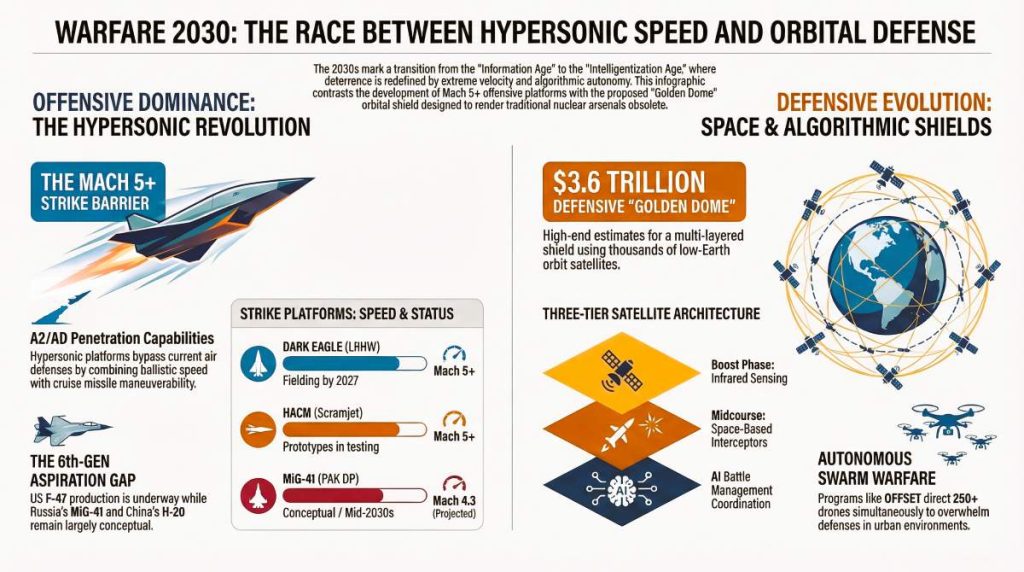
A hypersonic glide vehicle screams through the atmosphere at Mach 20. From the moment of detection, a human commander has 120 seconds to identify the threat, brief the chain of command, and authorize a counter-strike.
In the 2030s, 120 seconds is a luxury we no longer have.
We have crossed from the Information Age into the “Intelligentization Age”-where conflict moves at the speed of algorithms, not hardware. The bottleneck is no longer the missile. It’s the human in the loop. When warfare accelerates to millisecond exchanges, the side that insists on keeping a human finger on the trigger is the side that loses.
From Russia’s Mach 4 “ghost fighter” that likely doesn’t exist, to a $3.6 trillion missile shield that needs replenishing every seven years, to oceans so transparent that submarine stealth is effectively dead-the 2030s battlefield looks nothing like what most people imagine. Here are five brutal truths reshaping the future of conflict.
Reality 1: Russia’s Mach 4 Fighter Is a Political Prop
The MiG-41 (PAK DP) is marketed as a sixth-generation interceptor capable of Mach 4.3 and near-space combat. To the uninitiated, it looks like Russia’s next leap forward. To anyone watching the Russian defense industrial base crumble under sanctions, it’s a high-altitude bluff.
The reality: Russia’s “fifth-generation” Su-57 is still struggling to reach double-digit deployments. The idea that Russia can leapfrog to a Mach 4 space-plane is pure vaporware. With prototypes slipping into the mid-2030s, the MiG-41 serves one purpose-to distract from the conventional attrition and industrial decay hollowing out the Kremlin’s air force.
“The MiG-41 is a signaling asset designed to prove technological parity-not a reflection of Russia’s current capabilities.”
Reality 2: China’s “B-21 Killer” Bomber Is Frozen in Time
The Xi’an H-20 was touted for a decade as China’s stealthy flying wing that would break the Second Island Chain. Today the program has stalled against the brutal physics of low-observable (LO) technology and high-end engine integration.
U.S. Air Force Global Strike Command now dismisses the PLAAF as a “regional bomber force at best.” Recent H-20 “leaks” are less about military readiness and more about political theatre-following the massive 2025 purges of China’s Central Military Commission, Xi Jinping is using prestige projects to project stability. The H-20 remains a flying wing on paper, unable to match the B-21’s capability or delivery schedule.
Reality 3: The “Golden Dome” Is a $3.6 Trillion Subscription Service
The U.S. “Golden Dome”-the resurrection of Reagan’s “Star Wars”-carries a White House price tag of $175 billion. The actual cost? Closer to $3.6 trillion. The reason: atmospheric drag causes LEO interceptor satellites to suffer rapid orbital decay, requiring total fleet replenishment every seven years. It’s a multi-trillion-dollar subscription model for national security.
Two strategic chokepoints make the Dome possible-and dangerously fragile:
- Pituffik Space Base (Greenland): The only ground station capable of handling the V-band and laser data backhaul required to close the hypersonic kill chain
- Tanbreez Mineral Deposit (Greenland): The single-source supply of ultra-high temperature ceramics (Tantalum, Niobium, Zirconium) needed for hypersonic interceptors
This makes Greenland the most strategically vital ground in 2030s warfare-and explains a great deal about recent geopolitical tensions.
Reality 4: The Ocean Is Now Transparent
Submarine stealth-the cornerstone of naval deterrence for 80 years-is effectively dead.
The 2030s marks the maturity of Quantum Sensing. Quantum magnetometers and gravimeters can now detect the minute magnetic and gravitational disturbances a submarine’s hull creates simply by existing. Traditional acoustic stealth is irrelevant.
Undersea warfare has shifted from finding a “needle in a haystack” to navigating a “haystack made of glass.” The response: a pivot away from multi-billion-dollar manned submarines toward Extra-Large Uncrewed Underwater Vehicles (XLUUVs) like the Orca and Ghost Shark-autonomous, expendable platforms designed for an ocean that can no longer hide human crews.
Reality 5: The Kill Chain Has Been Handed to Algorithms
DARPA’s OFFSET and AMASS programs have moved beyond remote control to Agentic AI-self-optimizing swarms that don’t wait for instructions. They plan and execute multi-stage attacks at speeds that render legacy fire control systems obsolete.
The result: “algorithmic attrition.” Victory no longer goes to the side with the most kinetic energy, but to the side with the most decentralized collective intelligence. Human decision-makers are no longer “in the loop”-they are “on the loop”: spectators to a conflict decided in milliseconds by systems processing 10,000 times more data than any human brain.
The 5 Realities: Quick Comparison
| Reality | Program/Technology | Official Claim | Actual Reality | Strategic Implication |
|---|---|---|---|---|
| 1. Russia’s Ghost Fighter | MiG-41 (PAK DP) | Mach 4.3, near-space 6th-gen interceptor | Vaporware; Su-57 still in single digits | Political signaling to mask industrial collapse |
| 2. China’s Bomber | Xi’an H-20 | “B-21 killer”; breaks Second Island Chain | Frozen program; regional bomber force at best | Prestige project covering military purges |
| 3. U.S. Missile Shield | “Golden Dome” | $175 billion defense system | $3.6 trillion (7-year replenishment cycle) | Trillion-dollar subscription; incentivizes enemy blinding strikes |
| 4. Submarine Stealth | Manned submarines | Undetectable underwater deterrent | Transparent ocean via quantum sensing | Shift to XLUUVs (Orca, Ghost Shark) |
| 5. Human Decision-Making | AI Kill Chains | Humans authorize all lethal force | Algorithmic attrition; humans “on the loop” not “in the loop” | Escalation becomes a one-way automated street |
Technology Status Tracker: Hype vs. Reality
| Platform/System | Country | Status (2025) | Expected Operational | Credibility Rating | Key Obstacle |
|---|---|---|---|---|---|
| MiG-41 (PAK DP) | Russia | Concept/vaporware | Mid-2030s (optimistic) | ⭐ Very Low | Sanctions; Su-57 still failing |
| Xi’an H-20 | China | Frozen development | Unknown | ⭐⭐ Low | LO physics; engine integration |
| B-21 Raider | USA | In production | Delivered now | ⭐⭐⭐⭐⭐ High | Cost per unit |
| Su-57 Felon | Russia | <20 operational | Slow trickle | ⭐⭐ Low | Industrial base collapse |
| Golden Dome (LEO) | USA | Early design phase | 2030s | ⭐⭐⭐ Medium | $3.6T true cost; orbital decay |
| XLUUV Orca | USA | Testing | 2027-2028 | ⭐⭐⭐⭐ High | Software autonomy |
| Ghost Shark XLUUV | Australia | Development | 2028+ | ⭐⭐⭐⭐ High | Integration with fleet |
| AMASS AI Swarms | USA | DARPA trials | 2028-2030 | ⭐⭐⭐⭐ High | Rules of engagement |
The Quantum Sensing Revolution: Killing Submarine Stealth
| Detection Method | Era | Technology | Effectiveness vs. Submarines | Status |
|---|---|---|---|---|
| Acoustic (SONAR) | Cold War–present | Sound wave detection | Medium (countered by quiet propulsion) | Legacy; declining |
| Magnetic Anomaly Detection | 1960s–present | Airborne MAD sensors | Low range; close proximity needed | Limited |
| Quantum Magnetometers | 2025–2030s | Quantum sensing of hull disturbance | High; passive, long range | Emerging |
| Quantum Gravimeters | 2025–2030s | Gravitational displacement sensing | High; detects mass anomalies | Emerging |
| Satellite SAR/IR | Present | Surface thermal wake detection | Medium (periscope depth only) | Operational |
| Combined Quantum Suite | 2030s | Multi-spectrum fusion | Near-total transparency | Projected |
The “Golden Dome” Dependency Map
| Strategic Asset | Location | Function | Why It’s a Chokepoint |
|---|---|---|---|
| Pituffik Space Base | Greenland | V-band + laser data backhaul for kill chain | Only station that can close hypersonic intercept loop |
| Tanbreez Deposit | Greenland | Tantalum, Niobium, Zirconium supply | Single-source ceramics for hypersonic interceptors |
| LEO Interceptor Constellation | Low-Earth Orbit | Kill vehicles + offensive ambiguity | Decays every 7 years; must be fully replaced |
| Ground Command Nodes | Continental USA | AI kill chain authorization | Vulnerable to “blinding strike” first moves |
Key insight: Both critical dependencies point to the same location-making Greenland the single most strategically vital piece of real estate in 2030s warfare.
Human vs. Algorithm: The Decision Speed Gap
| Decision Type | Human Speed | AI/Algorithmic Speed | Speed Gap | Consequence |
|---|---|---|---|---|
| Threat identification | 15-30 seconds | <1 millisecond | 30,000x | Human is obsolete in hypersonic scenarios |
| Command authorization | 60-120 seconds | Autonomous (zero) | Infinite | Kill chain bypasses human approval |
| Counter-strike execution | 30-60 seconds | <100 milliseconds | 600x | Retaliation faster than human cognition |
| Swarm coordination (1,000 units) | Impossible | Real-time | Total gap | No human equivalent exists |
| Battlefield data processing | ~40 bits/second | 400,000+ bits/second | 10,000x | Humans become spectators (“on the loop”) |
The Strategic Paradox: Absolute Security Creates Maximum Risk
The pursuit of total immunity through systems like the Golden Dome creates a chilling reversal:
| Action | Intended Effect | Actual Strategic Result |
|---|---|---|
| Deploy Golden Dome (space-based interceptors) | Render enemy nukes “impotent and obsolete” | Incentivizes enemy blinding strikes against satellite infrastructure at first hint of tension |
| Defensive satellites in LEO | Protect against ICBMs | “Orbital ambiguity”-defensive interceptors indistinguishable from offensive hypersonic gliders |
| Full kill chain automation | Remove human error | One-way escalation street-no human can halt automated retaliation sequences |
| Quantum-transparent oceans | Eliminate submarine threat | Destabilizes second-strike deterrence-destroys the foundation of MAD (Mutually Assured Destruction) |
The Bottom Line: Speed Killed the Decision Window
The 2030s battlefield has three iron laws:
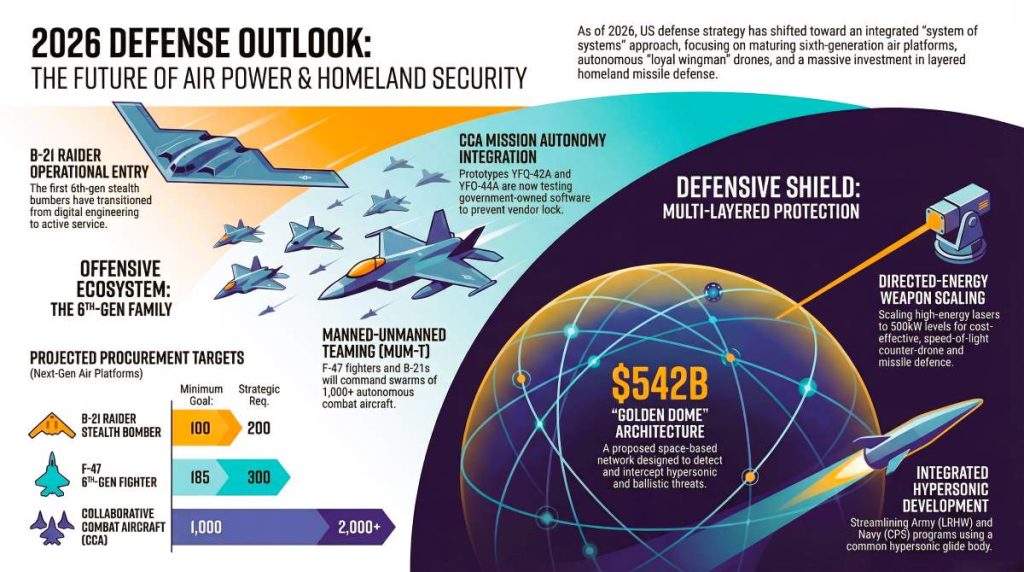
1. Vaporware Dominates the Headlines – Russia’s MiG-41 and China’s H-20 are political theatre, not operational platforms. The real competition is between the B-21 Raider (delivered now) and systems that exist only in press releases.
2. Trillion-Dollar Commitments Have Hidden Costs – The Golden Dome’s $175 billion headline masks a $3.6 trillion reality, with two dependencies that make a small Arctic island the most contested real estate on Earth.
3. Humans Are Being Engineered Out of the Kill Chain – From quantum-transparent oceans replacing manned submarines to agentic AI swarms executing attacks in milliseconds, the human decision-maker is transitioning from commander to spectator.
The most dangerous question of 2030s warfare isn’t whether we can build these systems. It’s whether we’ve already lost the ability to stop them once they start.
When the kill chain is fully automated and warfare moves at the speed of silicon, the path to escalation becomes a one-way street-and the humans are just along for the ride.
Conclusion: Navigating the Future of Warfare
These twenty emerging weapons technologies collectively represent the most revolutionary transformation in military capabilities since the development of nuclear weapons. Individually, each changes specific tactical or operational calculations. Together, they reshape the entire character of warfare across all domains simultaneously.
Cross-Cutting Themes:
- Speed and Decision Compression: Hypersonic weapons, LAWS, and cyber operations all compress decision cycles toward machine speed, potentially removing meaningful human control from critical junctures
- Democratization of Capability: Drone swarms, loitering munitions, and microsatellites bring advanced strike and surveillance to small states and non-state actors previously unable to access such capabilities
- Attribution Erosion: HPM, cyber-physical, acoustic, and autonomous systems create plausible deniability, complicating deterrence and escalation management
- Dual-Use Proliferation: Commercial drones, AI software, nanotechnology, and satellite access all have legitimate civilian uses while enabling military applications
- Domain Blurring: Space, cyber, electromagnetic, and physical effects are increasingly inseparable – a cyber attack enables a kinetic strike which triggers space-based response
Strategic Implications:
- Deterrence calculus changes: When adversaries can strike at machine speed with deniable weapons, classical deterrence through assured retaliation requires new architectures
- Arms control challenges: Verification of AI software, drone programs, or cyber capabilities is fundamentally harder than counting missiles or warheads
- Alliance implications: Technologies that enable rapid unilateral action reduce dependence on alliance coordination, potentially fragmenting collective security
- Economic competition: Military AI, quantum, and nanotech advantage depends on broader technology ecosystem leadership – defense and commercial R&D converge
The ethical dimensions cannot be separated from technical analysis. Lethal autonomous weapons raise questions about delegating life-or-death decisions to machines. Cyber-physical weapons targeting civilian infrastructure challenge fundamental proportionality principles. Human augmentation raises concerns about soldier welfare and long-term medical effects. Quantum sensing potentially obsoleting stealth could trigger arms races in new domains before governance frameworks exist.
Looking forward, the nations and coalitions that shape the development, deployment, and regulation of these technologies will determine the character of 21st-century warfare and, to a significant degree, the stability of international relations. The goal must be harnessing these capabilities for legitimate defense and deterrence while preventing destabilizing arms races, preserving human dignity, and maintaining the hard-won norms that constrain warfare’s worst excesses.
About This Analysis
This analysis draws from defense industry publications, Congressional budget documents, RAND Corporation reports, SIPRI arms databases, DARPA program documentation, military doctrine manuals, International Committee of the Red Cross guidelines on autonomous weapons, UN CCW proceedings, and academic journals including Journal of Strategic Studies, Survival, and Parameters. Technical specifications reflect publicly available unclassified information. Ethical and legal analyses reflect ongoing international debates. Operational concepts represent current thinking and will evolve as technologies mature.