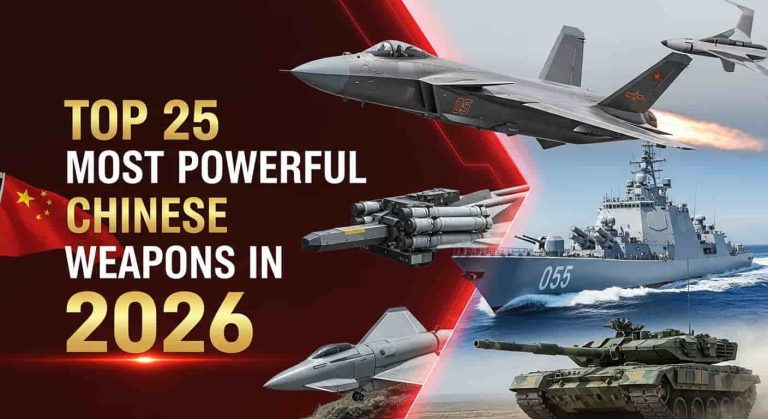
Today in this article we will discuss about the Top 25 Most Powerful Chinese Weapons in 2026 with PPT (.pptx) and infographics and China’s Military Arsenal 2026: The Complete Analysis of 25 Game-Changing Weapons so, The world is witnessing the most rapid military expansion in modern history. By 2026, the People’s Liberation Army (PLA) has transformed from a largely defensive force into a technologically sophisticated military capable of projecting power across multiple domains. China has officially completed its strategic nuclear triad-fielding advanced nuclear options by land, sea, and air-fundamentally altering the global balance of power.
Table of Contents
This transformation extends far beyond traditional ‘big missiles.’ Modern Chinese military doctrine emphasizes cutting-edge technologies including artificial intelligence-driven weapons, directed energy systems, and hypersonic missiles designed to challenge Western military dominance. From microwave weapons capable of paralyzing entire satellite networks to AI-controlled autonomous drones operating in swarms, China’s 2026 arsenal represents a fundamental shift in how future conflicts will be fought.
Note: This comprehensive analysis examines all 25 weapons systems based on publicly available information from U.S. Department of Defense reports, defense publications, official Chinese media, and open-source intelligence. Technical specifications reflect documented capabilities.
Top 25 Most Powerful Chinese Weapons in 2026 (.pptx)
Directed Energy and Electronic Warfare Systems
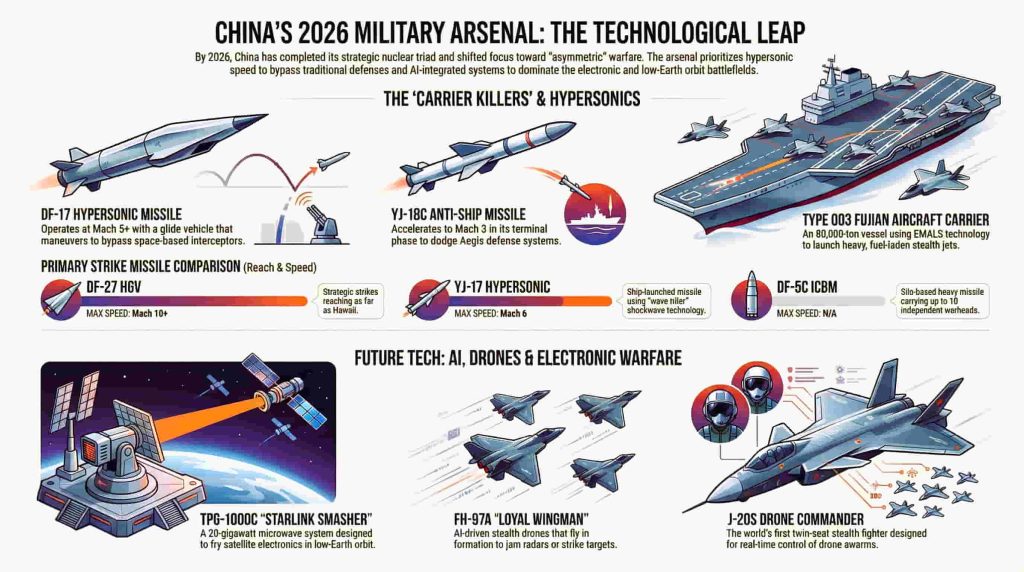
1. TPG-1000C High-Powered Microwave Weapon: ‘The Starlink Smasher’
The TPG-1000C represents China’s strategic investment in directed energy warfare, specifically targeting the satellite networks that modern militaries depend upon for communications, navigation, and intelligence. This 20-gigawatt high-powered microwave (HPM) system can generate electromagnetic pulses intense enough to permanently damage or destroy the delicate electronics of satellites operating in low Earth orbit (LEO).
Technical Specifications:
- Peak output power: 20 gigawatts in focused microwave bursts
- Primary targets: LEO satellites (300-2,000 km altitude)
- Secondary capability: Simultaneous drone swarm neutralization
- Attack mechanism: Electromagnetic pulse overload causing permanent component failure
- Engagement method: Ground-based directed energy transmission
Strategic Impact: Nicknamed the ‘Starlink Smasher,’ this system directly addresses Western dependence on satellite constellations. By threatening to disable communications satellites, GPS navigation systems, and intelligence-gathering platforms, China gains asymmetric leverage against technologically dependent adversaries. The anti-drone swarm capability simultaneously counters the proliferating threat of unmanned aerial systems on modern battlefields.
9. LY-1 Laser Cannon: Vehicle-Mounted Directed Energy Weapon
The LY-1 represents the tactical application of directed energy weapons, designed to provide frontline units with defense against drone swarms and precision-guided munitions. This vehicle-mounted system uses concentrated light beams to either overheat electronics until failure or detonate fuel tanks and warheads.
System Characteristics:
- Platform: Vehicle-mounted for tactical mobility
- Primary mission: Counter-drone swarm operations
- Secondary role: Precision-guided munition defeat
- Engagement method: Concentrated beam causing thermal damage
- Ammunition: Unlimited (power-source dependent)
Tactical Advantage: The LY-1 provides point defense without traditional ammunition limitations. As drone swarms become increasingly prevalent in modern warfare, directed energy weapons offer the only cost-effective solution for engaging multiple simultaneous targets. The system represents a fundamental shift from kinetic to energy-based defensive systems.
Anti-Ship Missile Systems
2. YJ-18C Anti-Ship Missile: ‘The Carrier’s Nightmare’
The YJ-18C employs a sophisticated two-phase flight profile designed to maximize range while creating extremely challenging interception scenarios. The missile cruises at subsonic speeds for fuel efficiency, then accelerates to supersonic speeds during its terminal attack phase-a combination that defeats most naval air defense systems.
Performance Profile:
- Cruise phase: Subsonic (approximately 0.8 Mach) for extended range
- Terminal phase: Accelerates to blistering Mach 3
- Evasive maneuvers: S-turn patterns to defeat Aegis tracking
- Estimated range: 540+ kilometers
- Guidance: Active radar homing with terminal sea-skimming
Anti-Carrier Role: Nicknamed the ‘Carrier’s Nightmare,’ the YJ-18C’s supersonic terminal phase provides defending ships with minimal reaction time-seconds rather than minutes. The S-turn evasive maneuvers complicate fire control solutions for systems like Aegis. When launched in salvos of dozens of missiles, the YJ-18C can saturate even the most sophisticated naval defenses, making it one of the most dangerous anti-ship weapons currently deployed.
4. YJ-15 and YJ-17 Hypersonic Anti-Ship Missiles
The YJ-15 and YJ-17 represent a new family of ship-launched hypersonic cruise missiles that make traditional missile interception mathematically improbable. The YJ-17 particularly employs waverider design-using its own shock waves to generate lift and maintain flight at extreme speeds.
Technical Capabilities:
- Speed: Mach 6 (approximately 7,350 km/h)
- Design: Waverider configuration utilizing shock wave compression
- Platform: Ship-launched from vertical launch systems
- Flight profile: Sea-skimming hypersonic trajectory
- Estimated range: 400+ kilometers
Interception Challenge: At Mach 6, these missiles cover 2 kilometers per second-faster than most interceptor missiles can accelerate. The waverider design maintains stable flight at hypersonic speeds while remaining at altitudes too low for ballistic missile interceptors. Current naval air defense systems lack the reaction time and speed to reliably engage hypersonic sea-skimming targets, making interception mathematically improbable.
Air Defense and Missile Interceptor Systems
3. HQ-9 Exoatmospheric Interceptor: China’s Answer to SM-3
The HQ-9 exoatmospheric variant represents China’s capability to engage ballistic missiles during their midcourse phase while they transit through the vacuum of space. Utilizing hit-to-kill kinetic technology, this system can destroy incoming warheads before they re-enter the atmosphere.
Interceptor Capabilities:
- Engagement altitude: Exoatmospheric (above 100 km)
- Technology: Hit-to-kill kinetic impact
- Target phase: Ballistic missile midcourse
- Guidance: Infrared homing with midcourse updates
- Comparable system: U.S. SM-3 interceptor
Strategic Significance: The HQ-9 exoatmospheric variant provides China with ballistic missile defense capability previously exclusive to the United States. By engaging missiles in the vacuum of space during their predictable midcourse phase, the system can defend against medium-range ballistic missile threats. This capability is particularly important for protecting Chinese territory and military installations from regional adversary missile forces.
Hypersonic Strike Systems
5. CJ-100 (DF-100) Supersonic Cruise Missile
The CJ-100, also designated DF-100, represents a quasi-ballistic supersonic cruise missile designed to bypass traditional air defenses through extreme altitude and speed. Flying at 30,000 meters-above most fighter aircraft and air defense systems-this missile reaches speeds exceeding Mach 4.
Performance Parameters:
- Altitude: 30,000 meters (approximately 98,000 feet)
- Speed: Mach 4+ (over 4,900 km/h)
- Classification: Quasi-ballistic supersonic cruise missile
- Primary role: Precision strike against high-value land targets
- Target set: Reinforced command centers, hardened facilities
Air Defense Gap: The CJ-100 exploits a critical vulnerability in traditional air defense architecture. Most systems are optimized for either high-altitude ballistic missiles or low-altitude cruise missiles. The CJ-100’s combination of extreme altitude and supersonic speed places it in a gap between these defensive layers. At 30,000 meters, it flies above the effective ceiling of most surface-to-air missiles while maintaining speeds that make interception extremely difficult.
7. DF-17 Hypersonic Glide Vehicle: The Weapon That Changed Defense Mathematics
The DF-17 represents perhaps the most significant development in missile technology since ICBMs. This system carries a hypersonic glide vehicle (HGV) that maneuvers at speeds exceeding Mach 5, creating engagement scenarios where existing missile defense systems prove inadequate. By 2026, it is considered effectively unstoppable.
Game-Changing Capabilities:
- Speed: Above Mach 5 (over 6,100 km/h) during glide phase
- Flight profile: Depressed trajectory below space-based detection
- Maneuverability: Continuous course corrections during flight
- Estimated range: 1,800-2,500 kilometers
- Warhead: Conventional or nuclear capable
The Unsolvable Problem: The DF-17 creates an almost impossible interception challenge. It flies too low for space-based interceptors designed to engage ballistic missiles in their midcourse phase-the vacuum of space where trajectories are predictable. Yet it moves too fast for traditional air defense systems optimized for aircraft or slower cruise missiles.
Additionally, the hypersonic glide vehicle’s maneuverability prevents the predictive interception calculations used against ballistic missiles. Traditional ballistic missiles follow predictable parabolic trajectories; the DF-17’s HGV can change course continuously. This combination makes it effectively unstoppable by current defense systems, fundamentally changing strategic calculations about power projection and territorial defense.
19. DF-27 Hypersonic Glide Vehicle: Strategic Range Threat
The DF-27 extends the hypersonic glide vehicle concept to strategic ranges, with the capability to strike targets as distant as Hawaii. Following a boost-glide trajectory, the missile’s payload literally skips off the upper atmosphere like a stone on water, achieving extreme range at speeds exceeding Mach 10.
Strategic Specifications:
- Range: 8,000 kilometers
- Speed: Exceeding Mach 10 (over 12,000 km/h)
- Trajectory: Boost-glide atmospheric skip
- Target capability: Hawaiian Islands, Guam, regional U.S. bases
- Classification: Strategic hypersonic missile
Strategic Impact: The DF-27’s 8,000-kilometer range places U.S. Pacific territories and forward bases within reach of hypersonic attack. The atmospheric skip trajectory-bouncing off denser lower atmosphere while transiting through thinner upper atmosphere-extends range while complicating interception. At Mach 10+, the missile crosses its maximum range in approximately 40 minutes, providing minimal warning time.
Ground Combat Systems
6. Type 99B Main Battle Tank: 2026 Land Warfare Standard
The Type 99B represents China’s vision for future armored warfare, incorporating technologies that fundamentally change tank survivability. The unmanned turret design allows the crew to sit in a heavily reinforced armored capsule separated from ammunition storage-dramatically improving survival rates when the vehicle is penetrated.
Revolutionary Features:
- Configuration: Unmanned turret with crew capsule
- Active Protection System (APS): Automatically defeats incoming threats
- APS capability: Shoots down RPGs and anti-tank missiles
- Main armament: 125mm smoothbore gun with autoloader
- Armor: Composite with explosive reactive armor (ERA)
Survivability Revolution: The unmanned turret addresses a fundamental tank vulnerability-ammunition detonation killing crews. By separating crew from ammunition, the Type 99B allows personnel to survive hits that would be fatal in traditional designs. The active protection system adds another defensive layer, automatically detecting and destroying incoming projectiles before impact. These technologies represent the future direction of armored vehicle design.
Reconnaissance and Intelligence Systems
8. WZ-8 Rocket-Powered Reconnaissance Drone
The WZ-8 represents a unique approach to high-speed reconnaissance-a rocket-powered drone launched from H-6 bombers that operates at the edge of space. Flying at Mach 3+ speeds, this system can locate U.S. carrier strike groups and provide high-fidelity targeting data to China’s arsenal of anti-ship missiles.
Operational Profile:
- Launch platform: H-6M bomber
- Speed: Mach 3+ (over 3,700 km/h)
- Altitude: High-altitude, near-space operations
- Primary mission: Carrier strike group detection
- Secondary role: High-fidelity targeting data provision
Kill Chain Integration: The WZ-8 serves as a critical link in China’s anti-access/area denial strategy. Hypersonic anti-ship missiles are useless without accurate targeting data for moving carrier groups. The WZ-8’s combination of speed and altitude allows it to locate carriers far from Chinese territory while its velocity makes interception by carrier-based fighters extremely difficult. Once targeting data is transmitted, ‘carrier killer’ missiles like the DF-21D and DF-26 can be launched with confidence.
Autonomous and AI-Driven Systems
10. FH-97A Loyal Wingman: AI-Driven Combat Drone
The FH-97A represents the future of aerial combat-an AI-driven stealth drone designed to fly in formation with the J-20 stealth fighter, serving as an autonomous ‘loyal wingman.’ This platform can execute kamikaze strikes, jam enemy radars, or act as a remote missile carrier, allowing the manned pilot to stay safely beyond enemy engagement range.
Autonomous Capabilities:
- Configuration: Stealth design with low observability
- Control: AI-driven with manned supervision
- Mission roles: Kamikaze attack, electronic warfare, missile carrier
- Formation flying: Operates in coordination with J-20
- Expendability: Designed for high-risk missions
Force Multiplication: The FH-97A fundamentally changes fighter combat by allowing a single manned J-20 to control multiple autonomous drones. These drones can be sent ahead to probe enemy defenses, drawing fire and revealing radar positions. They can carry additional missiles, effectively increasing the J-20’s payload beyond its internal weapons bay capacity. Or they can conduct suicide attacks against high-value targets. This manned-unmanned teaming concept multiplies combat effectiveness while keeping expensive trained pilots out of maximum danger zones.
15. HSU-100 Extra-Large Unmanned Underwater Vehicle
The HSU-100 represents China’s investment in autonomous underwater warfare. This extra-large unmanned underwater vehicle (XLUUV) can operate independently for months, conducting reconnaissance, laying mines, or acting as a decoy to lure enemy submarines into ambushes-all without risking human crews.
Autonomous Operations:
- Classification: Extra-large unmanned underwater vehicle
- Endurance: Months-long autonomous operations
- Mission roles: Reconnaissance, mine laying, decoy operations
- Acoustic signature: Designed for stealth operations
- Tactical advantage: Expendable submarine surrogate
Underwater Warfare Revolution: The HSU-100 addresses submarine warfare’s fundamental challenge-trained crews are precious and submarines are expensive. By creating an autonomous platform that can perform many submarine missions without risking personnel, China gains the ability to saturate operational areas with underwater assets. The HSU-100 can act as a decoy, drawing enemy anti-submarine forces while manned submarines operate safely elsewhere. Or it can conduct mine-laying operations in hostile waters too dangerous for crewed vessels.
Air Superiority and Carrier Aviation
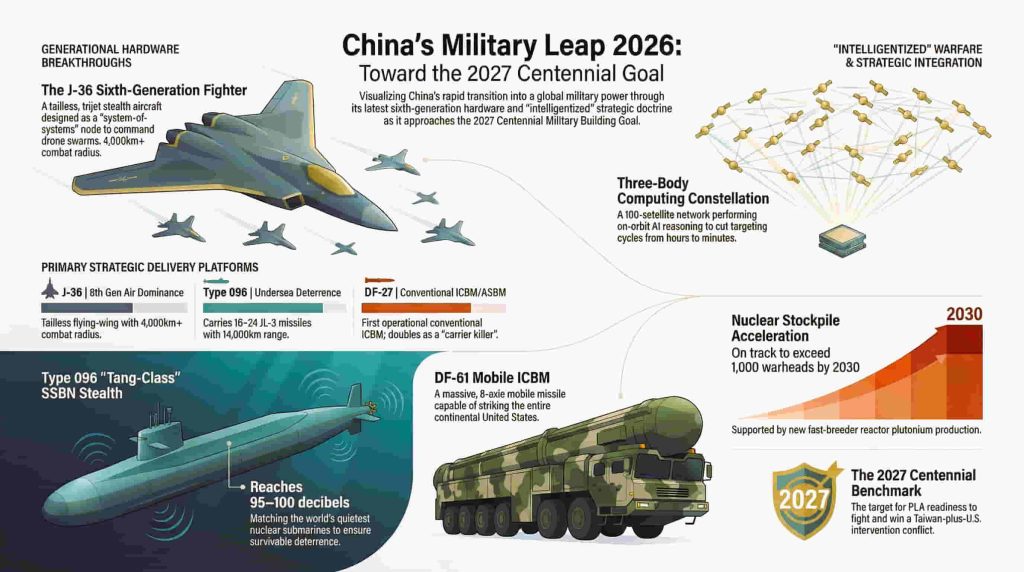
13. J-35A Stealth Fighter: ‘The F-35 Killer’
The J-35A represents China’s answer to the F-35-a twin-engine stealth fighter designed for both Air Force and Navy operations. Featuring an internal weapons bay and advanced sensor fusion, this platform provides pilots with complete battlespace awareness through helmet-mounted displays.
Stealth Capabilities:
- Configuration: Twin-engine stealth fighter
- Operators: Both PLAAF (Air Force) and PLAN (Navy)
- Weapons: Internal bay for reduced radar signature
- Avionics: High degree of sensor fusion
- Display: Helmet-mounted battlefield visualization
Strategic Parity: The J-35A demonstrates China’s ability to develop stealth fighters approaching Western standards. The internal weapons bay maintains radar cross-section during combat operations-external weapons destroy stealth characteristics. Sensor fusion integrates data from multiple sources, presenting pilots with comprehensive situational awareness. Nicknamed the ‘F-35 Killer,’ the J-35A provides China with the capability to contest airspace against America’s most numerous fifth-generation fighter.
16. J-20A Mighty Dragon: Fifth-Generation Air Superiority
The 2026 version of the J-20A marks a watershed moment-China’s premier stealth fighter is finally powered by the domestic WS-15 engine. This powerplant enables supercruise (supersonic flight without afterburners) and vastly improved maneuverability, bringing performance on par with or exceeding the F-22 Raptor.
Performance Breakthrough:
- Engine: Domestic WS-15 turbofan
- Supercruise: Sustained supersonic flight without afterburner
- Maneuverability: Dramatically improved thrust-to-weight ratio
- Comparison: Performance rivaling or exceeding F-22 Raptor
- Significance: No longer dependent on Russian engines
Indigenous Achievement: The WS-15 engine represents more than improved performance-it demonstrates China’s mastery of the most challenging aspect of fighter development. Advanced turbofan engines require metallurgy, manufacturing precision, and engineering expertise that few nations possess. By fielding a domestic engine matching or exceeding Western standards, China eliminates dependence on Russian powerplants and proves its aerospace industry can compete at the highest level.
17. J-20S: The Drone Commander
The J-20S represents a revolutionary concept-the world’s first twin-seat stealth fighter. But the second seat isn’t for a student pilot or traditional weapons system officer. It’s for a battle manager who uses AI interfaces to control a swarm of up to four FH-97A drones in real-time combat.
Manned-Unmanned Teaming:
- Configuration: Twin-seat stealth fighter
- Second seat role: AI-interface battle manager
- Drone control: Up to four FH-97A drones simultaneously
- Coordination: Real-time combat management
- World first: Only twin-seat stealth fighter
Force Multiplication: The J-20S fundamentally changes aerial combat mathematics. A single J-20S can coordinate four FH-97A drones-effectively creating a five-aircraft formation controlled by two people. These drones can conduct reconnaissance, electronic warfare, or strike missions while the manned fighter remains at safe standoff range. This manned-unmanned teaming concept represents the future of air combat, where expensive manned platforms orchestrate swarms of expendable autonomous systems.
18. J-15T Catapult Variant: Modernized Flying Shark
The J-15T represents the catapult-capable evolution of China’s carrier-based fighter. Beefed up for electromagnetic catapult launches from the Fujian carrier, this variant features reinforced landing gear and upgraded avionics, allowing it to carry the PL-15 long-range air-to-air missile.
Carrier Optimization:
- Launch method: Electromagnetic catapult compatible
- Structural: Reinforced landing gear for catapult stress
- Avionics: Upgraded for modern warfare
- Armament: PL-15 long-range air-to-air missile
- Platform: Type 003 Fujian carrier
Catapult Advantage: Electromagnetic catapults enable heavier, fuel-laden aircraft launches compared to ski-jump ramps. The J-15T can launch with maximum fuel and weapons loads, dramatically extending combat radius and persistence. Combined with the PL-15’s reported 200+ kilometer range, the J-15T provides carrier strike groups with extended air defense and offensive counter-air capabilities.
Strategic Support and Early Warning Systems
14. KJ-600 AWACS: China’s First Carrier-Based Early Warning Aircraft
The KJ-600 represents a critical capability for China’s carrier strike groups-organic airborne early warning. Acting as the ‘brain of the fleet,’ this aircraft detects incoming stealth fighters and sea-skimming missiles hundreds of miles away, then relays that data to J-15 and J-35 fighters for interception.
Early Warning Capabilities:
- Platform: Carrier-based AWACS aircraft
- Detection: Stealth fighters and sea-skimming missiles
- Range: Hundreds of miles beyond carrier group
- Data link: Real-time information relay to fighters
- Role: Fleet command and control node
Force Multiplier: The KJ-600 eliminates a critical vulnerability of earlier Chinese carriers-dependence on ship-based radars limited by radar horizon. By operating at altitude, the KJ-600 can detect threats far earlier than surface vessels, providing critical warning time. This extended detection range is particularly important for engaging stealth aircraft and low-flying anti-ship missiles before they reach launch positions.
Also read: Top 10 Most Powerful Electronic Attack Aircraft in the world
Strategic Nuclear Forces: Completing the Triad
11. JL-3 Air-Launched Ballistic Missile: Completing the Nuclear Triad
The JL-3 (also designated ‘Jingle-1’) officially completes China’s nuclear triad. Launched from H-6N bombers, this air-launched ballistic missile (ALBM) can strike regional targets or carrier groups with nuclear or conventional warheads from extreme standoff distances.
Strategic Specifications:
- Launch platform: H-6N bomber
- Classification: Air-launched ballistic missile (ALBM)
- Warhead: Nuclear or conventional capable
- Targets: Regional objectives, carrier strike groups
- Range: Extreme standoff distances
Triad Completion: The JL-3/Jingle-1 provides the airborne leg of China’s nuclear triad, joining land-based ICBMs and submarine-launched ballistic missiles. This redundancy ensures second-strike capability-even if land-based missiles are destroyed in a first strike, airborne and submarine assets can retaliate. Air-launched ballistic missiles also provide flexibility to strike time-sensitive targets like carrier groups before they can relocate.
12. DF-31BJ ICBM: Road-Mobile Strategic Deterrent
The DF-31BJ represents the 2026 evolution of China’s road-mobile ICBM. This solid-fuel missile employs a new cold-launch system, allowing rapid deployment from hidden tunnel networks that make satellite tracking nearly impossible before launch.
Survivability Features:
- Configuration: Road-mobile launcher
- Propulsion: Solid-fuel for rapid launch
- Launch method: Cold-launch system
- Deployment: Hidden tunnel networks
- Tracking resistance: Near-impossible pre-launch detection
Strategic Mobility: Road mobility makes the DF-31BJ extremely difficult to target in a first strike. The missiles can be moved continuously through China’s extensive tunnel networks, emerging only for launch. Cold-launch systems eject the missile from its canister before engine ignition, reducing launcher signature and enabling faster reloads. This survivability ensures credible second-strike capability.
20. DF-5C ICBM: Heavy Silo-Based Deterrent
Unlike mobile systems, the DF-5C is a massive silo-based liquid-fueled ICBM designed to carry up to 10 MIRVs (Multiple Independently-targetable Reentry Vehicles). With a range of 15,000 kilometers and multi-megaton yields, this missile can reach any point on the globe.
Heavy ICBM Specifications:
- Configuration: Silo-based strategic missile
- Propulsion: Liquid-fueled
- Payload: Up to 10 MIRVs
- Range: 15,000 kilometers (global reach)
- Yield: Multi-megaton warheads
Strategic Firepower: The DF-5C’s MIRV capability allows a single missile to engage up to 10 separate targets, overwhelming missile defense systems through sheer numbers. While silo-based missiles are theoretically vulnerable to first strikes, hardened silos and launch-on-warning postures maintain deterrent credibility. The 15,000-kilometer range ensures no point on Earth lies beyond reach.
Naval Strike and Maritime Bomber Forces
21. H-6J Naval Bomber: Dedicated Maritime Strike Platform
The H-6J represents China’s dedicated maritime strike capability-a bomber optimized for anti-ship missions. Capable of carrying up to eight YJ-12 supersonic anti-ship missiles under its wings, a single squadron can launch saturation attacks capable of overwhelming carrier defenses.
Strike Capabilities:
- Platform: Maritime strike bomber
- Armament: Up to 8 YJ-12 supersonic anti-ship missiles
- Missile performance: Mach 3+ terminal speed
- Squadron capability: Overwhelming saturation attacks
- Mission: Carrier strike group targeting
Saturation Strategy: A single H-6J squadron (typically 12-18 aircraft) can launch 96-144 supersonic anti-ship missiles in a coordinated strike. This mass of incoming missiles traveling at Mach 3+ overwhelms even sophisticated air defense systems through sheer numbers. Defending carriers must engage dozens of targets simultaneously-a scenario their defenses struggle to handle. This saturation approach represents China’s answer to U.S. carrier battle groups.
Naval Platforms: Surface and Subsurface
22. Type 052D ‘Luyang III’ Destroyer: China’s Aegis Equivalent
The Type 052D represents China’s mass-produced surface combatant-an Aegis-equivalent destroyer deployed in significant numbers. The 2026 extended version features a larger flight deck for Z-20 helicopters and upgraded AESA radar capable of tracking stealth targets at longer ranges.
Combat Systems:
- Classification: Multi-role guided missile destroyer
- Radar: Advanced AESA phased array
- Stealth tracking: Enhanced long-range detection
- Aviation: Enlarged flight deck for Z-20 helicopter
- Vertical launch: 64-cell VLS for missiles
Mass Production: With over 25 units built by 2026, the Type 052D demonstrates China’s shipbuilding capacity. Rather than small numbers of exquisite ships, China produces capable platforms in quantity. The upgraded AESA radar specifically addresses stealth threats, while the enlarged helicopter deck improves anti-submarine warfare capabilities. These destroyers form the backbone of China’s surface fleet.
23. Type 094A ‘Jin-Class’ Submarine: Second-Strike Capability
The Type 094A represents the backbone of China’s sea-based nuclear deterrent. The ‘A’ variant features a more streamlined hull to reduce acoustic signature, carrying 12 JL-3 submarine-launched ballistic missiles that allow China to strike the continental United States while remaining within the protective bastion of the South China Sea.
Strategic Submarine:
- Classification: Ballistic missile submarine (SSBN)
- Armament: 12 JL-3 submarine-launched ballistic missiles
- Hull: Streamlined design for reduced acoustic signature
- Range: Can target continental U.S. from South China Sea
- Role: Second-strike nuclear deterrent
Bastion Strategy: The Type 094A doesn’t need to venture into deep Pacific waters where U.S. attack submarines could hunt it. With JL-3’s extended range, these submarines can patrol the South China Sea-protected by China’s extensive air and naval forces-while maintaining strike capability against American cities. This bastion strategy ensures survivable second-strike capability even if land-based missiles are destroyed.
24. Type 075 LHD: Amphibious Assault Ship
The Type 075 is a 40,000-ton helicopter carrier serving as flagship for expeditionary operations. By 2026, these vessels integrate Z-20 helicopters and are armed with HQ-10 short-range defense systems to protect against swarm attacks.
Amphibious Capabilities:
- Displacement: 40,000 tons
- Role: Helicopter carrier and expeditionary flagship
- Aviation: Z-20 helicopter integration
- Defense: HQ-10 short-range anti-air system
- Mission: Amphibious assault and sea control
Expeditionary Power: Type 075 vessels provide China with power projection capability beyond immediate coastal waters. These ships can conduct amphibious assaults, humanitarian operations, or serve as command platforms for expeditionary groups. The HQ-10 defense system specifically addresses drone and missile swarm threats-an increasingly common danger on modern naval battlefields.
25. Type 003 ‘Fujian’ Aircraft Carrier: The Crown Jewel
The Type 003 Fujian represents the pinnacle of Chinese naval aviation-an 80,000-ton supercarrier utilizing electromagnetic aircraft launch systems (EMALS), the same technology found on the U.S. Ford-class. This allows launching heavier, fuel-laden aircraft like the J-35 and KJ-600 AWACS.
Carrier Specifications:
- Displacement: 80,000 tons
- Launch system: Electromagnetic Aircraft Launch System (EMALS)
- Technology: Equivalent to U.S. Ford-class
- Air wing: J-35 fighters and KJ-600 AWACS
- Advantage: Heavier aircraft launches with full fuel/weapons
Technological Parity: The Fujian’s EMALS represents a quantum leap over ski-jump ramps or steam catapults. Electromagnetic launch allows precise control of acceleration forces, enabling launches of heavily-loaded aircraft while reducing stress on airframes. This technology places China among the elite few nations capable of building modern supercarriers. Combined with the J-35 and KJ-600, the Fujian provides carrier strike group capability approaching U.S. standards-a remarkable achievement for a navy that operated no carriers until 2012.
China vs United States: Military Weapons Systems Comparison 2026
The strategic competition between China and the United States has produced parallel military modernization programs, with each nation developing weapons systems designed to counter the other’s capabilities. This comprehensive comparison examines equivalent or alternative weapons systems deployed by both militaries, highlighting how each nation approaches similar military challenges with distinct technological solutions.
While direct equivalence is rare-each system reflects unique doctrine, geography, and strategic priorities-this table identifies the closest counterparts across 25 major weapons categories. Understanding these parallels provides crucial insight into the technological balance of power and the evolution of modern warfare.
Complete Weapons Systems Comparison Table
| Category | China (PLA) | United States | Key Differences |
|---|---|---|---|
| 1. Directed Energy Weapons (Anti-Satellite) | JPG-1000C High-Powered Microwave • 20 gigawatt HPM system • Anti-satellite/anti-drone • Operational 2026 | Counter Communications System (CCS) • Ground-based jammer • Satellite communications disruption •Meadowlands/GSSAP programs | China focuses on microwave frying; US on electronic jamming. China system more powerful but less precise |
| 2. Anti-Ship Cruise Missiles | YJ-18C “Carrier Killer” • Subsonic cruise/Mach 3 terminal • 540 km range • S-turn evasion maneuvers | AGM-158C LRASM • Subsonic throughout flight • 560+ km range • AI-driven autonomous targeting | US emphasizes stealth and autonomy; China prioritizes terminal speed for penetration |
| 3. Ballistic Missile Defense | HQ-9 Exoatmospheric Interceptor • Midcourse interception • Hit-to-kill kinetic • 200+ km altitude | RIM-161 SM-3 Block IIA • Midcourse interception • Hit-to-kill kinetic • 1,500+ km range, 500 km altitude | SM-3 has significantly greater range and altitude capability; more proven track record |
| 4. Hypersonic Anti-Ship Missiles | YJ-17 Waverider • Mach 6 sea-skimming • Ship-launched • 400+ km range | (In Development) • Hypersonic Air-Launched Offensive ACM • DARPA Hypersonic programs • Not yet operational | China operationally ahead in hypersonic anti-ship; US focusing on air-launched variants |
| 5. Supersonic Cruise Missiles (Land Attack) | CJ-100 (DF-100) • Mach 4+ • 30,000m altitude • 2,000+ km range | (Limited Equivalent) • Tomahawk Block V (subsonic) • ARRW/HACM (hypersonic, development) • AGM-183A ARRW testing | US lacks operational supersonic cruise missiles; relies on subsonic stealth or hypersonic development |
| 6. Main Battle Tanks | Type 99B • 125mm smoothbore • Unmanned turret • Active Protection System • 58 tons | M1A2 SEPv3 Abrams • 120mm smoothbore • Manned turret • Trophy APS (some units) • 73.6 tons | Chinese unmanned turret innovative; US tank more proven, heavier armor, superior combat record |
| 7. Hypersonic Glide Vehicles (Theater) | DF-17 • Mach 5-10 • 1,800-2,500 km range • Operational since 2020 | (In Development) • Army Long Range Hypersonic Weapon • Navy CPS • Projected operational 2023-2025 | China operationally deployed; US programs delayed but may offer superior precision |
| 8. High-Speed Reconnaissance Drones | WZ-8 Rocket Drone • Mach 3+ reconnaissance • Air-launched from H-6 • High altitude | SR-72 (Rumored) • RQ-180 stealth UAV • RQ-4 Global Hawk • Subsonic but greater endurance | US emphasizes stealth over speed; SR-72 hypersonic remains unconfirmed |
| 9. Counter-Drone Laser Systems | LY-1 Laser Cannon • 30-100 kW estimated • Vehicle-mounted • Anti-drone/PGM | AN/SEQ-3 Laser Weapon System • 60 kW (LaWS) • Navy ship-mounted • DE M-SHORAD (Army 50kW) | US more operationally deployed on ships; China focuses on land-mobile systems |
| 10. Loyal Wingman Drones | FH-97A • Stealth design • AI-driven • J-20 compatible • 2024 operational | XQ-58A Valkyrie • MQ-28A Ghost Bat (with Australia) • Collaborative Combat Aircraft program • Testing phase | Both programs similar timeline; US broader international collaboration |
| 11. Air-Launched Ballistic Missiles | CH-AS-X-13 (Reported) • H-6N bomber launched • Nuclear/conventional • Regional range | (Historical Only) • AGM-69 SRAM (retired 1990) • Currently no ALBM in inventory • Doctrine shifted away | US abandoned ALBMs; China developing for nuclear triad completion |
| 12. Road-Mobile ICBMs | DF-31BJ • 11,200+ km range • Solid fuel • Cold launch from tunnels • MIRV capable | (None Currently) • Minuteman III (silo-based only) • Sentinel ICBM (development) • Mobile doctrine abandoned | US relies entirely on fixed silos; China prioritizes mobility for survivability |
| 13. Fifth-Generation Fighters | J-35A • Twin-engine stealth • Internal weapons bay • Naval/Air Force variants • Mach 1.8+ | F-35 Lightning II • Single-engine stealth • Three variants (A/B/C) • Network-centric warfare • Mach 1.6 | F-35 far more numerous (900+ built); superior sensor fusion; J-35 less proven |
| 14. Carrier-Based AEW&C | KJ-600 • Turboprop • Fixed-wing carrier AEW • Rotodome radar • 2024 testing | E-2D Advanced Hawkeye • Turboprop • Rotodome radar • 30+ years operational experience • Superior radar | E-2D significantly more capable and proven; KJ-600 just entering service |
| 15. Extra-Large UUVs | HSU-001 • Autonomous submarine • Multi-month endurance • Mine-laying/reconnaissance • Operational | Orca XLUUV • Boeing-built • 6,500 km range • Modular payload • Delivery starting 2024 | Both programs similar capability; US Orca more advanced autonomy algorithms |
| 16. Air Superiority Fighters | J-20A “Mighty Dragon”• WS-15 engines • Supercruise capable • Twin-engine • Mach 2.0+ | F-22A Raptor • F119 engines • Supercruise capable • Twin-engine • Mach 2.25 | F-22 more mature (20+ years operational); J-20 newer but less combat-proven |
| 17. Two-Seat Stealth Fighters | J-20S • Drone control variant • Battle manager seat • Controls 4x FH-97A • 2023+ operational | F-15EX Eagle II (non-stealth) • No operational 2-seat stealth variant • F-35 considered for future 2-seat • Concept only | China uniquely pursuing 2-seat stealth for drone control; US uses single-seat + ground control |
| 18. Catapult-Capable Carrier Fighters | J-15T • Flanker derivative • CATOBAR operations • PL-15 capable • Limited production | F/A-18E/F Super Hornet • Purpose-built carrier fighter • CATOBAR operations • AIM-120D, AIM-9X capable • 600+ built | Super Hornet far more capable, proven; J-15T derivative of Russian design |
| 19. Strategic Hypersonic Weapons | DF-27 • 8,000 km range • Mach 10+ • Boost-glide trajectory • Can reach Hawaii | (In Development) • AGM-183A ARRW (cancelled 2023) • LRHW “Dark Eagle” • Limited testing phase | China operationally ahead; US programs facing development challenges |
| 20. Heavy Silo-Based ICBMs | DF-5C • 15,000 km range • Liquid fuel • 10 MIRV capability • Multi-megaton yields | Minuteman III • 13,000+ km range • Solid fuel (more responsive) • 3 MIRV capability • 400 missiles deployed | US missiles older but solid fuel advantage; China has heavier payload capacity |
| 21. Maritime Strike Bombers | H-6J • 8x YJ-12 missiles • Subsonic bomber • 3,500 km combat radius • Naval focus | B-1B Lancer (maritime role) • 24x LRASM capable • Supersonic dash • Longer range • Multi-role | B-1B far more capable; can carry 3x the missiles with greater range and speed |
| 22. Aegis-Type Destroyers | Type 052D (Extended) • 7,500 tons • 64-cell VLS • AESA radar • 25+ in service | Arleigh Burke Flight III • 9,700 tons • 96-cell Mk 41 VLS • SPY-6 AESA radar • Most capable variant | Burke-class larger, more capable radar, greater missile capacity; more proven systems |
| 23. Ballistic Missile Submarines | Type 094A Jin-class • 12x JL-3 missiles • 9,000 km missile range • Relatively noisy • 6 operational | Ohio-class SSBN • 20x Trident II D5 • 12,000 km missile range • Quieter acoustics • 14 operational | Ohio-class significantly superior in stealth, payload, and reliability |
| 24. Amphibious Assault Ships | Type 075 LHD • 40,000 tons • Helicopter carrier • 30 helicopters • 3 operational | America-class LHA • 45,000 tons • Fixed-wing capable (F-35B) • More sophisticated systems • 2 operational, more building | America-class can operate F-35B jets; more versatile and capable |
| 25. CATOBAR Aircraft Carriers | Type 003 Fujian • 80,000 tons • EMALS catapults • 40-50 aircraft • 2024 trials | Gerald R. Ford-class • 100,000 tons • EMALS catapults • 75+ aircraft • USS Ford operational 2017 | Ford-class 25% larger, more aircraft, more proven EMALS; Fujian first Chinese CATOBAR |
Key Observations and Analysis
Areas of Chinese Advantage or Parity
- Hypersonic Weapons: China has operationally deployed hypersonic systems (DF-17, DF-27, YJ-17) while US equivalents remain largely in development
- Mobile ICBMs: China’s road-mobile nuclear forces provide survivability advantages over US silo-based systems
- Directed Energy Anti-Satellite: China’s HPM systems may be more powerful than current US deployed counterparts
- Two-Seat Stealth Fighters: Unique Chinese approach to manned-unmanned teaming with J-20S
Areas of US Advantage
- Naval Aviation: Superior carrier-based fighters, AEW&C, and amphibious capability
- Submarine Warfare: Quieter SSBNs with larger payloads and better survivability
- Fifth-Generation Fighters: F-35 program far more mature with 900+ aircraft vs. limited J-35A production
- Surface Combatants: Arleigh Burke destroyers remain more capable than Type 052D equivalents
- Operational Experience: US systems have decades of combat validation; Chinese systems largely untested
Technology Convergence
Both nations are pursuing remarkably similar technological solutions:
- Electromagnetic aircraft launch systems (EMALS)
- Loyal wingman drones for manned-unmanned teaming
- Directed energy weapons for drone defense
- Extra-large autonomous underwater vehicles
- Advanced AESA radars for air and missile defense
Doctrinal Differences
China emphasizes:
- Mobile systems for survivability (road-mobile ICBMs, mobile missile launchers)
- Speed over stealth in some domains (supersonic vs subsonic cruise missiles)
- Anti-access/area denial weapons (anti-ship missiles, hypersonics)
United States emphasizes:
- Network-centric warfare and sensor fusion
- Stealth over speed in many applications
- Power projection and expeditionary capabilities
- Alliance integration and interoperability
Strategic Implications
This comparison reveals neither nation holds comprehensive superiority across all domains. Instead, each has developed asymmetric advantages:
- China has moved faster on hypersonic weapons and mobile nuclear systems
- United States maintains superiority in traditional power projection (carriers, naval aviation, submarines)
- Both are rapidly advancing in autonomous systems and directed energy weapons
The most concerning aspect is not any single weapon system, but the convergence of capabilities that could enable rapid escalation or miscalculation in a crisis. As technologies mature and proliferate, maintaining strategic stability requires continuous dialogue, transparency measures, and updated arms control frameworks.
Methodology Note
This comparison is based on publicly available information from defense publications, official statements, and military analysis as of February 2026. Classified capabilities and performance data are not included. Some Chinese systems’ specifications are based on analysis and estimates rather than confirmed data. US developmental systems are included only if they have reached testing phases with public acknowledgment.
Sources: Jane’s Defence Weekly, CSIS Military Balance reports, Congressional Research Service reports, DOD annual reports to Congress, official military press releases, and defense industry publications.
Conclusion
The China-US military balance in 2026 reflects two technological peers pursuing different paths toward military modernization. Neither side possesses overwhelming superiority, but both have developed formidable capabilities designed to challenge the other’s strengths.
Understanding these parallel developments is essential for policymakers, defense analysts, and informed citizens as both nations navigate an increasingly complex security environment. The goal should not be achieving dominance, but maintaining stable deterrence while avoiding miscalculation.
Which comparative advantage do you consider most significant for future conflicts? Share your analysis in the comments.
Disclaimer: This comparison is for educational and analytical purposes only and does not constitute classified military intelligence or operational assessments.
The New Strategic Reality
China’s 25 most significant weapons systems collectively represent the most comprehensive military modernization in modern history. From directed energy weapons capable of paralyzing satellite networks to hypersonic missiles that current defenses cannot intercept, from AI-controlled autonomous systems to a complete nuclear triad featuring land, sea, and air delivery platforms, the People’s Liberation Army has transformed into a force capable of contesting Western military dominance across multiple domains.
Several strategic themes emerge from this comprehensive analysis:
- Asymmetric Advantage: Many systems specifically target Western vulnerabilities rather than competing head-to-head across all capabilities
- Technology Leapfrogging: China has bypassed incremental improvements to field revolutionary capabilities like hypersonics and directed energy weapons
- Integration and Networking: Systems increasingly operate as integrated networks rather than standalone platforms
- Anti-Access/Area Denial: The arsenal emphasizes preventing adversary operations within Chinese defensive zones
- Indigenous Development: Domestic production of advanced systems eliminates dependence on foreign suppliers
Which of these 25 weapons poses the greatest challenge to the current world order? The answer depends on strategic perspective. Hypersonic missiles threaten decades of missile defense investments. Anti-satellite systems endanger the space-based assets modern militaries depend upon. Carrier-killer missiles challenge naval supremacy. Nuclear systems ensure mutual deterrence. Collectively, they represent a military capable of executing Anti-Access/Area Denial strategies that could prevent Western intervention in regional conflicts-fundamentally altering the strategic calculus that has governed the Indo-Pacific since 1945.
The strategic implications extend beyond military balance to diplomatic calculations, alliance commitments, and regional security architecture. These capabilities force reconsideration of defense postures, intervention strategies, and technological investment priorities. Nations must now account for Chinese military capabilities when formulating their own defense policies and regional security strategies.
Looking forward, the question facing policymakers and defense planners is not whether China possesses formidable military capabilities-that question has been definitively answered. Rather, the crucial questions concern how Western militaries adapt to these capabilities, whether technological countermeasures can restore defensive advantages, and how strategic stability can be maintained in an era of hypersonic weapons, anti-satellite systems, AI-controlled autonomous platforms, and unprecedented precision strike capabilities.
The 25 weapons examined in this analysis represent China’s capabilities as of 2026. Future developments-including sixth-generation fighters, quantum communication systems, more advanced directed energy weapons, and enhanced artificial intelligence-will continue reshaping the global military balance. Understanding these systems and their strategic implications remains essential for comprehending the evolving dynamics of 21st-century great power competition and the future of warfare itself.
About This Analysis
This comprehensive analysis synthesizes information from multiple authoritative sources including U.S. Department of Defense annual reports to Congress on Chinese military power, defense industry publications, official Chinese media releases, academic research on PLA modernization, International Institute for Strategic Studies (IISS) assessments, and open-source intelligence evaluations. Technical specifications reflect publicly documented capabilities and may not include classified performance parameters or undisclosed systems.
This analysis is based on public information from defense publications, Wikipedia, Notebooklm, Chatgpt, Google, YT, official government sources, and reputable military analysis organizations.
Chinese military capabilities continue evolving at an unprecedented pace. Readers seeking current information should consult primary sources including annual DoD reports to Congress (‘Military and Security Developments Involving the People’s Republic of China’), IISS publications such as ‘The Military Balance,’ peer-reviewed defense journals, and congressional testimony from senior defense officials. The strategic assessments presented represent informed analysis based on available information and do not constitute official U.S. government policy positions.