

Today in this article we will discuss about the Mach to Light Speed Chart (Mach Number Conversion Calculator): Complete Speed Conversion Guide with PPT, PDF, Table and Infographic, from Mach 1 Speed to the Speed of Light – Everything You Need to Know so, Speed is one of the most fascinating concepts in science, aviation, and physics. Whether you are a student, an aviation enthusiast, a science writer, or just someone curious about how fast things can travel, understanding the relationship between Mach speed and the speed of light can completely change the way you see the universe.
Table of Contents
This comprehensive Mach to light speed chart covers everything – from Mach 1 speed at sea level, Mach 1 at various altitudes, top defense system speeds, the Master Mach Records Table, and all the way up to the theoretical maximum speed in the universe: the speed of light. You will also find a Mach speed table in mph and metric units, along with practical comparisons to help you make sense of these incredible numbers.
(Mach Number Conversion Calculator)
Mach Number Conversion Calculator
Enter a value in Mach number below to convert to another unit of speed.Mach to Light Speed Chat – Mach speed reference table
Mach Speed Conversion Table
All values calculated at Standard Sea Level conditions (15°C / 59°F). Mach 1 = 340.29 m/s.
| Mach | mph | km/h | m/s | ft/s | Knots | km/s | % Speed of Light | Regime |
|---|---|---|---|---|---|---|---|---|
| Mach 0.5 | 380.6 | 612.5 | 170.1 | 558.2 | 331.0 | 0.1701 | 0.0000568% | Subsonic |
| Mach 0.8 | 609.0 | 980.0 | 272.2 | 893.2 | 529.6 | 0.2722 | 0.0000908% | Subsonic |
| Mach 1 | 761.2 | 1,225 | 340.3 | 1,116.5 | 661.5 | 0.3403 | 0.000114% | Transonic |
| Mach 1.5 | 1,141.8 | 1,837.6 | 510.4 | 1,674.8 | 992.2 | 0.5104 | 0.000170% | Supersonic |
| Mach 2 | 1,522.4 | 2,450.1 | 680.6 | 2,233.0 | 1,323.0 | 0.6806 | 0.000227% | Supersonic |
| Mach 2.5 | 1,903.0 | 3,062.6 | 850.7 | 2,791.3 | 1,653.7 | 0.8507 | 0.000284% | Supersonic |
| Mach 3 | 2,283.6 | 3,675.1 | 1,020.9 | 3,349.5 | 1,984.5 | 1.0209 | 0.000340% | Supersonic |
| Mach 4 | 3,044.8 | 4,900.2 | 1,361.2 | 4,466.1 | 2,646.0 | 1.3612 | 0.000454% | Supersonic |
| Mach 5 | 3,806.0 | 6,125.2 | 1,701.5 | 5,582.6 | 3,307.5 | 1.7015 | 0.000568% | Hypersonic |
| Mach 6 | 4,567.2 | 7,350.3 | 2,041.7 | 6,699.2 | 3,969.0 | 2.0417 | 0.000681% | Hypersonic |
| Mach 7 | 5,328.4 | 8,575.3 | 2,382.0 | 7,815.7 | 4,630.5 | 2.3820 | 0.000795% | Hypersonic |
| Mach 8 | 6,089.6 | 9,800.4 | 2,722.3 | 8,932.2 | 5,292.0 | 2.7223 | 0.000908% | Hypersonic |
| Mach 9 | 6,850.8 | 11,025.4 | 3,062.6 | 10,048.8 | 5,953.5 | 3.0626 | 0.00102% | Hypersonic |
| Mach 10 | 7,612.0 | 12,250.4 | 3,402.9 | 11,165.3 | 6,615.0 | 3.4029 | 0.00114% | Hi-Hypersonic |
| Mach 15 | 11,418.0 | 18,375.7 | 5,104.4 | 16,747.9 | 9,922.5 | 5.1044 | 0.00170% | Hi-Hypersonic |
| Mach 20 | 15,224.0 | 24,500.9 | 6,805.8 | 22,330.6 | 13,230.0 | 6.8058 | 0.00227% | Hi-Hypersonic |
| Mach 25 | 19,030.0 | 30,626.1 | 8,507.3 | 27,913.2 | 16,537.5 | 8.5073 | 0.00284% | Re-entry |
| Mach 30 | 22,836.0 | 36,751.3 | 10,208.7 | 33,495.9 | 19,845.0 | 10.2087 | 0.00340% | Re-entry |
| Mach 50 | 38,060.0 | 61,252.2 | 17,014.5 | 55,826.5 | 33,075.0 | 17.0145 | 0.00568% | Re-entry |
| Mach 100 | 76,120.0 | 122,504.4 | 34,029.0 | 111,653.0 | 66,150.0 | 34.029 | 0.01136% | Re-entry |
| Mach 1,000 | 761,200.0 | 1,225,044 | 340,290 | 1,116,530 | 661,500 | 340.29 | 0.1136% | Re-entry |
| Mach 874,030 | 670,616,629 | 1,079,252,848 | 299,792,458 | 983,571,056 | 582,749,918 | 299,792.5 | 100% | Speed of Light |
Mach 1 Speed at Different Altitudes
The speed of sound decreases as altitude increases due to lower air temperature.
| Altitude | Temperature (°C) | Mach 1 (mph) | Mach 1 (km/h) | Mach 1 (m/s) | Mach 1 (knots) |
|---|---|---|---|---|---|
| Sea Level | +15.0°C | 761 | 1,225 | 340 | 661 |
| 5,000 ft | +5.1°C | 748 | 1,204 | 334 | 649 |
| 10,000 ft | -4.8°C | 735 | 1,182 | 328 | 638 |
| 15,000 ft | -14.7°C | 721 | 1,161 | 322 | 626 |
| 20,000 ft | -24.6°C | 707 | 1,138 | 316 | 614 |
| 25,000 ft | -34.5°C | 693 | 1,115 | 310 | 602 |
| 30,000 ft | -44.4°C | 678 | 1,091 | 303 | 589 |
| 36,089 ft (Tropopause) | -56.5°C | 660 | 1,062 | 295 | 573 |
| 40,000 ft | -56.5°C | 660 | 1,062 | 295 | 573 |
| 50,000 ft | -56.5°C | 660 | 1,062 | 295 | 573 |
Mach Speed Regime Classification Table
How aerospace engineers categorize speed ranges based on aerodynamic behavior.
| Regime | Mach Range | mph | km/h | m/s | Knots | Characteristics & Examples |
|---|---|---|---|---|---|---|
| Subsonic | < Mach 0.8 | < 609 | < 980 | < 272 | < 530 | Propeller planes, commercial airliners, helicopters |
| Transonic | Mach 0.8 – 1.2 | 609 – 914 | 980 – 1,470 | 272 – 409 | 530 – 794 | Swept wings; shock waves begin to form. Fighter jets near sound barrier |
| Supersonic | Mach 1.2 – 5.0 | 915 – 3,806 | 1,470 – 6,126 | 409 – 1,702 | 794 – 3,308 | Fighter jets, Concorde (Mach 2.04), SR-71 Blackbird (Mach 3.32) |
| Hypersonic | Mach 5.0 – 10.0 | 3,806 – 7,680 | 6,126 – 12,251 | 1,702 – 3,403 | 3,308 – 6,615 | NASA X-15 (Mach 6.7), X-51A Waverider, hypersonic missiles |
| Hi-Hypersonic | Mach 10.0 – 25.0 | 7,680 – 19,031 | 12,251 – 30,626 | 3,403 – 8,508 | 6,615 – 16,537 | NASA X-43A (Mach 9.6), extreme thermal heating; plasma forms |
| Re-entry | > Mach 25.0 | > 19,031 | > 30,626 | > 8,508 | > 16,537 | Space Shuttle (Mach 25), Apollo 10 (Mach 36), space capsules |
Fastest Aircraft & Vehicles — Mach Speed Records
Historical milestones from the first supersonic flight to the fastest human-made object.
| Vehicle / Object | Top Mach | mph | km/h | Category | Significance |
|---|---|---|---|---|---|
| Boeing 747-8 | Mach 0.85 | 652 | 1,050 | Subsonic | Standard long-haul cruise speed |
| Concorde | Mach 2.04 | 1,354 | 2,179 | Supersonic | Fastest commercial passenger airliner |
| SR-71 Blackbird | Mach 3.32 | 2,193 | 3,529 | Supersonic | Fastest air-breathing crewed aircraft |
| MiG-25 Foxbat | Mach 3.2 | 2,170 | 3,493 | Supersonic | Fastest fighter jet ever built |
| X-15 Rocket Plane | Mach 6.70 | 4,520 | 7,274 | Hypersonic | Fastest crewed atmospheric flight |
| NASA X-43A (Scramjet) | Mach 9.60 | 7,310 | 11,760 | Hypersonic | Fastest air-breathing uncrewed flight |
| Space Shuttle (Re-entry) | Mach 25.0 | 17,500 | 28,163 | Re-entry | Orbital velocity required to stay in space |
| Apollo 10 (Lunar Return) | Mach 36.0 | 24,791 | 39,897 | Re-entry | Fastest speed ever reached by humans |
| Parker Solar Probe | Mach ~565 | ~430,000 | ~692,000 | Spacecraft | Fastest human-made object ever |
| Speed of Light (c) | Mach ~874,030 | 670,616,629 | 1,079,252,848 | Light Speed | Universal speed limit — theoretical max |
World’s Fastest Missiles & Defense Systems by Mach Speed
Operational and verified top speeds for ballistic missiles, interceptors, and hypersonic weapons.
| Missile / System | Country | Type | Top Mach | Speed (mph) | Speed (km/h) |
|---|---|---|---|---|---|
| Ground-Based Interceptor (GBI) | USA | Anti-Ballistic Interceptor | Mach 33 | 25,000+ | 40,234+ |
| Avangard | Russia | Hypersonic Glide Vehicle | Mach 27 | 20,700 | 33,312 |
| DF-41 | China | ICBM (Re-entry) | Mach 25 | 19,000 | 30,578 |
| Agni-V | India | ICBM (Re-entry) | Mach 24 | 18,400 | 29,611 |
| Trident II D5 | USA / UK | SLBM (Submarine) | Mach 24 | 18,030 | 29,014 |
| S-400 Triumph (missile) | Russia | Air Defense System | Mach 14 | 10,600 | 17,060 |
| Kinzhal | Russia | Aero-ballistic Missile | Mach 10–12 | 7,600+ | 12,231+ |
| Zircon (Tsirkon) | Russia | Hypersonic Cruise Missile | Mach 9 | 6,900 | 11,104 |
| BrahMos-II | India / Russia | Hypersonic Cruise (testing) | Mach 7–8 | 5,329–6,090 | 8,575–9,800 |
| THAAD | USA | Terminal Interceptor | Mach 8 | 6,100 | 9,817 |
| BrahMos | India / Russia | Supersonic Cruise Missile | Mach 3 | 2,284 | 3,675 |
Mach to Light Speed Chart – PPT SLIDES
What Is Mach Speed? Understanding Mach 1 Speed
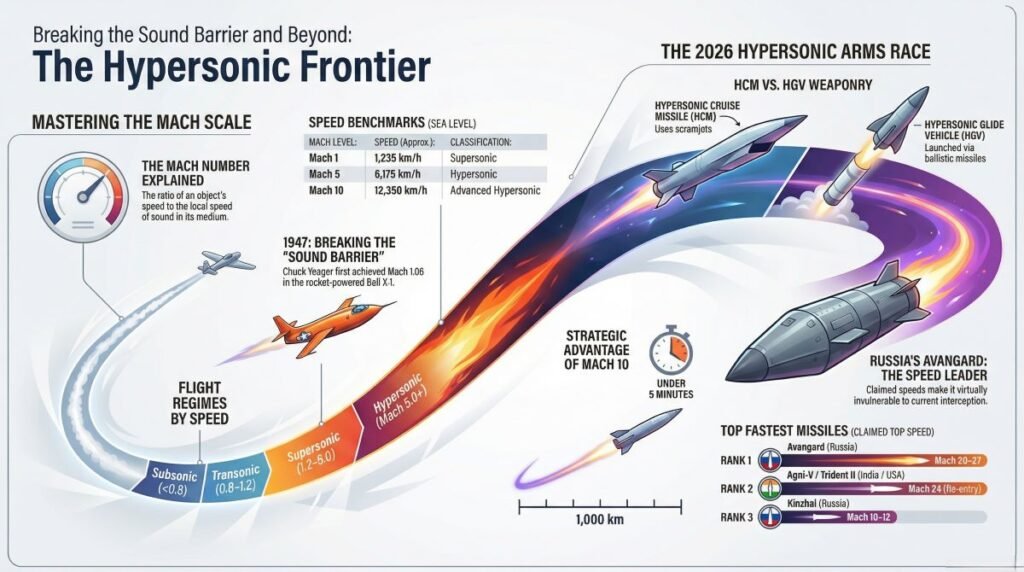
The Mach number is a dimensionless unit that represents the ratio of an object’s speed to the local speed of sound. It was named after Austrian physicist Ernst Mach, who contributed significantly to the study of supersonic motion.
Mach 1 speed is defined as the speed of sound, which varies depending on altitude, temperature, and atmospheric pressure. At sea level and a standard temperature of 15 degrees Celsius, Mach 1 speed equals approximately 343 meters per second, about 761 miles per hour (mph), or 1,225 kilometers per hour (km/h).
When an aircraft flies at Mach 2 speed, it is traveling at twice the speed of sound – roughly 1,522 mph or 2,450 km/h. At Mach 3 speed, that becomes about 2,284 mph or 3,675 km/h.
Quick Comparison: Mach 1 vs. Other Speed Units (Sea Level)
Before diving into the full charts, here is a quick reference for what Mach 1 equals in everyday units:
| Unit | Equivalent to Mach 1 (Sea Level) |
| Miles per Hour (mph) | 761 mph |
| Kilometers per Hour (km/h) | 1,225 km/h |
| Meters per Second (m/s) | 343 m/s |
| Feet per Second (ft/s) | 1,116 ft/s |
| Knots | 666.7 kn |
| Furlongs per Fortnight | 2,019,251 fl/fn |
Classification of Mach Regimes
Aerospace engineers categorize flight into several distinct regimes based on aerodynamic behavior. Here is the full Mach Regime Classification Table with Knots, mph, km/h, m/s, and real-world examples:
| Regime | Mach Range | Knots | mph | km/h | m/s | Characteristics & Examples |
| Subsonic | < 0.8 | < 530 | < 609 | < 980 | < 273 | Propeller planes, commercial airliners |
| Transonic | 0.8 – 1.2 | 530 – 794 | 609 – 914 | 980 – 1,470 | 273 – 409 | Swept wings; shock waves begin to form |
| Supersonic | 1.2 – 5.0 | 794 – 3,308 | 915 – 3,806 | 1,470 – 6,126 | 410 – 1,702 | Fighter jets, Concorde, SR-71 Blackbird |
| Hypersonic | 5.0 – 10.0 | 3,308 – 6,615 | 3,806 – 7,680 | 6,126 – 12,251 | 1,702 – 3,403 | NASA X-15, X-51A Waverider |
| High-Hypersonic | 10.0 – 25.0 | 6,615 – 16,537 | 7,680 – 19,031 | 12,251 – 30,626 | 3,403 – 8,508 | NASA X-43A; extreme thermal heating |
| Re-entry | > 25.0 | > 16,537 | > 19,031 | > 30,626 | > 8,508 | Space capsules, Space Shuttle (orbital speed) |
Mach Speed Table in MPH and Metric (km/h and m/s)
Below is a detailed Mach speed table covering Mach 1 through Mach 1,000, with conversions in mph, km/h, and m/s. All values are at standard sea-level conditions (15°C / 59°F).
| Mach Number | Speed (mph) | Speed (km/h) | Speed (m/s) | Category |
| Mach 1 | 761 mph | 1,225 km/h | 343 m/s | Transonic / Supersonic |
| Mach 2 | 1,522 mph | 2,450 km/h | 686 m/s | Supersonic |
| Mach 3 | 2,284 mph | 3,675 km/h | 1,029 m/s | Supersonic |
| Mach 5 | 3,806 mph | 6,125 km/h | 1,715 m/s | Hypersonic |
| Mach 10 | 7,680 mph | 12,251 km/h | 3,430 m/s | High Hypersonic |
| Mach 20 | 15,224 mph | 24,300 km/h | 6,860 m/s | High Hypersonic / Re-entry |
| Mach 30 | 23,018 mph | 37,044 km/h | 10,290 m/s | Re-entry |
| Mach 100 | 76,100 mph | 122,500 km/h | 34,300 m/s | Extreme |
| Mach 300 | 228,300 mph | 367,500 km/h | 102,900 m/s | Extreme |
| Mach 1,000 | 761,000 mph | 1,225,000 km/h | 343,000 m/s | Theoretical Extreme |
Mach 1 at Various Altitudes
Because sound travels slower in colder, thinner air, Mach 1 (the speed of sound) decreases as you climb through the International Standard Atmosphere. This is why aircraft traveling at the same indicated Mach number are actually moving at different true airspeeds depending on their altitude.
| Altitude (ft) | Mach 1 (mph) | Mach 1 (km/h) | Mach 1 (knots) | Temperature (°C) |
| Sea Level | 761 | 1,225 | 661 | 15.0 |
| 10,000 ft | 735 | 1,182 | 638 | -4.8 |
| 20,000 ft | 707 | 1,138 | 614 | -24.6 |
| 30,000 ft | 678 | 1,091 | 589 | -44.4 |
| 36,089 ft (Tropopause) | 660 | 1,062 | 573 | -56.5 |
| 50,000 ft | 660 | 1,062 | 573 | -56.5 |
1 Mach Speed in km: What Does It Actually Mean?
Note: Between approximately 36,000 and 65,000 feet, the temperature remains constant (the Tropopause), so the speed of Mach 1 also stays consistent at roughly 660 mph.
One of the most commonly searched questions is ‘1 Mach speed in km.’ Let us break it down simply.
1 Mach speed in km/h = approximately 1,225 km/h at sea level.
This means a jet aircraft flying at Mach 1 speed covers about 1,225 kilometers every hour, or roughly 20.4 kilometers per minute, or about 343 meters per second. That is faster than a bullet fired from most standard firearms.
| Mach Number | km per hour | km per minute | km per second |
| Mach 1 | 1,225 km/h | 20.4 km/min | 0.343 km/s |
| Mach 2 | 2,450 km/h | 40.8 km/min | 0.686 km/s |
| Mach 3 | 3,675 km/h | 61.3 km/min | 1.029 km/s |
| Mach 10 | 12,251 km/h | 204.2 km/min | 3.43 km/s |
| Mach 1,000 | 1,225,000 km/h | 20,417 km/min | 343 km/s |
Mach to Light Speed Chart: Complete Comparison Table
Now comes the most important section – the full Mach to light speed chart. The speed of light in a vacuum is exactly 299,792,458 meters per second, which equals approximately 670,616,629 mph or about 1,079,252,848 km/h.
Using sea-level Mach 1 speed (761 mph) as the baseline, the speed of light is approximately Mach 874,030 (sometimes rounded to Mach 881,000 in some references). This is a staggering number, and the chart below puts it all into perspective.
| Speed | Mach Number (approx.) | % of Light Speed | mph (approx.) |
| Speed of Sound (Mach 1) | Mach 1 | 0.000114% | 761 mph |
| Mach 10 | Mach 10 | 0.00114% | 7,610 mph |
| Mach 20 (Fastest Missile) | Mach 20 | 0.00228% | 15,220 mph |
| Mach 30 | Mach 30 | 0.0034% | 22,830 mph |
| Mach 300 | Mach 300 | 0.034% | 228,300 mph |
| Mach 1,000 | Mach 1,000 | 0.114% | 761,000 mph |
| Parker Solar Probe | ~Mach 565 | ~0.064% | ~430,000 mph |
| Speed of Light | ~Mach 874,030 | 100% | 670,616,629 mph |
Mach vs Light Speed: Direct Side-by-Side Comparison
To make this comparison fully concrete, here is a direct side-by-side table using Mach 1 at Sea Level (761 mph) versus the speed of light (c):
| Measurement | Mach 1 (Sound) | Light Speed (c) | Comparison |
| Miles per Hour | 761.2 mph | 670,616,629 mph | Light is 881,000x faster |
| Kilometers per Hour | 1,225 km/h | 1,079,252,848 km/h | Light is 881,000x faster |
| Meters per Second | 343 m/s | 299,792,458 m/s | Light is 874,000x faster |
| Travel Time (NY to LA) | ~3.2 hours | 0.013 seconds | Light is nearly instant |
| Travel Time (Earth to Moon) | ~313 hours | 1.28 seconds | Light reaches the moon in a blink |
Key Differences in Physics: Mach Speed vs. Speed of Light
Comparing Mach speed to light speed is not just about numbers. The two exist on fundamentally different physical planes:
- Medium Requirements: Sound (Mach) requires a medium to travel through – air, water, or metal. In the vacuum of space, Mach does not exist because there is no air to vibrate. Light requires no medium and travels fastest in a vacuum.
- The ‘Wall’: As an object approaches Mach 1, it hits the Sound Barrier, causing a sonic boom. As an object with mass approaches the speed of light, its relativistic mass effectively becomes infinite, meaning it would require infinite energy to reach light speed. This is Einstein’s cosmic speed limit.
- Variable vs. Constant: Mach 1 changes based on temperature and altitude – it is faster on a hot desert day (780 mph) than on a cold winter day (740 mph). The speed of light (c) is a universal constant – it never changes regardless of the observer’s motion.
Travel Time: Sun to Earth at Different Mach Speeds
The Sun is approximately 93 million miles (150 million km) away from Earth. Here is how long it would take to cover that distance at different speeds:
| Speed Type | Velocity (mph) | Velocity (km/h) | Mach Equivalent | Travel Time (Sun to Earth) |
| Mach 1 (Sound) | 761 | 1,225 | Mach 1 | ~14 years |
| Mach 20 (Fastest Missile) | 15,224 | 24,300 | Mach 20 | ~8.5 months |
| Sunlight / Light Speed | 670,616,629 | 1,079,232,848 | Mach ~874,030 | 8 minutes and 20 seconds |
This table powerfully illustrates why the speed of light is so extraordinary. What takes sound 14 years, light accomplishes in just 8 minutes and 20 seconds.
Highest Mach Speed Ever Recorded
Master Mach Records Table
This table tracks the fastest crewed and uncrewed vehicles ever recorded, moving from subsonic speeds to orbital velocity:
| Category | Vehicle / Object | Top Mach | Top Speed (mph) | Significance |
| Subsonic | Boeing 747-8 | Mach 0.85 | 652 | Standard long-haul cruise speed |
| Sound Barrier | Bell X-1 | Mach 1.06 | 807 | First crewed flight to break Mach 1 (1947) |
| Supersonic | Concorde | Mach 2.04 | 1,354 | Fastest commercial passenger airliner |
| Supersonic | SR-71 Blackbird | Mach 3.32 | 2,193 | Fastest air-breathing crewed aircraft |
| Hypersonic | X-15 Rocket Plane | Mach 6.70 | 4,520 | Fastest crewed flight within the atmosphere |
| Scramjet | NASA X-43A | Mach 9.60 | 7,310 | Fastest jet-engine (uncrewed) flight |
| Re-entry | Space Shuttle | Mach 25.0 | 17,500 | Orbital velocity required to stay in space |
| Lunar Return | Apollo 10 | Mach 36.0 | 24,791 | Fastest speed ever reached by humans |
Top Defense Speeds: Operational and Verified Missiles
In the world of defense, speed is life. Modern defense systems are categorized by whether they are Strategic Weapons (intercontinental missiles meant to deter) or Interceptors (defensive systems meant to shoot down incoming threats). Ballistic missiles reach their highest speeds during re-entry, while interceptors must achieve high Mach numbers almost instantly to meet an incoming threat.
| Missile / System | Type | Top Mach | Country | Speed (Approx. mph) |
| Ground-Based Interceptor (GBI) | Anti-Ballistic Interceptor | Mach 33.0 | USA | 25,000+ |
| Avangard | Hypersonic Glide Vehicle | Mach 27.0 | Russia | 20,700 |
| DF-41 | ICBM (Re-entry) | Mach 25.0 | China | 19,000 |
| Agni-V | ICBM (Re-entry) | Mach 24.0 | India | 18,400 |
| Trident II D5 | SLBM (Submarine) | Mach 24.0 | USA/UK | 18,030 |
| S37s (Gazelle) | ABM Interceptor | Mach 17.0 | Russia | 13,000 |
| S-400 Triumph | Air Defense System | Mach 14.0 | Russia | 10,600 |
| Kinzhal | Aero-ballistic Missile | Mach 10-12 | Russia | 7,600+ |
| Zircon | Hypersonic Cruise | Mach 9.0 | Russia | 6,900 |
| THAAD | Terminal Interceptor | Mach 8.0 | USA | 6,100 |
Key Performance Insights:
- The Fastest Interceptor: The U.S. Ground-Based Interceptor (GBI) is the fastest defensive weapon, reaching roughly Mach 33 to intercept incoming nuclear warheads in space.
- Hypersonic Maneuverability: Standard ballistic missiles (like the DF-41) are fast but follow a predictable arc. Hypersonic Glide Vehicles like the Avangard (Mach 27) can change direction mid-flight, making them nearly impossible for current radar to track and intercept.
- Cruise Missile Speed King: While most cruise missiles are subsonic (like the Tomahawk at Mach 0.7), the BrahMos remains the world’s fastest operational cruise missile at Mach 3.0, with a hypersonic BrahMos-II (Mach 7-8) currently in testing.
Mach 10 Speed: What Would It Feel Like?
Mach 10 speed is 10 times the speed of sound – roughly 7,680 mph (12,251 km/h) at sea level. At this speed, you could travel from New York to London in under 30 minutes.
In reality, flying at Mach 10 speed within the atmosphere generates enormous aerodynamic heating. The friction between a vehicle’s surface and the surrounding air creates temperatures exceeding 1,000 degrees Celsius. Mach 10 speed is also approximately 0.00114% of the speed of light – illustrating just how mind-bogglingly fast light really is.
Critical Mach Facts to Know
- The Heat Barrier: Once an aircraft exceeds Mach 5, air friction becomes so intense that the molecules in the air actually break apart (dissociate). This creates a ‘plasma’ around the vehicle, which can block radio signals – the famous re-entry ‘blackout.’
- Engine Limits: Standard jet engines (turbojets) fail at Mach 3 because the incoming air is moving too fast for the fans to handle. To go faster, engineers use Ramjets or Scramjets, which have no moving parts and simply ‘scoop’ the air.
- The Sonic Boom: A sonic boom is not a one-time event that happens at the moment you cross Mach 1. It is a continuous cone of sound that follows the aircraft the entire time it is supersonic. Anyone standing under the flight path will hear it.
- Temperature Sensitivity: Because the speed of sound depends on air temperature, Mach 1 is faster on a hot desert day (780 mph) than on a cold winter day (740 mph).
Mach Speed vs. Kinetic Energy
In defense and physics, the ‘damage’ an object does is not just about speed – it is about kinetic energy. Because kinetic energy (KE = 1/2 mv²) depends on the velocity squared, an object at Mach 10 has 100 times the destructive energy of an object at Mach 1. This is why ‘Kinetic Kill Vehicles’ (like the GBI missile) do not even need explosives – they just crash into the target to destroy it.
How Many Machs Is the Speed of Light?
If you were to describe the speed of light using Mach numbers (at sea level conditions), the answer is:
The speed of light is approximately Mach 874,030.
Even our fastest spacecraft, the Parker Solar Probe – which reaches about 430,000 mph – is only traveling at roughly Mach 565. That is not even 0.1% of the speed of light.
Also read: Top 10 Very Short Range Air Defense Systems in the World (VSHORAD)
FAQ:
What is Mach 1 speed in mph?
Mach 1 speed in mph is approximately 761 miles per hour at sea level. This varies with altitude and temperature.
What is 1 Mach speed in km?
1 Mach speed in km/h is approximately 1,225 km/h at sea level. In km/s, that is about 0.343 km per second.
What is the highest Mach speed ever achieved?
For a crewed vehicle, the Apollo 10 crew holds the record at Mach 36.0 (24,791 mph) during lunar return. For an uncrewed spacecraft, the Parker Solar Probe has reached approximately Mach 565. For aircraft, the fastest was the unmanned NASA X-43A scramjet at Mach 9.6.
How fast is the speed of light in Mach?
The speed of light is approximately Mach 874,030 (sometimes cited as Mach 881,000), using sea-level conditions as the baseline for Mach 1. This is the theoretical maximum speed in the universe.
What Mach is the speed of sound?
By definition, the speed of sound is Mach 1. At sea level, this equals approximately 343 m/s, 1,225 km/h, or 761 mph.
How does Mach 10 compare to the speed of light?
Mach 10 is approximately 0.00114% of the speed of light. While Mach 10 speed sounds extreme by human standards, it is a vanishingly small fraction of light speed.
What is the fastest missile in the world by Mach?
The U.S. Ground-Based Interceptor (GBI) reaches approximately Mach 33 during flight. Among offensive missiles, Russia’s Avangard hypersonic glide vehicle reaches Mach 27.
Conclusion: From Mach 1 Speed to the Speed of Light
The Mach to light speed chart reveals a profound truth about our universe: speed, as we experience it on Earth, is almost nothing compared to the cosmic scale. From Mach 1 speed – the crack of a supersonic jet breaking the sound barrier – to the speed of light at Mach 874,030, the journey is both humbling and awe-inspiring.
Whether you came here searching for a Mach speed table in mph, curious about 1 Mach speed in km, looking for the highest Mach speed ever recorded, wanting to understand how defense missiles compare in speed, or simply trying to visualize how Mach 10 stacks up against light speed – this complete guide has you covered.
The universe operates on scales that push human technology to its absolute limits. Even Apollo 10 astronauts traveling at Mach 36 are barely a rounding error compared to the speed of light. And yet, every Mach number we add is a step forward in our relentless human drive to go faster, farther, and deeper into the cosmos.
Bookmark this Mach to light speed chart for easy reference, and share it with anyone who loves science, aviation, or the pure thrill of speed.