Today in this article we will discuss about the Top 10 Biggest Aircraft Carriers in the World with PDF, PPT and Infographic, The Giants That Rule the Oceans, Complete Guide: Specs, Costs, Defense Systems & Amazing Facts – All in One Place so, If you have ever wondered which are the biggest aircraft carriers in the world right now – you are in the right place. Aircraft carriers are not just warships. They are floating cities, mobile air bases, and the single most powerful symbol of a nation’s military strength. Ranking them is not as simple as measuring length alone; the true measure of a carrier’s size is its full-load displacement – the total weight of the ship when fully loaded with aircraft, weapons, fuel, crew, and supplies.
Table of Contents
As of early 2026, the world’s biggest aircraft carriers are ranked primarily by their full-load displacement. The United States continues to dominate this list with its fleet of 11 nuclear-powered supercarriers, which are significantly larger than those of any other nation. But China, the United Kingdom, India, France, and Russia are all investing heavily in carrier programs of their own. In this article, I have compiled every key data point you need – technical specifications, construction costs, operating costs, defense systems, service life, and even some jaw-dropping facts about each carrier. This is the most comprehensive guide to the top 10 largest aircraft carriers in the world available anywhere online.
What Makes an Aircraft Carrier the ‘Biggest’?
Before we dive into the rankings, it is worth understanding what we mean when we say “biggest.” In the naval world, carriers are measured by several key metrics. Full-load displacement (in tonnes) is the most authoritative measure of size – it accounts for the total weight of everything on board. Overall length (in meters) gives us an intuitive sense of physical scale. Flight deck area determines how many aircraft can be parked, fueled, armed, and launched simultaneously. And aircraft capacity tells us just how powerful the ship is as an offensive platform.
For this list, I have ranked primarily by full-load displacement, which is the international standard used by naval analysts and defense institutions worldwide. Let us begin.
Top 10 Biggest Aircraft Carriers – Quick Overview (By Displacement)
Here is the ranked list at a glance before we break down each carrier in detail:
- USS Gerald R. Ford Class (USA) – ~100,000+ tonnes – The most advanced carrier ever built, featuring electromagnetic catapults (EALS) and a 337-meter flight deck.
- USS Nimitz Class (USA) – ~100,000 tonnes – The backbone of the U.S. Navy, with ten ships displacing ~97,000 tonnes each, capable of carrying over 75 aircraft.
- Fujian / Type 003 (China) – 80,000–85,000 tonnes – Commissioned in late 2025, China’s largest and first non-U.S. carrier to use electromagnetic catapults.
- Queen Elizabeth Class (UK) – ~65,000 tonnes – Displacing ~65,000 tonnes, the largest, most advanced warships ever built for the Royal Navy.
- Shandong / Type 002 (China) – 66,000–70,000 tonnes – China’s first domestically built, ski-jump equipped carrier.
- Liaoning / Type 001 (China) – ~60,000 tonnes – A refurbished Soviet-era vessel, displacing over 58,000 tonnes.
- Admiral Kuznetsov (Russia) – ~58,500 tonnes – Russia’s sole aircraft carrier, featuring significant onboard weapon systems.
- INS Vikramaditya (India) – ~45,400 tonnes – A 44,500-tonne, 284-meter modified Kiev-class carrier.
- INS Vikrant (India) – 43,000–45,000 tonnes – India’s first indigenous carrier, noted for its technological advancement.
- Charles de Gaulle (France) – ~42,500 tonnes – The only nuclear-powered carrier outside the U.S. Navy, utilizing a CATOBAR system.
Top 10 Biggest Aircraft Carriers in the World (PPT SLIDES)
Technical Comparison: Top 10 Biggest Aircraft Carriers in the World (Largest)
The table below provides a complete technical breakdown of each carrier – displacement, length, propulsion type, aircraft capacity, and crew size:
| Rank | Name / Class | Country | Displacement (Tonnes) | Length | Propulsion | Aircraft Capacity | Crew |
| 1 | Gerald R. Ford Class | USA | ~100,000+ | 337m | Nuclear (2x A1B Reactors) | 75+ | ~4,500 |
| 2 | Nimitz Class | USA | ~100,000 | 333m | Nuclear (2x A4W Reactors) | 60–75 | ~6,000 |
| 3 | Fujian (Type 003) | China | 80,000–85,000 | 316m | Conventional | 40–60 | ~2,000 |
| 4 | Queen Elizabeth Class | UK | ~65,000 | 280m | Integrated Electric | 40–50 | ~1,600 |
| 5 | Shandong (Type 002) | China | 66,000–70,000 | 308m | Conventional | 32–40 | ~2,000 |
| 6 | Liaoning (Type 001) | China | ~60,000 | 304m | Conventional | 36–40 | ~2,000 |
| 7 | Admiral Kuznetsov | Russia | ~58,500 | 305m | Conventional (Steam) | 30–40 | ~1,960 |
| 8 | INS Vikramaditya | India | ~45,400 | 284m | Conventional (Steam) | 30–36 | ~1,600 |
| 9 | INS Vikrant (IAC-1) | India | 43,000–45,000 | 262m | Conventional (COGAG) | 30–36 | ~1,700 |
| 10 | Charles de Gaulle | France | ~42,500 | 261m | Nuclear (2x K15 Reactors) | 30–40 | ~1,950 |
* COGAG = Combined Gas turbine And Gas turbine. All figures are approximate and based on open-source defense publications.
Detailed Profiles: Top 10 Biggest Aircraft Carriers in the World
#1. Gerald R. Ford Class – United States of America
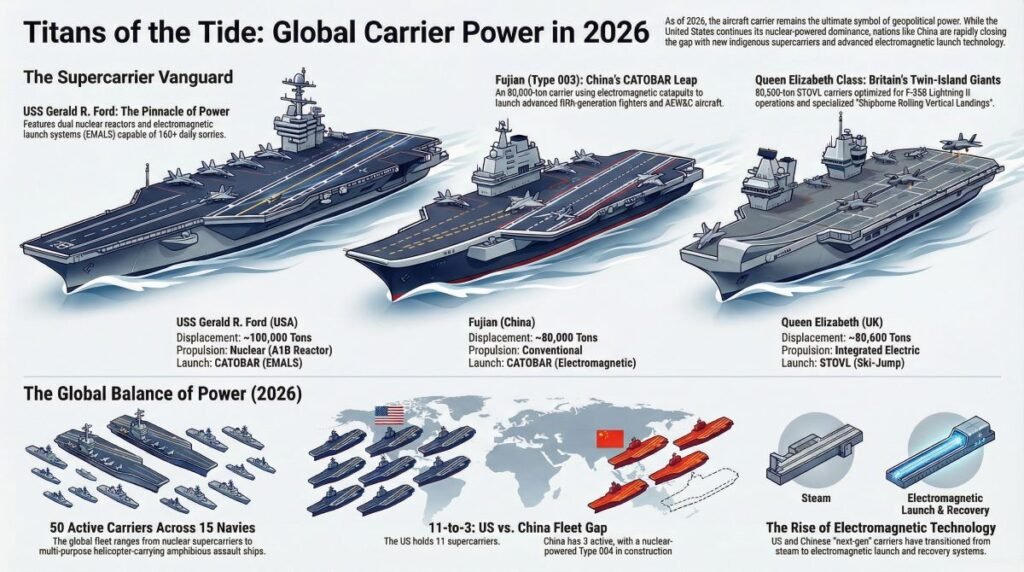
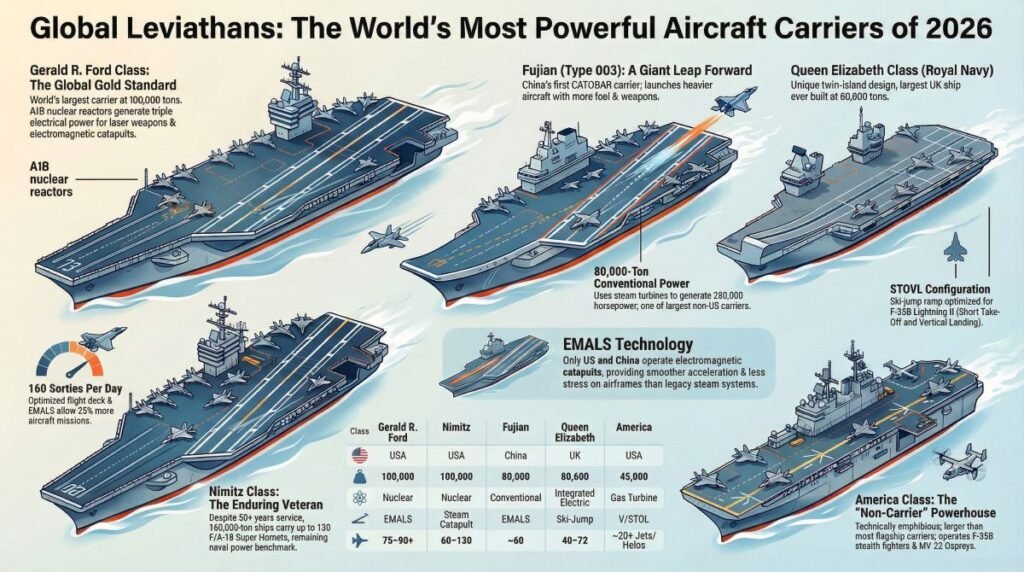
The USS Gerald R. Ford (CVN-78) is the largest aircraft carrier in the world and the most technologically advanced warship ever built. Commissioned in 2017 by the United States Navy, the Ford class represents a generational leap forward in naval aviation capability. The ship’s two A1B nuclear reactors generate three times the electrical power of the Nimitz class – enough to power three medium-sized cities – and this energy is channeled directly into the ship’s Electromagnetic Aircraft Launch System (EALS), which replaces the old steam-driven catapults.
What makes the Ford class truly special is not just its size – it is the 25 percent increase in sortie generation rate compared to the Nimitz, achieved through a redesigned flight deck, advanced weapons elevators, and reduced crew requirements due to automation. The Ford class will serve the US Navy for decades and is the yardstick against which all other carriers are measured.
#2. Nimitz Class – United States of America
The Nimitz class is arguably the most famous and battle-proven class of warships in human history. With ten ships still in active service as of 2025, these nuclear-powered supercarriers have been at the center of virtually every major U.S. military operation for over five decades. Each carrier is powered by two Westinghouse A4W nuclear reactors, giving them essentially unlimited range – they can operate for over 20 years without refueling.
A single Nimitz carrier operates an air wing larger than the entire air forces of most countries in the world. The class has seen combat in the Gulf War, the wars in Afghanistan and Iraq, and dozens of other operations. Though being gradually replaced by the Ford class, the Nimitz carriers will continue to serve until the 2040s and beyond.
#3. Fujian (Type 003) – People’s Republic of China
The Fujian, launched in June 2022 and undergoing sea trials as of 2025, is China’s most advanced aircraft carrier and a landmark achievement for the People’s Liberation Army Navy (PLAN). It is the world’s first carrier to use electromagnetic catapult launch technology outside of the United States – and it did so without nuclear propulsion, a fact that stunned many Western defense analysts.
With an estimated displacement of 80,000 to 85,000 tonnes, the Fujian is significantly larger than the Queen Elizabeth class and is quickly closing the gap with American supercarriers. It operates the J-35 stealth fighter – China’s answer to the F-35 – and carries a formidable air defense radar suite. The Fujian is a clear declaration that China intends to challenge American naval dominance in the Pacific.
#4. Queen Elizabeth Class – United Kingdom
The HMS Queen Elizabeth (R08) and HMS Prince of Wales (R09) are the largest warships ever built in British history and a major statement of the United Kingdom’s continued ambition as a global naval power. Displacing approximately 65,000 tonnes, these carriers are equipped with the F-35B Lightning II stealth fighter and use a Short Take-Off and Vertical Landing (STOVL) ski-jump configuration.
One of the most unique features of the Queen Elizabeth class is its twin-island design. One island controls ship navigation; the other manages air traffic. This setup dramatically improves flight deck efficiency. The carriers use Integrated Electric Propulsion (IEP), which provides excellent fuel efficiency and flexibility. Although they carry no organic missile defense of their own, they operate within a powerful carrier strike group that includes Type 45 destroyers armed with the Aster 30 missile system.
#5. Shandong (Type 002) – People’s Republic of China
The Shandong (CV-17) was commissioned in December 2019 as China’s second aircraft carrier and the first to be entirely designed and built on Chinese soil. An improvement over the Liaoning, it features a larger flight deck, improved sensors, and greater aircraft capacity. Like the Liaoning, it uses a ski-jump ramp and operates J-15 carrier-based fighters.
What makes the Shandong remarkable is the speed at which it was built – a 70,000-tonne warship completed in roughly 5 years. This demonstrated China’s industrial capacity to produce major warships at a rate no other country outside the United States can match. The Shandong operates primarily in the South China Sea, a region of significant geopolitical tension.
#6. Liaoning (Type 001) – People’s Republic of China
The Liaoning (CV-16) holds a special place in Chinese naval history as the country’s first aircraft carrier, commissioned in September 2012. Its origin story is remarkable: China purchased the half-built hull of the Soviet carrier Varyag from Ukraine in 1998, officially claiming it was destined to become a floating casino. Instead, it was towed back to China and spent over a decade being rebuilt into a fully operational warship.
While the Liaoning began its life as a training and research vessel, it has matured into a legitimate combat platform. It uses a ski-jump ramp for aircraft launches and operates J-15 fighters. Its story exemplifies China’s patient, long-term approach to building carrier capability from the ground up.
#7. Admiral Kuznetsov – Russian Federation
The Admiral Kuznetsov is Russia’s only aircraft carrier and one of the most distinctive warships in the world. Unlike any Western carrier, it is classified as a ‘heavy aircraft-carrying missile cruiser’ – and this title is no accident. The Kuznetsov is armed with P-700 Granit anti-ship cruise missiles, meaning it can project lethal offensive power even without launching a single aircraft. This reflects a core Russian naval philosophy: carriers should be able to fight independently, not just as floating air bases.
The Kuznetsov has had a troubled service history. It has suffered fires, flooding, crane accidents during repair, and chronic reliability issues with its steam turbines. As of 2025, it is undergoing a major refit and its return to service has been delayed multiple times. Whether it will ever be fully operational again remains an open question among defense analysts.
#8. INS Vikramaditya (R33) – Republic of India
The INS Vikramaditya is India’s first aircraft carrier to enter service, commissioned in November 2013 after a lengthy and expensive refit from the Russian Navy’s Admiral Gorshkov – a Kiev-class carrier. The transformation was extraordinary: the original ship had no proper runway and was designed for vertical take-off aircraft. Indian and Russian engineers had to add a massive ski-jump ramp and widen the flight deck entirely to make it capable of operating MiG-29K fighters.
Despite cost overruns and delays, the Vikramaditya has been an invaluable asset for the Indian Navy. It has given Indian carrier aviation personnel years of crucial operational experience that directly contributed to the successful commissioning of the indigenous INS Vikrant.
#9. INS Vikrant (IAC-1) – Republic of India
The INS Vikrant, commissioned in September 2022, is India’s greatest modern naval achievement. Built entirely in India at the Cochin Shipyard, it is constructed using approximately 76 percent indigenous materials – including a special grade of warship steel (DMR 249A) that India had to develop specifically for this project. It carries enough electrical cabling to stretch from Kochi all the way to Delhi.
The Vikrant makes India one of only a handful of countries in history capable of designing, building, and operating its own aircraft carriers. The ship took 13 years to build – longer than planned – but it represents the foundation of India’s future carrier force. It is expected to operate the twin-engine deck-based fighter (TEDBF) currently under development in India as a domestic alternative to the MiG-29K.
#10. Charles de Gaulle (R91) – French Republic
The Charles de Gaulle is France’s crown jewel – its only aircraft carrier and the only nuclear-powered carrier operated by any nation outside the United States. Despite being the smallest ship on this list in terms of displacement, it is arguably the most capable conventional-sized carrier in the world thanks to its nuclear propulsion and CATOBAR (Catapult Assisted Take-Off But Arrested Recovery) system.
The CATOBAR system allows the Charles de Gaulle to operate heavier, more capable fixed-wing aircraft – including the Rafale M multirole fighter and the E-2C Hawkeye airborne early warning aircraft – unlike ski-jump carriers that are limited to lighter planes. The carrier has been deployed in combat operations in Afghanistan, Libya, Iraq, and Syria. France is currently developing a next-generation carrier (PANG) to replace it by the mid-2030s, which will be significantly larger.
Financial Comparison: Aircraft Carrier Costs
Estimating the cost of an aircraft carrier is complex because figures vary based on inflation, whether research and development (R&D) is included, and the fluctuating price of manpower and fuel. The table below provides a comparison of the total construction cost and the estimated annual operating cost for crew, maintenance, and fuel:
| Rank | Class / Ship | Country | Construction Cost (Estimated) | Annual Operating Cost |
| 1 | Gerald R. Ford | USA | $13.3 Billion | ~$700M – $900M |
| 2 | Nimitz Class | USA | $4.5B – $8.5B | ~$500M – $700M |
| 3 | Fujian (Type 003) | China | $5.0B – $7.0B* | ~$300M – $400M* |
| 4 | Queen Elizabeth | UK | $3.8 Billion | ~$150M – $200M |
| 5 | Shandong | China | $3.0 Billion | ~$200M – $250M* |
| 6 | Liaoning | China | $2.5 Billion (Refit) | ~$150M – $200M* |
| 7 | Admiral Kuznetsov | Russia | N/A (Soviet Built) | ~$150M (currently in repair) |
| 8 | INS Vikramaditya | India | $2.3 Billion (Refit) | ~$100M – $180M |
| 9 | INS Vikrant | India | $3.6 Billion | ~$120M – $180M |
| 10 | Charles de Gaulle | France | $3.0 Billion | ~$150M – $200M |
* Asterisk: Data for Chinese vessels is based on expert estimates (CSIS/Pentagon reports), as the Chinese government does not release official budget breakdowns.
Also read: Top 10 Anti-Ship Missiles in the World 2026 (LRAShM) .PPTX
Important Context on These Costs
- The Hidden R&D Cost: The $13.3 billion for the USS Gerald R. Ford includes a massive ‘first-in-class’ research investment for its new nuclear reactors and electromagnetic catapults. Subsequent ships in the class, like the USS John F. Kennedy, are expected to be significantly cheaper.
- Operating Cost vs. Strike Group: The annual operating cost figures above are only for the ship itself. If you include the entire Carrier Strike Group – destroyers, submarines, supply ships, and the 60+ aircraft – the annual cost for a U.S. carrier group exceeds $2 billion.
- The Nuclear Factor: While nuclear carriers (USA/France) are more expensive to build and eventually decommission (due to radioactive waste), they save money in the long run by not requiring millions of gallons of marine diesel fuel every few weeks.
Construction Time & Service Life: Top 10 Aircraft Carriers
The construction of an aircraft carrier is a massive industrial undertaking that typically takes 5 to 10 years, depending on complexity and whether it is a new design or a repeat of an existing class. Once built, these ships are designed to last 40 to 50 years, often serving through multiple generations of sailors and aircraft:
| Rank | Name / Class | Country | Construction Time (Approx.) | Planned Service Life |
| 1 | Gerald R. Ford | USA | 8–12 Years | 50 Years |
| 2 | Nimitz Class | USA | 7–8 Years | 50+ Years |
| 3 | Fujian (Type 003) | China | 6–8 Years | 40–50 Years |
| 4 | Queen Elizabeth | UK | 8 Years | 50 Years |
| 5 | Shandong | China | 5–6 Years | 40 Years |
| 6 | Liaoning | China | 8 Years (Rebuild) | 30–40 Years |
| 7 | Admiral Kuznetsov | Russia | 8 Years | 35–40 Years (Extended) |
| 8 | INS Vikramaditya | India | 9 Years (Rebuild) | 40 Years (Post-Refit) |
| 9 | INS Vikrant | India | 13 Years | 40+ Years |
| 10 | Charles de Gaulle | France | 12 Years | 40 Years |
* Construction time measures from the ‘laying of the keel’ (start of physical assembly) to commissioning (entry into active service).
Why Does Construction Take So Long?
- First-in-Class Delays: The first ship of a new class always takes the longest. The USS Gerald R. Ford and INS Vikrant both faced significant delays because engineers were testing new technologies – like electromagnetic catapults or indigenous steel – for the first time during construction.
- Nuclear Complexity: Nuclear-powered ships (Ford, Nimitz, Charles de Gaulle) take longer to build than conventional ships because installing and testing the nuclear reactors requires extreme safety protocols and specialist workforces.
- Lifecycle Reality – The ‘Mid-Life Crisis’: While a carrier is built to last 50 years, it does not run continuously. Nuclear carriers like the Nimitz class must undergo a massive Refueling and Complex Overhaul (RCOH) around their 25th year. This process involves cutting the ship open to replace nuclear fuel rods and takes 3 to 4 years, during which the ship is completely out of service.
Radar & Missile Defense Comparison
Modern aircraft carriers are ‘floating islands’ that must defend themselves against high-speed missiles, torpedoes, and swarming drones. While they rely on their Carrier Strike Group for long-range protection, they carry advanced internal ‘last-resort’ defenses:
| Rank | Ship / Class | Primary Radar System | Key Missile Defenses | Close-In Weapon System (CIWS) |
| 1 | USS Gerald R. Ford | Dual-Band Radar (DBR): Combines X-band (precision) & S-band (search) AESA technology | RIM-162 ESSM (Medium Range) & RIM-116 RAM (Short Range) | 2x Phalanx 20mm Gatling guns |
| 2 | Nimitz Class | AN/SPS-48E & 49: High-performance 3D/2D air search radars | Sea Sparrow (RIM-7) and RIM-116 RAM launchers | 3–4x Phalanx CIWS |
| 3 | Fujian (China) | Type 346B ‘Star of the Sea’: Massive 4-panel S-band AESA radar | HHQ-10: A specialized short-range missile similar to the US RAM | Type 1130: 11-barrel 30mm gun firing 10,000+ rounds/min |
| 4 | Queen Elizabeth | S1850M & ARTISAN: Dual radar setup for long-range and 3D local tracking | None (missile-wise); relies on Type 45 Destroyers in its group | 3x Phalanx CIWS & 30mm small-caliber guns |
| 5 | Shandong (China) | Type 346A S-band AESA: Four large arrays on the island structure | HHQ-10 missile launchers | Type 1130 CIWS (the ‘missile shredder’) |
| 6 | Liaoning (China) | Type 346 S-band AESA: Early version of China’s phased-array radar | HHQ-10 missile launchers | Type 1130 CIWS |
| 7 | Admiral Kuznetsov | Sky Watch (Mars-Passat): Large phased-array radar (historically unreliable) | SA-N-9 Gauntlet: Vertical Launch System (VLS) with 192 missiles | 6x AK-630 Gatling guns and 8x Kashtan gun/missile systems |
| 8 | INS Vikramaditya | Fregat M2EM: 30 air search radar | Barak-8: Advanced long-range air defense system (India-Israel co-development) | 4x AK-630 CIWS |
| 9 | INS Vikrant | EL/M-2248 MF-STAR: One of the world’s most advanced digital AESA radars | Barak-8 VLS: Capable of intercepting threats up to 70km | 4x AK-630 CIWS |
| 10 | Charles de Gaulle | DRBJ 11B: Multi-function radar for tracking and weapon control | Aster 15: High-agility vertical launch missiles | 2x Sadral launchers and 20mm guns |
Defense Superlatives
- Best Radar: The USS Gerald R. Ford and INS Vikrant lead here. The Ford’s Dual-Band Radar can track a target the size of a golf ball from miles away, while India’s MF-STAR is highly regarded for its ability to track hundreds of targets simultaneously in 360 degrees.
- Fastest CIWS: China’s Type 1130 (on the Fujian and Shandong) is the king of ‘wall of lead’ defenses. It fires over 166 rounds per second, designed specifically to destroy incoming supersonic missiles.
- Most Missiles: Russia’s Admiral Kuznetsov carries the most internal surface-to-air missiles (192), reflecting the Soviet doctrine that a carrier should be able to fight even if its planes are destroyed.
- Smartest Defense: The US Ship Self-Defense System (SSDS) integrates all sensors and weapons into a single automated ‘brain’ that can react to a supersonic missile faster than a human operator ever could.
Amazing Facts: The Unique Identity of Each Carrier
Each aircraft carrier is a unique masterpiece of engineering with ‘personality traits’ that define its role on the global stage. Here are the most amazing and unique facts about each one:
| Rank | Name / Class | Unique Amazing Fact | Why It’s Special |
| 1 | USS Gerald R. Ford | Power of 3 Cities: Its two A1B reactors generate enough electricity to power three medium-sized cities | Uses this massive power for EALS (electromagnetic catapults) rather than traditional steam |
| 2 | Nimitz Class | The Floating Fortress: A single Nimitz carrier holds an air force larger than 70% of the world’s countries | It is the most battle-tested class in history, serving as the face of U.S. power for over 50 years |
| 3 | Fujian (Type 003) | The Physics Defier: It is the first carrier in history to use electromagnetic catapults WITHOUT a nuclear reactor | It recently became the first carrier to launch a 5th-gen stealth fighter (J-35) using EALS |
| 4 | Queen Elizabeth | The Twin Islands: It is the only carrier class with two separate ‘islands’ on deck | One island is for navigating the ship; the other is dedicated purely to controlling air traffic |
| 5 | Shandong | The Speed Builder: China built the 70,000-ton giant in just 5 years – a record pace for a ship of this size | It was China’s first 100% domestically built carrier, proving they could build massive warships without foreign hulls |
| 6 | Liaoning | The Casino Cover-up: China originally bought this ship’s hull from Ukraine by claiming they would turn it into a floating casino | Instead, they towed it to China and spent a decade turning it into their first operational aircraft carrier |
| 7 | Admiral Kuznetsov | The Heavy Cruiser: Unlike Western carriers, it is bristling with heavy anti-ship missiles designed to fight even without planes | It is Russia’s only aircraft carrier and can legally pass through the Turkish Straits due to its missile cruiser classification |
| 8 | INS Vikramaditya | The Extreme Makeover: It started as a Soviet ‘Vertical Take-Off’ ship with no runway and was rebuilt into a full STOBAR carrier | Engineers had to add a massive ski-jump and widen the deck to make it usable for modern MiG-29K jets |
| 9 | INS Vikrant | Indigenous Triumph: Built with 76% indigenous content, including special warship-grade steel India had to develop itself | It contains enough cabling to stretch from Kochi to Delhi (roughly 2,100 km) |
| 10 | Charles de Gaulle | The Mini-Supercarrier: It is the only nuclear-powered carrier in the world that is not American | Despite being the smallest on this list, it uses US-style catapults, allowing it to launch the same heavy planes as the US Navy |
Did You Know? Incredible Aircraft Carrier Facts
- A U.S. carrier desalinates over 400,000 gallons of seawater into fresh drinking water every single day. That is enough to supply a small town.
- During high-intensity operations, a carrier crew can launch a jet and land another every 60 seconds in total pitch darkness. The choreography on the flight deck is so precise that it has been compared to ballet – except a single mistake can cost lives.
- The flight deck of a Nimitz-class carrier is roughly the size of three football fields – yet it is only a fraction of the ship’s total interior space. Most of the ship lies below the water line, containing hangars, workshops, hospitals, kitchens, and accommodation for up to 6,000 people.
Nuclear-Powered vs. Conventional Aircraft Carriers: Key Differences
One of the most important distinctions between the world’s aircraft carriers is propulsion. Nuclear-powered carriers offer unlimited range, sustained high-speed capability, and free up space that would otherwise be used for marine diesel fuel – space that can instead be used for aviation fuel, aircraft weapons, and stores. The United States and France are currently the only two nations operating nuclear-powered carriers.
Conventional carriers, while less expensive to build and maintain on a per-ship basis, must refuel regularly – limiting their operational endurance during long deployments. China has publicly signaled its intention to develop nuclear-powered carriers as part of its long-term naval expansion strategy. Most defense analysts expect China’s first nuclear carrier to enter service sometime in the 2030s, which would significantly alter the strategic balance in the Indo-Pacific.
The Future of Aircraft Carriers: What Comes Next?
The global carrier race is accelerating, not slowing down. The United States is continuing to build Gerald R. Ford-class carriers, with the USS John F. Kennedy and USS Enterprise already under construction. France is developing the PANG (Porte-Avions de Nouvelle Génération), a nuclear carrier expected to be significantly larger than the Charles de Gaulle. China is believed to be developing a fourth carrier – likely nuclear-powered – under the designation Type 004.
South Korea and Japan are both converting their helicopter destroyers into light aircraft carriers capable of operating F-35B fighters. Turkey has commissioned the TCG Anadolu, a light carrier specifically designed for drone-based warfare. The United Kingdom is investing in upgrades for both Queen Elizabeth-class carriers to extend their service life and improve their combat capability.
The carriers of the 2040s will likely integrate hypersonic weapons, autonomous combat drones, directed-energy defenses (lasers), and artificial intelligence-driven operations. They will look different from today’s carriers – but they will remain the most powerful conventional weapons platforms on the planet.
The 2026 Naval Rebalance: Why 100,000 Tons of Diplomacy No Longer Belongs to One Flag
1. 100,000 Tons of Diplomacy
Eighty years after the close of World War II, the aircraft carrier remains the apex predator of the high seas. While critics often dismiss these behemoths as “floating targets” in an age of hypersonic missiles, the geopolitical reality of 2026 suggests otherwise. The carrier’s ability to project power, enforce sovereignty, and provide a persistent presence in contested waters remains unrivaled. As former U.S. Secretary of State Henry Kissinger famously observed: “An aircraft carrier is 100,000 tons of diplomacy. “However, in 2026, the diplomatic weight of those 100,000 tons is being recalibrated by the millisecond-precision of electromagnetic pulses. For decades, the United States maintained a unipolar grip on the oceans through its nuclear-powered fleet. Today, that era has effectively ended. Between the rapid maturation of the Chinese People’s Liberation Army Navy (PLAN) and a global shift toward “electromagnetic magic,” the landscape of naval supremacy has been fundamentally redrawn.
2. The “Ancient” Sovereignty of the Nimitz-Class
It is a profound paradox of modern naval engineering that the U.S. Navy’s primary tool for global power projection is, by many standards, “ancient.” The Nimitz -class has served for over half a century, with the lead ship currently facing its scheduled retirement. Yet it is a mistake to view these vessels as obsolete. Powered by twin nuclear reactors generating 260,000 horsepower, a Nimitz -class carrier can travel at speeds exceeding 30 knots with an unlimited operational range. While its standard air wing is formidable, its raw capacity is staggering; in a high-intensity “surge” scenario, these ships can theoretically house an arsenal of up to 130 F/A-18 Super Hornets. These “ancient” ships remain gamechangers because their mechanical reliability and massive deck space provide a level of persistence that newer, untested classes are still struggling to match. As the U.S. transitions to the Gerald R. Ford -class, the Nimitz fleet continues to hold the line, representing a standard of naval dominance that remains the benchmark for all rivals.
3. The American “Non-Carrier” Paradox
While supercarriers dominate the headlines, the true scale of U.S. naval hegemony is best understood through the America -class amphibious assault ships. Officially, these are not aircraft carriers; they are designed to support Marine expeditionary units. In reality, they represent a “Light Carrier” capability that exceeds the flagship capabilities of almost every other G7 nation. The America -class was designed with a specific aviation-centric philosophy, trading a traditional well deck for expanded hangar space and fuel capacity. Its versatile air wing includes:
- F-35B Lightning II: The fifth-generation stealth fighter capable of vertical take-off and landing (STOVL).
- MV-22 Osprey: Tilt-rotor aircraft that bridge the gap between helicopter flexibility and fixed-wing speed.
- Integrated Landing Craft: Support for traditional amphibious insertions when the mission shifts from air superiority to ground control.This “non-carrier” fleet highlights the sheer absurdity of American naval scale: even the U.S. Navy’s secondary aviation platforms are more powerful than the primary carriers of most global rivals.
4. China’s Quantum Leap: The Fujian and Beyond
In the 1970s, the idea of a state-of-the-art Chinese supercarrier was dismissed as a strategic fantasy. By 2026, that fantasy has become a formidable reality. The Fujian (Type 003) serves as the vanguard of a maturing “blue-water” force. Unlike its predecessors, which utilized “ski-jump” decks, the Fujian employs electromagnetic catapults. This technical leap allows the PLAN to operate a sophisticated air wing including the KJ-600 (Airborne Early Warning), the J-15T (a catapult-compatible variant of the Flanker), and the fifth-generation J-35 stealth fighter. According to an analysis by the International Institute for Strategic Studies (IISS):”Beijing’s main motivation… is that it sees aircraft carriers as an indispensable element in building a ‘blue-water’ navy that can independently project power and exert influence worldwide. “The speed of this expansion is historic. According to the 2025 Pentagon Report, China is projected to possess nine carriers by 2035-a trajectory that could soon see the PLAN outnumbering the U.S. Pacific Fleet in total hulls.
5. Electromagnetic Magic: The End of the Steam Era
The most significant shift in naval warfare in 2026 is the transition to the Electromagnetic Aircraft Launch System (EMALS) and Advanced Arresting Gear (AAG). By replacing the mechanical violence of steam with the digital precision of electromagnetics, carriers can now launch a wider variety of airframes with significantly less wear and tear.| Feature | Traditional Steam Catapults | EMALS | Acceleration | High-stress, “jerky” piston kick | Smooth, digitally controlled acceleration || Resource Demand | High fresh water and energy-intensive desalination | Lighter weight; efficient battery/supercapacitor storage || Versatility | Struggles with light UAVs; “jerky” start damages light airframes | Optimized for everything from heavy manned jets to light drones || Operational Tempo | Standard sortie rates | 25% increase in total sortie rates |
EMALS is the enabler for the drone revolution; its smooth acceleration allows for the launch of delicate, high-performance unmanned systems that would be shaken apart by a traditional steam catapult.
6. The British “Twin-Island” Philosophy and Project Ark Royal
The Royal Navy’s Queen Elizabeth -class carriers are defined by their striking “twin-island” superstructure. This design provides critical redundancy-separating navigation from flight control-while significantly reducing wind turbulence across the flight deck. However, the real story for the Royal Navy in 2026 is Project Ark Royal. This initiative is a strategic pivot to “future-proof” the fleet by retrofitting these STOVL carriers with catapults and arrestor gear. The objective is to move from a Short Take-Off/Vertical Landing (STOVL) model toward a STOBAR or CATOBAR configuration. This shift is designed specifically to accommodate high-performance unmanned strike systems and fixed-wing drones, ensuring that the Royal Navy’s smaller fleet remains relevant in an era of automated aerial warfare.
7. The 120,000-Ton Ghost: The Type 004
While the Fujian is the current face of the PLAN, the global intelligence community is focused on the “120,000-ton ghost”: the Chinese Type 004. Currently under construction at the Dalian Shipyard, this vessel is projected to reach a displacement of 110,000 to 120,000 tons, making it substantially more massive than the USS Gerald R. Ford. The Type 004 represents China’s ultimate naval milestone: the transition to nuclear marine propulsion. Intelligence regarding the Leshan prototype reactor in Sichuan suggests that China has solved the endurance puzzle required for global operations. Strategically, these ships are designed as a “blocking force” within the Second Island Chain, intended to deter American intervention regarding Taiwan and project Chinese power deep into the Pacific and Indian Oceans.
8. Conclusion: A Horizon of Nuclear Reactors and Drones
The transition from the Nimitz era to the age of the Ford and Type 004 defines the naval landscape of 2026. Global power is no longer just a matter of hull count; it is measured by nuclear endurance and electromagnetic efficiency. We are witnessing the evolution of the aircraft carrier from a manned fighter base into a floating, nuclear-powered drone hub. As these vessels become increasingly automated and digital, they offer a level of “electromagnetic diplomacy” that Henry Kissinger could scarcely have imagined. This leads to the defining question of our decade: As carriers evolve into floating nuclear-powered drone bases, will the traditional definition of “command of the sea” survive the next ten years, or are we witnessing the birth of an entirely different kind of naval warfare?
(FAQs)
What is the biggest aircraft carrier in the world in 2025?
The USS Gerald R. Ford (CVN-78) is the biggest aircraft carrier in the world in 2025 by overall design and technology, with a full-load displacement of approximately 100,000 tonnes and a length of 337 meters. Individual Nimitz-class carriers can exceed this displacement at maximum load.
How many aircraft carriers does the US have in 2025?
As of 2025, the United States Navy operates 11 active aircraft carriers – 10 Nimitz-class and 1 Gerald R. Ford-class (with more Ford-class ships under construction). This gives the US by far the world’s largest carrier fleet.
Which country has the most aircraft carriers?
The United States has the most aircraft carriers in the world with 11 active full-size carriers. China operates 3, the United Kingdom has 2, while France, India, and Russia each operate one.
What is the difference between CATOBAR and STOBAR carriers?
CATOBAR (Catapult Assisted Take-Off But Arrested Recovery) carriers use catapults to launch heavier, fully loaded aircraft – used by the US, France, and now China’s Fujian. STOBAR (Short Take-Off But Arrested Recovery) carriers use a ski-jump ramp instead of catapults – used by Russia, India, and China’s older Liaoning and Shandong. Ski-jump carriers are less expensive but limit the maximum weight (and thus fuel and weapons load) of aircraft they can launch.
Are aircraft carriers vulnerable to modern missiles?
This is one of the most debated topics in modern defense circles. Aircraft carriers do face growing threats from hypersonic anti-ship missiles (like China’s DF-21D and DF-26), advanced submarines, and drone swarms. However, carriers never operate alone – they are surrounded by a Carrier Strike Group with destroyers, submarines, and aircraft providing layered defense. The consensus among most defense analysts is that carriers remain viable and essential, though their operating concepts are evolving to meet new threats.
What is the most powerful aircraft carrier in the world?
By almost every measure – size, technology, aircraft capacity, strike capability, and defense systems – the USS Gerald R. Ford is the most powerful aircraft carrier in the world today.
Conclusion: The Era of the Supercarrier Is Far From Over
Aircraft carriers remain the ultimate symbols of national power in the 21st century. They represent decades of engineering excellence, enormous national investment, and the clear strategic ambition of the countries that operate them. From the nuclear supercarriers of the United States – which have no equal anywhere in the world – to the rapidly growing fleets of China and the continued pride of India, the United Kingdom, France, and Russia, the story of the world’s biggest aircraft carriers is really the story of global power competition itself.
Understanding which nations operate these platforms, how they are built, what they cost, and how they defend themselves gives us a window into the geopolitical realities that will shape the next fifty years. The details in this article – the specs, the costs, the construction times, and the incredible facts – are not just data points. They are the evidence of what it takes for a nation to truly project power across the world’s oceans.
As new carriers enter service in the coming years and older ones are retired, the competition for naval dominance will only grow more intense. But one thing is certain: the era of the aircraft carrier is not ending. If anything, it is just getting started.
Note: Found this guide useful? Share it with fellow defense and military history enthusiasts. Feel free to leave a comment with your thoughts – which aircraft carrier do you think is the most impressive, and why?