

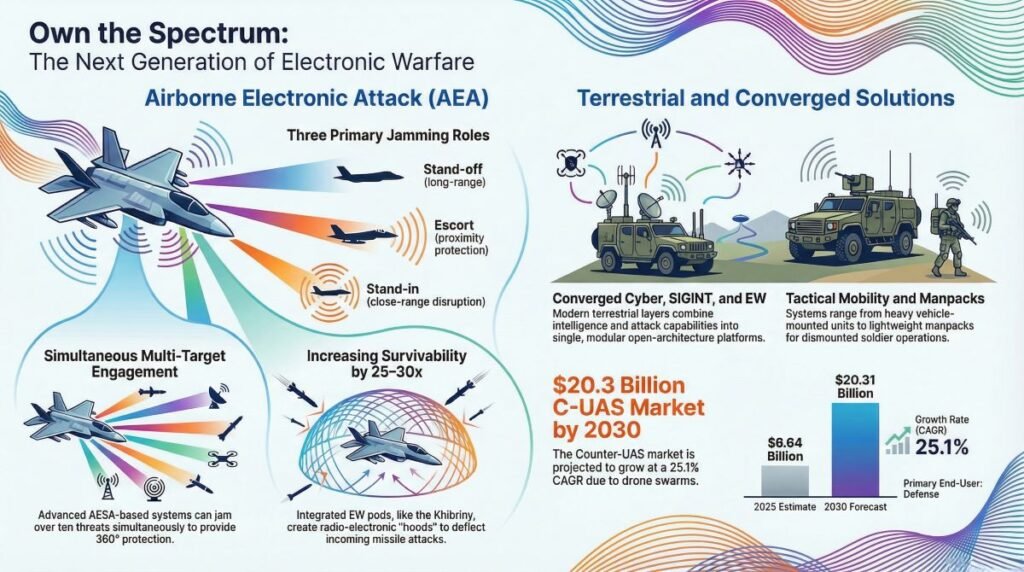
In the modern battlefield, the soldier who controls the electromagnetic spectrum wins. Military jammer systems have moved from being a niche electronic warfare tool to a front-line necessity – blocking enemy radars, disrupting drone communications, silencing GPS-guided weapons, and protecting entire military formations from missile threats. As of 2025–2026, the global military jammer market is valued at approximately $6.73 billion and is projected to grow to $9.05 billion by 2030, driven by AI integration, drone warfare proliferation, and the rise of Cognitive Electronic Warfare.
Table of Contents
This article presents the definitive, updated list of the top 10 military jammer systems in the world for 2025–2026, covering their manufacturers, platforms, capabilities, and what makes each one extraordinary. We also answer the most searched questions – what is a jammer, what are the types of jamming techniques, are drone jammers legal, can military drones be jammed, and do drone jammers work – along with a complete breakdown of military jammer systems in India, global market leaders, and financial data.
What Is a Jammer? (Jamming System Meaning)
A jammer is an electronic device or system that intentionally transmits radio frequency (RF) signals to interfere with a target’s communications, radar, or navigation. The jamming system meaning in a military context goes far beyond simple signal blocking – modern military jammers use sophisticated digital techniques to deceive, degrade, and destroy enemy electronic systems.
In contrast to civilian jammers (which simply block a frequency), military jammers are high-power, often mobile or airborne, and can target specific regions or systems with surgical precision. They are the cornerstone of Electronic Warfare (EW), which is one of the most classified and rapidly evolving fields in modern defence.
Types of Jamming Techniques
Before examining the top systems, it helps to understand the key types of jamming techniques used by military forces around the world:
- Noise Jamming: Floods the target frequency with high-power interference, masking legitimate signals. Includes barrage jamming (wide frequency coverage) and spot jamming (focused on one frequency).
- DRFM Jamming (Digital Radio Frequency Memory): One of the most advanced radar jamming techniques. DRFM jamming techniques capture an incoming radar signal digitally, modify it, and retransmit it to create false targets or ghost echoes. Used in the KORAL system, BriteCloud, and next-generation U.S. jammers.
- GPS/GNSS Jamming: Disrupts navigation signals used in precision-guided weapons and drones, causing them to go off course or lose lock entirely.
- Barrage Jamming: Covers a wide range of frequencies simultaneously. Effective when the exact enemy frequency is unknown, though power-intensive.
- Deceptive / Ghost Jamming: Sends false radar returns to make enemy radar see 50 planes where there is only one. Highly effective at creating confusion in enemy air defence networks.
- Drone Jamming: Targets the RF control links and GNSS signals of UAVs. Military drone jamming is the fastest-growing sub-category of electronic warfare in 2025–2026.
- Cognitive Electronic Warfare: The newest frontier – uses AI to learn a new enemy radar frequency in milliseconds, a task that used to take human analysts months. Systems like Kalastron Attack and NGJ-MB are integrating this capability.
Top 10 Military Jammer Systems in the World (2026) (PPT SLIDES)
Top 10 Military Jammer Systems in the World (2026)
The following rankings are based on technological sophistication (including GaN technology and AI integration), deployment scale, and recent operational updates as of March 2026.
#1. Next Generation Jammer (NGJ / AN/ALQ-249) – USA
Manufacturer: RTX (Raytheon) | Platform: Airborne (EA-18G Growler)
The Next Generation Jammer is the most advanced airborne tactical jammer in the world as of 2026. Developed by RTX (Raytheon), it uses Active Electronically Scanned Array (AESA) technology to simultaneously deny, degrade, and deceive multiple enemy radar and communication systems across multiple frequency bands – something no previous jammer could do at this scale.
Key 2025–2026 Updates: The U.S. Navy declared Initial Operational Capability (IOC) for the NGJ in late 2024. In 2025, RTX was awarded over $580 million for continued production. Initial deliveries to the Royal Australian Air Force began in 2025–2026. The NGJ-Mid-Band (AN/ALQ-249 NGJ-MB) specifically targets mid-band frequencies used by modern surface-to-air missiles and advanced fighter radars – considered the most dangerous threat frequency band on today’s battlefield.
The NGJ represents the gold standard among military jammer systems in the world and is part of what makes the United States the top 1 best defence system country in terms of electronic warfare capability.
#2. Krasukha-4 – Russia
Manufacturer: KRET (Russia) | Platform: Ground-Based (Mobile)
The Krasukha-4 is Russia’s most powerful ground-based military jammer vehicle. Mounted on a BAZ truck chassis, it is a broadband multifunctional jamming station specifically designed to counter airborne radars (AWACS) and low-earth orbit satellites at an operational range of up to 300 km. Few military jammer systems in the world can target satellites, making the Krasukha-4 genuinely unique.
The Satellite Killer: Unlike most jammers that focus on aircraft or communications, the Krasukha-4 can blind Low Earth Orbit (LEO) spy satellites – effectively turning expensive orbital assets into useless metal in the sky. It has been deployed in Syria and Ukraine and is considered one of the world’s best air defence system components in Russia’s ground-based EW arsenal.
#3. Scorplus-G – Israel (IAI / ELTA)
Manufacturer: IAI / ELTA | Platform: Ground-Based (Mobile)
Israel is one of the top 10 best defence system countries in the world, and the Scorplus-G is perhaps the most versatile of its electronic warfare products. It is the world’s first Electronic Warfare system capable of simultaneously jamming multiple threats across different frequency bands at the same time – like having 10 invisible shields pointing in every direction simultaneously.
This multi-tasking capability makes the Scorplus-G exceptionally effective in environments with diverse electronic threats. It is part of IAI’s record-breaking export year in 2026, with the system being acquired by multiple allied nations. Israel Aerospace Industries and ELTA Systems are among the top military jammer manufacturers globally.
#4. Viper Shield (EW Suite) – USA (L3Harris)
Manufacturer: L3Harris Technologies | Platform: Airborne (F-16)
The Viper Shield is an advanced digital Electronic Warfare suite integrated into F-16 aircraft. L3Harris, one of the leading military jammer manufacturers in the United States, developed it as a comprehensive self-protection and attack jamming system. It uses advanced digital signal processing and DRFM jamming techniques to counter both radar-guided and infrared-guided threats.
L3Harris launched a new integrated cyber-electronic warfare platform for multi-domain operations in 2025. The Viper Shield is seeing massive global expansion in 2025–2026 for international F-16 fleets, making it one of the most widely deployed airborne jamming solutions in the world.
#5. Kalastron Attack – Germany (HENSOLDT)
Manufacturer: HENSOLDT | Platform: Airborne / Ground
Germany’s HENSOLDT is one of Europe’s most respected military jammer manufacturers, and the Kalastron Attack system represents the frontier of AI-powered electronic warfare. It utilises Gallium Nitride (GaN) technology for high-power jamming output and integrates artificial intelligence for rapid signal classification and automated jamming response.
Why GaN? Gallium Nitride is a semiconductor material that allows jammers to transmit far more power at higher frequencies with much greater efficiency than older silicon-based systems. Combined with AI, the Kalastron Attack can identify and jam a new enemy radar frequency in milliseconds. By 2026, most top-tier military jammer systems are incorporating GaN as a baseline component.
#6. KORAL-2 Electronic Attack System – Turkey (Aselsan)
Manufacturer: Aselsan | Platform: Ground-Based (Mobile)
Turkey’s Aselsan has emerged as one of the most significant military jammer manufacturers outside of the traditional big-three EW nations (USA, Russia, Israel). The KORAL-2 is a land-based radar electronic attack system designed to jam and deceive enemy radars, providing what Aselsan describes as a protective umbrella for ground forces.
Aselsan secured a $410 million export contract for KORAL systems to Poland (a NATO ally) and continued expansion of the KORAL system for regional NATO-aligned missions in 2025–2026. The KORAL-2 is updated specifically for 2026 operations and specialises in the most advanced jamming and deceiving techniques against state-of-the-art radar systems. It is a major reason Turkey has entered the list of top 10 countries with best air defence and EW capabilities.
#7. BriteCloud / BriteStorm – UK (Leonardo)
Manufacturer: Leonardo | Platform: Airborne (Expendable Decoy / UAVs)
The BriteCloud is one of the most ingenious military jammer systems ever designed. It is literally the size of a soda can and is launched from standard aircraft flare dispensers. Once deployed, BriteCloud uses an onboard miniaturised DRFM jammer to mimic the host aircraft’s radar signature – causing incoming missiles to track the small decoy instead of the actual plane.
In 2024, Leonardo launched the BriteStorm variant, which weighs just 2.5 kg and is designed as a stand-in jammer for expendable drones. This makes BriteStorm a game-changer for drone-based electronic warfare. The BriteCloud has been mass-procured by the UK RAF and the U.S. Air National Guard. It proves that military jammer range and power do not always require a large platform – intelligence of design matters just as much.
#8. AN/SLQ-32(V)7 (SEWIP Block 3) – USA (Northrop Grumman)
Manufacturer: Northrop Grumman | Platform: Naval
The AN/SLQ-32(V)7, part of the Surface Electronic Warfare Improvement Program (SEWIP) Block 3, is the U.S. Navy’s most advanced shipborne electronic warfare suite. It protects surface warships from anti-ship missiles, enemy radar lock-ons, and communication threats. The naval sector is currently the fastest-growing segment of the military jammer market in 2025–2026.
Northrop Grumman has been integrating AARGM anti-radar systems with European Eurofighters alongside ongoing SEWIP development. The AN/SLQ-32 uses advanced DRFM jamming techniques and broadband jamming to provide ship self-defence in contested maritime environments. It has no finite ammunition – unlike missiles, it never runs out as long as the ship has fuel to generate power.
#9. GBVU Jammer / Samyukta – India (BEL)
Manufacturer: Bharat Electronics Limited (BEL) | Platform: Ground-Based (Mobile)
India is rapidly emerging as a serious player in military jammer systems, and the GBVU Jammer (with new 2026 deliveries) alongside the Samyukta Electronic Warfare system – both manufactured by Bharat Electronics Limited (BEL) – represent the country’s growing indigenous EW capability.
Samyukta is an integrated electronic warfare suite capable of intercepting, monitoring, and jamming a wide range of communication and radar signals. The GBVU Jammer targets the 30–1,000 MHz range to silence enemy tactical communications. In late 2025 and early 2026, India’s Ministry of Defense significantly boosted indigenous EW capabilities through Project Himshakti – contracts with BEL for advanced ground-based integrated systems.
Military jammer systems in India have historically relied on foreign technology, but BEL, Shoghi Communications, and other domestic military jammer manufacturers are changing that story. India’s goal is to be among the top 10 countries with best air defence system and homegrown EW capability by 2030.
#10. Silent Crow – USA (Lockheed Martin)
Manufacturer: Lockheed Martin | Platform: Airborne / Multi
The Silent Crow by Lockheed Martin rounds out the top 10 with one of the most forward-looking design philosophies in electronic warfare. It uses an open-architecture system design – nicknamed ‘The Lego Jammer’ – that allows operators to swap out its internal brain modules in minutes to fight a brand-new threat discovered that very morning.
In a world where enemy electronic warfare evolves rapidly, the Silent Crow’s adaptability is its greatest weapon. You don’t need a new aircraft or new hardware – just a software update, and the system is ready to counter a threat that didn’t exist yesterday. BAE Systems also received major contracts for F-35 Block 4 electronic warfare kits in 2025, underscoring how open-architecture EW design is reshaping the entire sector.
Top 10 Military Jammer Systems – Quick Comparison Table (2026)
| Rank | System | Manufacturer | Country | Platform | Key Capability |
| 1 | NGJ / AN/ALQ-249 | RTX (Raytheon) | USA | Airborne (EA-18G) | AESA jammer; Full-Rate Production 2025 |
| 2 | Krasukha-4 | KRET | Russia | Ground (Mobile) | Jams AWACS & LEO satellites; 300 km range |
| 3 | Scorplus-G | IAI / ELTA | Israel | Ground (Mobile) | World’s first multi-threat simultaneous jammer |
| 4 | Viper Shield | L3Harris | USA | Airborne (F-16) | Advanced digital EW; global F-16 expansion 2026 |
| 5 | Kalastron Attack | HENSOLDT | Germany | Airborne/Ground | GaN + AI for rapid signal classification |
| 6 | KORAL-2 | Aselsan | Turkey | Ground (Mobile) | DRFM deception; $410M Poland export contract |
| 7 | BriteCloud/BriteStorm | Leonardo | UK | Airborne/UAV | Soda-can DRFM decoy; UAV stand-in jammer |
| 8 | AN/SLQ-32(V)7 SEWIP | Northrop Grumman | USA | Naval | Ship EW suite; infinite soft-kill capability |
| 9 | GBVU / Samyukta | BEL (India) | India | Ground (Mobile) | 30–1,000 MHz tactical comms jamming |
| 10 | Silent Crow | Lockheed Martin | USA | Airborne/Multi | Open-architecture; rapid software-defined updates |
Financial Snapshot – Military Jammer Market (2026)
The global military jammer market is projected to reach approximately $6.73 billion in 2026, growing to $9.05 billion by 2030. The market is driven by increased military spending, the proliferation of drone warfare, and the rise of Cognitive Electronic Warfare. Below is a financial comparison of the top jammer systems:
| System | Unit Buy Price (Est.) | Annual Maintenance | Transport & Logistics | Notable Sale / Deal |
| NGJ (AN/ALQ-249 MB) | $40M–$60M per pod | $2.5M–$4M | Airborne; EA-18G carrier | $580M contract for 13 ship sets (US Navy/RAAF) |
| Krasukha-4 | $4.5M–$6M | $400K–$600K | Ground; 2x KamAZ truck | Sales reported to Iran and Syria |
| KORAL-2 (EW Suite) | $25M–$80M per system | $1.5M–$2M | Mobile ground units | $410M export contract to Poland (NATO) |
| BriteCloud | $25,000–$35,000 per unit | Negligible (expendable) | Hand-held crates; flare dispenser | Mass procurement by UK RAF and US Air National Guard |
| Viper Shield (EW) | $5M–$8M (internal suite) | $300K–$500K | Integrated into F-16 airframe | Multi-billion dollar F-16 global fleet upgrades |
| Scorplus-G | $15M–$20M (ground variant) | $1M–$1.5M | Mobile trailer or truck | Part of IAI’s record-breaking export year in 2026 |
Key Financial Trends (2026): Manufacturing investment for R&D-heavy radar and RF jamming facilities requires approximately $29.2 million for infrastructure. Maintenance and sustain contracts for advanced systems like the S-400 or large-scale EW suites (including those used by India) are valued in the hundreds of millions of dollars for long-term readiness.
Key Military Jammer Manufacturers and Market Leaders (2026)
The global military jammer market is dominated by several high-tech defence contractors:
- USA: Northrop Grumman, Lockheed Martin, L3Harris, RTX (Raytheon)
- Europe: BAE Systems (UK), Thales (France), Saab (Sweden), Leonardo (UK/Italy), HENSOLDT (Germany)
- Middle East / Asia: Elbit Systems and IAI/ELTA (Israel), Aselsan (Turkey), China Electronics Technology Group (CETC), BEL and Shoghi Communications (India)
2025–2026 Company Milestones
| Company | Recent Milestone (2025–2026) |
| Northrop Grumman | Integrating AARGM anti-radar systems with European Eurofighters |
| L3Harris | Launched new integrated cyber-electronic warfare platform for multi-domain operations |
| BAE Systems | Awarded major contracts for the F-35 Block 4 electronic warfare kits |
| Aselsan (Turkey) | Continued expansion of KORAL-2 system for regional NATO-aligned missions; $410M Poland deal |
| BEL (India) | Project Himshakti – significant boost to indigenous EW capabilities in 2025–2026 |
| Leonardo (UK) | BriteStorm launch in Oct 2024; lightweight UAV stand-in jammer entering service |

The “Electronic Battlefield” – 7 Wild Facts About Military Jammers
Electronic warfare is as fascinating as it is fearsome. Here are some remarkable facts about the systems on this list:
- NGJ Uses RAM Air Turbines: The Next Generation Jammer generates its own electricity in flight using small propeller-like turbines, producing enough raw power to run a small town – just to transmit jamming signals.
- Krasukha-4 Can Blind Satellites: It does not just jam planes – the Krasukha-4 can temporarily blind Low Earth Orbit spy satellites, turning billion-dollar orbital assets into useless metal in the sky.
- BriteCloud Is the Size of a Soda Can: It is literally the size of a soda can, launched from a standard aircraft flare dispenser, yet it mimics the host jet’s radar signature so convincingly that incoming missiles target it instead.
- Scorplus-G Jams 10+ Targets Simultaneously: Unlike older jammers that hit one target at a time, Scorplus-G can jam 10 or more targets in different directions at once – like having multiple radar shields active simultaneously.
- KORAL Creates Ghost Radars: Using DRFM, KORAL captures a radar signal, slightly modifies it, and sends it back – making the enemy radar see 50 planes where there is only one.
- AN/SLQ-32 Has Infinite Ammunition: Unlike missiles, the naval SEWIP Block 3 jammer never runs out of soft-kill capability as long as the ship has fuel to generate power. It is a weapon with no reload.
- Silent Crow Is Modular Like LEGO: Lockheed Martin’s Silent Crow can have its internal brain modules swapped in minutes in the field – allowing it to fight a completely new threat that was discovered that same morning.
Military Jammer Systems in India – A Growing Power
India deserves special focus as one of the most rapidly developing EW nations in the world. Military jammer systems in India are produced primarily by Bharat Electronics Limited (BEL) and Shoghi Communications Ltd., which is one of the leading private military jammer manufacturers in the country.
What is a Shoghi jammer? Shoghi offers a comprehensive range of electronic warfare products including military jammer vehicle systems (vehicle-mounted broadband jammers for convoy protection), military jammer backpack units for infantry (portable soldier-worn jammers), portable cell phone jammers for IED neutralization, drone signal jammers for border security, and radar jamming techniques training systems.
India’s Project Himshakti (2025–2026) has significantly boosted indigenous EW capabilities through BEL contracts for advanced ground-based integrated systems. The GBVU Jammer saw new 2026 deliveries, targeting the 30–1,000 MHz range for tactical communication jamming. India’s ambition is to rank among the top 10 countries with best air defence system capabilities by 2030, and its electronic warfare investments are a key part of that strategy.
Conclusion
Military jammer systems have become the backbone of modern electronic warfare – as essential to a 21st-century military as tanks were to 20th-century warfare. From the AI-powered NGJ that dominates the skies aboard the EA-18G Growler, to the satellite-blinding Krasukha-4 on a Russian truck, to the soda-can-sized BriteCloud decoy, to India’s growing BEL-produced systems – the diversity and sophistication of military jamming in 2025–2026 is breathtaking.
The $6.73 billion global military jammer market is being driven by drone warfare proliferation, cognitive electronic warfare, GaN technology adoption, and AI integration. Countries that master the electromagnetic spectrum will hold a decisive strategic advantage in every conflict domain – air, land, sea, and space.
Whether you are a defence enthusiast, a policy researcher, or simply curious about what is jammer technology and how military drone jamming works, understanding these systems is essential to understanding modern warfare.
Also read: Top 10 Stealth Aircraft in the World 2026 (.PPTX)
(FAQ)
Are Drone Jammers Legal?
This is one of the most searched questions: are drone jammers legal? The short answer is: it depends on who you are and where you are. In the United States, civilian use of RF jammers – including drone jammers – is strictly prohibited by the FCC under the Communications Act. However, military, federal law enforcement, and specifically authorized government agencies can deploy anti-drone jamming systems under national security frameworks.
In most countries, drone jammers are regulated under telecommunications and aviation law. Civilian ownership and use is typically illegal. Military and law enforcement use is generally authorized. For hobbyists and businesses asking about military grade drone jammer purchase options – while some platforms like Amazon list drone signal jammer products, buying or using them as a civilian is likely illegal in your jurisdiction. Always consult local telecommunications regulations before purchasing.
Can Military Drones Be Jammed?
Can military drones be jammed? Yes – but it is significantly harder than jamming a consumer drone. Military-grade drones are engineered with frequency-hopping encrypted control links, anti-jamming GPS receivers, autonomous waypoint navigation (so they can fly a mission even with no communication link), and sometimes laser-based communications that are immune to RF jamming entirely.
That said, even hardened military drones can be degraded or disrupted by advanced military drone jamming systems – particularly those using wideband DRFM jamming techniques and AI-driven frequency adaptation. The ongoing conflict in Ukraine has demonstrated both the vulnerability of cheaper military drones to jamming and the resilience of better-engineered systems. Military anti drone technology is an arms race, and both sides are advancing rapidly.
Do Drone Jammers Work?
Do drone jammers work? Yes, very effectively against most commercial and semi-military drones. Consumer drones that rely on standard 2.4 GHz or 5.8 GHz control frequencies are highly vulnerable. When the control link is jammed, most commercial drones will hover in place, land automatically, or return to their home point – making drone jamming a non-destructive, reversible countermeasure.
The effectiveness depends on the jammer’s output power, frequency coverage, military jammer range, and the sophistication of the target drone. A drone jammer gun can be highly effective at short range, while vehicle-mounted military jammer systems can protect large perimeters against swarms.
What Is Anti Drone Jamming System Price?
Anti Drone Jamming System price varies enormously. Entry-level drone detection and jamming systems for security use start from a few thousand dollars. A military drone jammer gun (handheld/shoulder-mounted) typically costs $5,000–$50,000. Vehicle-mounted military anti drone systems range from $50,000 to several million dollars. Full integrated anti-drone platforms like Israel’s Drone Guard Enhanced (by IAI/ELTA) – a multi-layered system that detects and jams both commercial and military drones by disrupting their GNSS and control links – can cost tens of millions of dollars for a complete installation.
Which Country Has the Best Defence System in the World?
In terms of electronic warfare and military jamming capability, the United States consistently ranks first – possessing the most advanced airborne jamming aircraft (EA-18G Growler with NGJ), the largest EW R&D budget, and the most combat-proven systems. Russia ranks second with its Krasukha-4 and Khibiny systems. Israel is third, with IAI/ELTA producing some of the most sophisticated and combat-tested electronic warfare solutions globally.
Top 10 countries with best air defence system (including EW capability): United States, Russia, Israel, China, United Kingdom, France, Germany, Turkey, India, and Australia. India is rapidly climbing this list through Project Himshakti and domestic production expansion under BEL.
Key Takeaways
- The global military jammer market is worth $6.73 billion in 2026, projected to reach $9.05 billion by 2030.
- The NGJ (Next Generation Jammer) by Raytheon is currently the world’s most advanced airborne military jammer.
- Russia’s Krasukha-4 is the only widely deployed military jammer capable of targeting low-earth orbit satellites.
- Israel, Turkey, Germany, and India have emerged as major new military jammer manufacturers alongside the USA, Russia, and UK.
- AI and GaN technology are now standard in next-generation military jammer systems.
- Military drone jamming is the fastest-growing segment of electronic warfare in 2025–2026.
- Drone jammers are illegal for civilians in most countries, including the USA, but are widely used by military and law enforcement.
- India’s BEL and Shoghi are leading domestic military jammer manufacturers, with major capability boosts under Project Himshakti.
- Types of jamming techniques include noise jamming, DRFM jamming, GPS/GNSS jamming, barrage jamming, deceptive jamming, and cognitive EW.
Disclaimer: This article is intended for informational and educational purposes only. All information is sourced from publicly available data as of 2026. Classified specifications, exact operational capabilities, and export restrictions may differ from publicly reported figures.