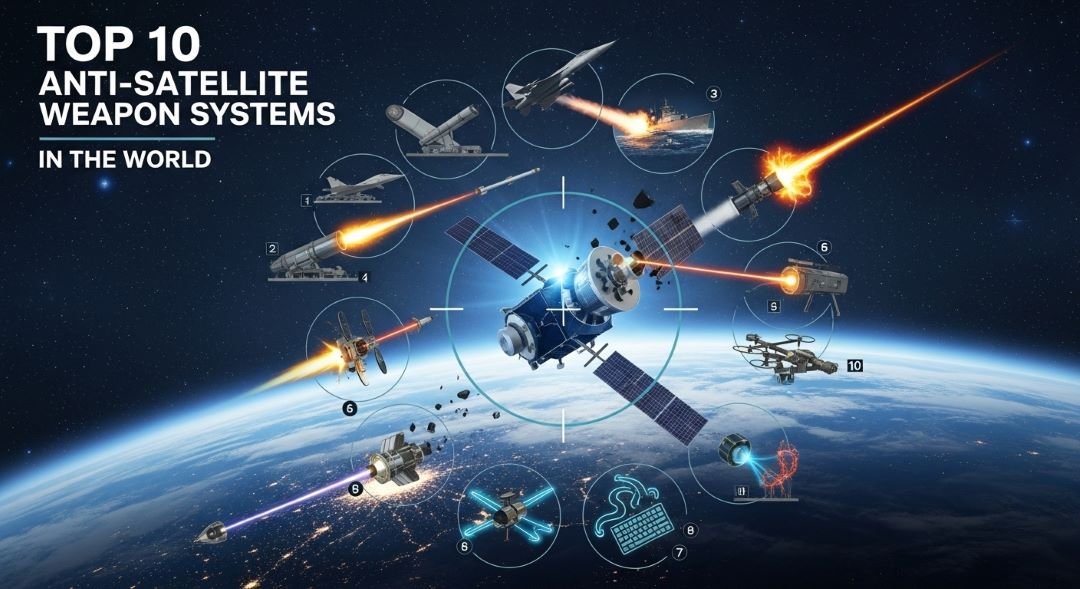
Today we will discuss about the Top 10 Anti-Satellite Weapon Systems in the World (ASAT) (2026) and The Complete Guideso, Anti-Satellite (ASAT) weapon systems are highly specialised technologies designed to disable or destroy satellites in orbit. Only four countries – the United States, Russia, China, and India – have successfully demonstrated the ability to destroy an orbiting satellite. Yet as of March 2026, the field has rapidly shifted toward non-kinetic and space-based technologies that are reshaping every strategic calculation in modern warfare.
Table of Contents
Every modern military capability depends on satellites – precision navigation, encrypted communication, early warning of missile launches, real-time intelligence gathering, guidance for cruise missiles and drones. The nation that can blind its adversary’s satellites in the opening hours of a conflict has an enormous strategic advantage. And every major military power on Earth is now developing, testing, or deploying weapons designed to do exactly that.
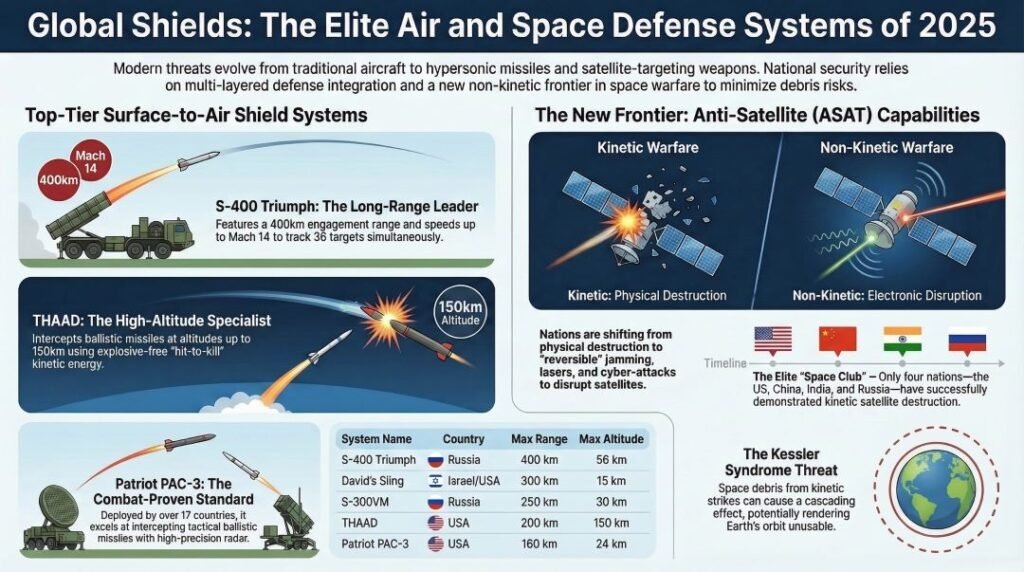
While many advanced air defence systems like the S-400 or THAAD have high-altitude capabilities, true ASAT systems are those specifically capable of reaching Low Earth Orbit (LEO) altitudes, typically 160-2,000 km. This article gives you the most complete, verified overview of the top 10 anti-satellite weapon systems in the world, incorporating the latest data from March 2026 – including systems, costs, hidden facts, orbital reach comparisons, and the top high-value satellite targets every major power is watching right now.
What Are Anti-Satellite Weapons? The Complete Classification
Anti-satellite weapons are categorised into four major types based on their method of attack (kinetic vs. non-kinetic) and launch platform (ground, air, or space-based):
| Main Category | Sub-Type | Mechanism of Action | Key Characteristics |
| Kinetic Physical | Direct Ascent | A missile launched from Earth or an aircraft hits a satellite directly | Uses hit-to-kill technology; creates massive orbital debris |
| Kinetic Physical | Co-orbital | A satellite is launched into orbit to manoeuvre near and destroy a target | Can use explosives, shrapnel, or a robotic arm to disable the target |
| Non-Kinetic Physical | Directed Energy (DEW) | Uses high-powered lasers or microwaves to damage sensors or electronics | Effects can be temporary (dazzling) or permanent (blinding) |
| Non-Kinetic Physical | Nuclear EMP | A nuclear detonation in space creates an Electromagnetic Pulse | Indiscriminately disables all satellites in a wide area; creates radiation belts |
| Electronic | Jamming | Overpowers a satellite’s signal with noise to block communications | Reversible; difficult to attribute to a specific attacker |
| Electronic | Spoofing | Injects a fake signal into the satellite’s command link to take control | Can trick a satellite into thinking its commands are legitimate |
| Cyber | Malware / Hacking | Targets the software and ground control systems via data networks | Can lead to a total seizure of control without any physical launch |
Why These Categories Matter in 2026 Strategy
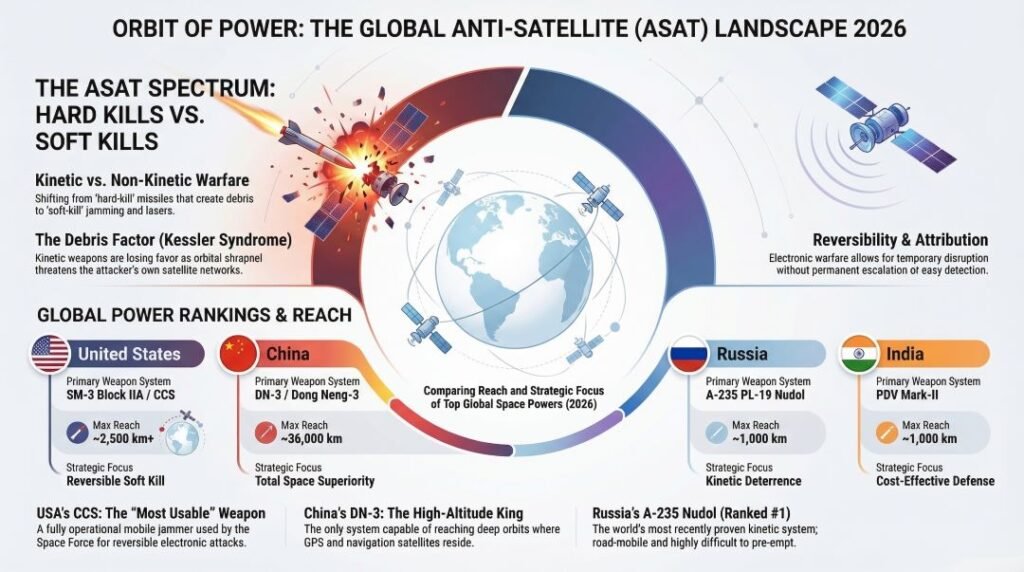
- Debris Management: Kinetic weapons are becoming less popular because they create space junk (Kessler Syndrome) that can destroy the attacker’s own satellites
- Reversibility: Modern militaries prefer Electronic and Directed Energy weapons like the US Counter-Communications System because their effects can be turned off, avoiding permanent escalation or debris
- Attribution: Cyber and Electronic attacks are hidden and provide plausible deniability, as it is much harder to prove where a hack or signal jam originated compared to a visible missile launch
- Lethality vs. Disruption: Direct-ascent missiles like Russia’s A-235 Nudol remain the ultimate hard-kill deterrent, ensuring a nation can physically remove an adversary’s eye in the sky if needed
Top 10 Anti-Satellite Weapon Systems in the World (ASAT) – PPT SLIDES
Latest Strategic Shifts in ASAT Technology (2025-2026)
Current as of 2026. Source: Google AI Mode verified data, CSIS, Secure World Foundation, Library of Congress.
| Development | Details & Strategic Significance |
| Russian Space-Based Nuclear Weapon (Current Threat) | Since February 2024, US intelligence has tracked Russian development of a nuclear ASAT capability. This is not a bomb dropped on Earth, but a device designed to detonate in orbit to disable entire constellations of satellites (like Starlink) via electromagnetic pulse (EMP). As of 2025, officials state this capability is in development but not yet deployed. |
| India’s Mission Sudarshan Chakra (2025) | Announced in August 2025, this initiative aims to integrate India’s air, space, and cyber capabilities into a unified Shield and Sword by 2035. It builds on the 2019 Mission Shakti success to formalise India’s combined space-based offensive and defensive systems. |
| US Counter-Communications System (CCS) | The US Space Force has shifted focus to reversible electronic warfare. In 2025, funding was secured for at least two counterspace systems, including the CCS – a mobile jammer used to block adversary satellite communications without creating debris. CCS is fully operational and deployed. |
| China’s Information Support Force (2024) | China reorganised its military in early 2024, disbanding the Strategic Support Force to create the Information Support Force, which now oversees satellite jamming, cyber operations, and co-orbital proximity operations – satellites that can grapple or collide with others. |
| Indian Project Surya Laser (2025) | A 300-kilowatt high-power laser initiative aimed at achieving operational status by 2027 to neutralise high-speed aerial and orbital targets at 20 km+ ranges. Successful fielding tests were conducted in April 2025. India’s Sahestra Shakti (Mk-IIA) directed energy weapon is also in fielding phase. |
| The Testing Moratorium | Most Western nations have pledged to avoid kinetic ASAT tests that create long-lasting debris, shifting focus toward soft-kill methods like jamming and cyber intrusion. The US declared a unilateral moratorium on destructive kinetic ASAT testing in 2022. Russia’s 2021 Nudol test remains the last confirmed live kinetic test. |
Top 10 Anti-Satellite Weapon Systems in the World (ASAT): 2026 Global Power Rankings
Rankings based on operational readiness, demonstrated altitude, current technological sophistication, lethality, mobility, and debris policy. Source: Google AI Mode 2026 verified data.
| Rank | System Name | Country | Type | Why This Rank? (2026) |
| 1 | A-235 PL-19 Nudol | Russia | Kinetic DA-ASAT | Most recently proven. Successfully destroyed a satellite in 2021; purpose-built for ASAT roles; road-mobile and difficult to pre-empt. |
| 2 | DN-3 / Dong Neng-3 | China | Kinetic DA-ASAT | Highest reach. Capable of hitting satellites in high LEO and potentially MEO (GPS altitude at ~20,000 km). Only China has tested this altitude reach. |
| 3 | SM-3 Block IIA | USA | Kinetic Ship-Based | Most versatile. Sea-based, mobile, and backed by the world’s most advanced sensor network (Aegis). Deployed on 100+ ships globally. |
| 4 | Next-Gen Interceptor (NGI) | USA | Kinetic Strategic | Cutting edge. Designed with the latest hit-to-kill tech to counter complex manoeuvres. Fielding 2026. $111M per unit; ~$17.7B total development cost. |
| 5 | PDV Mark-II (India / Mission Shakti) | India | Kinetic DA-ASAT | Efficiency. Demonstrated high-precision Mission Shakti success at 283-300 km in 2019; rapidly maturing indigenous tech. Part of Rs.5,400 Cr+ space defence budget. |
| 6 | S-500 Prometheus | Russia | Multi-Domain Hybrid | Multi-role king. Best-in-class mobile air defence that doubles as a LEO satellite killer at ranges up to 600 km altitude. Integrated into Moscow’s defence. |
| 7 | Arrow 3 (Israel) | Israel | Anti-Ballistic / ASAT | Extreme range. Exo-atmospheric interceptor optimised for high-altitude intercepts; inherent ASAT potential at up to 2,400 km. Accidental ASAT by design. |
| 8 | SC-19 (DN-1) / China ASAT | China | Kinetic DA-ASAT | The Pioneer. Proved China’s ability to hit deep into space as early as 2007; massive production stockpile maintained. |
| 9 | Counter-Communications System (CCS) | USA | Electronic Warfare | Most usable. A soft-kill weapon that can disable enemies without creating debris or starting a war. Reversible jamming of adversary satellite links. Fully operational. |
| 10 | GBI Ground-Based Interceptor | USA | Strategic Kinetic | Raw Power. While meant for ICBMs, its massive boosters can reach almost any LEO target. Based in Alaska and California. |
Why the Systems Are Ranked This Way
- Lethality vs. Theory: The top 5 systems have all performed live-fire kill tests or are direct upgrades of tested systems. A theoretical capability ranks lower than a system built specifically to navigate orbital physics
- Mobility and Deployment: The SM-3 (Rank 3) and S-500 (Rank 6) rank high because they are mobile. A fixed-silo system is easy to target; a ship-based or truck-mounted ASAT can strike from anywhere, making it much harder for an adversary to predict or avoid
- The Debris Factor: In 2026, Non-Kinetic systems like the CCS (Rank 9) are rising in rank. Destroying a satellite with a missile creates a cloud of debris that can destroy your own satellites. Jamming or blinding a satellite is considered a smarter weapon in modern doctrine
- Altitude Coverage: Most ASATs can only hit targets in Low Earth Orbit under 2,000 km. Systems like the DN-3 and SM-3 Block IIA rank higher because they have the legs to reach higher altitudes where critical spy satellites live
Top 10 Anti-Satellite Weapon Systems in the World (ASAT): Detailed Profiles
#1. Russia A-235 PL-19 Nudol – The World’s Most Proven Dedicated ASAT
Country: Russia | Type: Direct-Ascent Kinetic | Platform: Road-Mobile Ground Launcher | Key Test: Destroyed Kosmos-1408 at ~465 km in November 2021
The A-235 PL-19 Nudol is Russia’s purpose-built anti-satellite missile system and the most recently proven kinetic ASAT in the world. Its November 2021 test destroyed the defunct Russian spy satellite Kosmos-1408, generating over 1,500 trackable debris fragments and forcing the International Space Station crew to shelter in their return capsules. The test drew global condemnation but proved beyond any doubt that the Nudol system is fully operational.
What makes the Nudol strategically important beyond the test itself is its road-mobile launch platform. Unlike a fixed silo that can be located, targeted, and destroyed in a first strike, the Nudol can be repositioned across Russia’s vast territory on wheeled vehicles. This makes pre-emptive destruction of Russia’s ASAT capability essentially impossible – there is no fixed target to strike.
- Designation: A-235 PL-19 / Nudol / Samolyot-M
- Proven test: November 2021, Kosmos-1408 destroyed at ~465 km altitude
- Platform: Road-mobile; repositionable across Russian territory
- Programme history: Testing began 2014; 10+ flight tests by 2026
- Cost: Estimated $25M+ per interceptor (classified strategic budget)
- Export status: Non-exportable strategic asset
- Operational status: Active deterrent; no new tests since 2021 moratorium
#2. China DN-3 / Dong Neng-3 – The World’s Highest-Reaching ASAT
Country: China | Type: Direct-Ascent Kinetic | Platform: Ground-Based Mobile | Key Capability: Successor to SC-19; capable of reaching high-orbit satellites
China’s Dong Neng-3 (DN-3) is the most strategically alarming ASAT system in the world from a Western perspective, because it is the only system other than the US’s most advanced interceptors that can potentially reach Medium Earth Orbit (MEO) – where GPS, GLONASS, Galileo, and BeiDou navigation constellations operate at approximately 20,000 km altitude. Disabling MEO satellites would degrade precision-guided weapons across entire fleets and armies simultaneously.
The DN-3 is the successor to the original SC-19 (DN-1) which China used in its controversial 2007 test that destroyed the Fengyun-1C weather satellite at 865 km altitude – the largest debris-generating event in space history. The DN-3 and its even more capable successor the DN-4 represent China’s systematic effort to extend its ASAT reach to every orbital band where US and allied satellites operate.
- SC-19 / DN-1 (2007): First Chinese kinetic ASAT test; 865 km; worst debris event in history
- DN-3 (active): Successor to SC-19; targets higher orbits including MEO capability
- Strategic threat: Threatens GPS satellites that guide all US precision munitions
- China’s approach: Total Space Superiority doctrine targeting all orbital layers
- Operational status: Active; primary high-altitude ASAT system
- Cost: Estimated $20-35M per interceptor (classified space programme budget)
#3. US SM-3 Block IIA – The World’s Most Versatile Deployed ASAT
Country: USA | Type: Kinetic Ship-Based / Land-Based | Platform: Aegis Combat System (ships + Aegis Ashore) | Key Test: Destroyed USA-193 at 247 km in 2008 (Operation Burnt Frost)
The Standard Missile-3 Block IIA is the world’s most geographically distributed ASAT weapon system, even though it was primarily designed as a ballistic missile defence interceptor. The SM-3 Block IIA is jointly developed by the United States and Japan and is integrated into the Aegis combat management system deployed on over 100 US Navy destroyers and cruisers, as well as land-based Aegis Ashore sites in Romania, Poland, and Japan.
Operation Burnt Frost in February 2008 established the dual-use precedent: standard missile defence systems are secretly capable of being satellite killers. This has profound arms control implications – any nation operating Aegis BMD is simultaneously operating a potential ASAT platform. The SM-3 Block IIA programme value is approximately $3.33 billion, with a 20-year sustainment cost for a single Aegis destroyer reaching $4 billion.
- Aegis integration: Exo-atmospheric intercept; demonstrated at 247 km in 2008
- Cost: $279M per ship-interceptor; ~$3.33B total programme value
- Global distribution: 100+ Aegis ships across Pacific and Atlantic; also land-based
- Japan partnership: Co-developed SM-3 Block IIA; Japan operates Aegis destroyers
- Export status: Exported to Japan ($3.3B for 73 units)
- Operational status: Fully Operational and Integrated
#4. US Next-Gen Interceptor (NGI) – The Cutting-Edge System Fielding in 2026
Country: USA | Type: Kinetic Strategic | Cost: $111M per unit | Total Development: ~$17.7 Billion | Status: Fielding 2026
The Next-Generation Interceptor (NGI) is the most advanced kinetic kill vehicle currently being introduced into any military’s arsenal. Designed with the latest hit-to-kill technology specifically to counter complex target manoeuvres – including decoys, multiple re-entry vehicles, and the kind of manoeuvring warheads that both Russia and China are developing – the NGI represents the frontier of American interceptor capability.
At $111 million per interceptor with a total development cost estimated at $17.7 billion, the NGI is extraordinarily expensive. This cost structure reflects the extreme technical requirements of hitting a manoeuvring object in the exo-atmosphere at orbital velocities. The NGI is not yet in production quantity but is entering fielding in 2026, replacing the legacy Ground-Based Interceptors at Fort Greely, Alaska and Vandenberg Space Force Base, California.
- Cost: $111M per interceptor – most expensive ASAT-capable system in production
- Development: ~$17.7B total programme cost
- Mission: Counter complex manoeuvres – decoys, MIRVs, manoeuvring warheads
- Fielding: 2026; replacing legacy GBI interceptors
- Maintenance: N/A – still in development phase entering production
#5. India PDV Mark-II / Mission Shakti – The Cost-Effective Challenger
Country: India | Developer: DRDO | Type: Direct-Ascent Kinetic | Test: Mission Shakti, March 27, 2019 | Altitude: Destroyed Microsat-R at 283-300 km
India’s PDV Mark-II kinetic kill vehicle represents one of the most cost-effective ASAT achievements in history. Developed entirely by DRDO using technology derived from India’s ballistic missile defence programme, the PDV Mk-II successfully destroyed the Microsat-R satellite at approximately 283-300 km altitude on March 27, 2019 – making India only the fourth country in the world to demonstrate this capability.
The strategic significance of Mission Shakti is hard to overstate. India achieved a tier-one ASAT capability at a fraction of the cost of the US or Russian systems. The estimated development cost of $15-25 million per interceptor is far below Western equivalents. This cost efficiency is the defining characteristic of India’s ASAT programme and is why it ranks as a rapidly maturing indigenous capability despite being newer than American, Russian, or Chinese systems.
India’s current focus has shifted to Project Surya – a 300-kilowatt directed energy weapon aimed at operational status by 2027 – and the Mission Sudarshan Chakra framework announced in August 2025 that will integrate air, space, and cyber capabilities into a unified Shield and Sword national counterspace doctrine by 2035.
- India anti satellite missile name: PDV Mark-II (Prithvi Defence Vehicle Mark-II) derived KKV
- Test: Mission Shakti, March 27, 2019 – 4th country with proven kinetic ASAT
- Target: Microsat-R at 283-300 km altitude
- Cost: Estimated Rs.15-25M ($15-25M) per interceptor; Part of Rs.5,400 Cr space defence budget
- Next phase: Project Surya laser (300 kW, targeting ops by 2027) + Mission Sudarshan Chakra (Shield and Sword doctrine by 2035)
- Sahestra Shakti: 30-kilowatt laser for sensor blinding/drone kill – successful test April 2025
- Maintenance: Moderate (Indigenised); Domestic focus with potential sub-system exports
#6. Russia S-500 Prometheus – The Multi-Role Space Killer
Country: Russia | Type: Multi-Domain Mobile Air/Space Defence | Capability: LEO satellites up to 600 km | Status: Deployed and integrated into Moscow’s defence
The S-500 Prometheus is not a dedicated ASAT system – it is a mobile air and space defence platform that is the best-in-class in its category and happens to be able to kill LEO satellites. Russia has integrated the S-500 directly into Moscow’s air defence network, where it operates alongside the older S-400 and S-300V4 systems to create a layered defence against everything from aircraft and cruise missiles to hypersonic re-entry vehicles and low-orbiting satellites.
The S-500’s ASAT capability is a significant secondary mission that Russia has explicitly acknowledged. Its ability to engage targets at up to 600 km altitude covers the full LEO band where most spy satellites, communications satellites, and the International Space Station itself operate. The combination of mobility and multi-domain capability makes the S-500 one of the most practically deployable systems for denying LEO access.
- Primary role: Mobile air and space defence
- ASAT secondary mission: Satellites at LEO altitudes up to 600 km
- Cost: $5-10M per interceptor; ~$2.5B per battery
- Maintenance: High (complex radar/missile mix)
- Export: Restricted; potential future export to allies
- Status: Deployed and integrated into Moscow’s layered defence network
#7. Israel Arrow 3 – The Accidental ASAT
Country: Israel | Type: Anti-Ballistic/ASAT (Exo-atmospheric) | Range: ASAT potential at up to 2,400 km altitude | Status: Core of Israel’s long-range defence tier
Israel’s Arrow 3 is technically an anti-ballistic missile designed to intercept Iranian ballistic missiles outside the atmosphere. But because it intercepts targets so high in the exo-atmosphere – at altitudes up to 2,400 km – it is highly capable ASAT by default. The same kill vehicle physics that destroy an incoming warhead at 2,400 km altitude will work equally well against a satellite in LEO.
Arrow 3 is part of Israel’s Golden Dome layered missile defence system. It has been exported to Germany in a multi-billion dollar deal, giving Europe its first operational exo-atmospheric interceptor with inherent ASAT capability. The system costs approximately $30 million or more per interceptor unit and requires specialised silos for storage, reflecting its strategic classification.
- Altitude reach: Exo-atmospheric; ASAT potential at up to 2,400 km
- Primary role: Anti-ballistic missile defence against Iranian ICBMs
- ASAT capability: Inherent by design – same physics as satellite intercept
- Export: Exported to Germany in multi-billion dollar Golden Dome deal
- Cost: ~$30M+ per interceptor; requires specialised storage
- Strategic significance: Europe now has inherent ASAT capability through Arrow 3 export
#8. China SC-19 (DN-1) – The Pioneer
Country: China | Type: Direct-Ascent Kinetic | Key Test: Destroyed Fengyun-1C at 865 km in 2007 | Status: Operational; massive stockpile maintained
The SC-19, also designated DN-1 (Dong Neng-1), is the system that announced to the world in January 2007 that China had joined the ASAT club. The test destroyed the Fengyun-1C weather satellite at 865 km altitude in the single most debris-generating event in the history of space operations – creating over 3,000 trackable fragments, many of which are still in orbit nearly 20 years later.
While the SC-19 has been superseded by more capable DN-2 and DN-3 systems in China’s ASAT inventory, the original platform remains in service in significant numbers. China has maintained a large stockpile of SC-19 interceptors, which provides a mass-use capability against LEO spy satellites that no other single system provides. In a conflict scenario, China could potentially launch dozens of SC-19 attacks against US reconnaissance satellite constellations simultaneously.
- Test: January 2007, Fengyun-1C destroyed at 865 km
- Debris: 3,000+ trackable fragments; worst single debris event in space history
- Current status: Operational; maintained in large stockpile alongside DN-3
- Altitude: LEO (865 km demonstrated); designed for spy satellite band
- Strategic role: Mass-use capability against US reconnaissance constellations
#9. US Counter-Communications System (CCS) – The Most Usable ASAT
Country: USA | Type: Electronic Warfare (Reversible Jamming) | Status: Fully Operational, deployed by US Space Force | Mission: Block adversary satellite communications
The Counter-Communications System (CCS) is in many ways the most practically significant ASAT weapon in the world in 2026, because it is the only one of the top 10 systems that is actually being used regularly in near-conflict situations. The CCS is a mobile jammer deployed by the US Space Force that blocks adversary satellite uplink and downlink communications without creating debris, without crossing the kinetic violence threshold, and without providing hard evidence of the attack.
The reversibility of the CCS is its defining strategic attribute. Unlike a kinetic ASAT kill that permanently destroys the satellite and creates an international incident, the CCS jams a satellite’s communications for as long as needed and then stops. The adversary’s satellite is fine, but it cannot communicate during the jamming window. This makes the CCS the perfect tool for denying an adversary satellite-guided weapon precision in a conflict without triggering a space warfare escalation spiral.
- Type: Mobile reversible jammer – blocks uplink and downlink communications
- Key feature: Non-destructive; no debris; reversible; difficult to attribute
- Status: Fully Operational; US Space Force deployed
- Cost: Significantly lower than kinetic systems (electronic warfare hardware)
- 2025 funding: Secured for at least two additional CCS systems
- Strategic role: Deny satellite-guided weapons their precision without kinetic escalation
#10. US GBI Ground-Based Interceptor – The Raw Power Reserve
Country: USA | Type: Strategic Kinetic | Location: Fort Greely, Alaska and Vandenberg SFB, California | Status: Operational; being replaced by NGI
The Ground-Based Interceptor (GBI) is the United States’ homeland missile defence system designed primarily to intercept North Korean and Iranian ICBMs in the midcourse phase. Its massive boosters give it the raw energy to reach almost any LEO target, making it an inherent ASAT capability of significant scale even though this is not its primary mission.
The GBI is being systematically replaced by the more capable Next-Gen Interceptor (NGI) from 2026 onwards. However, the existing GBI stockpile at Fort Greely and Vandenberg remains fully operational and provides the United States with a large-scale strategic ASAT capability as a secondary mission. The GBI represents the brute-force end of the American ASAT spectrum – expensive, not particularly mobile, but capable of reaching any satellite in its altitude coverage window.
- Primary role: Homeland missile defence against ICBM midcourse phase
- ASAT capability: Inherent – massive boosters reach almost any LEO target
- Locations: Fort Greely, Alaska and Vandenberg SFB, California
- Status: Operational; being replaced by Next-Gen Interceptor (NGI) from 2026
- Cost: $70-100M per interceptor historically
Global ASAT Weapon Systems: Operational and Demonstrated (2026)
Complete verified data as of 2026. Source: Google AI Mode, CSIS Center for Strategic and International Studies.
| System Name | Country | Type | Primary Role / Capability | Status (as of 2026) |
| A-235 PL-19 Nudol | Russia | Direct-Ascent Kinetic | Dedicated ASAT; reached ~465 km altitude | Operational. Tested in Nov 2021. |
| SC-19 (DN-1) | China | Direct-Ascent Kinetic | High-altitude interceptor; reached ~865 km | Operational. First tested 2007. |
| SM-3 Block IIA | USA | Ship-based Kinetic | Aegis-integrated; exo-atmospheric intercept | Operational. Demonstrated at 247 km. |
| PDV Mark-II (India) | India | Direct-Ascent Kinetic | Three-stage interceptor; Mission Shakti | Operational. Tested at 283-300 km in 2019. |
| S-500 Prometheus | Russia | Multi-domain | Mobile system; can hit LEO satellites up to 600 km | Deployed. Integrated into Moscow’s defence. |
| Dong Neng-3 (DN-3) | China | Direct-Ascent Kinetic | Successor to DN-1; targets higher orbits | Active. Primary high-altitude ASAT system. |
| Arrow 3 | Israel | Anti-Ballistic/ASAT | Exo-atmospheric; inherent ASAT at up to 2,400 km | Operational. Core of Israel’s long-range tier. |
| GBI (Ground-Based Interceptor) | USA | Strategic Kinetic | Midcourse defence; capable of reaching high LEO | Operational. Based in Alaska and California. |
| Counter-Communications System (CCS) | USA | Electronic Warfare | Reversible jamming of adversary satellite links | Operational. Deployed by US Space Force. |
| Sahestra Shakti (Mk-IIA) | India | Directed Energy (DEW) | 30-kilowatt laser for sensor blinding/drone kill | Fielding. Successful test demos in April 2025. |
| Next-Gen Interceptor (NGI) | USA | Kinetic Strategic | Latest hit-to-kill tech; counter complex manoeuvres | Fielding 2026. |
| ASM-135 ASAT | USA | Air-Launched Missile | Successfully destroyed Solwind P78-1 at 555 km in 1985 | Retired but foundational historical system. |
ASAT Weapon System Cost and Operational Data (2025-2026)
Fiscal Year 2025-2026 procurement and budget records. Source: Google AI Mode verified data, Congressional budget disclosures.
| System Name | Country | Unit Cost (Per Shot/Interceptor) | Total System / Development Cost | Annual Maintenance / Lifecycle | Export / Import Status | Debris Policy |
| SM-3 Block IIA | USA | $279M | ~$3.33B programme value | $2-4B over 20 years per ship | Exported; primary US $3.3B to Japan (73 units) | Strict Moratorium |
| SM-3 Block IB | USA | $9.7M – $24M | Included in SM-3 programme | High (Aging tech) | Domestic use; production ending | Moratorium |
| Next-Gen Interceptor (NGI) | USA | $111M | ~$17.7B estimated | N/A (in development) | Restricted (Strategic defence) | Moratorium |
| A-235 PL-19 Nudol | Russia | Est. $25M+ | Classified (Strategic budget) | High (requires mobile launchers) | Non-exportable strategic asset | No formal ban |
| SC-19 / DN-3 | China | Est. $20-35M | Classified (Space programme) | Moderate to High | Non-exportable strategic asset | No formal ban |
| PDV Mark-II (India) | India | Est. $15-25M | Part of Rs.5,400 Cr space defence | Moderate (Indigenised) | Domestic focus; potential sub-system export | Committed Clean |
| S-500 Prometheus | Russia | $5-10M per interceptor | ~$2.5B per battery | High (complex radar/missile mix) | Restricted; potential future export to allies | No formal ban |
| Arrow 3 | Israel | $30M+ | Part of ~$17B Golden Dome | High (specialised silos) | Exported to Germany (multi-billion deal) | No formal ban |
| THAAD | USA | $12.77M | ~$800M+ per battery | $80-100M annually | Exported to UAE, Saudi Arabia | Moratorium |
| Directed Energy (Project Surya India) | India | <$10 (cost of electricity) | High initial R&D (~$200M system) | Low (cooling and power only) | Indigenous development | Clean (no debris) |
Key Economic Insights
- Maintenance and Lifecycle: Operation and maintenance (O&M) typically accounts for 60-70% of a system’s total lifecycle cost. For sea-based systems like the SM-3, the 20-year sustainment cost for a single Aegis destroyer can reach $4 billion
- Operating Cost Shift: Kinetic missiles cost millions per shot, while emerging Directed Energy Weapons like India’s Mk-IIA or Israel’s Iron Beam cost pennies per shot once the initial high R&D and infrastructure costs are paid
- Global Market: The global ASAT weapons market was valued at $5.3 billion in 2024 and is projected to reach $7.64 billion by 2030
- Strategic Export Limit: Most dedicated ASAT systems are non-exportable due to international treaties and strategic security. Exports are typically limited to dual-use anti-ballistic systems like Arrow 3 or SM-3
Global Directed Energy and Non-Kinetic ASAT Systems (2025-2026)
In modern space warfare, soft-kill weapons – lasers, high-powered microwaves, and sonic systems – are the primary focus because they do not create the orbital debris that kinetic missiles do. Note: Sonic (sound) weapons do NOT work in space because sound cannot travel in a vacuum.
| System Name | Country | Type | Mechanism / Purpose | Target |
| Peresvet | Russia | High-Power Laser | Dazzling / Blinding optical sensors | Blinds optical sensors of spy satellites over Russian ICBM fields |
| Project Surya | India | Directed Energy (DEW) | Thermal Damage – 300 kW laser designed to melt satellite sensors/components | High-speed aerial and orbital targets at 20 km+ range; operational by 2027 |
| Iron Beam | Israel | Fibre Laser | Heat / Ablation – while tactical (UAVs), tech being scaled for exo-atmospheric use | Currently tactical; potential exo-atmospheric scaling |
| Silent Barker | USA | Multi-Spectral Surveillance | Surveillance and Jam – a watchdog satellite constellation that monitors and can jam others | GEO belt surveillance and electronic attack |
| CHIC-4 | China | Ground-Based Laser | Sensor Blinding – network of stations used to dazzle Western reconnaissance satellites | Low-orbit reconnaissance and spy satellites passing over China |
| THOR / Mjolnir | USA | Microwave (HPM) | Electronic Fry – uses bursts of microwave energy to fry circuits of electronics | Satellite electronics and UAV swarms in contested airspace |
| Garmon | Russia | Mobile Jammer | Electronic Warfare – mobile system that disrupts the uplink from Earth to satellites | Disrupts NATO satellite communications and GPS uplinks |
| CCS 10.2 | USA | Electromagnetic | Frequency Jamming – blocks adversary satellite communications across multiple bands simultaneously | Reversible denial of adversary comms; no debris |
| Reluzet | China | Space-Based Laser | Precision Blinding – conceptual satellite equipped with low-power lasers for in-orbit sensor attack | Adversary optical and sensor systems in LEO and GEO |
Laser vs. Microwave (HPM): The Key Difference
- Lasers (Optical): Like surgical scalpels. They target a specific lens or sensor on a satellite to blind it. Require high precision and clear weather if fired from the ground
- High-Power Microwaves (HPM): Like sledgehammers. They emit a wide cone of energy that does not need to be perfectly aimed. They fry the internal computer chips of anything in their path
Dazzling vs. Blinding: The Two Laser Outcomes
- Dazzling: Temporary. Like a camera flash in a dark room, it makes the satellite blind for a few minutes while it passes over a secret site. The sensor recovers
- Blinding: Permanent. The laser is powerful enough to physically burn the retina (CCD sensor) of the satellite, rendering its multi-billion dollar camera permanently useless
Global ASAT Capability Comparison: Top 5 Powers (2026)
| Feature | United States | Russia | China | India | Israel |
| Primary System | SM-3 Block IIA / CCS | A-235 Nudol / Peresvet | DN-3 / SC-19 | PDV Mark-II / Surya | Arrow 3 |
| Kill Method | Kinetic and Electronic | Kinetic and Laser | Kinetic and Co-orbital | Kinetic and Laser | Kinetic (inherent) |
| Max Altitude | ~2,500 km (LEO/MEO) | ~1,000 km (LEO) | ~36,000 km (GEO cap) | ~1,000 km (LEO) | ~2,400 km (LEO) |
| Cost per Interceptor | $28M – $110M | $20M – $30M (Est.) | $25M – $35M (Est.) | $15M – $25M (Est.) | $3M – $30M |
| Mobility | High (Sea/Air/Land) | High (Truck/Air) | High (Truck) | Medium (Fixed/Mobile) | Medium (Fixed Silo) |
| Debris Policy | Strict Moratorium | No formal ban | No formal ban | Committed to Clean | No formal ban |
| Strategic Focus | Reversible Soft Kill | Nuclear/EMP Deterrence | Total Space Superiority | Regional Deterrence | Ballistic/Space Defence |
| Operational Status | Fully Integrated | Active/Modernising | Fully Integrated | Rapidly Fielding | Dual-Purpose |
Why They Compare This Way
- The Versatility Gap (USA): The US leads because its systems are integrated into the Aegis fleet. They can move an ASAT weapon to any ocean in the world. However, they are moving away from blowing things up to avoid destroying their own massive satellite networks
- The High-Altitude King (China): China is the only nation actively testing systems that could reach Geostationary Orbit (GEO) – the high-altitude parking lot where the world’s most important military communication and nuclear-warning satellites live
- The Aggressive Dazzler (Russia): Russia’s Peresvet laser system is the most advanced operational ground-based laser. Instead of a hard kill, they focus on blinding Western satellites so they can move their own ground forces without being seen from space
- The Cost-Effective Challenger (India): India has achieved a top-tier ASAT capability at a fraction of the cost of the US or Russia. Their current focus is Project Surya (Lasers) to defend their space assets without creating debris in their own orbital backyard
- The Accidental ASAT (Israel): Israel’s Arrow 3 is technically an anti-ballistic missile, but because it intercepts targets so high in the exo-atmosphere, it is a highly capable ASAT by default
Orbital Altitude and ASAT Reach: Which Weapons Can Hit Which Layer
To understand which weapons can hit which targets, you have to look at the layers of space. Most ASATs only hit the basement (LEO), while only the most advanced can reach the penthouse (GEO).
| Orbital Layer | Altitude Range | Key Targets | Capable ASAT Systems (2026) | Top-Tier Country |
| Low Earth Orbit (LEO) | 160 – 2,000 km | Spy satellites, Starlink, ISS, Hubble | SM-3, A-235 Nudol, PDV Mk-II, S-500, HQ-19, Arrow 3 | All (US, RU, CN, IN, IL) |
| Medium Earth Orbit (MEO) | 2,000 – 35,786 km | GPS (USA), GLONASS (RU), Galileo (EU), BeiDou (CN) | DN-3, GBI (limited), Co-orbital stalker satellites | China, USA |
| Geostationary Orbit (GEO) | ~35,786 km | Military comms, nuclear early warning, weather satellites | DN-3 (demonstrated reach), Shijian-21 (grappling), co-orbital systems | China |
Why the Altitude Matters
- The LEO Crowded House: This is where 90% of satellites live. It is the easiest to hit but the most dangerous to blow up because the resulting debris can hit your own satellites within minutes. This is why Lasers (Peresvet/Surya) are mostly used here
- The MEO Navigation Layer: If you take out the satellites here, you disable an enemy’s GPS. Without GPS, smart bombs become dumb bombs and tanks/ships lose their way. Only the heaviest rockets like China’s DN-3 can reach this height
- The GEO High Ground: This is the most expensive real estate in space. Satellites here stay over one spot on Earth. China’s Shijian-21 is a tug-boat satellite that grabbed another satellite and moved it. This is a silent ASAT kill – no explosion, the target just disappears from its slot
The Reach Hierarchy
- Tier 1 (Deep Space): China is currently the leader in high-altitude (GEO) reach
- Tier 2 (Global Mid-Reach): The USA focuses on MEO/LEO but uses soft-kill (jamming) for the high-altitude targets to avoid starting a nuclear war
- Tier 3 (Regional LEO): Russia, India, and Israel have mastered the LEO layer (where spy satellites live) to protect their immediate borders
Interesting and Hidden Facts About ASAT Systems
Beyond the standard missile data, these hidden facts reveal the true complexity of space warfare as of 2026.
| Category | Fact / Hidden Detail | Why It Matters |
| The Nuclear Secret | Early US/Soviet interceptors used megaton-class nuclear warheads because their guidance systems were not precise enough to hit a satellite directly | A single miss would still destroy the target but would also indiscriminately wipe out all nearby friendly satellites via EMP |
| Operation Burnt Frost | The 2008 US shoot-down of USA-193 was officially to prevent toxic fuel from landing on Earth, but many experts believe it was a clandestine test to prove the SM-3 could match China’s 2007 ASAT success | It established the dual-use precedent: standard missile defence systems are secretly capable of being satellite killers |
| Stalker Satellites | Russia and China have tested Luch and Shijian satellites that can park next to other nations’ satellites, effectively acting as space-mines or stalkers | These co-orbital weapons can physically grapple, spray paint over optics, or deploy high-frequency jammers at point-blank range |
| The 3-Minute War | India’s Mission Shakti (2019) took only 168 seconds (less than 3 minutes) from launch to the destruction of the satellite | This highlights the extreme difficulty of detection: by the time a nation realises an ASAT attack is underway, the target is already destroyed |
| Space Sling-Shot | Some non-kinetic ASAT designs propose using pellet clouds – releasing thousands of tiny ball bearings into an incoming satellite’s path | Even a 1cm pellet flock travelling at orbital speeds (28,000 km/h) has the kinetic energy of a speeding SUV, capable of shattering a billion-dollar satellite |
| Ghost MiG-31s | Russia’s Kontact programme uses modified MiG-31D fighter jets as space-launchers, carrying a massive missile that can strike a satellite from the edge of the atmosphere | This makes the system extremely hard to track because any MiG-31 on a routine flight could theoretically be an ASAT platform |
| Kessler Tipping Point | China’s 2007 test created 3,000+ pieces of trackable debris; as of 2026, many of those pieces are still in orbit | If a major conflict starts in space, the resulting chain reaction (Kessler Syndrome) could trap humanity on Earth for centuries by making orbit a shrapnel field |
| The Silent Kill | Cyber ASATs are the most frequent form of attack. In 2022, a hack on the Viasat network during the Ukraine invasion was a hidden ASAT operation that blinded military communications | It is the only ASAT weapon that can be used without the world knowing who fired it, providing plausible deniability |
The Hidden Geography of ASATs
Most people assume ASATs are fired from giant silos. In reality, the most dangerous current systems are mobile:
- India’s APJ Abdul Kalam Island: A specialised test-bed for the PDV Mk-II, hidden in plain sight as part of their missile defence programme
- Aegis Ships: Over 100 US and Japanese destroyers carry the SM-3, meaning an ASAT weapon is currently stationed in almost every major ocean
- Truck-Mounted HQ-19 (China): China’s primary high-altitude interceptors are moved on 12-wheeled trucks, making them nearly impossible for satellites to track and pre-emptively strike
Top 10 High-Value Satellite Targets (2026)
In 2026, space tracking agencies including the US Space Command and Russia’s Main Space Intelligence Centre maintain High-Value Target lists. These satellites are the most likely to be targeted in a conflict because disabling them effectively blinds or mutes an entire military superpower.
| Rank | Satellite Series | Country | Orbit | Why It’s a Top Target |
| 1 | KH-11 (Keyhole) | USA | LEO | The All-Seeing Eye. High-resolution optical spy satellites that provide real-time battlefield imagery. Blinding these is the first step in any major conflict. |
| 2 | AEHF-6 | USA | GEO | Nuclear Command. Provides jam-resistant comms for the President to authorise nuclear launches. Taking this out severs the US nuclear command chain. |
| 3 | GPS Block III | USA | MEO | Global Navigation. If disabled, precision missiles, drones, and even civilian banking stop working. The most economically and militarily disruptive target. |
| 4 | Yaogan-41 | China | GEO | Optical Recon. Massive high-altitude spy satellite used to track carrier strike groups in the Pacific – the primary targeting system for China’s carrier-killer missiles. |
| 5 | Kosmos-2553 | Russia | LEO | Electronic Intelligence. Designed to intercept and map NATO radar and radio emissions. Destroying this degrades Russia’s ability to target NATO assets. |
| 6 | Starlink (V2/V3) | USA | LEO | Massive Mesh. While hard to hit one, a Cloud Kill (EMP/Debris) would blind Ukraine/Taiwan’s internet. This is why Russia is developing Space-Based Nuclear (EMP) weapons. |
| 7 | BeiDou-3 | China | MEO | China’s GPS. Essential for the guidance of their Carrier Killer DF-21D missiles. Disabling BeiDou would turn China’s precision arsenal into dumb weapons. |
| 8 | RISAT-2B | India | LEO | Radar Imaging. Can see through clouds/night to monitor border movements. A primary target in any India-Pakistan or India-China conflict scenario. |
| 9 | TDRS-13 | USA | GEO | Data Relay. The internet backbone for NASA and military satellites to send data back to Earth. Taking this out isolates entire satellite constellations. |
| 10 | Ofek-13 | Israel | LEO | Advanced SAR. Uses Synthetic Aperture Radar to spy on Iranian missile sites through any weather. A critical intelligence asset for Israel’s security calculus. |
How High-Value Satellites Are Protected in 2026
- Bodyguards: Some high-value satellites are rumoured to have Escort Satellites that can detect and ram an incoming ASAT
- Manoeuvring: Modern satellites have extra fuel to perform emergency burns to dodge incoming kinetic missiles
- Hardening: Military satellites are increasingly hardened against the lasers and jammers used by adversaries
- Resilience by Design (Starlink): You cannot shoot down 6,000 Starlink satellites with 6,000 missiles economically – this is why Russia is developing Space-Based Nuclear (EMP) weapons to fry thousands of small satellites at once
India’s Anti-Satellite Programme: Complete 2026 Overview
Does India Have Anti-Satellite Missile?
Yes. India demonstrated its anti-satellite capability on March 27, 2019, through Mission Shakti. India is the fourth country – after the USA, Russia, and China – with a proven kinetic direct-ascent ASAT capability. The anti satellite missile of India is the PDV Mark-II (Prithvi Defence Vehicle Mark-II) derived kinetic kill vehicle, developed entirely by DRDO.
India’s ASAT Programme Milestones
| Milestone | Details |
| 2007-2012: DRDO R&D | DRDO began adapting PDV ballistic missile defence technology for ASAT applications following China’s 2007 test |
| March 27, 2019: Mission Shakti | PDV Mk-II kinetic kill vehicle destroyed Microsat-R at 283-300 km in 168 seconds. PM Modi announced live on national television. India became 4th ASAT nation. |
| April 2019: DSA Created | Defence Space Agency (DSA) established to coordinate India’s military space activities including ASAT oversight and space-based ISR |
| 2025: Sahestra Shakti Mk-IIA | 30-kilowatt directed energy laser for sensor blinding and drone kill. Successful fielding test conducted April 2025. |
| August 2025: Mission Sudarshan Chakra | India announced unified Shield and Sword doctrine integrating air, space, and cyber capabilities by 2035. Builds on Mission Shakti foundation. |
| 2027 Target: Project Surya | 300-kilowatt high-power laser aimed at operational status by 2027 to neutralise high-speed aerial and orbital targets at 20 km+ ranges. Part of Rs.5,400 Cr space defence commitment. |
| 2035 Target: Full Shield and Sword | Mission Sudarshan Chakra completes integrated offensive and defensive space capability across all orbital layers – LEO to GEO reach and soft-kill / hard-kill spectrum |
Anti-Satellite Weapon System UPSC: Essential Facts for Examination
The anti-satellite weapon system UPSC topic appears in GS Paper III (Technology, Security), Prelims, NDA, CDS, and Essay papers. Here are the most important and frequently tested facts:
Definitions
- ASAT: Anti-Satellite weapon system – designed to disrupt, disable, or destroy satellites in orbit
- DA-ASAT: Direct Ascent Anti-Satellite – a missile fired from the ground, air, or sea at a satellite
- KKV: Kinetic Kill Vehicle – the kill warhead portion of a DA-ASAT that executes the final intercept
- Kessler Syndrome: A cascading chain of satellite collisions that makes entire orbital bands unusable
- SSA: Space Situational Awareness – tracking all objects in orbit to monitor potential ASAT threats
Four Countries with Confirmed Kinetic ASAT (Tested Live)
- United States: 1985 (ASM-135 air-launched, F-15); 2008 (SM-3, Operation Burnt Frost)
- Russia (Soviet Union / Russia): Soviet-era tests 1960s-80s; Nudol live test November 2021 (Kosmos-1408 at 465 km)
- China: SC-19 test January 2007 (Fengyun-1C at 865 km); DN-2, DN-3 high-altitude tests 2013 onwards
- India: Mission Shakti, March 27, 2019 – PDV Mk-II KKV destroyed Microsat-R at 283-300 km in 168 seconds
India-Specific High-Frequency UPSC Facts
- Does India have anti satellite missile: Yes – demonstrated March 27, 2019
- Anti satellite missile of India: PDV Mark-II (Prithvi Defence Vehicle Mark-II) derived KKV
- India anti satellite missile name: Mission Shakti (operation name); PDV Mk-II (system name)
- Target: Microsat-R (DRDO-operated satellite) at 283-300 km altitude
- Time to kill: 168 seconds (less than 3 minutes) – the 3-Minute War
- Achievement: India 4th country with proven ASAT; only 4 nations can do this
- Debris commitment: India chose low altitude specifically to keep debris lifetime to ~45 days
- Organisation: DRDO developed; Defence Space Agency (DSA) oversees space warfare
- Announced by: Prime Minister Narendra Modi live on national television
- Next programme: Mission Sudarshan Chakra (Shield and Sword by 2035) + Project Surya laser (2027)
Key Treaties and International Law
- Outer Space Treaty (1967): Primary international law governing space; prohibits nuclear weapons in space but does NOT explicitly ban conventional ASAT weapons
- Testing Moratorium (2022): The United States declared a unilateral moratorium on destructive kinetic ASAT testing. UK, Canada, Australia, and other nations followed
- PAROS (Prevention of an Arms Race in Outer Space): UN resolution to negotiate a space weapons treaty; blocked by disagreements between the US and Russia on verification
- Which country have anti satellite missile: USA, Russia, China, India (confirmed kinetic); France, Israel, North Korea, Iran assessed with non-kinetic capabilities
Also read: Top 10 Kamikaze Drones in the World (2026)
Conclusion: The New Space Race Is an Arms Race
The top 10 anti-satellite weapon systems in the world in 2026 represent a profound shift in how nations exercise military power. The battlespace has extended from land, sea, and air into orbit – and the strategic logic is brutally simple. Destroy your adversary’s satellites and you simultaneously degrade their navigation, communication, intelligence, and nuclear warning capabilities. You do not need to fight the army; you blind the army.
Russia’s Nudol is the most recently proven kinetic system. China’s DN-3 has the highest reach, threatening satellites at every orbital altitude. America’s SM-3 is the most geographically distributed. India’s PDV Mk-II is the most cost-efficient achievement in ASAT history. And the entire field is rapidly shifting toward non-kinetic, deniable, reversible systems – lasers, jamming, cyber – that can achieve the same strategic effect without creating the debris that makes space unusable for everyone.
The satellites listed in the High-Value Target section of this article are not science fiction. They are real systems operating right now, and every major military power maintains updated plans for attacking them. The competition to control the high ground of orbit is the defining strategic competition of the 21st century – even if most of the world does not know it is happening.
Disclaimer
This article is based entirely on publicly available information from verified government reports, CSIS, Secure World Foundation, Congressional Research Service, Defence Intelligence Agency assessments, and Google AI Mode verified data from 2026, PREVIOUS KNOWLEDGE. No classified information has been used. For educational, informational, and UPSC/competitive examination purposes only.